Building a strong home-to-school partnership with families is important throughout the school year. Students need to have consistent support both in and out of the classroom, and the best way to achieve this is by establishing relationships between the school community and the families and students that we support. I start the year by emailing families and students using our gradebook messaging system. I introduce myself and share my excitement for the new school year, provide some resources that we will use in class, and make sure that families know that I am available to support them and my students. Many times I receive an email from families right away and it is great to start forming those connections and learning about my students and their families.
Why the home-to-school partnership is essential
We want to engage families in their children’s day-to-day learning experiences. Establishing consistent collaboration with families will help us cultivate an environment for learning at home and at school.
Continue reading the rest of this article on Edutopia.
About the Author:
Dr. Rachelle Dené Poth is a Spanish and STEAM: What’s Next in Emerging Technology Teacher at Riverview High School in Oakmont, PA. Rachelle is also an attorney with a Juris Doctor degree from Duquesne University School of Law and a Master’s in Instructional Technology. Rachelle received her Doctorate in Instructional Technology, and her research focus was on AI and Professional Development. In addition to teaching, she is a full-time consultant and works with companies and organizations to provide PD, speaking, and consulting services. Contact Rachelle for your event!
Rachelle is an ISTE-certified educator and community leader and served as president of the ISTE Teacher Education Network. She was named the EdTech Trendsetter of 2024 by EdTech Digest, one of 30 K-12 IT Influencers to follow in 2021, and one of 150 Women Global EdTech Thought Leaders in 2022.
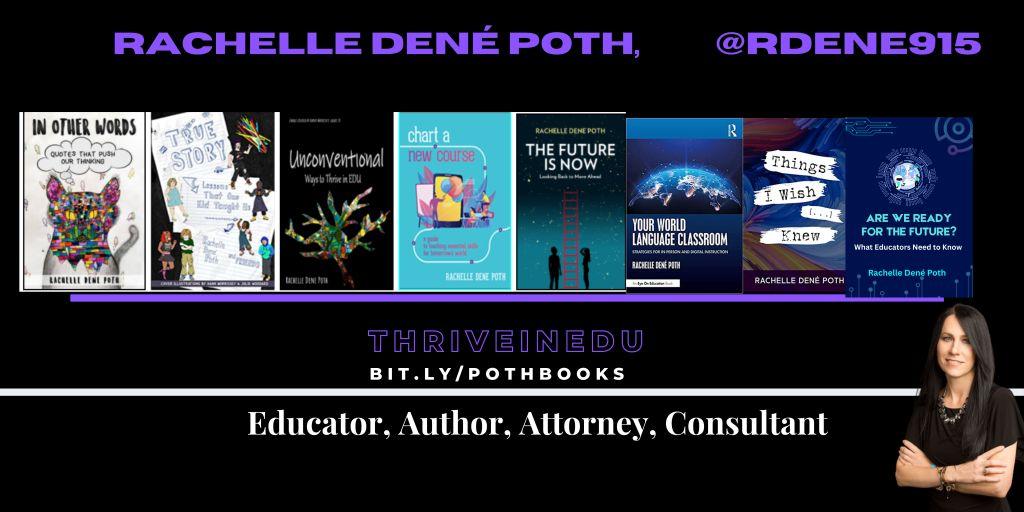
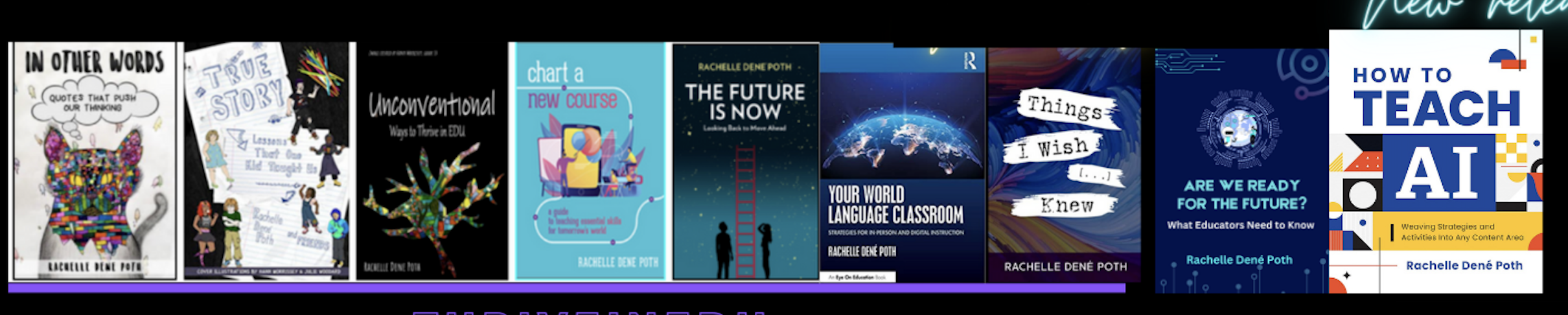
She is the author of nine books including ‘In Other Words: Quotes That Push Our Thinking,” “Unconventional Ways to Thrive in EDU,” “The Future is Now: Looking Back to Move Ahead,” “Chart A New Course: A Guide to Teaching Essential Skills for Tomorrow’s World, “True Story: Lessons That One Kid Taught Us,” “Things I Wish […] Knew” and her newest “How To Teach AI” is available from ISTE or on Amazon.
Contact Rachelle to schedule sessions about Artificial Intelligence, Coding, AR/VR, and more for your school or your event! Submit the Contact Form.
Follow Rachelle on Twitter(X) and Instagram at @Rdene915
**Interested in writing a guest blog for my site? Would love to share your ideas! Submit your post here. Looking for a new book to read? Find these available at bit.ly/Pothbooks
************ Also check out my THRIVEinEDU PodcastHere!
Join my show on THRIVEinEDU on Facebook. Join the group here
Guest post by Dr. Amy Mathews-Perez, a Director of Special Programs in a public school in Central Texas. Connect with Amy on X (formerly Twitter) at @drgrowtoknow, on Facebook at DrAmy MP, or at her website dramyperez.com
I’m wondering how you read the title of this blog. Did you read it as Dear, Stressed Me (self pity-ish) or as the beginning of a letter? Either way works (and both apply at some point or another for all of us, right?) and serve as an opportunity to self-reflect on why you read it that way. The intention was that the title is the beginning of a note – to yourself.
We all get stressed out, no doubt. Stress is not a selective force – it impacts every one of us in different ways, at different times, for different reasons, for different lengths of time, and with different results/responses. If you have spent time reflecting, you’ve probably figured out (or are figuring out) how to talk yourself through these stressful times. There is a popular quote by Zig Ziglar: “The most influential person you will talk to all day is you.” There are also many varieties of this message floating around, but the point is the same: Self-talk is powerful.
The hard part about self-talk is easy to identify: judgment. We second guess ourselves, we feel silly, we want to do it “right.” However, I want to make you aware of two important things related to self-talk: (1) You already talk to yourself, whether out loud or just in your head -or both for some of us. When it is instinctive, we don’t pause to evaluate it, we just do it. Whether we are pumping ourselves up to do something challenging (EX: A job interview), calming ourselves down to get through something difficult (EX: Getting pulled over) or celebrating our success in getting something accomplished (EX: We got the job?). Here is your challenge: pay attention next time it happens, and then add to it with an intentional, positive phrase. The second thing I want to make you aware of is this: (2) There is no “right” or “perfect” way to do self-talk. You know yourself – or are learning about yourself. We figure out if we need a voice of rant, rage, encouragement, empowerment, cheer (or all of these). Some of us need a pep-talk, some of us need to be reminded to live up to our potential, some of us need to be remotivated with goals, some of us need a “no-excuses” approach, and some of us need empathy during times of stress.
We live, we learn; we stress, we recover; we breathe and continue going forward in learning.
Understanding the value of positive talk, encouragement and kindness, imagine if you could facilitate a positive outcome for someone else that is going through a stressful time. This blog provides a method for you to do that. Originally intended for leaders in work settings, this activity can be done with any group or person you choose.
Whatever your relationship (leader, friend, co-worker, etc.) I’m going to assume that you want to help others be their best; you do your best to meet the needs of others. There will be times when your support will be effective & that is awesome. However, other times, a person’s “self-talk” support can be more helpful than our support. A common situation we all face is that we get so busy we don’t take the time to think about motivating ourselves or others, much less by writing it down. So, here is an activity that capitalizes on creating that opportunity for others: it honors each person’s self-awareness/knowledge and allows you to support each person individually during stressful times. This is an activity that I’ve done with my staff for three years in a row and it has had multiple positive outcomes every time.
You pick the “Who” & the “When.”. Here is the “How” (then we’ll visit the benefits):
Give each person a blank note card & envelope. (have each person seated away from each other)
Have the person write their name on the envelope.
Ask each person to write themselves a “Dear Stressed Me” note. Assure them that this is 100% confidential; NO ONE will read their note.
Once they each complete the note, have them put it in the envelope that they put their name on – and seal the envelope.
Collect the envelopes and put them in a place you’ll remember.
During the school year, when you notice that one of those people is stressed out, hand-deliver their note to them. (If you want to give them a treat when you do that, that typically brings a smile; a Sonic drink, candy bar, favorite pen, etc., but this is not foundational to this activity)
When they say, “Thank you” (they typically do) you can respond with something like: “Don’t thank me, thank yourself.”
What they are really thanking you for is “seeing” them; acknowledging them, and showing care about them being stressed. Done with authenticity, this can build relationships, ease stress, and create a moment to take a breath. As an added benefit, it promotes the value of you being in tune with each person because YOU are going to give each person their own note….at a time that you notice they need it. Notice a need, share your care, and build resiliency.
I believe in positive intent, and I’m passionate about empowering and encouraging others. I hope that this has provided an easy action you can take, and, equally importantly, I hope you take time to validate yourself for the hard work you’ve done, the progress you’ve made, and your willingness to learn. If you use this activity & would like to share your outcomes, I’d appreciate the opportunity to connect. dramymp@gmail.com or on X @drgrowtoknow.
About Amy
Texas-born & raised, Amy is in her 32nd year of serving public education. General Ed. Teacher, SLP, Diagnostician, SPED Supervisor, Assistant Principal, Principal, and Director of Special Education are roles she’s held. She is the CEO of Making Education Special for All (M.E.S.A), an LLC dedicated to training, facilitation, consultation, and speaking engagements that revolve around information, motivation, and insights on why and how to make education special for all stakeholders. Her passions are communication, joy, authenticity, and empowerment. “Life is short but our influence is never-ending,” and Amy is committed to connecting with others through service and smiles.
Rachelle’s blog
Dr. Rachelle Dené Poth is a Spanish and STEAM: What’s Next in Emerging Technology Teacher at Riverview High School in Oakmont, PA. Rachelle is also an attorney with a Juris Doctor degree from Duquesne University School of Law and a Master’s in Instructional Technology. Rachelle received her Doctorate in Instructional Technology, and her research focus was on AI and Professional Development. In addition to teaching, she is a full-time consultant and works with companies and organizations to provide PD, speaking, and consulting services. Contact Rachelle for your event!
Rachelle is an ISTE-certified educator and community leader who served as president of the ISTE Teacher Education Network. By EdTech Digest, she was named the EdTech Trendsetter of 2024, one of 30 K-12 IT Influencers to follow in 2021, and one of 150 Women Global EdTech Thought Leaders in 2022.
She is the author of nine books including ‘In Other Words: Quotes That Push Our Thinking,” “Unconventional Ways to Thrive in EDU,” “The Future is Now: Looking Back to Move Ahead,” “Chart A New Course: A Guide to Teaching Essential Skills for Tomorrow’s World, “True Story: Lessons That One Kid Taught Us,” “Things I Wish […] Knew” and her newest “How To Teach AI” is available from ISTE or on Amazon.
Contact Rachelle to schedule sessions about Artificial Intelligence, Coding, AR/VR, and more for your school or your event! Submit the Contact Form.
Follow Rachelle on Twitter(X) and Instagram at @Rdene915
**Interested in writing a guest blog for my site? Would love to share your ideas! Submit your post here. Looking for a new book to read? Find these available at bit.ly/Pothbooks
************ Also check out my THRIVEinEDU PodcastHere!
Join my show on THRIVEinEDU on Facebook. Join the group here.
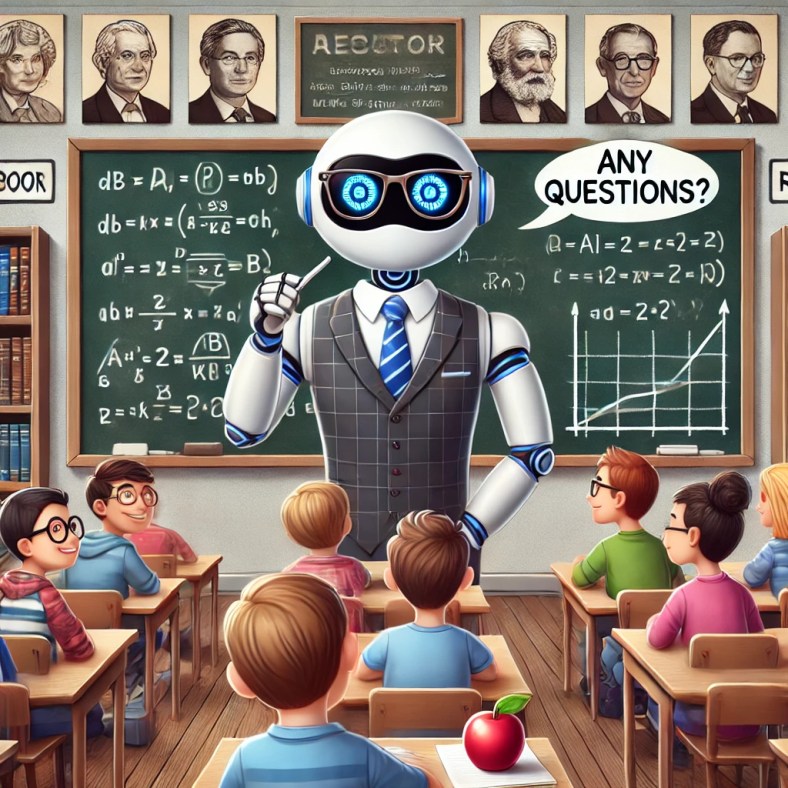
A slight update of my first post on AI in 2018. Image above generated by AI.
Over the past seven years, I have focused on learning more about artificial intelligence. Initially I thought I understood the meaning of AI. But I did not.
In early 2018, I noticed that AI was becoming an increasingly popular topic of discussion in the blogs that I was reading and in social media posts. When I first started thinking of AI, I had a flashback to the 2004 movie I, Robot, which starred Will Smith. In the movie, set in 2035, robots filled public service positions and were able to think like humans and take action. Then, I thought about virtual assistants such as Alexa and Siri. But what is AI, and how do we use it daily?
What is AI?
A quick Google search turns up more than 615 million results. AI is computer code that displays some form of intelligence, learning and problem-solving in what has been referred to as a “super intelligence.” AI “learns” on its own, and makes adjustments and improvements based on past iterations. As AI becomes “smarter,” its knowledge base grows, and it is able to complete more tasks. Digging a little deeper, I found #AskAboutAI, a research project launched by Getting Smart, which identified over 100 applications of AI.
Shehzad Najib, CEO and co-founder of Kinteract, told me a few years ago: “You shouldn’t notice that AI is working. You should notice that life is easier and you’re saving time.”
Keep that in mind. Here are a few ways that we interact with AI daily:
Communication: We all use email and receive a lot of spam. AI is used to streamline the amount of spam allowed through filters, and it continues to learn over time as you mark items as spam.
Travel: If you use driving apps such as Uber or Lyft, you have experienced machine learning, a form of AI that determines your estimated arrival time. In the airline industry, “human-steered” flight time is estimated to be about seven minutes, leaving the rest to autopilot, which is AI.
Social networks: Most people are engaging in some form of social media use. Years ago, Facebook shared results of how AI successfully detects spam but was not as successful at detecting hate speech or cyberbullying. When photos are used in social media, AI uses facial detection to suggest a name for photo tagging. If you’ve wondered how it recognizes your friends and family without even typing a name into the platform. It learns over time.
Shopping: Many people use Amazon and similar services. They are quite helpful, and who doesn’t appreciate it when suggestions are provided for other items of interest? AI analyzes your prior data and makes decisions based on your preferences over time.
Fraud protection: When making purchases online or in person, systems analyze your purchasing trends and locations and can immediately flag and send alerts for unusual transactions.
Were you familiar with all of these AI uses? Thinking back to Shehzad’s statement, these do save time and often go unnoticed because they are just performing what they have been programmed to do.
What can AI do for education?
One of the most interesting articles that I read during my initial research, came from an article in Forbes, which highlighted 10 ways to use AI in education. Looking at these, how much has changed? Remember, this article is from nearly 10 years ago, which was the original post before its update in 2017.
AI can automate basic activities in education, such as grading.
Educational software can be adapted to student needs.
AI can point out places where courses need improvements.
AI tutors can help support students.
AI-driven programs can give students and educators helpful feedback.
AI is altering how we find and interact with information.
AI could change teachers’ roles.
AI can make trial-and-error learning less intimidating.
Data powered by AI can change how schools find, teach, and support students.
AI could change where students learn, who teaches them, and how students acquire basic skills.
Regardless of the technology we choose to explore and use in education, we have to focus on the technology’s purpose. What are the benefits of using AI? Is it practical to use AI?
Time is always a consideration, and when it comes to providing authentic, meaningful, and personalized learning experiences for our students, we need to make the most of it. AI can make an impact here.
For example, students and teachers can connect and have instant access to resources that meet their specific needs. AI will make decisions based on responses and interactions.
AI can save teachers time in grading and help to provide differentiated instruction that adjusts as students continue to work through class materials. AI analyzes data faster, so teachers can act on it faster and, again, have more time to work with students.
We must actively explore the resources that are being shared in the education world today. There are many blogs, books, podcasts, webinars, and other learning opportunities for educators. We have so many digital tools available to choose from. Have fun exploring but be mindful of not just the possibilities, but always focus on our responsibilities as educators.
If you want to learn more, check out recent Edutopia and Getting Smart blogs. Many AI books are available, including my recent book. Keep on learning and growing, and don’t be afraid of not being the expert. We are all learning as we go!
About the Author:
Dr. Rachelle Dené Poth is a Spanish and STEAM: What’s Next in Emerging Technology Teacher at Riverview High School in Oakmont, PA. Rachelle is also an attorney with a Juris Doctor degree from Duquesne University School of Law and a Master’s in Instructional Technology. Rachelle received her Doctorate in Instructional Technology, and her research focus was on AI and Professional Development. In addition to teaching, she is a full-time consultant and works with companies and organizations to provide PD, speaking, and consulting services. Contact Rachelle for your event!
Rachelle is an ISTE-certified educator and community leader who served as president of the ISTE Teacher Education Network. By EdTech Digest, she was named the EdTech Trendsetter of 2024, one of 30 K-12 IT Influencers to follow in 2021, and one of 150 Women Global EdTech Thought Leaders in 2022.
She is the author of nine books including ‘In Other Words: Quotes That Push Our Thinking,” “Unconventional Ways to Thrive in EDU,” “The Future is Now: Looking Back to Move Ahead,” “Chart A New Course: A Guide to Teaching Essential Skills for Tomorrow’s World, “True Story: Lessons That One Kid Taught Us,” “Things I Wish […] Knew” and her newest “How To Teach AI” is available from ISTE or on Amazon.
Contact Rachelle to schedule sessions about Artificial Intelligence, Coding, AR/VR, and more for your school or your event! Submit the Contact Form.
Follow Rachelle on Twitter(X) and Instagram at @Rdene915
**Interested in writing a guest blog for my site? Would love to share your ideas! Submit your post here. Looking for a new book to read? Find these available at bit.ly/Pothbooks
************ Also check out my THRIVEinEDU PodcastHere!
Join my show on THRIVEinEDU on Facebook. Join the group here.
Over the past few years, we have seen many changes in education. We live in an increasingly digital world that involves rapid technological advancements through emerging technologies such as artificial intelligence (AI). The technologies are not only impacting our lives as educators, but they are impacting the world of work our students will enter.
To best prepare our students, educators must constantly adapt and evolve to keep up with these changes. However, there are challenges when it comes to these technologies: a lack of professional learning opportunities, not enough time to participate, and uncertainty about the best options for learning. Bringing in new technology can also feel like adding to an already overflowing plate.
Beyond the basic technology skills that educators need for every day teaching, they also need to be knowledgeable about emerging technologies, particularly AI, and how to bring them into their classrooms. With these technologies impacting our work, especially with the capabilities of AI to generate content and concerns about the impact of this technology on our work, it is essential that educators receive training. Over the past five years, my work has focused on collaborating with teachers to get them started with emerging technology including, more recently, AI. Here are some things that work when designing AI-related professional learning.
AI professional development for educators
Professional development focused on implementing classroom technology goes beyond simply training educators to use it and apply it to their curriculum. It requires rich and personalized learning experiences that will engage educators and enable them to see the possibilities for amplifying learning through educational technology.
Dr. Rachelle Dené Poth is a Spanish and STEAM: What’s Next in Emerging Technology Teacher at Riverview High School in Oakmont, PA. Rachelle is also an attorney with a Juris Doctor degree from Duquesne University School of Law and a Master’s in Instructional Technology. Rachelle received her Doctorate in Instructional Technology, and her research focus was on AI and Professional Development. In addition to teaching, she is a full-time consultant and works with companies and organizations to provide PD, speaking, and consulting services. Contact Rachelle for your event!
Rachelle is an ISTE-certified educator and community leader who served as president of the ISTE Teacher Education Network. By EdTech Digest, she was named the EdTech Trendsetter of 2024, one of 30 K-12 IT Influencers to follow in 2021, and one of 150 Women Global EdTech Thought Leaders in 2022.
She is the author of nine books including ‘In Other Words: Quotes That Push Our Thinking,” “Unconventional Ways to Thrive in EDU,” “The Future is Now: Looking Back to Move Ahead,” “Chart A New Course: A Guide to Teaching Essential Skills for Tomorrow’s World, “True Story: Lessons That One Kid Taught Us,” “Things I Wish […] Knew” and her newest “How To Teach AI” is available from ISTE or on Amazon.
Contact Rachelle to schedule sessions about Artificial Intelligence, Coding, AR/VR, and more for your school or your event! Submit the Contact Form.
Follow Rachelle on Twitter(X) and Instagram at @Rdene915
**Interested in writing a guest blog for my site? Would love to share your ideas! Submit your post here. Looking for a new book to read? Find these available at bit.ly/Pothbooks
************ Also check out my THRIVEinEDU PodcastHere!
Join my show on THRIVEinEDU on Facebook. Join the group here.






 Learning as I go: Reflections & lessons learned