

Guest post by Rachel Wood, PhD Candidate studying AI and the future of work, education, and relationships: LinkedIn at www.linkedin.com/in/rachelwoodphd
Opinions expressed are those of the guest blogger.
Every night at bedtime, I sing songs with my son. We snuggle close as the lyrics “lullaby and goodnight, go to sleep…” dance off our lips. Lately, he has begun asking me to make up songs about various important objects in his life- blue blankey, mister fox, and big excavators. I sing songs on the spot that tie melodies to his little world of things. One night, out of his mouth comes “sing a song about Ms. Davey”. Delightfully surprised, I met this request with a smile in my heart because of how it exemplified the fondness he feels toward his school teacher.
Educators are irreplaceable. They are far more than academic messengers; they serve as overseers of students’ psychological wellbeing. Learning has been and always will be a social experience. We learn from teachers, from peers, from successes, from mistakes, and from interactions with others. Sure, we learn our academic material, but more so, we learn social and relational skills. We begin to learn our place in the world as we rub shoulders with others. Relationships are the foundation for motivation and learning (McKay & Macomber, 2023). Educators offer numerous key psychological and relational nutrients, two of which are object constancy and friction. These unique human components are increasingly important to instill in students amidst a world of proliferating emerging technologies.
Object Constancy
Definition: object constancy begins when the “empathic parent holds a vision of the future child and in various ways mediates this vision to the child. The child, in identification with it, can then grow. By internalizing aspects of the parent, the child also internalizes the parent’s image of the child…a primary concern for a teacher is the aiding in the growth and development of another. The idea that teacher’s capacity to imagine future growth, anticipate something for the student, hold that in mind for them, and offer that vision is a reflective way of expanding possibilities and potentialities for them. Perhaps in this way, the successful, authentic, and autonomous student begins in the mind of the teacher” (Danze, 2022, pg. 149).
As overseers of students’ psychological and emotional development, educators contribute to the formation of students’ object constancy. Object constancy is a psychological concept describing how we acquire our internal voice. When we are young, parental figures, family members, and teachers speak into us and speak over us. The tone and content of these voices become embedded in our developing identities. Over time, and with enough repetition, these voices become our own internal voice. For better or for worse, what we hear in our early developmental stages sticks with us. Object constancy is when we internalize external voices, making them our own inner dialog.
Educators contribute to students’ developing object constancy on a regular basis; recognizing achievements, applauding kindness, and course-correcting missteps. Teachers even have the privilege of helping rewire negative voices ringing in students’ ears. Neuroplasticity is the science that reveals how we can change our thoughts, feelings, and actions, unlearning that which is detrimental and instead, learning what is beneficial. A consistent, encouraging voice from a teacher can act as a counterpoint to disparaging voices that may be lingering in students’ minds. Just as educators help students internalize positive voices, they also create opportunities for students to learn from challenges.
Friction
Definition: friction is “shap[ing] learning as people with different backgrounds and skill sets engage with each other on real problems if these people are provided with the right context. Productive friction is particularly valuable at boundaries because it exposes people to different ways of seeing problems and the potential solutions” (Ward et al., 2011).
All human relationships contain some degree of friction. Friction is the concept of learning through challenges. Friction may be small or great, it may be above or below the surface, and it may be beneficial or consequential. Friction is a necessary element of relationships because it teaches us to consider others, compromise, and reduces our tendency toward self-absorption. Educators encourage, yes, but they also challenge. Both are equally important. Excellent educators can gauge the individual balance for each student between encouragement and challenge. This both affirms students as they are and calls them forward to who they can be.
AI and Educators
Definition: Artificial Intelligence, AI is broadly defined as giving a computer human-like capabilities, such as understanding, problem-solving, and reasoning (Enholm et al., 2022).
Object constancy and friction are two components of relationships that cannot be replaced by emerging technologies such as Artificial Intelligence (AI). Sure, on a superficial level you could prompt a Generative AI Large Language Model to mimic these relational elements, but they come naturally in human interactions. There are specific use cases for AI that can offer support in the form of augmentation for teachers who are overwhelmed with work yet longing to return to what led them to education in the beginning: the opportunity to positively influence students through relational connection. There is a place for AI in the classroom that does not threaten but enhances the role of the teacher. Drawing the conclusion that we must choose between teachers and AI is a false dichotomy. Augmenting work with AI can serve as a catalyst to redesign the vocational identity of educators. This ever-present help can afford teachers the opportunity to once again return to a primary role of relational facilitator and guide. Bringing AI into the classroom cannot and will not replace educators, but it may open the door for administrative burdens to lighten and therefore relational dynamics to increase.
The vital role of educators extends beyond the confines of academic instruction, shaping students’ emotional and psychological landscapes through concepts like object constancy and friction. Just as the simple yet profound request to “sing a song about Ms. Davey” highlights the deep bond students form with their teachers, it underscores the immeasurable value of human connection in education. Successful integration of AI into the classroom is predicated upon the fact that technology complements, not replaces, the relational essence of teaching. Leveraging AI to assist with administrative tasks allows educators to return to their core mission: fostering meaningful relationships that guide and shape students’ development. So tonight, as we sing about Ms. Davey, and by extension countless other educators, may AI serve as a tool to enhance impact, and bolster ongoing service in the name of young minds.
References
Danze, E. (2022). How the psychoanalytic use of object constancy and internalization can inform our understanding of the teacher/student relationship. ACSA 110th Annual Meeting. https://www.acsa- arch.org/proceedings/Annual%20Meeting%20Proceedings/ACSA.AM.110/ACSA.AM.1 10.20.pdf?v=2
Enholm, I. M., Papagiannidis, E., Mikalef, P., & Krogstie, J. (2022). Artificial intelligence and business value: A literature review. Information Systems Frontiers, 24(5), 1709-1734. https://doi.org/10.1007/s10796-021-10186-w
McKay, C., & Macomber, G. (2023). The Importance of Relationships in Education: Reflections of Current Educators. Journal of Education, 203(4), 751-758.
https://doi.org/10.1177/00220574211057044
Ward, C. J., Nolen, S. B., and Horn, I. S. (2011). Productive friction: How conflict in student teaching creates opportunities for learning at the boundary. International Journal of Educational Research, 50(1), 14-20. https://doi.org/10.1016/j.ijer.2011.04.004
Interested in guest blogging or Rachelle’s consulting services?
Contact Rachelle to schedule sessions about Artificial Intelligence, Coding, AR/VR, and more for your school or event! Submit the Contact Form.
Follow Rachelle on Twitter(X) and Instagram at @Rdene915
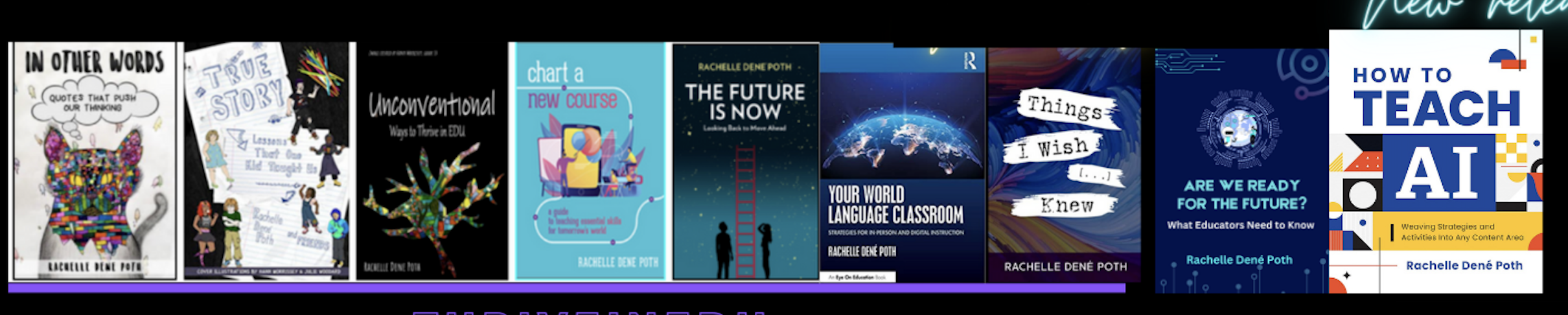
**Interested in writing a guest blog for my site? Would love to share your ideas! Submit your post here. Looking for a new book to read? Find these available at bit.ly/Pothbooks
************ Also check out my THRIVEinEDU Podcast Here!
Join my show on THRIVEinEDU on Facebook. Join the group here.
 Learning as I go: Reflections & lessons learned