Transform Public Speaking with Yoodli: Your AI Coach

Guest post by Paula Johnson, see Paula’s other blogs here and subscribe!

Public speaking. Just reading those two words probably made your palms sweat a little. Whether you’re a student giving a book report, a teacher presenting at a PD (with no AC and bad coffee), or someone just trying to sound confident in a meeting, speaking clearly and effectively is a real skill, and one that usually comes with years of awkward ums and cringey filler words.

Enter Yoodli, your friendly-but-firm AI-powered speech coach. Think of it like Toastmasters… if Toastmasters lived inside your laptop and never interrupted you

🧰 What Is Yoodli?

Yoodli is an AI tool designed to help users improve their public speaking skills. It analyzes your speech in real-time or after a recording and gives you feedback on things like:

  • Filler words (“um,” “like,” “you know”)
  • Pacing (Are you sprinting or sedating your audience?)
  • Word choice and sentence complexity
  • Eye contact and body language (with video)
  • And yes, even your “uhhh” to actual word ratio

Yoodli gives you a transcript and a confidence score, plus suggestions that range from helpful to brutally honest. It’s basically Simon Cowell with AI ethics and a smiley face interface.

🏫 Classroom Uses: From the Speech Team to the Math Teacher

Yoodli is one of those tools that sneaks up on you with its usefulness. Here’s how educators can integrate it meaningfully across content areas:

💬 1. Speech & Debate or Language Arts

The most obvious use case. Have students record their speeches or presentations, then analyze their own pacing, tone, and use of filler words using Yoodli. Students can track their growth over time, which is far more helpful (and less awkward) than just watching themselves on video.

🎤 2. ELL/ESL Support

For multilingual students, Yoodli provides private, low-stakes speaking practice. It doesn’t judge accents; it focuses on clarity, pacing, and fluency. Students can speak into the tool and get instant feedback, helping build confidence without the pressure of speaking in front of the class.

🧠 3. Teacher PD & Self-Reflection

Want to see how you really sound during that lesson on quadratic equations? Use Yoodli to record part of your instruction or PD session. You might be surprised how often you say “so yeah” (guilty). This can also be helpful for instructional coaches working with teachers on presentation or communication skills.

🧪 4. Science Fairs and Project-Based Learning

Anytime students are explaining a process or presenting their thinking, Yoodli can give them that extra polish. It encourages students to reflect on how they communicate their ideas, not just what they say, but how they say it.

💻 5. Interview Practice and Career Readiness

Mock interviews? Elevator pitches? College essays turned spoken narratives? Yoodli is ideal for helping students practice for real-world moments where confidence and clarity are key.

🧠 The AI Behind the Tool

Yoodli uses automatic speech recognition (ASR) and natural language processing (NLP) to analyze spoken words in real time. Think of it as a very nerdy parrot that listens, transcribes, and then gently tells you you’re rambling.

Some quick nerd notes:

  • Speech recognition turns your words into text (transcription)
  • NLP analyzes your speech for filler words, tone, sentiment, and repetition
  • Yoodli can detect your pace and word variety over time

Importantly, Yoodli doesn’t train its model on your data without consent. Users can opt into saving their data for progress tracking, but educators should check settings for student accounts. They’ve made good strides toward ethical design—no surprise, since one of the co-founders used to work at Google AI but left to build tech that was more human-focused.

Data privacy tip: Make sure to read the privacy policy if you’re using it with students under 18, and consider creating class-specific accounts or using it in “demo mode” with no login required.


🧪 Try It Out: Tips for Teachers

Here’s how to get rolling without needing a 47-slide training deck:

  • Start small: Have students practice a 1-minute talk on any topic. Favorite food. Least favorite math concept. Why dogs are better than cats. (Yoodli is cat-neutral.)
  • Use the transcript: Yoodli gives a full transcript of each session, great for writing reflection, peer feedback, or revision activities.
  • Gamify it: Who can lower their filler word count the most in one week? Who has the smoothest pacing? Instant leaderboard.
  • Model it: Record yourself first and share the feedback you got. Vulnerability builds classroom trust (and shows that even grown-ups say “like” too much).
  • Be intentional: Don’t let Yoodli become a surveillance tool. Use it for growth, not gotchas. Let students control their recordings and reflection.

👩‍🏫 Final Thoughts: AI Coaching That Doesn’t Need Coffee

Yoodli isn’t replacing speech teachers or taking over your drama class—it’s a supplement, not a substitute. But it is an amazing, low-barrier way to help students hear themselves and improve one of the most universally useful skills: effective communication.

Plus, unlike your coworker in the next room, Yoodli never interrupts you mid-sentence to ask if you’ve “seen the new attendance policy.” So that’s a win.

I believe educators deserve access to tools, knowledge, and support that empower them to do their best work. If my content has helped you, inspired you, or made your day a little lighter, supporting me on Ko-fi helps me continue creating resources that support teachers who are changing the world one student at a time.

If this work supports you, you can support it too: ko-fi.com/paulajohnsontech

About Rachelle

Dr. Rachelle Dené Poth is a Spanish and STEAM: What’s Next in Emerging Technology Teacher at Riverview High School in Oakmont, PA. Rachelle is also an attorney with a Juris Doctor degree from Duquesne University School of Law and a Master’s in Instructional Technology. Rachelle received her Doctorate in Instructional Technology, and her research focus was on AI and Professional Development. In addition to teaching, she is a full-time consultant and works with companies and organizations to provide PD, speaking, and consulting services. Contact Rachelle for your event!

Rachelle is an ISTE-certified educator and community leader who served as president of the ISTE Teacher Education Network. By EdTech Digest, she was named the EdTech Trendsetter of 2024, one of 30 K-12 IT Influencers to follow in 2021, and one of 150 Women Global EdTech Thought Leaders in 2022.

She is the author of ten books, including ‘What The Tech? An Educator’s Guide to AI, AR/VR, the Metaverse and More” and ‘How To Teach AI’. In addition, other books include, “In Other Words: Quotes That Push Our Thinking,” “Unconventional Ways to Thrive in EDU,” “The Future is Now: Looking Back to Move Ahead,” “Chart A New Course: A Guide to Teaching Essential Skills for Tomorrow’s World, “True Story: Lessons That One Kid Taught Us,” “Things I Wish […] Knew” and her newest “How To Teach AI” is available from ISTE or on Amazon.

Contact Rachelle to schedule sessions about Artificial Intelligence, Coding, AR/VR, and more for your school or event! Submit the Contact Form.

Follow Rachelle on Bluesky, Instagram, and X at @Rdene915

**Interested in writing a guest blog for my site? Would love to share your ideas! Submit your post here. Looking for a new book to read? Find these available at bit.ly/Pothbooks

************ Also, check out my THRIVEinEDU Podcast Here!

Join my show on THRIVEinEDU on Facebook. Join the group here.

Increasing Cybersecurity

Schools have experienced an increase in the number of cyberattacks over the past year. Cybersecurity attacks can include data breaches, ransomware, and phishing, all of which disrupt learning. These can result in compromised sensitive personal information, disrupt the learning environment, and, at times, bring a high financial burden due to the need to investigate the attack, add network security, restore files, or make payments to recover the encrypted files stolen in a ransomware attack. We are all susceptible to these attacks and risk having our personally identifiable information (PII) shared with others without even knowing.

With these challenges, schools must take steps to safeguard data and implement policies and best practices for cybersecurity. This can involve everyone in the school:

  • Administrators and IT can work together to create comprehensive cybersecurity policies that outline expectations for staff and students. These policies should include topics like password strength, data protection, and acceptable use of technology.
  • Schools should provide ongoing training for all staff on cybersecurity best practices and incident response procedures.
  • Classroom teachers can guide students in creating strong passwords and teach them about the risks of phishing, malware, and other risks.
  • Students can protect themselves by creating strong passwords, closely evaluating sites and links, and asking for help if they are unsure about an email or a website.

By having clear policies in place and conducting regular audits of digital tools, educators can protect themselves, students, and students’ families from these risks. 

Continue reading the article on Edutopia, where it was originally posted.

About Rachelle

Dr. Rachelle Dené Poth is a Spanish and STEAM: What’s Next in Emerging Technology Teacher at Riverview High School in Oakmont, PA. Rachelle is also an attorney with a Juris Doctor degree from Duquesne University School of Law and a Master’s in Instructional Technology. Rachelle received her Doctorate in Instructional Technology, and her research focus was on AI and Professional Development. In addition to teaching, she is a full-time consultant and works with companies and organizations to provide PD, speaking, and consulting services. Contact Rachelle for your event!

Rachelle is an ISTE-certified educator and community leader who served as president of the ISTE Teacher Education Network. By EdTech Digest, she was named the EdTech Trendsetter of 2024, one of 30 K-12 IT Influencers to follow in 2021, and one of 150 Women Global EdTech Thought Leaders in 2022.

She is the author of ten books, including ‘What The Tech? An Educator’s Guide to AI, AR/VR, the Metaverse and More” and ‘How To Teach AI’. In addition, other books include, “In Other Words: Quotes That Push Our Thinking,” “Unconventional Ways to Thrive in EDU,” “The Future is Now: Looking Back to Move Ahead,” “Chart A New Course: A Guide to Teaching Essential Skills for Tomorrow’s World, “True Story: Lessons That One Kid Taught Us,” “Things I Wish […] Knew” and her newest “How To Teach AI” is available from ISTE or on Amazon.

Contact Rachelle to schedule sessions about Artificial Intelligence, Coding, AR/VR, and more for your school or event! Submit the Contact Form.

Follow Rachelle on Bluesky, Instagram, and X at @Rdene915

**Interested in writing a guest blog for my site? Would love to share your ideas! Submit your post here. Looking for a new book to read? Find these available at bit.ly/Pothbooks

************ Also, check out my THRIVEinEDU Podcast Here!

Join my show on THRIVEinEDU on Facebook. Join the group here.
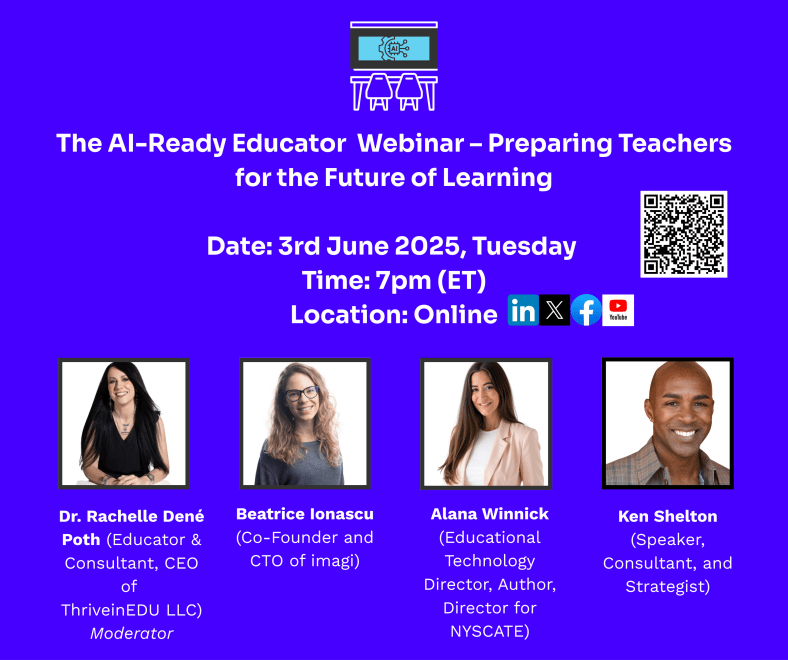
Imagi Webinar: AI-Ready Educators: Preparing Teachers for the Future of Learning

We had a great turnout for our recent webinar and a great panel! Read more here and check out the recording.

Artificial Intelligence is no longer a concept for the future—it’s transforming classrooms everywhere. The sudden and widespread availability of powerful AI tools has left many educators with a mix of excitement and apprehension. How can we, as educators, prepare our students for an AI-driven future? How do we harness the potential of these tools while carefully and consistently navigating their pitfalls?

These were the central questions addressed in a recent webinar, “The AI-Ready Educator: Preparing Teachers for the Future of Learning,” hosted by ThriveinEDU and Imagi-Labs. The session brought together a panel of experts, including educator, author, and attorney, Dr. Rachelle Dené Poth, who moderated a powerful conversation with panelists Alana Winnick, Beatrice Ionascu, and Ken Shelton about the intersection of computer science, computational thinking, AI, and ethics in modern education.

“We’re not here because we’re experts—we’re here because we’re learners,” said Poth, who has spent the past eight years working with AI in education. “This is a conversation. We’re figuring it out together.” This insightful conversation provided a roadmap for educators looking to become AI-ready.

Understanding the Fundamentals

Before exploring the practical applications of AI in the classroom, it’s essential to understand what AI is. As Beatrice explained, AI systems are designed to perform tasks that typically require human intelligence, such as pattern recognition, language processing, and decision-making, all of which are fueled by data. Ken Shelton further clarified that ‘not all AI is the same,” breaking it down into three types: reactive, predictive, and generative. While we’ve been interacting with reactive AI (like spell check and email spam filters) and predictive AI for years, it’s the recent explosion of generative AI that has captured our collective attention.

Understanding these distinctions is the first step toward developing a nuanced approach to AI in education. A blanket policy to “block all AI,” as Ken pointed out, is not only impractical but also counterproductive, as it would mean eliminating tools we rely on daily. Instead, the focus should be on using these systems effectively and responsibly.

From Educators to Empowerers

The panel opened with introductions from four leaders who are not only immersed in educational innovation but also actively working to shape its future.

Alana Winnick, Educational Technology Director and Data Protection Officer at Pocantico Hills Central School District in New York, emphasized the need for purpose-driven integration of AI. “I also started a program called Students for Innovation, which empowers students to advocate for change in their schools,” she shared. With a book and podcast on generative AI, Winnick has centered her work on amplifying student voices in tech spaces.

Beatrice Ionascu, co-founder and CTO of Imagi, echoed the importance of inspiring student curiosity. “I truly believe that technology education is the key to creating a better world,” she said. “At Imagi, our mission is to make computer science and AI literacy as essential and accessible as reading and math.” With a background in engineering, product design, and education, she brings a unique perspective to building tools that connect students, especially girls, to technology through creative coding.

The Imperative of AI Literacy

A recurring theme throughout the discussion was the concept of “AI literacy.” Ken Shelton offered a comprehensive definition: “AI literacy means knowing, understanding, and using AI in smart and safe ways. It helps people ask good questions about how AI works, how it helps or hurts others, and how it can change or impact the world around us.”

Alana Winnick provided a practical framework for fostering AI literacy in students, assigning them two critical roles: the “detective” and the “DJ”. As detectives, students must be on the lookout for bias and misinformation, understanding that AI is not a magical, infallible source of truth. This is a crucial skill, especially in a world where AI-generated content can be convincingly inaccurate. As DJs, students are encouraged to “remix” AI-generated content, infusing it with their own thoughts, ideas, and voice, ensuring that their work remains a reflection of their own learning and creativity.

The Irreplaceable Human Element

One of the most pressing concerns for educators is the fear that AI will render their roles obsolete. The panelists, however, were unanimous in their belief that the human element in teaching is not only irreplaceable but will become even more critical in an AI-integrated world. Beatrice painted a stark picture of a “dystopic future” where learners are isolated with machines, a vision that underscores the fundamental need for human connection in education.

Ken Shelton passionately argued that AI cannot and should not replace the meaningful interactions that are the bedrock of effective teaching and learning. He cautioned against “cognitively offloading” the human aspects of education to AI, emphasizing that these systems don’t know our students’ individual needs, dreams, and challenges. Alana added that AI, when used thoughtfully, can actually enhance the human element by automating tedious tasks, freeing up teachers to focus on what they do best: building relationships, fostering a positive classroom culture, and providing individualized support. Poth agreed that when using AI in her classroom, she guides students on how to use it for enhancing learning and engages in more conversations and interactions with students because of the time that can be saved when using these tools.

The Role of Computational Thinking

While discussing AI and various important topics, we also emphasized the importance of computational thinking (CT) as a foundational skill for AI readiness. CT includes logic, pattern recognition, decomposition, and abstraction—core elements that help students understand how computers “think” before they ever write a line of code.

Panelists agreed that you can’t fully understand AI without understanding the process of problem-solving that goes into it. Computational thinking is the gateway to coding and beyond.

Winnick added, “We’re seeing kids jump straight to AI tools, but they still need to understand how algorithms are structured, how data works, and how to identify problems worth solving. AI doesn’t replace thinking—it amplifies it when used responsibly.”

AI as a Tool for Creation—not Just Consumption

One key takeaway was that AI should be positioned as a tool that supports students as creators, not just consumers. This shift requires educators to rethink traditional computer science instruction.

“We want students to code, but also to see how AI can help them prototype faster, solve problems differently, or iterate creatively,” Ionascu explained. “That’s why we need to teach both the fundamentals and how to critically use AI tools.”

The panel discussed how students can use AI to generate code, explore new ideas, or debug faster—but only if they’ve first learned the structure and logic of programming.

Ethics Must Be Front and Center

Beyond skills and tools, panelists emphasized that students need to learn how to use AI responsibly, and this starts with intentional discussions about ethics.

“We can’t wait until something goes wrong to start talking about ethics,” said Winnick. “Students need to understand bias, privacy, and the societal impact of AI from the beginning.”

Ionascu added, “In our work at Imagi, we try to normalize conversations about ethics early on. It’s not a separate unit—it’s woven into every experience with technology. Students should be asking, ‘What could go wrong?’ Who is this helping? Who might it harm?”

Shelton also highlighted the role of educators in modeling ethical inquiry. “We don’t need to have all the answers, but we do need to show students how to ask the right questions.” Shelton’s work related to equity is well-known,  and his book “The Promises and Perils of AI in Education: Ethics and Equity Have Entered The Chat,” which he co-authored with Dee Lanier, is a great resource for educators.

Practical Strategies for Educators

The webinar also offered classroom-ready strategies to help educators bridge the gap between foundational computer science and AI-enhanced learning:

  1. Use block-based coding (like Scratch or Imagi) to introduce logic before jumping into text-based languages.
  2. Incorporate AI exploration tools (such as ChatGPT or Google’s Teachable Machine) to show how models are trained.
  3. Encourage journaling or reflection prompts about ethical dilemmas related to AI tools.
  4. Introduce AI early, but always in tandem with skill-building and reflection.

Poth emphasized, “It’s not about having a perfect curriculum. It’s about giving students opportunities to explore, experiment, and reflect.”

Preparing Educators to Prepare Students

At its core, the panel’s message was clear: educators themselves must become AI-literate if they’re going to prepare students for an AI-driven world.

“We have to do the work of learning ourselves,” said Winnick. “That means experimenting with tools, joining communities, reading critically, and being honest with students when we don’t know something yet.”

Ionascu reinforced this, noting that teacher curiosity is contagious. “When students see educators exploring and asking thoughtful questions, it empowers them to do the same.”

As the conversation closed, panelists left attendees with words of encouragement: It is an opportunity to rethink what we teach, how we teach it, and how we prepare students to lead in the future.

The message of the evening was one of hope, responsibility, and action. As AI continues to evolve, so too must our approach to teaching. By grounding our work in computational thinking, ethical reasoning, and curiosity, we can help students not only adapt to the future but shape it. To learn more about the panelists, see below the video. To sign up for our next webinar, register here.

Contact Information:

Consulting Dr. Rachelle Dené Poth: bit.ly/thriveineduPD

X, Instagram, Bluesky: @Rdene915 

LinkedInhttps://www.linkedin.com/in/rachelledenepoth/ 

Website/blog: www.Rdene915.com 

Relevant book: How To Teach AI 

LinkedIn: Beatrice Ionascu

Imagi Labs

Alana Winnick 

AlanaWinnick.com

GenerativeAge.com

Studentsforinnovation.org

Relevant book:  Generative AI

Ken Shelton 

LinkedIn https://www.linkedin.com/in/kenashelton/ 

Twitter  https://x.com/k_shelton 

Website https://kennethshelton.net/ 

Book The Promises and Perils of AI in Education: Ethics and Equity Have Entered The Chat.”

About Rachelle

Dr. Rachelle Dené Poth is a Spanish and STEAM: What’s Next in Emerging Technology Teacher at Riverview High School in Oakmont, PA. Rachelle is also an attorney with a Juris Doctor degree from Duquesne University School of Law and a Master’s in Instructional Technology. Rachelle received her Doctorate in Instructional Technology, and her research focus was on AI and Professional Development. In addition to teaching, she is a full-time consultant and works with companies and organizations to provide PD, speaking, and consulting services. Contact Rachelle for your event!

Rachelle is an ISTE-certified educator and community leader who served as president of the ISTE Teacher Education Network. By EdTech Digest, she was named the EdTech Trendsetter of 2024, one of 30 K-12 IT Influencers to follow in 2021, and one of 150 Women Global EdTech Thought Leaders in 2022.

She is the author of ten books, including ‘What The Tech? An Educator’s Guide to AI, AR/VR, the Metaverse and More” and ‘How To Teach AI’. In addition, other books include, “In Other Words: Quotes That Push Our Thinking,” “Unconventional Ways to Thrive in EDU,” “The Future is Now: Looking Back to Move Ahead,” “Chart A New Course: A Guide to Teaching Essential Skills for Tomorrow’s World, “True Story: Lessons That One Kid Taught Us,” “Things I Wish […] Knew” and her newest “How To Teach AI” is available from ISTE or on Amazon.

Contact Rachelle to schedule sessions about Artificial Intelligence, Coding, AR/VR, and more for your school or event! Submit the Contact Form.

Follow Rachelle on Bluesky, Instagram, and X at @Rdene915

**Interested in writing a guest blog for my site? Would love to share your ideas! Submit your post here. Looking for a new book to read? Find these available at bit.ly/Pothbooks

************ Also, check out my THRIVEinEDU Podcast Here!

Join my show on THRIVEinEDU on Facebook. Join the group here.
Developing AI Literacy

Educators must stay informed, current, and ahead of the game (if possible) when it comes to emerging technologies. This means fostering the development of AI literacy skills. Being AI literate means more than knowing the basics about the technology or understanding relevant terms such as machine learning and algorithms. Literacy involves knowing the uses of AI in the world and being aware of the ethical considerations involved with its use. AI literacy should focus on developing skills to critically evaluate information and content generated by AI as well as to identify misinformation. Teachers should also know how to use AI in safe, ethical, and responsible ways and model this use for students.

Getting Started Teaching AI Literacy Skills

Introducing AI concepts at an earlier age gives students the opportunity to build their knowledge and skills over time—with younger students, starting with the basics of AI, such as focusing on where we see it in daily life. Begin with key definitions, and find resources that have been vetted and are safe for student and educator use. Several organizations provide a wealth of resources for educators, including ready-to-run lessons.

Modeling AI use in the classroom: As we teach students about AI, we can engage them in activities where they evaluate images, text, or videos to decide whether they are AI-generated or real. I have used game-based learning tools, such as Quizizz AI, to quickly create a quiz to check students’ understanding of the concepts covered, or Eduaide.Ai, to make a gamified activity or lesson related to AI literacy.

Continue reading on Edutopia.

About Rachelle

Dr. Rachelle Dené Poth is a Spanish and STEAM: What’s Next in Emerging Technology Teacher at Riverview High School in Oakmont, PA. Rachelle is also an attorney with a Juris Doctor degree from Duquesne University School of Law and a Master’s in Instructional Technology. Rachelle received her Doctorate in Instructional Technology, and her research focus was on AI and Professional Development. In addition to teaching, she is a full-time consultant and works with companies and organizations to provide PD, speaking, and consulting services. Contact Rachelle for your event!

Rachelle is an ISTE-certified educator and community leader who served as president of the ISTE Teacher Education Network. By EdTech Digest, she was named the EdTech Trendsetter of 2024, one of 30 K-12 IT Influencers to follow in 2021, and one of 150 Women Global EdTech Thought Leaders in 2022.

She is the author of ten books, including ‘What The Tech? An Educator’s Guide to AI, AR/VR, the Metaverse and More” and ‘How To Teach AI’. In addition, other books include, “In Other Words: Quotes That Push Our Thinking,” “Unconventional Ways to Thrive in EDU,” “The Future is Now: Looking Back to Move Ahead,” “Chart A New Course: A Guide to Teaching Essential Skills for Tomorrow’s World, “True Story: Lessons That One Kid Taught Us,” “Things I Wish […] Knew” and her newest “How To Teach AI” is available from ISTE or on Amazon.

Contact Rachelle to schedule sessions about Artificial Intelligence, Coding, AR/VR, and more for your school or event! Submit the Contact Form.

Follow Rachelle on Bluesky, Instagram, and X at @Rdene915

**Interested in writing a guest blog for my site? Would love to share your ideas! Submit your post here. Looking for a new book to read? Find these available at bit.ly/Pothbooks

************ Also, check out my THRIVEinEDU Podcast Here!

Join my show on THRIVEinEDU on Facebook. Join the group here.
Reimagining Assessment with AI: Purposeful Tools for Transforming Learning

Educators today have more options than ever for assessing student learning. Years ago, our toolkit was limited to paper-based tests, verbal check-ins, classroom observations, and creative projects. While effective, these methods were time-consuming and often didn’t lead to meaningful engagement with feedback. In my own experience, students would frequently glance at their grade, then toss the paper aside—missing the valuable feedback meant to help them grow.

We know feedback is critical for student growth—it must be authentic, meaningful, and timely. Since the end of 2022, advances in generative AI have introduced powerful tools that can help educators meet these goals more efficiently and effectively. When chosen and implemented thoughtfully, AI-powered tools can transform how we assess, teach, and connect with students.

Rethinking Assessment with AI

AI tools are not a replacement for strong pedagogy; rather, they serve as a support system that can amplify good teaching. Traditional assessments are now being enhanced—or in some cases, reimagined—with technology that provides real-time data, personalized feedback, and engaging formats that meet students where they are.

When deciding whether to integrate a specific AI tool, I always ask myself:

  • Will it help me assess student learning more efficiently?
  • Can it help me provide feedback that students will actually read and act on?
  • Does it allow for differentiation and accessibility?

One major advantage of AI tools is automated scoring and instant feedback, which significantly reduces grading time. This allows educators to focus on what matters most—supporting students. AI-driven analysis offers immediate and valuable insights into student performance, helping educators to identify trends and tailor instruction to meet evolving needs.

AI can also ensure greater consistency in grading and provide accessible pathways for students with diverse needs through features like text-to-speech, translation, and adaptive learning pathways. With AI tracking student progress, questions and assignments can be adjusted in real-time to offer the right level of challenge and support.

Choosing the Right AI Tools: Questions to Guide You

With so many tools available, selection can be overwhelming. To avoid using tech for tech’s sake, consider these essential questions:

  • What is the purpose? Begin with the “why.” What instructional challenge are you trying to solve?
  • Does it support your content area and learning goals? Choose tools aligned with curriculum standards and classroom objectives.
  • Will it elevate your teaching, not replace it? Technology should enhance, not substitute, quality instruction.
  • Is student data safe? Always evaluate data privacy policies and ensure compliance with FERPA, COPPA, or your district’s guidelines.
  • Does it offer choice and voice? Look for tools that let students express learning in various formats—written, spoken, visual, etc.
  • How user-friendly is it for families and students? Accessibility and ease of use matter for long-term success.

I also ask myself:

  • Do I want students to continue discussions beyond class time?
  • How quickly can I provide feedback?
  • Is there an option for audio, video, or scaffolded feedback?

4 AI Tools to Get Started

Here are four versatile AI tools that I regularly recommend for planning, instruction, and assessment:

⭐️ Curipod

A fast way to create interactive, student-driven lessons. Simply input a topic, and Curipod generates an engaging lesson with polls, open-ended questions, word clouds, and more. It’s great for sparking classroom discussion and promoting real-time student voice.

📘 Diffit

Perfect for differentiating content across grade levels and reading abilities. Input a prompt, website, PDF, or even a video link, and Diffit generates reading passages with vocabulary support and comprehension questions. You can export content to Google tools for seamless integration.

🧠 Eduaide.Ai

Designed by teachers, for teachers, Eduaide offers over 120 content creation tools. From syllabi and lesson plans to gamified activities, feedback, and even IEP support, this tool can save hours of planning time while providing high-quality resources that align with best practices.

Quizizz AI

Quizizz AI makes assessment creation fast and fun. Input a webpage, document, or even a set of questions, and the platform generates quizzes with real-world scenarios and themes. Since last Arpil, Quizizz includes accommodation profiles to ensure equitable access for all learners.

Final Thoughts: Plan with Purpose, Teach with Intention

AI should never be a gimmick. Before adopting any new tool, always reflect on how it will support student learning and make your work as an educator more impactful. The most effective tools are the ones that align with your goals and empower students to become active participants in their learning.

We are also responsible for modeling ethical and responsible AI use in our classrooms. As students explore these tools, we can guide them in using AI as a partner in learning, one that supports curiosity, creativity, and critical thinking.

The future of education isn’t just about technology—it’s about purposefully using technology to create more engaging, inclusive, and personalized learning experiences. AI isn’t here to replace us but to support us in doing what we do best: inspiring and empowering learners.

About Rachelle

Dr. Rachelle Dené Poth is a Spanish and STEAM: What’s Next in Emerging Technology Teacher at Riverview High School in Oakmont, PA. Rachelle is also an attorney with a Juris Doctor degree from Duquesne University School of Law and a Master’s in Instructional Technology. Rachelle received her Doctorate in Instructional Technology, and her research focus was on AI and Professional Development. In addition to teaching, she is a full-time consultant and works with companies and organizations to provide PD, speaking, and consulting services. Contact Rachelle for your event!

Rachelle is an ISTE-certified educator and community leader who served as president of the ISTE Teacher Education Network. By EdTech Digest, she was named the EdTech Trendsetter of 2024, one of 30 K-12 IT Influencers to follow in 2021, and one of 150 Women Global EdTech Thought Leaders in 2022.

She is the author of ten books, including ‘What The Tech? An Educator’s Guide to AI, AR/VR, the Metaverse and More” and ‘How To Teach AI.’ In addition, other books include, “In Other Words: Quotes That Push Our Thinking,” “Unconventional Ways to Thrive in EDU,” “The Future is Now: Looking Back to Move Ahead,” “Chart A New Course: A Guide to Teaching Essential Skills for Tomorrow’s World, “True Story: Lessons That One Kid Taught Us,” “Things I Wish […] Knew” and her newest “How To Teach AI” is available from ISTE or on Amazon.

Contact Rachelle to schedule sessions about Artificial Intelligence, Coding, AR/VR, and more for your school or event! Submit the Contact Form.

Follow Rachelle on Bluesky, Instagram, and X at @Rdene915

**Interested in writing a guest blog for my site? Would love to share your ideas! Submit your post here. Looking for a new book to read? Find these available at bit.ly/Pothbooks

************ Also, check out my THRIVEinEDU Podcast Here!

Join my show on THRIVEinEDU on Facebook. Join the group here.