AI isn’t coming—it’s already here. It has been embedded in the various educational platforms we use and the assessments we give. It’s likely involved in both the professional development we participate in and the writing and work that our students are doing.
As an educator, speaker, and advocate for technology integration, I’ve spent a lot of time researching, using, and teaching with AI so that I can prepare students and other educators. In my classroom, from using a variety of AI tools that help me save time so I can spend it working with students to integrating chatbots to support student learning, I see the value and impact of leveraging this technology. If we want our students to be ready for their future careers, we must start teaching them about AI. They need to move beyond being consumers of content and instead become creators and innovators.
Where Do We See AI?
For educators, many AI-powered platforms help us to target instruction, assess students, and find resources for our lessons.
Confidence building: Encouraging students to speak in class can be a challenge. At the end of 2023, I started to use SchoolAI with my students and created a “Sidekick” for them to have conversations in Spanish based on the content that I used for the prompt. They loved it—it not only helped them build language skills and confidence but also showed how AI can support their learning. MagicSchool AI is another great option, with a tutor function that helps students in areas where they need support. Both of these tools also have historical characters that students can chat with and other features to enhance learning. I love that I can monitor student responses, provide additional support, and adjust instruction as needed.
Using Eduaide, teachers can kick off a class debate with pros and cons and an outline to quickly get started, and they can also develop other collaborative and engaging activities for students.
For language learners, confidence matters. Snorkl enables students to practice speaking and receive real-time AI and teacher feedback. The AI gives real-time feedback on fluency and pronunciation, helping students grow as communicators and build confidence. Snorkl can be used with students starting in kindergarten, and it has a library full of ready-to-use activities. Throughout the times I have used Snorkl or one of the chatbots, the feedback provided has been tailored to each student’s responses and offered insights and examples to support their learning.
Continue reading the rest of this post on Edutopia.
About Rachelle
Dr. Rachelle Dené Poth is a Spanish and STEAM: What’s Next in Emerging Technology Teacher at Riverview High School in Oakmont, PA. Rachelle is also an attorney with a Juris Doctor degree from Duquesne University School of Law and a Master’s in Instructional Technology. Rachelle received her Doctorate in Instructional Technology, and her research focus was on AI and Professional Development. In addition to teaching, she is a full-time consultant and works with companies and organizations to provide PD, speaking, and consulting services. Contact Rachelle for your event!
Rachelle is an ISTE-certified educator and community leader who served as president of the ISTE Teacher Education Network. By EdTech Digest, she was named the EdTech Trendsetter of 2024, one of 30 K-12 IT Influencers to follow in 2021, and one of 150 Women Global EdTech Thought Leaders in 2022.
She is the author of ten books, including ‘What The Tech? An Educator’s Guide to AI, AR/VR, the Metaverse and More” and ‘How To Teach AI’. In addition, other books include, “In Other Words: Quotes That Push Our Thinking,” “Unconventional Ways to Thrive in EDU,” “The Future is Now: Looking Back to Move Ahead,” “Chart A New Course: A Guide to Teaching Essential Skills for Tomorrow’s World, “True Story: Lessons That One Kid Taught Us,” “Things I Wish […] Knew” and her newest “How To Teach AI” is available from ISTE or on Amazon.
Contact Rachelle to schedule sessions about Artificial Intelligence, AI and the Law, Coding, AR/VR, and more for your school or event! Submit the Contact Form.
Follow Rachelle on Bluesky, Instagram, and X at @Rdene915
**Interested in writing a guest blog for my site? Would love to share your ideas! Submit your post here. Looking for a new book to read? Find these available at bit.ly/Pothbooks
************ Also, check out my THRIVEinEDU PodcastHere!
Join my show on THRIVEinEDU on Facebook. Join the group here.
“Where are you with AI today—curious, testing, using weekly, or all in?”
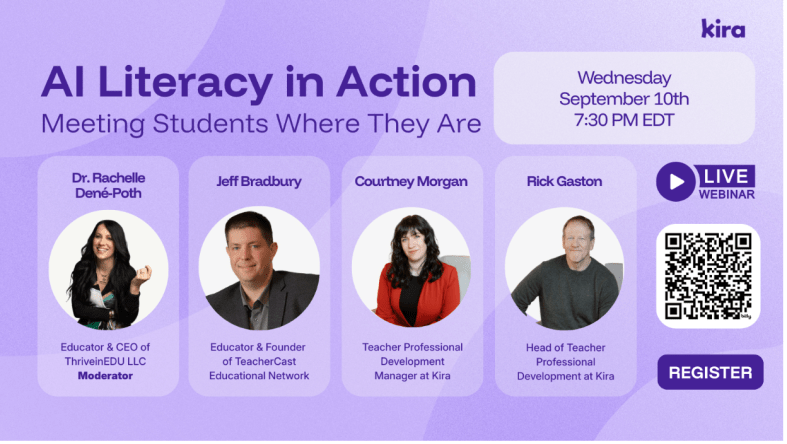
That’s how we opened our recent panel on AI literacy for educators. Whether you feel energized, overwhelmed, or skeptical, you’re not alone, and that’s exactly why having conversations around AI and how to bring it into our schools matters.
Why AI Literacy, Why Now?
I enjoyed the opportunity to serve as the panelist for this great discussion about AI Literacy. We had so much engagement from attendees from more than 25 countries around the world!
The panelists engaged in rich discussion and offered insight into our role as educators and how we can help our students and ourselves better understand: What do we need to be doing when AI-powered tools surround us?” How does learning change?
Literacy isn’t about knowing how to navigate AI platforms, but rather it is about habits of mind. Asking better questions, evaluating outputs, knowing how to evaluate sources, understanding the limitations of AI, and aligning use with learning goals, ethics, and policy. AI is something that we need to consider and how it is involved in our planning, teaching, assessment, and reflection. And being able to determine whether something is real or not, something that I thought more about after reading the book Futureproof, by Kevin Roos, two years ago. Shifting from digital literacy to discernment is key.
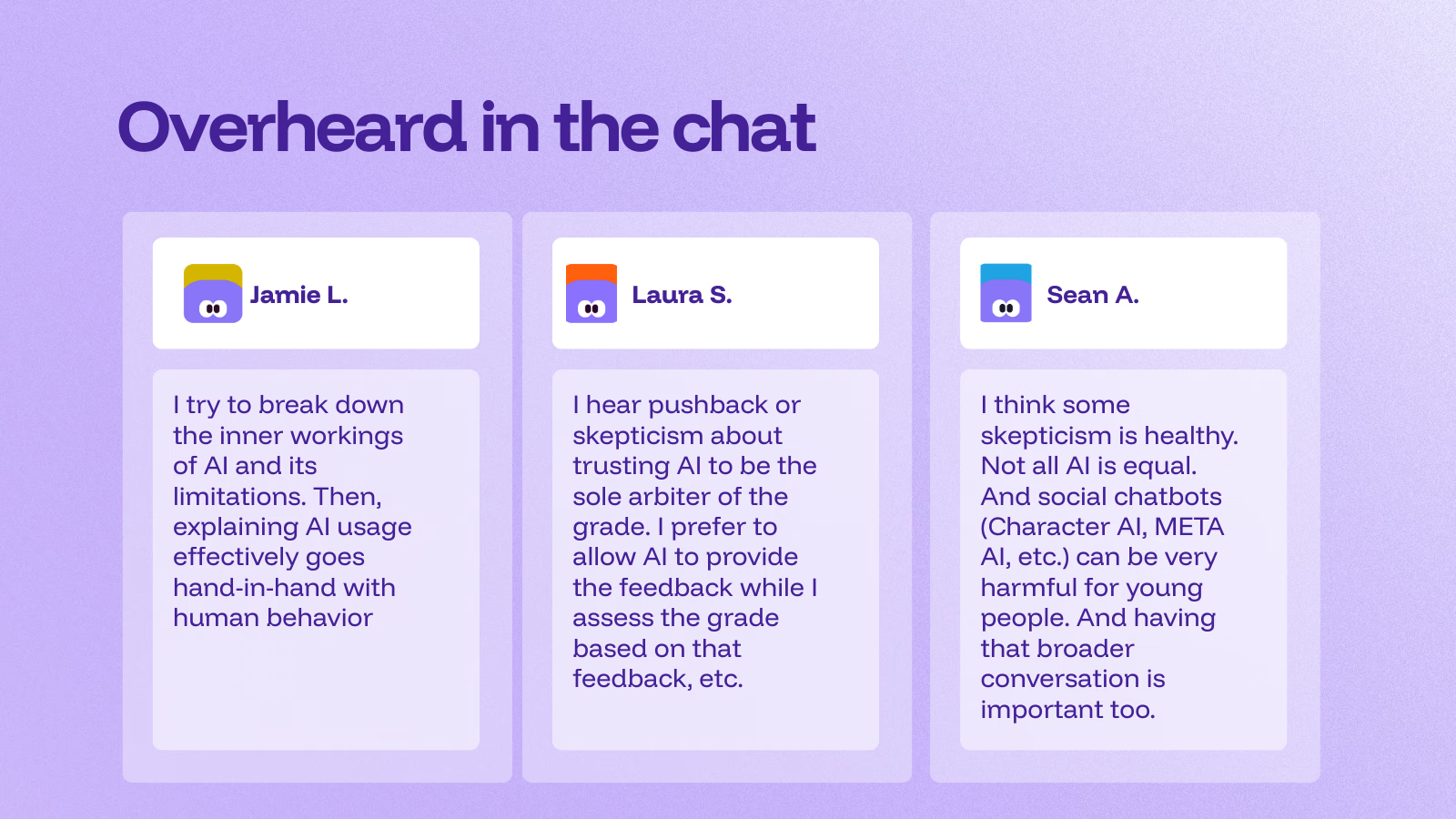
The Skepticism Is Real (and Reasonable)
We started our discussion with what we called initial skepticism. Many teachers are hesitant to introduce AI into their classrooms, schools, or even their own workflows. As Jeff Bradbury put it:
“There are educators out there trying to figure this out, but they are not yet sure how to do it. There are educators out there who are scared. And then you have educators on the other side of the innovation curve… How do you work with all of those at the same time?”
He continued: “That question hits home. In every district I visit, I meet the AI All-Ins, the Cautious Curious, and the Not-Now crowd. Suppose this is your staff, good, because having discussions with educators who have these different viewpoints is key. It means you have internal mentors and internal skeptics—the two groups you need most to build something responsible and resilient, especially when the topic is AI”.
Some ideas shared: Start with a common language or practices. Define “AI literacy” and what that means. Identify how to best use AI (lesson planning, differentiation, feedback drafting) and some ways where you want to avoid the use of AI or be more cautious (grading without verification, sensitive data, replacing teacher judgment). Establishing clear guardrails reduces anxiety and helps to ensure that AI implementation in our schools is consistent and purposeful.
The “Aha” That Changes Everything: Specificity
Jeff told a story about a colleague—a music teacher—who tried AI “seven or eight different ways” to create a budget and concluded, “I hate this thing.” The pivot came with one question: “Were you specific?” Did he tell the AI it was for a middle school music program? The approximate budget? The categories? The constraints?
“You didn’t fail eight ways,” Jeff said. “You found eight ways the system didn’t have enough to listen to you.”
The quality of your prompt is not about clever “hacks”—it’s about context, criteria, and constraints.
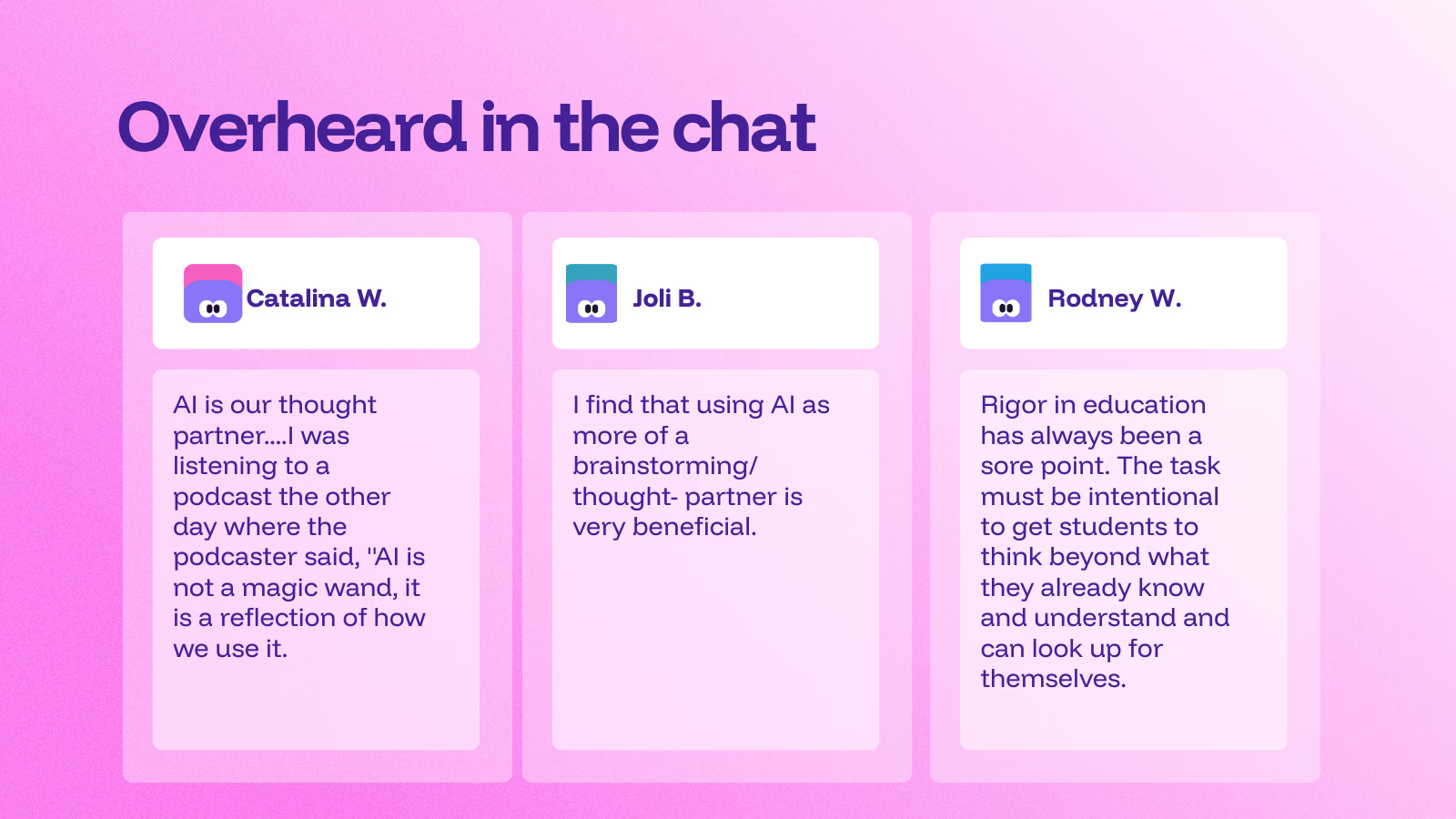
Prompting is a pedagogy: We are modeling for students how to ask precise questions, set criteria, and iterate. That is AI literacy.
Meet Teachers Where They Are
Rick Gaston and Courtney Morgan from Kira emphasized a simple, human truth: people learn faster when they feel safe and seen.
“We like to meet teachers where they’re at to help them begin with AI,” Rick said. “Start with lesson content they’re comfortable with and have them experience how quickly AI can provide new ideas in that content area.”
“We believe in learning by doing,” Courtney added. “We facilitate that process so teachers can experience that our AI tools can be their teaching buddies.”
I love that phrase: teaching buddies. Not a shortcut. An assistant or collaborator who drafts, riffs, and reframes so that educators can focus on the human aspects of teaching, such as relationships, feedback, and instructional decision-making.
Time: The Gift Teachers Actually Feel
Jeff’s coaching mantra resonated with the chat: “What is the one thing I can give you that no one else can? Time.” When AI saves a teacher 30 minutes tonight, their stance moves from skeptical to curious. When it saves them three hours before conferences, they become advocates.
Concrete time-savers that build trust:
Parent emails: Draft a positive progress update with two examples of growth and one specific next step—translated into Spanish and English.
Rubric remix: Convert a long analytic rubric into a student-friendly checklist; add “I can” statements.
Formative checks: Generate two exit tickets (one multiple-choice, one open-ended) targeting the same standard; include an answer key/rubric slice.
When teachers see the time they can save and then shift to students or colleague interactions, they’re more willing to explore deeper integrations of AI into their practice.
Additional insights from participants (courtesy of Kira)
About Kira
Kira is an AI-powered teaching & learning platform built to save teachers time, personalize instruction, and keep teachers in control.
During the panel discussion, attendees had the chance to learn more about the platform and the AI Tutor. “This is just a quick preview of the Kira platform,” said Courtney, “and why we keep mentioning the built-in AI Tutor we’re really proud of.”
At its core, the AI Tutor is designed to coach, rather than simply provide answers. Students can highlight any passage and ask a question, or simply discuss it directly with the tutor. “You’re going to see me try to make it solve the problem for me,” Courtney joked, “but it won’t. Instead, it walks you through highly scaffolded steps.” That means support questions, targeted hints, and extra practice. The Tutor will work at nudging learners toward the how and why, not just the what. You can adjust the support level and reading level per student. It never gives direct answers and provides context-aware, course-specific feedback.
The AI Tutor is subject-agnostic and works across K–12 courses, math included. It’s available to both teachers and students, and it’s been a game-changer for first-time teachers who lean on it to deepen their own understanding while teaching. The message is clear: AI as a teaching buddy, not a replacement.
Differentiation is built in. Teachers can adjust the tutor’s level of support if students are over-relying on it, or increase it for learners who need more targeted assistance, including those with IEPs or language-learning needs. The goal is precision teaching: the right help, to the right student, at the right moment.
Getting started is easy. Kira offers ready-to-use courses, including AI Demystified for students, answering the big questions, “What is AI? What is it doing? How do I use it responsibly?”—and AI 101 for Educators, which builds teacher AI literacy. Looking to be part of a learning community?
Join the upcoming AI 101 for Educators cohort starting in October. Learn more and express your interest here! It is a short, self-paced PD (about 2 hours) for any subject area that builds confidence using AI in real classrooms.
It will cover:
What is AI, and what AI tools are helpful for educators?
How can I teach my students to use AI responsibly?
How can I use AI tools to enhance my students’ critical thinking?
How can I reduce risks and maximize the benefits of using AI in the classroom?
Once you fill out the form, the team at Kira will follow up with more details.
Dr. Rachelle Dené Poth is a Spanish and STEAM: What’s Next in Emerging Technology Teacher at Riverview High School in Oakmont, PA. Rachelle is also an attorney with a Juris Doctor degree from Duquesne University School of Law and a Master’s in Instructional Technology. Rachelle received her Doctorate in Instructional Technology, and her research focus was on AI and Professional Development. In addition to teaching, she is a full-time consultant and works with companies and organizations to provide PD, speaking, and consulting services. Contact Rachelle for your event!
Rachelle is an ISTE-certified educator and community leader who served as president of the ISTE Teacher Education Network. By EdTech Digest, she was named the EdTech Trendsetter of 2024, one of 30 K-12 IT Influencers to follow in 2021, and one of 150 Women Global EdTech Thought Leaders in 2022.
She is the author of ten books, including ‘What The Tech? An Educator’s Guide to AI, AR/VR, the Metaverse and More” and ‘How To Teach AI’. In addition, other books include, “In Other Words: Quotes That Push Our Thinking,” “Unconventional Ways to Thrive in EDU,” “The Future is Now: Looking Back to Move Ahead,” “Chart A New Course: A Guide to Teaching Essential Skills for Tomorrow’s World, “True Story: Lessons That One Kid Taught Us,” “Things I Wish […] Knew” and her newest “How To Teach AI” is available from ISTE or on Amazon.
Contact Rachelle to schedule sessions about Artificial Intelligence, AI and the Law, Coding, AR/VR, and more for your school or event! Submit the Contact Form.
Follow Rachelle on Bluesky, Instagram, and X at @Rdene915
**Interested in writing a guest blog for my site? Would love to share your ideas! Submit your post here. Looking for a new book to read? Find these available at bit.ly/Pothbooks
************ Also, check out my THRIVEinEDU PodcastHere!
Join my show on THRIVEinEDU on Facebook. Join the group here.
I never expected artificial intelligence to change the way I listen.
But it has.
Not in the way you might think — not with smart assistants, personalized lesson plans, or AI-generated quizzes. No, for me, it started with coffee and quiet conversation.
Every Sunday for the past 15 years, I’ve sat down with Russ, a 91-year-old master carpenter. He’s the kind of guy who builds houses with his hands, still reads blueprints better than books, and spent decades showing up to Emotions Anonymous meetings because the words he needed weren’t available anywhere else. Russ is dyslexic. He’s quiet. He’s deep. And he’s wise.
But that wisdom — decades of it — was hard to capture. He struggled to get the words out. His kids never really listened. His friends mostly stayed on the surface. Even in men’s groups, the real stuff — shame, regret, transformation — often went unsaid.
Then something surprising happened.
I started bringing our conversations to ChatGPT. Not to replace Russ, but to amplify his voice — to help us understand what he was really trying to say. I would enter his phrases, his metaphors, his pauses — and the AI would respond with uncanny clarity, warmth, and insight. It was like someone had installed a cochlear implant for the soul.
Suddenly, Russ’s stories became prose. His insights became chapters. The builder found his blueprint for truth.
That experiment became a book. Cracked Open: A Field Guide for Men in Search of the Truth, and itis not a book about AI. It’s a book made possible by AI. And it’s made me rethink everything I thought I knew about the role of technology in learning — especially emotional learning.
Empathy Is the New Literacy
I taught graduate school for 17 years. I spent countless hours helping students articulate ideas, frame arguments, and structure their thinking. But I never had a tool like this.
To be clear, I’m not talking about ChatGPT as a replacement for student voice — I’m talking about it as a mirror. A probe. A translator. A collaborator. When used well, it becomes a catalyst for self-awareness, not a shortcut around it.
The most surprising thing?
The empathy.
Over the past year, I’ve worked with this tool nearly every day. And while the technology evolves, one thing has remained consistent: its capacity to reflect back the emotional tone of a person’s experience — not just the words, but the meaning behind the words. Whether we were writing about Russ’s regret over spanking his kids or his frustration with shallow men’s conversations, the AI didn’t just generate text. It offered presence.
And presence, as any educator knows, is the rarest and most powerful tool in learning.
What Russ Taught Me (with Help from AI)
Russ doesn’t believe in small talk.
He says we need to talk about “matters that matter.” And when I asked him what made him feel accepted in a conversation, he said: “When someone really listens and doesn’t try to fix me.”
AI, oddly enough, does that remarkably well. It doesn’t interrupt. It doesn’t judge. And when guided properly, it doesn’t spin its own agenda. It just listens, reflects, and gently invites more.
Through the AI, Russ’s quotes — what we now call Russisms — became chapter openers. His metaphors about wood, about warping and strength and building foundations, became the framing for chapters on parenting, aging, regret, conflict, death, and masculinity.
This wasn’t artificial intelligence replacing human wisdom.
It was AI helping recover it.
Implications for the Classroom
So what does this mean for educators?
A few things.
AI can amplify unheard voices. Russ is dyslexic. Many of your students are too — or English learners, or neurodivergent, or emotionally guarded. AI can help them hear themselves in new ways. It can offer fluency before fluency arrives.
AI can be a practice partner for courage. Russ and I created what we now call Cracked Open Circles — spaces where men talk honestly about what’s really going on. In classrooms, students often avoid emotional risk. But AI offers a strange safety — a “listener” who won’t laugh, interrupt, or gossip. That’s fertile ground for growth.
AI can teach reflection. With the right prompt, ChatGPT becomes a Socratic coach. It can ask follow-ups, reframe narratives, or help students synthesize personal experience with academic content. That’s not cheating. That’s scaffolding.
AI can model tone and humility. Russ once said, “I no longer refer to people by their name. I refer to them as ‘a human being.’ That helps me feel less judgmental.” That idea, fed to AI, came back as a short meditation on compassion and seeing others as flawed and trying. What would happen if students fed their own values into an AI and asked it to reflect those back as a story, a letter, or a lesson?
The Real Assignment
We live in an age of noise — performative posts, polarized opinions, and deep emotional isolation.
According to a recent study, only 27% of men say they have six or more close friends — down from 55% in 1990. Over 70% of men report feeling inadequate at work. Most don’t talk about their inner world at all.
We don’t need more content.
We need more courage. More clarity. More connection.
AI, surprisingly, can help with that.
Not by replacing human relationship — but by preparing us for it. By giving us a dry run. By letting us rehearse hard conversations, rewrite tired narratives, and finally — finally — tell the truth.
Final Thought
Russ listened to a popular men’s podcast a few months ago. He sat quietly through the whole thing, then turned to me and said:
“This is great. But what are they doing about it?”
That became the question that drives our work.
Cracked Open Circles is our answer — one story at a time, one circle at a time.
And now, perhaps, one classroom at a time.
About Rachelle
Dr. Rachelle Dené Poth is a Spanish and STEAM: What’s Next in Emerging Technology Teacher at Riverview High School in Oakmont, PA. Rachelle is also an attorney with a Juris Doctor degree from Duquesne University School of Law and a Master’s in Instructional Technology. Rachelle received her Doctorate in Instructional Technology, and her research focus was on AI and Professional Development. In addition to teaching, she is a full-time consultant and works with companies and organizations to provide PD, speaking, and consulting services. Contact Rachelle for your event!
Rachelle is an ISTE-certified educator and community leader who served as president of the ISTE Teacher Education Network. By EdTech Digest, she was named the EdTech Trendsetter of 2024, one of 30 K-12 IT Influencers to follow in 2021, and one of 150 Women Global EdTech Thought Leaders in 2022.
She is the author of ten books, including ‘What The Tech? An Educator’s Guide to AI, AR/VR, the Metaverse and More” and ‘How To Teach AI’. In addition, other books include, “In Other Words: Quotes That Push Our Thinking,” “Unconventional Ways to Thrive in EDU,” “The Future is Now: Looking Back to Move Ahead,” “Chart A New Course: A Guide to Teaching Essential Skills for Tomorrow’s World, “True Story: Lessons That One Kid Taught Us,” “Things I Wish […] Knew” and her newest “How To Teach AI” is available from ISTE or on Amazon.
Contact Rachelle to schedule sessions about Artificial Intelligence, Coding, AR/VR, and more for your school or event! Submit the Contact Form.
Follow Rachelle on Bluesky, Instagram, and X at @Rdene915
**Interested in writing a guest blog for my site? Would love to share your ideas! Submit your post here. Looking for a new book to read? Find these available at bit.ly/Pothbooks
************ Also, check out my THRIVEinEDU PodcastHere!
Join my show on THRIVEinEDU on Facebook. Join the group here.
I started researching artificial intelligence in July 2017. I dove into the topic so that I could write a blog post for Getting Smart in January 2018. I had no idea at that point, thinking ahead, how much time I would invest in learning about AI and how much I would invest in working with students and educators over the past 7 1/2 years.
I love working with students in my classroom and also, I am very much aware of the ethical and legal considerations that we have to think about when it comes to any technology, but more specifically AI. Over the past two years, I have challenged myself to go beyond the training that I have done related to AI and different tools, and now I have also been focusing on AI and the law, working with administrators to evaluate policies, create opportunities to provide professional development for the educators in their school systems, and so much more. I am always looking for more opportunities to work within schools.
And with all these opportunities, things have changed a lot from seven years ago when I started presenting, compared with nearly 2 years ago when ChatGPT came out, and even this year. Artificial intelligence isn’t just a buzzword anymore—it’s becoming a tool that education leaders can no longer ignore. As an educator and consultant who works at the intersection of AI, law, and learning, I’ve seen how quickly AI is reshaping classrooms and professional practices. But what about those leading from an administrator’s viewpoint?
For administrators, AI is not just about the tools students or teachers use; it’s about strategy, policy, and shaping the future of learning in your schools. So how can you, as an education leader, leverage AI effectively and responsibly? Here are some ideas and practical tips to help you get started.
1. Streamlining Administrative Work
One of the most immediate uses of AI is in reducing the workload that often takes administrators away from instructional leadership. AI-powered tools can:
Draft communications: If you spend time writing newsletters to families, updates to the school board, or memos for staff, AI can help you to generate polished drafts that you can refine and personalize.
Summarize long reports: Instead of sifting through dozens of pages, AI can condense state policy updates, research articles, or professional learning reports into actionable takeaways.
Automate scheduling: Tools now exist that can suggest meeting times, analyze calendar patterns, and even help coordinate professional development sessions.
💡 Reminder: Always add your authentic voice and context when using AI for communication. AI should be used as an assistant, not as a replacement for the work we do.
2. Using AI for Data-Informed Decisions
Administrators are constantly making decisions based on data. They focus on assessment results, attendance records, and even budgetary considerations. AI can help to identify patterns and provide insights more quickly. For example:
Equity checks: AI can highlight disparities in discipline, participation, or achievement data that might otherwise be hidden.
Enrollment predictions: Some districts are already using AI to forecast shifts in student numbers and staffing needs.
Resource allocation: Imagine tools that analyze spending trends and suggest areas where funds could be more impactful.
💡 Tip: AI should not replace your own judgment. Use it as a lens to see trends and then combine those insights with your leadership expertise and community input.
3. Supporting Teachers with AI
Your role is so important, especially for supporting teachers:
Lesson planning: Teachers can use AI to brainstorm activities aligned with standards or to differentiate for diverse learners.
Assessment support: AI-powered graders can provide fast feedback on essays or projects, giving teachers more time to focus on deeper feedback.
Professional growth: AI-driven platforms can recommend resources or communities based on teachers’ needs and interests.
💡 Tip: Encourage and support teachers as they experiment with AI. Promote ideas like generating quiz questions or creating rubrics. Building confidence and trust is key.
4. Enhancing Communication and Community Engagement
Administrators recognize that clear communication with families and the broader school community is crucial. AI can assist in many ways:
Translation tools: AI-driven translators are becoming increasingly accurate, enabling schools to connect with families in their native languages. Promoting accessibility and inclusivity is absolutely essential.
Chatbots for FAQs: Districts can set up AI-powered bots on websites to answer common parent questions about schedules, policies, or enrollment.
Sentiment analysis: Some tools can gauge community concerns by analyzing feedback surveys or social media mentions.
💡 Reminder: Being transparent helps to build trust. If you’re using AI to engage families, be clear about what it is and how it works.
5. Keeping Students Safe and Supported
Administrators have a responsibility to ensure that AI tools support—not endanger—student well-being. This means looking at both opportunities and risks:
Early warning systems: AI can help flag attendance or behavioral patterns that may indicate a student is at risk.
Cybersecurity monitoring: With cyber threats on the rise, AI can help IT teams detect unusual activity more quickly.
Digital citizenship: As students use AI themselves, administrators can help set the tone for safe, ethical, and responsible use.
💡 Tip: Always vet AI tools for compliance with laws like FERPA and COPPA, and check with legal teams before large-scale implementation. I am available to help you with policy creation and evaluation for your school!
6. Building an AI-Ready Culture
Perhaps the most critical role for administrators is shaping culture. AI is somewhat new(in the sense that GenAi is new and it can be intimidating, but it’s also full of promise. Leaders can set the tone by:
Modeling use: Share examples of how you use AI to save time or make decisions.
Creating professional learning opportunities: Dedicate PD sessions to exploring AI tools and their classroom applications.
Starting conversations: Make space for teachers, students, and families to share questions and concerns.
7. Policy and Ethical Leadership
AI brings with it new challenges in ethics and policy. Administrators should be proactive in:
Drafting AI guidelines: Develop policies for teachers and students that encourage innovation while addressing risks.
Evaluating vendors: Not every AI tool is created equal. Ask about how tools protect student data, align with standards, and support equity.
Monitoring impact: Establish checkpoints to evaluate whether AI tools are meeting their intended goals.
💡 Tip: Create a small task force of teachers, tech staff, and even students to help monitor AI use in your school or district. Shared ownership builds stronger policies.
Planning Ahead
As an administrator, it’s okay to not have all the answers about AI. You just need to be willing to ask the right questions. Over the past seven+ years, I have seen the most success when educators approach AI with curiosity, caution, and courage.
Curiosity allows you to explore the potential of AI without fear. Caution keeps you grounded in ethics, equity, and student safety. Courage helps you lead your community into a future that is still unfolding.
AI can be a powerful tool to help administrators focus on what matters most: supporting teachers, empowering students, and building thriving school communities.
The question isn’t whether AI belongs in education leadership—it’s how you, as an administrator, will guide its use. By starting small, asking thoughtful questions, and keeping your community at the center, you can ensure AI becomes an asset rather than a distraction.
About Rachelle
Dr. Rachelle Dené Poth is a Spanish and STEAM: What’s Next in Emerging Technology Teacher at Riverview High School in Oakmont, PA. Rachelle is also an attorney with a Juris Doctor degree from Duquesne University School of Law and a Master’s in Instructional Technology. Rachelle received her Doctorate in Instructional Technology, and her research focus was on AI and Professional Development. In addition to teaching, she is a full-time consultant and works with companies and organizations to provide PD, speaking, and consulting services. Contact Rachelle for your event!
Rachelle is an ISTE-certified educator and community leader who served as president of the ISTE Teacher Education Network. By EdTech Digest, she was named the EdTech Trendsetter of 2024, one of 30 K-12 IT Influencers to follow in 2021, and one of 150 Women Global EdTech Thought Leaders in 2022.
She is the author of ten books, including ‘What The Tech? An Educator’s Guide to AI, AR/VR, the Metaverse and More” and ‘How To Teach AI’. In addition, other books include, “In Other Words: Quotes That Push Our Thinking,” “Unconventional Ways to Thrive in EDU,” “The Future is Now: Looking Back to Move Ahead,” “Chart A New Course: A Guide to Teaching Essential Skills for Tomorrow’s World, “True Story: Lessons That One Kid Taught Us,” “Things I Wish […] Knew” and her newest “How To Teach AI” is available from ISTE or on Amazon.
Contact Rachelle to schedule sessions about Artificial Intelligence, Coding, AR/VR, and more for your school or event! Submit the Contact Form.
Follow Rachelle on Bluesky, Instagram, and X at @Rdene915
**Interested in writing a guest blog for my site? Would love to share your ideas! Submit your post here. Looking for a new book to read? Find these available at bit.ly/Pothbooks
************ Also, check out my THRIVEinEDU PodcastHere!
Join my show on THRIVEinEDU on Facebook. Join the group here.
I grew up in a small town in rural Illinois. Neither of my parents has a high school diploma, so I am a first-generation high school graduate. Having that diploma opened a world of possibilities to me that would otherwise have been closed, including going on to earn a college degree, which then led to a terrific career and becoming the CEO of Acceleration Academies.
It was my high school diploma that put me on that path to giving back through a career dedicated to improving education. I began decades ago working on products that brought online educational video into the classroom. Now, I have the privilege of helping young people who, like me, face and overcome barriers impeding their education.
I love telling the story about growing up in rural Illinois to graduation candidates attending our Acceleration Academies. Because I want every young person to know they have a path open to them achieving their own dreams, I say to them, “I am a first-generation high school graduate, and now I’m a CEO. You can be anything you want to be!”
Reconnecting Students Who Have Been Pushed Out
At Acceleration Academies (AA), we focus on students who are disengaged. Usually, that means they have dropped out, but we find that more often than not, these students feel like they were pushed out by a traditional approach to schooling that wasn’t supporting their needs. They may have to work full-time to support their families, or they may already have a little one of their own. They may struggle with mental health, such as paralyzing anxiety about attending a school with 1,000 other students. Some students drop out because of bullying or fall behind because of food insecurity. There are so many challenges students can face that have nothing to do with their ability or drive. Instead, it is a school environment that doesn’t work with the circumstances of their lives.
We partner with local school districts to overcome that barrier by providing an alternative school environment where students get all kinds of support, no matter the challenges they face. They get a second chance at a high school diploma with no cost to them. The districts benefit by graduating more students and recovering the funding they lost when students disenrolled.
‘Content Coaches’ and ‘Graduation Candidates’
Creating a different environment is so central to our model that it even filters into the language we use. Our students are called “graduation candidates” to remind them that they are there to complete a goal – a goal, we tell them, that they are 100 percent capable of reaching. Our teachers are called “content coaches” because they help students work through their classes and assignments. We even have staff who will call students who have trouble waking up to their alarm to make sure they get out the door. Our staff will even help them find a job with an employer who will accommodate their school schedule and prioritize their education.
A Different Environment
All of this, our entire model, is about removing barriers and adding in support to help students overcome obstacles. That includes the setting. Our schools offer a cafe-style environment with wide open spaces, varied seating and working areas, several small rooms for meetings, and enclosed workspaces for students who prefer a more private setting.
Students take one class at a time, generally taking about three to four weeks per class, so their content coaches can guide them one subject at a time. We offer a hybrid format that allows them to learn in-person and online. There’s flexible scheduling for everyone so students who have obligations during traditional school hours can come in during the evenings or on weekends. Pacing is up to the student, guided and encouraged by coaches.
We also operate on a 12-month schedule, rather than the traditional nine-month academic calendar. Many of our students are behind grade level, and they need extra months to get back on track. We’ve also found that students lose connection with school during longer breaks and are less likely to continue with their education when they haven’t attended for even a couple of weeks.
A Win-Win-Win for Everyone
Each AA site is a program of choice within the partner district, which makes it a win-win-win. The district recovers funding when students re-enroll and their graduation rate improves as we matriculate students. Young people get back on track to earn a diploma and all the educational and career opportunities that come with it. Their immediate family and even their communities benefit from the increased economic potential each graduate earns as well.
It’s a win for students who have a variety of reasons for needing something different. For example, those who are mostly on the right track, but get into a little trouble, can continue working at their district’s AA site and then either return to their traditional school or continue with us. It is as much a win for the students who are struggling academically or socially as it is for those who want (or need) to graduate faster. See several inspiring student stories here.
A Gwinnett County Public Schools student told me her story recently. She had been depressed, unable to get out of bed and attend school because she felt afraid, almost paralyzed at school. She enrolled at Acceleration Academies after about three months at her parents’ urging. For the first six weeks, she told me she would come to school and go straight to one of the low-stimulus rooms we offer and wouldn’t talk to anyone. Little by little, she began to feel safe.
A few months later, this student walked with me – who was once, to her, a scary adult – around her school. Now, she is confident and sure of her surroundings. She is able to communicate, to advocate for herself, to tell a painful story about a hard time in her life to a stranger. This young woman is still a graduation candidate in our school, and I hope she earns her diploma. Even if she doesn’t, I’m proud to be a part of an organization that helped her find her confidence and reconnect with her goals and her community.
At every graduation I attend, someone will approach me, maybe a teacher, a caregiver, or a graduate, to tell me their personal story and thank me for Acceleration Academies. Every time, when I ask who wants to stay in school, every one of those students who had been labeled as a dropout raises their hands. It really is such meaningful work we are able to do here, and the only reason I am able to do it is because years ago I overcame my own barriers to earn a diploma. I want every graduation candidate to have the same opportunity to improve their communities, and that means removing every barrier we find with student-centered support.
About Kelli
Kelli Campbell is a first-generation high school graduate and a first-generation college graduate. She is the CEO of Acceleration Academies.
About Rachelle
Dr. Rachelle Dené Poth is a Spanish and STEAM: What’s Next in Emerging Technology Teacher at Riverview High School in Oakmont, PA. Rachelle is also an attorney with a Juris Doctor degree from Duquesne University School of Law and a Master’s in Instructional Technology. Rachelle received her Doctorate in Instructional Technology, and her research focus was on AI and Professional Development. In addition to teaching, she is a full-time consultant and works with companies and organizations to provide PD, speaking, and consulting services. Contact Rachelle for your event!
Rachelle is an ISTE-certified educator and community leader who served as president of the ISTE Teacher Education Network. By EdTech Digest, she was named the EdTech Trendsetter of 2024, one of 30 K-12 IT Influencers to follow in 2021, and one of 150 Women Global EdTech Thought Leaders in 2022.
She is the author of ten books, including ‘What The Tech? An Educator’s Guide to AI, AR/VR, the Metaverse and More” and ‘How To Teach AI’. In addition, other books include, “In Other Words: Quotes That Push Our Thinking,” “Unconventional Ways to Thrive in EDU,” “The Future is Now: Looking Back to Move Ahead,” “Chart A New Course: A Guide to Teaching Essential Skills for Tomorrow’s World, “True Story: Lessons That One Kid Taught Us,” “Things I Wish […] Knew” and her newest “How To Teach AI” is available from ISTE or on Amazon.
Contact Rachelle to schedule sessions about Artificial Intelligence, Coding, AR/VR, and more for your school or event! Submit the Contact Form.
Follow Rachelle on Bluesky, Instagram, and X at @Rdene915
**Interested in writing a guest blog for my site? Would love to share your ideas! Submit your post here. Looking for a new book to read? Find these available at bit.ly/Pothbooks
************ Also, check out my THRIVEinEDU PodcastHere!
Join my show on THRIVEinEDU on Facebook. Join the group here.







 Learning as I go: Reflections & lessons learned