

The Importance of Reflective Practices

Making time for reflection as an educator is essential. Education is a field defined by personal and professional growth. Not just for educators, but also for students, the school community, and the systems involved, too. Growth doesn’t happen on its own. It requires intention, curiosity, and ongoing, consistent reflection. By looking back on our experiences, analyzing what worked and what didn’t, and identifying ways to improve, we build a solid reflective practice in our work. Reflection should not be considered as a routine, but rather as a mindset that transforms teaching into a continuous cycle of learning.

Why Reflection Matters

In classrooms filled with continuous changes, such as emerging technologies, alignment to varying standards, and working to best meet the needs of all learners, reflection helps to anchor us. It offers educators a chance to take a moment to pause and ask themselves questions such as, “Why did this lesson work? What could I do differently next time? What did my students need that I missed? How can I improve for tomorrow?

Reflection:

  • Encourages professional growth and lifelong learning.
  • Improves instructional decisions through ongoing thinking and self-evaluation
  • Builds self-awareness and resilience.
  • Strengthens the connection between teacher and learner experience.
  • Models metacognitive thinking for students.

As a huge fan of quotes, and having written one focused on quotes, I often think of this quote by John Dewey:

“We do not learn from experience… we learn from reflecting on experience.”

When we take the time to reflect on our experiences as educators, we transform them into opportunities for innovation, empathy, and personal growth.

The Cycle of Reflection

A simple way to frame reflection in education is through Gibbs’ Reflective Cycle, which includes six stages:

  1. Description – What happened?
  2. Feelings – How did you feel about it? How did it impact you?
  3. Evaluation – What was good or bad about the experience?
  4. Analysis – Why did things happen that way?
  5. Conclusion – What have you learned? What impact did it have?
  6. Action Plan – What will you do differently next time?

This framework helps teachers to pause, slow down, and analyze practice systematically, rather than relying solely on intuition or habit. It encourages educators to move from being reactive to becoming more intentional. When we do this, we make a shift and turn each lesson into a source of insight to better inform our practice.

Reflection Strategies for Educators

There are many ways to integrate reflective practice into our daily work. It can vary depending on teaching style, teaching and personal schedule, and even the school environment. Here are a few practical strategies that can help make reflection a part of your professional practice.

1. Journaling or Blogging

A reflective journal, whether digital or handwritten, or starting a blog, offers a space to explore thoughts about teaching, students, or school culture. Writing helps us identify or clarify patterns and challenges that we may otherwise be unaware of.

Try this:
At the end of each week, make a note of:

  • A success from the week
  • A challenge faced
  • A surprising moment
  • One thing you’ll try differently next week

This short routine will help to turn reflection into an intentional practice rather than an afterthought.

2. Peer Observation and Feedback

Invite a colleague to observe one of your classes or co-teach a lesson with you. These opportunities can provide new perspectives that deepen our reflection. While it can be uncomfortable at times, it is necessary. Having someone else with us can be insightful for identifying things we may overlook.

When working with a colleague and engaging in peer feedback, it shifts to a dialogue that, rather than being a solo conversation, becomes a dialogue that moves from focusing on what happened in a lesson to what happened, what it means, and what can I do now.

Try this:
After a peer observation, engage in a quick debrief with your colleague. Consider using prompts like:

  • “What did you notice about student engagement?”
  • “How did my questioning or feedback shape learning?”
  • “What assumptions might I have made during that lesson?”
  • “How was my pace during instruction?”
  • “Did I provide opportunities for students to lead more?”

3. Engage in Reflective Conversations with Students

I have found that asking my students for their thoughts is very helpful. I ask them what resonated with them, what confused them, how my class made them feel, and what ideas they can share about the impact of the strategies or teaching tools used in class.

Try this:
End a unit or project with a student reflection survey:

  • “What helped you learn most in this unit?”
  • “When did you feel most challenged?”
  • “What could I do differently to help you learn better?”

When we gain insights like these, they will not only inform instruction but also empower students to become reflective learners.

4. Video Reflection

Over the years, I have used a few different tools to reflect on my teaching practices. It can be uncomfortable at times, but by using video, it can be eye-opening for us. I have used Edthena Coaching for input, a Swivl, and through these, I have noticed several things. I quickly noticed patterns in my tone, pacing in lessons, student interactions, questioning practices, and more, that I often had overseen while teaching.

Try this:
Choose one aspect to focus on, such as questioning techniques, transitions, or body language (I tend to move my hands a lot!), and analyze that specifically. Small, focused reflection leads to meaningful improvement.

Reflection and Innovation

In our age of AI, digital learning tools, and evolving pedagogies, reflection is crucial to integrating innovation effectively. Reflective educators ask:

  • “Is this tool enhancing learning, or is it too much?”
  • “How are my students using technology to think critically, not just consume?”
  • “What role does empathy play in how I use data or AI to personalize learning?”

Reflection ensures that innovation stays human-centered and grounded in purpose, not just as a novelty.

Connecting Reflection to Student Growth

When teachers model reflection, students learn to think about their own thinking, they engage in a process known as metacognition. Reflective learners:

  • Understand their strengths and challenges.
  • Set personal goals.
  • Monitor their progress and adapt strategies.
  • Build self-awareness

Encouraging students to reflect, whether through the use of portfolios, self-assessments, or classroom discussions, cultivates ownership of learning. Reflection is powerful as it helps students to shift the focus of learning from grades to ongoing growth.

Building a Culture of Reflection

Creating a reflective classroom starts with modeling vulnerability. I’ve spoken about vulnerability a lot and often quote Dr. Brené Brown from her book Daring Greatly, in which she speaks of vulnerability in reference to Teddy Roosevelt’s speech, “The Man in the Arena” from 1910. Vulnerability is not a sign of weakness, but rather a sign of strength and willingness to grow. When teachers openly admit what they’re learning, they normalize growth and imperfection.

Try saying:

“I tried something new today, and it didn’t go as I expected. Let’s think about why.”

Transparency like this builds trust and shows students that reflection isn’t about failure. Reflection is about curiosity and continuous improvement.

When reflection becomes part of the culture, it deepens engagement and innovation at every level, from classrooms to leadership teams.

Reflective practice is at the heart of great teaching. It reminds us that education is an evolving journey that brings with it challenges and successes, both of which require reflection. Through reflection, we discover meaning in our work, develop empathy for our students, and gain clarity in our purpose for the work that we do.

The best educators are not those who have all the answers, but those who keep asking better questions.

About Rachelle

Dr. Rachelle Dené Poth is a Spanish and STEAM: What’s Next in Emerging Technology Teacher. Rachelle is also an attorney with a Juris Doctor degree from Duquesne University School of Law and a Master’s in Instructional Technology. Rachelle received her Doctorate in Instructional Technology, with a research focus on AI and Professional Development. In addition to teaching, she is a full-time consultant and works with companies and organizations to provide PD, speaking, and consulting services. Contact Rachelle for your event!

Rachelle is an ISTE-certified educator and community leader who served as president of the ISTE Teacher Education Network. By EdTech Digest, she was named the EdTech Trendsetter of 2024, one of 30 K-12 IT Influencers to follow in 2021, and one of 150 Women Global EdTech Thought Leaders in 2022.

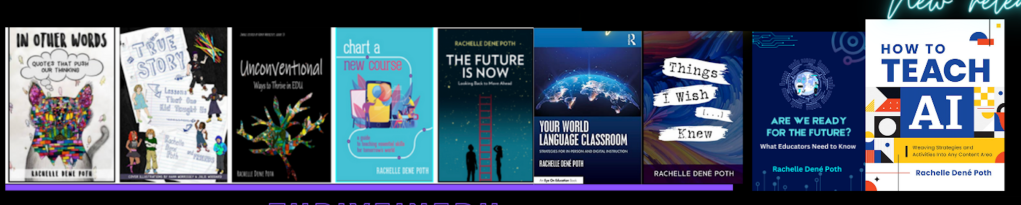
She is the author of ten books, including ‘What The Tech? An Educator’s Guide to AI, AR/VR, the Metaverse and More” and ‘How To Teach AI’. In addition, other books include, “In Other Words: Quotes That Push Our Thinking,” “Unconventional Ways to Thrive in EDU,” “The Future is Now: Looking Back to Move Ahead,” “Chart A New Course: A Guide to Teaching Essential Skills for Tomorrow’s World, “True Story: Lessons That One Kid Taught Us,” “Things I Wish […] Knew” and her newest “How To Teach AI” is available from ISTE or on Amazon.

Contact Rachelle to schedule sessions about Artificial Intelligence, AI and the Law, Coding, AR/VR, and more for your school or event! Submit the Contact Form.

Follow Rachelle on Bluesky, Instagram, and X at @Rdene915

**Interested in writing a guest blog for my site? Would love to share your ideas! Submit your post here. Looking for a new book to read? Find these available at bit.ly/Pothbooks
************ Also, check out my THRIVEinEDU Podcast Here!

Join my show on THRIVEinEDU on Facebook. Join the group here.
Entrepreneurial Mindset in Middle School

My former post on Edutopia

As an educator, attorney, and advocate for innovation in education, I’ve had the opportunity to work with my students through project-based learning experiences that have led them on real-world entrepreneurial journeys as they sought solutions to global challenges. In my eighth-grade STEAM course, students selected and researched careers; developed logos, business concepts, and branding strategies; and even created podcasts to make their business plan.

I noticed them developing artistic talents, whether through painting, calligraphy, crocheting, or making plushies. We talked about their love of creation and how they could create a business. Being an entrepreneur does not necessarily mean that students will start their own businesses, but rather, they will develop in-demand skills such as resilience, creativity, collaboration, problem-solving, and adaptability, which promote flexibility in our changing world. These entrepreneurial experiences enable students to shift from consumers of content to creators, leaders, problem solvers, and innovators.

Essential skills for an entrepreneurial mindset

Students need to extend learning beyond the classroom walls. In my school, students have opportunities to engage in career shadowing, do volunteer work, or participate in events organized by local companies or those that provide career learning experiences. These opportunities promote collaboration, enabling students to work together to design solutions and become changemakers and entrepreneurs. Here are some of the ways these activities build students’ skills:

  1. Agency creates opportunities for ideation and iteration. Through project-based learning or challenge-based learning, students choose a focus for their work and learn that their ideas matter and that they can design their learning journey. Entrepreneurs know that it takes time to improve and build a brand, product, or solve a problem.
  2. Collaboration celebrates the effort, not just the outcomes. Students engaging in project or independent work become involved in decision-making and learn to appreciate the learning process, which provides opportunities for discussion through feedback and promotes greater collaboration.
  3. Creativity and innovation connect learning to real-world problems that students care about. Ask students about challenges they see in their community, and pull those into their learning. Students connect with it more deeply and will create and innovate because it is meaningful and purposeful to them.

Continue reading the article on Edutopia for more ideas!

About Rachelle

Dr. Rachelle Dené Poth is a Spanish and STEAM: What’s Next in Emerging Technology Teacher. Rachelle is also an attorney with a Juris Doctor degree from Duquesne University School of Law and a Master’s in Instructional Technology. Rachelle received her Doctorate in Instructional Technology, with a research focus on AI and Professional Development. In addition to teaching, she is a full-time consultant and works with companies and organizations to provide PD, speaking, and consulting services. Contact Rachelle for your event!

Rachelle is an ISTE-certified educator and community leader who served as president of the ISTE Teacher Education Network. By EdTech Digest, she was named the EdTech Trendsetter of 2024, one of 30 K-12 IT Influencers to follow in 2021, and one of 150 Women Global EdTech Thought Leaders in 2022.

She is the author of ten books, including ‘What The Tech? An Educator’s Guide to AI, AR/VR, the Metaverse and More” and ‘How To Teach AI’. In addition, other books include, “In Other Words: Quotes That Push Our Thinking,” “Unconventional Ways to Thrive in EDU,” “The Future is Now: Looking Back to Move Ahead,” “Chart A New Course: A Guide to Teaching Essential Skills for Tomorrow’s World, “True Story: Lessons That One Kid Taught Us,” “Things I Wish […] Knew” and her newest “How To Teach AI” is available from ISTE or on Amazon.

Contact Rachelle to schedule sessions about Artificial Intelligence, AI and the Law, Coding, AR/VR, and more for your school or event! Submit the Contact Form.

Follow Rachelle on Bluesky, Instagram, and X at @Rdene915

**Interested in writing a guest blog for my site? Would love to share your ideas! Submit your post here. Looking for a new book to read? Find these available at bit.ly/Pothbooks

************ Also, check out my THRIVEinEDU Podcast Here!

Join my show on THRIVEinEDU on Facebook. Join the group here.
Preparing students for the future

We live in a rapidly evolving world shaped by artificial intelligence (AI) and emerging technologies, and we are preparing students for an uncertain future. These changes require educators to continue learning and exploring, to prepare students. We now have to focus on career-connected learning. This learning will help bridge the gap between education and the workforce, enabling students to develop adaptability, purpose, and the real-world skills necessary to thrive in jobs that may not yet exist.

Technology has been advancing at a rate faster than we could have imagined. From AI and automation to data analytics and immersive learning and working environments, the world of work is undergoing a significant transformation. As educators, we can no longer predict with certainty what future jobs will look like, but we can work to equip students with the flexibility and curiosity to succeed in any setting.

The World Economic Forum (WEF) provides valuable information and insights into in-demand skills. I refer to their Top 10 skills often as I work to prepare my students for the future. The WEF continues to emphasize the importance of transferable, human-centered skills. Its list of in-demand competencies, which include analytical thinking, creativity, resilience, and technological literacy, highlights how the focus has shifted from content memorization to capability building. To prepare our students, the best we can do is to always focus on connecting their learning to real-world experiences which will help them to experience authentic learning and develop skills in adaptability and many other essential skills.

What Does “Career Ready” actually mean today?

Traditionally, being “career ready” has referred to having strong academics and a set of soft skills such as collaboration and communication. While these are still essential skills, we have to also focus on skills in digital literacy, ethical reasoning, and the ability to navigate technologies increasingly powered by AI.

To truly prepare students, we must also help them use AI as a collaborative tool that enhances and does not replace their opportunities for learning. By leveraging platforms such as ChatGPT to brainstorm ideas, analyze information, and refine their thinking or using platforms such as Brisk Teaching, Kira Learning, Learning Genie, Magic School, School AI, and others, we can create opportunities for them or place AI in their hands. As more careers begin to require AI proficiency, classroom experiences that integrate generative tools responsibly will ensure students are well-prepared for the digital demands of the workplace.

Designing Spaces for Exploration and Purpose

Career-connected learning transforms classrooms into environments of exploration. Students need opportunities to dream big, test their ideas, fail, and iterate, and apply their skills in authentic contexts. Through hands-on projects and simulations that reflect real-world scenarios, we will foster curiosity while demonstrating the relevance of what students learn.

When we build intentional career connections into learning, we empower students to see themselves as the creators and innovators. By bringing in design thinking projects, project-based learning (PBL), place-based learning, community partnerships, or global collaboration, relevance and purpose become the driving forces behind engagement.

Elements of Career-Connected Learning

  • Project-Based Learning (PBL): Develop projects that address community or industry needs.
  • Emerging Tech Integration: Introduce students to AI, coding, and data science.
  • Authentic, Real-World Tasks: Use simulations or case studies that are based on real-world issues.
  • Partnerships: Collaborate with local businesses, universities, or nonprofits to provide mentorship or feedback.
  • Skill Challenges: Incorporate AI, cybersecurity, or innovation competitions that mirror workforce skills.

An important focus of all of this is promoting student agency. When students see that their work connects to real-world possibilities, it boosts motivation and engagement in learning and promotes long-term retention.

The WEF’s Future of Jobs Report predicts that by 2027, 85 million jobs will be displaced by automation and AI—but 97 million new roles will emerge. These new opportunities will require high-level cognitive ability, digital agility, and ethical decision-making.

Roles like AI ethics consultant, digital twin designer, and data privacy advocate are already appearing—and most students haven’t even heard of them. Meanwhile, more than half of all workers will need reskilling within a few years. This shift highlights a crucial point: education must evolve to keep pace with innovation.

Strategies for Building Career-Connected Classrooms

  1. Create Interdisciplinary Learning Experiences
    Combine subjects to reflect real-world problem-solving. For instance, collaborate math and art for data visualization projects, or integrate English and computer science to explore ethical storytelling with AI.
  2. Leverage AI Tools to Design Career-Ready Tasks
    Platforms like Eduaide, Kira Learning, Knowt, MagicSchool AI, and Brisk Teaching can help educators design simulations or career-based challenges aligned with workforce trends without adding to planning time. Lack of time and resources are the top two reasons that bringing AI experiences into classrooms can be a challenge.
  3. Partner with Industry and Community Organizations
    Collaborate with businesses, universities, and nonprofits to provide mentorship, guest speakers, job shadowing, and feedback on student projects. Even virtual connections can make a lasting impact. Not only do students benefit, but the greater school community learns from these experiences and it further solidifies the home to school connection and the sense of a supportive school community.
  4. Empower Students to Lead
    Provide students with an opportunity to create and lead tech support programs, host digital wellness campaigns, or work with their teachers on technology developments.

Keeping the focus on human skills

Career-connected learning isn’t just about building skills. It is about skills, and it’s also about building identity and purpose. It helps students answer three essential questions:
Who am I? Where am I going? How can I make a difference?

As automation and AI reshape every industry, schools must prioritize technological fluency and human skills such as compassion, creativity, and ethical reasoning. Keeping humanity involved is essential, as this is what distinguishes us from machines and the technologies available.

Educators play a crucial role in striking a balance between innovation and humanity. By providing students with authentic opportunities to explore careers, solve problems, and apply their learning, we’re helping them become not just workers of tomorrow, but leaders, innovators, and changemakers.

About Rachelle

Dr. Rachelle Dené Poth is a Spanish and STEAM: What’s Next in Emerging Technology Teacher at Riverview High School in Oakmont, PA. Rachelle is also an attorney with a Juris Doctor degree from Duquesne University School of Law and a Master’s in Instructional Technology. Rachelle received her Doctorate in Instructional Technology, with a research focus on AI and Professional Development. In addition to teaching, she is a full-time consultant and works with companies and organizations to provide PD, speaking, and consulting services. Contact Rachelle for your event!

Rachelle is an ISTE-certified educator and community leader who served as president of the ISTE Teacher Education Network. By EdTech Digest, she was named the EdTech Trendsetter of 2024, one of 30 K-12 IT Influencers to follow in 2021, and one of 150 Women Global EdTech Thought Leaders in 2022.

She is the author of ten books, including ‘What The Tech? An Educator’s Guide to AI, AR/VR, the Metaverse and More” and ‘How To Teach AI’. In addition, other books include, “In Other Words: Quotes That Push Our Thinking,” “Unconventional Ways to Thrive in EDU,” “The Future is Now: Looking Back to Move Ahead,” “Chart A New Course: A Guide to Teaching Essential Skills for Tomorrow’s World, “True Story: Lessons That One Kid Taught Us,” “Things I Wish […] Knew” and her newest “How To Teach AI” is available from ISTE or on Amazon.

Contact Rachelle to schedule sessions about Artificial Intelligence, AI and the Law, Coding, AR/VR, and more for your school or event! Submit the Contact Form.

Follow Rachelle on Bluesky, Instagram, and X at @Rdene915

**Interested in writing a guest blog for my site? Would love to share your ideas! Submit your post here. Looking for a new book to read? Find these available at bit.ly/Pothbooks

************ Also, check out my THRIVEinEDU Podcast Here!

Join my show on THRIVEinEDU on Facebook. Join the group here.