

Making time for reflection as an educator is essential. Education is a field defined by personal and professional growth. Not just for educators, but also for students, the school community, and the systems involved, too. Growth doesn’t happen on its own. It requires intention, curiosity, and ongoing, consistent reflection. By looking back on our experiences, analyzing what worked and what didn’t, and identifying ways to improve, we build a solid reflective practice in our work. Reflection should not be considered as a routine, but rather as a mindset that transforms teaching into a continuous cycle of learning.
Why Reflection Matters
In classrooms filled with continuous changes, such as emerging technologies, alignment to varying standards, and working to best meet the needs of all learners, reflection helps to anchor us. It offers educators a chance to take a moment to pause and ask themselves questions such as, “Why did this lesson work? What could I do differently next time? What did my students need that I missed? How can I improve for tomorrow?
Reflection:
- Encourages professional growth and lifelong learning.
- Improves instructional decisions through ongoing thinking and self-evaluation
- Builds self-awareness and resilience.
- Strengthens the connection between teacher and learner experience.
- Models metacognitive thinking for students.
As a huge fan of quotes, and having written one focused on quotes, I often think of this quote by John Dewey:
“We do not learn from experience… we learn from reflecting on experience.”
When we take the time to reflect on our experiences as educators, we transform them into opportunities for innovation, empathy, and personal growth.
The Cycle of Reflection
A simple way to frame reflection in education is through Gibbs’ Reflective Cycle, which includes six stages:
- Description – What happened?
- Feelings – How did you feel about it? How did it impact you?
- Evaluation – What was good or bad about the experience?
- Analysis – Why did things happen that way?
- Conclusion – What have you learned? What impact did it have?
- Action Plan – What will you do differently next time?
This framework helps teachers to pause, slow down, and analyze practice systematically, rather than relying solely on intuition or habit. It encourages educators to move from being reactive to becoming more intentional. When we do this, we make a shift and turn each lesson into a source of insight to better inform our practice.
Reflection Strategies for Educators
There are many ways to integrate reflective practice into our daily work. It can vary depending on teaching style, teaching and personal schedule, and even the school environment. Here are a few practical strategies that can help make reflection a part of your professional practice.
1. Journaling or Blogging
A reflective journal, whether digital or handwritten, or starting a blog, offers a space to explore thoughts about teaching, students, or school culture. Writing helps us identify or clarify patterns and challenges that we may otherwise be unaware of.
Try this:
At the end of each week, make a note of:
- A success from the week
- A challenge faced
- A surprising moment
- One thing you’ll try differently next week
This short routine will help to turn reflection into an intentional practice rather than an afterthought.
2. Peer Observation and Feedback
Invite a colleague to observe one of your classes or co-teach a lesson with you. These opportunities can provide new perspectives that deepen our reflection. While it can be uncomfortable at times, it is necessary. Having someone else with us can be insightful for identifying things we may overlook.
When working with a colleague and engaging in peer feedback, it shifts to a dialogue that, rather than being a solo conversation, becomes a dialogue that moves from focusing on what happened in a lesson to what happened, what it means, and what can I do now.
Try this:
After a peer observation, engage in a quick debrief with your colleague. Consider using prompts like:
- “What did you notice about student engagement?”
- “How did my questioning or feedback shape learning?”
- “What assumptions might I have made during that lesson?”
- “How was my pace during instruction?”
- “Did I provide opportunities for students to lead more?”
3. Engage in Reflective Conversations with Students
I have found that asking my students for their thoughts is very helpful. I ask them what resonated with them, what confused them, how my class made them feel, and what ideas they can share about the impact of the strategies or teaching tools used in class.
Try this:
End a unit or project with a student reflection survey:
- “What helped you learn most in this unit?”
- “When did you feel most challenged?”
- “What could I do differently to help you learn better?”
When we gain insights like these, they will not only inform instruction but also empower students to become reflective learners.
4. Video Reflection
Over the years, I have used a few different tools to reflect on my teaching practices. It can be uncomfortable at times, but by using video, it can be eye-opening for us. I have used Edthena Coaching for input, a Swivl, and through these, I have noticed several things. I quickly noticed patterns in my tone, pacing in lessons, student interactions, questioning practices, and more, that I often had overseen while teaching.
Try this:
Choose one aspect to focus on, such as questioning techniques, transitions, or body language (I tend to move my hands a lot!), and analyze that specifically. Small, focused reflection leads to meaningful improvement.
Reflection and Innovation
In our age of AI, digital learning tools, and evolving pedagogies, reflection is crucial to integrating innovation effectively. Reflective educators ask:
- “Is this tool enhancing learning, or is it too much?”
- “How are my students using technology to think critically, not just consume?”
- “What role does empathy play in how I use data or AI to personalize learning?”
Reflection ensures that innovation stays human-centered and grounded in purpose, not just as a novelty.
Connecting Reflection to Student Growth
When teachers model reflection, students learn to think about their own thinking, they engage in a process known as metacognition. Reflective learners:
- Understand their strengths and challenges.
- Set personal goals.
- Monitor their progress and adapt strategies.
- Build self-awareness
Encouraging students to reflect, whether through the use of portfolios, self-assessments, or classroom discussions, cultivates ownership of learning. Reflection is powerful as it helps students to shift the focus of learning from grades to ongoing growth.
Building a Culture of Reflection
Creating a reflective classroom starts with modeling vulnerability. I’ve spoken about vulnerability a lot and often quote Dr. Brené Brown from her book Daring Greatly, in which she speaks of vulnerability in reference to Teddy Roosevelt’s speech, “The Man in the Arena” from 1910. Vulnerability is not a sign of weakness, but rather a sign of strength and willingness to grow. When teachers openly admit what they’re learning, they normalize growth and imperfection.
Try saying:
“I tried something new today, and it didn’t go as I expected. Let’s think about why.”
Transparency like this builds trust and shows students that reflection isn’t about failure. Reflection is about curiosity and continuous improvement.
When reflection becomes part of the culture, it deepens engagement and innovation at every level, from classrooms to leadership teams.
Reflective practice is at the heart of great teaching. It reminds us that education is an evolving journey that brings with it challenges and successes, both of which require reflection. Through reflection, we discover meaning in our work, develop empathy for our students, and gain clarity in our purpose for the work that we do.
The best educators are not those who have all the answers, but those who keep asking better questions.
About Rachelle
Dr. Rachelle Dené Poth is a Spanish and STEAM: What’s Next in Emerging Technology Teacher. Rachelle is also an attorney with a Juris Doctor degree from Duquesne University School of Law and a Master’s in Instructional Technology. Rachelle received her Doctorate in Instructional Technology, with a research focus on AI and Professional Development. In addition to teaching, she is a full-time consultant and works with companies and organizations to provide PD, speaking, and consulting services. Contact Rachelle for your event!
Rachelle is an ISTE-certified educator and community leader who served as president of the ISTE Teacher Education Network. By EdTech Digest, she was named the EdTech Trendsetter of 2024, one of 30 K-12 IT Influencers to follow in 2021, and one of 150 Women Global EdTech Thought Leaders in 2022.
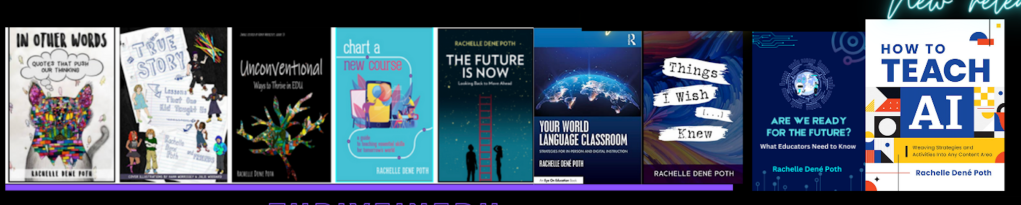
She is the author of ten books, including ‘What The Tech? An Educator’s Guide to AI, AR/VR, the Metaverse and More” and ‘How To Teach AI’. In addition, other books include, “In Other Words: Quotes That Push Our Thinking,” “Unconventional Ways to Thrive in EDU,” “The Future is Now: Looking Back to Move Ahead,” “Chart A New Course: A Guide to Teaching Essential Skills for Tomorrow’s World, “True Story: Lessons That One Kid Taught Us,” “Things I Wish […] Knew” and her newest “How To Teach AI” is available from ISTE or on Amazon.
Contact Rachelle to schedule sessions about Artificial Intelligence, AI and the Law, Coding, AR/VR, and more for your school or event! Submit the Contact Form.
Follow Rachelle on Bluesky, Instagram, and X at @Rdene915
**Interested in writing a guest blog for my site? Would love to share your ideas! Submit your post here. Looking for a new book to read? Find these available at bit.ly/Pothbooks
************ Also, check out my THRIVEinEDU Podcast Here!
Join my show on THRIVEinEDU on Facebook. Join the group here.
 Learning as I go: Reflections & lessons learned