

In my previous post, I focused on reflection. Thinking about it, if 2025 was a year of recalibration in education, the year ahead feels like it might shift toward a more intentional direction.
After slowing down, reflecting, and identifying what felt misaligned, educators now face an important decision. One is to thoughtfully consider what we continue with as we move forward. What should we keep because it makes sense and makes an impact? Or two, to decide whether there is something we need to leave behind so we can make an impact.
The future of education is not about moving faster, adopting more tools, or trying to keep up with all the changes, because that is not reasonable nor purposeful. And in full transparency, that is exactly what I thought years ago. After ongoing reflection, I now know that I should focus on how I can align and drive innovation with purpose, humanity, and care. Especially focusing on humanity.
As we look to the future and do our best to plan and prepare, several themes have emerged with greater clarity, at least in the experiences I have had. More focus on artificial intelligence, wearable technology, digital wellness, AI literacy, and a greater focus on student agency. Each of these generates opportunities to learn and continue to grow. Educators and students should engage in ongoing reflection, and, for educators, this requires asking better questions before making decisions about what is best for our classrooms.
Progress Without So Much Pressure
One of the greatest hopes I have for education now and in the future is that the progress made does not come at the expense of people. We need “humans in the loop,” as we have heard many times and will probably continue to hear. Schools are involved in so many initiatives that at times, it is absolutely exhausting. And that is for any educator, regardless of how long they have been in education.
Sometimes we invest our time and effort into an initiative, spending hours, days, weeks, only to have it disappear from the conversation either that same school year or in the not-too-distant future. The time we spend working on these initiatives takes us away from the truly impactful work that we could be doing instead. Initiatives are important and, in many instances, required; however, focusing on initiatives can lead to reactive decision-making and technology-first thinking rather than proactive decision-making, which negatively impacts what truly matters: our students and our own learning. The goal should not be to hesitate when it comes to innovation, but instead, to integrate intentionally, transparently, carefully, and responsibly.
AI in Education: From Capability to Responsibility
Artificial intelligence is the number one in-demand skill. Look at the World Economic Forum and the prediction for skills and jobs in demand, and you will see. AI will continue to shape education in many ways this year and in upcoming years, and of course, continue to evolve as technology advances. There are some things that I think about when considering AI and other technologies that are on the rise.
Sometimes I think that rather than thinking about what AI can do, maybe we should ask:
- What should AI do?
- When does AI support thinking, and when does it replace it?
- How do we ensure AI is used ethically, transparently, and equitably?
A Few Predictions for AI in Education
- AI should and hopefully will become more embedded in everyday tools rather than standing alone as an extra or an add-on, or time-consuming for educators and students to use.
- Schools will shift from banning AI, and I hope to shift to supporting educators as they teach responsible use and attribution.
- AI will support feedback, differentiation, and accessibility, especially for multilingual learners and students with disabilities or diverse learning needs.
- There will be greater emphasis on process over product, requiring students to be more accountable for how they answer a question. And they will know why that matters.
My hope is that AI is, or will be, considered a thought partner, not a replacement for the work we do. I hope that educators feel empowered to shape its role in their work, rather than react to it, because that removes the opportunity for learning and growing.
Wearable Technology
Wearable technology is something that many people may not be aware of, yet it has become so common for some. Examples include smart watches, fitness trackers, and biometric tools, all of which will continue to be part of the conversations about learning, health, and attention. Many conversations that I have had around digital wellness have brought some of these technologies up, and educators are trying to determine whether they are draining or beneficial, or is it a mix?
While these tools offer potential insights into movement, focus, and well-being, the use of and reliance on them also raise important concerns about privacy, data ownership, and surveillance, which are serious concerns when it comes to emerging technology.
Predictions for Wearable Tech in Education
- Increased discussion around student consent and data ethics.
- Wearables are used more for self-awareness and personal growth tracking, which is beneficial.
- Stronger guardrails are in place to protect any data that is collected
- Greater integration and connections made with digital wellness initiatives rather than performance monitoring.
The goal should not be to track students and their habits without ongoing support, but instead to empower students to understand their attention, habits, and how they use and rely on technology in healthy ways.
AI Literacy: Fundamental, not supplemental
One of the most important goals for the year ahead is recognizing AI literacy as a fundamental, not a supplemental skill.
AI literacy is not just technical knowledge. It includes:
- Understanding how AI systems work at a high level
- Recognizing bias, limitations, and hallucinations
- Knowing when AI is appropriate and when it isn’t
- Practicing ethical use, attribution, and transparency
- Developing critical thinking in AI-supported environments
Predictions for AI Literacy
- AI literacy will begin appearing across disciplines—not just in computer science.
- Educators will focus more on questioning, evaluating, and reflecting than on tool mastery.
- Students will be asked to justify decisions made with AI support.
- Schools will prioritize human skills such as judgment, empathy, and creativity, along with the development of technical fluency.
- The goal should be that students will graduate and know how to use AI, and also how to think with discernment in an AI-shaped world.
Guiding Questions
As schools plan for the remainder of the 2025-2026 school year, the most important tool may not be a new platform or site, but rather some guiding questions to push reflective thinking.
When Evaluating AI Tools
- Does this tool enhance or amplify learning or simply replace thinking?
- How transparent is the AI about its limitations?
- What skills do students still need to demonstrate independently, and that hold them accountable?
- How are we teaching ethical use and attribution?
Considering Innovation
- Does it(the tech) align with our values?
- Does it support student well-being?
- Does it simplify learning, or does it make it more complex?
- Are educators provided with time and voice in its implementation? What about students?
These are just a few questions that I have considered, and I think can help shift decisions from being reactive to proactive and reflective.
As educators look ahead, reflection remains essential to our work and should not require educators to do more, but instead, guide us to focus on what matters most.
About Rachelle
Dr. Rachelle Dené Poth is a Spanish and STEAM: What’s Next in Emerging Technology Teacher. Rachelle is also an attorney with a Juris Doctor degree from Duquesne University School of Law and a Master’s in Instructional Technology. Rachelle received her Doctorate in Instructional Technology, with a research focus on AI and Professional Development. In addition to teaching, she is a full-time consultant and works with companies and organizations to provide PD, speaking, and consulting services. Contact Rachelle for your event!
Rachelle is an ISTE-certified educator and community leader who served as president of the ISTE Teacher Education Network. By EdTech Digest, she was named the EdTech Trendsetter of 2024, one of 30 K-12 IT Influencers to follow in 2021, and one of 150 Women Global EdTech Thought Leaders in 2022.
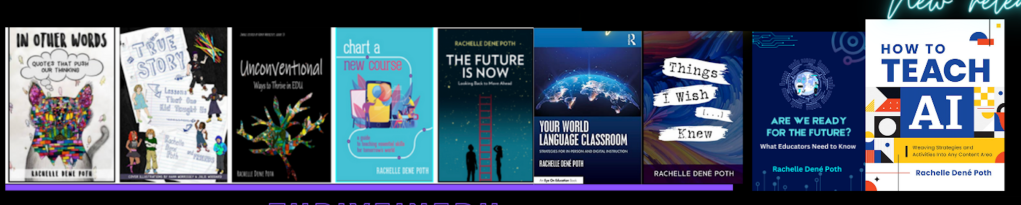
She is the author of ten books, including ‘What The Tech? An Educator’s Guide to AI, AR/VR, the Metaverse and More” and ‘How To Teach AI’. In addition, other books include, “In Other Words: Quotes That Push Our Thinking,” “Unconventional Ways to Thrive in EDU,” “The Future is Now: Looking Back to Move Ahead,” “Chart A New Course: A Guide to Teaching Essential Skills for Tomorrow’s World, “True Story: Lessons That One Kid Taught Us,” “Things I Wish […] Knew” and her newest “How To Teach AI” is available from ISTE or on Amazon.
Contact Rachelle to schedule sessions about Artificial Intelligence, AI and the Law, Coding, AR/VR, and more for your school or event! Submit the Contact Form.
Follow Rachelle on Bluesky, Instagram, and X at @Rdene915
**Interested in writing a guest blog for my site? Would love to share your ideas! Submit your post here. Looking for a new book to read? Find these available at bit.ly/Pothbooks
************ Also, check out my THRIVEinEDU Podcast Here!
Join my show on THRIVEinEDU on Facebook. Join the group here.
 Learning as I go: Reflections & lessons learned