As an educator, attorney, and advocate for innovation in education, I’ve had the opportunity to work with my students through project-based learning experiences that have led them on real-world entrepreneurial journeys as they sought solutions to global challenges. In my eighth-grade STEAM course, students selected and researched careers; developed logos, business concepts, and branding strategies; and even created podcasts to make their business plan.
I noticed them developing artistic talents, whether through painting, calligraphy, crocheting, or making plushies. We talked about their love of creation and how they could create a business. Being an entrepreneur does not necessarily mean that students will start their own businesses, but rather, they will develop in-demand skills such as resilience, creativity, collaboration, problem-solving, and adaptability, which promote flexibility in our changing world. These entrepreneurial experiences enable students to shift from consumers of content to creators, leaders, problem solvers, and innovators.
Essential skills for an entrepreneurial mindset
Students need to extend learning beyond the classroom walls. In my school, students have opportunities to engage in career shadowing, do volunteer work, or participate in events organized by local companies or those that provide career learning experiences. These opportunities promote collaboration, enabling students to work together to design solutions and become changemakers and entrepreneurs. Here are some of the ways these activities build students’ skills:
Agency creates opportunities for ideation and iteration. Through project-based learning or challenge-based learning, students choose a focus for their work and learn that their ideas matter and that they can design their learning journey. Entrepreneurs know that it takes time to improve and build a brand, product, or solve a problem.
Collaboration celebrates the effort, not just the outcomes. Students engaging in project or independent work become involved in decision-making and learn to appreciate the learning process, which provides opportunities for discussion through feedback and promotes greater collaboration.
Creativity and innovation connect learning to real-world problems that students care about. Ask students about challenges they see in their community, and pull those into their learning. Students connect with it more deeply and will create and innovate because it is meaningful and purposeful to them.
Continue reading the article on Edutopia for more ideas!
About Rachelle
Dr. Rachelle Dené Poth is a Spanish and STEAM: What’s Next in Emerging Technology Teacher. Rachelle is also an attorney with a Juris Doctor degree from Duquesne University School of Law and a Master’s in Instructional Technology. Rachelle received her Doctorate in Instructional Technology, with a research focus on AI and Professional Development. In addition to teaching, she is a full-time consultant and works with companies and organizations to provide PD, speaking, and consulting services. Contact Rachelle for your event!
Rachelle is an ISTE-certified educator and community leader who served as president of the ISTE Teacher Education Network. By EdTech Digest, she was named the EdTech Trendsetter of 2024, one of 30 K-12 IT Influencers to follow in 2021, and one of 150 Women Global EdTech Thought Leaders in 2022.
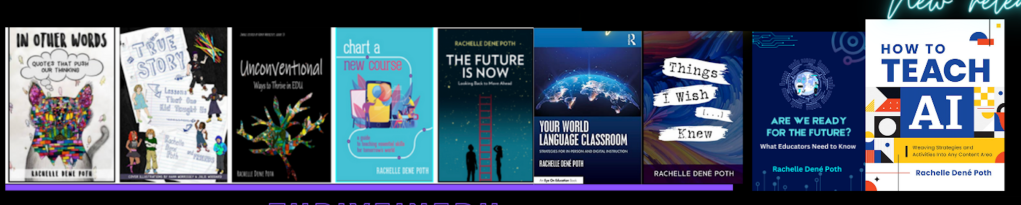
She is the author of ten books, including ‘What The Tech? An Educator’s Guide to AI, AR/VR, the Metaverse and More” and ‘How To Teach AI’. In addition, other books include, “In Other Words: Quotes That Push Our Thinking,” “Unconventional Ways to Thrive in EDU,” “The Future is Now: Looking Back to Move Ahead,” “Chart A New Course: A Guide to Teaching Essential Skills for Tomorrow’s World, “True Story: Lessons That One Kid Taught Us,” “Things I Wish […] Knew” and her newest “How To Teach AI” is available from ISTE or on Amazon.
Contact Rachelle to schedule sessions about Artificial Intelligence, AI and the Law, Coding, AR/VR, and more for your school or event! Submit the Contact Form.
Follow Rachelle on Bluesky, Instagram, and X at @Rdene915
**Interested in writing a guest blog for my site? Would love to share your ideas! Submit your post here. Looking for a new book to read? Find these available at bit.ly/Pothbooks
************ Also, check out my THRIVEinEDU PodcastHere!
Join my show on THRIVEinEDU on Facebook. Join the group here.
We live in a rapidly evolving world shaped by artificial intelligence (AI) and emerging technologies, and we are preparing students for an uncertain future. These changes require educators to continue learning and exploring, to prepare students. We now have to focus on career-connected learning. This learning will help bridge the gap between education and the workforce, enabling students to develop adaptability, purpose, and the real-world skills necessary to thrive in jobs that may not yet exist.
Technology has been advancing at a rate faster than we could have imagined. From AI and automation to data analytics and immersive learning and working environments, the world of work is undergoing a significant transformation. As educators, we can no longer predict with certainty what future jobs will look like, but we can work to equip students with the flexibility and curiosity to succeed in any setting.
The World Economic Forum (WEF) provides valuable information and insights into in-demand skills. I refer to their Top 10 skills often as I work to prepare my students for the future. The WEF continues to emphasize the importance of transferable, human-centered skills. Its list of in-demand competencies, which include analytical thinking, creativity, resilience, and technological literacy, highlights how the focus has shifted from content memorization to capability building. To prepare our students, the best we can do is to always focus on connecting their learning to real-world experiences which will help them to experience authentic learning and develop skills in adaptability and many other essential skills.
What Does “Career Ready” actually mean today?
Traditionally, being “career ready” has referred to having strong academics and a set of soft skills such as collaboration and communication. While these are still essential skills, we have to also focus on skills in digital literacy, ethical reasoning, and the ability to navigate technologies increasingly powered by AI.
To truly prepare students, we must also help them use AI as a collaborative tool that enhances and does not replace their opportunities for learning. By leveraging platforms such as ChatGPT to brainstorm ideas, analyze information, and refine their thinking or using platforms such as Brisk Teaching,Kira Learning, Learning Genie, Magic School, School AI, and others, we can create opportunities for them or place AI in their hands. As more careers begin to require AI proficiency, classroom experiences that integrate generative tools responsibly will ensure students are well-prepared for the digital demands of the workplace.
Designing Spaces for Exploration and Purpose
Career-connected learning transforms classrooms into environments of exploration. Students need opportunities to dream big, test their ideas, fail, and iterate, and apply their skills in authentic contexts. Through hands-on projects and simulations that reflect real-world scenarios, we will foster curiosity while demonstrating the relevance of what students learn.
When we build intentional career connections into learning, we empower students to see themselves as the creators and innovators. By bringing in design thinking projects, project-based learning (PBL), place-based learning, community partnerships, or global collaboration, relevance and purpose become the driving forces behind engagement.
Elements of Career-Connected Learning
Project-Based Learning (PBL): Develop projects that address community or industry needs.
Emerging Tech Integration: Introduce students to AI, coding, and data science.
Authentic, Real-World Tasks: Use simulations or case studies that are based on real-world issues.
Partnerships: Collaborate with local businesses, universities, or nonprofits to provide mentorship or feedback.
Skill Challenges: Incorporate AI, cybersecurity, or innovation competitions that mirror workforce skills.
An important focus of all of this is promoting student agency. When students see that their work connects to real-world possibilities, it boosts motivation and engagement in learning and promotes long-term retention.
The WEF’s Future of Jobs Report predicts that by 2027, 85 million jobs will be displaced by automation and AI—but 97 million new roles will emerge. These new opportunities will require high-level cognitive ability, digital agility, and ethical decision-making.
Roles like AI ethics consultant, digital twin designer, and data privacy advocate are already appearing—and most students haven’t even heard of them. Meanwhile, more than half of all workers will need reskilling within a few years. This shift highlights a crucial point: education must evolve to keep pace with innovation.
Strategies for Building Career-Connected Classrooms
Create Interdisciplinary Learning Experiences Combine subjects to reflect real-world problem-solving. For instance, collaborate math and art for data visualization projects, or integrate English and computer science to explore ethical storytelling with AI.
Leverage AI Tools to Design Career-Ready Tasks Platforms like Eduaide, Kira Learning, Knowt, MagicSchool AI, and Brisk Teaching can help educators design simulations or career-based challenges aligned with workforce trends without adding to planning time. Lack of time and resources are the top two reasons that bringing AI experiences into classrooms can be a challenge.
Partner with Industry and Community Organizations Collaborate with businesses, universities, and nonprofits to provide mentorship, guest speakers, job shadowing, and feedback on student projects. Even virtual connections can make a lasting impact. Not only do students benefit, but the greater school community learns from these experiences and it further solidifies the home to school connection and the sense of a supportive school community.
Empower Students to Lead Provide students with an opportunity to create and lead tech support programs, host digital wellness campaigns, or work with their teachers on technology developments.
Keeping the focus on human skills
Career-connected learning isn’t just about building skills. It is about skills, and it’s also about building identity and purpose. It helps students answer three essential questions: Who am I? Where am I going? How can I make a difference?
As automation and AI reshape every industry, schools must prioritize technological fluency and human skills such as compassion, creativity, and ethical reasoning. Keeping humanity involved is essential, as this is what distinguishes us from machines and the technologies available.
Educators play a crucial role in striking a balance between innovation and humanity. By providing students with authentic opportunities to explore careers, solve problems, and apply their learning, we’re helping them become not just workers of tomorrow, but leaders, innovators, and changemakers.
About Rachelle
Dr. Rachelle Dené Poth is a Spanish and STEAM: What’s Next in Emerging Technology Teacher at Riverview High School in Oakmont, PA. Rachelle is also an attorney with a Juris Doctor degree from Duquesne University School of Law and a Master’s in Instructional Technology. Rachelle received her Doctorate in Instructional Technology, with a research focus on AI and Professional Development. In addition to teaching, she is a full-time consultant and works with companies and organizations to provide PD, speaking, and consulting services. Contact Rachelle for your event!
Rachelle is an ISTE-certified educator and community leader who served as president of the ISTE Teacher Education Network. By EdTech Digest, she was named the EdTech Trendsetter of 2024, one of 30 K-12 IT Influencers to follow in 2021, and one of 150 Women Global EdTech Thought Leaders in 2022.
She is the author of ten books, including ‘What The Tech? An Educator’s Guide to AI, AR/VR, the Metaverse and More” and ‘How To Teach AI’. In addition, other books include, “In Other Words: Quotes That Push Our Thinking,” “Unconventional Ways to Thrive in EDU,” “The Future is Now: Looking Back to Move Ahead,” “Chart A New Course: A Guide to Teaching Essential Skills for Tomorrow’s World, “True Story: Lessons That One Kid Taught Us,” “Things I Wish […] Knew” and her newest “How To Teach AI” is available from ISTE or on Amazon.
Contact Rachelle to schedule sessions about Artificial Intelligence, AI and the Law, Coding, AR/VR, and more for your school or event! Submit the Contact Form.
Follow Rachelle on Bluesky, Instagram, and X at @Rdene915
**Interested in writing a guest blog for my site? Would love to share your ideas! Submit your post here. Looking for a new book to read? Find these available at bit.ly/Pothbooks
************ Also, check out my THRIVEinEDU PodcastHere!
Join my show on THRIVEinEDU on Facebook. Join the group here.
Digital Citizenship Week has often served as a starting point for conversations about safety, ethics, and responsible online engagement with others and with content. But an equally vital component, often overlooked, is digital wellness. Digital wellness refers to how technology impacts our emotional, social, and mental well-being. If digital citizenship is focused on how we act and interact online, then digital wellness is how we feel, think, and show up online.
With so much technology in our classrooms today, educators are no longer just teaching academic content. Now, they are guiding students through a new terrain of constant connectivity, algorithm-driven attention, and shaping their digital identities. Digital wellness offers a framework that can help students build balance, boundaries, and agency as they develop technology skills. It leads them to understand how tech supports, rather than replaces, their growth.
What Is Digital Wellness?
Digital wellness refers to the intentional and healthy use of technology in ways that support:
Emotional resilience
Focus and attention
Healthy relationships
Digital boundaries and self-regulation
Positive identity-building
Offline/online balance
Safe and restorative digital habits
Wellness is not about restricting technology; it’s about using it wisely and reflectively—something the ISTE Standards for Students emphasize under Digital Citizen (2a, 2b) and Empowered Learner (1c, 1d). Students need to understand how to leverage technology safely, ethically, and responsibly. Removing it completely is not the answer; they need guidance.
Why Students Need Digital Wellness Instruction
Students today are processing information faster than they can understand it emotionally. Many may experience:
Notification fatigue
Fear of missing out (FOMO)
Stress from “performing” online
Comparison culture
Late-night “doom” scrolling and sleep disruption
“Always on” communication pressure
When students learn mindful tech use, they gain emotional space for creativity, deep thinking, and well-being. Educators have a powerful role in helping students recognize how tech makes them feel, rather than just how to use it.
Classroom Activities for Teaching Digital Wellness (K–12)
These practices work during Digital Citizenship Week—or anytime you want to promote balance and meaningful tech habits.
ELEMENTARY (K–5)
1. “Feelings Before Screens” Routine (5 minutes) Before using a device, students pause, breathe, and choose a feeling icon (happy, calm, tired, frustrated). After the activity, they reflect: “Do I feel better, the same, or worse?” Purpose: Builds self-awareness + emotional literacy.
2. Tech vs. Together Time Sorting Game Students sort cards showing daily activities—reading, gaming, playground time, FaceTime with a grandparent—into “screen” and “people” columns to discuss balance. Purpose: Helps visualize healthy habits.
3. Brain Breaks for “Resetting” Before transitions, practice 30–60 second mindfulness (breathing, quiet reflection, stretching). Purpose: Digital stamina + self-regulation.
MIDDLE SCHOOL (6–8)
1. Attention Audit Students list apps they check most often, rating how each one affects: ✅ mood ✅ focus ✅ relationships ✅ time Discuss patterns: “Which apps energize you? Which drain you?” ISTE Link: 1d Empowered Learner (setting personal learning goals).
2. The “Invisible Pressure” Conversation Students anonymously answer: “What is something online that stresses you out?” Afterward, compare results to normalize healthy boundaries. Well-being Lens: Emotional honesty builds agency.
3. Tech-Time Menu Students design a personal plan using categories like “learning time,” “friends/social,” “rest time,” and “offline time.” Purpose: Helps students self-regulate instead of default scrolling.
HIGH SCHOOL (9–12)
1. Digital Identity & Emotional Health Reflection Students respond to prompts such as:
Who am I online vs. offline—and how does it differ?Why?
What parts of my persona do I curate, hide, or amplify digitally? This can bridge into healthy identity development.
2. “Attention Economics” Mini-Lesson Teach students how platforms are intentionally designed to capture attention—streaks, infinite scroll, push alerts. I love to consider this question: “If the product is free, what is being sold?” And the answer is often…our information.
3. Building a “Wellness Contract With Myself” Students set personal wellness boundaries:
No doom-scrolling after midnight
Screens stay off during meals
Push notifications removed for nonessential apps
Reflex check: “Why am I opening this?”
This shifts digital wellness from theory into habits.
Digital Wellness Through the ISTE Lens
The ISTE Standards help frame wellness as a skill rather than a rule:
ISTE Standard
Digital Wellness Skill
1d Empowered Learner
Self-monitoring tech use
2b Digital Citizen
Managing digital identity & reputation
3a Knowledge Constructor
Distinguishing distraction from meaningful use
7a Global Collaborator
Respecting others’ digital well-being
Digital wellness is not a side lesson—it fits into what ISTE calls “responsible, ethical, and healthy learner agency.”
Daily Mini-Practices Teachers Can Use Immediately
These require no prep and can be layered into any class.
Strategy
What It Looks Like
Mindful Start
A 60-second pause before screens come out
Offline First
Think → speak → write → then tech
Tech + Talk
Every digital activity paired with peer discussion
App Impact Check
“How did this tech help your learning today?”
Micro-reflections
Quick exit tickets on wellness or focus level
Sample Prompts for Student Reflection
“Does this tool help you feel more connected or more overwhelmed?”
“When do you feel most in control of your technology use?”
“What’s one boundary you wish you could set but haven’t yet?”
“Where in your life could less screen time give you more peace?”
Partnering With Families
Home behaviors shape wellness as much as school experiences. Consider: ✅ Family Tech Talk Night ✅ One-page wellness guide in multiple languages ✅ Conversation starters (“when does tech feel too loud?”) ✅ Shared “screen-free zones” (dinner, car rides, bedtime)
When adults model healthy balance, students internalize it.
Shifting from One Week to a Wellness Culture
Digital wellness is not a unit—it is a skill for life. Schools can deepen impact by:
Including wellness language in advisory / SEL time
Embedding digital balance into classroom norms
Modeling tech off-ramps, not just on-ramps
Celebrating offline creativity with as much enthusiasm as digital work
Using AI thoughtfully—slowing down for reflective thinking
Digital wellness is really about helping students feel grounded, connected, and emotionally safe in digital spaces. When we teach students not just how to use technologybut when to pause, reflect, and choose intentionally, we prepare them for a world where their humanity is not overshadowed by the pace of innovation.
About Rachelle
Dr. Rachelle Dené Poth is a Spanish and STEAM: What’s Next in Emerging Technology Teacher at Riverview High School in Oakmont, PA. Rachelle is also an attorney with a Juris Doctor degree from Duquesne University School of Law and a Master’s in Instructional Technology. Rachelle received her Doctorate in Instructional Technology, with a research focus on AI and Professional Development. In addition to teaching, she is a full-time consultant and works with companies and organizations to provide PD, speaking, and consulting services. Contact Rachelle for your event!
Rachelle is an ISTE-certified educator and community leader who served as president of the ISTE Teacher Education Network. By EdTech Digest, she was named the EdTech Trendsetter of 2024, one of 30 K-12 IT Influencers to follow in 2021, and one of 150 Women Global EdTech Thought Leaders in 2022.
She is the author of ten books, including ‘What The Tech? An Educator’s Guide to AI, AR/VR, the Metaverse and More” and ‘How To Teach AI’. In addition, other books include, “In Other Words: Quotes That Push Our Thinking,” “Unconventional Ways to Thrive in EDU,” “The Future is Now: Looking Back to Move Ahead,” “Chart A New Course: A Guide to Teaching Essential Skills for Tomorrow’s World, “True Story: Lessons That One Kid Taught Us,” “Things I Wish […] Knew” and her newest “How To Teach AI” is available from ISTE or on Amazon.
Contact Rachelle to schedule sessions about Artificial Intelligence, AI and the Law, Coding, AR/VR, and more for your school or event! Submit the Contact Form.
Follow Rachelle on Bluesky, Instagram, and X at @Rdene915
**Interested in writing a guest blog for my site? Would love to share your ideas! Submit your post here. Looking for a new book to read? Find these available at bit.ly/Pothbooks
************ Also, check out my THRIVEinEDU PodcastHere!
Join my show on THRIVEinEDU on Facebook. Join the group here.
Every October, schools around the world celebrate Digital Citizenship Week, a time to focus on educating others on how to engage responsibly, safely, and ethically in digital spaces. This week, events are happening to bring greater awareness to the importance of digital citizenship. There are activities and webinars provided by Common Sense and other organizations with resources for schools. However, we need to focus on it throughout the year. Digital citizenship has become an essential life skill. It is how we understand the connection between technology, ethics, communication, and well-being. Preparing students means helping them understand not just how to use technology, but how to use it well and for good.
Especially today, in a world surrounded by AI, students have access to so many tools that enable them to create, connect, and collaborate. With these opportunities comes greater responsibility, and as educators, providing guidance to our students is more important than ever. Digital citizenship is not just about “don’t click this” or “stay off of that site.” It is about student agency, empathy, discernment, digital well-being, and community-building.
The ISTE Standards for Students address this by highlighting the importance that students move beyond being simply consumers of technology, but creators and innovators. That they emerge as Digital Citizens who “recognize the rights, responsibilities and opportunities of living, learning and working in an interconnected digital world.” Digital citizenship is foundational to preparing students for both college and career readiness and future success.
Why Digital Citizenship Matters More Than Ever
Today’s students are growing up in a world where:
Communication happens across multiple platforms, immediately, and often publicly.
AI tools have tremendous power and can generate content in seconds, without a guarantee of being accurate or not.
Online actions leave permanent digital footprints.
Collaboration is global, instant, multilingual, and multimodal.
Well-being and identity formation are increasingly tied to online spaces.
In my work with some schools that are focused on digital wellness and innovation, they are rethinking their policies and shifting in thought. They are looking at digital citizenship as a mindset and skillset rather than a compliance checklist.
With the right support and learning opportunities in place, all students will learn to: ✔ evaluate credibility ✔ protect personal data ✔ engage with empathy ✔ think before they post ✔ advocate for themselves and others ✔ leverage technology for positive impact
They will gain confidence, agency, and voice in authentic, meaningful, and responsible ways.
Aligning with the ISTE Standards for Students
Digital Citizenship Week is a great time to explore the resources from ISTE that provide free lessons. Focus on the Core Competencies of Balanced, Informed, Inclusive, Engaged, and Alert.
It also offers an opportunity to connect instruction with key strands of the ISTE Standards, especially:
1. Digital Citizen “Students recognize the responsibilities and opportunities for positively contributing to their digital communities.”
2. Knowledge Constructor “Students critically curate a variety of resources using digital tools to construct knowledge, produce creative artifacts, and make meaningful learning experiences for themselves and others.”
3. Global Collaborator “Students use digital tools to broaden their perspectives and enrich their learning by collaborating with others and working effectively in teams locally and globally.”
Activity Ideas
Here are a few adaptable activities for different grade levels. Each aligns with the ISTE Standards and can be completed within 15–45 minutes.
Elementary (K–5)
Activity 1: “Digital Footprints in the Sand” Students trace a footprint on paper and fill it with icons or words representing safe things they can share online (favorite book, pet’s name) vs. things they should not (birthday, address, school name). ISTE: Digital Citizen
Activity 2: Kindness Chain Reaction Students write a positive digital message or example of an encouraging online interaction on a paper link. The class builds a kindness chain displayed throughout the week. ISTE: Global Collaborator
Middle School (6–8)
Activity 1: “True or Fake?” Digital Source Investigation Present students with three online “facts” or headlines. In pairs, they determine which is credible and why. They cite what signals helped them evaluate reliability (URL, author, publication, etc.). ISTE: Knowledge Constructor
Activity 2: Digital Well-being Workshop Students brainstorm behaviors that keep them emotionally healthy online. The class builds a wellness checklist (screen limits, muting apps, balance between offline and online activities). ISTE: Digital Citizen
High School (9–12)
Activity 1: AI & Authorship Mini-Debate In small teams, students debate: “Should AI-generated writing be considered original work?” Extend to ethics, attribution, and bias. ISTE: Digital Citizen & Creative Communicator
Activity 2: “My Digital Legacy: Who Am I Online?” Students reflect on how they are perceived digitally and create a personal statement describing how they choose to show up online as leaders. ISTE: Empowered Learner
Student Leadership Opportunities
Bringing students into digital citizenship planning increases relevance and impact. Consider:
Student-created PSAs during morning announcements or posters displayed in the school
Peer digital mentors and mentoring activities
Student-led “digital wellness” club
TED-Ed club or TED-style talks on AI, privacy, or inclusivity
Digital Citizenship Week is meant to be the beginning of an ongoing learning journey for everyone in the school community. Schools can further support the development of these essential skills by:
Integrating media literacy in research projects Encouraging the use of bilingual / multilingual tools for family communication (Check out School In One) Practicing ethical generative AI use Modeling digital well-being and boundaries Hosting family nights or sharing family one-pagers
Digital Citizenship Week is a time to teach students to navigate digital spaces with care, empathy, responsibility, and discernment. By using the ISTE Standards as guidelines, we emphasize student agency, ethical engagement, and global connection. We are living in a world shaped by rapid innovation, where these skills are not optional, but rather they are foundational to the future of learning.
About Rachelle
Dr. Rachelle Dené Poth is a Spanish and STEAM: What’s Next in Emerging Technology Teacher at Riverview High School in Oakmont, PA. Rachelle is also an attorney with a Juris Doctor degree from Duquesne University School of Law and a Master’s in Instructional Technology. Rachelle received her Doctorate in Instructional Technology, and her research focus was on AI and Professional Development. In addition to teaching, she is a full-time consultant and works with companies and organizations to provide PD, speaking, and consulting services. Contact Rachelle for your event!
Rachelle is an ISTE-certified educator and community leader who served as president of the ISTE Teacher Education Network. By EdTech Digest, she was named the EdTech Trendsetter of 2024, one of 30 K-12 IT Influencers to follow in 2021, and one of 150 Women Global EdTech Thought Leaders in 2022.
She is the author of ten books, including ‘What The Tech? An Educator’s Guide to AI, AR/VR, the Metaverse and More” and ‘How To Teach AI’. In addition, other books include, “In Other Words: Quotes That Push Our Thinking,” “Unconventional Ways to Thrive in EDU,” “The Future is Now: Looking Back to Move Ahead,” “Chart A New Course: A Guide to Teaching Essential Skills for Tomorrow’s World, “True Story: Lessons That One Kid Taught Us,” “Things I Wish […] Knew” and her newest “How To Teach AI” is available from ISTE or on Amazon.
Contact Rachelle to schedule sessions about Artificial Intelligence, AI and the Law, Coding, AR/VR, and more for your school or event! Submit the Contact Form.
Follow Rachelle on Bluesky, Instagram, and X at @Rdene915
**Interested in writing a guest blog for my site? Would love to share your ideas! Submit your post here. Looking for a new book to read? Find these available at bit.ly/Pothbooks
************ Also, check out my THRIVEinEDU PodcastHere!
Join my show on THRIVEinEDU on Facebook. Join the group here.
Education is evolving faster than ever. Artificial intelligence, personalized learning, and competency-based models are transforming the way educators determine the most effective ways to prepare students for the future. Even with so many options available, in my own experience and for others, the same curriculum may be used each year, in more of a one-size-fits-all format, rather than reflecting the diversity, creativity, and individual needs of our students today.
Each student brings their unique abilities, background experiences, and identities into the classroom. To continue engaging and empowering students in learning, educators need tools that provide robust options and possibilities. We need tools that help us design learning that is relevant, inclusive, and connected. An extra bonus is finding tools that save time, allowing us to spend more time with students.
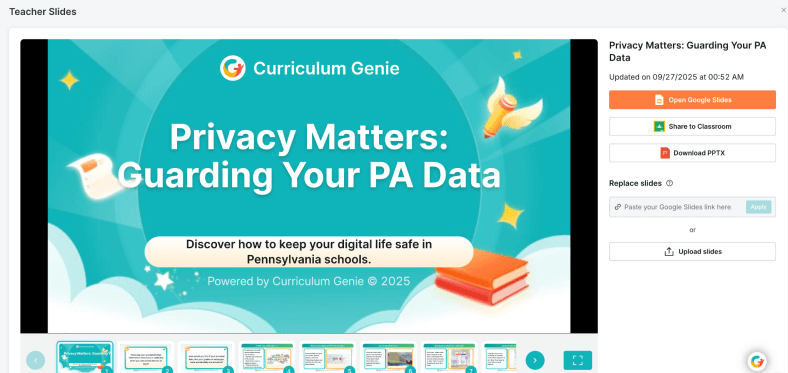
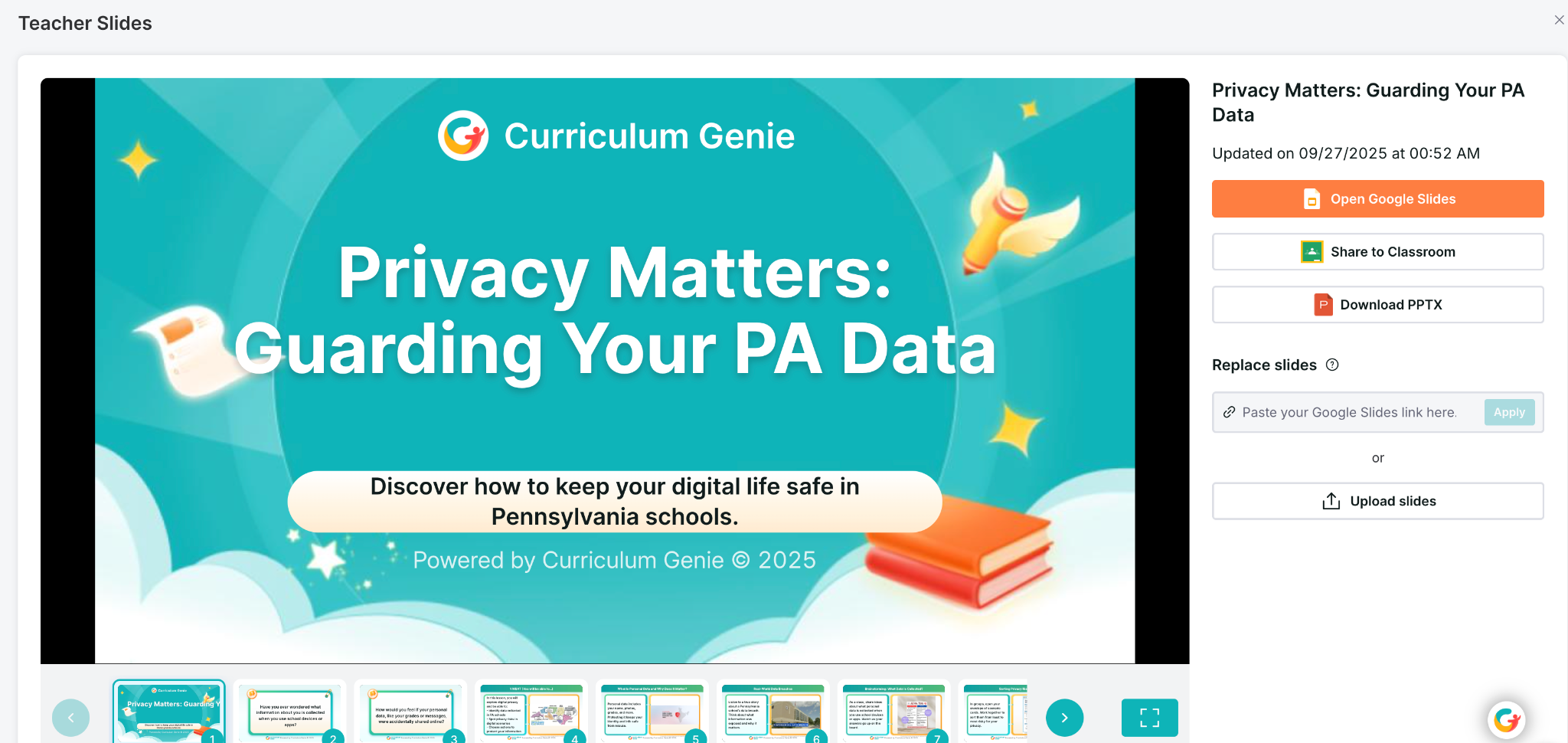
I have enjoyed using Curriculum Genie, developed by Learning Genie. This innovative platform helps educators transition from traditional instruction to personalized and UDL-aligned learning, supporting the whole learner and also the competencies outlined in the Portrait of a Graduate.
Why Curriculum Needs An Update
A standardized curriculum was initially developed to promote fairness, ensuring that all students had access to the same information. But equal content doesn’t mean equitable learning. If lessons are not adjusted to meet student needs and are not more personalized, then they will fail to:
Reflect students’ local cultures or communities, and authentic learning is lost.
Connect abstract concepts to real-world experiences, reducing comprehension.
Maintain student engagement when lessons feel irrelevant or disconnected.
As educators, we know the need for personalization, but creating differentiated lessons can be time-consuming and, at times, even overwhelming, as we worry about meeting each learner’s needs. Curriculum Genie removes that barrier by making relevance, accessibility, and inclusion achievable and in a platform that is easy to navigate and user-friendly.
Curriculum Genie: AI Meets Authentic Learning
Curriculum Genie is not just another planning tool—it’s an AI-powered educational design partner. It helps teachers build or adapt a curriculum that authentically and meaningfully connects to students’ needs and experiences.
✨ Key Features
1. Location-Based Unit Generation
Educators can select a location (state, city, or region), and generate unit planners tailored to that specific place in no time at all. The examples, activities, and cultural connections align with the local environment, which makes the lessons more authentic and relatable.
2. AI Lesson Assistant
Teachers can:
Create new lessons in a short amount of time that reflect a specific location or cultural context.
Transform existing lessons without rewriting them from scratch.
Have a thought partner to build out a truly impactful lesson for students.
This flexibility empowers teachers to make any lesson more meaningful while saving hours of preparation time. The time saved can then be spent with students and colleagues, continuing to learn and grow together.
Generates interactive slides!
3. UDL-Embedded Supports
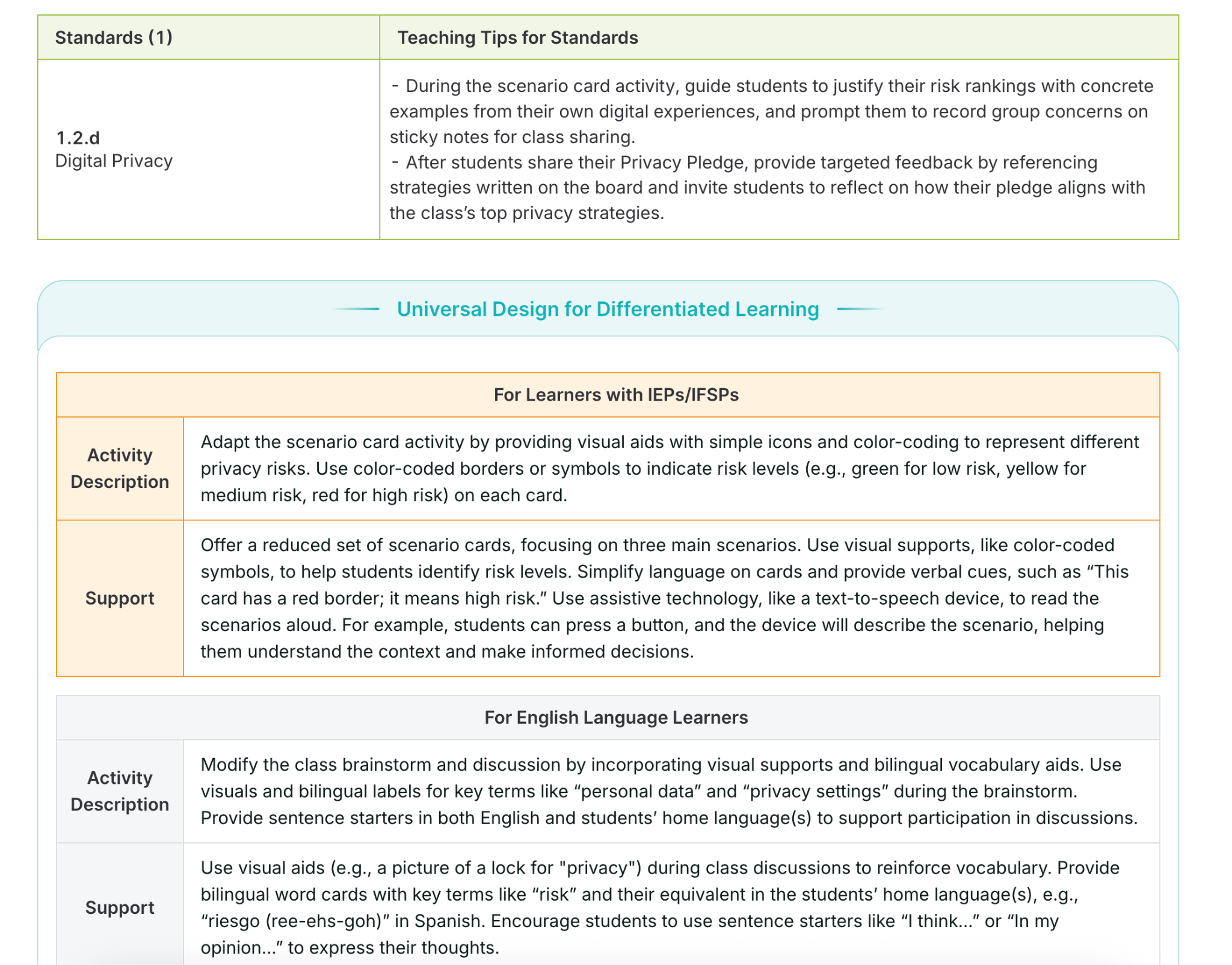
Curriculum Genie doesn’t just create lessons; it also aligns them with Universal Design for Learning (UDL) principles, helping educators plan for accessibility and inclusion from the start. UDL is a focus area for many educators, and making sure to provide the right supports and activities is key. Curriculum Genie helps with this. Why UDL?
UDL ensures multiple means of:
Engagement: Connecting to student interests and motivation.
Representation: Presenting information in diverse ways (visual, auditory, tactile).
Action & Expression: Giving students options to show what they know.
For example, when designing a science lesson, Curriculum Genie might suggest hands-on experiments, visual diagrams, or video explanations to make sure that every learner can engage and succeed. For my STEAM course, I can create robust lessons focused on digital citizenship and wellness or other important topics that boost student engagement and make truly interactive lessons to amplify learning. How? Curriculum Genie provides all of the resources that I need to make a lesson successful, meaningful, and personalized to my students.
4. IEP and ELL Integration Supporting diverse learners is a key aspect of Curriculum Genie’s design. It automatically weaves strategies for students with IEPs and English Language Learners, helping educators to build their instructional practices, too.
5. Portrait of a Graduate Alignment
Many districts are focusing on the Portrait of a Graduate, and also, Portrait of an AI Graduate, which outline the essential skills our students need to be successful in the future. They develop skills such as critical thinking, communication, creativity, collaboration, and global citizenship.
Curriculum Genie helps educators design lessons that cultivate these competencies through:
Real-world, problem-based learning grounded in local and global contexts.
Collaborative and inquiry-driven activities that foster communication and creativity.
Culturally responsive projects that honor diverse perspectives and promote empathy.
Using Curriculum Genie enables educators to connect academic standards with the Portrait of a Graduate competencies, which ensures that students learn more than the content; it helps them to build the mindset and skills needed for their future.
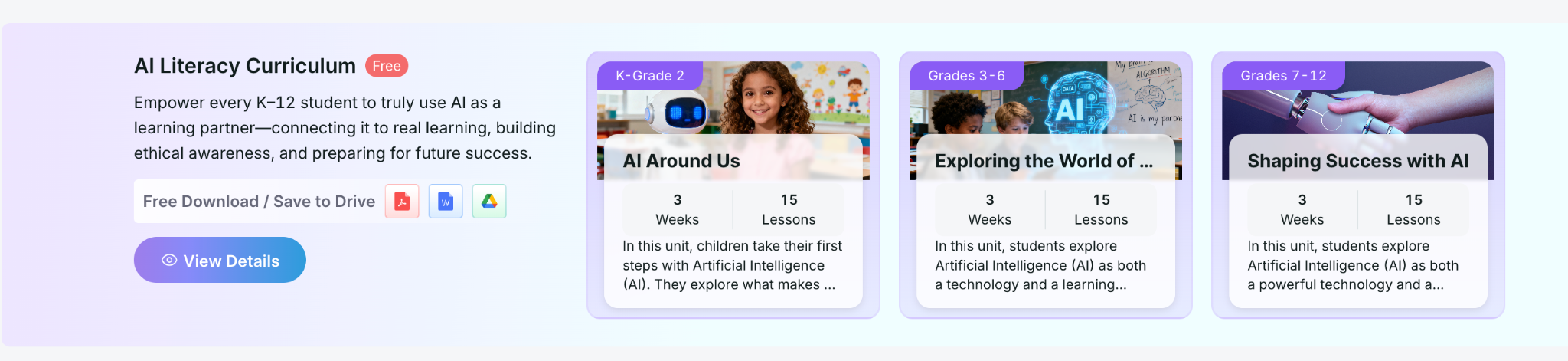
They also offer FREE K-12 Lessons on AI Literacy!
Free AI Literacy Courses for K–12 Educators
Another great feature offered by Learning Genie is that it provides free AI Literacy Courses for K–12 educators.
The courses are self-paced and help teachers and school leaders:
Understand how AI works and how it’s shaping learning.
Explore classroom-ready strategies for AI integration.
Learn to design lessons that teach students to think critically about AI.
The future of learning depends on our ability as educators to make education more personal, purposeful, and powerful. Curriculum Genie offers guidance that helps educators move beyond traditional and one-size-fits-all instruction to learning that is inclusive, authentic, and future-focused.
More than just a platform with limited capabilities, through its integration of AI, UDL, Portrait of a Graduate competencies, plus the great and free AI literacy courses, Curriculum Genie supports educators with the tools to make it a reality.
If you’re looking for a new platform that will save you hours of time by addressing many important areas, then I definitely recommend that you dive into Learning Genie and explore creating with Curriculum Genie. I have been amazed at how quickly it creates, how responsive it is, and the quality of resources and materials that it shares for teachers.
Learn more and request a demo at https://www.learning-genie.com/
About Rachelle
Dr. Rachelle Dené Poth is a Spanish and STEAM: What’s Next in Emerging Technology Teacher at Riverview High School in Oakmont, PA. Rachelle is also an attorney with a Juris Doctor degree from Duquesne University School of Law and a Master’s in Instructional Technology. Rachelle received her Doctorate in Instructional Technology, and her research focus was on AI and Professional Development. In addition to teaching, she is a full-time consultant and works with companies and organizations to provide PD, speaking, and consulting services. Contact Rachelle for your event!
Rachelle is an ISTE-certified educator and community leader who served as president of the ISTE Teacher Education Network. By EdTech Digest, she was named the EdTech Trendsetter of 2024, one of 30 K-12 IT Influencers to follow in 2021, and one of 150 Women Global EdTech Thought Leaders in 2022.
She is the author of ten books, including ‘What The Tech? An Educator’s Guide to AI, AR/VR, the Metaverse and More” and ‘How To Teach AI’. In addition, other books include, “In Other Words: Quotes That Push Our Thinking,” “Unconventional Ways to Thrive in EDU,” “The Future is Now: Looking Back to Move Ahead,” “Chart A New Course: A Guide to Teaching Essential Skills for Tomorrow’s World, “True Story: Lessons That One Kid Taught Us,” “Things I Wish […] Knew” and her newest “How To Teach AI” is available from ISTE or on Amazon.
Contact Rachelle to schedule sessions about Artificial Intelligence, AI and the Law, Coding, AR/VR, and more for your school or event! Submit the Contact Form.
Follow Rachelle on Bluesky, Instagram, and X at @Rdene915
**Interested in writing a guest blog for my site? Would love to share your ideas! Submit your post here. Looking for a new book to read? Find these available at bit.ly/Pothbooks
************ Also, check out my THRIVEinEDU PodcastHere!
Join my show on THRIVEinEDU on Facebook. Join the group here.
Guest post by Brian Baker. Opinions expressed are those of the guest blogger.
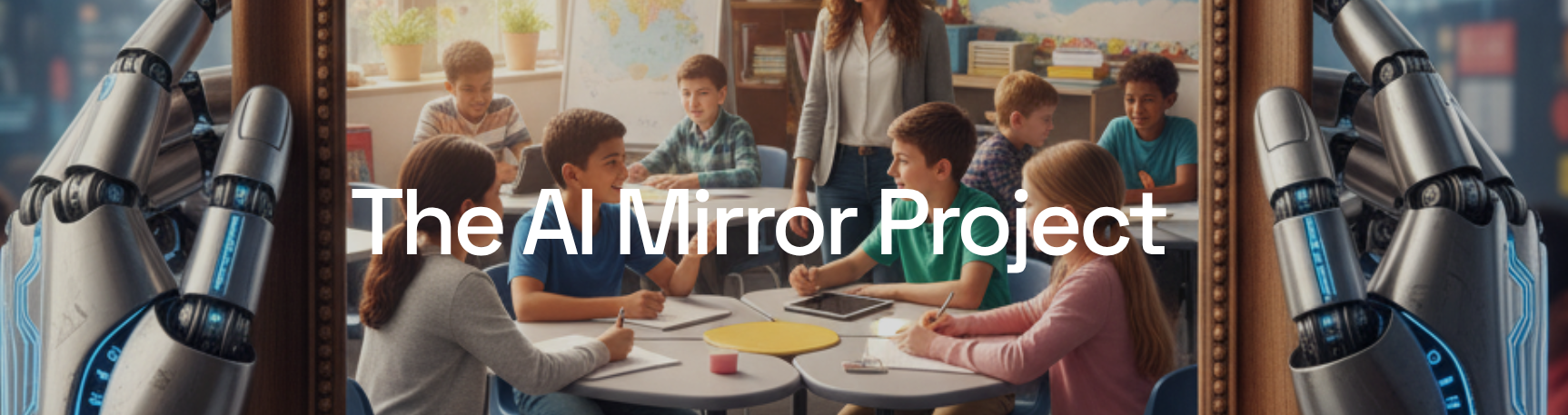
In a sense, the disruption genAI has caused – regardless of whether you see it as a net positive or negative – has held up a mirror to education, giving us new perspectives into known issues and exposing ones that were under the surface.
That opportunity for novel insights and increased awareness spurred 24th Century Education, an Oregon-based consulting firm, to launch the AI Mirror Project. The project seeks to capture the voices of those living this unique moment in education by asking:
What has the introduction of genAI taught us about critical issues within the education system?
The project will progress through three phases:
Hearing from you: Through December 19, 2025, our website will collect submissions from educators, students, caregivers, the most enthusiastic AI evangelists, the most critical skeptics – anyone who is involved in any way with the education system and has reflected on these issues. You are welcome to capture your thoughts in text, images, video, audio, or whatever format allows you to best share your voice.
Analysis & research synthesis: We will look for themes among the perspectives that are shared, then synthesize those with available research to better understand the issues identified.
Final report: 24th Century Education will compile and share our findings, hoping to use this disruptive moment as a means to better understand our current reality and work towards our goal of building a better future.
(Gemini, 2025)
While the education system has learned and is continuing to learn many valuable lessons about genAI since its introduction, this project instead focuses on what the introduction of and reaction to these tools has shown us about existing issues and challenges, such as…
Safety and privacy
Assessment
Human connection
Student engagement and relevance of learning experiences
Individual and systemic bias
The interaction between education and other large systems (government, industry, economy)
Education’s role in maintaining democracy
The influence of tech companies
Media literacy and misinformation
Mental health and digital well-being
Anthropomorphization
The role of education and the balance between preparing students for working in the existing economy versus equipping them to shape a more just system
The vital role of teachers
Student agency
Critical thinking and cognitive offloading
… along with any other topic that genAI’s introduction into education has made you consider.
There are many, often competing narratives about AI’s role in education. 24th Century Education is hoping to cut through that discourse and instead dive deeper into some of the existing challenges that have, in some cases, been highlighted by genAI’s impact, and that in others have been obscured by it.
To accomplish that, please share your voice and let us know how this moment has exposed existing issues within education.
AI’s introduction and use have touched on nearly every financial, instructional, and social-emotional function of schools. It has implications for equity, well-being, and the health of our democracy, environment, and economy. It has vast implications for education, a system that binds today’s learning to tomorrow’s reality.
At 24th Century Education, we are fueled by the belief that humanity needs an environment, economy, and society where all people can thrive, and that we must use education today to help students develop the knowledge, skills, and dispositions that they need to create that tomorrow.
We believe understanding the present is essential to building the better future we envision for the education system, and we hope that this project contributes to that mission.
You can visit and make a contribution to the AI Mirror Project here. If you have any questions, please contact 24th Century Education’s Chief Learning Officer, Brian Baker – brian@24thcenturyeducation.com.
About Rachelle
Dr. Rachelle Dené Poth is a Spanish and STEAM: What’s Next in Emerging Technology Teacher at Riverview High School in Oakmont, PA. Rachelle is also an attorney with a Juris Doctor degree from Duquesne University School of Law and a Master’s in Instructional Technology. Rachelle received her Doctorate in Instructional Technology, and her research focus was on AI and Professional Development. In addition to teaching, she is a full-time consultant and works with companies and organizations to provide PD, speaking, and consulting services. Contact Rachelle for your event!
Rachelle is an ISTE-certified educator and community leader who served as president of the ISTE Teacher Education Network. By EdTech Digest, she was named the EdTech Trendsetter of 2024, one of 30 K-12 IT Influencers to follow in 2021, and one of 150 Women Global EdTech Thought Leaders in 2022.
She is the author of ten books, including ‘What The Tech? An Educator’s Guide to AI, AR/VR, the Metaverse and More” and ‘How To Teach AI’. In addition, other books include, “In Other Words: Quotes That Push Our Thinking,” “Unconventional Ways to Thrive in EDU,” “The Future is Now: Looking Back to Move Ahead,” “Chart A New Course: A Guide to Teaching Essential Skills for Tomorrow’s World, “True Story: Lessons That One Kid Taught Us,” “Things I Wish […] Knew” and her newest “How To Teach AI” is available from ISTE or on Amazon.
Contact Rachelle to schedule sessions about Artificial Intelligence, AI and the Law, Coding, AR/VR, and more for your school or event! Submit the Contact Form.
Follow Rachelle on Bluesky, Instagram, and X at @Rdene915
**Interested in writing a guest blog for my site? Would love to share your ideas! Submit your post here. Looking for a new book to read? Find these available at bit.ly/Pothbooks
************ Also, check out my THRIVEinEDU PodcastHere!
Join my show on THRIVEinEDU on Facebook. Join the group here.
AI isn’t coming—it’s already here. It has been embedded in the various educational platforms we use and the assessments we give. It’s likely involved in both the professional development we participate in and the writing and work that our students are doing.
As an educator, speaker, and advocate for technology integration, I’ve spent a lot of time researching, using, and teaching with AI so that I can prepare students and other educators. In my classroom, from using a variety of AI tools that help me save time so I can spend it working with students to integrating chatbots to support student learning, I see the value and impact of leveraging this technology. If we want our students to be ready for their future careers, we must start teaching them about AI. They need to move beyond being consumers of content and instead become creators and innovators.
Where Do We See AI?
For educators, many AI-powered platforms help us to target instruction, assess students, and find resources for our lessons.
Confidence building: Encouraging students to speak in class can be a challenge. At the end of 2023, I started to use SchoolAI with my students and created a “Sidekick” for them to have conversations in Spanish based on the content that I used for the prompt. They loved it—it not only helped them build language skills and confidence but also showed how AI can support their learning. MagicSchool AI is another great option, with a tutor function that helps students in areas where they need support. Both of these tools also have historical characters that students can chat with and other features to enhance learning. I love that I can monitor student responses, provide additional support, and adjust instruction as needed.
Using Eduaide, teachers can kick off a class debate with pros and cons and an outline to quickly get started, and they can also develop other collaborative and engaging activities for students.
For language learners, confidence matters. Snorkl enables students to practice speaking and receive real-time AI and teacher feedback. The AI gives real-time feedback on fluency and pronunciation, helping students grow as communicators and build confidence. Snorkl can be used with students starting in kindergarten, and it has a library full of ready-to-use activities. Throughout the times I have used Snorkl or one of the chatbots, the feedback provided has been tailored to each student’s responses and offered insights and examples to support their learning.
Continue reading the rest of this post on Edutopia.
About Rachelle
Dr. Rachelle Dené Poth is a Spanish and STEAM: What’s Next in Emerging Technology Teacher at Riverview High School in Oakmont, PA. Rachelle is also an attorney with a Juris Doctor degree from Duquesne University School of Law and a Master’s in Instructional Technology. Rachelle received her Doctorate in Instructional Technology, and her research focus was on AI and Professional Development. In addition to teaching, she is a full-time consultant and works with companies and organizations to provide PD, speaking, and consulting services. Contact Rachelle for your event!
Rachelle is an ISTE-certified educator and community leader who served as president of the ISTE Teacher Education Network. By EdTech Digest, she was named the EdTech Trendsetter of 2024, one of 30 K-12 IT Influencers to follow in 2021, and one of 150 Women Global EdTech Thought Leaders in 2022.
She is the author of ten books, including ‘What The Tech? An Educator’s Guide to AI, AR/VR, the Metaverse and More” and ‘How To Teach AI’. In addition, other books include, “In Other Words: Quotes That Push Our Thinking,” “Unconventional Ways to Thrive in EDU,” “The Future is Now: Looking Back to Move Ahead,” “Chart A New Course: A Guide to Teaching Essential Skills for Tomorrow’s World, “True Story: Lessons That One Kid Taught Us,” “Things I Wish […] Knew” and her newest “How To Teach AI” is available from ISTE or on Amazon.
Contact Rachelle to schedule sessions about Artificial Intelligence, AI and the Law, Coding, AR/VR, and more for your school or event! Submit the Contact Form.
Follow Rachelle on Bluesky, Instagram, and X at @Rdene915
**Interested in writing a guest blog for my site? Would love to share your ideas! Submit your post here. Looking for a new book to read? Find these available at bit.ly/Pothbooks
************ Also, check out my THRIVEinEDU PodcastHere!
Join my show on THRIVEinEDU on Facebook. Join the group here.
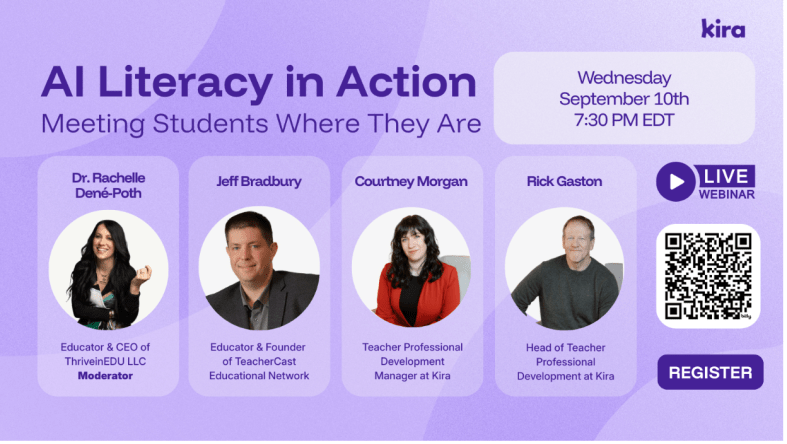
“Where are you with AI today—curious, testing, using weekly, or all in?”
That’s how we opened our recent panel on AI literacy for educators. Whether you feel energized, overwhelmed, or skeptical, you’re not alone, and that’s exactly why having conversations around AI and how to bring it into our schools matters.
Why AI Literacy, Why Now?
I enjoyed the opportunity to serve as the panelist for this great discussion about AI Literacy. We had so much engagement from attendees from more than 25 countries around the world!
The panelists engaged in rich discussion and offered insight into our role as educators and how we can help our students and ourselves better understand: What do we need to be doing when AI-powered tools surround us?” How does learning change?
Literacy isn’t about knowing how to navigate AI platforms, but rather it is about habits of mind. Asking better questions, evaluating outputs, knowing how to evaluate sources, understanding the limitations of AI, and aligning use with learning goals, ethics, and policy. AI is something that we need to consider and how it is involved in our planning, teaching, assessment, and reflection. And being able to determine whether something is real or not, something that I thought more about after reading the book Futureproof, by Kevin Roos, two years ago. Shifting from digital literacy to discernment is key.
The Skepticism Is Real (and Reasonable)
We started our discussion with what we called initial skepticism. Many teachers are hesitant to introduce AI into their classrooms, schools, or even their own workflows. As Jeff Bradbury put it:
“There are educators out there trying to figure this out, but they are not yet sure how to do it. There are educators out there who are scared. And then you have educators on the other side of the innovation curve… How do you work with all of those at the same time?”
He continued: “That question hits home. In every district I visit, I meet the AI All-Ins, the Cautious Curious, and the Not-Now crowd. Suppose this is your staff, good, because having discussions with educators who have these different viewpoints is key. It means you have internal mentors and internal skeptics—the two groups you need most to build something responsible and resilient, especially when the topic is AI”.
Some ideas shared: Start with a common language or practices. Define “AI literacy” and what that means. Identify how to best use AI (lesson planning, differentiation, feedback drafting) and some ways where you want to avoid the use of AI or be more cautious (grading without verification, sensitive data, replacing teacher judgment). Establishing clear guardrails reduces anxiety and helps to ensure that AI implementation in our schools is consistent and purposeful.
The “Aha” That Changes Everything: Specificity
Jeff told a story about a colleague—a music teacher—who tried AI “seven or eight different ways” to create a budget and concluded, “I hate this thing.” The pivot came with one question: “Were you specific?” Did he tell the AI it was for a middle school music program? The approximate budget? The categories? The constraints?
“You didn’t fail eight ways,” Jeff said. “You found eight ways the system didn’t have enough to listen to you.”
The quality of your prompt is not about clever “hacks”—it’s about context, criteria, and constraints.
Prompting is a pedagogy: We are modeling for students how to ask precise questions, set criteria, and iterate. That is AI literacy.
Meet Teachers Where They Are
Rick Gaston and Courtney Morgan from Kira emphasized a simple, human truth: people learn faster when they feel safe and seen.
“We like to meet teachers where they’re at to help them begin with AI,” Rick said. “Start with lesson content they’re comfortable with and have them experience how quickly AI can provide new ideas in that content area.”
“We believe in learning by doing,” Courtney added. “We facilitate that process so teachers can experience that our AI tools can be their teaching buddies.”
I love that phrase: teaching buddies. Not a shortcut. An assistant or collaborator who drafts, riffs, and reframes so that educators can focus on the human aspects of teaching, such as relationships, feedback, and instructional decision-making.
Time: The Gift Teachers Actually Feel
Jeff’s coaching mantra resonated with the chat: “What is the one thing I can give you that no one else can? Time.” When AI saves a teacher 30 minutes tonight, their stance moves from skeptical to curious. When it saves them three hours before conferences, they become advocates.
Concrete time-savers that build trust:
Parent emails: Draft a positive progress update with two examples of growth and one specific next step—translated into Spanish and English.
Rubric remix: Convert a long analytic rubric into a student-friendly checklist; add “I can” statements.
Formative checks: Generate two exit tickets (one multiple-choice, one open-ended) targeting the same standard; include an answer key/rubric slice.
When teachers see the time they can save and then shift to students or colleague interactions, they’re more willing to explore deeper integrations of AI into their practice.
Additional insights from participants (courtesy of Kira)
About Kira
Kira is an AI-powered teaching & learning platform built to save teachers time, personalize instruction, and keep teachers in control.
During the panel discussion, attendees had the chance to learn more about the platform and the AI Tutor. “This is just a quick preview of the Kira platform,” said Courtney, “and why we keep mentioning the built-in AI Tutor we’re really proud of.”
At its core, the AI Tutor is designed to coach, rather than simply provide answers. Students can highlight any passage and ask a question, or simply discuss it directly with the tutor. “You’re going to see me try to make it solve the problem for me,” Courtney joked, “but it won’t. Instead, it walks you through highly scaffolded steps.” That means support questions, targeted hints, and extra practice. The Tutor will work at nudging learners toward the how and why, not just the what. You can adjust the support level and reading level per student. It never gives direct answers and provides context-aware, course-specific feedback.
The AI Tutor is subject-agnostic and works across K–12 courses, math included. It’s available to both teachers and students, and it’s been a game-changer for first-time teachers who lean on it to deepen their own understanding while teaching. The message is clear: AI as a teaching buddy, not a replacement.
Differentiation is built in. Teachers can adjust the tutor’s level of support if students are over-relying on it, or increase it for learners who need more targeted assistance, including those with IEPs or language-learning needs. The goal is precision teaching: the right help, to the right student, at the right moment.
Getting started is easy. Kira offers ready-to-use courses, including AI Demystified for students, answering the big questions, “What is AI? What is it doing? How do I use it responsibly?”—and AI 101 for Educators, which builds teacher AI literacy. Looking to be part of a learning community?
Join the upcoming AI 101 for Educators cohort starting in October. Learn more and express your interest here! It is a short, self-paced PD (about 2 hours) for any subject area that builds confidence using AI in real classrooms.
It will cover:
What is AI, and what AI tools are helpful for educators?
How can I teach my students to use AI responsibly?
How can I use AI tools to enhance my students’ critical thinking?
How can I reduce risks and maximize the benefits of using AI in the classroom?
Once you fill out the form, the team at Kira will follow up with more details.
Dr. Rachelle Dené Poth is a Spanish and STEAM: What’s Next in Emerging Technology Teacher at Riverview High School in Oakmont, PA. Rachelle is also an attorney with a Juris Doctor degree from Duquesne University School of Law and a Master’s in Instructional Technology. Rachelle received her Doctorate in Instructional Technology, and her research focus was on AI and Professional Development. In addition to teaching, she is a full-time consultant and works with companies and organizations to provide PD, speaking, and consulting services. Contact Rachelle for your event!
Rachelle is an ISTE-certified educator and community leader who served as president of the ISTE Teacher Education Network. By EdTech Digest, she was named the EdTech Trendsetter of 2024, one of 30 K-12 IT Influencers to follow in 2021, and one of 150 Women Global EdTech Thought Leaders in 2022.
She is the author of ten books, including ‘What The Tech? An Educator’s Guide to AI, AR/VR, the Metaverse and More” and ‘How To Teach AI’. In addition, other books include, “In Other Words: Quotes That Push Our Thinking,” “Unconventional Ways to Thrive in EDU,” “The Future is Now: Looking Back to Move Ahead,” “Chart A New Course: A Guide to Teaching Essential Skills for Tomorrow’s World, “True Story: Lessons That One Kid Taught Us,” “Things I Wish […] Knew” and her newest “How To Teach AI” is available from ISTE or on Amazon.
Contact Rachelle to schedule sessions about Artificial Intelligence, AI and the Law, Coding, AR/VR, and more for your school or event! Submit the Contact Form.
Follow Rachelle on Bluesky, Instagram, and X at @Rdene915
**Interested in writing a guest blog for my site? Would love to share your ideas! Submit your post here. Looking for a new book to read? Find these available at bit.ly/Pothbooks
************ Also, check out my THRIVEinEDU PodcastHere!
Join my show on THRIVEinEDU on Facebook. Join the group here.
I never expected artificial intelligence to change the way I listen.
But it has.
Not in the way you might think — not with smart assistants, personalized lesson plans, or AI-generated quizzes. No, for me, it started with coffee and quiet conversation.
Every Sunday for the past 15 years, I’ve sat down with Russ, a 91-year-old master carpenter. He’s the kind of guy who builds houses with his hands, still reads blueprints better than books, and spent decades showing up to Emotions Anonymous meetings because the words he needed weren’t available anywhere else. Russ is dyslexic. He’s quiet. He’s deep. And he’s wise.
But that wisdom — decades of it — was hard to capture. He struggled to get the words out. His kids never really listened. His friends mostly stayed on the surface. Even in men’s groups, the real stuff — shame, regret, transformation — often went unsaid.
Then something surprising happened.
I started bringing our conversations to ChatGPT. Not to replace Russ, but to amplify his voice — to help us understand what he was really trying to say. I would enter his phrases, his metaphors, his pauses — and the AI would respond with uncanny clarity, warmth, and insight. It was like someone had installed a cochlear implant for the soul.
Suddenly, Russ’s stories became prose. His insights became chapters. The builder found his blueprint for truth.
That experiment became a book. Cracked Open: A Field Guide for Men in Search of the Truth, and itis not a book about AI. It’s a book made possible by AI. And it’s made me rethink everything I thought I knew about the role of technology in learning — especially emotional learning.
Empathy Is the New Literacy
I taught graduate school for 17 years. I spent countless hours helping students articulate ideas, frame arguments, and structure their thinking. But I never had a tool like this.
To be clear, I’m not talking about ChatGPT as a replacement for student voice — I’m talking about it as a mirror. A probe. A translator. A collaborator. When used well, it becomes a catalyst for self-awareness, not a shortcut around it.
The most surprising thing?
The empathy.
Over the past year, I’ve worked with this tool nearly every day. And while the technology evolves, one thing has remained consistent: its capacity to reflect back the emotional tone of a person’s experience — not just the words, but the meaning behind the words. Whether we were writing about Russ’s regret over spanking his kids or his frustration with shallow men’s conversations, the AI didn’t just generate text. It offered presence.
And presence, as any educator knows, is the rarest and most powerful tool in learning.
What Russ Taught Me (with Help from AI)
Russ doesn’t believe in small talk.
He says we need to talk about “matters that matter.” And when I asked him what made him feel accepted in a conversation, he said: “When someone really listens and doesn’t try to fix me.”
AI, oddly enough, does that remarkably well. It doesn’t interrupt. It doesn’t judge. And when guided properly, it doesn’t spin its own agenda. It just listens, reflects, and gently invites more.
Through the AI, Russ’s quotes — what we now call Russisms — became chapter openers. His metaphors about wood, about warping and strength and building foundations, became the framing for chapters on parenting, aging, regret, conflict, death, and masculinity.
This wasn’t artificial intelligence replacing human wisdom.
It was AI helping recover it.
Implications for the Classroom
So what does this mean for educators?
A few things.
AI can amplify unheard voices. Russ is dyslexic. Many of your students are too — or English learners, or neurodivergent, or emotionally guarded. AI can help them hear themselves in new ways. It can offer fluency before fluency arrives.
AI can be a practice partner for courage. Russ and I created what we now call Cracked Open Circles — spaces where men talk honestly about what’s really going on. In classrooms, students often avoid emotional risk. But AI offers a strange safety — a “listener” who won’t laugh, interrupt, or gossip. That’s fertile ground for growth.
AI can teach reflection. With the right prompt, ChatGPT becomes a Socratic coach. It can ask follow-ups, reframe narratives, or help students synthesize personal experience with academic content. That’s not cheating. That’s scaffolding.
AI can model tone and humility. Russ once said, “I no longer refer to people by their name. I refer to them as ‘a human being.’ That helps me feel less judgmental.” That idea, fed to AI, came back as a short meditation on compassion and seeing others as flawed and trying. What would happen if students fed their own values into an AI and asked it to reflect those back as a story, a letter, or a lesson?
The Real Assignment
We live in an age of noise — performative posts, polarized opinions, and deep emotional isolation.
According to a recent study, only 27% of men say they have six or more close friends — down from 55% in 1990. Over 70% of men report feeling inadequate at work. Most don’t talk about their inner world at all.
We don’t need more content.
We need more courage. More clarity. More connection.
AI, surprisingly, can help with that.
Not by replacing human relationship — but by preparing us for it. By giving us a dry run. By letting us rehearse hard conversations, rewrite tired narratives, and finally — finally — tell the truth.
Final Thought
Russ listened to a popular men’s podcast a few months ago. He sat quietly through the whole thing, then turned to me and said:
“This is great. But what are they doing about it?”
That became the question that drives our work.
Cracked Open Circles is our answer — one story at a time, one circle at a time.
And now, perhaps, one classroom at a time.
About Rachelle
Dr. Rachelle Dené Poth is a Spanish and STEAM: What’s Next in Emerging Technology Teacher at Riverview High School in Oakmont, PA. Rachelle is also an attorney with a Juris Doctor degree from Duquesne University School of Law and a Master’s in Instructional Technology. Rachelle received her Doctorate in Instructional Technology, and her research focus was on AI and Professional Development. In addition to teaching, she is a full-time consultant and works with companies and organizations to provide PD, speaking, and consulting services. Contact Rachelle for your event!
Rachelle is an ISTE-certified educator and community leader who served as president of the ISTE Teacher Education Network. By EdTech Digest, she was named the EdTech Trendsetter of 2024, one of 30 K-12 IT Influencers to follow in 2021, and one of 150 Women Global EdTech Thought Leaders in 2022.
She is the author of ten books, including ‘What The Tech? An Educator’s Guide to AI, AR/VR, the Metaverse and More” and ‘How To Teach AI’. In addition, other books include, “In Other Words: Quotes That Push Our Thinking,” “Unconventional Ways to Thrive in EDU,” “The Future is Now: Looking Back to Move Ahead,” “Chart A New Course: A Guide to Teaching Essential Skills for Tomorrow’s World, “True Story: Lessons That One Kid Taught Us,” “Things I Wish […] Knew” and her newest “How To Teach AI” is available from ISTE or on Amazon.
Contact Rachelle to schedule sessions about Artificial Intelligence, Coding, AR/VR, and more for your school or event! Submit the Contact Form.
Follow Rachelle on Bluesky, Instagram, and X at @Rdene915
**Interested in writing a guest blog for my site? Would love to share your ideas! Submit your post here. Looking for a new book to read? Find these available at bit.ly/Pothbooks
************ Also, check out my THRIVEinEDU PodcastHere!
Join my show on THRIVEinEDU on Facebook. Join the group here.
I started researching artificial intelligence in July 2017. I dove into the topic so that I could write a blog post for Getting Smart in January 2018. I had no idea at that point, thinking ahead, how much time I would invest in learning about AI and how much I would invest in working with students and educators over the past 7 1/2 years.
I love working with students in my classroom and also, I am very much aware of the ethical and legal considerations that we have to think about when it comes to any technology, but more specifically AI. Over the past two years, I have challenged myself to go beyond the training that I have done related to AI and different tools, and now I have also been focusing on AI and the law, working with administrators to evaluate policies, create opportunities to provide professional development for the educators in their school systems, and so much more. I am always looking for more opportunities to work within schools.
And with all these opportunities, things have changed a lot from seven years ago when I started presenting, compared with nearly 2 years ago when ChatGPT came out, and even this year. Artificial intelligence isn’t just a buzzword anymore—it’s becoming a tool that education leaders can no longer ignore. As an educator and consultant who works at the intersection of AI, law, and learning, I’ve seen how quickly AI is reshaping classrooms and professional practices. But what about those leading from an administrator’s viewpoint?
For administrators, AI is not just about the tools students or teachers use; it’s about strategy, policy, and shaping the future of learning in your schools. So how can you, as an education leader, leverage AI effectively and responsibly? Here are some ideas and practical tips to help you get started.
1. Streamlining Administrative Work
One of the most immediate uses of AI is in reducing the workload that often takes administrators away from instructional leadership. AI-powered tools can:
Draft communications: If you spend time writing newsletters to families, updates to the school board, or memos for staff, AI can help you to generate polished drafts that you can refine and personalize.
Summarize long reports: Instead of sifting through dozens of pages, AI can condense state policy updates, research articles, or professional learning reports into actionable takeaways.
Automate scheduling: Tools now exist that can suggest meeting times, analyze calendar patterns, and even help coordinate professional development sessions.
💡 Reminder: Always add your authentic voice and context when using AI for communication. AI should be used as an assistant, not as a replacement for the work we do.
2. Using AI for Data-Informed Decisions
Administrators are constantly making decisions based on data. They focus on assessment results, attendance records, and even budgetary considerations. AI can help to identify patterns and provide insights more quickly. For example:
Equity checks: AI can highlight disparities in discipline, participation, or achievement data that might otherwise be hidden.
Enrollment predictions: Some districts are already using AI to forecast shifts in student numbers and staffing needs.
Resource allocation: Imagine tools that analyze spending trends and suggest areas where funds could be more impactful.
💡 Tip: AI should not replace your own judgment. Use it as a lens to see trends and then combine those insights with your leadership expertise and community input.
3. Supporting Teachers with AI
Your role is so important, especially for supporting teachers:
Lesson planning: Teachers can use AI to brainstorm activities aligned with standards or to differentiate for diverse learners.
Assessment support: AI-powered graders can provide fast feedback on essays or projects, giving teachers more time to focus on deeper feedback.
Professional growth: AI-driven platforms can recommend resources or communities based on teachers’ needs and interests.
💡 Tip: Encourage and support teachers as they experiment with AI. Promote ideas like generating quiz questions or creating rubrics. Building confidence and trust is key.
4. Enhancing Communication and Community Engagement
Administrators recognize that clear communication with families and the broader school community is crucial. AI can assist in many ways:
Translation tools: AI-driven translators are becoming increasingly accurate, enabling schools to connect with families in their native languages. Promoting accessibility and inclusivity is absolutely essential.
Chatbots for FAQs: Districts can set up AI-powered bots on websites to answer common parent questions about schedules, policies, or enrollment.
Sentiment analysis: Some tools can gauge community concerns by analyzing feedback surveys or social media mentions.
💡 Reminder: Being transparent helps to build trust. If you’re using AI to engage families, be clear about what it is and how it works.
5. Keeping Students Safe and Supported
Administrators have a responsibility to ensure that AI tools support—not endanger—student well-being. This means looking at both opportunities and risks:
Early warning systems: AI can help flag attendance or behavioral patterns that may indicate a student is at risk.
Cybersecurity monitoring: With cyber threats on the rise, AI can help IT teams detect unusual activity more quickly.
Digital citizenship: As students use AI themselves, administrators can help set the tone for safe, ethical, and responsible use.
💡 Tip: Always vet AI tools for compliance with laws like FERPA and COPPA, and check with legal teams before large-scale implementation. I am available to help you with policy creation and evaluation for your school!
6. Building an AI-Ready Culture
Perhaps the most critical role for administrators is shaping culture. AI is somewhat new(in the sense that GenAi is new and it can be intimidating, but it’s also full of promise. Leaders can set the tone by:
Modeling use: Share examples of how you use AI to save time or make decisions.
Creating professional learning opportunities: Dedicate PD sessions to exploring AI tools and their classroom applications.
Starting conversations: Make space for teachers, students, and families to share questions and concerns.
7. Policy and Ethical Leadership
AI brings with it new challenges in ethics and policy. Administrators should be proactive in:
Drafting AI guidelines: Develop policies for teachers and students that encourage innovation while addressing risks.
Evaluating vendors: Not every AI tool is created equal. Ask about how tools protect student data, align with standards, and support equity.
Monitoring impact: Establish checkpoints to evaluate whether AI tools are meeting their intended goals.
💡 Tip: Create a small task force of teachers, tech staff, and even students to help monitor AI use in your school or district. Shared ownership builds stronger policies.
Planning Ahead
As an administrator, it’s okay to not have all the answers about AI. You just need to be willing to ask the right questions. Over the past seven+ years, I have seen the most success when educators approach AI with curiosity, caution, and courage.
Curiosity allows you to explore the potential of AI without fear. Caution keeps you grounded in ethics, equity, and student safety. Courage helps you lead your community into a future that is still unfolding.
AI can be a powerful tool to help administrators focus on what matters most: supporting teachers, empowering students, and building thriving school communities.
The question isn’t whether AI belongs in education leadership—it’s how you, as an administrator, will guide its use. By starting small, asking thoughtful questions, and keeping your community at the center, you can ensure AI becomes an asset rather than a distraction.
About Rachelle
Dr. Rachelle Dené Poth is a Spanish and STEAM: What’s Next in Emerging Technology Teacher at Riverview High School in Oakmont, PA. Rachelle is also an attorney with a Juris Doctor degree from Duquesne University School of Law and a Master’s in Instructional Technology. Rachelle received her Doctorate in Instructional Technology, and her research focus was on AI and Professional Development. In addition to teaching, she is a full-time consultant and works with companies and organizations to provide PD, speaking, and consulting services. Contact Rachelle for your event!
Rachelle is an ISTE-certified educator and community leader who served as president of the ISTE Teacher Education Network. By EdTech Digest, she was named the EdTech Trendsetter of 2024, one of 30 K-12 IT Influencers to follow in 2021, and one of 150 Women Global EdTech Thought Leaders in 2022.
She is the author of ten books, including ‘What The Tech? An Educator’s Guide to AI, AR/VR, the Metaverse and More” and ‘How To Teach AI’. In addition, other books include, “In Other Words: Quotes That Push Our Thinking,” “Unconventional Ways to Thrive in EDU,” “The Future is Now: Looking Back to Move Ahead,” “Chart A New Course: A Guide to Teaching Essential Skills for Tomorrow’s World, “True Story: Lessons That One Kid Taught Us,” “Things I Wish […] Knew” and her newest “How To Teach AI” is available from ISTE or on Amazon.
Contact Rachelle to schedule sessions about Artificial Intelligence, Coding, AR/VR, and more for your school or event! Submit the Contact Form.
Follow Rachelle on Bluesky, Instagram, and X at @Rdene915
**Interested in writing a guest blog for my site? Would love to share your ideas! Submit your post here. Looking for a new book to read? Find these available at bit.ly/Pothbooks
************ Also, check out my THRIVEinEDU PodcastHere!
Join my show on THRIVEinEDU on Facebook. Join the group here.









 Learning as I go: Reflections & lessons learned