

Guest post by Brian Baker. Opinions expressed are those of the guest blogger.
In a sense, the disruption genAI has caused – regardless of whether you see it as a net positive or negative – has held up a mirror to education, giving us new perspectives into known issues and exposing ones that were under the surface.
That opportunity for novel insights and increased awareness spurred 24th Century Education, an Oregon-based consulting firm, to launch the AI Mirror Project. The project seeks to capture the voices of those living this unique moment in education by asking:
What has the introduction of genAI taught us about critical issues within the education system?
The project will progress through three phases:
- Hearing from you: Through December 19, 2025, our website will collect submissions from educators, students, caregivers, the most enthusiastic AI evangelists, the most critical skeptics – anyone who is involved in any way with the education system and has reflected on these issues.
You are welcome to capture your thoughts in text, images, video, audio, or whatever format allows you to best share your voice. - Analysis & research synthesis: We will look for themes among the perspectives that are shared, then synthesize those with available research to better understand the issues identified.
- Final report: 24th Century Education will compile and share our findings, hoping to use this disruptive moment as a means to better understand our current reality and work towards our goal of building a better future.
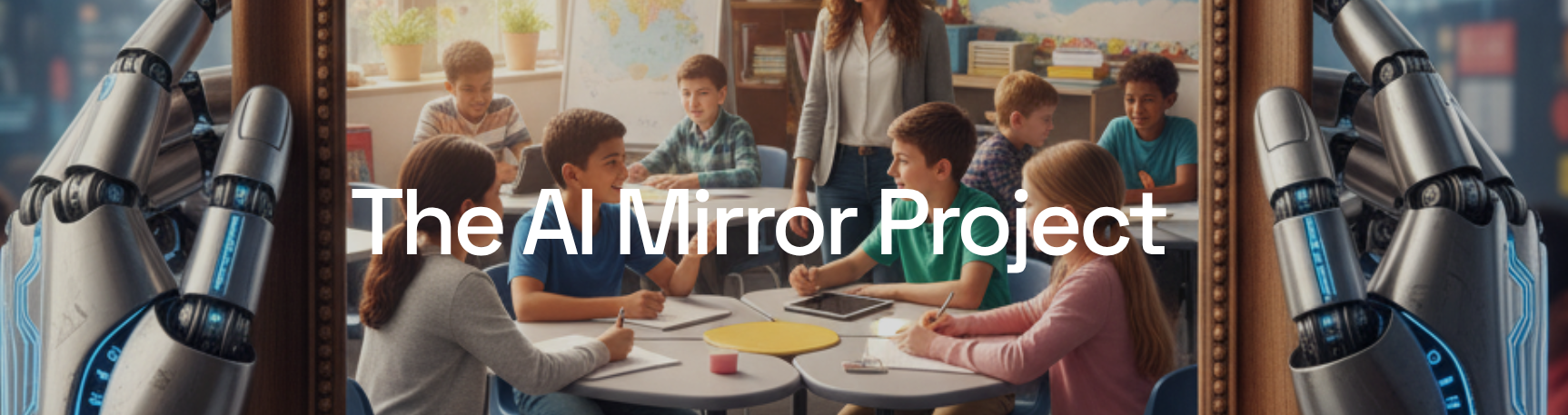
(Gemini, 2025)
While the education system has learned and is continuing to learn many valuable lessons about genAI since its introduction, this project instead focuses on what the introduction of and reaction to these tools has shown us about existing issues and challenges, such as…
- Safety and privacy
- Assessment
- Human connection
- Student engagement and relevance of learning experiences
- Individual and systemic bias
- The interaction between education and other large systems (government, industry, economy)
- Education’s role in maintaining democracy
- The influence of tech companies
- Media literacy and misinformation
- Mental health and digital well-being
- Anthropomorphization
- The role of education and the balance between preparing students for working in the existing economy versus equipping them to shape a more just system
- The vital role of teachers
- Student agency
- Critical thinking and cognitive offloading
… along with any other topic that genAI’s introduction into education has made you consider.
There are many, often competing narratives about AI’s role in education. 24th Century Education is hoping to cut through that discourse and instead dive deeper into some of the existing challenges that have, in some cases, been highlighted by genAI’s impact, and that in others have been obscured by it.
To accomplish that, please share your voice and let us know how this moment has exposed existing issues within education.
AI’s introduction and use have touched on nearly every financial, instructional, and social-emotional function of schools. It has implications for equity, well-being, and the health of our democracy, environment, and economy. It has vast implications for education, a system that binds today’s learning to tomorrow’s reality.
At 24th Century Education, we are fueled by the belief that humanity needs an environment, economy, and society where all people can thrive, and that we must use education today to help students develop the knowledge, skills, and dispositions that they need to create that tomorrow.
We believe understanding the present is essential to building the better future we envision for the education system, and we hope that this project contributes to that mission.
You can visit and make a contribution to the AI Mirror Project here. If you have any questions, please contact 24th Century Education’s Chief Learning Officer, Brian Baker – brian@24thcenturyeducation.com.
About Rachelle
Dr. Rachelle Dené Poth is a Spanish and STEAM: What’s Next in Emerging Technology Teacher at Riverview High School in Oakmont, PA. Rachelle is also an attorney with a Juris Doctor degree from Duquesne University School of Law and a Master’s in Instructional Technology. Rachelle received her Doctorate in Instructional Technology, and her research focus was on AI and Professional Development. In addition to teaching, she is a full-time consultant and works with companies and organizations to provide PD, speaking, and consulting services. Contact Rachelle for your event!
Rachelle is an ISTE-certified educator and community leader who served as president of the ISTE Teacher Education Network. By EdTech Digest, she was named the EdTech Trendsetter of 2024, one of 30 K-12 IT Influencers to follow in 2021, and one of 150 Women Global EdTech Thought Leaders in 2022.
She is the author of ten books, including ‘What The Tech? An Educator’s Guide to AI, AR/VR, the Metaverse and More” and ‘How To Teach AI’. In addition, other books include, “In Other Words: Quotes That Push Our Thinking,” “Unconventional Ways to Thrive in EDU,” “The Future is Now: Looking Back to Move Ahead,” “Chart A New Course: A Guide to Teaching Essential Skills for Tomorrow’s World, “True Story: Lessons That One Kid Taught Us,” “Things I Wish […] Knew” and her newest “How To Teach AI” is available from ISTE or on Amazon.
Contact Rachelle to schedule sessions about Artificial Intelligence, AI and the Law, Coding, AR/VR, and more for your school or event! Submit the Contact Form.
Follow Rachelle on Bluesky, Instagram, and X at @Rdene915
**Interested in writing a guest blog for my site? Would love to share your ideas! Submit your post here. Looking for a new book to read? Find these available at bit.ly/Pothbooks

************ Also, check out my THRIVEinEDU Podcast Here!
Join my show on THRIVEinEDU on Facebook. Join the group here.






 Learning as I go: Reflections & lessons learned