End of the school year? Dive into Brisk Teaching Today!

In collaboration with Brisk Teaching, All opinions are my own

The life of an educator is always quite busy! There are so many demands on our days that finding extra time to try something different can be tough! However, when you find out about a great tool that not only helps you to save time and is easy to use but also provides many other benefits that will enhance instruction and impact students, then it’s definitely worth diving into some exploration!

Especially during this school year, which brought even more tools, educators are increasingly turning to technology to streamline workflows and enhance instructional quality. A few months ago, I started exploring something new that I found, and I love sharing it with educators. Brisk Teaching, an AI-powered Chrome extension, is designed specifically for educators! What makes it incredibly powerful is how seamless it is to use. Brisk is not an additional app or tool that you have to manage – it integrates directly into the tools teachers are already using (Google Docs, slides, articles, YouTube videos) to save you time right where you’re already working! Efficiency and productivity with Brisk!

The end of the school year is the perfect time to try out these great features and see how Brisk can save time, help with assessments, and more.

Here’s a look at some of Brisk Teaching’s key features, which are helping educators do more in less time! Brisk’s key features include Content Creation, Feedback, Inspect writing, and Differentiation.

Content Creation

Brisk Teaching is amazing in how it transforms the way educators create their materials. With Brisk, you can quickly transform articles, YouTube videos, Google Docs, and other content into worksheets, quizzes, presentations, and more – right from the original sources. I really enjoy using awesome features like the AI Presentation Maker and AI Lesson Plan Generator, which enable teachers to design high-quality, engaging instructional content in minutes! For example, my favorite option, the AI Presentation Maker, enables educators to convert information obtained from articles, websites, or YouTube videos directly into a Google Slides presentation. The slides are created within minutes, and they automatically save directly in your Google Drive so you can easily change them as you normally would when using Google Slides. It just streamlines the whole process, all possible with a simple prompt, grade level, and design selection. It has been so much fun to demonstrate how quickly the slides are generated from a simple prompt of a few words.

Educators are amazed to see each slide being generated with content, images, and a great layout! Brisk not only simplifies the creation process but also ensures that the content is relevant and engaging for students.

The AI Lesson Plan Generator generates comprehensive plans in alignment with specific teaching objectives, grade levels, and more, which significantly reduces the time that teachers spend on lesson planning. Quickly generate a detailed rubric with the AI Rubric Generator or some Depth of Knowledge (DOK) questions. Brisk Teaching empowers educators to produce a variety of educational resources efficiently, which gives them more time to spend working with students!

Feedback

As we know, feedback is essential for learning. It needs to be authentic, meaningful, and timely. With Brisk Teaching, educators can provide this feedback even faster using the Targeted Feedback Generator. This feature enables educators to provide individualized comments to each student right within the student’s Google Docs.

Additionally, there are several feedback styles to choose from, including Glow & Grow praises and actionable Next Steps. The feedback will help students understand their strengths and identify areas for improvement. For educators, by automating the feedback process, Brisk helps educators keep providing feedback in a time-sensitive manner and promotes more consistent feedback for students. Choosing from the feedback styles can also help foster a supportive learning environment.

Inspect Writing

When you first explore the Inspect Writing feature of Brisk Teaching, seeing the replay of how a student has completed their assignment is really cool. The Inspect Writing feature provides educators with some insight into a student’s writing process, starting with any initial drafts to their final submission. With the replay, educators can develop a greater understanding of how a student approaches their work and can then use this to better target instructional approaches and provide more personalized feedback to better meet student needs and help them to grow.

Inspect writing is also a good way to engage a discussion about academic integrity. I see this as a way to focus on accountability also, especially when working with a group, and also as a way to focus on time management when conducting research or writing.

Differentiation

It is essential that all educators ensure that students have access to the learning materials that best match their reading levels and language needs. Promoting inclusivity is critical, and with Brisk Teaching tools like the Text Leveler and Translate Text Tool, educators can instantly adjust the complexity of texts or translate them into different languages for students. With these options, we can ensure that all classroom materials we use are accessible to students from varying linguistic and academic backgrounds and learning needs.

Why I recommend Brisk

Brisk Teaching is more than just a tool; it provides a comprehensive solution that has been designed by educators for educators. It aims to reduce burnout and enhance instructional effectiveness. It is easy to integrate in the classroom and its key features help to streamline our workflow and save time for us to work more with students and colleagues! As technology continues to evolve, tools like Brisk Teaching will continue to add new features in response to educator and student needs. Stay tuned for some other exciting features coming from Brisk. Brisk Boost for Students coming soon!

Teachers use free! Sign up here: https://www.briskteaching.com/

Check out tips to get started on their PD page: https://www.briskteaching.com/brisk-professional-development-resources

Guest blogging opportunities

Contact Rachelle to schedule sessions about Artificial Intelligence, Coding, AR/VR, and more for your school or your event! Submit the Contact Form.

Follow Rachelle on Twitter(X) and Instagram at @Rdene915

**Interested in writing a guest blog for my site? Would love to share your ideas! Submit your post here. Contact me directly for a sponsored post.

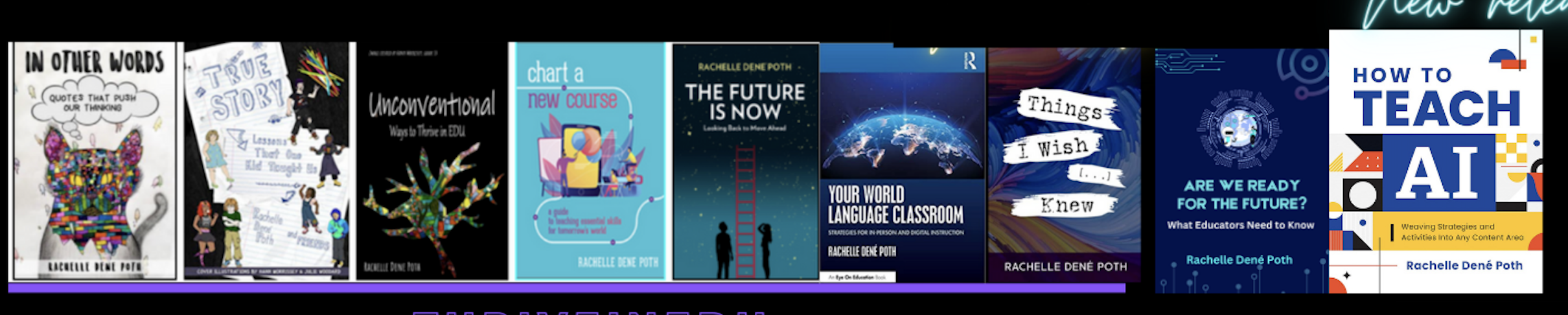
Looking for a new book to read? Find these available at bit.ly/Pothbooks

************ Also check out my THRIVEinEDU Podcast Here!

Join my show on THRIVEinEDU on Facebook. Join the group here

Empowering Teachers with Conversational AI

In collaboration with Kyron Learning, All opinions are my own

As educators, we have access to a wide variety of digital tools to bring into our classrooms. We use these to enhance learning and provide new opportunities for students to build content knowledge, as well as help them to develop essential digital skills. With the right methods and tools, educators are able to achieve the goal of providing the most authentic, meaningful, and personalized learning experiences for all students. Leveraging these resources helps us to do this more efficiently and effectively and enables us to provide timely feedback and support to our students.

Now, with the power of generative AI, there are even more valuable resources available for educators to bring into their classrooms. We can use these tools to enhance the content being taught and also to support students so they learn how to interact with AI responsibly and safely.

Kyron Learning is a revolutionary interactive video learning platform that leverages conversational AI to transform the way educators can support their students. Kyron empowers teachers by saving them time, personalizing instruction, and providing valuable student data. With Kyron, students have access to a personal tutor who works with them as they build their skills in an engaging space. The power of AI helps teachers create interactive lessons that are student-paced and student-focused. As students work through a lesson, it truly feels like a one-on-one tutoring session with a real teacher. Students can ask and respond to questions, engage in further discussions, and receive immediate feedback, all made possible by Kyron’s AI assistant. The “conversational engine” listens to the student’s responses and selects the most appropriate pre-recorded video segment to play next. When you try a Kyron lesson for the first time, you will be amazed at how well it flows!

Using Kyron, teachers can provide additional opportunities for students that give them more individualized learning experiences. It is easy to get started by simply choosing from the many lessons already available for students. Are you teaching math? Explore the lessons available such as “Base Ten,” “Place Value,” or “Comparing Fractions.” You will see the objectives, the number of lessons, and the languages available. You can even choose your tutor! With Kyron, teachers also have access to resources such as blogs and other materials to get them started!

Kyron Studio

Newly available in March, teachers can now create their own lessons for students using Kyron Studio! In addition to what Kyron already provides, with Kyron Studio, teachers can become AI tutors! Educators are also able to share and collaborate on lessons, leveraging the collective expertise of the teaching community. In Kyron Studio, teachers can design multi-modal AI-facilitated tutoring sessions for their students and make them even more personalized.

The sessions can be customized based on each teacher’s curriculum and include videos and visuals. It is a learning experience that engages and helps every learner to understand a concept in an authentic way and at their own pace.

Getting started with Kyron Studio is easy! You simply enter your objectives and provide relevant information about your learners, and a lesson outline with materials and questions will be generated. Once the lesson is generated, teachers can make any changes to the AI-generated content.

Learning with Kyron is fun!

As students work through lessons, they experience those “aha” moments when they finally understand something, and you can see their excitement! It is an engaging learning experience for students and one that also teaches them about purposeful and safe uses of AI. It benefits teachers because they can see students’ progress and support them right when they need it! While we all know technology can’t replicate the relationships between a teacher and a student, Kyron aims to also provide a supportive digital environment where students feel seen and valued.

I worked through several lessons and really enjoyed the experience. It was very different from other interactive lessons and platforms that place students in the lead. To start, I spent time selecting a lesson to dive into and then was surprised that I was able to choose my tutor! I enjoyed testing how my tutor would respond to my answers and questions. I told my tutor that I was confused, entered incorrect answers, and asked for help and more clarification. Each time it responded to me in such a personalized way that helped me to understand. If I got an answer wrong, my tutor provided me with an explanation or another example. It was amazing to see how well it responded to my questions and adjusted similarly to how a teacher would with students in the classroom.

Some of the great features of Kyron are:

Multimodal Learning: Lessons can incorporate videos, images, and text, catering to diverse learning preferences and creating a more engaging experience.

Easy Lesson Creation: Kyron Studio offers an automated and user-friendly interface for educators to build custom AI-powered tutoring sessions.

Educator Choice: Educators control lesson content, can upload their own visuals, and curate the questions and answers, which makes it more authentic for students.

Assessment and Misconception Detection: Kyron identifies student misconceptions during lessons, providing valuable insights for educators to personalize and target instruction.

Focus on Safety and Ethics: Kyron prioritizes student safety by implementing controls and moderation layers to prevent inappropriate interactions.

Commitment to Transparency: User data is anonymized and used ethically to enhance the platform.

Supporting Educators and Students

In an increasingly digital world, especially with the rapid advancements in AI, what I value about Kyron is its approach when it comes to the use of AI and the creation of this platform. The key principles are:

  • Connect, Engage, Encourage: When students complete a lesson, they are supported and receive encouraging feedback during their learning journey.
  • Teach Through Dialogue: The lessons are interactive and fun for students to complete because they are involved in a conversation. Through prompts that promote critical thinking and problem-solving, students can build their skills in ways that meet their pace and specific needs.
  • Work in Concert with Teachers: Kyron provides high-quality, differentiated curriculum and gives teachers access to real-time student progress data. It helps teachers to target instruction and personalize instruction for every student.

There are so many great lessons available to start with, or just dive in and create your own lesson in very little time. I definitely recommend that you try some lessons to experience how unique Kyron is.

Ready to transform your classroom and empower your students? Visit Kyron Learning today at http://app.kyronlearning.com and see how Kyron can help you create a personalized and engaging learning experience for all students!

And if you want to learn more and connect with other educators, Kyron just launched a community for educators called the Visionaries! Educators can join at www.kyronlearning.com/visionaries. Explore the great resources such as tutorials and more!

About the Author:

Rachelle Dené is a Spanish and STEAM: What’s Next in Emerging Technology Teacher at Riverview High School in Oakmont, PA. Rachelle is also an attorney with a Juris Doctor degree from Duquesne University School of Law and a Master’s in Instructional Technology. Rachelle is currently finishing her doctorate with a focus on AI and Professional Development. In addition to teaching, she is a full-time consultant and works with companies and organizations to provide PD, speaking, and consulting services. Contact Rachelle for your event!

Rachelle is an ISTE-certified educator and community leader and served as president of the ISTE Teacher Education Network. She was named one of 30 12 IT Influencers to follow in 2021 and one of 150 Women Global EdTech Thought Leaders in 2022.

She is the author of eight books including ‘In Other Words: Quotes That Push Our Thinking,” “Unconventional Ways to Thrive in EDU,” “The Future is Now: Looking Back to Move Ahead,” “Chart A New Course: A Guide to Teaching Essential Skills for Tomorrow’s World, “True Story: Lessons That One Kid Taught Us,” and her newest book “Things I Wish […] Knew” is now available at bit.ly/thingsiwishedu.

Contact Rachelle to schedule sessions about Artificial Intelligence, Coding, AR/VR, and more for your school or your event! Submit the Contact Form.

Follow Rachelle on Twitter(X) and Instagram at @Rdene915

**Interested in writing a guest blog for my site? Would love to share your ideas! Submit your post here. Looking for a new book to read? Find these available at bit.ly/Pothbooks

************ Also check out my THRIVEinEDU Podcast Here!

Join my show on THRIVEinEDU on Facebook. Join the group here

Diving Into Tomorrow: AI’s Role in Revolutionizing Writing Education

Guest post by Micah Miner @MinerClass

As GenAI tools increasingly shape the spaces where we teach and learn, it’s time to reimagine how we assess student writing. By embracing distributed assessment, we can harness the power of AI to foster growth, safeguard integrity, and center the student experience in a dynamic and exciting way. This shift aims to ensure students get the necessary support and guidance to thrive. Enter distributed assessment, a game-changing strategy that marries the strengths of AI with the irreplaceable insight of human teachers, nurturing student growth, fostering integrity, and sparking engagement in writing.

Unlocking the Potential of Distributed Assessment

Imagine breaking down the essay writing process into smaller, more manageable pieces. With each step, students receive specific feedback, guiding their journey. Picture the structure of a typical 5-paragraph essay. By harnessing AI tools in collaboration with educators, students are enveloped in a tailored support system, one that adjusts to their personal needs and aspirations through every phase of writing. From the initial AI starter that helps students generate a table of contents or starting sentence, to the multiple checkpoints where both AI and human teachers provide feedback and record grades, this distributed approach ensures that students receive timely and tailored support throughout the writing journey.

The Synergy of AI and Educators

What makes distributed assessment stand out is its inherent collaborative spirit. AI excels in offering immediate, precise feedback on the technicalities of writing, and identifying areas for enhancement such as clarity and coherence. Teachers, on the other hand, bring a human touch that AI cannot replicate. They provide in-depth, personalized advice, exploring the reasons behind writing decisions and fostering creativity and analytical thinking. This powerful combination ensures students receive well-rounded feedback throughout the writing journey.

Navigating Through Checkpoints

Gone are the days of assessing an essay only at its conclusion. Distributed assessment introduces a paradigm shift—feedback is integrated at pivotal moments throughout the writing journey. This approach allows students to refine their work continuously, ensuring a polished final piece. It empowers students, offering them the chance to improve with the guidance of both AI and their teachers at crucial intervals, like after drafting their first version or during peer reviews. This method not only bolsters learners but it ensures students receive well-rounded human and AI feedback throughout the writing journey.

Championing Academic Integrity

The rise of AI in writing education brings up valid concerns about academic honesty. Distributed assessment addresses these head-on. By engaging students in a process where drafts are reviewed, and feedback is given regularly, educators can closely follow each student’s writing evolution, identifying any discrepancies early. This ongoing dialogue between students, teachers, and AI tools creates a culture of transparency and accountability that is essential in an era where the lines between human and machine-generated writing are increasingly blurred.

Empowering Learners Every Step of the Way

Perhaps the most significant impact of distributed assessment lies in its ability to transform writing education into a student-centric experience. With ongoing support and feedback, students are better positioned to grasp new concepts, set achievable goals, and actively participate in their learning journey. This shift from focusing solely on grades to fostering growth and introspection encourages students to view writing as an evolving, continual process.

Looking Forward

As AI starts playing a bigger part in how we learn and teach, it’s clear that distributed assessment is becoming a game-changer. It’s all about using this tech to its fullest while keeping things personal and focused on the students. This means teachers can do more than just beef up writing skills; they can help students think more deeply and reflect on their learning, skills that are gold in today’s world. So, let’s dive in, eager to try new things, shift gears when needed, and put our hearts into guiding our students forward.

It is important to note that the U.S. Department of Education’s guidelines advocate for a human-centric, equitable, and transparent application of AI in classrooms where humans are in the loop. It is true that we should always remind ourselves as educators of the importance of keeping human relationships, reasoning skills, and ethics at the forefront of educational AI use. AI holds incredible potential to automate mundane tasks, enabling a deeper focus on fostering student relationships and growth. By moving forward with equity and collaboration at the core, we can collectively harness AI’s power to enrich education like never before.

About the Author

Micah Miner – District Administrator Instructional Technology & Social Studies at Maywood, Melrose Park, Broadview School District 89, American Consortium for Equity in Education Contributing Writer, Times 10 Publications Author

Contact Rachelle to schedule sessions about Artificial Intelligence, Coding, AR/VR, and more for your school or your event! Submit the Contact Form.

Follow Rachelle on Twitter(X) and Instagram at @Rdene915

**Interested in writing a guest blog for my site? Would love to share your ideas! Submit your post here. Looking for a new book to read? Find these available at bit.ly/Pothbooks

************ Also check out my THRIVEinEDU Podcast Here!

Join my show on THRIVEinEDU on Facebook. Join the group here

More Ideas to Try in 2024: Reflection

Part II: Getting students to think about their learning journey

Throughout the year, engaging students in ongoing reflection on what they are learning is essential. One of the five core competencies of social-emotional learning (SEL) is for students to develop self-awareness. It’s also vital for them to build self-management skills to work through challenges that can come with learning, reflect on their growth, and set new goals.

Whether students engage in discussions with classmates or use digital tools to share ideas in a comfortable virtual space, there are many options. We need to get our students to share what they are thinking and take time to reflect on their learning. We also need to model this reflective practice for them. This is essential for academic, personal, and future professional growth. To best prepare students for the future, ongoing reflection is vital.

With an opportunity to reflect, students are able to better understand their thought processes and interests. It helps them to identify areas where they can improve and recognize areas that they are strong in. Creating opportunities for students to share their learning with classmates and with us promotes collaboration, fostering a stronger sense of community in our classrooms. Together, we can create a supportive learning community.

Through the five competencies of SEL, we can help students focus on developing skills of social awareness and building relationships. Students will better understand their own thought processes and deepen their understanding of the content they are learning. However, getting students to share their thoughts and reflect on their learning can be challenging. Here are five ideas for encouraging students to reflect on their learning and share their thoughts.

1.Think-Pair-Share is an activity that doesn’t require much time at all to use and can be very effective. It encourages students to share their ideas, learning experiences, and thoughts with one another. The teacher can provide a short prompt or topic for discussion and then give students time to think individually before pairing up with a partner. Those one-on-one conversations can help students become more comfortable expressing themselves in class. After a certain period of time, each pair can share their thoughts with the class. This strategy will work well without digital tools; however, there are some options to explore.

2. Peer-pairing: To randomly place students in pairs, use a random name generator so students build relationships with their classmates. It is fun to have the names on the big wheel and place students into groups. I have used this also as a way to select the order of presentations. It helps to reduce a bit of the stress with wondering when you have to present and makes it a fun experience.

3. Class sharing: To help students build confidence, use a tool such as Padlet or Flip to have students post ideas on a collaborative board or create audio or video responses. Whatever way we have students “share,” it encourages them to engage in conversation and more active listening. Students learn about different perspectives on a given topic, which promotes the development of social awareness skills.

4. Snorkl is a new AI-powered tool that I found, and I really love the possibilities. Teachers assign an activity and it enables students to record their screen and speak about the work they have done. For example, how they solved a math problem, writing and reading in the language they are learning, describe an image, and so much more. It can be set to provide AI feedback with or without teacher approval. It was fun to try for the first time in my class. Look for more information in an upcoming post.

With the tools that offer audio or video options, it is a more authentic way to learn about the student. Teachers see and hear their students’ thought processes and can then offer more personalized and meaningful feedback to each student.

One extra is for teacher and student reflection. Learning about students’ thoughts about our methods, their comfort in the classroom, and more is important. Last year, I started exploring LessonLoop, which provides anonymous surveys that teachers can issue to students. It provides a rating with explanations based on student engagement, SEL, and comfort in the learning space and provides additional insights. Teachers can then take the information and use it to reflect on their practice and involve students by showing their input is valued through the use of these surveys. LessonLoop also has educators who will prepare some tips for teachers to try!

Whatever method or tools we choose to bring into our classrooms, the goal is still the same: Prepare students for the future with skills that enable them to be flexible and adapt to the changing look of education and work. Reflective practice is a key component of this future preparation!

Author

About the Author:

Rachelle Dené is a Spanish and STEAM: What’s Next in Emerging Technology Teacher at Riverview High School in Oakmont, PA. Rachelle is also an attorney with a Juris Doctor degree from Duquesne University School of Law and a Master’s in Instructional Technology. Rachelle is an ISTE-certified educator and community leader and served as president of the ISTE Teacher Education Network. She was named one of 30 12 IT Influencers to follow in 2021 and one of 150 Women Global EdTech Thought Leaders in 2022.

She is the author of eight books including ‘In Other Words: Quotes That Push Our Thinking,” “Unconventional Ways to Thrive in EDU,” “The Future is Now: Looking Back to Move Ahead,” “Chart A New Course: A Guide to Teaching Essential Skills for Tomorrow’s World, “True Story: Lessons That One Kid Taught Us,” and her newest book “Things I Wish […] Knew” is now available at bit.ly/thingsiwishedu.

Contact Rachelle to schedule sessions about Artificial Intelligence, Coding, AR/VR, and more for your school or your event! Submit the Contact Form.

Follow Rachelle on Twitter(X) and Instagram at @Rdene915

**Interested in writing a guest blog for my site? Would love to share your ideas! Submit your post here. Looking for a new book to read? Find these available at bit.ly/Pothbooks

************ Also check out my THRIVEinEDU Podcast Here!

Join my show on THRIVEinEDU on Facebook. Join the group here

AI Image Wizardry: 8 Tips to Get You Started

Guest post by Megan Lowe, Passionate Educator, and Tech Enthusiast

Opinions expressed are those of the guest blogger.

Lessons Learned (TL;DR)

  • Push back, refine, reiterate: it takes time!
  • AI image generators have a bias
  • Learn some great tokens
  • Free tools don’t get you too far
  • The race is on; no image generator is superior to all others
  • Engage with the community
  • Count the fingers
  • Check out Kids Think Wide

The Genesis of a Family-Driven Project

In April 2023, our family – comprising two dynamic teenagers, a mom in education, and a tech-savvy husband – embarked on a quest fueled by a simple yet profound question: ‘What great things can we accomplish with AI today?’ This question ignited our passion project, Kids Think Wide.

‘Kids Think Wide’: Born from AI

Our initial challenge was finding a name that echoed our vision and passion, particularly for art. We sought guidance from ChatGPT, which suggested names like ‘kidsthinkingdiversely.com’. However, seeking a more kid-friendly name, we settled on ‘Kids Think Wide’. This title perfectly aligns with our goal of expanding young minds through AI-driven educational tools. AI’s role extended beyond naming; it was instrumental in designing our logo, creating web content, and assisting in coding. Admittedly, AI solutions aren’t flawless – we’ve encountered coding limitations and often diverged from AI suggestions. In this creative process, we learned to embrace the journey and be patient, open to change, and always learning.

Crafting a Universe of AI-Generated Content

‘Kids Think Wide’ is dedicated to fostering a more equitable educational landscape. We are committed to representing everyone, promoting gender equality, and amplifying historically overlooked or unheard voices in engaging and fun ways! We’ve created over 10,000 AI-generated images and published approximately 400 on Kids Think Wide.  A writing prompt and discussion questions accompany each image to help prepare and inspire students to write. Our unique offerings include ‘choose your own adventure’ stories. In these, students collaboratively brainstorm and build ideas for their narratives before selecting from 3 to 5 adventure paths to personalize them, such as:

Additionally, we’ve leveraged the popularity of short-form videos, similar to reels and TikTok, using animated images, or ‘Sparks’, to captivate and spark enthusiasm for creative writing among students.

Our journey with AI also revealed the biases and limitations inherent in image generators. We’ve found it’s easier to create images that involve subjects that are very common online – celebrities, movie scenes, and well-photographed places but getting an accurate representation of a wheelchair can be more challenging. 

AI has allowed us to create scenes that challenge reality:

Journey through time, space, and into other worlds:

Create the fun, wild and whimsical:

The Evolution and Magic of AI-Generated Images

The last nine months have seen dramatic advancement in AI-generated images. The improvement in image quality, accuracy in prompt interpretation, and the ability to adjust specific image elements has been remarkable. Our journey through this dynamic domain has been an exhilarating blend of discovery and creativity. While perfecting an image is usually challenging and time-consuming, the results are frequently astonishing and rewarding. We start simple and slowly build on prompts. The arrangement of phrases and the specific words chosen play crucial roles. However, you can unlock unexpected and extraordinary outcomes through iteration, experimentation, and patience. It helps to know tokens (short phrases that often produce excellent results), e.g., playful mood, cinematic, low Angle shot, bokeh, or Chiaroscuro to name a few! On other occasions, it might require 30, 50, or even more re-rolls and remixes to create an image that genuinely captivates and is worth sharing.

While free tools provide a starting point, they often have limitations; investment in paid resources is usually necessary for more advanced or specific requirements.

As AI image generation rapidly evolves, we find ourselves exploring various tools. Midjourney stands out with its detailed control and often superior imagery, while Adobe Firefly is notable for its dedication to diversity and inclusivity. On the other hand, Dall-E brings a sense of whimsy to its creations. Each platform offers a unique experience. It’s not uncommon to initially admire an image, only to later discover anomalies like an extra limb or oddly placed fingers – the quirks of AI can lead to both amusing distortions and unexpected additions. 

Engage with the AI Community

Our journey has shown us how important connecting with the AI community is. There are many skilled and helpful creators out there. We often turn to Twitter to engage with this community. It’s an excellent place for learning, sharing experiences, and finding support. 

Check out the following: 

Hashtags – #aiart #digitalart #aiartcommunity #promptshare #LeonardoAI #midjourney #ArtificialInteligence 

Creators – @nickfloats, @HBCoop_, @saana_ai, @ProperPrompter, @ciguleva, @techhalla, @madaro_art, @Mr_AllenT, @OrctonAI

Final Thoughts and What’s to Come

‘Kids Think Wide’ has evolved from a simple ‘what if’ conversation into a reality, thanks to AI’s extraordinary capabilities. This concept, unimaginable even nine months ago, has come to life through our family’s collective imagination and AI’s power. We’re excited to unveil more awe-inspiring images, thought-provoking writing prompts, and enhanced interactivity, all while staying at the forefront of AI developments. As ‘Kids Think Wide’ continues to grow, one thing is sure: the best is yet to come, with AI playing a pivotal role in our journey.

You discover a pair of magical headphones in your pocket during recess. When you put them on, every sound around you changes into a beautiful sensation. The bounce of a basketball might feel like a gentle tap on your shoulder, and the teacher’s whistle might look like a rainbow flashing across the sky.

Write about your recess experience with these headphones. What sensations do you encounter with the different sounds of recess? How does this magical hearing change how you play and interact with your friends?

Thanks to Megs for the guest post


Rachelle Dené is a Spanish and STEAM: What’s Next in Emerging Technology Teacher at Riverview High School in Oakmont, PA. Rachelle is also an attorney with a Juris Doctor degree from Duquesne University School of Law and a Master’s in Instructional Technology. Rachelle is an ISTE-certified educator and community leader and served as president of the ISTE Teacher Education Network. She was named one of 30 12 IT Influencers to follow in 2021 and one of 150 Women Global EdTech Thought Leaders in 2022.

She is the author of eight books including ‘In Other Words: Quotes That Push Our Thinking,” “Unconventional Ways to Thrive in EDU,” “The Future is Now: Looking Back to Move Ahead,” “Chart A New Course: A Guide to Teaching Essential Skills for Tomorrow’s World, “True Story: Lessons That One Kid Taught Us,” and her newest book “Things I Wish […] Knew” is now available at bit.ly/thingsiwishedu.

Contact Rachelle to schedule sessions for your school about Artificial Intelligence, Coding, AR/VR, and more! Contact Form

Follow her on Twitter and Instagram at @Rdene915

**Interested in writing a guest blog for my site? Would love to share your ideas! Submit your post here. Looking for a new book to read? Find these available at bit.ly/Pothbooks

************ Also check out my THRIVEinEDU Podcast Here!

Six Resources To Try in 2024

Image by Rawpixel.

This will be the first post where I will share some different tools or resources to explore!

Each year, I like to take time and think about the digital tools we use in our classroom, the benefits, and how I might find new ways to use them. When I look to use technology in my classroom, I always start with the “purpose”Why” behind it. What will it help me to do better as a teacher? How can it help students to learn in more personalized or authentic ways? And what skills will students build as a result that traditional non-technology methods might not afford?

There are tools that I continue to use each year because they have added new features or they have integrated with other tools that we are using in our classroom. Here are six tools to check out as we start 2024! And one that is highly recommended to dive into AI in your classroom!

  • CoSpaces EDU is a virtual reality platform that became a favorite for some of my 8th-grade students this year. Whether creating a space in 360, designing a game, an interactive story, or an experiment, students will enjoy creating in VR and developing coding skills too. Another benefit is the Merge Cube add-on, which enables students to hold the space they have created in their hands! Students can even collaborate by working in teams to create a space together. With MergeEDU, educators can use the cube as an interactive tool to further engage students in learning about the earth, dissecting a frog, exploring a volcano, and more.
  • Gimkit, a game-based learning tool, has continued to be a favorite with my students because of the potential for increased content retention through repetitive questions and because of the different ways it can be played in the classroom. It enables students to develop strategies and have fun while learning. There are multiple ways to look at the student data and provide authentic and timely feedback. And there are always new modes to play, which helps to boost student engagement and gives us some laughter, too! Check out Blastball!
  • ISTE’s AI and STEM Explorations Network has created four free hands-on AI projects for the classroom guides, which are available for download from ISTE and GM. For elementary, secondary, electives, computer science courses, and a new guide on ethics, these guides offer various topics relevant to all content areas. The guides are available in English, Spanish, and Arabic.
  • Nearpod is a multimedia, interactive presentation tool that enables teachers to create engaging lessons that can include virtual trips and 3D objects. It offers lessons on topics such as digital citizenship, social-emotional learning, career exploration, English learner lessons, and professional development resources for teachers. Educators can create lessons with many options, including quizzes, polls, drawings, matching pairs, audio, video, and content from PhET Simulations, Desmos, BBC, YouTube, and more. Nearpod lessons can be done live in class or student-paced, and there is also the option for use as sub plans.
  • Wakelet is a content curation tool and so much more. I use it to curate blogs, videos, and other resources I want to access quickly to be a powerful tool for student learning. With Wakelet, teachers can provide blended learning experiences, use it for station rotations, have students create a digital portfolio, share class projects, create a scavenger hunt, and many other possibilities. It even offers the ability to record a Flip short video within the Wakelet collection. Educators and students can collaborate in a Wakelet collection and so much more!

Think about some of the tasks that might be taking up a lot of your time, or consider some issues or challenges you might be having. A few years ago, I noticed a decrease in student engagement and looked for ways to open up more choices for students to share their learning. Any of these tools can be suitable for addressing those concerns.

My Advice? Start thinking about your own personal goals and start with one thing. Try it and see how it goes, ask students or colleagues for feedback, and then make adjustments as needed.

About Rachelle

Follow Rachelle on Twitter @Rdene915 and on Instagram @Rdene915. Rachelle has a podcast, ThriveinEDU available at https://anchor.fm/rdene915.

Looking for PD for your school or keynotes for your conference? I provide in-person and virtual training on the following topics. If you want to learn more about and explore AI and ChatGPT, contact me to schedule! Rdene915@gmail.com or use the Book Me form on my website. bit.ly/thriveineduPD

**Interested in writing a guest blog or submitting a sponsored post for my site? Would love to share your ideas! Submit your post here. Looking for a new book to read? Find these available at bit.ly/Pothbooks

Saving Time and Learning About AI

*AI is one of my favorite areas to work in and I love sharing ideas!

As a classroom teacher with almost six years of experience integrating AI into my teaching practice and training other educators, I have enjoyed exploring the possibilities through AI and engaging in conversations with students and teachers. Every educator needs to learn about AI and how we can leverage this technology to benefit our students and enhance our work. To best provide for our students, we need to understand how this technology will impact them and us.

Especially as we see such as increase in technology in education, it is essential that we embrace and understand emerging technologies, especially AI and how it can impact not only our work but the benefits it can offer for student learning. In my work as a classroom teacher and consultant, I enjoy helping other educators get started with AI.

Why Educators Need to Understand the AI Tools Available

Our roles as educators have continued to change over the years. Not only do we teach the content, but we serve as mentors, facilitators of learning, and co-learners with our students, especially as we embrace these emerging technologies. It is important that we explore the benefits and how it can help us to “work smarter, not harder” so that we have more time to work with students, build relationships and support them in their learning journey.

AI, ChatGPT, and other forms of generative AI have become some of the most talked about topics in education this past year. But with all technology comes some hesitancy, especially with something as powerful as AI. Schools need to provide opportunities for students to learn about this changing technology because of its impact on their future. Not only can AI tools enhance creativity and productivity, they can also provide educators with valuable insights into student learning and assist with some of the time-consuming tasks that educators have.

How to leverage some tools with benefits

I like to think of three key areas where AI can make an impact for educators and for students.

1. Personalized Learning: Through AI, educators can provide tailored learning experiences based on AI-driven analytics that provide valuable insights into student performance and learning trends. It can adapt to each student’s strengths, weaknesses, and learning pace.

2.Efficiency and Productivity: Another benefit of AI is greater efficiency. Educators may spend more time on clerical tasks that takes time away from working directly with students. The right AI tools can help to automate or streamline tasks uch as grading assignments or providing feedback, giving teachers more time with their students.

3. Creating and supplementing the content: Through AI-powered platforms, teachers can curate various educational resources for their students and their own professional learning. With generative AI in particular, quickly being able to create lessons, activities, assessments, prompts for discussion, and presentations by providing a short prompt with keywords, educators can create engaging lessons for students in far less time.

But how do we know where to begin?

Tools to Explore

With so many different tools becoming available or integrating AI into them, it can be hard to keep up. My recommendation is to select one or two to start with. Explore how they work and the content that is created. Take time to evaluate the accuracy of the information and even involve students in discussions about the benefits for their learning.

Here are five AI-powered tools that will help teachers with personalized learning, efficiency, and saving time. I have created and experimented with so many tools, and my students’ responses have always been positive. Embracing these tools also sparks curiosity for learning. Creating and sharing these resources with our students leads to rich conversations about AI’s benefits and the proper use of this technology for creating and learning. See below for an additional article link and my contact form to bring me to your school or provide coaching.

  • Curipod: Enables teachers to create interactive lessons in minutes using AI. Teachers simply type in a topic, and a ready-to-run lesson is generated with text, images, and activities such as polls, open-ended responses, word clouds, and more. There are even activities to build in that focus on SEL check-ins. Use my code CURIRACHELLE
  • Eduaide.Ai: An AI-assisted lesson development tool that provides educators with more than 100 resource types to choose from. It offers the ability to translate the generated content into more than 15 languages instantly. Educators can generate a syllabus and discussion prompts, use the Teaching Assistant to help with creating IEP plans, write emails, or even create a list of accommodations for students in addition to many other options. I enjoy using Eduaide for a variety of tasks, especially creating lesson and project outlines and testing out the feedback bot! Try some and then tag @eduaideAI and @Rdene915 in a tweet and win a book!
  • Quizizz: With Quizizz, teachers can design quizzes that create a personalized learning path in response to each student’s responses and based on their needs. Teachers can also create lessons with Quizizz, which now has AI enhancements that can adjust question difficulty, check grammar, redesign questions to reflect real-world scenarios, create a quiz from a URL or PDF, and more features on the way.
  • Slidesgo: Provides access to free templates via Google Slides and now has the AI Presentation Maker. With this new functionality, presentations can be created within minutes. Start by choosing a topic, selecting a tone such as casual, creative, or professional, making changes, and downloading your presentation. A time saver, for sure! I really enjoyed testing it out and creating some amazing presentations! Want to learn more? Be sure to check out their recent survey, which has great insights into AI and tools for education! Dive into exploring more today!

Also, head to my additional post via Edutopia for more AI tools to try here: 7 Tools

Do you want to learn more about AI and how to bring it into your classroom? I have six years of experience working with students and teachers and would love to work with your school, at your conference or individual coaching: bit.ly/thriveineduPD

About Rachelle

Follow Rachelle on Twitter @Rdene915 and on Instagram @Rdene915. Rachelle has a podcast, ThriveinEDU, available at https://anchor.fm/rdene915.

Looking for PD for your school or keynotes for your conference? I provide in-person and virtual training on the following topics. If you want to learn more about and explore AI and ChatGPT, contact me to schedule! Rdene915@gmail.com or use the Book Me form on my website.

**Interested in writing a guest blog or submitting a sponsored post for my site? Would love to share your ideas! Submit your post here. Looking for a new book to read? Find these available at bit.ly/Pothbooks

Reflecting on AI in education

 I have been speaking and teaching about AI in my classroom for more than five years. I was curious to understand where we see it in the world and how to teach about it in our schools. I was also fascinated by the capabilities of AI for learning and in the world. 

I reached out to several educators and some students to find out what they thought about the changes we are experiencing in education, especially with these emerging technologies. There are, of course, concerns, ongoing conversations, and definitely excitement, although sometimes hesitant excitement, about what these technologies might bring to the world of education and work. 

Educator predictions

Nicole Biscotti @BiscottiNicoleEducator 

“AI has exploded on the scene and everyone is trying to figure it out at the same time which is exciting. A lot of educators are afraid that kids will use technologies like ChatGPT to cheat and have even banned its use. The reality is that kids have been cheating since the beginning of school and we have an exciting opportunity as educators to shape the narrative around this new technology. Biscotti plans to continue to learn as much as she can about how to use AI to better support her students. She says as an educator, “I feel that I am obligated to prepare my students for their future, not my past. These tools will only improve and they are here to stay. It’s imperative that kids are familiar with them and know how to use them or we risk sending graduates out into the workforce at a competitive disadvantage.”  

Dr. Michael Harvey @doctor_harvesPedagogical Prognosticator from Blenheim New Zealand

“AI/emerging tech has yet to really shape this past school year. Questions are being asked of what learning is and the role of assessment, but the actions to this change are yet to be realized.” He is thinking about /planning how to transition assessment tasks to a process rather than a product model. As for the future, Harvey thinks that “the next school year will bring pushback from the establishment and for those who want to progress in education a movement away from assessment of learning to assessment for learning and the role of AI to support student independence in learning.”

Alex Isaacs @mr_isaacs_mathEdtech Specialist from Long Branch Public Schools 

“Emerging tech has helped teachers gain time while assisting with lesson planning, quick questions, and providing feedback to students in real-time. It has also helped increase data analytic capabilities by providing insights into student performance trends and instructional practice.” He plans to delve more into emerging technologies and how they can benefit the teachers and students in his school district. By participating in multiple coaching cohorts, including GoGuardian and Pear Deck, he hopes to gain more insight into helping his colleagues with these platforms. As for the future, “the discussions surrounding the ethical use of emerging tech will continue next school year.” He believes that more edtech platforms will increase their integrations of AI-related tech to provide differentiated instruction and personalized pathways to every learner.” Check out his AI-themed Wakelet collection that he and colleague Lois Alston created.

Vicki Van Matre @MsVanMatreArtRmTeacher at Bluffton High School and  ISTE Certified Instructor 

Next year, Vicki will be teaching a class called the” 3rd class” for their new Education Professions pathway. One basis for this class is introducing technology’s role in the modern classroom. She was planning on discussing AI and how it could help the teacher but also discuss how to use it appropriately as a student. Her plans focus on involving students more in learning about ChatGPT by writing a lesson for them and having them make modifications where necessary. She also wants her students to experiment with a variety of technology to see “what THEY think would work best in the classroom.”  While she uses technology in her art room, she has not yet experimented a lot with DALL E to see if I want to use AI for any of my art classes. However, she believes that if she does choose to use it, most likely it would be with the senior independent study students to have them experiment with it. 

Student reflections

Holden, grade 10

“As soon as I was introduced to AI, I knew that it would change the world. The more I interacted with it, the more I understood its vast potential.” He shared that he “may or may not have used it to complete a few small assignments (Never in Spanish).” His uses were more as a study tool, in particular for reviewing for Chemistry. He would ask it to give a simple definition and an example and it worked perfectly to help him process the information and content better. He believes that “AI by itself is mediocre at best. However, when collaborating with humans, it can do amazing things.” As for benefits, he has an interest in starting an online store but has never really had the time and he hopes that with the help of AI to get a jumpstart this summer. “The school will look right through all the great things that AI is capable of and try to prevent it from being used completely.”

Lola, grade 11

“I believe that emerging technology has provided and created new opportunities for students. The new ideas and aspects of technology accessible to students now provide new experiences and can help to improve a student’s capabilities and knowledge about the subject they are studying.” Looking ahead, “I believe that by next school year, technology will continue to grow and emerge in new ways that will allow students to continue to have opportunities that will enhance their learning environment.”

Dimitri, grade 8

“AI and a lot of new tech has helped me with coming up with ideas for projects or providing me with a summary of a book, if I forgot something that I had read or I didn’t understand it.” As for the next school year, “I hope we will be allowed to use ChatGPT in class to help us understand books and literature more.”

With the rapid advancements in AI and emerging technologies, there are now incredible opportunities available to us and as we reflect on the past year, it becomes evident that AI and emerging tech have revolutionized education in ways we never imagined.

About Rachelle

Follow Rachelle on Twitter @Rdene915 and on Instagram @Rdene915. Rachelle has a podcast, ThriveinEDU available at https://anchor.fm/rdene915.

Looking for PD for your school? I provide in-person and virtual training on the following topics. If you want to learn more about and explore AI and ChatGPT, contact me to schedule! Rdene915@gmail.com

**Interested in writing a guest blog or submitting a sponsored post for my site? Would love to share your ideas! Submit your post here. Looking for a new book to read? Find these available at bit.ly/Pothbooks

Learning about Civics and Government: The Ethics of AI in Political Campaigns

Guest post by: Torrey Trust and Robert W. Maloy, University of Massachusetts Amherst

The Ethicist” – Kwane Anthony Appiah’s column in the New York Times Magazine – offers philosophical advice about how to respond to the dilemmas and complexities of everyday life. People submit questions they want answered, and the rights and wrongs or ethics of what to do are not immediately clear or self-evident. Questions posed include: “Is it ever acceptable to visit a Confederate historical site?” “My salary is too high. Is it wrong to stay in my job?” “Can I sell my Taylor Swift tickets for thousands of dollars?” and “Can I use ChatGPT for the tedious parts of my job?” In July 2023, the Ethicist responded to this last question about ChatGPT, which was written by the chair of the English department at a small college. The reply was “yes,” as long as “you exercise proper vigilance and can stand by what you submit” (para. 4). 

Utilizing “The Ethicist” as the starting point for instructional ideas, we envision giving elementary, middle, and high school students ongoing opportunities to develop their own ethical responses to authentic questions and issues they are facing in their lives, schools, and communities – especially those related to the use of GenAI tools and large language models (LLMs) – as a means of helping them develop their civic engagement skills and knowledge. Ideally, students engage in discussions about how they and others should act in the different situations and settings of everyday life. By stating their views and restating and understanding the views of others, students will become more socially conscious and civically engaged as members of our diverse society. 

Questions of ethics and ethical behavior are central to how individuals and groups conduct political campaigns. In the run-up to the 2024 election, political candidates, parties, and action and advocacy groups have been using GenAI tools to generate campaign speeches, policy proposals, and even fundraising emails. In one example, the Democratic Party used AI to write fundraising emails and found that AI-generated fundraising requests performed as well as or better than human-generated requests in generating financial responses from donors (Goldmacher, 2023). However, not all uses of GenAI in political campaigns have been done with honorable intentions. University of Georgia journalism professor David E. Clementson (2023) identified multiple ways that GenAI tools could make political campaigns more deceptive than ever, including using these tools to design customized bogus campaign promises, write outright lies presented as truthful statements, convince voters to reevaluate their choice of candidates, and craft manipulated photos of candidates.

Following the model of “The Ethicist,” students could be asked: “Is it ethical to use GenAI tools to craft political campaign materials and media?” To begin this activity, students could be encouraged to use the Teacher and Student Guide to Analyzing AI Writing Tools to critically investigate popular GenAI tools, including ChatGPT, Bard, Stable Diffusion, and DALL-E. This guide provides a series of prompts that motivate students to examine the design and production of AI tools (questioning things like “Who designed this tool and why? “How does this tool make money?” “What data was used to train this tool?” “What biases are represented in the data?” and “What privacy protections are in place for users’ data?”) and the output of AI tools (questioning things like “Who or what is included in the output and who or what is left out?” and “How does the AI-generated output compare to human-generated text or media?”). Through this type of critical investigation, students might uncover that GenAI tools are trained on data that has embedded biases and consider what that might mean if political campaign staff use these tools, for example, to write fundraising campaigns based on demographic data. 

Next, students could work on designing their own political campaign to run for a local or statewide political office (see the “Online Campaigning for Political Office” activity). Students could start this activity without any assistance from GenAI tools and then mid-way through the activity have the opportunity to use AI to help with or improve their campaign materials. For example, students might ask ChatGPT to generate a series of social media posts related to their campaign promises, write a script for a podcast or video that will be embedded into their campaign website, improve the quality of the text for their campaign website, or devise a strategy for increasing voter engagement with their campaign. Or, they could use image generators, like Microsoft Bing Image Creator powered by DALL-E, to produce visuals for their campaign websites or social media posts. 

After designing their own political campaigns with and without the assistance of GenAI tools, students could engage in a discussion or debate about whether they think it is ethical for politicians and their campaign staff to use GenAI tools to craft political campaign materials and media. Integrating an ethical question about the use of AI in political campaigns as students design their own run for political office gives students an opportunity to investigate what AI can and cannot do and what AI should and should not do as a tool. The cognitive scientist Fei-Fei Li said nearly a decade ago: “AI is a machine that can make a perfect chess move while the room is on fire” (quoted in Knight, 2017, para. 4). Her point is AI can generate content, but not critical thought or socially and morally ethical plans for action. Through this activity, students consider what role AI should play in politics, and then they should be able to form their own opinion to the prompt: “Is it ethical to use GenAI tools to craft political campaign materials and media?”

Author Bios

Torrey Trust, Ph.D. is a Professor of Learning Technology in the Department of Teacher Education and Curriculum Studies in the College of Education at the University of Massachusetts Amherst. Her scholarship and teaching focus on how technology shapes educator and student learning. Specifically, Dr. Trust studies how educators engage with digitally enhanced professional learning networks (PLNs), how emerging pedagogical tools (e.g., HyperDocs), practices (e.g., Making), and technologies (e.g., 3D printers, augmented reality) facilitate new learning experiences, and how to design and use open educational resources (OERs). Dr. Trust served as a professional learning network leader for the International Society for Technology in Education (ISTE) for five years, including a two-year term as the President of the Teacher Education Network from 2016 to 2018. In 2018, Dr. Trust was selected as a recipient of the ISTE Making IT Happen Award, which “honors outstanding educators and leaders who demonstrate extraordinary commitment, leadership, courage, and persistence in improving digital learning opportunities for students.” www.torreytrust.com

Robert W. Maloy is a senior lecturer in the College of Education at the University of Massachusetts Amherst where he coordinates the history teacher education program and co-directs the TEAMS Tutoring Project, a community engagement/service learning initiative through which university students provide academic tutoring to culturally and linguistically diverse students in public schools throughout the Connecticut River Valley region of western Massachusetts. His research focuses on technology and educational change, teacher education, democratic teaching, and student learning. He is co-author of Transforming Learning with New Technologies (4th edition); Kids Have All the Write Stuff:  Revised and Updated for a Digital Age; Wiki Works: Teaching Web Research and Digital Literacy in History and Humanities Classrooms; We, the Students and Teachers: Teaching Democratically in the History and Social Studies Classroom; Ways of Writing with Young Kids: Teaching Creativity and Conventions Unconventionally; Kids Have All the Write Stuff: Inspiring Your Child to Put Pencil to Paper; The Essential Career Guide to Becoming a Middle and High School Teacher; Schools for an Information Age; and Partnerships for Improving Schools. 

**Interested in writing a guest blog for my site? Would love to share your ideas! Submit your post here. Looking for a new book to read? Find these available at bit.ly/Pothbooks

************ Also check out my THRIVEinEDU Podcast Here!

Join my show on THRIVEinEDU on Facebook. Join the group here

How does a techy teacher navigate ChatGPT and AI?

Guest post by Joe Warner, 2nd-grade teacher at West Lafayette Elementary School in West Lafayette, IN

@jdswarner – Twitter

I am what most refer to as a “Techy teacher.” I love most things edtech and pursue a lot of edtech use in my classroom. I have been so driven by edtech that I pursued a master’s degree from Purdue University in Learning Design and Technology. The program has really helped me develop stronger edtech tools and designs for my classroom. When someone needs help with tech in our school, they usually come to ask me. I am not saying this in a bragging sense, it is merely to give the background that I love technology and see its benefits to our daily lives as human beings, especially as teachers.

All that said, I have some reservations about AI and the newly discovered ChatGPT (which I have only read about, and not used). Let’s first start with AI. For me, AI is an easier topic to discuss. I use Google Assistant on my phone to prioritize my daily life. I have even used IFTTT in conjunction with my Google Assistant to create a verbal command system that would award points to table groups similar to the house points in Harry Potter. So there are some great benefits of AI. My only reservation is something that I read about in EdTech Magazine. The title of this article is Empowering Teaching and Learning with Interoperability written by Douglas Konopelko. Interoperability was a new term to me but I have since embraced it. Interoperability in short is the ability of various programs and software to talk and work with each other seamlessly. My frustration with this topic and AI is how little companies are trying to accomplish this. The Google, Microsoft, and Apple battle are well known. None of those companies seem to want to work together and share their systems to work with each other. The same can be said for EdTech. If we are to fully be able to use the systems we have in education, we need them to have interoperability. The companies behind them need to embrace this. The question then turns to, can AI help us in accomplishing this? I am writing this post hoping to seek the answer to this question. There is so much overwhelming data in education and we need systems that can easily combine all the pieces we need into one system that makes it easy for teachers to use.

This brings me to the next tricky subject, ChatGPT. I have not used ChatGPT. It is blocked in my school and I have no desire to use it at home. I keep coming across Twitter posts with articles discussing the benefits of ChatGPT in education and for educators. I am extremely cautious to embrace this. The biggest issue I have with ChatGPT is originality and authenticity. In the article How CHATGPT is fast becoming the teacher’s pet from Forbes, a teacher is quoted saying that he lets the students use ChatGPT to write their first draft of code for them. But if ChatGPT is writing the first draft of code, then how is it “their” code or program? Other uses for ChatGPT in this article discussed are writing emails, comments for students, and creating tables and charts to name a few. And sure, automating these processes do seem like they would make my life as a teacher more efficient. The struggle I have is how can we confirm originality with these processes. How can we ensure there will not be mistakes? Yes, we all know “Skynet” is not taking over but when will ChatBot perceive the student, parent, or teacher as a threat and send the wrong message home? And maybe this is because I have some control and trust issues with the processes of my own classroom.

Let’s circle back to our topic of interoperability. What role does AI or even ChatGPT play in this term? If ChatGPT can create charts and tables, can it then provide interoperability for the systems that we use in schools? Can it gather all of the data from all the sources we use and make reports for schools to use? I for one am tired of chasing down data, copying it from one source to another. Could ChatGPT and AI automate and streamline this process for me? There are systems out there like Class Composer which let us take all of our data and put it into one place. I am a teacher so I am not on the backend of the data dump but I do know, I have had to enter my student data into Class Composer. So what can be done to make this process easier and eliminate my need to enter the data? We all know how much time this will save. Can ChatGPT solve this issue for us?

In this evolving world, I am more than happy to embrace change and technology. There are great benefits to using technology in our lives, especially in the classroom. And we can forget to take the time to measure the value of technology in the classroom. Our efforts should be on interoperability. How are we going to push all these systems to work together? How can ChatGPT help with that? How can I be assured of trust in ChatGPT’s originality or authenticity? I am just a techy teacher trying to navigate this evolving world and embrace the new tech.

Sources:

Konopelko, D. (2020, July 9). Empowering Teaching and Learning with Interoperability. Technology Solutions That Drive Education. https://edtechmagazine.com/k12/article/2020/07/empowering-teaching-and-learning-interoperability.

Whitford, E. (2023, March 27). How CHATGPT is fast becoming the teacher’s pet. Forbes. Retrieved March 28, 2023, from https://www.forbes.com/sites/emmawhitford/2023/03/25/how-chatgpt-is-fast-becoming-the-teachers-pet/?sh=39c665de5177

**Interested in writing a guest blog for my site? Would love to share your ideas! Submit your post here. Looking for a new book to read? Find these available at bit.ly/Pothbooks

************ Also check out my THRIVEinEDU Podcast Here!

Join my weekly show on Fridays at 6pm ET THRIVEinEDU on Facebook. Join the group here