
Leading with AI: Practical Ideas for School and District Administrators

I started researching artificial intelligence in July 2017. I dove into the topic so that I could write a blog post for Getting Smart in January 2018. I had no idea at that point, thinking ahead, how much time I would invest in learning about AI and how much I would invest in working with students and educators over the past 7 1/2 years.

I love working with students in my classroom and also, I am very much aware of the ethical and legal considerations that we have to think about when it comes to any technology, but more specifically AI. Over the past two years, I have challenged myself to go beyond the training that I have done related to AI and different tools, and now I have also been focusing on AI and the law, working with administrators to evaluate policies, create opportunities to provide professional development for the educators in their school systems, and so much more. I am always looking for more opportunities to work within schools.

And with all these opportunities, things have changed a lot from seven years ago when I started presenting, compared with nearly 2 years ago when ChatGPT came out, and even this year. Artificial intelligence isn’t just a buzzword anymore—it’s becoming a tool that education leaders can no longer ignore. As an educator and consultant who works at the intersection of AI, law, and learning, I’ve seen how quickly AI is reshaping classrooms and professional practices. But what about those leading from an administrator’s viewpoint?

For administrators, AI is not just about the tools students or teachers use; it’s about strategy, policy, and shaping the future of learning in your schools. So how can you, as an education leader, leverage AI effectively and responsibly? Here are some ideas and practical tips to help you get started.

1. Streamlining Administrative Work

One of the most immediate uses of AI is in reducing the workload that often takes administrators away from instructional leadership. AI-powered tools can:

  • Draft communications: If you spend time writing newsletters to families, updates to the school board, or memos for staff, AI can help you to generate polished drafts that you can refine and personalize.
  • Summarize long reports: Instead of sifting through dozens of pages, AI can condense state policy updates, research articles, or professional learning reports into actionable takeaways.
  • Automate scheduling: Tools now exist that can suggest meeting times, analyze calendar patterns, and even help coordinate professional development sessions.

💡 Reminder: Always add your authentic voice and context when using AI for communication. AI should be used as an assistant, not as a replacement for the work we do.

2. Using AI for Data-Informed Decisions

Administrators are constantly making decisions based on data. They focus on assessment results, attendance records, and even budgetary considerations. AI can help to identify patterns and provide insights more quickly. For example:

  • Equity checks: AI can highlight disparities in discipline, participation, or achievement data that might otherwise be hidden.
  • Enrollment predictions: Some districts are already using AI to forecast shifts in student numbers and staffing needs.
  • Resource allocation: Imagine tools that analyze spending trends and suggest areas where funds could be more impactful.

💡 Tip: AI should not replace your own judgment. Use it as a lens to see trends and then combine those insights with your leadership expertise and community input.

3. Supporting Teachers with AI

Your role is so important, especially for supporting teachers:

  • Lesson planning: Teachers can use AI to brainstorm activities aligned with standards or to differentiate for diverse learners.
  • Assessment support: AI-powered graders can provide fast feedback on essays or projects, giving teachers more time to focus on deeper feedback.
  • Professional growth: AI-driven platforms can recommend resources or communities based on teachers’ needs and interests.

💡 Tip: Encourage and support teachers as they experiment with AI. Promote ideas like generating quiz questions or creating rubrics. Building confidence and trust is key.

4. Enhancing Communication and Community Engagement

Administrators recognize that clear communication with families and the broader school community is crucial. AI can assist in many ways:

  • Translation tools: AI-driven translators are becoming increasingly accurate, enabling schools to connect with families in their native languages. Promoting accessibility and inclusivity is absolutely essential.
  • Chatbots for FAQs: Districts can set up AI-powered bots on websites to answer common parent questions about schedules, policies, or enrollment.
  • Sentiment analysis: Some tools can gauge community concerns by analyzing feedback surveys or social media mentions.

💡 Reminder: Being transparent helps to build trust. If you’re using AI to engage families, be clear about what it is and how it works.

5. Keeping Students Safe and Supported

Administrators have a responsibility to ensure that AI tools support—not endanger—student well-being. This means looking at both opportunities and risks:

  • Early warning systems: AI can help flag attendance or behavioral patterns that may indicate a student is at risk.
  • Cybersecurity monitoring: With cyber threats on the rise, AI can help IT teams detect unusual activity more quickly.
  • Digital citizenship: As students use AI themselves, administrators can help set the tone for safe, ethical, and responsible use.

💡 Tip: Always vet AI tools for compliance with laws like FERPA and COPPA, and check with legal teams before large-scale implementation. I am available to help you with policy creation and evaluation for your school!

6. Building an AI-Ready Culture

Perhaps the most critical role for administrators is shaping culture. AI is somewhat new(in the sense that GenAi is new and it can be intimidating, but it’s also full of promise. Leaders can set the tone by:

  • Modeling use: Share examples of how you use AI to save time or make decisions.
  • Creating professional learning opportunities: Dedicate PD sessions to exploring AI tools and their classroom applications.
  • Starting conversations: Make space for teachers, students, and families to share questions and concerns.

7. Policy and Ethical Leadership

AI brings with it new challenges in ethics and policy. Administrators should be proactive in:

  • Drafting AI guidelines: Develop policies for teachers and students that encourage innovation while addressing risks.
  • Evaluating vendors: Not every AI tool is created equal. Ask about how tools protect student data, align with standards, and support equity.
  • Monitoring impact: Establish checkpoints to evaluate whether AI tools are meeting their intended goals.

💡 Tip: Create a small task force of teachers, tech staff, and even students to help monitor AI use in your school or district. Shared ownership builds stronger policies.

Planning Ahead

As an administrator, it’s okay to not have all the answers about AI. You just need to be willing to ask the right questions. Over the past seven+ years, I have seen the most success when educators approach AI with curiosity, caution, and courage.

Curiosity allows you to explore the potential of AI without fear.
Caution keeps you grounded in ethics, equity, and student safety.
Courage helps you lead your community into a future that is still unfolding.

AI can be a powerful tool to help administrators focus on what matters most: supporting teachers, empowering students, and building thriving school communities.

The question isn’t whether AI belongs in education leadership—it’s how you, as an administrator, will guide its use. By starting small, asking thoughtful questions, and keeping your community at the center, you can ensure AI becomes an asset rather than a distraction.

About Rachelle

Dr. Rachelle Dené Poth is a Spanish and STEAM: What’s Next in Emerging Technology Teacher at Riverview High School in Oakmont, PA. Rachelle is also an attorney with a Juris Doctor degree from Duquesne University School of Law and a Master’s in Instructional Technology. Rachelle received her Doctorate in Instructional Technology, and her research focus was on AI and Professional Development. In addition to teaching, she is a full-time consultant and works with companies and organizations to provide PD, speaking, and consulting services. Contact Rachelle for your event!

Rachelle is an ISTE-certified educator and community leader who served as president of the ISTE Teacher Education Network. By EdTech Digest, she was named the EdTech Trendsetter of 2024, one of 30 K-12 IT Influencers to follow in 2021, and one of 150 Women Global EdTech Thought Leaders in 2022.

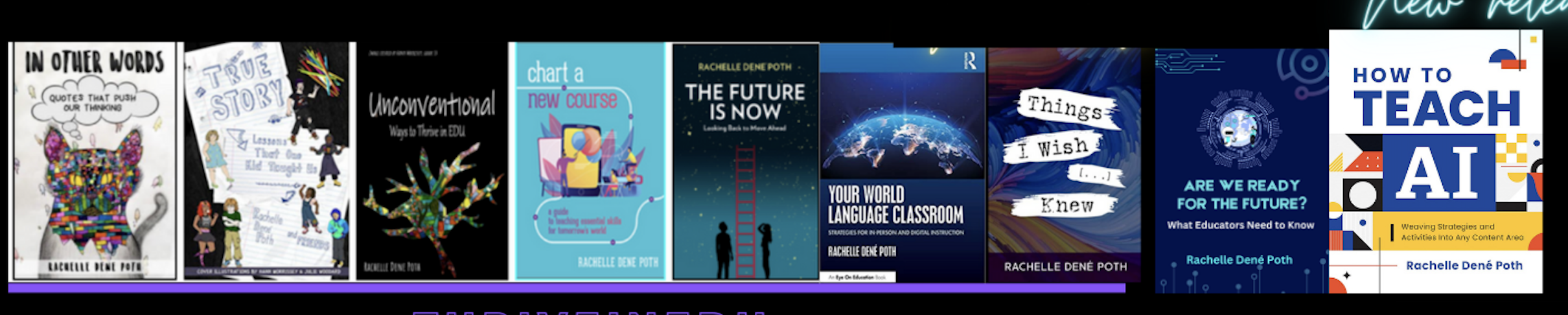
She is the author of ten books, including ‘What The Tech? An Educator’s Guide to AI, AR/VR, the Metaverse and More” and ‘How To Teach AI’. In addition, other books include, “In Other Words: Quotes That Push Our Thinking,” “Unconventional Ways to Thrive in EDU,” “The Future is Now: Looking Back to Move Ahead,” “Chart A New Course: A Guide to Teaching Essential Skills for Tomorrow’s World, “True Story: Lessons That One Kid Taught Us,” “Things I Wish […] Knew” and her newest “How To Teach AI” is available from ISTE or on Amazon.

Contact Rachelle to schedule sessions about Artificial Intelligence, Coding, AR/VR, and more for your school or event! Submit the Contact Form.

Follow Rachelle on Bluesky, Instagram, and X at @Rdene915

**Interested in writing a guest blog for my site? Would love to share your ideas! Submit your post here. Looking for a new book to read? Find these available at bit.ly/Pothbooks

************ Also, check out my THRIVEinEDU Podcast Here!

Join my show on THRIVEinEDU on Facebook. Join the group here.

Developing AI Literacy

Educators must stay informed, current, and ahead of the game (if possible) when it comes to emerging technologies. This means fostering the development of AI literacy skills. Being AI literate means more than knowing the basics about the technology or understanding relevant terms such as machine learning and algorithms. Literacy involves knowing the uses of AI in the world and being aware of the ethical considerations involved with its use. AI literacy should focus on developing skills to critically evaluate information and content generated by AI as well as to identify misinformation. Teachers should also know how to use AI in safe, ethical, and responsible ways and model this use for students.

Getting Started Teaching AI Literacy Skills

Introducing AI concepts at an earlier age gives students the opportunity to build their knowledge and skills over time—with younger students, starting with the basics of AI, such as focusing on where we see it in daily life. Begin with key definitions, and find resources that have been vetted and are safe for student and educator use. Several organizations provide a wealth of resources for educators, including ready-to-run lessons.

Modeling AI use in the classroom: As we teach students about AI, we can engage them in activities where they evaluate images, text, or videos to decide whether they are AI-generated or real. I have used game-based learning tools, such as Quizizz AI, to quickly create a quiz to check students’ understanding of the concepts covered, or Eduaide.Ai, to make a gamified activity or lesson related to AI literacy.

Continue reading on Edutopia.

About Rachelle

Dr. Rachelle Dené Poth is a Spanish and STEAM: What’s Next in Emerging Technology Teacher at Riverview High School in Oakmont, PA. Rachelle is also an attorney with a Juris Doctor degree from Duquesne University School of Law and a Master’s in Instructional Technology. Rachelle received her Doctorate in Instructional Technology, and her research focus was on AI and Professional Development. In addition to teaching, she is a full-time consultant and works with companies and organizations to provide PD, speaking, and consulting services. Contact Rachelle for your event!

Rachelle is an ISTE-certified educator and community leader who served as president of the ISTE Teacher Education Network. By EdTech Digest, she was named the EdTech Trendsetter of 2024, one of 30 K-12 IT Influencers to follow in 2021, and one of 150 Women Global EdTech Thought Leaders in 2022.

She is the author of ten books, including ‘What The Tech? An Educator’s Guide to AI, AR/VR, the Metaverse and More” and ‘How To Teach AI’. In addition, other books include, “In Other Words: Quotes That Push Our Thinking,” “Unconventional Ways to Thrive in EDU,” “The Future is Now: Looking Back to Move Ahead,” “Chart A New Course: A Guide to Teaching Essential Skills for Tomorrow’s World, “True Story: Lessons That One Kid Taught Us,” “Things I Wish […] Knew” and her newest “How To Teach AI” is available from ISTE or on Amazon.

Contact Rachelle to schedule sessions about Artificial Intelligence, Coding, AR/VR, and more for your school or event! Submit the Contact Form.

Follow Rachelle on Bluesky, Instagram, and X at @Rdene915

**Interested in writing a guest blog for my site? Would love to share your ideas! Submit your post here. Looking for a new book to read? Find these available at bit.ly/Pothbooks

************ Also, check out my THRIVEinEDU Podcast Here!

Join my show on THRIVEinEDU on Facebook. Join the group here.

Reimagining Assessment with AI: Purposeful Tools for Transforming Learning

Educators today have more options than ever for assessing student learning. Years ago, our toolkit was limited to paper-based tests, verbal check-ins, classroom observations, and creative projects. While effective, these methods were time-consuming and often didn’t lead to meaningful engagement with feedback. In my own experience, students would frequently glance at their grade, then toss the paper aside—missing the valuable feedback meant to help them grow.

We know feedback is critical for student growth—it must be authentic, meaningful, and timely. Since the end of 2022, advances in generative AI have introduced powerful tools that can help educators meet these goals more efficiently and effectively. When chosen and implemented thoughtfully, AI-powered tools can transform how we assess, teach, and connect with students.

Rethinking Assessment with AI

AI tools are not a replacement for strong pedagogy; rather, they serve as a support system that can amplify good teaching. Traditional assessments are now being enhanced—or in some cases, reimagined—with technology that provides real-time data, personalized feedback, and engaging formats that meet students where they are.

When deciding whether to integrate a specific AI tool, I always ask myself:

  • Will it help me assess student learning more efficiently?
  • Can it help me provide feedback that students will actually read and act on?
  • Does it allow for differentiation and accessibility?

One major advantage of AI tools is automated scoring and instant feedback, which significantly reduces grading time. This allows educators to focus on what matters most—supporting students. AI-driven analysis offers immediate and valuable insights into student performance, helping educators to identify trends and tailor instruction to meet evolving needs.

AI can also ensure greater consistency in grading and provide accessible pathways for students with diverse needs through features like text-to-speech, translation, and adaptive learning pathways. With AI tracking student progress, questions and assignments can be adjusted in real-time to offer the right level of challenge and support.

Choosing the Right AI Tools: Questions to Guide You

With so many tools available, selection can be overwhelming. To avoid using tech for tech’s sake, consider these essential questions:

  • What is the purpose? Begin with the “why.” What instructional challenge are you trying to solve?
  • Does it support your content area and learning goals? Choose tools aligned with curriculum standards and classroom objectives.
  • Will it elevate your teaching, not replace it? Technology should enhance, not substitute, quality instruction.
  • Is student data safe? Always evaluate data privacy policies and ensure compliance with FERPA, COPPA, or your district’s guidelines.
  • Does it offer choice and voice? Look for tools that let students express learning in various formats—written, spoken, visual, etc.
  • How user-friendly is it for families and students? Accessibility and ease of use matter for long-term success.

I also ask myself:

  • Do I want students to continue discussions beyond class time?
  • How quickly can I provide feedback?
  • Is there an option for audio, video, or scaffolded feedback?

4 AI Tools to Get Started

Here are four versatile AI tools that I regularly recommend for planning, instruction, and assessment:

⭐️ Curipod

A fast way to create interactive, student-driven lessons. Simply input a topic, and Curipod generates an engaging lesson with polls, open-ended questions, word clouds, and more. It’s great for sparking classroom discussion and promoting real-time student voice.

📘 Diffit

Perfect for differentiating content across grade levels and reading abilities. Input a prompt, website, PDF, or even a video link, and Diffit generates reading passages with vocabulary support and comprehension questions. You can export content to Google tools for seamless integration.

🧠 Eduaide.Ai

Designed by teachers, for teachers, Eduaide offers over 120 content creation tools. From syllabi and lesson plans to gamified activities, feedback, and even IEP support, this tool can save hours of planning time while providing high-quality resources that align with best practices.

Quizizz AI

Quizizz AI makes assessment creation fast and fun. Input a webpage, document, or even a set of questions, and the platform generates quizzes with real-world scenarios and themes. Since last Arpil, Quizizz includes accommodation profiles to ensure equitable access for all learners.

Final Thoughts: Plan with Purpose, Teach with Intention

AI should never be a gimmick. Before adopting any new tool, always reflect on how it will support student learning and make your work as an educator more impactful. The most effective tools are the ones that align with your goals and empower students to become active participants in their learning.

We are also responsible for modeling ethical and responsible AI use in our classrooms. As students explore these tools, we can guide them in using AI as a partner in learning, one that supports curiosity, creativity, and critical thinking.

The future of education isn’t just about technology—it’s about purposefully using technology to create more engaging, inclusive, and personalized learning experiences. AI isn’t here to replace us but to support us in doing what we do best: inspiring and empowering learners.

About Rachelle

Dr. Rachelle Dené Poth is a Spanish and STEAM: What’s Next in Emerging Technology Teacher at Riverview High School in Oakmont, PA. Rachelle is also an attorney with a Juris Doctor degree from Duquesne University School of Law and a Master’s in Instructional Technology. Rachelle received her Doctorate in Instructional Technology, and her research focus was on AI and Professional Development. In addition to teaching, she is a full-time consultant and works with companies and organizations to provide PD, speaking, and consulting services. Contact Rachelle for your event!

Rachelle is an ISTE-certified educator and community leader who served as president of the ISTE Teacher Education Network. By EdTech Digest, she was named the EdTech Trendsetter of 2024, one of 30 K-12 IT Influencers to follow in 2021, and one of 150 Women Global EdTech Thought Leaders in 2022.

She is the author of ten books, including ‘What The Tech? An Educator’s Guide to AI, AR/VR, the Metaverse and More” and ‘How To Teach AI.’ In addition, other books include, “In Other Words: Quotes That Push Our Thinking,” “Unconventional Ways to Thrive in EDU,” “The Future is Now: Looking Back to Move Ahead,” “Chart A New Course: A Guide to Teaching Essential Skills for Tomorrow’s World, “True Story: Lessons That One Kid Taught Us,” “Things I Wish […] Knew” and her newest “How To Teach AI” is available from ISTE or on Amazon.

Contact Rachelle to schedule sessions about Artificial Intelligence, Coding, AR/VR, and more for your school or event! Submit the Contact Form.

Follow Rachelle on Bluesky, Instagram, and X at @Rdene915

**Interested in writing a guest blog for my site? Would love to share your ideas! Submit your post here. Looking for a new book to read? Find these available at bit.ly/Pothbooks

************ Also, check out my THRIVEinEDU Podcast Here!

Join my show on THRIVEinEDU on Facebook. Join the group here.

AI in Education, Part 3: Looking Ahead – The Future of AI in Learning

In the first and second parts of my AI series, I focused on where we see AI in classrooms. Benefits range from personalized learning and accessibility tools to AI-driven grading and support of a teaching assistant. In Part 2, I chose to focus on some of the important considerations related to ethics that must be part of the conversation. Schools need to focus on data privacy, bias, overreliance, and the equity divide. I wanted to focus on the future for this last part in the current AI series. Where do we go from here?

I have seen a shift in the focus of conversations around AI and also a shift in the mindset when thinking about AI. Where there once was heightened concern about the use of AI for cheating on assignments and hesitation to start using AI, now there is more of a realization that AI is here to stay, and its role in education will only grow. The conversation is no longer about whether we should use AI—it’s about how we choose to use it, and more importantly, why.

AI will, without a doubt, be part of that future. It’s our responsibility as educators, tech leaders, school community members, and edtech providers to ensure we’re guiding its integration in a way that best serves students, empowers teachers, and prepares us all for the future.

Here are some things that I have been thinking about:

Human-AI Collaboration in Teaching?

We’ve heard it many times before: AI will never replace great teachers. But it will “change how we teach” and how we think about teaching, impacting our work in many ways.

For some educators, they are just exploring AI or have only recently heard about the possibilities for human-AI collaboration. Have you thought about AI becoming a co-pilot in your classroom? Consider some of the possibilities:

  • Teachers can get real-time insights into student understanding. (Feedback that is authentic, meaningful, and timely is essential. AI helps with timeliness and gives us time back that can be spent providing authentic and meaningful feedback to students.
  • AI assistants can help educators to further differentiate instruction. (Think about the time it takes to evaluate student responses and adjust our instruction to best meet student needs. Using AI can help with saving some valuable time).
  • Brainstorming new ideas can be faster with the help of an AI assistant.

Will AI stick around?

AI is not new, and it is not going away.

Our roles as educators are evolving. Beyond delivering content, we have to be content curators, learning coaches, and mentors. We need to understand how to best leverage the AI tools available to create meaningful learning experiences for all students.

Some things to consider:

  • Shift from thinking that AI is going to replace us. Think of it as a teammate that is always available instead. There are many ways that it can supplement the work we are doing.
  • Work toward ongoing professional learning that supports AI fluency. Move beyond learning how to use a tool, think about its potential for enhancing our work, and be aware of its limitations.
  • Create space in your school or district for educators to experiment, reflect, and share what’s working (and what’s not). Pop-up PD events where someone shares a new idea, resource, or tips are great ways to continue learning and share the teacher talent!

How Can Schools Prepare Students for an AI-Driven World?

As we have probably said ourselves and heard many times, we are preparing students for a future that doesn’t exist yet, while we know that AI will definitely be a part of it. So we have to be intentional in the opportunities we create and the tools we choose to use.

Our students will need to be technologically savvy, but their knowledge needs to go beyond that. They will need to understand how AI works, how it can hallucinate or return inaccurate information, and how to use it ethically and creatively. Understanding AI is about more than computer science—it’s about focusing on skills such as critical thinking, media literacy, and how to innovate responsibly.

What Are The Key Skills for an AI-Ready Generation?

  • AI literacy: Knowing what AI is, how it functions, and how it makes decisions. We talk a lot about AI Literacy, but we need to focus on exactly what it means and how to create opportunities for these skills to be developed.
  • Ethical reasoning: Developing an understanding of bias in algorithms, the importance of data privacy, and the impact of automation on humans and the future of work.
  • Enhanced Creativity: Deciding how to use AI to enhance storytelling, design, research, and innovation.
  • Collaboration and adaptability: These are critical skills which means that developing skills for problem-solving in interdisciplinary, tech-rich environments.

Schools now need to think about: How should we shift our curriculum to reflect this new reality? How often should we bring digital citizenship into our conversations about AI use? Do students have opportunities to create with AI and not just consume it?

What are the Biggest Opportunities with AI on the Horizon?

When I think about the future of AI in education, I think about a lot of concerns, but also focus on the benefits. Often, I say responsibilities versus possibilities, or maybe you have heard of “guidelines and guardrails.” More than just automation or replacing work done by humans, streamlining tasks and more. It’s about amplification. When integrated with purpose and oversight, AI has the potential to:

  • Help educators identify gaps in learning earlier and more accurately.
  • Support neurodiverse learners with personalized, accessible tools.
  • Provide just-in-time support for language learners, students in rural areas, and those who might otherwise be overlooked.
  • Enable more student-centered learning by freeing up educator bandwidth.
  • Support schools and organizations in many of the time-consuming administrative tasks and other responsibilities that take away from time working with students and colleagues.

Also at the school-wide and district-wide level, there has been a rise in AI-informed school operation. I just returned from the ASU+GSV AI Show and saw more of this than in prior events. With AI, schools can take advantage of tools for smart scheduling, predictive analytics for attendance and engagement, and AI-supported mental health monitoring (of course, only when used responsibly and ethically).

But here’s something to remember: AI will not by itself make learning better. It will amplify or enhance the system it’s placed in. While we have new opportunities, the big responsibility belongs to us to use this technology ethically, purposefully, and safely.

What Can We Do?

Here’s how we start:

  • Create school-wide policies for AI that address ethics, bias, and transparency—before tools are adopted.
  • Build educator confidence through ongoing, hands-on training and support.
  • Collaborate across roles— administrators, teachers, tech staff, students, and even the school community, should be involved when AI decisions are made and aware of changes that happen.
  • Model digital citizenship by treating AI as part of the ecosystem of responsible technology use.

Looking Ahead:

We’re all going to need to keep learning and expanding our skills together. AI will continue to evolve quickly, and because of this, education may continue to play catch-up if we don’t dive in and continue to learn and expand the work we do.

We have a chance—right now—to lead the conversation, set the norms, and create the kind of learning environments we believe in—not ones driven by hype or fear but by intentionality, inclusion, and imagination.

Some questions to consider:

  • How do we want our classrooms to feel? What experiences do we want to create for our students?
  • How can AI support relationships, not replace them?
  • What does equitable, empowered learning look like—and how can AI help us get there?

Let’s Keep the Conversation Going

What are you seeing in your school or district right now when it comes to AI? What conversations are happening—or still need to happen?

I’d love to hear how you’re navigating this space, what challenges you’re facing, and what’s working for you. Whether you’re just getting started or already diving in, this is a journey we’re on together.

Drop your thoughts in the comments, send a message, or reach out. I would love to work with you and your school or speak at your event. Contact me at bit.ly/thriveineduPD.

If our current system is inequitable, overworked, and compliance-focused, AI won’t fix that—it might just accelerate it.

Let’s also remember that students are watching how we respond to new tools. They’ll model our curiosity, our caution, and our creativity. If we approach AI with a balanced, thoughtful mindset, they will too.


About Rachelle

Dr. Rachelle Dené Poth is a Spanish and STEAM: What’s Next in Emerging Technology Teacher at Riverview High School in Oakmont, PA. Rachelle is also an attorney with a Juris Doctor degree from Duquesne University School of Law and a Master’s in Instructional Technology. Rachelle received her Doctorate in Instructional Technology, and her research focus was on AI and Professional Development. In addition to teaching, she is a full-time consultant and works with companies and organizations to provide PD, speaking, and consulting services. Contact Rachelle for your event!

Rachelle is an ISTE-certified educator and community leader who served as president of the ISTE Teacher Education Network. By EdTech Digest, she was named the EdTech Trendsetter of 2024, one of 30 K-12 IT Influencers to follow in 2021, and one of 150 Women Global EdTech Thought Leaders in 2022.

She is the author of nine books including, ‘In Other Words: Quotes That Push Our Thinking,” “Unconventional Ways to Thrive in EDU,” “The Future is Now: Looking Back to Move Ahead,” “Chart A New Course: A Guide to Teaching Essential Skills for Tomorrow’s World, “True Story: Lessons That One Kid Taught Us,” “Things I Wish […] Knew” and her newest “How To Teach AI” is available from ISTE or on Amazon.

Contact Rachelle to schedule sessions about Artificial Intelligence, Coding, AR/VR, and more for your school or event! Submit the Contact Form.

Follow Rachelle on Bluesky, Instagram, and X at @Rdene915

**Interested in writing a guest blog for my site? Would love to share your ideas! Submit your post here. Looking for a new book to read? Find these available at bit.ly/Pothbooks

************ Also, check out my THRIVEinEDU Podcast Here!

Join my show on THRIVEinEDU on Facebook. Join the group here.

The Future of AI Education: Leveraging the Power of Nous AI

In collaboration with MatataStudio EDU, All opinions are my own

As educators, we seek innovative ways to prepare our students for the future. Whether we choose different teaching methods or leverage the technology available to us, we have to make sure they are prepared to succeed in today’s rapidly evolving technological landscape. According to recent studies, the global AI job market is expected to grow exponentially in the coming decades. However, a significant skills gap threatens to limit opportunities for many individuals.

Educators must ensure that all students have opportunities that will equip them with the necessary skills. By incorporating tools like the Nous AI Set, educators can help bridge this gap, ensuring their students are not only employable but also leaders in the workforce. Introducing them to AI concepts early on is essential, and with the MatataStudio EDU and their great robot kits like the Nous AI Set, we can help students build these essential skills.

For educators seeking to prepare students for a world increasingly driven by AI and STEM, the MatataStudio Nous AI Set is a game-changer. Its modular design, real-world applications, and extensive resources make it an invaluable addition to any classroom. My students are excited to explore the possibilities of becoming innovators and problem-solvers.

Experience in STEM or AI is not necessary because the Nous AI Set provides everything educators need to create a dynamic, engaging, and impactful learning environment.

Real-World Applications in the Classroom

You may be wondering how to use Nous AI in the classroom. Because the MatataStudio Nous AI Set is such a versatile, modular AI educational robot, it is easier for educators to bring AI-focused learning experiences to elementary and secondary schools. The Nous AI offers students an opportunity to independently or collaboratively explore AI technologies and bring abstract AI concepts to life through practical, hands-on activities. Here are some ways it can be used in the classroom:

  • Autonomous Navigation
    Programming the robot to follow paths or avoid obstacles teaches students about the principles of autonomous driving.
  • AI-Generated Content
    Exploring AI-generated music, art, or text (AIGC) enables students to understand the creative potential of AI technologies.
  • Image and Object Recognition
    Students can train the robot to recognize and categorize different objects, introducing them to machine learning and neural networks.
  • MatataChat: Engage students with AI-powered chatbots that can respond to queries and provide information.
  • Neural Networks: Introduce the concept of artificial neural networks, inspired by the human brain, and the role networks have in carrying out complex tasks like image and speech recognition.
  • Speech Recognition Projects
    By programming the robot to understand and respond to voice commands, students gain insights into natural language processing and its real-world uses, such as virtual assistants. Engage students with activities that teach them how machines can process and understand spoken language.

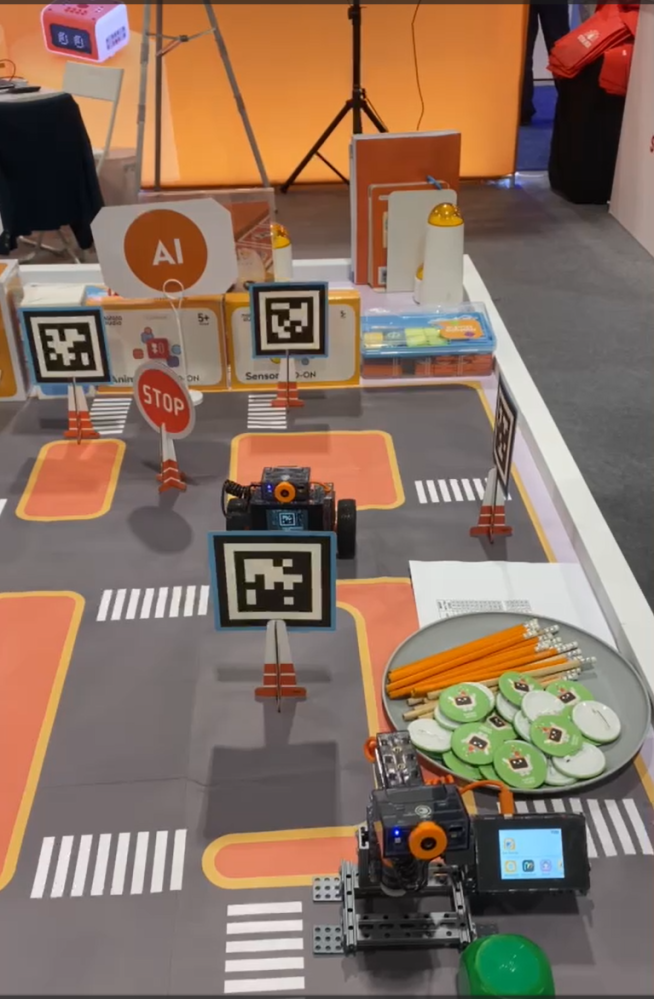
Students can choose one of these areas to focus on and build something of interest or something for fun. Great examples include an Automatic Door, a Smart Fan, a Car, or the Gimbal set that teaches students about advanced face and color tracking.

What Makes the Nous AI Set Special?

The Nous AI Set is a versatile, modular AI educational robot tailored to the needs of primary and secondary school students. What sets it apart is its ability to make complex AI concepts accessible, engaging, and practical for learners of all skill levels.

Key Features

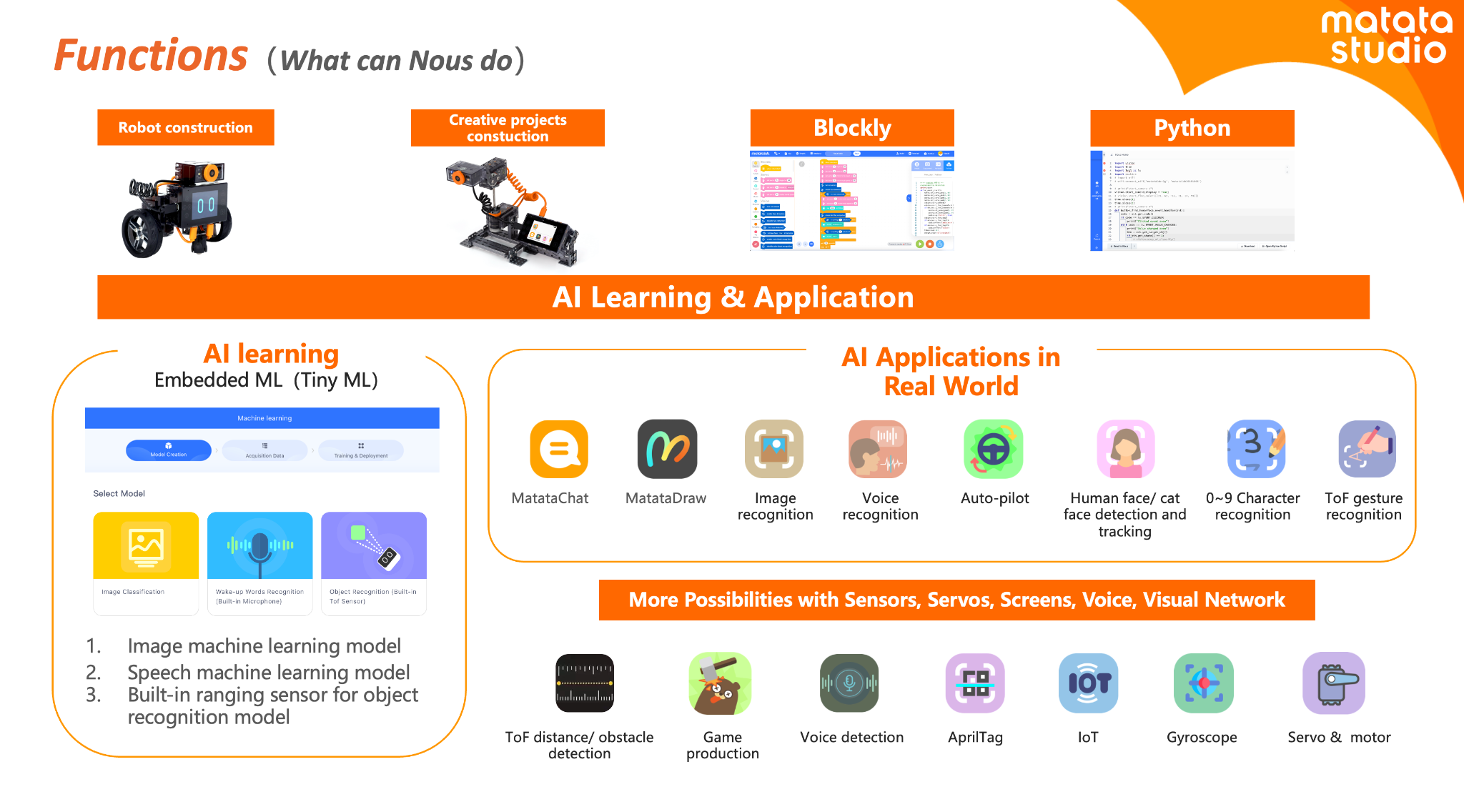
  • Advanced AI Functions Students can explore state-of-the-art AI technologies, including:
    • Machine learning
    • Neural networks
    • Machine vision
    • Speech recognition
    • Autonomous driving capabilities
    • AI-generated content (AIGC)
    • Interactive MatataChat functions
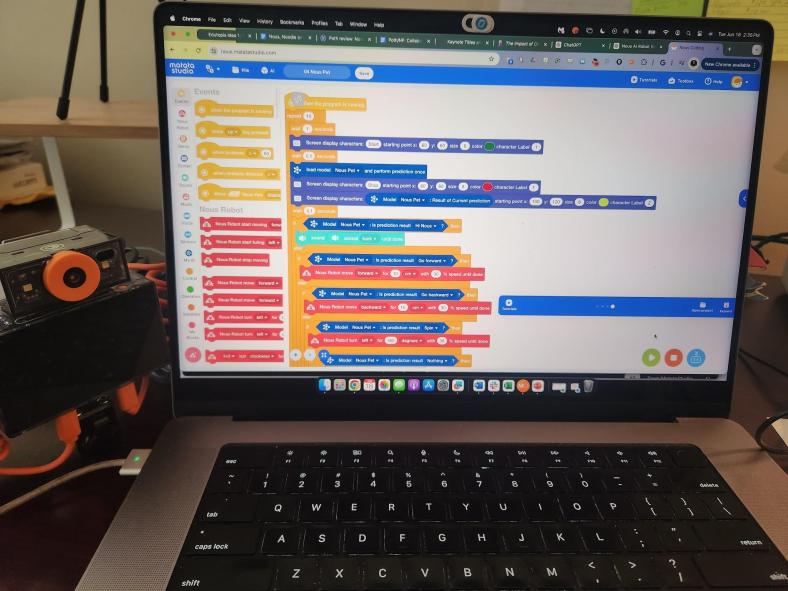
  • Hands-On Learning Opportunities The Nous AI Set emphasizes experiential learning. Students can collect data, train AI models, and deploy them using graphical and Python programming interfaces.
  • Durable, Flexible Design Built with a sturdy metal structure, the robot is compatible with building block systems. Its structure fosters creativity and adaptability, which allows students to design and reimagine their projects.

Why all educators need to bring AI and STEM into the classroom

AI is rapidly transforming industries, from healthcare to finance and transportation. STEM skills are increasingly in demand, especially as we move toward the future and look at the Job Skills Outlook. By introducing these concepts early on, we can:

  • Cultivate Future Innovators: Inspire the next generation of AI researchers, engineers, and entrepreneurs.
  • Develop Critical Thinking Skills: Encourage students to analyze complex problems and develop creative solutions.
  • Foster Problem-Solving Abilities: Equip students with the tools to tackle challenges and find innovative solutions.
  • Enhance Computational Thinking: Develop logical reasoning and algorithmic thinking skills.
  • Prepare for the Future Workforce: Ensure students are ready for the jobs of tomorrow, which will increasingly rely on AI and automation.

Resources to Support Educators

One of the standout aspects of MatataStudio is the extensive support available for educators. Their curriculum guides, aligned with ISTE and CSTA standards and the 5 Big Ideas for AI, provide step-by-step instructions for integrating Nous AI into various learning environments. Building the robot is easy to do with their step-by-step instructions. Additionally, tutorials and professional development workshops ensure that educators are confident in teaching these advanced topics.

These resources save valuable time and effort. Everything you need—from lesson plans to assessments—is ready to go, allowing you to focus on fostering creativity and exploration in your students.

About the Author:

Dr. Rachelle Dené Poth is a Spanish and STEAM: What’s Next in Emerging Technology Teacher at Riverview High School in Oakmont, PA. Rachelle is also an attorney with a Juris Doctor degree from Duquesne University School of Law and a Master’s in Instructional Technology. Rachelle received her Doctorate in Instructional Technology, and her research focus was on AI and Professional Development. In addition to teaching, she is a full-time consultant and works with companies and organizations to provide PD, speaking, and consulting services. Contact Rachelle for your event!

Rachelle is an ISTE-certified educator and community leader and served as president of the ISTE Teacher Education Network. She was named the EdTech Trendsetter of 2024 by EdTech Digest, one of 30 K-12 IT Influencers to follow in 2021, and one of 150 Women Global EdTech Thought Leaders in 2022.

She is the author of nine books including, ‘In Other Words: Quotes That Push Our Thinking,” “Unconventional Ways to Thrive in EDU,” “The Future is Now: Looking Back to Move Ahead,” “Chart A New Course: A Guide to Teaching Essential Skills for Tomorrow’s World, “True Story: Lessons That One Kid Taught Us,” “Things I Wish […] Knew” and her newest “How To Teach AI” is available from ISTE or on Amazon.

Contact Rachelle to schedule sessions about Artificial Intelligence, Coding, AR/VR, and more for your school or your event! Submit the Contact Form.

Follow Rachelle on Twitter(X) and Instagram at @Rdene915

**Interested in writing a guest blog for my site? Would love to share your ideas! Submit your post here. Looking for a new book to read? Find these available at bit.ly/Pothbooks

AI in Education, Part 2: Challenges, Opportunities, and Responsibilities

In Part 1 of this series, I shared some of the ways AI is transforming education—personalized learning, automation of routine tasks, and improved accessibility. But like any powerful tool, AI also comes with challenges that we need to think through carefully if we want it to truly support students and educators.

Thinking through it carefully doesn’t mean that we should ban the use of AI or greatly limit it. It means being intentional about how we use it, asking the right questions, and making sure that technology enhances learning rather than replacing it, and understanding how to make sure that we are using tools that are safe for students and educators.

Here are some challenges (and opportunities) that AI in education brings, as well as ideas for how we can navigate them wisely.


1. The Balance Between AI and Human Instruction

AI-powered learning platforms are helping teachers provide personalized instruction in ways that weren’t possible before. While we have always been able to personalize instruction in our classrooms, these tools can save time, enable faster feedback, and provide greater insights into student learning in less time. Adaptive learning tools can indicate gaps in understanding, adjust content based on individual student progress, and provide instant feedback.

All of these possibilities are beneficial. But these possibilities raise an important question: Where does AI fit into the teacher-student relationship?

Why It Matters:

AI can help educators, or anyone, to be more efficient, but teaching isn’t just about delivering content. It’s about essentially human qualities such as mentorship, creativity, and human connection—things AI can’t replicate. If we rely too much on AI-driven instruction, we risk creating a learning environment and experiences that are transactional rather than transformational in our schools.

Some solutions:

  • Use AI to complement, not replace, teacher-led instruction. AI is capable of handling routine tasks and providing insights, but teachers bring authentic connections, relevant context, and inspiration that technology can’t.
  • Prioritize collaborative learning, project-based learning experiences, and hands-on activities to balance AI-driven efficiency with human creativity.
  • Encourage students to engage in critical thinking and discussion— essential skills that go beyond what AI is able to offer.

2. AI-Generated Content: Helpful or a Shortcut?

There are so many questions surrounding AI-generated content. Should we use it? Can we create with AI and sell it, or are we violating copyright? We know there are endless things we can create, from lesson plans to assessments, project ideas, audio and video creations, and more. AI has become a “go-to” tool for educators and learners alike. But is that always a good thing?

Why It Matters:

AI can generate fast, but speed doesn’t always mean quality or accuracy. Sometimes, AI outputs are generic, lack depth, or contain inaccuracies. As educators, we need to work with it, evaluate our prompts and the output, and find ways to guide students to appropriate use of the tools available. If students rely too much on AI for writing or problem-solving, they will miss out on the critical thinking and creativity that come with the process.

Some solutions:

  • Guide students on how to engage with AI critically. It’s not about completely banning AI tools but helping students learn when and how to use them responsibly.
  • Encourage students to edit, refine, and build on AI-generated content rather than accepting it at face value. Think of AI as a brainstorming tool, not a finished product.
  • Use AI for efficiency, not as a replacement for thought. Generating a study guide is great. Letting AI do all the work is not so great.

3. Data Privacy and Student Security

AI-powered tools are collecting a lot of student data—performance analytics, typing patterns, and even behavioral insights in some cases. While this data can help improve learning experiences, it raises important questions surrounding privacy, security, and consent.

Why It Matters:

AI is making education more personalized, but we make sure that this enhanced personalization doesn’t come at the cost of student privacy. Some questions that schools and educators should consider on a regular basis are:

  • What data is being collected, and how is it stored?
  • Who has access to it?
  • Is it being used to help students learn or for other purposes?

Some solutions:

  • Choose AI tools that prioritize transparency and security. Ask companies tough questions about their data policies. Review the policies frequently to make sure that the companies are staying up-to-date as AI evolves.
  • Teach students about digital literacy and privacy so they understand how their data is being used and can advocate for themselves.
  • Dedicate time to developing clear school policies on AI and data use. If we don’t ask these questions now, we might not like the answers later.

4. Making Sure Every Student Benefits

AI has great potential for providing personalized support to students who need it most. However, if only well-funded schools have access to the best AI-powered tools, it could widen educational gaps.

Why It Matters:

  • Not all students have equal access to technology. We learned this in 2020 as schools had to shift to virtual learning. If AI-driven learning becomes the norm, students in under-resourced schools could fall behind and risk being unprepared for the evolving world of work involving AI.
  • Bias in AI models can unintentionally disadvantage certain student groups if the training data isn’t diverse enough.

Some solutions:

  • Advocate for equitable access to AI tools in schools, ensuring that every student—not just those in tech-rich districts—benefits from AI-driven learning.
  • Be mindful of bias in AI-driven assessments and grading tools. If AI is making decisions that impact students, we need to question how those decisions are being made.

5. The Need for Clear AI Guidelines in Schools

One of the biggest challenges right now is that there’s no universal roadmap for AI in education. Schools are adopting AI tools at different rates, and students are at different levels of understanding about their risks and benefits. Some schools do not have policies in place or have not even started the discussion. I have learned this over the past six months when working with schools across the country in my AI and the Law training sessions and speaking events.

Why It Matters:

  • Without clear guidelines, educators are left to figure things out on their own, which can lead to inconsistent policies and even ethical dilemmas.
  • Schools need AI policies that address data privacy, academic integrity, and responsible AI use.

Some solutions:

  • It takes a team. Work together to develop best practices for AI in the classroom. AI in our schools isn’t just a tech issue—it’s a teaching issue.
  • Push for state and district-level guidelines so that AI use in education is consistent and transparent.
  • Keep the conversation going—AI is evolving fast, and education needs to keep up. We need to be proactive rather than reactive.

As we continue integrating AI into our schools, I believe the key is approaching it with curiosity, caution, and a commitment to making it work for all learners. I would not consider the challenges that I have shared to be giant roadblocks but rather opportunities for us to be proactive and strategic about the use of AI in the classroom.

By staying informed, advocating for responsible AI use, and keeping students and educators at the center of the conversation, we can ensure that AI enhances education rather than disrupting it. In Part 3 of this series, I plan to look at what’s next for the future of learning. What skills will students need in an AI-driven world, and how do we prepare for what’s coming?

Thanks for reading! Stay tuned for Part 3. If you’re looking for PD training for your school or a speaker for your event, contact me via bit.ly/thriveineduPD.

About Rachelle

Dr. Rachelle Dené Poth is a Spanish and STEAM: What’s Next in Emerging Technology Teacher at Riverview High School in Oakmont, PA. Rachelle is also an attorney with a Juris Doctor degree from Duquesne University School of Law and a Master’s in Instructional Technology. Rachelle received her Doctorate in Instructional Technology, and her research focus was on AI and Professional Development. In addition to teaching, she is a full-time consultant and works with companies and organizations to provide PD, speaking, and consulting services. Contact Rachelle for your event!

Rachelle is an ISTE-certified educator and community leader who served as president of the ISTE Teacher Education Network. By EdTech Digest, she was named the EdTech Trendsetter of 2024, one of 30 K-12 IT Influencers to follow in 2021, and one of 150 Women Global EdTech Thought Leaders in 2022.

She is the author of nine books including, ‘In Other Words: Quotes That Push Our Thinking,” “Unconventional Ways to Thrive in EDU,” “The Future is Now: Looking Back to Move Ahead,” “Chart A New Course: A Guide to Teaching Essential Skills for Tomorrow’s World, “True Story: Lessons That One Kid Taught Us,” “Things I Wish […] Knew” and her newest “How To Teach AI” is available from ISTE or on Amazon.

Contact Rachelle to schedule sessions about Artificial Intelligence, Coding, AR/VR, and more for your school or event! Submit the Contact Form.

Follow Rachelle on Bluesky, Instagram, and X at @Rdene915

**Interested in writing a guest blog for my site? Would love to share your ideas! Submit your post here. Looking for a new book to read? Find these available at bit.ly/Pothbooks

************ Also, check out my THRIVEinEDU Podcast Here!

Join my show on THRIVEinEDU on Facebook. Join the group here.
7 Ways AI is Set to Make Teachers’ Jobs Easier

Collaborative blog post.

Since the early 2000s, education has had to evolve with the rapid integration of technology into the classroom. From the general use of computers and laptops for schoolwork to the rise of smartphones and tablets in the classroom, teachers have had to be agile to keep up with these changing trends. Unfortunately, despite these advancements, many teachers struggle in their jobs, leading to a mass exodus in recent years. In August this year alone, Statista reported that 51,000 teachers and other educational staff quit their jobs in the United States. As the education sector is struggling to find teachers to replace them, artificial intelligence (AI) could be the next advancement that not only changes how students learn but also improves the teaching profession by making the job easier. In a guest post by Matthew Rhoads, Ed.D., he wrote that AI can improve teachers’ workflow by providing opportunities for them to optimize their workflow and instruction in the classroom. Below are 7 ways that AI will make teachers’ jobs easier.

Grading

One of the biggest reasons for teacher stress and burnout is the extra work they must do in addition to teaching. Grading is one of the most time-consuming tasks and is often done outside of regular school hours, eating into a teacher’s work-life balance. As discussed in A Look Back at AI in Education, AI grading tools can automate this process. AI can appraise student work instantaneously with very little human input needed, thereby increasing the time teachers can spend on other aspects of their job as well as increasing their free time. These tools also provide much faster feedback to the students, which in turn will help with engagement.

Roleplaying

One factor of AI that will provide a new dimension to how students learn about different subjects is Generative AI (GenAI). MongoDB details how GenAI is based on foundation models that can perform tasks like classification, sentence completion, the generation of images or voice, and synthetic (artificially generated) data. This means that teachers can use AI to educate students through roleplaying. Gabriel Rshaid, co-founder and director at The Learnerspace & The Global School, writes on LinkedIn that GenAI systems that can impersonate a famous, historical, or even current person as well as replicate historical situations. He argues that not only will it foster critical thinking, but it will also elevate the level of interest and engagement for students. Lack of engagement in lessons is regularly touted as a common issue in modern classrooms, leading to added stress for teachers.

Foreign Language Teaching

Language learning in the classroom can be very difficult for teachers due to the lack of one-on-one time with students. With AI, students can speak to a Language Learning Model such as ChatGPT or an AI interlocutor to create a dialogue that is exactly pitched at their level. In a previous post on AI Literacy, we asked a student about the benefits of using AI for language learning. She replied: “The chatbot was very helpful. Immersing yourself with technology that helps you learn Spanish or any other language can help a lot. You have real-time conversations, and the chatbot expands the conversation so you can learn even more about the language. It also helps you become more comfortable speaking!” As students engage with the AI on their own terms, foreign language teachers will have more time to address individual needs.

Plan Lessons

Like grading, a good amount of time outside teaching is spent planning lessons due to the amount of research and reinvention needed. AI can streamline and optimize this process by not only creating new plans from scratch very quickly but also analyzing past lesson plans to cater to the teacher’s own preferences and style of teaching. Curriculum standards also change very frequently, and AI can be used to ensure that the lessons are updated with the latest requirements. This decreases the time teachers spend on planning lessons and increases their ability to work with students.

Personalized Learning For Students

One of the major issues that makes a teacher’s job difficult is not being able to adapt their teaching methods for individual students. It is not possible for teachers to create personalized learning plans for each student in their classroom, which can lead to some students getting left behind and resulting in a lack of engagement. AI-powered adaptive learning platforms can analyze students’ strengths and weaknesses and provide personalized lessons and study paths. 

Improve Classroom Management

While AI will revolutionize how teachers can adapt their lessons to students to improve their learning outcomes, another important aspect of AI that will make a teacher’s job easier is classroom management. A Medium post notes how “one of the most pressing challenges for teachers has always been classroom management,” with discipline being one of the most difficult aspects of the job. When it comes to class management, AI can create a more harmonious classroom environment by being able to “detect when a student is distracted, struggling with a concept, or even feeling unwell.” This will allow teachers to immediately intervene and address the issues before they escalate and result in classroom disruption.

Reduce Burnout

As the above benefits show, AI can have a positive impact on many different facets of teaching to make the job easier. By improving each of the above aspects, AI will reduce overall burnout in teachers, which is having a massive impact on the industry. HMH’s 9th Annual Educator Confidence Report found that burnout is a critical issue, with 82% of educators citing that what they need most is a more balanced workload. Education and students are changing fast, with one teacher noting that “today’s student is different from students even five years ago.” AI will not only allow teachers to keep up, but it will also reduce their workload and give them more time to focus on their students. This will make their job easier and improve their work-life balance, which will hopefully stem the number of teachers leaving the profession.


About Rachelle

Dr. Rachelle Dené Poth is a Spanish and STEAM: What’s Next in Emerging Technology Teacher at Riverview High School in Oakmont, PA. Rachelle is also an attorney with a Juris Doctor degree from Duquesne University School of Law and a Master’s in Instructional Technology. Rachelle received her Doctorate in Instructional Technology, and her research focus was on AI and Professional Development. In addition to teaching, she is a full-time consultant and works with companies and organizations to provide PD, speaking, and consulting services. Contact Rachelle for your event!

Rachelle is an ISTE-certified educator and community leader who served as president of the ISTE Teacher Education Network. By EdTech Digest, she was named the EdTech Trendsetter of 2024, one of 30 K-12 IT Influencers to follow in 2021, and one of 150 Women Global EdTech Thought Leaders in 2022.

She is the author of nine books including ‘In Other Words: Quotes That Push Our Thinking,” “Unconventional Ways to Thrive in EDU,” “The Future is Now: Looking Back to Move Ahead,” “Chart A New Course: A Guide to Teaching Essential Skills for Tomorrow’s World, “True Story: Lessons That One Kid Taught Us,” “Things I Wish […] Knew” and her newest “How To Teach AI” is available from ISTE or on Amazon.

Contact Rachelle to schedule sessions about Artificial Intelligence, Coding, AR/VR, and more for your school or event! Submit the Contact Form.

Follow Rachelle on Twitter(X) and Instagram at @Rdene915

**Interested in writing a guest blog for my site? Would love to share your ideas! Submit your post here. Looking for a new book to read? Find these available at bit.ly/Pothbooks

************ Also check out my THRIVEinEDU Podcast Here!

Join my show on THRIVEinEDU on Facebook. Join the group here.
Guest Post: Jooble Recommends How to Start Your Career in Artificial Intelligence: Key Steps and Skills

This article was created in collaboration with Dr. Rachelle Dené Poth and Jooble. Opinions are those of the guest writer.

In particular, Artificial Intelligence (AI) is invigorating each line of business, opening up enormous potential for persons trained in AI and associated areas. If your goal is to become an AI developer, you are positioning yourself for terrific job growth, with an average salary of an AI engineer of $160,000 per year in the US, according to Jooble. To help you get started on your AI journey, we provide some tips on essential steps and skills that will help you make it through the course.

Where can Artificial Intelligence be applied?

Artificial Intelligence is a branch of study and application of computing systems that manifest attributes associated with human intelligence to perform tasks that would otherwise necessitate human input. Compared to other SCH software, AI systems can learn from data, and its performance can be refined without needing rewiring. AI is an emerging and growing sector that has penetrated almost all industries across the globe, including the service industry, medical, and financial. For example, 50% of companies plan to invest in machine learning engineers and data departments focused on AI adoption, emphasizing the importance of upskilling the workforce to meet future demands.

AI can simply be a chatbot, up to a complex intelligent model based on neural networks used to make predictions and sophisticated analyses. By far one of the core constructs of AI is the notion that algorithms learn from data input — a key component in the creation of programs that get smarter with time.

The Role of AI in Modern Industries

The United States and China lead in AI investments, making them prime hubs for AI development and job opportunities. AI integration is becoming crucial in various industries as businesses increasingly implement AI technologies to reduce costs and boost productivity. In sectors such as healthcare and automotive, AI solutions are driving a revolution through automated processes, big data analysis, and the development of smart systems, reshaping the way these industries operate. As Ulrich Spiesshofer said, “The countries with the highest robot density have among the lowest unemployment rates. Technology and humans combined in the right way will drive prosperity.”

AI also assists in creating individualized services and goods. For example, generative AI is already altering marketing and entertainment with its ability to design or write content/results based on data. AI processes can even predict consumer behavior, becoming valuable assets for businesses. The demand for AI experts who can learn and apply AI in real-life scenarios is rapidly increasing.

Most Important Things You Need to Learn for a Career in AI

To embark on your AI learning journey, it’s crucial to have a structured learning program and acquire a strong foundation in the following skills:

Computer Science: Learn Python, R, and Java as they are the most used programming languages in AI and data-related fields. Depending on the project or this level of work, knowledge of these languages will be required to deal with AI solutions.

Mathematics and Statistics: Khan says that knowledge of math is ESSENTIAL for AI, and examples of such skills are linear algebra, probability, and statistical methods.

Machine learning and Deep learning of Artificial Intelligence Concepts: Learning about another class of AI, known as machine learning, will enable you to understand how machines learn and optimize from data.

AI Tools and Libraries: Analyze artificial intelligence for business and learn some helpful tools and libraries, such as TensorFlow and PyTorch, for building models.

Main Technologies of the field of AI

AI technology encompasses various fields with new advancements in AI revolving around the existing structure. Key technologies that play a pivotal role include:

Natural Language Processing (NLP): Under the NLP study, machines are capable of learning how to handle human language which is much more useful in other advanced technologies like artificial intelligence digital assistants such as the use of chatbots.

Computer Vision: This field allows users to understand and interpret visual data and is crucial for fields such as healthcare, the automotive industry, and security.

Deep Learning: This superior artificial intelligence method is modeled on the action of the human brain and allows a machine to recognize patterns in the data.

Step-by-Step Guide to Becoming an AI Expert

1. Select Your Right Line of Study

There are multiple opportunities to learn with the help of AI in 2024, from online courses to a university degree. First of all, choose the program that will suit you best if you are eager to master AI as a beginner or if you are eager to obtain an AI degree. There are many universities as well as online centres offering classes from the fundamentals of artificial intelligence to advanced artificial intelligence classes containing concepts such as deep learning and neural networks.

Vacancies in AI presuppose a solid educational background, and thus, the reception of the education that inscribes AI as learning from data, machine learning, and AI engineering is essential.

2. Where to Get Experience in AI Projects

AI learning libraries and tools are essential for gaining practical experience and understanding artificial intelligence. To truly become an AI engineer, working on AI projects is mandatory. The best way to practice is by contributing to AI-related projects whenever possible, participating in hackathons, or providing suggestions for open-source projects. These activities help solidify your knowledge of AI concepts and demonstrate your expertise to potential employers. As Stephen Hawking warned, “Success in creating AI would be the biggest event in human history. Unfortunately, it might also be the last unless we learn how to avoid the risks.” To be a good AI engineer, it’s crucial to continuously gain new knowledge, study daily, and stay updated with the latest advancements to ensure responsible and safe development of AI technologies.

Minimum Qualifications Required for AI and Data Science Professionals

First of all, certifications in the world of AI are very important when it comes to the development of your profession, as many jobs in AI require some proof of your knowledge. Not only do they prove that you are worth your salt, but they also provide you with the necessary leverage to go for a job.

AI certifications that help where to take your AI career

Developments in AI or any related field certification will make you a better candidate for employment. AI certifications from globally technologically advanced companies such as Google, Microsoft, or IBM can let you highlight your strong points in specific areas of interest, such as machine learning, data science, or AI tools. These certifications will give you ways to get on your plan for learning AI and assist you in gaining mastery from the entry-level AI to the expert level.

A number of AI Learning Plans and Learning Systems we currently have are accredited by the respective industries they belong to.

Proprietary AI programs, like Coursera and edX, offer complete programs with necessary learning experiences. These courses are developed in collaboration with professionals in the field, and the topics include different aspects of AI and its applications. Such programs are helpful for beginners in AI and for people who already have some experience in the field but would want to learn more about the development of more complex topics in AI.

Whether you’re a complete newcomer or an advanced AI practitioner looking to elevate your career, these programs will guide you along your AI path. With over 95% of executives agreeing that generative AI will revolutionize AI applications, its use is extending into new domains such as product design and customer engagement, making this an exciting time to dive deeper into AI.

Conclusion

The journey to learn AI proficiency in this exciting field, its process, and its course can be thrilling yet sometimes frustrating, especially when grappling with machine learning concepts. However, with the right skills, relevant education, and practical experience, you can become an AI engineer, helping shape the future of AI and data science. As Fei-Fei Li aptly said, “Artificial intelligence is not a substitute for human intelligence; it is a tool to amplify human creativity and ingenuity.” Across industries, businesses are increasingly employing artificial intelligence, driving demand for AI specialists with highly rewarding salaries. This makes it the perfect time to begin your journey into this promising and rapidly growing field and continue to adopt AI technologies.

About Rachelle

Dr. Rachelle Dené Poth is a Spanish and STEAM: What’s Next in Emerging Technology Teacher at Riverview High School in Oakmont, PA. Rachelle is also an attorney with a Juris Doctor degree from Duquesne University School of Law and a Master’s in Instructional Technology. Rachelle received her Doctorate in Instructional Technology, and her research focus was on AI and Professional Development. In addition to teaching, she is a full-time consultant and works with companies and organizations to provide PD, speaking, and consulting services. Contact Rachelle for your event!

Rachelle is an ISTE-certified educator and community leader who served as president of the ISTE Teacher Education Network. By EdTech Digest, she was named the EdTech Trendsetter of 2024, one of 30 K-12 IT Influencers to follow in 2021, and one of 150 Women Global EdTech Thought Leaders in 2022.

She is the author of nine books including ‘In Other Words: Quotes That Push Our Thinking,” “Unconventional Ways to Thrive in EDU,” “The Future is Now: Looking Back to Move Ahead,” “Chart A New Course: A Guide to Teaching Essential Skills for Tomorrow’s World, “True Story: Lessons That One Kid Taught Us,” “Things I Wish […] Knew” and her newest “How To Teach AI” is available from ISTE or on Amazon.

Contact Rachelle to schedule sessions about Artificial Intelligence, Coding, AR/VR, and more for your school or event! Submit the Contact Form.

Follow Rachelle on Twitter(X) and Instagram at @Rdene915

**Interested in writing a guest blog for my site? Would love to share your ideas! Submit your post here. Looking for a new book to read? Find these available at bit.ly/Pothbooks

************ Also check out my THRIVEinEDU Podcast Here!

Join my show on THRIVEinEDU on Facebook. Join the group here.
Sing a Song about Ms. Davey

Guest post by Rachel Wood, PhD Candidate studying AI and the future of work, education, and relationships: LinkedIn at www.linkedin.com/in/rachelwoodphd

Opinions expressed are those of the guest blogger.

Every night at bedtime, I sing songs with my son. We snuggle close as the lyrics “lullaby and goodnight, go to sleep…” dance off our lips. Lately, he has begun asking me to make up songs about various important objects in his life- blue blankey, mister fox, and big excavators. I sing songs on the spot that tie melodies to his little world of things. One night, out of his mouth comes “sing a song about Ms. Davey”. Delightfully surprised, I met this request with a smile in my heart because of how it exemplified the fondness he feels toward his school teacher. 

Educators are irreplaceable. They are far more than academic messengers; they serve as overseers of students’ psychological wellbeing. Learning has been and always will be a social experience. We learn from teachers, from peers, from successes, from mistakes, and from interactions with others. Sure, we learn our academic material, but more so, we learn social and relational skills. We begin to learn our place in the world as we rub shoulders with others. Relationships are the foundation for motivation and learning (McKay & Macomber, 2023). Educators offer numerous key psychological and relational nutrients, two of which are object constancy and friction. These unique human components are increasingly important to instill in students amidst a world of proliferating emerging technologies. 

Object Constancy 

Definition: object constancy begins when the “empathic parent holds a vision of the future child and in various ways mediates this vision to the child. The child, in identification with it, can then grow. By internalizing aspects of the parent, the child also internalizes the parent’s image of the child…a primary concern for a teacher is the aiding in the growth and development of another. The idea that teacher’s capacity to imagine future growth, anticipate something for the student, hold that in mind for them, and offer that vision is a reflective way of expanding possibilities and potentialities for them. Perhaps in this way, the successful, authentic, and autonomous student begins in the mind of the teacher” (Danze, 2022, pg. 149).

As overseers of students’ psychological and emotional development, educators contribute to the formation of students’ object constancy. Object constancy is a psychological concept describing how we acquire our internal voice. When we are young, parental figures, family members, and teachers speak into us and speak over us. The tone and content of these voices become embedded in our developing identities. Over time, and with enough repetition, these voices become our own internal voice. For better or for worse, what we hear in our early developmental stages sticks with us. Object constancy is when we internalize external voices, making them our own inner dialog. 

Educators contribute to students’ developing object constancy on a regular basis; recognizing achievements, applauding kindness, and course-correcting missteps. Teachers even have the privilege of helping rewire negative voices ringing in students’ ears. Neuroplasticity is the science that reveals how we can change our thoughts, feelings, and actions, unlearning that which is detrimental and instead, learning what is beneficial. A consistent, encouraging voice from a teacher can act as a counterpoint to disparaging voices that may be lingering in students’ minds. Just as educators help students internalize positive voices, they also create opportunities for students to learn from challenges.

Friction

Definition: friction is “shap[ing] learning as people with different backgrounds and skill sets engage with each other on real problems if these people are provided with the right context. Productive friction is particularly valuable at boundaries because it exposes people to different ways of seeing problems and the potential solutions” (Ward et al., 2011).

All human relationships contain some degree of friction. Friction is the concept of learning through challenges. Friction may be small or great, it may be above or below the surface, and it may be beneficial or consequential. Friction is a necessary element of relationships because it teaches us to consider others, compromise, and reduces our tendency toward self-absorption. Educators encourage, yes, but they also challenge. Both are equally important. Excellent educators can gauge the individual balance for each student between encouragement and challenge. This both affirms students as they are and calls them forward to who they can be. 

AI and Educators 

Definition: Artificial Intelligence, AI is broadly defined as giving a computer human-like capabilities, such as understanding, problem-solving, and reasoning (Enholm et al., 2022).

Object constancy and friction are two components of relationships that cannot be replaced by emerging technologies such as Artificial Intelligence (AI). Sure, on a superficial level you could prompt a Generative AI Large Language Model to mimic these relational elements, but they come naturally in human interactions. There are specific use cases for AI that can offer support in the form of augmentation for teachers who are overwhelmed with work yet longing to return to what led them to education in the beginning: the opportunity to positively influence students through relational connection. There is a place for AI in the classroom that does not threaten but enhances the role of the teacher. Drawing the conclusion that we must choose between teachers and AI is a false dichotomy. Augmenting work with AI can serve as a catalyst to redesign the vocational identity of educators. This ever-present help can afford teachers the opportunity to once again return to a primary role of relational facilitator and guide. Bringing AI into the classroom cannot and will not replace educators, but it may open the door for administrative burdens to lighten and therefore relational dynamics to increase. 

The vital role of educators extends beyond the confines of academic instruction, shaping students’ emotional and psychological landscapes through concepts like object constancy and friction. Just as the simple yet profound request to “sing a song about Ms. Davey” highlights the deep bond students form with their teachers, it underscores the immeasurable value of human connection in education. Successful integration of AI into the classroom is predicated upon the fact that technology complements, not replaces, the relational essence of teaching. Leveraging AI to assist with administrative tasks allows educators to return to their core mission: fostering meaningful relationships that guide and shape students’ development. So tonight, as we sing about Ms. Davey, and by extension countless other educators, may AI serve as a tool to enhance impact, and bolster ongoing service in the name of young minds. 

References

Danze, E. (2022). How the psychoanalytic use of object constancy and internalization can inform our understanding of the teacher/student relationship. ACSA 110th Annual Meeting. https://www.acsa- arch.org/proceedings/Annual%20Meeting%20Proceedings/ACSA.AM.110/ACSA.AM.1 10.20.pdf?v=2

Enholm, I. M., Papagiannidis, E., Mikalef, P., & Krogstie, J. (2022). Artificial intelligence and business value: A literature review. Information Systems Frontiers24(5), 1709-1734. https://doi.org/10.1007/s10796-021-10186-w

McKay, C., & Macomber, G. (2023). The Importance of Relationships in Education: Reflections of Current Educators. Journal of Education203(4), 751-758. 

https://doi.org/10.1177/00220574211057044

Ward, C. J., Nolen, S. B., and Horn, I. S. (2011). Productive friction: How conflict in student teaching creates opportunities for learning at the boundary. International Journal of Educational Research, 50(1), 14-20. https://doi.org/10.1016/j.ijer.2011.04.004

Interested in guest blogging or Rachelle’s consulting services?

Contact Rachelle to schedule sessions about Artificial Intelligence, Coding, AR/VR, and more for your school or event! Submit the Contact Form.

Follow Rachelle on Twitter(X) and Instagram at @Rdene915

**Interested in writing a guest blog for my site? Would love to share your ideas! Submit your post here. Looking for a new book to read? Find these available at bit.ly/Pothbooks

************ Also check out my THRIVEinEDU Podcast Here!

Join my show on THRIVEinEDU on Facebook. Join the group here.
Nous AI Set: A Transformative Tool for Middle School STEAM Education

In collaboration with MatataStudio EDU, All opinions are my own

When it comes to STEAM courses (Science, Technology, Engineering, Arts, Mathematics), especially in the past year and a half, the integration of artificial intelligence (AI) and robotics has increased. AI can no longer be thought of as a passing fad or trend; instead, it is a necessity for students in all classrooms.

For many years, I didn’t think I could bring these opportunities to my students; however, I have realized that to best prepare all students, every educator needs to include activities that help students develop their skills in these growing areas.

As a Spanish and STEAM teacher, I bring in a variety of learning experiences for all students to engage in innovative learning opportunities. Over the past three years, we have really enjoyed working with the robots and coding resources from MatataStudio, and we were thrilled to get the newest model, the Nous AI Set! My motivation for selecting this was the focus on AI, one of my key areas of interest for the past seven years! I also love seeing how students respond to the new tools we use, how they dive in and collaborate, and what they create! Remember, we just need to get them started and then see where the learning journey takes them and learn from their experiences, too!

With Matata, we started by testing the Tale-Bot Pro, VinciBot, and now Nous AI Set. What I value the most is that there are tools for all learners of all levels. Even though I teach an 8th-grade STEAM class, we still explore the different robots to understand the students’ learning experience. Now, we are excited about the Nous AI Set and the variety of ways you can build and learn from it!

What is Nous AI?

The Nous AI Set is a modular AI educational tool that will revolutionize how educators teach their students about coding and AI. As an 8th-grade STEAM educator, I had the opportunity to explore this innovative tool. It is always fun to dive in and see the benefits and then share our learning with other educators. It helps others know what to expect and how to get started, answers some common questions, and hopefully provides some ideas, too! We will look at its capabilities, its educational value, and how it can be a game-changer in the classroom.

Benefits and Features

The Nous AI Set will support comprehensive AI education for both primary and secondary schools. It offers a wide range of AI technologies and functionalities. This robot is designed to be suitable for students aged 12 and up. The focus areas for working with the Nous AI Set are for developing computational and design thinking skills and problem-solving skills. In addition to these 21st-century and in-demand skills, it will also help students develop their digital literacy skills, which are essential in today’s advancing digital world.

Key Features and Capabilities of the Nous AI Set

Modular Design and Compatibility

At first, I did not realize the different options for creating the robot. With the Nous AI Set, multiple options are available. It has a highly modular design that is compatible with various structures and electronic modules. Through different options, it helps to spark creativity and allows students to build and program a wide range of projects. Whether students design simple robots or dive into creating more complex AI-driven tasks, the possibilities are endless! And student engagement and motivation in learning increases!

Programming that meets your needs!

Something that I really appreciate about the Nous AI Set is its dual programming capability. Beginners can start with block-based programming (Blockly) to learn basic AI functions such as face detection and image classification. As they progress, students can transition to text-based programming (Python), exploring advanced AI concepts like machine learning, neural networks, and autonomous driving.

[We built it this way first]

Teach students about Machine Learning

MatataStudio’s Nous AI Set covers fundamental AI topics, including machine learning, computer vision, and speech recognition. It supports AI model training and data collection. When students learn through a more hands-on approach, they can connect with and understand complex AI concepts by engaging in practical application and meaningful and relevant learning. Working together, they develop these essential skills and have fun learning!

[Trying to figure out how to assemble it, letting students take the lead!]

The Right Resources!

MatataStudio provides extensive learning resources for all of its products. Educators know that they are supported through access to online tutorials, e-books, and even video-based courses. The resources are beneficial because not only do they support educators, but they also help guide students through the various functionalities of the robot, ensuring a comprehensive understanding of AI and programming.

Engaging in Design and Engineering Thinking

The Nous AI Set’s design encourages students to think, process information, solve problems, and think like engineers. Students can design and build their projects, test different solutions, and iterate on their designs. We want students to focus on the ongoing learning process rather than a finite product. This learning process promotes critical thinking and problem-solving skills, which are essential for future engineers, scientists, and other in-demand STEM-related fields.

What I love about the Nous AI Set is that there are so many choices available and tutorials to help you get started! See some examples below.

Improving Digital Literacy

Being digitally literate is crucial in today’s digital age. By using the Nous AI Set, students improve their digital literacy by engaging in programming and AI applications. They have opportunities to learn how to use technology creatively and responsibly, which will best prepare them for future digital challenges.

From passive to active learning!

The Nous AI Set offers a variety of interactive activities that make learning more engaging and fun. Students shift from being consumers of learning to becoming more active creators. Activities like MatataChat and MatataDraw allow students to explore basic computer vision and speech recognition. These activities lead to discussions between students and will spark curiosity about learning. The activities are not only educational but also highly engaging, keeping students motivated and interested.

[Working on a project and following the steps closely to see all of its capabilities.]

Real-World Applications

The Nous AI Set is not just a learning tool; it also provides students with insights into real-world AI applications. For instance, through activities involving image recognition, speech recognition, and autonomous driving, students can see how AI technologies are used in everyday life. This exposure helps them understand the relevance of what they are learning and inspires them to pursue careers in AI and technology.

Why should you explore Nous AI?

There are so many possibilities, and with the Nous AI Set, we will better prepare students for the future. As an educator who has seen the collaboration in building and the ideas that students generated, I recommend the Nous AI Set for any classroom looking to incorporate AI and robotics into their curriculum.

About the Author:

Dr. Rachelle Dené Poth is a Spanish and STEAM: What’s Next in Emerging Technology Teacher at Riverview High School in Oakmont, PA. Rachelle is also an attorney with a Juris Doctor degree from Duquesne University School of Law and a Master’s in Instructional Technology. Rachelle received her Doctorate in Instructional Technology, and her research focus was on AI and Professional Development. In addition to teaching, she is a full-time consultant and works with companies and organizations to provide PD, speaking, and consulting services. Contact Rachelle for your event!

Rachelle is an ISTE-certified educator and community leader who served as president of the ISTE Teacher Education Network. By EdTech Digest, she was named the EdTech Trendsetter of 2024, one of 30 K-12 IT Influencers to follow in 2021, and one of 150 Women Global EdTech Thought Leaders in 2022.

She is the author of nine books including ‘In Other Words: Quotes That Push Our Thinking,” “Unconventional Ways to Thrive in EDU,” “The Future is Now: Looking Back to Move Ahead,” “Chart A New Course: A Guide to Teaching Essential Skills for Tomorrow’s World, “True Story: Lessons That One Kid Taught Us,” “Things I Wish […] Knew” and her newest “How To Teach AI” is available from ISTE or on Amazon.

Contact Rachelle to schedule sessions about Artificial Intelligence, Coding, AR/VR, and more for your school or your event! Submit the Contact Form.

Follow Rachelle on Twitter(X) and Instagram at @Rdene915

**Interested in writing a guest blog for my site? Would love to share your ideas! Submit your post here. Looking for a new book to read? Find these available at bit.ly/Pothbooks

************ Also check out my THRIVEinEDU Podcast Here!

Join my show on THRIVEinEDU on Facebook. Join the group here.