

A Closer Look
Guest post by Miles DeMacedo, Kylie Gannon, and Pierre Ayer, Opinions expressed are those of the authors.
Schools across the United States have been grappling with how to improve student engagement, quality of work, and attitude toward learning. Administrators and teachers alike are blaming cell phones and their widespread use in schools for distracting students from what they should be focusing on – their learning.
In a congressional press release, Senator Tom Cotton of Arkansas stated: “Widespread use of cellphones in schools are at best a distraction for young Americans; at worst, they expose schoolchildren to content that is harmful and addictive,” (as cited in Langreo, 2023, para. 6). Proponents contend that students are using cellphones in manners that hinder not just their own learning but also that of their peers (Ugur & Koc, 2015). As a result, schools across the U.S. and even other countries have implemented such bans.
What are the results? A number of studies have found that there has been an increase in student test scores (Beland, 2021) and noticeable reductions of bullying incidence among teenagers (Beneito, Vincente-Chrivella, 2022).
That’s quite the claim! We’re inclined to believe it, too. It seems like common sense, and the claims are based on research. The writing is on the wall: Smartphones in schools are on their way out, as they should be! However, that might not be the whole story. The issue at hand requires a more nuanced look at schools, students, and their relationship with smartphones. Let’s dive deeper!
In the current climate, it is safe to say that smartphones and how they are utilized are criticized. Senator Tom Cotton will have you believe that they are nothing but insidious devices that demand the attention of your children. While there is some truth to this, Tom Cotton fails to consider the potential positives of smartphones and what they can bring to the table for students seeking to learn. While each new piece of technology produces a wave of skepticism, McKenna (2023) says that “banning a technology or behavior prematurely, based on its initial negative impacts, can prevent society from learning how to adapt to and effectively manage the technology” (para. 15).
One argument for allowing cellphones in schools is that they allow for students to practice control over their actions and responsible technology use, becoming more active learners in the classroom. Chris Davis, a teacher in Glendale Unified School District, noted that with clear expectations, “the classroom rewards outweigh the risks of a more open policy” (as cited in Walker, 2016, para. 3).
A large portion of teachers are already having students utilize their cellphones for learning. One study surveyed 79 teachers to determine their perceptions of using cellphones for classroom instruction, and “findings indicated that the majority (69%) of teachers support the use of cellphones in the classroom and were presently using them for school-related work” (Thomas et al., 2013, para. 1).
Even in schools with strict cellphone ban policies, students are still using cellphones in the classroom as requested by teachers. At South Eugene High School, the policy is that students keep their cellphones off and out of sight during class unless instructed otherwise. One teacher working under this policy, Bobbie Willis, says she asks students to use their cellphones as documentation tools used to record or take photos. “The convenience makes her wonder if the phones are more valuable than the school-issued laptop” (Snelling, 2024, para. 19).
But what about the test score improvements cited in the Beland and Murphy study in Swedish secondary schools? Well, a study was done to replicate those claims, with an increase in the survey response rate of schools to approximately 75% (a bigger sample size than the original study), it was found that there was “no impact of mobile phone bans on student performance and [we] can reject even small-sized gains” (Kessel et al., 2020, Abstract).
Another important note to consider is the student’s perspective. After all, these are the people that cellphone ban policies affect most. Overall, these policies can be discouraging to students because they take away their ability to make their own choices when it comes to the use of technology. Teaching responsibility must include some level of trust, otherwise the school atmosphere can become hostile. The relationship between the students and the school can significantly affect a student’s learning (Singer, 2023).
So, are cell phone bans in schools the answer to the lack of engagement from students? Well, like we said previously, this issue requires a more nuanced view. At the very least, there is a need for school policymakers to align cell phone rules and restrictions accordingly (Keengwe, 2012, para. 1). Then it becomes a matter of using a variety of approaches, looking at the research, and adapting accordingly.
Author Bios
Miles DeMacedo is majoring in Community Education and Social Change at the University of Massachusetts Amherst. He has also applied to the 4+1 masters program for higher education at UMass Amherst.
Kylie Gannon is majoring in Physics with minors in Mathematics and Education at the University of Massachusetts Amherst. Outside of the classroom, she is an instructor at an educational maker-space, teaching children and teens about robotics and coding.
Pierre Ayer is majoring in Community Education and Social Change at the University of Massachusetts Amherst.
References
- Beland. (2021, March 25). Banning mobile phones in schools can improve students’ academic performance. This is how we know. World Leading Higher Education Information and Services. https://world.edu/banning-mobile-phones-in-schools-can-improve-students-academic-performance-this-is-how-we-know/
- Beneito, P. and Vicente-Chirivella, Ó. (2022). Banning mobile phones in schools: Evidence from regional-level policies in Spain. Applied Economic Analysis, 30(90), 153-175. https://doi.org/10.1108/AEA-05-2021-0112
- Keengwe, J., Schnellert, G. & Jonas, D. (2014). Mobile phones in education: Challenges and opportunities for learning. Education and Information Technologies, 19, 441–450. https://doi.org/10.1007/s10639-012-9235-7
- Kessel, D., Hardardottir, H. L., & Tyrefors, B. (2020). The impact of banning mobile phones in Swedish secondary schools. Economics of Education Review, 77, 102009. https://doi.org/10.1016/j.econedurev.2020.102009
- Langreo, L. (2023, November 21). Should more schools ban cellphones? It’s a question U.S. lawmakers want answered. Education Week. https://www.edweek.org/technology/should-more-schools-ban-cellphones-its-a-question-u-s-lawmakers-want-answered/2023/11
- McKenna, J. (2023, November 13). Navigating the digital tide: Balancing technology and engagement in modern education. Medium. https://medium.com/@McKennaJ/navigating-the-digital-tide-balancing-technology-and-engagement-in-modern-education-c5c60b40c9cc
- Thomas, K., O’Bannon, B., & Bolton, N., (2013). Cell Phones in the Classroom: Teachers’ Perspectives of Inclusion, Benefits, and Barriers. Computers in the Schools, 30(4), 295-308, https://www.tandfonline.com/doi/full/10.1080/07380569.2013.844637
- Singer, N. (2023, October 31). This Florida school district banned cellphones. Here’s what happened. The New York Times. https://www.nytimes.com/2023/10/31/technology/florida-school-cellphone-tiktok-ban.html
- Snelling, J. (2024, January 8). Do smartphones belong in schools? A look at different approaches. ISTE. https://iste.org/blog/do-smartphones-belong-in-schools-a-look-at-different-approaches
- Uğur, N. G., & Koç, T. (2015, December 30). Mobile phones as distracting tools in the classroom: College students perspective. The Journal of Operations Research, Statistics, Econometrics and Management Information Systems. https://dergipark.org.tr/en/pub/alphanumeric/article/287550
- Walker, T. (n.d.). By opening the door to cell phones, are schools also feeding an addiction? NEA. https://www.nea.org/nea-today/all-news-articles/opening-door-cell-phones-are-schools-also-feeding-addiction
- Zalaznick, M. (2024, January 17). Want students to be more engaged? Don’t ban cellphones!, District Administration. https://districtadministration.com/want-students-to-be-more-engaged-dont-ban-cellphones//
Contact Rachelle to schedule sessions about Artificial Intelligence, Coding, AR/VR, and more for your school or your event! Submit the Contact Form.
Follow Rachelle on Twitter(X) and Instagram at @Rdene915
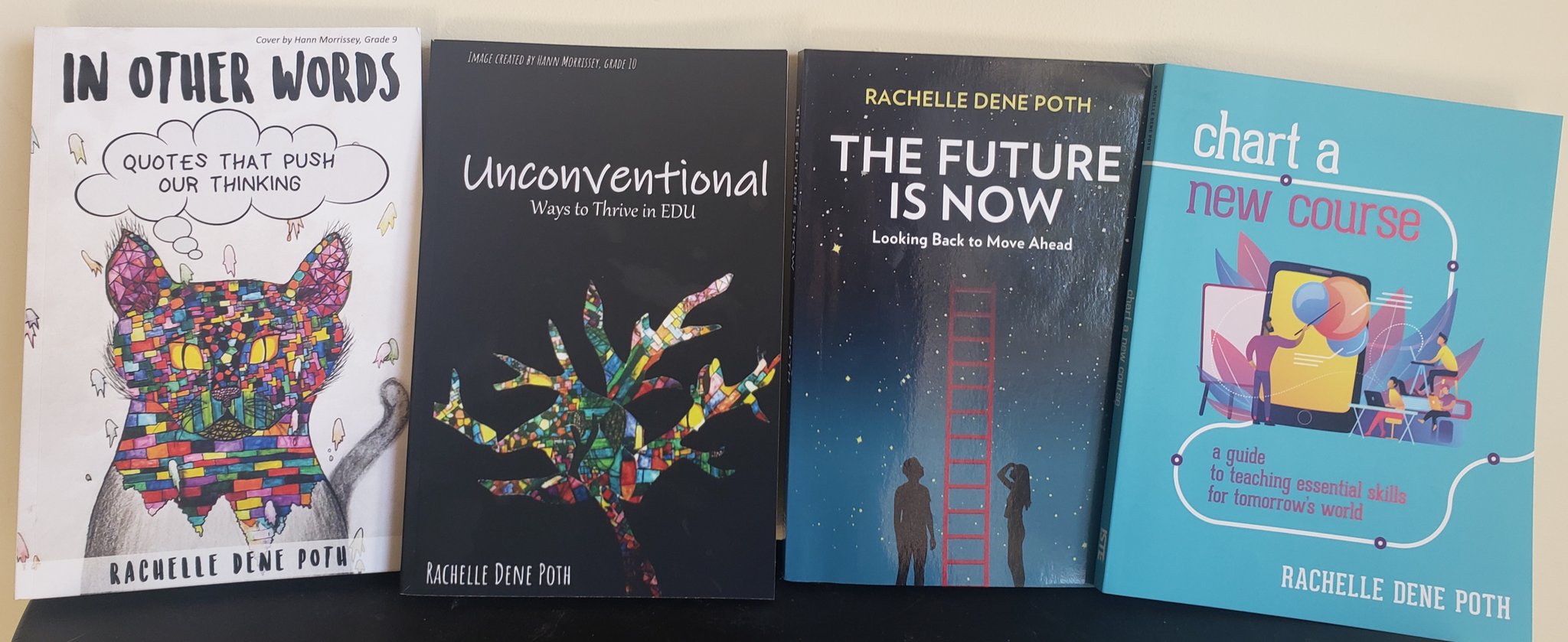
**Interested in writing a guest blog for my site? Would love to share your ideas! Submit your post here. Looking for a new book to read? Find these available at bit.ly/Pothbooks












 Libraries might seem dated, but they are in fact one of the best-kept secrets. We got library cards for our kids as soon as they could write their names. Today, cards can be used to check out everything from audiobooks to new release movies. Apps like Hoopla and Overdrive are amazing. With a library card, these two sites offer thousands of books, movies, and music. Giving kids the opportunity to borrow a stack of books without any cost is ideal for many families. Taking advantage of MEL, the state’s interlibrary loan program, allows people to request books from all over the state of Michigan and have them sent right to your local library. Showing someone how to use the library unlocks a world of possibility. Anything can be learned by using the public library. And, using the library saves a lot of money. Surrounding kids with books is one of the best things you can do to get them reading. The library makes reading an inexpensive activity. I am not alone when it comes to using the library. Several
  A few years ago one of my boys really got into hockey. We found all of the Matt Christopher books about hockey in the library, and he eagerly read each one cover to cover. Last summer my daughter was obsessed with learning about swimming. We raided the library for any nonfiction book we could find on the topic. During the winter it was graphic novels, and today she loves to dive into anything related to fairy tales. Even though I have a pretty good idea about what each of my kids likes to read, I had experiences where I selected a book or two I thought might be perfect, only to have them not show an interest in what I picked out. I do not take it personally, since there is no cost associated with it, and know that as a reader I don’t read every book I take home from the library.
 When I first started teaching, I would ask the parents of my really motivated readers who seemed to always be reading, “Tell me how you did it? What do you think has made the difference in getting your child excited about reading?” Almost every time I was given the same answer, “I suppose he just sees me reading all the time, and it just seemed like the thing to do. My nose is always in a book”.
 Exposure to good literature and authors is one of the best gifts we can give our readers. I absolutely love sharing some of my favorites with kids. Just as we could taste cheese, wine, sauces, desserts, or other menu items, book tastings are a great way to try new things. I typically put a book in front of each place setting. Each child will get a chart to list the title he or she tasted along with the author, genre, and the likelihood that he or she might read the book. The tasting is timed to keep it moving. And so after a total of several, ninety-second tastings, kids are able to walk away with several new titles that could be considerations for future reading. This activity can be adapted to any size (I have had great success with it in the classroom).
 There are times that I find my kids book hopping, and not finishing titles. I have also seen my kids plateau as readers. It is fun when we all work together and focus on completing a challenge that encourages reading and celebrating the success of others. It works well for us to keep a running list of books read on the refrigerator. We set a goal for a number of books to be read and immediately start brainstorming how to we will celebrate our success. It is nice to focus on working together and cheering each other on.


 Learning as I go: Reflections & lessons learned