
Technology is evolving at a pace we have never experienced before. There have been so many changes in the world through artificial intelligence, automation, data science, and other emerging technologies. These are reshaping industries in real time. As an educator, I feel this shift daily, and I try to push myself to keep learning and looking for opportunities to do more for my students. The challenge is no longer simply preparing students for a job. It’s knowing how to prepare them for careers that may not even exist yet and also supporting them as they develop a variety of skills to be prepared.
When I think about how to prepare students for the uncertainty around the world of work, I look at insights from the World Economic Forum and its Future of Jobs research. While AI was listed as #3 for 2027 and is now listed as #1 for 2030, the other rankings reinforce what we already know: adaptability, analytical thinking, creativity, and resilience are becoming increasingly important in our world.
If we cannot predict the careers that will exist five or ten years from now, the best we can do is prepare students to be flexible thinkers, confident problem-solvers, and ethical technology users. And this is why I believe that career-connected learning is essential.
Redefining “Career Ready”
When I thought about “career ready,” I aligned it with strong academics plus essential skills of communication, collaboration, and the other “soft skills.” These are still relevant and necessary for success, however with the changes in technology, there are other areas that I believe must be addressed and become part of preparing students to be career-ready. remain foundational. Now, I include:
- Digital and AI literacy
- Ethical reasoning in technology use
- Data awareness and cybersecurity knowledge
- The ability to evaluate and question AI-generated information
- Comfort navigating complex digital systems
Students need to understand how to use tools like generative AI. And that means using it to enhance and not replace their own learning. They can learn to brainstorm with AI, analyze outputs for bias or inaccuracy, and be able to recognize when human judgment must be at the forefront, providing consistent oversight. Research and interviews of employers have shown that employees will be expected to work alongside AI systems. That preparation has to begin in our classrooms from K through 12 and beyond.
Career-connected learning ensures students understand how what they are studying connects with real careers and real-world impact.
Why This Matters Now More Than Ever
According to projections highlighted by the World Economic Forum, millions of roles will be displaced due to automation, while millions of new ones will emerge. This is not the first time. More than 100 years ago, thousands of traffic light controllers in New York were displaced due to automation. They did not all lose their jobs, some shifted into others. And many of these new positions demand higher-order thinking, digital agility, and ethical decision-making.
I like to talk about some career options that minimally existed a few years ago:
- AI prompt engineer
- Ethical technologist
- Data privacy consultant
These are some of the many growing fields of work and some which are increasing because of AI. I think about how we are preparing our students and believe that career-connected learning will help to show the connections between classroom content and workforce relevance. I also believe this is something that can be done in every classroom and in all content areas.
What Does Career-Connected Learning Look Like?
Career-connected learning is more than occasional career days. It is something that is embedded into daily instruction, not an extra element. It can include a variety of possibilities, such as:
- Project-based learning connected to community or industry challenges. (Builds relevance for students).
- Integration of AI, data science, and emerging technologies
- Authentic problem-solving rooted in real scenarios
- Partnerships with local businesses, universities, or nonprofits
- Coding, AI, and cybersecurity challenges
Through opportunities like these, we can foster the development of student agency. When students understand how what they are learning connects to real opportunities, it sparks curiosity, increases students engagement and motivation. Learning is more purposeful, authentic, and meaningful.
Some ideas:
Artificial intelligence is an area that students need to understand. They need to know, how AI systems function, how to evaluate the outputs, how bias can be embedded, and what the ethical responsibilities are for using AI. In career-connected classrooms, AI might be used to discuss and explore how the legal field, healthcare and business industries, and schools are using AI tools. They can engage in role-playing that focuses on ethical decision-making. The goal is for students to leverage AI as a partner, rather than a replacement in learning.
STEM is a great option to focus on career-connected learning. In my own classroom experiences, I’ve seen what happens when students combine AI tools with engineering design, language learning, and problem-solving. When students train image classifiers and then collaborate, problem-solve, and evaluate where the model fails, they are not just learning about the technology, they are developing skills in critical analysis and bias detection.
Cybersecurity is another area that is seeing tremendous growth. Students need to understand how their data is collected, protected, and in some cases, misused. There are hundreds of thousands of cybersecurity roles unfilled in the United States alone, yet many students and perhaps even educators, have not heard of careers such as a threat analyst or a security operations engineer. Lessons on cybersecurity can be done in all classes. Here are some examples that I have shared:
- English: Analyze phishing emails as persuasive writing
- History: Debate privacy vs. security
- Math: Explore encryption models
- Technology: Investigate AI-related vulnerabilities
Career-ready also means a Human-Centered Future
With all of the technology, especially with AI and automation, we have to keep focused on what makes us uniquely human. Technology will continue to evolve, even faster than it has been. But empathy, integrity, resilience, and collaboration will always matter and we need to make sure that students develop these skills.
With career-connected learning opportunities, we will prepare students for success in the future, even in careers that don’t exist. We will offer opportunities for them to discover their interests and purpose and be prepared to embrace the changes they will encounter and be successful.
About Rachelle
Dr. Rachelle Dené Poth is a Spanish and STEAM: What’s Next in Emerging Technology Teacher. Rachelle is also an attorney with a Juris Doctor degree from Duquesne University School of Law and a Master’s in Instructional Technology. Rachelle received her Doctorate in Instructional Technology, with a research focus on AI and Professional Development. In addition to teaching, she is a full-time consultant and works with companies and organizations to provide PD, speaking, and consulting services. Contact Rachelle for your event!
Rachelle is an ISTE-certified educator and community leader who served as president of the ISTE Teacher Education Network. By EdTech Digest, she was named the EdTech Trendsetter of 2024, one of 30 K-12 IT Influencers to follow in 2021, and one of 150 Women Global EdTech Thought Leaders in 2022.
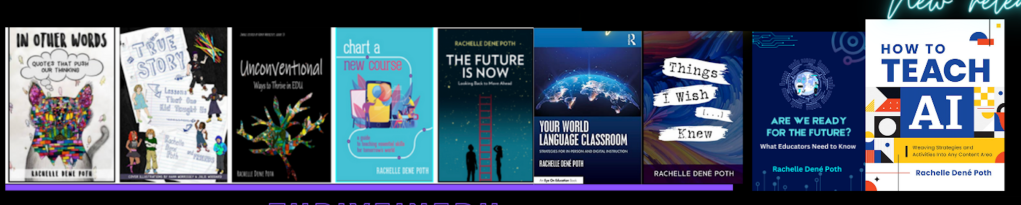
She is the author of ten books, including ‘What The Tech? An Educator’s Guide to AI, AR/VR, the Metaverse and More” and ‘How To Teach AI’. In addition, other books include, “In Other Words: Quotes That Push Our Thinking,” “Unconventional Ways to Thrive in EDU,” “The Future is Now: Looking Back to Move Ahead,” “Chart A New Course: A Guide to Teaching Essential Skills for Tomorrow’s World, “True Story: Lessons That One Kid Taught Us,” “Things I Wish […] Knew” and her newest “How To Teach AI” is available from ISTE or on Amazon.
Contact Rachelle to schedule sessions about Artificial Intelligence, AI and the Law, Coding, AR/VR, and more for your school or event! Submit the Contact Form.
Follow Rachelle on Bluesky, Instagram, and X at @Rdene915
**Interested in writing a guest blog for my site? Would love to share your ideas! Submit your post here. Looking for a new book to read? Find these available at bit.ly/Pothbooks
************ Also, check out my THRIVEinEDU Podcast Here!
Join my show on THRIVEinEDU on Facebook. Join the group here.






 Learning as I go: Reflections & lessons learned