Using a Lens of “Gratitude”-

Guest post by Debbie Tannenbaum (@TannenbaumTech)

This past week was probably the best week I have had since schools closed for COVID-19 on March 13, 2020. I have felt more productive, more centered and most of all, more focused. As I reflected on the week, I identified lots of things that I did differently this week, but one really stood out.

During my morning walk with my dog Monday morning, I was listening to an episode of George Couros’ podcast, The Innovators’ Mindset. In this episode, number 18, he shared five ideas for improving mental and physical health. Idea #1 was to approach life with a lens of “gratitude,” but he shared gratitude using a new approach to me. He explained after reading an article by Tim Denning called the Most Important Way to Measure Your Day, he modified what Denning shared to identify three simple questions to ask yourself daily.

  1. Did I learn one new thing today?
  2. Did I help or inspire one person:
  3. Did I show gratitude to someone who had a positive impact on me?

Prior to this , I had been recording 3 things that I was grateful for each day in my journal. So I decided to experiment with this practice this week and from Monday on, I answered the three questions above. I have to admit that I was amazed by its impact. Suddenly, I looked at each day as an opportunity.

  • What was I going to learn?
  • Who was I going to help or inspire?
  • How would I show gratitude to people who had a positive impact on me?

It is shocking how when you specifically focus on or are more aware of something how it reveals itself more often. That’s what happened to me this past week and it was transformational.

What did I learn this week?

I began the week by learning about the idea of framing gratitude with these three questions. This led me to be more conscious of other things I learned. The biggest thing that I learned this past week was the awareness of how it felt when you needed to persevere through a hard task. As my Monday blog post shared, this helped me have not only more empathy for my colleagues as I asked them to try new things this week during trainings, but more patience. It made me more reflective as I worked with my colleagues and increased my sense of gratitude as many took risks and tried new things using technology.

I also learned this week how much I missed interacting with students. I had not seen any students since March 13th, but this week, I was invited in to model technology into three classrooms. Yes, I was happy to share new ways to use some of my favorite edtech tools, but seeing those faces I missed so much, it made me realize how important my interactions and relationships with students are.

Who did I help or inspire this week?

This past week, I provided four trainings and had eight hours of virtual office hours. I knew that I had been busy, but writing down who and how I helped people made me feel so grateful to have the opportunity to help and inspire some many people.

This past week, fifteen people attended one of my trainings. Nine of them learned about Pear Deck, while three learned about EdPuzzle and another three learned about Flipgrid. In addition, sixteen people came to my virtual office hours. But two people specifically shared feedback that warmed my heart.

  • “You are a life saver.” One of my colleagues shared as I helped her learn how to trim the end of her synchronous learning session.
  • The band teacher at my school shared at our CLT how she was using Flipgrid to have students share their instrumental practice in a moderated grid and then was able to give them individualized feedback!

How did I show gratitude to people who made a positive impact on me?

This question helped me to ensure that I shared appreciation for those who had a positive impact on me. As a result, I ended up sending emails and tweets that I might not have sent otherwise.

The first group of people I thanked for their positive impact on me were the teachers who invited me into their synchronous sessions to model edtech this week. I wanted them and their students to know how much it meant to me to connect with students again. I also wanted them to know how much I appreciated them giving me some of their valuable synchronous minutes.

I also thanked some people who had made a positive impact on me through their suggestions of healthier habits. Last Saturday at a WW meeting, a friend suggested taking more movement breaks. I ended up adding circles to my journal and filling them in as I took more breaks. This Saturday, I thanked her for inspiring to add this healthy habit to my day. In addition, last Saturday, during a #crazyPLN chat, Matthew Joseph discussed training as a way to be more positive. I used to train- last year, I trained for my second half marathon. But since then, I have stopped running. Until now- this week, I began and completed Couch to 5K Week 1. I am so glad that I did this.

Lastly, I want to let George Couros know the positive impact that his blog made on me this past week. That is one of the reasons I wrote this week’s blog post. Like George, I am a work in progress. His strategies, especially the first one, really helped me this week and I hope me sharing this will encourage others to listen to his podcast and be as inspired as I am. As I begin this new week, I plan to continue these practices. I can’t wait to see what else I discover as I view life more using a lens of “gratitude.”


**Interested in writing a guest blog for my site? Would love to share your ideas! Submit your post here.


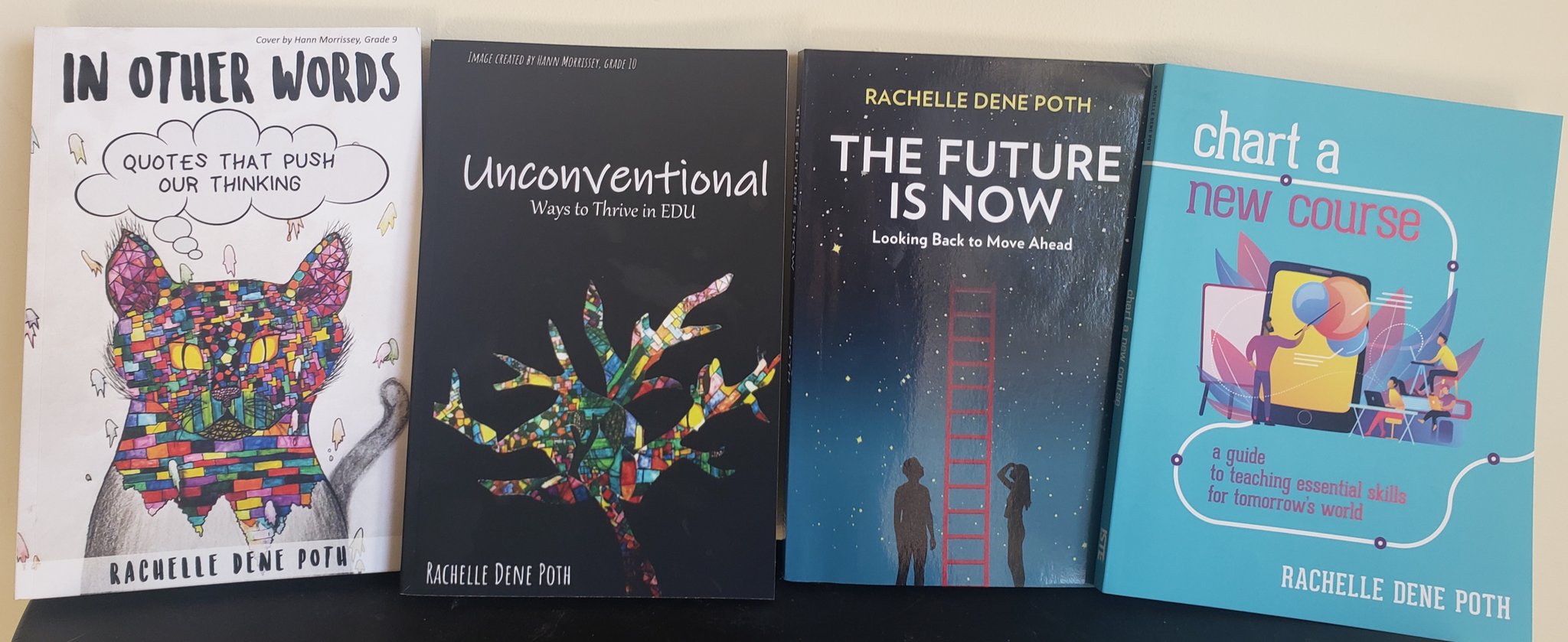
Looking for a new book to read? Many stories from educators, two student chapters, and a student-designed cover for In Other Words.

Find these available at bit.ly/Pothbooks  
 

When you feel like you’re not getting anywhere

Sometimes it’s difficult to figure out what the problem is or where to start when you feel like you’re not getting anywhere. What I mean is that as teachers, we may have days when we might feel like we’re just not connecting with the students. Sometimes when trying to create a lesson or some new experience for students, we are met with less enthusiasm than we had hoped for, and sometimes, it might even be nonexistent.

About two years ago, I really struggled with finding ways to engage my students in learning. I reached out to my PLN to ask for advice, I tried Twitter, pretty much anywhere that I could think of to gather ideas from other educators who might be experiencing the same thing. That’s probably the most important point if anything out of my thought process, is that had it not been for those connections and knowing where to look to find help that I greatly needed, I would have been working through it on my own in isolation, as I had been for many years of my teaching career.

It’s not easy to ask for help especially when as teachers, we feel like we are supposed to be the experts when it comes to students and learning and teaching. There may or may not be assumptions about our abilities to manage our classroom, deal with student behaviors, to be flexible in our instruction, and to balance so many different things every day. But without having a way of connecting with others, we would be stuck doing the same things we’ve always done. While in some cases that might be good if the experiences went well, often times it might not be that great. And that is how it was for me.

Last year is what I considered to be probably my best year in teaching and it came to be because of relationships I had formed over the years and also because I got away from doing some of the same traditional things I had always done and pushed the limits a little bit and tried some different things in my classroom. There were some things I just didn’t appreciate any more like standing in the front of the room and talking at my students. It was exhausting trying to think of ways to spend 42 minutes leading the class and keeping the students “busy.”

I had reached a breaking point early in September two years ago when I just decided to get rid of the rows in my classroom and see what would happen. The combination of these actions and everything in between is what I believe led me to have the best year yet. I felt connected with the students, I could see them learning and that they were more engaged. Students would come in throughout the day and say how much they liked class better than the prior-year. I just felt that there was a different vibe, I sensed a more of an excitement about being in the class and while at times it was uncomfortable worrying about if my class was too noisy or if students were off task on occasion, I really felt good about it

So I decided to keep the same kind of methods and habits in the new school year, making changes here and there, but I was not seeing the same results. I had different students than I had in the past and so it kind of led me to go back and rethink what I had been doing. What had worked so well last year was not working as well this year. I did not expect that because I was assuming that things would be the same as they were the year before. Thinking like this, the “way we’ve always done it” is what gave me some trouble in the first place. I taught the way I had been taught using methods that worked for me as a student and even as an adult, but these methods did not work for all of my students. So by doing that I was doing them a disservice. Flash forward to this school year, trying to use the same methods and strategies should not work because I had different students than the year before.

There have been days that I left school feeling frustrated and overwhelmed, a bit uneasy because like I said, last year I had a great year. And I had not experienced that type of struggle in several years. so trying to figure out what the problem was and how to work through it has been something I’ve been working ever since. I felt some moments of success and other times I thought I just couldn’t do it anymore. Sometimes I became so frustrated at the behaviors, whether it be lack of respect or lack of wanting to work or negative attitudes that instead of trying to better understand the students and focus on having conversations, I responded to their behaviors and the reactions. I lost my “cool,” I lost my composure, my eyes filled with tears of frustration and I didn’t like it. I even told them that it was something that would bother me the rest of the day and for days to come, because that was not like me but I had “had it.” I had been doing everything that I thought I could to help them and I was getting nothing or the bare minimum in return. I just wanted them to hear me and to understand that their behavior matters. Being respectful matters, and that it doesn’t matter how great your grades are or what you have in life if you are not a nice person. If you do not show respect and you don’t take time to listen to others and give them their attention when they ask for it or when they deserve it, that makes it very uncomfortable.

I thought it was just me, I had convinced myself that it was something that I was not doing. There was something wrong with me that I needed to fix within myself. But the more that I talked to people I was connected with locally, nationally and even around the world, I soon realized it was not just a problem that I was facing. Again, if I was still in isolation staying in my room and not connecting anywhere in my school building, I would feel exactly like I did. It’s just me, I’m the problem. Because I had those connections, I was able to recognize that it isn’t just me it’s a struggle other educators face and there are different ways that they deal with it that may or may not work for me.

I had lots of recommendations, great ideas, stories of how changes in different classrooms made a big difference for different friends of mine and for every suggestion they offered I felt terrible telling them that know it just would not work for me. While I may not have all the answers, I know my students well enough to be able to figure out what might and might not work for them. So while I did not come up with a magic solution to any of the challenges that I feel like I’m facing, which in the scheme of things in the rest of the world they’re not that big at all. But there are bumps in the road, a road which prior to this year had finally been mostly well paved with occasional potholes along the way.

But a new year, new challenges changes just to show why we can’t teach every year the same way that we were taught. You can’t do things the way you’ve always done them and as Don Wettrick’s dad said: “Don’t teach the same year 20 times.”

I guess I felt that because my methods worked so well last year, that I should just do the same thing again this year. I was wrong. New year, new beginnings, some changes, a bit of discomfort, challenges, through all of it. Yes, please. That’s what keeps us moving, what keeps us active and engaged and although sometimes you feel like you’re becoming disengaged from the profession when you sit back at the end of the day or in the middle of the day or whenever it is that you reflect, you must stay focused on your why. The why is your purpose, your passion for what you do and why you’ve gotten up early every morning and worked through weekends, holidays and even summer vacations. It is when you come full circle and realize that you’re there to make it work to find an answer and a solution because it might be that you are the problem

And sometimes you might be the problem creator, it’s never the same. It’s always changing, it’s uncomfortable but it’s how we grow. And if you don’t share your experiences with others then you are going to be limited to only growing in your own space. To put yourself out there, be vulnerable and ask for help when you need it, that is not a sign of weakness it’s a sign of tremendous strength. When you can identify that you have a need, a weakness, an area of struggle, you show that you are vulnerable and that is more than okay. Because as many times as I’ve said it, I will continue to say it twice as much:

I’m not an expert.

I don’t know everything.

I make tons of mistakes every single day.

I’m willing to try and I’m willing to grow.

I’m willing to get up no matter how many times I’m knocked down and go for it again.

I am a work in progress and I am learning as I go. 


**Interested in writing a guest blog for my site? Would love to share your ideas! Submit your post here.


Looking for a new book to read? Many stories from educators, two student chapters, and a student-designed cover for In Other Words.

Find these available at bit.ly/Pothbooks  


Finding Peace and Balance


Guest post by Karl O’Leary, @KarlOLeary4, High School Principal

The new normal has looked very different for all of us. From work, to family, to personal lifestyles, so much has changed to acclimate to what we need to do for our society. The old manner of taking time to have space, sit down dinners to review your children’s day at school, and the weekend at sporting events looks drastically different. But does it have to?

Peace and Balance

What does is mean? Peace has been connected to the long-haired hippie days of Woodstock and tie dye colored shirts. This is a misconception of perception. Finding Peace within yourself enables you to:

  • Look inwardly and reflect about how you live your life.
  • Be true to yourself.
  • Maintain a positive mental attitude (PMA).
  • Do good toward others.

This can be in mediation, or reflection, or journaling. Taking the time to look in the mirror to assess yourself and what you do can provide opportunities to reconnect with your passions. Start with the question: Am I being what I wish to be?

Balance is connected to daily routines and activities. Like any pie chart, listing what activities are done each day provides a visual to understand where time is spent. Finding Balance entails making the necessary goals for living life how you wish.

What is different now is everything! But there are opportunities with how change exists.

  • Find time to take the morning walk
  • Incorporate routine
  • Have fun with family in a different manner
  • Leave work for work hours
  • Be realistic with expectations

The new Balance does require for some phone calls outside the old hours, but there is also opportunity to not send information late to others. By flipping the conversation, would you wish to have your child’s teacher email you during dinner, or family time? That time can be used for reflection and relaxation. Balance the need to send assignments outside of school hours; the email will still be there in the morning!

The new normal of Peace and Balance are what we make it to be. There are so many great opportunities to connect, at a low or free cost, to try what we have always wanted to. Look inwardly to reassess our daily activities and press the reset for moving forward.


**Interested in writing a guest blog for my site? Would love to share your ideas! Submit your post here.


Looking for a new book to read? Many stories from educators, two student chapters, and a student-designed cover for In Other Words.

Find these available at bit.ly/Pothbooks  

Why Making Time for Reflection Matters: 5 Ideas to Try

Some recent ideas I have shared, by @rdene915

Reflection is an important act that regardless of your profession or role, is something that we all need to take part in regularly. On a daily basis, the interactions we have, the actions we take, and the decisions we make, likely have an impact on someone else, ourselves, or otherwise that we may never be aware of. Personally, reflecting was not something that I had always done. As a student in high school and growing up, I had a diary that I wrote in quite often, which at the time, I didn’t realize that I was in fact reflecting. But looking back now, that’s exactly what I was doing.

As a teacher, for many of my beginning years, mentors would ask for my thoughts on a lesson that I had taught or my principals would discuss their observations with me and ask me to reflect on my lesson. Whether it was to reflect on the choice in the activities I had used in my lesson or they offered additional questions in order to help me think through my methods and set new goals. But other than those experiences, reflecting was not something that I could say I did on a regular basis. I was not intentional about it and did not fully realize the importance of doing so for many years.

Why We Must Practice Reflection

In order to bring our best selves into our classrooms each day, we must evaluate our own practice and use a reflective process to grow professionally. We also need to help our students develop these skills and because of our role, it is important that we model reflection and provide different ways for our students to reflect as well. Not only will we help them build their skills, become self-aware and develop a greater understanding of their interests and needs, but we will also provide them with learning experiences that will benefit them in the future regardless of where their education takes them or which careers they pursue later on in life. Doing this will also help us continue to engage in the practice ourselves, and enable us to reflect with our students by asking for their feedback and working on goals together. However, not everyone feels comfortable expressing themselves in the same way, which is why it’s important to have different options available for engaging in the practice of reflection.

Here are some ways that you can incorporate reflection in your daily practice as well as include it as part of the work you do with students and colleagues. There is an idea here that can match your interests, needs and even time and place constraints,

  1. Old-fashioned pen and paper. Take time to jot down thoughts at certain periods throughout the day. For some people, trying to remember to write notes down throughout the day can be overwhelming, so instead pick a specific point in the day where it can become part of your routine. Grab a notepad or a special journal that you use, anything that makes sense to you. Make the effort to write down at least one thing or a few things each day and then the next day review your thoughts. See what you could change, if you want to change anything and how you can improve a little bit from the prior day. I used this practice with my students years ago, as a daily journal entry in Spanish and gave them questions to consider as prompts. It can also be a good practice to include in your daily activities.
  2. Blogging has become a great outlet for many educators to share the work they’re doing in their classroom, to express challenges or frustrations, or share positive thoughts or anything in between. Incorporating blogging into the classroom is also good for students for many reasons beyond just simply enhancing their writing and literacy skills. By using digital tools for this purpose, we can also promote peer collaboration, digital citizenship skills and it helps to build a solid online presence. Students can build their reflective skills with their peers and develop communication skills and better understand the importance and power of feedback.
  3. Podcasting can also be effective for reflection. Create your own podcast and invite people to listen to your thoughts, respond in a thread or simply create a podcast just for your own purpose of listening and reviewing. There are many free tools out there to use including Anchor and Synth, and who knows, it just might be something that you decide to pursue on a more regular basis and share with other educators in your PLN.
  4. Voxer is a walkie-talkie messaging app that can be used for anything ranging from recording voice memos for yourself, participating in synchronous or asynchronous discussions, connecting with other educators from around the world. It can be used for participating in a book study, having a topic and engaging with colleagues about specific discussion points and reflecting together. Voxer makes it easier to “think out loud” and then be able to process your thoughts. It is also a convenient way to communicate to meet everybody’s schedule and location. Students in my classes have also used it for their project-based learning to share ideas with me and to reflect on the work they have done and to ask questions and feedback.
  5. Videos. There are a lot of options out there for recording oneself while teaching, Swivl, as well as some online web applications that school districts can use. Although it can feel uncomfortable, especially watching yourself teach, it’s really good to be able to analyze your teaching practices, evaluate your rate of speech, how well you explained ideas, the involvement of your students, and many more important components of teaching. Having a video recording of a lesson or lessons that you’ve taught, are great ways to reflect because it gives you the chance to go back and really focus on key parts of your lesson delivery. You can also use these videos to share with a supportive group and use as a way to give one another feedback

Reflecting is important for all of us because it’s how we evaluate our actions. We can explore who we are, whether looking at the qualities and traits that we convey to others, our behaviors and how we interact with other people. It’s important that we continue to understand ourselves and to work on bringing our best selves to our families every day and to those with whom we work. When we work on this together, we will have it become a regular part of our daily practice and will continue to grow. We will also empower our students and those we lead with this powerful practice for personal and professional growth.


**Interested in writing a guest blog for my site? Would love to share your ideas! Submit your post here.


Looking for a new book to read? Many stories from educators, two student chapters, and a student-designed cover for In Other Words.

Find these available at bit.ly/Pothbooks  

A focus on Learning… in a “Remote World”

Guest post by: Whittney Smith, Ed.D. (@whittneysmith_) is the Principal at Mineola High School. You can follow the work done by our amazing students and teachers by following us at @mineolahs on both Twitter and Instagram.

In high schools across New York State there is always talk of the Regents Exam. This exam has been the focus of teachers since 1878 when the first high school exams were given. On April 6, 2020, that changed… at least for the time being. 

Now what?  I think we now have the unique opportunity to focus on learning, not the test anymore.  While we rely solely on remote learning opportunities… our ability to leverage technology will certainly accelerate our ability to focus on student agency. Some cynics will say that without a Regents Exam, the students will not be motivated anymore, they’re going to “check out.” I don’t think so. Instead, I believe we need to seize this opportunity and engage our students.  Remember that first and foremost we teach students, then we teach content… and remember, children are naturally curious, want to make connections, and desire learning things that are relevant to them; things that are real. 

When we were thrust into this remote world as we walked out of our schools on March 13, 2020,  I sent an email to the faculty. I will never forget that email. Along with a remote learning planning guide, I sent teachers my phone numbers and those of my assistant principals’, so they could reach us at any time.  I wanted them to know that we cared about them as people first; we cared about their social and emotional well being just as we wanted them to care for our students and their families.

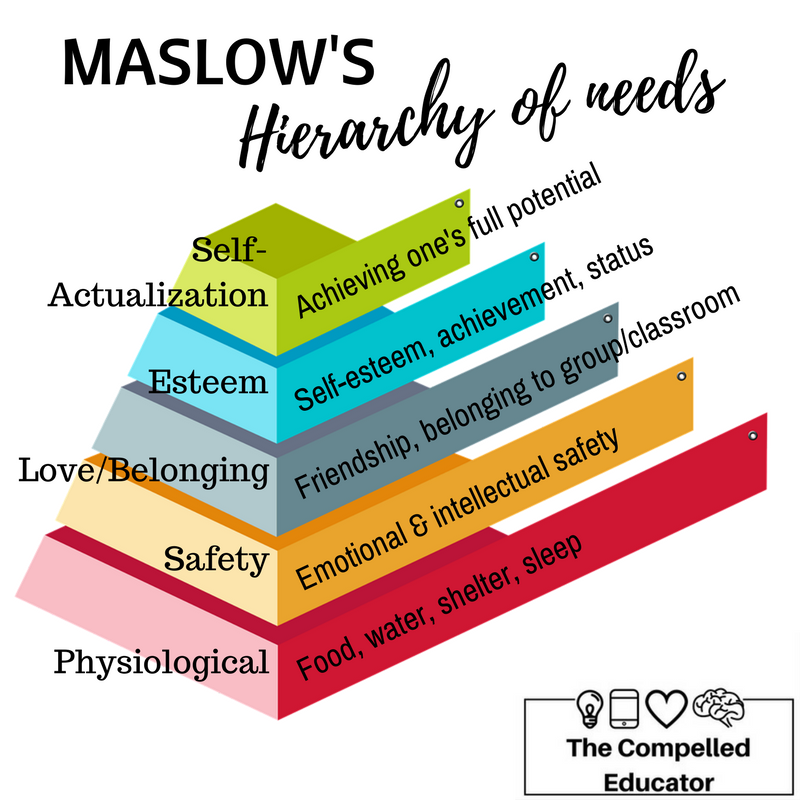
In the educational world we hear a lot about “Maslow before Blooms;” in other words, we need to take into account the hierarchy of human needs before the hierarchy of human learning. 

Next, I asked our educators to reflect on remote learning and consider the following while they focused on what remote learning would look like in their ‘new’ classrooms.

  • Emphasize Choice – allowing students to choose how they demonstrate their learning will increase completion and help them navigate misconceptions
  • Emphasize Learning and Not Grades – when students are not concerned about “the grade,” they are more likely to learn the material on their own, rather than “collaborating” with others (unless that is what you intend them to do). 
  • Direct All Student & Teacher Tech Related Issues to Bonnie and Katie (they are our Coordinators of Information Technology (CITs) and can do just about anything… and know who to reach out to when they can’t)).
  • Last but not least (for now) —> If you are having difficulty reaching a student (e.g. they are not responding) please reach out to our mental health team. They are counseling students and are ready to assist in any way possible.

Never did I think that I would be writing this post on April 30, 2020 (30 days into an extended school closure) telling you that the Regents exams have been canceled. 

Now is the time to tap into student interests and passions.

Now is the time to focus on strengths.

​Now is the time to give choice.

Now is the time to leverage creation tools. Whether it is a product to create or a problem to solve, allow students to determine how they demonstrate and share their learning. 

Now is the time to shift the paradigm  as we are  not going to take high stakes, multiple choice tests! Let’s do what we’ve always wanted to do… make learning fun!


Bloom’s Taxonomy graphic taken from: https://mylearningnetwork.com/blooming-as-a-learner/ 


**Interested in writing a guest blog for my site? Would love to share your ideas! Submit your post here.


Looking for a new book to read? Many stories from educators, two student chapters, and a student-designed cover for In Other Words.

Find these available at bit.ly/Pothbooks  


Guest Post: 5 Ways to Empower Your Students with OneNote

Guest Post by: Jeni Long & Sallee Clark, @salleeclark @Jlo731 @Jenallee1

Instructional Technologists from Eagle Mountain Saginaw ISD, Ft Worth, TX

#Jenallee #MIEExpert #MicrosoftEDU #Onederful

https://linktr.ee/thejenalleeshow

As you probably know by now, #Jenallee LOVES OneNote! We feel it is one of the best educational technology applications for our students for many reasons. (Check out the original post here).

  1. When we look at using technology, we do not look at the technology first and then decide what to teach… We look at what our learning objective is and then we select an application to fit our goals. Because OneNote offers a vast amount of educational benefits, we like suggesting it for teachers to utilize. Through using OneNote, teachers can help their students master their learning objectives first, while also utilizing one application versus a new app each week.
  2. One phrase we use a lot with teachers is to “Select an educational technology application and own it”. Meaning, don’t get overwhelmed with all of the different applications available, yet select one and learn how to use it in your classroom well. Own that one app and then move on to another when you are ready.
  3. With OneNote, students have the opportunity to learn through research based strategies including the ability to:
    • Justify their work both verbally and through writing
    • See worked examples in action
    • Listen to direct instruction or videos of instruction
    • Collaborate with their peers
    • Receive timely feedback from their teachers
    • And so much more

All of this is great but the real question is how? Here are 5 ways we use OneNote to empower our students.

#1 Student Portfolios

Student portfolios offer students the ability to create products, evaluate their creations, revise their products, and curate their best work throughout the year. It allows the students time to reflect upon their growth, set goals and truly see the evidence, purpose, & benefit of their learning. Read this blog post to see step by step directions on how to create and implement student portfolios in the K-3 classroom.

#2 Worked Examples

Recently we ran across a great article online written by Shaun Killian, “8 Strategies Robert Marzano & John Hattie Agree On” We really enjoyed reading this article because it showed the strategies both researchers found in their study of how students learn. One of the strategies both agreed upon was utilizing direct instruction.

Robert Marzano claims, “It is important to explicitly teach your students,” while Hattie says, “Direct Instruction involves explicitly teaching a carefully sequenced curriculum. And, it has built-in cumulative practice.” Hattie also highlighted the power of giving students worked examples.

OneNote makes it easy for teachers to implement this strategy into their daily instruction.

Here’s How:

  • Teachers can directly teach their students specific content from OneNote. It is an infinite white board! It goes on and on and on. The draw feature offers teachers ease in writing content (space pen is our favorite), highlighting content to be learned, and it automatically saves and updates in student notebooks or shared OneNotes! Boom! You just provided your students with class notes so that they can refer back to your content at any time.
  • We love the replay feature. Work out a math problem, label a diagram, fill in the blanks, and students can “replay” those steps at a later time. Once class is over and students want to review the content taught, they can simply click on View > Replay and see the steps replayed as many times as needed!! Did you catch that? As many times as needed! This is powerful and empowering for students! Check it out in action below

Replay ink strokes in OneNote for Windows 10

  • Don’t want to write? No problem! OneNote allows you to insert a printout of any PDF, Word, or image into OneNote. Why is this beneficial? Well, now students can follow along and make their own notes, highlight, and learn as you directly tell them the content to be learned with examples of what to do and what not to do.
  • According to Sebastian Waack and his Visible Learning chart of Hattie’s strategies, video review of lessons has a .88 effect size! Wow! This is also a way to provide examples for students that explicitly teach the content. OneNote makes it easy to embed YouTube videos into your pages! Simply copy the link and paste it in the page. All students can view the video in your OneNote.

#3 OneNote Breakouts

Looking for a way to help your students engage in problem solving and bring a slightly competitive gaming aspect into learning? Try using a OneNote Breakout! In the same article mentioned above by Shaun Killian, “8 Strategies Robert Marzano & John Hattie Agree On” It is also mentioned that both Marzano and Hattie both agree that problem solving and collaboration are high yield strategies. OneNote Breakouts offer students the ability to engage in solving relative problems in a collaborative way. This allows students to apply their knowledge of concepts to solve problems. “They also agree that inter-group competition can increase the effect of cooperative learning even more.” Breakouts are the way to go!

How does it work?

Students work together to “Breakout or escape” a series of challenges all housed in a OneNote. We complete this by locking pages in a OneNote and students reveal the lock combinations through completing various challenges utilizing their knowledge of concepts. Find out more about how we create and use breakouts with our students in this blog post.

#4 Feedback

We also know from Visible Learning that offering feedback has .70 effect size! Wow! OneNote offers teachers a powerful and meaningful way to give feedback to students. While students are working on content, teachers can access and see their progress. We want to offer our students feedback during the entirety of their work, not just at the end of a project. OneNote allows teachers to see student progress in real time, leave feedback throughout the process, and truly impact learning.

#5 Differentiation

OneNote offers teachers ease in differentiating content and providing accommodations for students. With the ability to distribute pages, teachers can distribute specific content to specific students, groups, or the entire class. That means you can distribute articles to groups of students according to reading level, or chunk assignments for certain students, or provide graphic organizers to specific students, etc. This allows the teacher the ability to scaffold instruction for their students strategically and with ease.

Not only can I send out individualized assignments, I can also empower my students with access to content. Students that may struggle with reading, writing, have dyslexia or ADHD, etc. are empowered by the learning tools that are built in to OneNote! According to Visible Learning, we see that when students with learning needs utilize technology, the effect size is 0.57. Utilizing OneNote with these students is a great way to empower them to be able to access content on their own, read on their own, and to write on their own. Let’s just say… they own their learning. We think Mike Tholfsen, Microsoft Product Manager, says it best!

OneNote Learning Tools are non-stigmatizing, mainstream, built in, and free.

So what are Learning Tools? These are tools built into Microsoft OneNote, Word, Forms, and many other partner companies. See the list of partner companies below

These tools include:

Immersive Reader – Reads any typed text, PDF, or word documents to the students!

Features include:

  • Human like recorded voices in both male and female
  • Reading speed settings
  • Customization for background color
  • Font options
  • Grammar options
  • Line focus
  • Picture dictionary
  • Translates a word or the entire document into over 80 different languages (yes, it still reads many of these languages!)
  • https://youtu.be/3n5emMEm3

Check out these click by click tutorials by MicrosoftEDU!

Want to see how we use Microsoft OneNote to offer our students audio tests? Check out this Jenallee blog post.

Recently we shared all of these ways and more on an episode of Ditch That Textbook with Matt Miller and Holly Clark. Watch the episode to learn more.

https://youtu.be/HopiR25ZlH8


**Interested in writing a guest blog for my site? Would love to share your ideas! Submit your post here.


Looking for a new book to read? Many stories from educators, two student chapters, and a student-designed cover for In Other Words.

Find these available at bit.ly/Pothbooks  


What we deny

Check out the Podcast too: “Just Conversations” with Melanie White and Amanda Potts. https://voiced.ca/project/just-conversations/

Only in our isolation and disconnectedness do we discover that everything and everyone is localized and connected. And, in this distancing, I am beginning to question what we deny.

Rebecca Solnit kept appearing in my daily consumption of media and I’m beginning to wonder if this is the work of a latent existential force drawing my attention to something I should have known or done long ago. I listened to her voice in an episode of On Being last week. She wrote, “When all the ordinary divides and patterns are shattered, people step up to become their brothers’ keepers…and that purposefulness and connectedness bring joy even amidst death, chaos, fear, and loss.” The unusual lilt of her voice and calm intellect still spin in my mind’s ear. And, this morning, I stopped scrolling my Twitter feed struck by this linguistic wisdom. She wrote,

“Inside the word ’emergency’ is ’emerge’; from an emergency new things come forth. The old certainties are crumbling fast, but danger and possibility are sisters.” #RebeccaSolnit

And then on Twitter, Gianpiero Petriglieri wrote that an “old therapist friend” told him why everyone was “so exhausted after video calls. It’s the plausible deniability of each other’s absence. Our minds tricked into the idea of being together when our bodies feel we’re not. Dissonance is exhausting. Our bodies process so much context…” I stopped to think about that wording, “plausible deniability”, and the more common legalistic use for one escaping criminal repercussions as a member of a corrupt organization or political power.

However, I couldn’t wrap my head around this experience of dissonance and the connotations of “plausible deniability” as something happening to us rather than something we choose to avoid like the truth or an injustice. According to Wikipedia“the expression was first used by the CIA” but the idea apparently has a longer history. I needed to understand the term, like Solnit explored “emergency”; it was an itch that pressed me, so I read further. “Plausible denial involves the creation of power structures and chains of command loose and informal enough to be denied if necessary”.

Then a thought struck me. What power structures are currently in place which I deny? What small almost imperceptible movements have made me complicit in this dance of distraction? Solnit reappeared during my longer moment of breakfast reading in The Guardian article entitled: “The impossible has already happened: what coronavirus can teach us about hope”. How marvelous and uplifting it is to read her vibrant words calling us to action and existence, to make the most of the worst.

While I cannot deny there is absence in my new-found isolation, I can also see that my thoughts attend a new experience. I am paying attention to moving about my house, to walking the dog, to gazing out the window with no real productivity pressure of this instant. And, yes, I am teaching remotely, but connecting, supporting personalized learning is my focus rather than a product on the line of academic factory life. This is where I cannot sense Petriglieri’s Tweet about “plausible deniability”. I am now working on processing the context of my daily life which I previously ignored in mind-numbing haste consumed by the blind goals of my own productivity or some socialized version of productivity.

My body is processing the context of my life in isolation and thinking about the actions needed for when we might connect again. I am trying not to deny my own physical interaction with and existence in the world.


**Interested in writing a guest blog for my site? Would love to share your ideas! Submit your post here.


Looking for a new book to read? Many stories from educators, two student chapters, and a student-designed cover for In Other Words.

Find these available at bit.ly/Pothbooks  

Connecting Students through Buncee

Leveraging  the right tools for remote learning

By Rachelle Dene Poth, Spanish and STEAM Teacher, @Rdene915

One of the things that I love the most about ​Buncee is that it can be used in so many different ways, not only for instruction in our classrooms but also in life. I have used Buncee to create cards for family and friends, personal business cards, graphics for Twitter chats and webinars, quote graphics for my books, invitations, and more. When I decide to use digital tools in my classroom, I want students to practice the content in a more authentic and engaging way, while developing skills such as collaboration, critical thinking, problem-solving, and creativity that can be transferred to their future. In using digital tools like Buncee, my hope is that they will also use them in other classes, for personal use, and will share them with family too.


Buncee is more than just a creation tool, it is a supportive educator network that is invested in fostering connections, expressing kindness and gratitude. There have been  many initiatives for classrooms and families around the world to join in, most recently Hugs for Heroes. This is an amazing project worked on by Kristina Holzweiss, Barbie Monty and Amy Storer. Learn more about itand create your own!

Why Buncee?

Now with the shift to remote learning and educators looking for ways to connect with students and provide authentic and meaningful learning opportunities, I have been recommending Buncee more. As a multimedia creation tool, it offers so many possibilities for educators of any  content area or grade level, and provides resources for students, families and educators to get started right away. For ideas, check out some of the  Coffee Talks!

Finding time to explore new resources can be a challenge because our lives as educators become quite busy and we may find ourselves lacking in time to really explore a variety of options for use in our classroom. With the sudden transition to remote instruction, this is another one of the reasons that I recommend and choose Buncee and appreciate the team’s investment in providing exactly what educators, students and their families need. It truly has become a go to multi-purpose platform that can do so much, that I feel pretty comfortable in saying that the possibilities really are endless when it comes to creation with Buncee.

null

Fostering the SEL skills and making connections

At the start of each school year and throughout the year, I focus my efforts on student relationships, learning about my students and also providing opportunities for them to learn about one another. In the past I have done this by using activities in our classroom such as ice breakers or having students work together on different review games and other in class collaborations like that. Earlier this year I created a project for students to learn about the Spanish language and culture and also to engage more in learning about one another. I came up with a project focused on using the “About Me” template in Buncee. I wanted students to share who they were and create one slide to show this using words, animations, stickers, and other add-ins. My hope was that by looking at each student’s slide, we would understand one another better and relate to each other based on similarities and differences.

I also thought this would be a good opportunity for them to choose and learn a little about a place where Spanish is spoken and create an “About_(​country​)_____” to share that information with the rest of the class. But I also realize that there are many students who are visual learners like me and I wanted to encourage students to be able to quickly look at and process information and represent it in a different way. Rather than simply restating the same content, push them to apply it at a higher level or find a different way to demonstrate an understanding of a concept.

null

I also wanted students to choose a Spanish speaking country and I placed a limit on the number of actual words they could use because I wanted them to represent what they had learned about the place that had chosen using the Buncee features. The topics they had to include were: languages spoken, school subjects, foods, activities, and other information like that that they could display using Buncee.

How did it go?

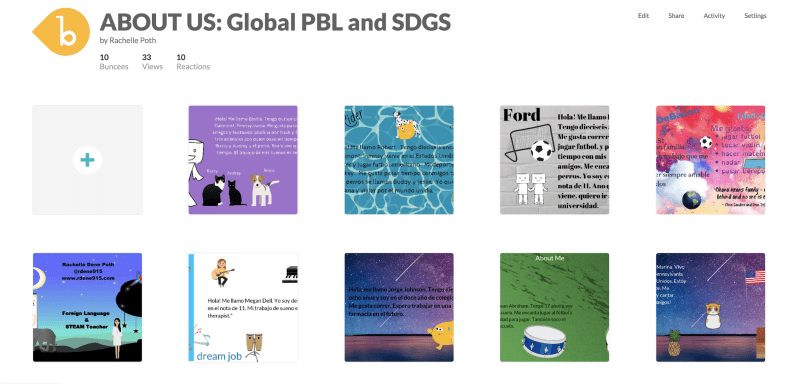
It was a fun activity and I learned so much about them and they learned about each other and what life is like in countries where Spanish is spoken. We shared them on a Buncee board ​which made it easy to access and created a colorful display of students and their creativity. Students shared their slides and gave a brief description in Spanish about themselves and made connections with their classmates. We had good conversations exchanging our likes, dislikes, and learning about our backgrounds.

For the second slide, students were able to get a quick glimpse of different Spanish-speaking countries and begin to understand the culture of some of the places they would be studying. It was fun that they could only include 3D objects, animations, stickers or emojis, to represent the information for each country. So for visual learners, being able to choose the right object to use to share this information made the learning stick a little bit more. Students who enjoy creating but not drawing really enjoyed the activity.

A recent feature is the ability for students to comment and give feedback on the boards. This is a great way to encourage online student interaction whether through comments or emojis!

nullOne other feature that I thought was important to share with students was the new Immersive Reader and how it works. We enjoyed looking at all of the capabilities with it and using Buncee for learning!  Check out the video to learn more here!

Check out  the information from Buncee for Remote Learning and everything you need to get started here.  Want to learn more about  Buncee? Sign up for their live webinars happening each day, Monday through Friday  at 12:00 and 3:00 pm EST. Sign up here.


**Interested in writing a guest blog for my site? Would love to share your ideas! Submit your post here.


Looking for a new book to read? Many stories from educators, two student chapters, and a student-designed cover for In Other Words.

Find these available at bit.ly/Pothbooks  

An In-Home Learning Strategy for Busy Quarantine Families

Guest post byAndrew Easton: teacher, edu-blogger, podcaster, and future author for Dave Burgess Consulting Inc. Follow him on Twitter @EastonA1, on Instagram @andrew.d.easton, or at andrewdeaston.com/


In our household there are two teachers and two primary-age students, and during our first week staying at home, we had a problem. As adults, we still have work responsibilities, and at ages 5 and 8, the kids need help navigating the five subjects of schoolwork they receive each day.

Our first thought was to set a schedule so that routines would be established. In that way, designated times would kick-start certain subjects and tasks. 

Fail. 

What we quickly realized was that sometimes the kids needed support with certain tasks, and if there happened to be a Zoom staff meeting or any other commitment that prevented us from supporting them in that immediate moment, the structure fell apart. The schedule needed more flexibility.

Then, we tried a checklist.

Fail.

Next, we tried using a checklist. I mean, who doesn’t love the feeling of crossing things off your to-do list?!? Well, the answer to that is my children. Even though a checklist does not have to be done in a specific order, don’t try telling that to them. The checklist was frustrating, and stopping a task to take a break routinely killed all their motivation to continue on with their work.


Finally, an answer.

Recognizing the shortcomings of our initial attempts, we felt optimistic about using a “To-Do, Doing, Done” board. The idea was that each day we would write down each item on their to-do list on a separate post-it note. Those post-its get placed in their “To-Do” column, and then as they start a task, the post-it moves to the “Doing” column. Once complete, it gets moved to “Done” and five completed tasks earns a sticker that is worth 30 minutes of free time.

Success.

Here’s what’s happened since we started. The kids now wake up each morning and run to their board to search through their list for the day. We intentionally scatter the post-its so that there is no implied order, and we like to put a fun, surprise activity on a post-it and hide it in the mix. 

Oh, and in case you are wondering, yes, chores also go on post-its.

The “Doing” column has also been a godsend. There are times throughout the day when our responsibilities as adults make us momentarily unavailable to lead them through a portion of their work. The kids now know that they can leave a task in the “Doing” column and start something else if an adult is busy.

The “Doing” column has also been great for motivation. When the kids choose to stop mid-activity, we ask them to reflect on how close they are to finishing and to move that post-it to the place between the start/finish lines in the “Doing” column that reflects just how close they are to completing that task. Last week, my daughter had stopped her writing earlier in the day, but she was bent on moving the post-it to done. Seeing just how close she was to finishing, she, unprompted, wrote for an additional 30 minutes later that night.


Overall, this board has made our household happier and more productive. It’s helped us to maintain a more positive learning dynamic during these stressful times, which is why I wanted to share our story. I hope this strategy can help you! 


So from our family to yours, please know that we are thinking about you all and are sending our best wishes your way.


**Interested in writing a guest blog for my site? Would love to share your ideas! Submit your post here.


Looking for a new book to read? Many stories from educators, two student chapters, and a student-designed cover for In Other Words.

Find these available at bit.ly/Pothbooks  

Teaching HardDoes Not Always Equate to Teaching Well

Opinions expressed are those of Guest Blogger

Guest Post by Kwame Sarfo-Mensah, Founder of Identity Talk Consulting, LLC. (www.identitytalk4educators.com

Math Educator & Teacher Development Specialist, @identityshaper


I have been in many situations throughout my teaching career where I spent countless hours planning, what I thought, was the greatest lesson ever!   I then delivered the lesson plan with the expectation that all of my students will be successful. Over the course of the unit, I provided classwork & homework assignments, conducted small group instruction for students in need of additional support, sacrificed my lunch periods to tutor struggling students, and pretty much did everything in my power to reach all of my scholars.  After weeks of teaching my heart out, I gave my students an end-of-unit test with the confidence that all my efforts would translate to passing test scores. To my dismay, the converse of that expectation happened and that left me totally dumbfounded and wondering where it all went wrong.  


For too many of us, we’re quick to place all the blame on our students for their failures and stand on the notion that we did everything we needed to do to fully prepare our students for success.  As I write this piece, I’m not questioning the effort and energy that I exerted into our lessons nor am I questioning my dedication and love for them. The paramount question I had to ask was whether I taught the lesson well enough for my students to demonstrate mastery of the academic standard.   Given my past failures, I surmised that my students had gaps in their understanding because I had gaps in my own understanding of the academic standard. That being said, I had to ask myself the following questions:


Did I unpack the language of the academic standard? It is one thing to identify the academic standard but it’s another thing to decipher its language and develop a complete understanding of what it actually means.  I visited the Common Core Standards website to identify the standard of focus and read it carefully to identify the verbs (i.e. what students need to do), as well as the nouns (i.e. what students need to know) within it.  Some standards require students to perform multiple skills so I needed to make sure to highlight each individual skill.        


Did I identify the prerequisites of the academic standard?  To determine the starting point for my lesson, I had to figure out what prior knowledge students should already have in order to master the standard.  As I’ve taught previous lessons, I realized that I didn’t give some students a fair shot at having success because I never addressed the gaps in their basic skills foundation.  By identifying the prerequisites of the standard, I was able to determine if I needed to reteach previous grade-level concepts before formally introducing the new standard to the students.


Did I closely monitor and assess my students’ progress throughout the unit? Throughout any lesson or unit we teach, we should be actively assessing our students’ understanding of the content.  The assessment of student progress towards academic standards should be daily and ongoing. Regardless of whether the assessment is formative or summative, we should be gathering data and analyzing what type of errors they are making in their thinking.  Are there specific concepts within the unit where students are demonstrating a level of mastery? When students are sharing their thinking verbally or through writing, are we solely focusing on their response or going the extra mile by asking them clarifying questions to investigate the thought process they underwent to arrive at their response?  The bottom line is this…….if we are proactively assessing how our students are progressing throughout the unit, then we should have an accurate gauge of how well they will perform when given a final assessment.


Did I make the tasks challenging enough and accessible to each and every student in my class?  With any new standard, teachers have to thoroughly assess the scope of it and determine the appropriate tasks or assignments that our students need to complete in order to build their knowledge of the standard.  Every student enters the lesson at a specific developmental level so using a uniform instructional method probably won’t yield the best results. Some students may be further along the learning curve than their peers so teachers need to differentiate their instructional approach and create tasks that will meet the diverse academic needs of their students. To assess the difficulty level of the task, I used Bloom’s Taxonomy as a reference point.  If I’m only giving my students “easy” tasks so they can feel good about themselves, I’m doing them a huge disservice.


Teaching is a hard enough job as it is.  With the overemphasis of standardized testing, we sometimes find ourselves in a position where we don’t always have the time allotted to thoroughly assess how well we are teaching.  However, our students cannot excel academically if we don’t develop the habit of asking the aforementioned questions and take the time to evaluate our performance as facilitators. If we are bold enough to point the finger at our students when they fail, then we must be equally bold enough to point it back at ourselves when we fall short.

**********************************


**Interested in writing a guest blog for my site? Would love to share your ideas! Submit your post here.


Looking for a new book to read? Many stories from educators, two student chapters, and a student-designed cover for In Other Words.

Find these available at bit.ly/Pothbooks  

TeacherCast Educational Network | Developing Standards-Based Instructional Technology Integration

Technology Integration - Instructional Coaching - Productivity Secrets for Educators

Leadership Liner Notes: Sean Gaillard

Built on Connection. Tuned for Impact.

Stories by Thomas Oppong on Medium

Dr. Rachelle Dené Poth @Rdene915 Educator, Consultant & Keynote Speaker, Author, Attorney #THRIVEinEDU

Hooked On Innovation

When Innovation slaps you in the face, we slap back.

Teach Better

Dr. Rachelle Dené Poth @Rdene915 Educator, Consultant & Keynote Speaker, Author, Attorney #THRIVEinEDU

BrianKulak.com

Dr. Rachelle Dené Poth @Rdene915 Educator, Consultant & Keynote Speaker, Author, Attorney #THRIVEinEDU

The Principal of Change

Stories of learning and leading

Mandy Froehlich

Dr. Rachelle Dené Poth @Rdene915 Educator, Consultant & Keynote Speaker, Author, Attorney #THRIVEinEDU

Katie Martin

Informed by research, refined by practice

#RocknTheBoat

Rocking today's classrooms, one teacher, student, and class at a time.

User Generated Education

Education as it should be - passion-based.

Learning as I go: Reflections & lessons learned

Dr. Rachelle Dené Poth @Rdene915 Educator, Consultant & Keynote Speaker, Author, Attorney #THRIVEinEDU

Serendipity in Education

Join me, Allyson Apsey, as I stumble upon the fortunes of learning, laughing, and celebrating alongside incredible people.