Planning for the Future: Exploring Careers Through Real-World Learning

The world is constantly evolving and the skills that are in demand now may not be needed five years from now. Jobs are changing, technology is becoming even more advanced and careers that exist today may not be needed in the future. And on the other side, there are many jobs that don’t exist yet that will need to be filled by the students in our classrooms today. How do we prepare for what we can’t truly know and understand? We need to make sure that all students have opportunities to explore a variety of topics, careers and learn about their areas of interest and about themselves. We need to spark curiosity for learning and help to guide students to discovering what they might actually be interested in.

Students need to be active in learning and have time to explore the world around them. In some classrooms, students may experience passive learning and solely be consuming content, rather than creating. To amplify learning for students today, we need experiences that will potentially cause some chaos and shift from what has been the traditional classroom structure. Instead, we need to extend learning beyond our classroom space and embrace new learning models that promote student agency and spark curiosity for learning. We need methods and opportunities that foster the development of essential SEL skills and that will best prepare students for the future through real-world learning opportunities. Students need to understand the relevance of what they are learning in our classrooms and how that applies to the real world and careers that are available to them.

Finding methods and tools that will best meet student interests and needs is essential. In education, we have been focusing on the development of “21st-century skills” for many years. We can’t possibly know everything about what the future holds for students when it comes to careers and specific skills, so to prepare, we must help students build a variety of skills. With opportunities that support students as they learn how to adapt to changes and become flexible in learning and growing, will prepare them for whatever the world of work will look like five, ten, or more years from now. Defined Careers offers information that is applicable to all grade levels and has information for many different areas of work. It includes job descriptions, education requirements, and salary information. Recent webinars from Defined Learning have also focused on careers that are in demand and how to engage students in career-connected learning.

Here are three more ways to spark curiosity for careers of the future and engage students in career-focused learning:

  • CTE and Work-based learning: It is important for students to continue to learn about the career options that are available and how they may be changing. With CTE, work-based learning, and even job shadowing programs, students can gain practical and real-world insights into different fields. In the classroom, students can learn about careers and speak with people in their local community. However, being able to experience what it is like in the work environment, and interact with people who are working in careers of interest to students, will have a bigger impact. There are opportunities available locally and virtually that will greatly benefit students. By partnering with local businesses and professionals, inviting guest speakers, and involving students in real-world, hands-on projects, they will become more aware of the opportunities available to them. Through these experiences, they learn about what their interests are and how they can make an impact in the world. Diving into the Defined Careers resources can also help students learn more about specific careers and the types of work that may be involved. Career Course focuses on providing students with relevant career experiences and skills needed for a specific career. Each career course is a collection of projects that gives students hands-on learning opportunities.
  • Place-based learning: By shifting our focus from solely the content area, we can identify a geographical area or the culture of a place as a way to build content knowledge and help students develop SEL skills. Through place-based learning, we place students into the community to collaborate with local businesses, entrepreneurs, and other organizations. These experiences give students an opportunity to apply the content they are learning in the real world. They foster the development of student agency, boost student engagement, and enhance student awareness of the issues and perspectives of the world around them. To further engage students, we can organize field trips to relevant locations, invite guest speakers from the community, and encourage students to research and present on local challenges and solutions.
  • Project-based learning (PBL): With PBL, students take the lead in deciding what they want to learn and how they want to learn it. With PBL, students choose an area of interest, design their own learning journey and through the experience, see the process of learning rather than a finite end point. In our classroom, we explored a variety of student-chosen topics and also incorporated the United Nations Sustainable Development Goals (SDGs) into the projects. We can help students to become more globally aware and involved in finding solutions to challenges faced in the world. PBL helps students to become more independent in learning while developing essential SEL skills such as self-management and social awareness.
  • STEM-focused learning: We want to make sure that students take a break from technology, especially during the summer, however, there are some great resources available for students to explore on their own. With sites such as Defined Learning, Code.org, and Khan Academy, students can explore different STEM-focused courses and resources. With these tools, they can explore in-demand topics like data science, artificial intelligence, cybersecurity, and other STEM-related fields and be more involved through the interactive modules, videos, and other resources that are offered. Online platforms like these and many others like them enable students to explore areas of interest at their own pace and develop skills that may lead them toward a specific career. Find guest speakers who can provide some personal insight into careers in STEM-related fields and the importance of building skills that are applicable to these areas.

There are many options available to inform students of the possibilities for their future careers. While we may not know exactly which jobs will still exist, we do know that there are specific skills that will help students stay flexible and adapt to the changing landscape of learning and work. Through these real-world opportunities, students will make connections that will positively impact their learning and hopefully, spark curiosity or make them aware of areas they have an interest in for their future

About the Author:

Rachelle Dené is a Spanish and STEAM: What’s Next in Emerging Technology Teacher at Riverview High School in Oakmont, PA. Rachelle is also an attorney with a Juris Doctor degree from Duquesne University School of Law and a Master’s in Instructional Technology. Rachelle is an ISTE Certified Educator and Community Leader and served as president of the ISTE Teacher Education Network. She was named one of 30 K-12 IT Influencers to follow in 2021.

She is the author of eight books including ‘In Other Words: Quotes That Push Our Thinking,” “Unconventional Ways to Thrive in EDU,” “The Future is Now: Looking Back to Move Ahead,” “Chart A New Course: A Guide to Teaching Essential Skills for Tomorrow’s World, “True Story: Lessons That One Kid Taught Us,” and her newest book “Things I Wish […] Knew” is now available at bit.ly/thingsiwishedu.

Contact Rachelle to schedule sessions for your school about Artificial Intelligence, Coding, AR/VR, and more!

Follow her on Twitter and Instagram at @Rdene915

**Interested in writing a guest blog for my site? Would love to share your ideas! Submit your post here. Looking for a new book to read? Find these available at bit.ly/Pothbooks

************ Also check out my THRIVEinEDU Podcast Here!

Join my show on THRIVEinEDU on Facebook. Join the group here

Empowering Students with Computer Science

Building skills in STEM-related fields especially in computer science is important for our students today. The World Economic Forum stated that approximately 1 billion jobs will be transformed by technology over the course of the next 10 years and the Bureau of Labor Statistics “predicts a 13% growth in computer and IT-related fields between 2020 and 2030. As educators, we must continue to find ways to best prepare all students for the rapidly evolving world we live in. A valuable skill that we can equip them with is computer science. By exploring the careers that are highlighted through Defined Careers, students become aware of the different fields that require skills in computer science the types of jobs that will exist in the future, and how to prepare.

Although not every teacher has a computer science background, it is important to find ways to bring related learning activities into our classrooms for the benefits they can offer students. There are many advantages of integrating computer science into different grade levels and content areas through activities and projects. Defined Learning offers many resources that can help educators to get started.

What are the benefits of computer science for students?

Computer science helps students to develop some of the essential skills that are required in the world of work and that will continue to be needed, even though we don’t necessarily know what types of jobs will exist. Computer science-related learning can help students to build the following skills:

  • Analytical Thinking: Students will need to learn how to analyze by examining data, identifying patterns, and making data-driven decisions as they learn. Provide students with some problems to solve and task them with analyzing various aspects of it and potential solutions.
  • Collaboration: Students can work together in teams to explore computer science topics or work through activities together. In these experiences, they not only develop skills related to the content but also other skills in collaboration, critical thinking, and problem-solving, they learn to work together as a team as they push through challenges that may come with learning. It will prepare them for future careers where collaboration is essential.
  • Creativity and Innovation: By allowing students to design their own projects, such as creating apps, designing websites, or even games, they learn about computer science in an engaging way. These experiences also empower them to bring their ideas to life and spark their creativity!
  • Problem-Solving Skills: Computer science encourages students to develop their critical thinking skills and be better able to solve complex problems in learning and in the future. Through lessons in coding and programming, students will learn to break down tasks into smaller, manageable steps. These skills are essential when thinking about SEL skills and developing resilience in learning and dealing with challenges.

Ideas for exploring computer science

  • Coding: There is an increase in need for people with coding skills and that need will continue to grow over the next five years. A predicted 58 million STEM-related jobs will exist, many of which will require coding skills. Some options include Code.org, Scratch, or Tynker which offer age-appropriate coding activities that make learning fun. Matatalab has several robots available for learners as young as 3 and which provide screen-free coding options too. For younger students, trying the KIBO robot from KinderLab Robotics is a great option. Code with Google is focused on closing equity gaps in computer science opportunities and it provides free resources for students.
  • Hour of Code: Even though the Hour of Code happens during December, it is something that should be a focus throughout the year. There are many websites that offer activities for all grade levels. Options to explore include Scratch and Scratch Jr. which are designed for kids and available for free. CS Unplugged is an option that does not require computers, which promotes accessibility for all students.
  • Game or App Development: Students can try MIT App inventor and other online tools to create their own game. It can be done as a project-based learning experience. Students can design and create their own video games, and focus on the process of learning. Students can design and build mobile apps using platforms such as App Inventor or Swift Playgrounds that offer beginner-friendly environments for app development. These will help to encourage students to take some risks and hopefully spark curiosity for coding and computer science.
  • ISTE Curriculum: ISTE offers free curriculum guides for computer science educators that also bring in Artificial intelligence learning into the classroom. These guides are full of standards, resources, activities, and lesson plans that make it easy to get started. The guides are focused on elementary, secondary, computer science, electives, and ethics.
  • Robotics: There are a lot of resources for students to learn about robotics and explore more about what a career in computer science might involve.

Regardless of whether computer science may not be our primary field of expertise, integrating it into our classrooms can be incredibly beneficial for our students. The advantages include the development of problem-solving skills, enhanced creativity, real-world learning experiences, fostering collaborative skills, and analytical thinking. By exploring coding challenges, robotics, game and web development, data analysis, and app development, students can gain valuable computer science skills.

About the Author

Rachelle Dené Poth is a Spanish and STEAM Educator at Riverview High School in Oakmont, PA. She is also an Attorney, Edtech Consultant, Speaker, and the Author of seven books about education and edtech. Rachelle is available to provide PD on Artificial Intelligence, Augmented and Virtual Reality, Coding, SEL and STEM. 

Contact Rachelle to schedule sessions for your school about Artificial Intelligence, Coding, AR/VR, and more!

Follow her on Twitter and Instagram at @Rdene915

**Interested in writing a guest blog for my site? Would love to share your ideas! Submit your post here. Looking for a new book to read? Find these available at bit.ly/Pothbooks

************ Also check out my THRIVEinEDU Podcast Here!

Join my show on THRIVEinEDU on Facebook. Join the group here

Navigating the Teacher Shortage: The Impact on Student Programs and the Solution for Civic Engagement

Blog + Social Headers (10)-1

Guest post in collaboration with @x2VOL

Civic engagement is of the utmost importance for students. Service and community engagement during formative high school years improve social-emotional growth, student outcomes, leadership skills, and more. But how are these programs being managed when educators are leaving schools in record numbers?

The current teacher shortage in the United States has far-reaching implications for education.

According to The Washington Post, the teacher shortage is impacting schools across the country. In a study done by Kansas State University, 37 states were surveyed to assess the extent of the current shortage: The teacher shortage increased by 35% in the past year alone in these states. Districts across the country are seeing teachers and other faculty leaving education citing stress, low pay, and safety concerns, among other reasons.

While classrooms are suffering due to fewer teachers and larger class sizes, how do the teacher shortages impact other student programs?

Being “Voluntold”

Because there are many vacancies in school positions, there’s a lack of staff to run student programs. Many teachers and student administrators are reporting they are being “voluntold” to take on new responsibilities. These include different clubs and organizations, service programs and requirements, work-based learning programs, and more – programs that can’t run without staff involvement.

Teachers and educators are passionate about student success and want to see their students flourish; they take on these responsibilities for the betterment of their students.

However, educators aren’t always given the proper compensation or resources to manage these additional responsibilities. These student programs are vital in student development, but what happens when they aren’t given proper attention?

Student engagement suffers without proper leadership over these programs. Community service, service learning, and work-based learning programs are important elements of a student’s education. There are a number of benefits such as:

  • Betterment of skills such as communication, teamwork, leadership, initiative, and more
  • Career discovery from experiencing new industries and positions
  • Social-emotional development and widened worldview leading to personal growth
  • Increased feelings of belonging from being engaged in one’s community

These benefits lead to well-rounded students. Students who participate in community service during their high school career learn valuable life skills that increase college acceptance, university success, job acquisition, and more.

The Solution

x2VOL Founder & CEO, Michele Pitman discussed this topic and solutions to support teachers on the ThriveInEdu Podcast with Rachelle & Mel. Check out the full podcast and discussion below.

Watch ThriveInEdu

In this podcast, Michele joins the ThriveInEdu team to share current trends in schools, why student programs are vital, and what districts can do to better support their educators.

x2VOL is a resource that steps in to make the management of these important student programs much easier, allowing educators to focus on student engagement and growth. x2VOL takes tracking and reporting for student programs online. Whether schools have a service hour requirement or a work-based learning program, x2VOL tracks hours and experiences for student programs online. Students are empowered with an activity log of their experiences and reflections and educators are relieved from the burden of managing these platforms.

Student service and WBL programs are an important piece in a young person’s education and managing these programs shouldn’t be a burden to educators.

Learn more in our one-minute demo below and reach out to our team to get started!

View x2VOL Demo

About Rachelle

Follow Rachelle on Twitter @Rdene915 and on Instagram @Rdene915. Rachelle has a podcast, ThriveinEDU available at https://anchor.fm/rdene915.

Looking for PD for your school or keynotes for your conference? I provide in-person and virtual training on the following topics. If you want to learn more about and explore AI and ChatGPT, contact me to schedule! Rdene915@gmail.com or use the Book Me form on my website.

**Interested in writing a guest blog or submitting a sponsored post for my site? Would love to share your ideas! Submit your post here. Looking for a new book to read? Find these available at bit.ly.pothbooks

Tonies Toniebox: A Game-Changer for Early Childhood Education

In collaboration with Drew Vernon

In a world where technology often competes with traditional learning methods, educators are always on the lookout for innovative tools that can genuinely impact children’s development. The Toniebox, a revolutionary audio device, has recently released the results of a study conducted between January and June 2023. The study explored how this creative tool can influence young learners’ comprehension, language skills, and attention.

Unlocking the Potential of the Toniebox

We should first understand what makes the Toniebox stand out. It’s an audio storytelling device that combines the magic of bedtime stories with captivating learning content. It makes it an excellent addition to the early childhood education toolkit and the best part is that kids are independent in their learning and can use it without much help at all.

A recent study

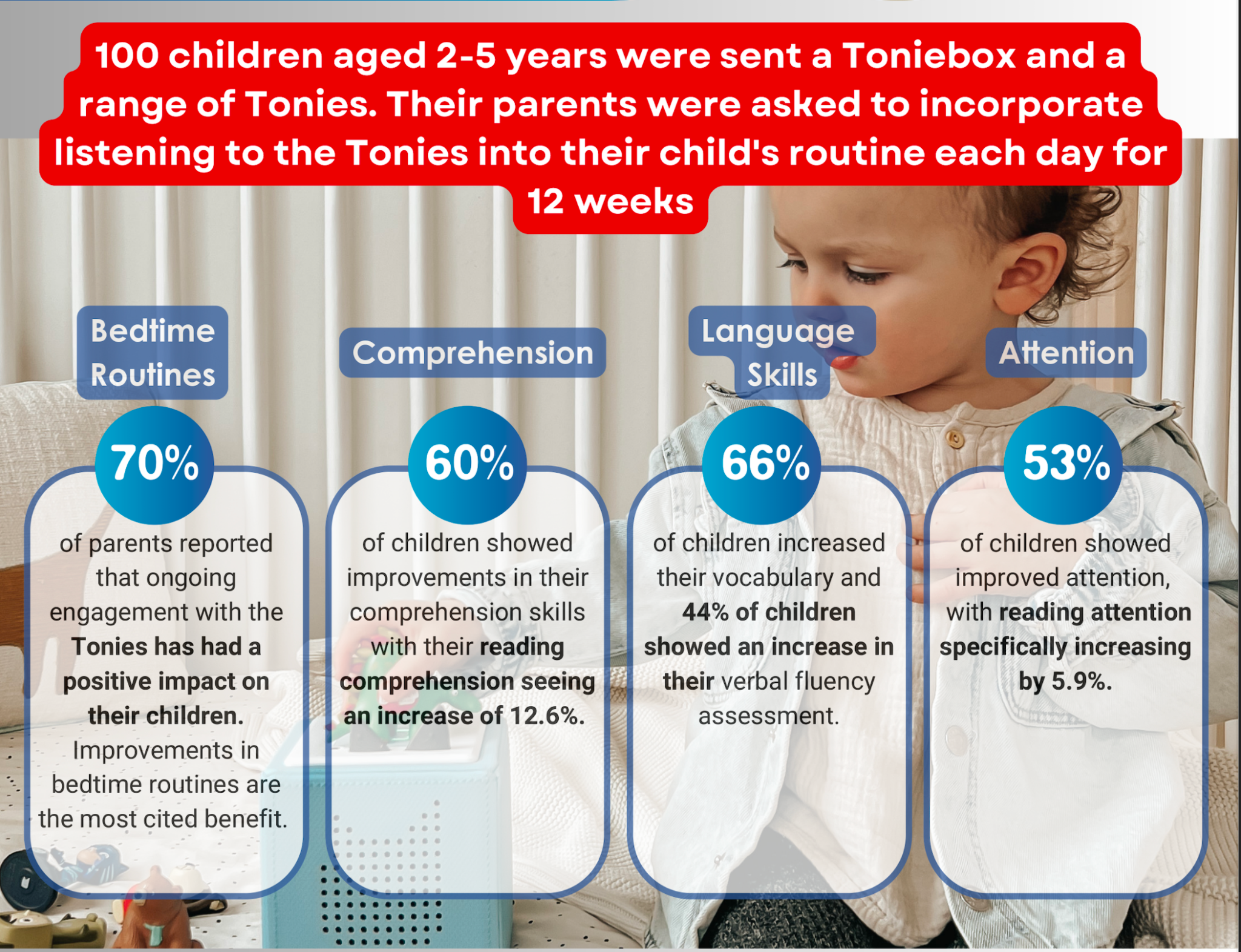
Imagine a learning tool that cultivates comprehension, language skills, and attention in young children. The recent study included 100 families from the UK and the United States, and involved children of ages 2 through 5. The research began with interviews to establish baseline measurements for each child’s development. Families were then provided with a Toniebox and bedtime Tonies, along with instructions to integrate them into their bedtime routines. After a period of 2-3 weeks, there were follow-up interviews that assessed the impact of Tonies on each child. Families were then provided with additional Tonies from the 4 Learning Centers: Discovery, Reading, Mindfulness, and Independent Play. After at least 12 weeks, there was another round of interviews which evaluated the effects of the Toniebox on children’s learning.

The Impact

1. Bedtime Routine Improvement:

– For parents who initially struggled with bedtime, using the Toniebox improved the situation for a remarkable 92% of them.

– Even if routines took longer, parents noted less resistance from their children, a welcome relief for many.

– Satisfaction scores increased significantly, from 6.6 to 7.4 out of 10, indicating happier bedtime experiences.

2. Comprehension and Language Skills:

– 60% of children’s comprehension scores increased

– Researcher-assessed comprehension levels improved by an impressive 6.3%.

– Reading comprehension scores saw a substantial increase of 12.6%.

– Verbal fluency jumped by over 10%, with 44% of children demonstrating improved verbal fluency.

– Vocabulary scores increased by 13.2%, with 66% of children scoring higher.

3. Enhanced Attention and Engagement:

– 53% of children’s general attention scores improved.

– For reading-specific attention, there was a 5.9% average increase.

– Engagement with stories increased by 7%, indicating greater interest.

Educators’ Takeaway: Tonies Toniebox

What makes the Toniebox an invaluable addition to early childhood education? It’s the perfect blend of entertainment and education. Here’s why educators should consider integrating it into their teaching strategies:

1. Promotes Literacy and Learning: The Toniebox enhances comprehension, language skills, and attention, crucial for early childhood education. The significant boost in reading comprehension is especially noteworthy.

2. Bedtime Routine Improvement: Better bedtime routines mean well-rested, alert learners in the classroom. Educators can appreciate the positive impact on children’s behavior and readiness to learn.

3. Screen-Free Learning: In a world dominated by screens, the Toniebox offers a refreshing screen-free alternative, promoting auditory learning and imaginative thinking.

4. Parent and Child Collaboration: The Toniebox encourages parent-child interaction, fostering a love for storytelling and learning from an early age.

Feedback from parents

The feedback offered by parents provides some valuable insights into the unique experiences they had with the Toniebox in their home.

1. Vocabulary Development and Screen-Free Engagement: A parent highlighted how Tonies significantly contributed to her child’s vocabulary development while serving as a screen-free alternative. The child’s enthusiasm for their Toniebox was so profound that he even listened to them for extended periods during road trips, showcasing the potential of this audio-based medium.

2. Design and Quality: Parents appreciated the figurine design of Tonies, which differentiated it from other devices. Many found Tonies ideal for storytelling, while other devices were preferred for music. The Toniebox engaged a child’s mind safely and offered high-quality manufacturing.

3. Innovative Possibilities: Parents associated reduced screen time with improved behavior in their children, emphasizing Tonies’ role in promoting a healthy balance.

The Toniebox is a valuable addition to childhood The feedback from parents underscores the versatility and potential of the Toniebox. While the study’s quantitative findings reveal its substantial impact on bedtime routines, comprehension, language skills, and attention, the individual comments paint a more comprehensive picture of its role in children’s lives. The Toniebox offers not only educational benefits but also a unique opportunity for children to engage with audio-based content in a screen-free and imaginative manner.

Toniebox is more than just a device; it’s a tool that empowers educators and parents to inspire young minds while nurturing positive habits and fostering a lifelong love for learning. As we navigate the ever-changing landscape of early education, the Toniebox supports the development of young learners in a dynamic and enriching way.

It is more than just a storytelling device; it’s a game-changer for early childhood education. Its potential to transform bedtime routines, enhance comprehension, language skills, and attention makes it a tool that educators should bring to their classroom. This innovative approach to learning is not only effective but also a whole lot of fun for young learners.

Contact Rachelle to schedule sessions for your school or keynotes for your conference about Artificial Intelligence, Coding, AR/VR, SEL, STEM and more!

Follow her on Twitter and Instagram at @Rdene915

**Interested in writing a guest blog for my site? Would love to share your ideas! Submit your post here. Looking for a new book to read? Find these available at bit.ly/Pothbooks
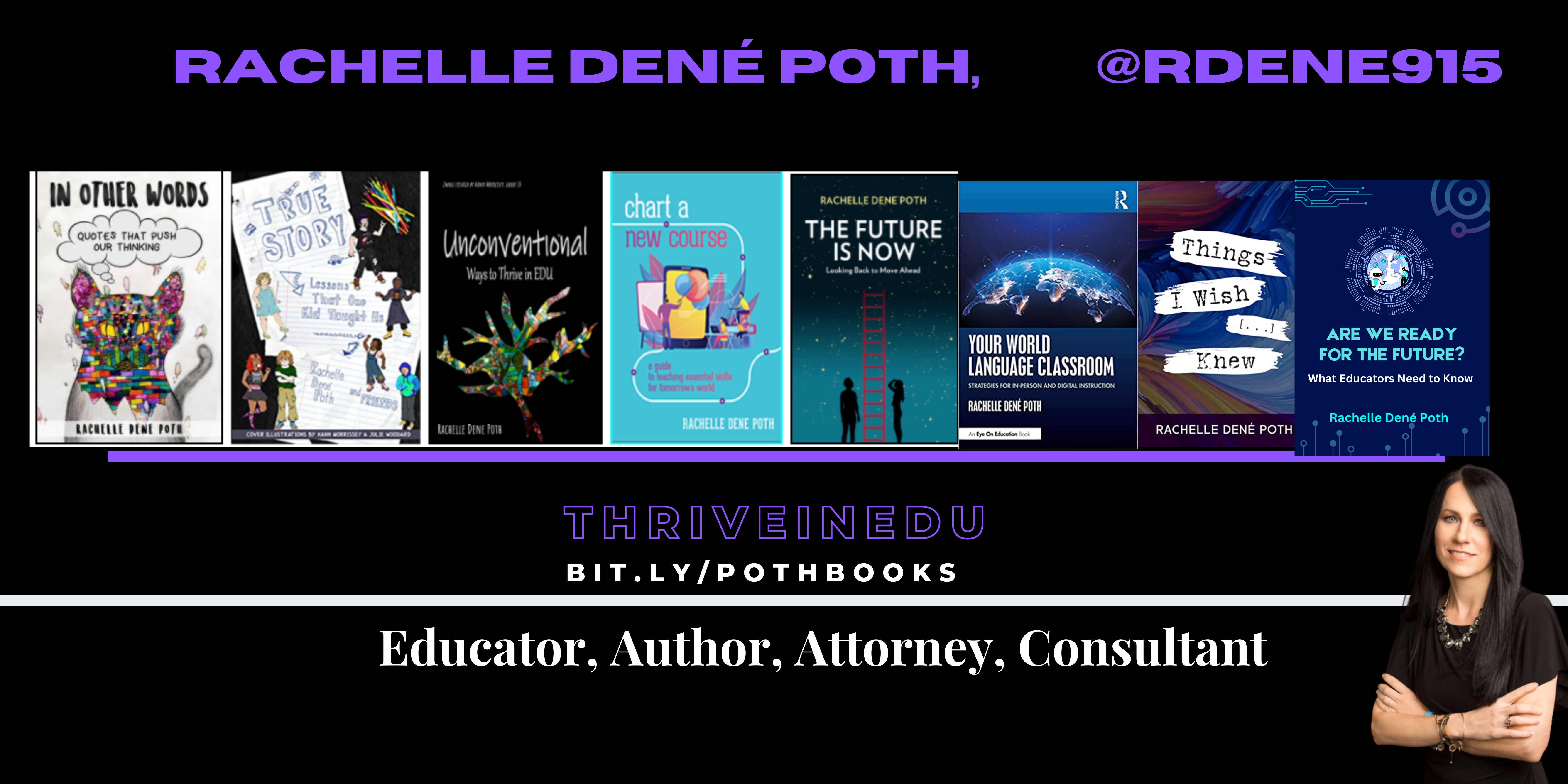
************ Also check out my THRIVEinEDU Podcast Here!

Join my show on THRIVEinEDU on Facebook. Join the group here

Reflecting on AI in education

 I have been speaking and teaching about AI in my classroom for more than five years. I was curious to understand where we see it in the world and how to teach about it in our schools. I was also fascinated by the capabilities of AI for learning and in the world. 

I reached out to several educators and some students to find out what they thought about the changes we are experiencing in education, especially with these emerging technologies. There are, of course, concerns, ongoing conversations, and definitely excitement, although sometimes hesitant excitement, about what these technologies might bring to the world of education and work. 

Educator predictions

Nicole Biscotti @BiscottiNicoleEducator 

“AI has exploded on the scene and everyone is trying to figure it out at the same time which is exciting. A lot of educators are afraid that kids will use technologies like ChatGPT to cheat and have even banned its use. The reality is that kids have been cheating since the beginning of school and we have an exciting opportunity as educators to shape the narrative around this new technology. Biscotti plans to continue to learn as much as she can about how to use AI to better support her students. She says as an educator, “I feel that I am obligated to prepare my students for their future, not my past. These tools will only improve and they are here to stay. It’s imperative that kids are familiar with them and know how to use them or we risk sending graduates out into the workforce at a competitive disadvantage.”  

Dr. Michael Harvey @doctor_harvesPedagogical Prognosticator from Blenheim New Zealand

“AI/emerging tech has yet to really shape this past school year. Questions are being asked of what learning is and the role of assessment, but the actions to this change are yet to be realized.” He is thinking about /planning how to transition assessment tasks to a process rather than a product model. As for the future, Harvey thinks that “the next school year will bring pushback from the establishment and for those who want to progress in education a movement away from assessment of learning to assessment for learning and the role of AI to support student independence in learning.”

Alex Isaacs @mr_isaacs_mathEdtech Specialist from Long Branch Public Schools 

“Emerging tech has helped teachers gain time while assisting with lesson planning, quick questions, and providing feedback to students in real-time. It has also helped increase data analytic capabilities by providing insights into student performance trends and instructional practice.” He plans to delve more into emerging technologies and how they can benefit the teachers and students in his school district. By participating in multiple coaching cohorts, including GoGuardian and Pear Deck, he hopes to gain more insight into helping his colleagues with these platforms. As for the future, “the discussions surrounding the ethical use of emerging tech will continue next school year.” He believes that more edtech platforms will increase their integrations of AI-related tech to provide differentiated instruction and personalized pathways to every learner.” Check out his AI-themed Wakelet collection that he and colleague Lois Alston created.

Vicki Van Matre @MsVanMatreArtRmTeacher at Bluffton High School and  ISTE Certified Instructor 

Next year, Vicki will be teaching a class called the” 3rd class” for their new Education Professions pathway. One basis for this class is introducing technology’s role in the modern classroom. She was planning on discussing AI and how it could help the teacher but also discuss how to use it appropriately as a student. Her plans focus on involving students more in learning about ChatGPT by writing a lesson for them and having them make modifications where necessary. She also wants her students to experiment with a variety of technology to see “what THEY think would work best in the classroom.”  While she uses technology in her art room, she has not yet experimented a lot with DALL E to see if I want to use AI for any of my art classes. However, she believes that if she does choose to use it, most likely it would be with the senior independent study students to have them experiment with it. 

Student reflections

Holden, grade 10

“As soon as I was introduced to AI, I knew that it would change the world. The more I interacted with it, the more I understood its vast potential.” He shared that he “may or may not have used it to complete a few small assignments (Never in Spanish).” His uses were more as a study tool, in particular for reviewing for Chemistry. He would ask it to give a simple definition and an example and it worked perfectly to help him process the information and content better. He believes that “AI by itself is mediocre at best. However, when collaborating with humans, it can do amazing things.” As for benefits, he has an interest in starting an online store but has never really had the time and he hopes that with the help of AI to get a jumpstart this summer. “The school will look right through all the great things that AI is capable of and try to prevent it from being used completely.”

Lola, grade 11

“I believe that emerging technology has provided and created new opportunities for students. The new ideas and aspects of technology accessible to students now provide new experiences and can help to improve a student’s capabilities and knowledge about the subject they are studying.” Looking ahead, “I believe that by next school year, technology will continue to grow and emerge in new ways that will allow students to continue to have opportunities that will enhance their learning environment.”

Dimitri, grade 8

“AI and a lot of new tech has helped me with coming up with ideas for projects or providing me with a summary of a book, if I forgot something that I had read or I didn’t understand it.” As for the next school year, “I hope we will be allowed to use ChatGPT in class to help us understand books and literature more.”

With the rapid advancements in AI and emerging technologies, there are now incredible opportunities available to us and as we reflect on the past year, it becomes evident that AI and emerging tech have revolutionized education in ways we never imagined.

About Rachelle

Follow Rachelle on Twitter @Rdene915 and on Instagram @Rdene915. Rachelle has a podcast, ThriveinEDU available at https://anchor.fm/rdene915.

Looking for PD for your school? I provide in-person and virtual training on the following topics. If you want to learn more about and explore AI and ChatGPT, contact me to schedule! Rdene915@gmail.com

**Interested in writing a guest blog or submitting a sponsored post for my site? Would love to share your ideas! Submit your post here. Looking for a new book to read? Find these available at bit.ly/Pothbooks

Addressing Teacher Shortages: The Role of Substitute Teachers and Swing Education

In Collaboration with Swing Education

Over the past few years, teacher shortages have become a challenge in schools across the United States. There has been a shortage in filling full-time teaching positions as well as finding substitute teachers to fill in on a day-to-day basis. The shortages add to the pressure on all teachers as they take on additional responsibilities to cover classes and other duties. As a result, teachers lose time that can be spent working with students and also valuable planning time.

Earlier this year, I learned about Swing Education, which is a centralized platform that connects substitute teachers with schools and school districts. They serve as a recruiter of substitute teachers in support of school districts. Swing Education helps schools to streamline the process of hiring, expanding their pool of substitute teachers, easing payroll and onboarding. Swing’s value for substitute teachers is that they have more jobs to choose from because Swing lists all the openings in their area. They also get paid each week (instead of each month) and becoming a sub is much faster because Swing helps with onboarding. I had the opportunity to speak with Mike Teng, Co-Founder of Swing Education and enjoyed the conversation and also gained insight into how large of a problem schools in the United States are facing.

The teacher shortage is affecting schools in every state. According to a report by the nonprofit Learning Policy Institute, there is currently a shortage of approximately 314,000 teachers in the U.S. school system. That means they need subs, but when there aren’t enough, it negatively impacts the learning experience for students and can also lead to teacher burnout. Substitute teachers play a vital role in addressing teacher shortages. They can step in when full-time teachers are absent, ensuring that students receive consistent instruction. Furthermore, substitute teachers can also bring fresh perspectives and diverse experiences to the classroom, enriching students’ learning experiences. I have experienced this in my own classroom when I needed a substitute teacher.

Swing Education’s Initiative

Swing Education launched a campaign to recruit substitute teachers throughout California and in Texas, in the Dallas/Fort Worth area. These are the areas of biggest need at this exact moment for the Swing schools. However, schools all over the nation are facing a shortage, and substitute teachers are needed everywhere. Because Swing Education has a centralized platform, it is easier for schools to find and manage substitutes. The platform handles recruiting, onboarding, and payroll, giving schools more control over their substitute pool. Substitute teachers can find teaching assignments that fit their schedules and have the resources they need to be classroom-ready from day one.

The Benefits of Swing Education

The Swing Education platform offers numerous benefits, such as:

Streamlined Recruitment: Swing simplifies the recruitment process, making it easier for schools to find qualified substitutes quickly.

Improved Management: Schools can efficiently manage their substitute pool, ensuring they have adequate coverage for teacher vacancies.

Support for Substitutes: Substitutes have access to resources via the Swing Education site to help them get started.

Community Engagement: Swing encourages college students, prospective teachers, retirees, and others to sign up as substitutes, fostering community involvement.

Recruiting substitute teachers not only helps with immediate staffing needs but also helps to bring in opportunities for people who may not have considered teaching. There are substitute teachers that are college students, prospective teachers, or even retirees who decide to pursue teaching as a long-term career after having some experience in classrooms. By actively recruiting and supporting substitutes, schools can bring in prospective future educators and work toward eliminating or at least, reducing the teacher shortage crisis.

Swing Education’s initiative to recruit substitute teachers is a significant step toward addressing this challenge. By leveraging platforms like Swing, schools can ensure that classrooms are adequately staffed, and students continue to receive quality instruction. Furthermore, by the support offered for substitute teachers, schools can contribute to building a stronger and more sustainable teaching workforce for the future. Click here to learn how to become a sub. For schools and districts, click here to learn more about Swing.

About Rachelle

Follow Rachelle on Twitter @Rdene915 and on Instagram @Rdene915. Rachelle has a podcast, ThriveinEDU available at https://anchor.fm/rdene915.

Looking for PD for your school? I provide in-person and virtual training on the following topics. If you want to learn more about and explore AI and ChatGPT, contact me to schedule! Rdene915@gmail.com

**Interested in writing a guest blog or submitting a sponsored post for my site? Would love to share your ideas! Submit your post here. Looking for a new book to read? Find these available at bit.ly/Pothbooks

Learning about Civics and Government: The Ethics of AI in Political Campaigns

Guest post by: Torrey Trust and Robert W. Maloy, University of Massachusetts Amherst

The Ethicist” – Kwane Anthony Appiah’s column in the New York Times Magazine – offers philosophical advice about how to respond to the dilemmas and complexities of everyday life. People submit questions they want answered, and the rights and wrongs or ethics of what to do are not immediately clear or self-evident. Questions posed include: “Is it ever acceptable to visit a Confederate historical site?” “My salary is too high. Is it wrong to stay in my job?” “Can I sell my Taylor Swift tickets for thousands of dollars?” and “Can I use ChatGPT for the tedious parts of my job?” In July 2023, the Ethicist responded to this last question about ChatGPT, which was written by the chair of the English department at a small college. The reply was “yes,” as long as “you exercise proper vigilance and can stand by what you submit” (para. 4). 

Utilizing “The Ethicist” as the starting point for instructional ideas, we envision giving elementary, middle, and high school students ongoing opportunities to develop their own ethical responses to authentic questions and issues they are facing in their lives, schools, and communities – especially those related to the use of GenAI tools and large language models (LLMs) – as a means of helping them develop their civic engagement skills and knowledge. Ideally, students engage in discussions about how they and others should act in the different situations and settings of everyday life. By stating their views and restating and understanding the views of others, students will become more socially conscious and civically engaged as members of our diverse society. 

Questions of ethics and ethical behavior are central to how individuals and groups conduct political campaigns. In the run-up to the 2024 election, political candidates, parties, and action and advocacy groups have been using GenAI tools to generate campaign speeches, policy proposals, and even fundraising emails. In one example, the Democratic Party used AI to write fundraising emails and found that AI-generated fundraising requests performed as well as or better than human-generated requests in generating financial responses from donors (Goldmacher, 2023). However, not all uses of GenAI in political campaigns have been done with honorable intentions. University of Georgia journalism professor David E. Clementson (2023) identified multiple ways that GenAI tools could make political campaigns more deceptive than ever, including using these tools to design customized bogus campaign promises, write outright lies presented as truthful statements, convince voters to reevaluate their choice of candidates, and craft manipulated photos of candidates.

Following the model of “The Ethicist,” students could be asked: “Is it ethical to use GenAI tools to craft political campaign materials and media?” To begin this activity, students could be encouraged to use the Teacher and Student Guide to Analyzing AI Writing Tools to critically investigate popular GenAI tools, including ChatGPT, Bard, Stable Diffusion, and DALL-E. This guide provides a series of prompts that motivate students to examine the design and production of AI tools (questioning things like “Who designed this tool and why? “How does this tool make money?” “What data was used to train this tool?” “What biases are represented in the data?” and “What privacy protections are in place for users’ data?”) and the output of AI tools (questioning things like “Who or what is included in the output and who or what is left out?” and “How does the AI-generated output compare to human-generated text or media?”). Through this type of critical investigation, students might uncover that GenAI tools are trained on data that has embedded biases and consider what that might mean if political campaign staff use these tools, for example, to write fundraising campaigns based on demographic data. 

Next, students could work on designing their own political campaign to run for a local or statewide political office (see the “Online Campaigning for Political Office” activity). Students could start this activity without any assistance from GenAI tools and then mid-way through the activity have the opportunity to use AI to help with or improve their campaign materials. For example, students might ask ChatGPT to generate a series of social media posts related to their campaign promises, write a script for a podcast or video that will be embedded into their campaign website, improve the quality of the text for their campaign website, or devise a strategy for increasing voter engagement with their campaign. Or, they could use image generators, like Microsoft Bing Image Creator powered by DALL-E, to produce visuals for their campaign websites or social media posts. 

After designing their own political campaigns with and without the assistance of GenAI tools, students could engage in a discussion or debate about whether they think it is ethical for politicians and their campaign staff to use GenAI tools to craft political campaign materials and media. Integrating an ethical question about the use of AI in political campaigns as students design their own run for political office gives students an opportunity to investigate what AI can and cannot do and what AI should and should not do as a tool. The cognitive scientist Fei-Fei Li said nearly a decade ago: “AI is a machine that can make a perfect chess move while the room is on fire” (quoted in Knight, 2017, para. 4). Her point is AI can generate content, but not critical thought or socially and morally ethical plans for action. Through this activity, students consider what role AI should play in politics, and then they should be able to form their own opinion to the prompt: “Is it ethical to use GenAI tools to craft political campaign materials and media?”

Author Bios

Torrey Trust, Ph.D. is a Professor of Learning Technology in the Department of Teacher Education and Curriculum Studies in the College of Education at the University of Massachusetts Amherst. Her scholarship and teaching focus on how technology shapes educator and student learning. Specifically, Dr. Trust studies how educators engage with digitally enhanced professional learning networks (PLNs), how emerging pedagogical tools (e.g., HyperDocs), practices (e.g., Making), and technologies (e.g., 3D printers, augmented reality) facilitate new learning experiences, and how to design and use open educational resources (OERs). Dr. Trust served as a professional learning network leader for the International Society for Technology in Education (ISTE) for five years, including a two-year term as the President of the Teacher Education Network from 2016 to 2018. In 2018, Dr. Trust was selected as a recipient of the ISTE Making IT Happen Award, which “honors outstanding educators and leaders who demonstrate extraordinary commitment, leadership, courage, and persistence in improving digital learning opportunities for students.” www.torreytrust.com

Robert W. Maloy is a senior lecturer in the College of Education at the University of Massachusetts Amherst where he coordinates the history teacher education program and co-directs the TEAMS Tutoring Project, a community engagement/service learning initiative through which university students provide academic tutoring to culturally and linguistically diverse students in public schools throughout the Connecticut River Valley region of western Massachusetts. His research focuses on technology and educational change, teacher education, democratic teaching, and student learning. He is co-author of Transforming Learning with New Technologies (4th edition); Kids Have All the Write Stuff:  Revised and Updated for a Digital Age; Wiki Works: Teaching Web Research and Digital Literacy in History and Humanities Classrooms; We, the Students and Teachers: Teaching Democratically in the History and Social Studies Classroom; Ways of Writing with Young Kids: Teaching Creativity and Conventions Unconventionally; Kids Have All the Write Stuff: Inspiring Your Child to Put Pencil to Paper; The Essential Career Guide to Becoming a Middle and High School Teacher; Schools for an Information Age; and Partnerships for Improving Schools. 

**Interested in writing a guest blog for my site? Would love to share your ideas! Submit your post here. Looking for a new book to read? Find these available at bit.ly/Pothbooks

************ Also check out my THRIVEinEDU Podcast Here!

Join my show on THRIVEinEDU on Facebook. Join the group here

Promoting collaboration in the classroom

Updated from prior post on Defined Learning

“Collaboration is being open to each other’s ideas and benefiting from each other’s perspectives in an open way.”

Alan Menken

Preparing our students for the future means that we need to continue to learn more about the types of jobs that are in demand and create opportunities for our students to develop a variety of skills that are transferable to many types of work. As we have experienced over the past few years, being able to collaborate whether in person or remote, was critical. We all faced challenges in our practice, especially in being able to connect with our students and create learning experiences that fostered the building of relationships and collaborative skills.

For our own professional learning, being able to facilitate instruction with students, and working with colleagues in the absence of being together in the physical space, we had to explore and learn what worked the best. By leveraging the right digital tools and spaces, whether in-person or virtual, we kept learning going and continued to build our own professional skills.

There is tremendous power in collaboration and if we want to best prepare our students with essential skills they need, being able to collaborate and work as part of a team are two of the top skills required by employers. There are a variety of ways that we can foster collaboration in our classrooms which are beneficial to our own learning and growth, but more importantly, for our students.

Benefits of Collaboration

When we collaborate, it not only impacts our growth as educators, it amplifies the learning potential for our students. In an article by Lily Jones, “The Power of Teacher Collaboration”, research showed that teacher collaboration helps to raise student achievement. They found that when teachers had more conversations that focused on the content area, that it helped to provide more for students. By modeling collaboration, students will see and experience the benefits of collaborating with classmates and even beyond our own classroom and school. Building relationships is important for social-emotional learning (SEL) and future preparedness, especially for having a system of support in place. Finding methods and tools that foster collaboration between students and teachers in the same school or school district as well as on a global scale, will provide many benefits.

When educators collaborate, it enables us to stay relevant and current with teaching methods and digital tools, and we have access to more feedback that helps with our professional growth. For our students, collaboration needs to be a priority so that we can provide the most beneficial learning experiences for them. When students work together on a common goal and share responsibility for creating a product of that learning, there are many benefits beyond just learning the content.

As students collaborate, they are building relationships and their own learning network. They can bounce ideas off of each other, provide peer feedback, work through learning challenges together and build SEL skills throughout. Through collaboration, students build their comfort and confidence in the classroom.

Here are three ideas to explore for promoting more collaboration:

  • Brainstorming spaces: Using a variety of digital tools, we promote collaboration beyond our classroom space. Whether through Google Jamboard, sharing ideas in a Wakelet collection, or posting on a Padlet board, everyone can contribute from wherever they are. With some of these options, audio or video can be added, which enhances the learning experience by feeling more connected to classmates and teachers. When students need to work together, they often need a way to collaborate beyond the school space. These options create a space for students to work as a team and feel more connected whenever they cannot be in the classroom working together. For students to explore and brainstorm ideas on their own, try Ideamapper for mind-mapping.
  • Methods: When we bring in methods like project based-learning, we provide many benefits for students. They can work together to solve a problem being faced in the world, for example, by learning about the United Nations Sustainable Development Goals (SDGs). PBL is also a good method that will help students to develop SEL skills, especially in self-management and decision-making. Game-based learning is always a good choice to not only build content area skills but also for promoting collaboration and boosting student engagement. Through the digital tools available, students can collaborate on teams and build teamwork skills while using the games to become self-aware of their growth and set new goals for learning. Some of my students’ favorites are Gimkit and Quizizz. Providing opportunities for summer learning and STEM exploration is another way to keep learning going and spark curiosity! Check out Lobee Learning and how they provide STEM and PBL experiences for students.
  • Feedback and reflection tools: Just as educators need feedback and opportunities to engage in conversations and collaborate, students also need to learn how to track their growth over time. Being able to identify strengths and also areas where they may want to focus on improving is important. Having a small group to collaborate and reflect with can help students not only become more self-aware, but also develop supportive relationships in the classroom. Some ideas for collaborating to help each other grow are to write a collaborative blog, launch a podcast, or even use collaborative spaces where students can share their progress and provide feedback. With Flip, students can record videos to reflect on their learning experiences and share these videos with the teacher or collaborate with classmates to reflect and give feedback to each other. Sharing a blogging space, even using Microsoft or Google tools, where students can write and collaborate would be beneficial. We also use Spaces EDU which offers individual, class, and group spaces, all great for collaboration at different levels. For teacher-to- student, the individual space helps students to build confidence in sharing their learning with teachers and the group spaces for working together on activities like a scavenger hunt, discussion, or PBL for example. In using formats like blogs, podcasts or even portfolios, students will not only develop skills for collaborating, but also skills of self-awareness and self-management which are vital for now and the future.

Each of these methods and tools offer a lot of ways to promote collaboration for students and teachers. Collaboration is an essential skill for everyone. Being able to ask for help, provide support to others, and work as part of a team, are transferable skills to any area of work and life. With a variety of methods and the use of different digital tools to facilitate them, we can foster collaboration and the other essential skills needed that are needed for future careers and success.

About the Author:

Rachelle Dené is a Spanish and STEAM: What’s nExT in Emerging Technology Teacher at Riverview High School in Oakmont, PA. Rachelle is also an attorney with a Juris Doctor degree from Duquesne University School of Law and a Master’s in Instructional Technology. Rachelle is an ISTE Certified Educator and serves as the past president of the ISTE Teacher Education Network. She was named one of 30 K-12 IT Influencers to follow in 2021.

She is the author of seven books including ‘In Other Words: Quotes That Push Our Thinking,” “Unconventional Ways to Thrive in EDU”, “The Future is Now: Looking Back to Move Ahead,” “Chart A New Course: A Guide to Teaching Essential Skills for Tomorrow’s World, “True Story: Lessons That One Kid Taught Us” and her newest book “Things I Wish […] Knew” is now available at bit.ly/thingsiwishedu.

Follow Rachelle on Twitter @Rdene915 and on Instagram @Rdene915. Rachelle has a podcast, ThriveinEDU available at https://anchor.fm/rdene915

I am available for PD sessions in-person and virtual on a variety of topics. Key focus areas are AI, ChatGPT, AR and VR, SEL and STEM.

**Interested in writing a guest blog for my site? Would love to share your ideas! Submit your post here. Looking for a new book to read? Find these available at bit.ly/Pothbooks

Learn to Help Students Correct Science Misconceptions by Producing Instructional Videos

Guest post By Reggie Grant, Twitter @media4literacy

This project was presented at the FSU-Teach STEM Teaching Mini-Conference at Florida State University on June 28, 2023.

“While we teach, we learn.”

These words are attributed to the Roman philosopher Seneca and are the inspiration for a classroom project that I recently developed with my former colleague Brian McClain. “In what scientists have dubbed ‘the protégé effect,’ student teachers score higher on tests than pupils who are learning only for their own sake,” according to a 2011 Time article.

As a longtime high school science teacher, Brian has encountered various common science misconceptions that students hold, some of which are directly or indirectly related to photosynthesis. In an article published in the 2015 issue of the European of Teacher Education, researchers say misconceptions like these must be confronted and corrected to prevent them from stunting students’ future understanding.

“Misconceptions operate to distort new learning. …learners’ existing misconceptions will hinder future-related learning,” the article says. “Before new concepts can be understood, misconceptions must be dispelled.”

Brian and I designed this media project to help students use research and credible evidence to correct some of these common science misconceptions. The project guides students in the production of a short instructional video presentation that sets the record straight about a chosen misconception.

This “Set it Straight!” video project is similar to another project I developed a decade ago when I was teaching high schoolers. In that project, students taught others the correct use of a commonly misused set of words. Examples include there / their / they’re, affect / effect, and farther / further.

The process of creating a media product to teach others develops critical thinking, problem solving and creativity – three of the top five skills necessary for today’s workplace, according to the Future of Jobs Report 2020 produced by the World Economic Forum.

Using media this way in the classroom is endorsed by the Science Education Resource Center at Carleton University. SERC recommends teachers use media technology to engage students in more meaningful and deeper learning experiences. It should be used for more than delivering PowerPoint presentations and showing videos.

“Media can also be student-generated,” the SERC website said. “This approach asks the student to step into the role of the teacher and create content that will engage learners and help them to master concepts.”

“Involving students in creating media encourages collaboration, accountability, creativity, and mastery of ideas and concepts,” the SERC website said. “Importantly, one does not need a large budget, fancy studio, or advanced degree to create original media that is informative, entertaining and educational.”

The Project

The “Set it Straight!” video project is guided by a series of prompts.

For example: “What is the common misconception you researched?”

“Why do you think this is a common misconception?”

“Identify and list two or three important facts necessary to correct this misconception.”

The questions require students to restate the questions and answer them clearly and briefly. Limiting the number of sentences students can use in their answers is important. Short answers require students to really understand the concept. Clarity and brevity are the keys to effective media production.

After feedback has been provided and final revisions have been made, the questions/prompts are removed and the answers/responses become the script.

Students record themselves reading the script.

Accompanying visuals (photos/charts/graphics) are created and/or identified and downloaded.

Then, the visuals and narration are edited together for the video, which will be no longer than about three minutes.

The steps above are detailed in this document with accompanying links.

“Nutrients in the soil are the primary source of the mass increase in plants during their lives.” This misconception is corrected in this example video that we produced.

Conclusion

Making sense of a complex concept by creating media products is empowering for students. It is an effective way to actively involve students in their own education by teaching others.

And by teaching, they learn.

If you have any suggestions for this project, please send them to mediaforliteracy@gmail.com

Reggie Grant teaches journalism and mass communications at Tallahassee Community College. For 11 years, he taught media production — introduction to mass communication, photography, video production, and graphic design — at Lincoln High School in Tallahassee, Florida. He blogs at https://mediaforliteracy.wordpress.com and can be found on Twitter @media4literacy.

Looking for some PD for your school? I provide in-person and virtual training on the following topics. If you want to learn more about and explore AI and ChatGPT, contact me to schedule! Rdene915@gmail.com

**Interested in writing a guest blog or submitting a sponsored post for my site? Would love to share your ideas! Submit your post here. Looking for a new book to read? Find these available at bit.ly/Pothbooks

Advice from an elementary teacher about summer learning

Guest post by Ashley Cooley @ashleyecooley

Next year will mark my twenty-fifth year to be an elementary teacher. Parents ask me a lot of questions about how to keep their child learning during the summer. The best thing is to of course enjoy summertime and get in all the family time that school schedules get in the way of. Here are some ideas that I recommend and used with my own children.

  • Check out recommendations from your local librarian. 
  • Review math facts (addition, subtraction, and multiplication) with flashcards or play “war” with a deck of cards or dominos.
  • Visit museums, children’s theatres and check out ideas from DFW Child… My favorite in the DFW area are the Dallas Museum of Art, The Modern, and the Dallas Children’s Theatre  
  • Review math and science workbooks that were sent home! If your child had an educational platform like Seesaw, review the assignments.
  • Have your child write letters to grandparents. They will write back! Letter writing is a lost art that children need to bring back.
  • Go to a baseball game and let your child keep a record of runs, outs, hits, steals, etc. Then make a bar graph at home to show the info.
  • Cook together! Cooking with your child is a valuable life skill that teaches children about nutrition and food safety while building math, science, and literacy skills.
  • Going on a road trip? Take these math wrap-ups with you and challenge your child to go faster
  • Take your kids to the grocery store and have them keep a running total of what’s going in the cart.
  • Keep a gratitude journal. It will keep your child writing and focused on the positive things in their lives. View the journals that were sent home (along with more workbooks, folders, and supplies). Children’s writing is so innocent and sweet, you will love reading what they wrote.
  • Visit your local library and encourage them to start a series. My first graders LOVED the “Humphrey” series.

Find inspiration from this list and make it work for you. Learning over the summer doesn’t have to be complicated or require long hours of planning. Have fun with it and give your child ownership in their learning. Wishing you a very happy summer full of learning.

My first-grade class helping me celebrate earning teacher of the year!

**Interested in writing a guest blog or submitting a sponsored post for my site? Would love to share your ideas! Submit your post here. Looking for a new book to read? Find these available at bit.ly/Pothbooks

About Rachelle

Looking for some PD for your school? I provide in-person and virtual training on the following topics. If you want to learn more about and explore AI and ChatGPT, contact me to schedule! Rdene915@gmail.com