
Preparing students for the future

We live in a rapidly evolving world shaped by artificial intelligence (AI) and emerging technologies, and we are preparing students for an uncertain future. These changes require educators to continue learning and exploring, to prepare students. We now have to focus on career-connected learning. This learning will help bridge the gap between education and the workforce, enabling students to develop adaptability, purpose, and the real-world skills necessary to thrive in jobs that may not yet exist.

Technology has been advancing at a rate faster than we could have imagined. From AI and automation to data analytics and immersive learning and working environments, the world of work is undergoing a significant transformation. As educators, we can no longer predict with certainty what future jobs will look like, but we can work to equip students with the flexibility and curiosity to succeed in any setting.

The World Economic Forum (WEF) provides valuable information and insights into in-demand skills. I refer to their Top 10 skills often as I work to prepare my students for the future. The WEF continues to emphasize the importance of transferable, human-centered skills. Its list of in-demand competencies, which include analytical thinking, creativity, resilience, and technological literacy, highlights how the focus has shifted from content memorization to capability building. To prepare our students, the best we can do is to always focus on connecting their learning to real-world experiences which will help them to experience authentic learning and develop skills in adaptability and many other essential skills.

What Does “Career Ready” actually mean today?

Traditionally, being “career ready” has referred to having strong academics and a set of soft skills such as collaboration and communication. While these are still essential skills, we have to also focus on skills in digital literacy, ethical reasoning, and the ability to navigate technologies increasingly powered by AI.

To truly prepare students, we must also help them use AI as a collaborative tool that enhances and does not replace their opportunities for learning. By leveraging platforms such as ChatGPT to brainstorm ideas, analyze information, and refine their thinking or using platforms such as Brisk Teaching, Kira Learning, Learning Genie, Magic School, School AI, and others, we can create opportunities for them or place AI in their hands. As more careers begin to require AI proficiency, classroom experiences that integrate generative tools responsibly will ensure students are well-prepared for the digital demands of the workplace.

Designing Spaces for Exploration and Purpose

Career-connected learning transforms classrooms into environments of exploration. Students need opportunities to dream big, test their ideas, fail, and iterate, and apply their skills in authentic contexts. Through hands-on projects and simulations that reflect real-world scenarios, we will foster curiosity while demonstrating the relevance of what students learn.

When we build intentional career connections into learning, we empower students to see themselves as the creators and innovators. By bringing in design thinking projects, project-based learning (PBL), place-based learning, community partnerships, or global collaboration, relevance and purpose become the driving forces behind engagement.

Elements of Career-Connected Learning

  • Project-Based Learning (PBL): Develop projects that address community or industry needs.
  • Emerging Tech Integration: Introduce students to AI, coding, and data science.
  • Authentic, Real-World Tasks: Use simulations or case studies that are based on real-world issues.
  • Partnerships: Collaborate with local businesses, universities, or nonprofits to provide mentorship or feedback.
  • Skill Challenges: Incorporate AI, cybersecurity, or innovation competitions that mirror workforce skills.

An important focus of all of this is promoting student agency. When students see that their work connects to real-world possibilities, it boosts motivation and engagement in learning and promotes long-term retention.

The WEF’s Future of Jobs Report predicts that by 2027, 85 million jobs will be displaced by automation and AI—but 97 million new roles will emerge. These new opportunities will require high-level cognitive ability, digital agility, and ethical decision-making.

Roles like AI ethics consultant, digital twin designer, and data privacy advocate are already appearing—and most students haven’t even heard of them. Meanwhile, more than half of all workers will need reskilling within a few years. This shift highlights a crucial point: education must evolve to keep pace with innovation.

Strategies for Building Career-Connected Classrooms

  1. Create Interdisciplinary Learning Experiences
    Combine subjects to reflect real-world problem-solving. For instance, collaborate math and art for data visualization projects, or integrate English and computer science to explore ethical storytelling with AI.
  2. Leverage AI Tools to Design Career-Ready Tasks
    Platforms like Eduaide, Kira Learning, Knowt, MagicSchool AI, and Brisk Teaching can help educators design simulations or career-based challenges aligned with workforce trends without adding to planning time. Lack of time and resources are the top two reasons that bringing AI experiences into classrooms can be a challenge.
  3. Partner with Industry and Community Organizations
    Collaborate with businesses, universities, and nonprofits to provide mentorship, guest speakers, job shadowing, and feedback on student projects. Even virtual connections can make a lasting impact. Not only do students benefit, but the greater school community learns from these experiences and it further solidifies the home to school connection and the sense of a supportive school community.
  4. Empower Students to Lead
    Provide students with an opportunity to create and lead tech support programs, host digital wellness campaigns, or work with their teachers on technology developments.

Keeping the focus on human skills

Career-connected learning isn’t just about building skills. It is about skills, and it’s also about building identity and purpose. It helps students answer three essential questions:
Who am I? Where am I going? How can I make a difference?

As automation and AI reshape every industry, schools must prioritize technological fluency and human skills such as compassion, creativity, and ethical reasoning. Keeping humanity involved is essential, as this is what distinguishes us from machines and the technologies available.

Educators play a crucial role in striking a balance between innovation and humanity. By providing students with authentic opportunities to explore careers, solve problems, and apply their learning, we’re helping them become not just workers of tomorrow, but leaders, innovators, and changemakers.

About Rachelle

Dr. Rachelle Dené Poth is a Spanish and STEAM: What’s Next in Emerging Technology Teacher at Riverview High School in Oakmont, PA. Rachelle is also an attorney with a Juris Doctor degree from Duquesne University School of Law and a Master’s in Instructional Technology. Rachelle received her Doctorate in Instructional Technology, with a research focus on AI and Professional Development. In addition to teaching, she is a full-time consultant and works with companies and organizations to provide PD, speaking, and consulting services. Contact Rachelle for your event!

Rachelle is an ISTE-certified educator and community leader who served as president of the ISTE Teacher Education Network. By EdTech Digest, she was named the EdTech Trendsetter of 2024, one of 30 K-12 IT Influencers to follow in 2021, and one of 150 Women Global EdTech Thought Leaders in 2022.

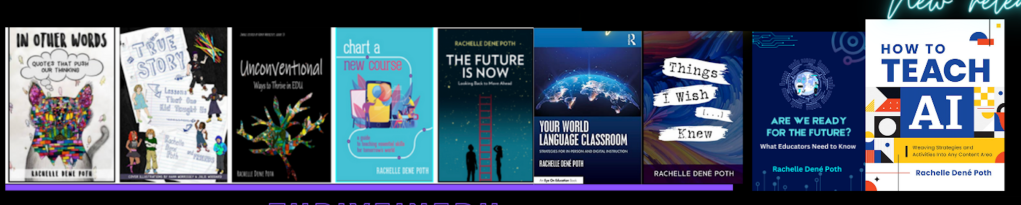
She is the author of ten books, including ‘What The Tech? An Educator’s Guide to AI, AR/VR, the Metaverse and More” and ‘How To Teach AI’. In addition, other books include, “In Other Words: Quotes That Push Our Thinking,” “Unconventional Ways to Thrive in EDU,” “The Future is Now: Looking Back to Move Ahead,” “Chart A New Course: A Guide to Teaching Essential Skills for Tomorrow’s World, “True Story: Lessons That One Kid Taught Us,” “Things I Wish […] Knew” and her newest “How To Teach AI” is available from ISTE or on Amazon.

Contact Rachelle to schedule sessions about Artificial Intelligence, AI and the Law, Coding, AR/VR, and more for your school or event! Submit the Contact Form.

Follow Rachelle on Bluesky, Instagram, and X at @Rdene915

**Interested in writing a guest blog for my site? Would love to share your ideas! Submit your post here. Looking for a new book to read? Find these available at bit.ly/Pothbooks

************ Also, check out my THRIVEinEDU Podcast Here!

Join my show on THRIVEinEDU on Facebook. Join the group here.

Guest Post: Jooble Recommends How to Start Your Career in Artificial Intelligence: Key Steps and Skills

This article was created in collaboration with Dr. Rachelle Dené Poth and Jooble. Opinions are those of the guest writer.

In particular, Artificial Intelligence (AI) is invigorating each line of business, opening up enormous potential for persons trained in AI and associated areas. If your goal is to become an AI developer, you are positioning yourself for terrific job growth, with an average salary of an AI engineer of $160,000 per year in the US, according to Jooble. To help you get started on your AI journey, we provide some tips on essential steps and skills that will help you make it through the course.

Where can Artificial Intelligence be applied?

Artificial Intelligence is a branch of study and application of computing systems that manifest attributes associated with human intelligence to perform tasks that would otherwise necessitate human input. Compared to other SCH software, AI systems can learn from data, and its performance can be refined without needing rewiring. AI is an emerging and growing sector that has penetrated almost all industries across the globe, including the service industry, medical, and financial. For example, 50% of companies plan to invest in machine learning engineers and data departments focused on AI adoption, emphasizing the importance of upskilling the workforce to meet future demands.

AI can simply be a chatbot, up to a complex intelligent model based on neural networks used to make predictions and sophisticated analyses. By far one of the core constructs of AI is the notion that algorithms learn from data input — a key component in the creation of programs that get smarter with time.

The Role of AI in Modern Industries

The United States and China lead in AI investments, making them prime hubs for AI development and job opportunities. AI integration is becoming crucial in various industries as businesses increasingly implement AI technologies to reduce costs and boost productivity. In sectors such as healthcare and automotive, AI solutions are driving a revolution through automated processes, big data analysis, and the development of smart systems, reshaping the way these industries operate. As Ulrich Spiesshofer said, “The countries with the highest robot density have among the lowest unemployment rates. Technology and humans combined in the right way will drive prosperity.”

AI also assists in creating individualized services and goods. For example, generative AI is already altering marketing and entertainment with its ability to design or write content/results based on data. AI processes can even predict consumer behavior, becoming valuable assets for businesses. The demand for AI experts who can learn and apply AI in real-life scenarios is rapidly increasing.

Most Important Things You Need to Learn for a Career in AI

To embark on your AI learning journey, it’s crucial to have a structured learning program and acquire a strong foundation in the following skills:

Computer Science: Learn Python, R, and Java as they are the most used programming languages in AI and data-related fields. Depending on the project or this level of work, knowledge of these languages will be required to deal with AI solutions.

Mathematics and Statistics: Khan says that knowledge of math is ESSENTIAL for AI, and examples of such skills are linear algebra, probability, and statistical methods.

Machine learning and Deep learning of Artificial Intelligence Concepts: Learning about another class of AI, known as machine learning, will enable you to understand how machines learn and optimize from data.

AI Tools and Libraries: Analyze artificial intelligence for business and learn some helpful tools and libraries, such as TensorFlow and PyTorch, for building models.

Main Technologies of the field of AI

AI technology encompasses various fields with new advancements in AI revolving around the existing structure. Key technologies that play a pivotal role include:

Natural Language Processing (NLP): Under the NLP study, machines are capable of learning how to handle human language which is much more useful in other advanced technologies like artificial intelligence digital assistants such as the use of chatbots.

Computer Vision: This field allows users to understand and interpret visual data and is crucial for fields such as healthcare, the automotive industry, and security.

Deep Learning: This superior artificial intelligence method is modeled on the action of the human brain and allows a machine to recognize patterns in the data.

Step-by-Step Guide to Becoming an AI Expert

1. Select Your Right Line of Study

There are multiple opportunities to learn with the help of AI in 2024, from online courses to a university degree. First of all, choose the program that will suit you best if you are eager to master AI as a beginner or if you are eager to obtain an AI degree. There are many universities as well as online centres offering classes from the fundamentals of artificial intelligence to advanced artificial intelligence classes containing concepts such as deep learning and neural networks.

Vacancies in AI presuppose a solid educational background, and thus, the reception of the education that inscribes AI as learning from data, machine learning, and AI engineering is essential.

2. Where to Get Experience in AI Projects

AI learning libraries and tools are essential for gaining practical experience and understanding artificial intelligence. To truly become an AI engineer, working on AI projects is mandatory. The best way to practice is by contributing to AI-related projects whenever possible, participating in hackathons, or providing suggestions for open-source projects. These activities help solidify your knowledge of AI concepts and demonstrate your expertise to potential employers. As Stephen Hawking warned, “Success in creating AI would be the biggest event in human history. Unfortunately, it might also be the last unless we learn how to avoid the risks.” To be a good AI engineer, it’s crucial to continuously gain new knowledge, study daily, and stay updated with the latest advancements to ensure responsible and safe development of AI technologies.

Minimum Qualifications Required for AI and Data Science Professionals

First of all, certifications in the world of AI are very important when it comes to the development of your profession, as many jobs in AI require some proof of your knowledge. Not only do they prove that you are worth your salt, but they also provide you with the necessary leverage to go for a job.

AI certifications that help where to take your AI career

Developments in AI or any related field certification will make you a better candidate for employment. AI certifications from globally technologically advanced companies such as Google, Microsoft, or IBM can let you highlight your strong points in specific areas of interest, such as machine learning, data science, or AI tools. These certifications will give you ways to get on your plan for learning AI and assist you in gaining mastery from the entry-level AI to the expert level.

A number of AI Learning Plans and Learning Systems we currently have are accredited by the respective industries they belong to.

Proprietary AI programs, like Coursera and edX, offer complete programs with necessary learning experiences. These courses are developed in collaboration with professionals in the field, and the topics include different aspects of AI and its applications. Such programs are helpful for beginners in AI and for people who already have some experience in the field but would want to learn more about the development of more complex topics in AI.

Whether you’re a complete newcomer or an advanced AI practitioner looking to elevate your career, these programs will guide you along your AI path. With over 95% of executives agreeing that generative AI will revolutionize AI applications, its use is extending into new domains such as product design and customer engagement, making this an exciting time to dive deeper into AI.

Conclusion

The journey to learn AI proficiency in this exciting field, its process, and its course can be thrilling yet sometimes frustrating, especially when grappling with machine learning concepts. However, with the right skills, relevant education, and practical experience, you can become an AI engineer, helping shape the future of AI and data science. As Fei-Fei Li aptly said, “Artificial intelligence is not a substitute for human intelligence; it is a tool to amplify human creativity and ingenuity.” Across industries, businesses are increasingly employing artificial intelligence, driving demand for AI specialists with highly rewarding salaries. This makes it the perfect time to begin your journey into this promising and rapidly growing field and continue to adopt AI technologies.

About Rachelle

Dr. Rachelle Dené Poth is a Spanish and STEAM: What’s Next in Emerging Technology Teacher at Riverview High School in Oakmont, PA. Rachelle is also an attorney with a Juris Doctor degree from Duquesne University School of Law and a Master’s in Instructional Technology. Rachelle received her Doctorate in Instructional Technology, and her research focus was on AI and Professional Development. In addition to teaching, she is a full-time consultant and works with companies and organizations to provide PD, speaking, and consulting services. Contact Rachelle for your event!

Rachelle is an ISTE-certified educator and community leader who served as president of the ISTE Teacher Education Network. By EdTech Digest, she was named the EdTech Trendsetter of 2024, one of 30 K-12 IT Influencers to follow in 2021, and one of 150 Women Global EdTech Thought Leaders in 2022.

She is the author of nine books including ‘In Other Words: Quotes That Push Our Thinking,” “Unconventional Ways to Thrive in EDU,” “The Future is Now: Looking Back to Move Ahead,” “Chart A New Course: A Guide to Teaching Essential Skills for Tomorrow’s World, “True Story: Lessons That One Kid Taught Us,” “Things I Wish […] Knew” and her newest “How To Teach AI” is available from ISTE or on Amazon.

Contact Rachelle to schedule sessions about Artificial Intelligence, Coding, AR/VR, and more for your school or event! Submit the Contact Form.

Follow Rachelle on Twitter(X) and Instagram at @Rdene915

**Interested in writing a guest blog for my site? Would love to share your ideas! Submit your post here. Looking for a new book to read? Find these available at bit.ly/Pothbooks
************ Also check out my THRIVEinEDU Podcast Here!

Join my show on THRIVEinEDU on Facebook. Join the group here.