How does a techy teacher navigate ChatGPT and AI?

Guest post by Joe Warner, 2nd-grade teacher at West Lafayette Elementary School in West Lafayette, IN

@jdswarner – Twitter

I am what most refer to as a “Techy teacher.” I love most things edtech and pursue a lot of edtech use in my classroom. I have been so driven by edtech that I pursued a master’s degree from Purdue University in Learning Design and Technology. The program has really helped me develop stronger edtech tools and designs for my classroom. When someone needs help with tech in our school, they usually come to ask me. I am not saying this in a bragging sense, it is merely to give the background that I love technology and see its benefits to our daily lives as human beings, especially as teachers.

All that said, I have some reservations about AI and the newly discovered ChatGPT (which I have only read about, and not used). Let’s first start with AI. For me, AI is an easier topic to discuss. I use Google Assistant on my phone to prioritize my daily life. I have even used IFTTT in conjunction with my Google Assistant to create a verbal command system that would award points to table groups similar to the house points in Harry Potter. So there are some great benefits of AI. My only reservation is something that I read about in EdTech Magazine. The title of this article is Empowering Teaching and Learning with Interoperability written by Douglas Konopelko. Interoperability was a new term to me but I have since embraced it. Interoperability in short is the ability of various programs and software to talk and work with each other seamlessly. My frustration with this topic and AI is how little companies are trying to accomplish this. The Google, Microsoft, and Apple battle are well known. None of those companies seem to want to work together and share their systems to work with each other. The same can be said for EdTech. If we are to fully be able to use the systems we have in education, we need them to have interoperability. The companies behind them need to embrace this. The question then turns to, can AI help us in accomplishing this? I am writing this post hoping to seek the answer to this question. There is so much overwhelming data in education and we need systems that can easily combine all the pieces we need into one system that makes it easy for teachers to use.

This brings me to the next tricky subject, ChatGPT. I have not used ChatGPT. It is blocked in my school and I have no desire to use it at home. I keep coming across Twitter posts with articles discussing the benefits of ChatGPT in education and for educators. I am extremely cautious to embrace this. The biggest issue I have with ChatGPT is originality and authenticity. In the article How CHATGPT is fast becoming the teacher’s pet from Forbes, a teacher is quoted saying that he lets the students use ChatGPT to write their first draft of code for them. But if ChatGPT is writing the first draft of code, then how is it “their” code or program? Other uses for ChatGPT in this article discussed are writing emails, comments for students, and creating tables and charts to name a few. And sure, automating these processes do seem like they would make my life as a teacher more efficient. The struggle I have is how can we confirm originality with these processes. How can we ensure there will not be mistakes? Yes, we all know “Skynet” is not taking over but when will ChatBot perceive the student, parent, or teacher as a threat and send the wrong message home? And maybe this is because I have some control and trust issues with the processes of my own classroom.

Let’s circle back to our topic of interoperability. What role does AI or even ChatGPT play in this term? If ChatGPT can create charts and tables, can it then provide interoperability for the systems that we use in schools? Can it gather all of the data from all the sources we use and make reports for schools to use? I for one am tired of chasing down data, copying it from one source to another. Could ChatGPT and AI automate and streamline this process for me? There are systems out there like Class Composer which let us take all of our data and put it into one place. I am a teacher so I am not on the backend of the data dump but I do know, I have had to enter my student data into Class Composer. So what can be done to make this process easier and eliminate my need to enter the data? We all know how much time this will save. Can ChatGPT solve this issue for us?

In this evolving world, I am more than happy to embrace change and technology. There are great benefits to using technology in our lives, especially in the classroom. And we can forget to take the time to measure the value of technology in the classroom. Our efforts should be on interoperability. How are we going to push all these systems to work together? How can ChatGPT help with that? How can I be assured of trust in ChatGPT’s originality or authenticity? I am just a techy teacher trying to navigate this evolving world and embrace the new tech.

Sources:

Konopelko, D. (2020, July 9). Empowering Teaching and Learning with Interoperability. Technology Solutions That Drive Education. https://edtechmagazine.com/k12/article/2020/07/empowering-teaching-and-learning-interoperability.

Whitford, E. (2023, March 27). How CHATGPT is fast becoming the teacher’s pet. Forbes. Retrieved March 28, 2023, from https://www.forbes.com/sites/emmawhitford/2023/03/25/how-chatgpt-is-fast-becoming-the-teachers-pet/?sh=39c665de5177

**Interested in writing a guest blog for my site? Would love to share your ideas! Submit your post here. Looking for a new book to read? Find these available at bit.ly/Pothbooks

************ Also check out my THRIVEinEDU Podcast Here!

Join my weekly show on Fridays at 6pm ET THRIVEinEDU on Facebook. Join the group here

ChatGPT for Spanish Classrooms 


¿Amigo o Enemigo?

Guest post By Nicole Biscotti, M. Ed. @BiscottiNicole

The short answer: Don’t fight progress – embrace it, learn how to better prepare kids for their future with AI, AND use it to save yourself time with a few important caveats

ChatGPT is free, works in English and Spanish, and generates text on any topic in seconds.  You can use it to generate readings, sample readings, explanations of grammatical concepts, lesson plans, songs, poems, narratives, and the list goes on. ChatGPT frees me up to focus more on the aspects of teaching that make a difference for my kids – building relationships, differentiation, formative assessment, instruction design, being present and less stressed out…you get the idea. 

Integrating ChatGPT also benefits students in the long term because it prepares students for success in the job market that they will enter. ChatGPT will likely become increasingly relevant because its user base, accuracy, and capabilities are increasing exponentially and rapidly. Students’ competitiveness in their careers will depend partially on their ability to be productive with this tool. Unlike most AI, ChatGPT is expected to shake up the landscape for white-collar workers in industries as varied as healthcare and computer science (Lowrey, 2023).

Personalized Learning

Back to the classroom. ChatGPT is just what the busy Spanish teacher necesita – no wasted time searching for the perfect “lectura” (text). Effective language instruction is coupled with learning about culture and now I’m able to generate texts in seconds AND I can even center them around a Latin American country, cultural point of interest, holiday, grammatical structure, etc.  Differentiation and personalized learning, those lofty teaching ideals that can feel a bit heavy when you mean well but have 35 kids in your room, have become that much easier to attain with ChatGPT.  It’s possible to generate texts about diverse aspects of culture in seconds and make adjustments for interests, length, rigor, etc. (Kuo & Lai, 2006) (Salaberry, 1999; Rost, 2002).

Flexible Texts for Creating Lessons That Address ACTFL Standards

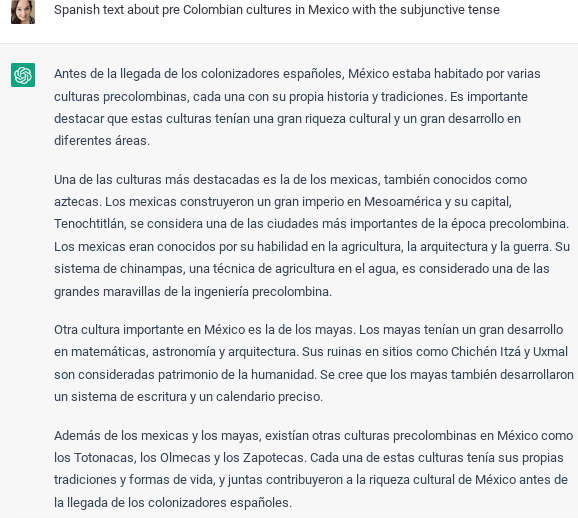
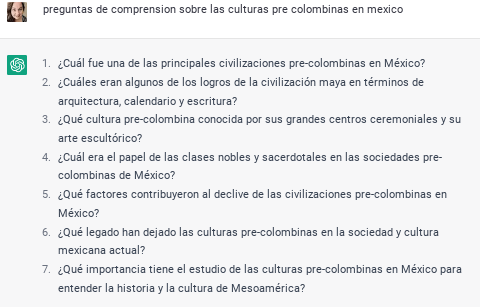
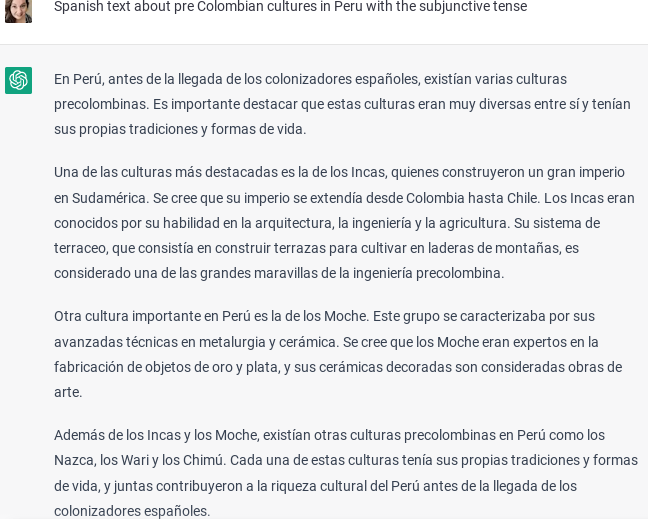
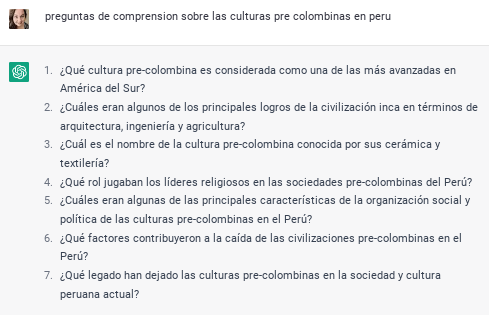
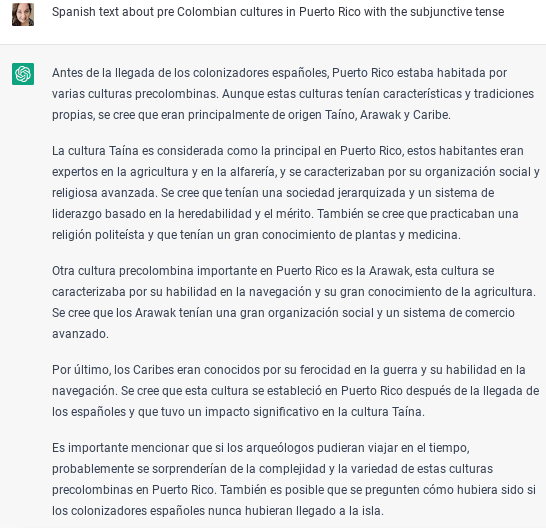
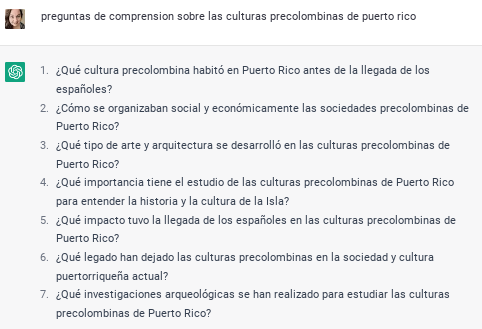
ChatGPT effortlessly generated texts about the pre-Columbian cultures of Peru, Mexico, and Puerto Rico respectively that used the subjunctive mood for my classes.  Additionally, ChatGPT was kind enough to make comprehension questions for each reading as well.  ¡Muy buen amigo indeed! All I had to do was type in “preguntas de comprensión sobre culturas pre colombinas de Perú” and I had seven great questions for each reading. Students learned about the products and practices of indigenous cultures of Latin America directly through these readings which could be used as an integral part of an endless list of interpretive, interpersonal, or presentational activities.

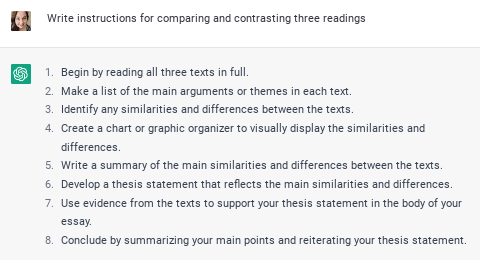
The possibilities for quickly generating texts about any aspect of culture using any grammatical structure with ChatGPT to address World-Readiness Standards for Learning Languages from the American Council of Foreign Language Teacher’s (ACTFL) are seemingly endless.  As an example, students could use the texts below to form comparisons between pre-Columbian cultures and identify intercultural influences in an interpretive activity.  In small groups they could engage in an interpersonal activity to support a subsequent presentational activity comparing and contrasting the indigenous cultures. Mi amigo ChatGPT kindly provided me with a list of prompts for students to use in guiding them with comparing and contrasting as well (ACTFL, 2022).

Engaging Grammar Instruction

With mi amigo ChatGPT I have access to texts and comprehension questions about almost any topic that highlights any grammatical structure in Spanish so my students have more frequent opportunities to use text to identify and explore the uses of grammar in context. Research shows that students are highly motivated to learn grammar through the tasks of reading, writing, speaking, and listening. While reading and learning about culture, students are exposed to the subtleties of the use of grammar and gain a better understanding of the nuances of the language (ACTFL, 2022). 

ChatGPT’s Limitations

Interestingly, I was not able to ask ChatGPT to create an essay comparing and contrasting pre-Columbian cultures using the subjunctive tense because each time it wanted to compare and contrast the use of the subjunctive tense in the respective cultures.  This is actually not even a valid discussion given that pre-Columbian cultures didn’t speak Spanish.  The description of why the subjunctive would be used was accurate however the premise of the ChatGPT’s essay was that the Aztecs and the Mayan spoke Spanish.

“El subjuntivo es un tiempo verbal que se utiliza para expresar acciones inciertas o deseos. En las culturas precolombinas, el subjuntivo se utilizaba a menudo en los rituales religiosos para expresar deseos o peticiones a los dioses. Por ejemplo, en la cultura azteca, se utilizaba el subjuntivo en las oraciones de ofrenda a los dioses para pedirles prosperidad y buenas cosechas.”

“Otra cultura precolombina que utilizaba ampliamente el subjuntivo era la maya. En esta cultura, el subjuntivo se utilizaba en los textos jeroglíficos para describir eventos futuros o inciertos.”

This could be user error because I may not have known how to ask mi amigo ChatGPT the right way to elicit the correct response. However I think it’s safe to say that at a minimum it’s not easy to figure out how to create a cultural comparison with the subjunctive mood in Spanish – at least for now.  

Cheating or Opportunity to Analyze Texts?

Only one kid so far tried to pass a paragraph written by ChatGPT by me and honestly I could tell even though I was not using any software to monitor his computer.  I didn’t need Edward Tian’s GPTZero app either.  I’ve been a teacher and a mom long enough to recognize vocabulary, verb conjugations, and style that is unusual for teenagers to use. Also he seemed to know a lot about the topic for someone who wrote the paragraph in about five minutes.  

In the sample texts that ChatGPT generated for me about pre-Columbian cultures you’ll notice similarities in style and depth.  First of all, the wording is very similar, as is the paragraph length, sentence structure, etc.  Another noticeable attribute is how general the information is.  

Since the likelihood of the student not using ChatGPT on another assignment again in any other class is pretty low, I decided to illustrate a point to him about the tool. I told him that the information lacked depth and sources.  We looked over it and agreed on specific places where more information would be important to the reader and which insights it would provide in the overall cultural context of his topic.

When he finished finding sources and editing his work, he presented a much more robust discussion.  We discussed the differences in the two writing pieces and he admitted to using ChatGPT for the first one.  We then talked about the differences in his experience as a learner from writing the first to the second piece and also about how ChatGPT might change writing academically and professionally given its capabilities and limitations.  As ChatGPT improves undoubtedly it will become harder to spot so easily but like everything about technology we’ll learn how to work with that as it comes.

Safety

Although there are benefits to the classroom, this tool can only be used in compliance with the law and its terms of use by teachers.  There are legal issues with minors using ChatGPT so for at least the short term it’s best used by adults for the classroom.  ChatGPT collects information such as users’ IP addresses, interactions, country, etc. that is prohibited under the Children’s Online Privacy Protection Act of 1998 for children under the age of 13.  Although ChatGPT doesn’t allow minors to open accounts according to their terms of use; however it doesn’t verify the age of its users (Claybourn, 2023). 

Spontaneous Classroom Connection & Fun

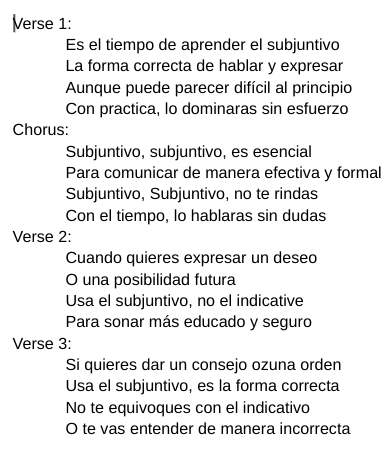
When one of my students wondered aloud what rap in Spanish sounded like I casually offered to write a rap about the subjunctive. That definitely got their attention and quickly became a challenge that I confidently accepted knowing that I had an amigo who could help.  The rap was actually a really great explanation of the subjunctive and was pretty catchy. A comment from a student quickly turned into kids making beats and rapping about the subjunctive in Spanish. It was a great learning moment and maybe most poignantly, technology-facilitated spontaneous fun and connection in my classroom.

I’d love to hear how it’s going in your classroom with ChatGPT. Please comment below. 

American Council of Teachers of Foreign Languages. (2022). Teach Grammar as a Concept in Context. ACTFL Language Connects. Retrieved January 20, 2023, from https://www.actfl.org/resources/guiding-principles-language-learning/grammar-concept-in-context 

American Council of Teachers of Foreign Languages. (2022). World-readiness standards for learning languages – ACTFL. World Readiness Standards For Learning Languages. Retrieved January 20, 2023, from https://www.actfl.org/sites/default/files/publications/standards/World-ReadinessStandardsforLearningLanguages.pdf 

Claybourn, C. (2023, January 18). CHATGPT in classrooms: What to know | high schools | U.S. news. ChatGPT in Classrooms: What to Know. Retrieved January 21, 2023, from https://www.usnews.com/education/best-high-schools/articles/chatgpt-in-classrooms-what-to-know 

Kuo, M.-M., & Lai, C.-C. (2006). Linguistics across Cultures: The Impact of Culture on Second Language Learning. Journal of Foreign Language Instruction, 1(1). 

Lowrey, A. (2023). The Atlantic. How ChatGPT Will Destabilize White-Collar Work. Retrieved January 20, 2023, from https://apple.news/ArNwgCNfBRA6Y9xCCQp5G2g 

Rost, M. (2002). New Technologies in Language Education: Opportunities for Professional Growth. Retrieved October 12, 2006 from http://www.longman.com/ ae/multimedia/pdf/MikeRost_PDF.pdf

Salaberry, R. (1999). CALL in the year 2000: still developing the research agenda’. Language learning and technology 3/1: 104-107

**Interested in writing a guest blog for my site? Would love to share your ideas! Submit your post here. Looking for a new book to read? Find these available at bit.ly/Pothbooks

************ Also check out my THRIVEinEDU Podcast Here!

Join my weekly show on Fridays at 6pm ET THRIVEinEDU on Facebook. Join the group here