In April 2023, our family – comprising two dynamic teenagers, a mom in education, and a tech-savvy husband – embarked on a quest fueled by a simple yet profound question: ‘What great things can we accomplish with AI today?’ This question ignited our passion project, Kids Think Wide.
‘Kids Think Wide’: Born from AI
Our initial challenge was finding a name that echoed our vision and passion, particularly for art. We sought guidance from ChatGPT, which suggested names like ‘kidsthinkingdiversely.com’. However, seeking a more kid-friendly name, we settled on ‘Kids Think Wide’. This title perfectly aligns with our goal of expanding young minds through AI-driven educational tools. AI’s role extended beyond naming; it was instrumental in designing our logo, creating web content, and assisting in coding. Admittedly, AI solutions aren’t flawless – we’ve encountered coding limitations and often diverged from AI suggestions. In this creative process, we learned to embrace the journey and be patient, open to change, and always learning.
Crafting a Universe of AI-Generated Content
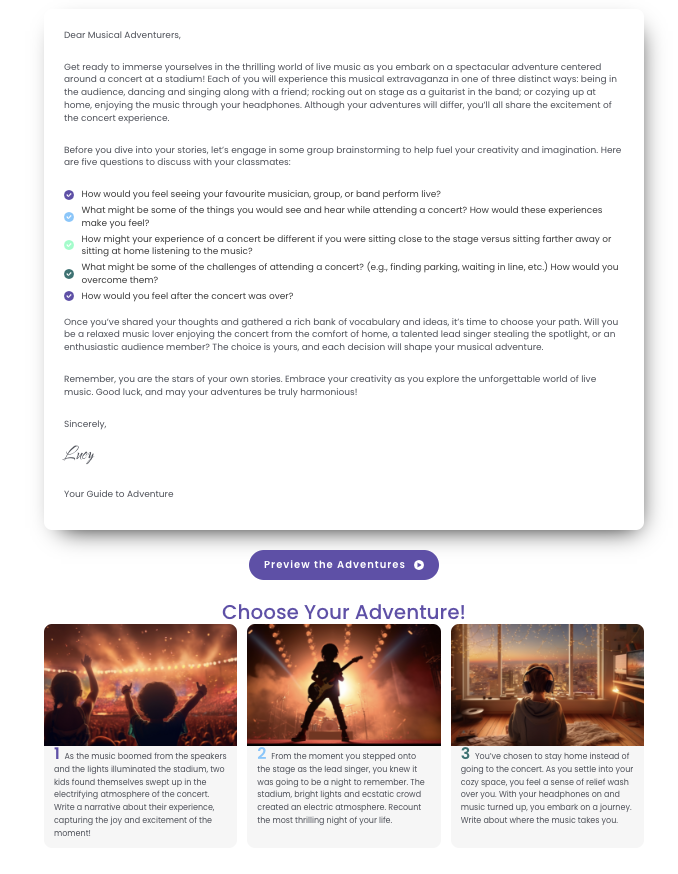
‘Kids Think Wide’ is dedicated to fostering a more equitable educational landscape. We are committed to representing everyone, promoting gender equality, and amplifying historically overlooked or unheard voices in engaging and fun ways! We’ve created over 10,000 AI-generated images and published approximately 400 on Kids Think Wide. A writing prompt and discussion questions accompany each image to help prepare and inspire students to write. Our unique offerings include ‘choose your own adventure’ stories. In these, students collaboratively brainstorm and build ideas for their narratives before selecting from 3 to 5 adventure paths to personalize them, such as:
Additionally, we’ve leveraged the popularity of short-form videos, similar to reels and TikTok, using animated images, or ‘Sparks’, to captivate and spark enthusiasm for creative writing among students.
Our journey with AI also revealed the biases and limitations inherent in image generators. We’ve found it’s easier to create images that involve subjects that are very common online – celebrities, movie scenes, and well-photographed places but getting an accurate representation of a wheelchair can be more challenging.
AI has allowed us to create scenes that challenge reality:
Journey through time, space, and into other worlds:
Create the fun, wild and whimsical:
The Evolution and Magic of AI-Generated Images
The last nine months have seen dramatic advancement in AI-generated images. The improvement in image quality, accuracy in prompt interpretation, and the ability to adjust specific image elements has been remarkable. Our journey through this dynamic domain has been an exhilarating blend of discovery and creativity. While perfecting an image is usually challenging and time-consuming, the results are frequently astonishing and rewarding. We start simple and slowly build on prompts. The arrangement of phrases and the specific words chosen play crucial roles. However, you can unlock unexpected and extraordinary outcomes through iteration, experimentation, and patience. It helps to know tokens (short phrases that often produce excellent results), e.g., playful mood, cinematic, low Angle shot, bokeh, or Chiaroscuro to name a few! On other occasions, it might require 30, 50, or even more re-rolls and remixes to create an image that genuinely captivates and is worth sharing.
While free tools provide a starting point, they often have limitations; investment in paid resources is usually necessary for more advanced or specific requirements.
As AI image generation rapidly evolves, we find ourselves exploring various tools. Midjourney stands out with its detailed control and often superior imagery, while Adobe Firefly is notable for its dedication to diversity and inclusivity. On the other hand, Dall-E brings a sense of whimsy to its creations. Each platform offers a unique experience. It’s not uncommon to initially admire an image, only to later discover anomalies like an extra limb or oddly placed fingers – the quirks of AI can lead to both amusing distortions and unexpected additions.
Engage with the AI Community
Our journey has shown us how important connecting with the AI community is. There are many skilled and helpful creators out there. We often turn to Twitter to engage with this community. It’s an excellent place for learning, sharing experiences, and finding support.
‘Kids Think Wide’ has evolved from a simple ‘what if’ conversation into a reality, thanks to AI’s extraordinary capabilities. This concept, unimaginable even nine months ago, has come to life through our family’s collective imagination and AI’s power. We’re excited to unveil more awe-inspiring images, thought-provoking writing prompts, and enhanced interactivity, all while staying at the forefront of AI developments. As ‘Kids Think Wide’ continues to grow, one thing is sure: the best is yet to come, with AI playing a pivotal role in our journey.
Thanks to Megs for the guest post
Rachelle Dené is a Spanish and STEAM: What’s Next in Emerging Technology Teacher at Riverview High School in Oakmont, PA. Rachelle is also an attorney with a Juris Doctor degree from Duquesne University School of Law and a Master’s in Instructional Technology. Rachelle is an ISTE-certified educator and community leader and served as president of the ISTE Teacher Education Network. She was named one of 30 12 IT Influencers to follow in 2021 and one of 150 Women Global EdTech Thought Leaders in 2022.
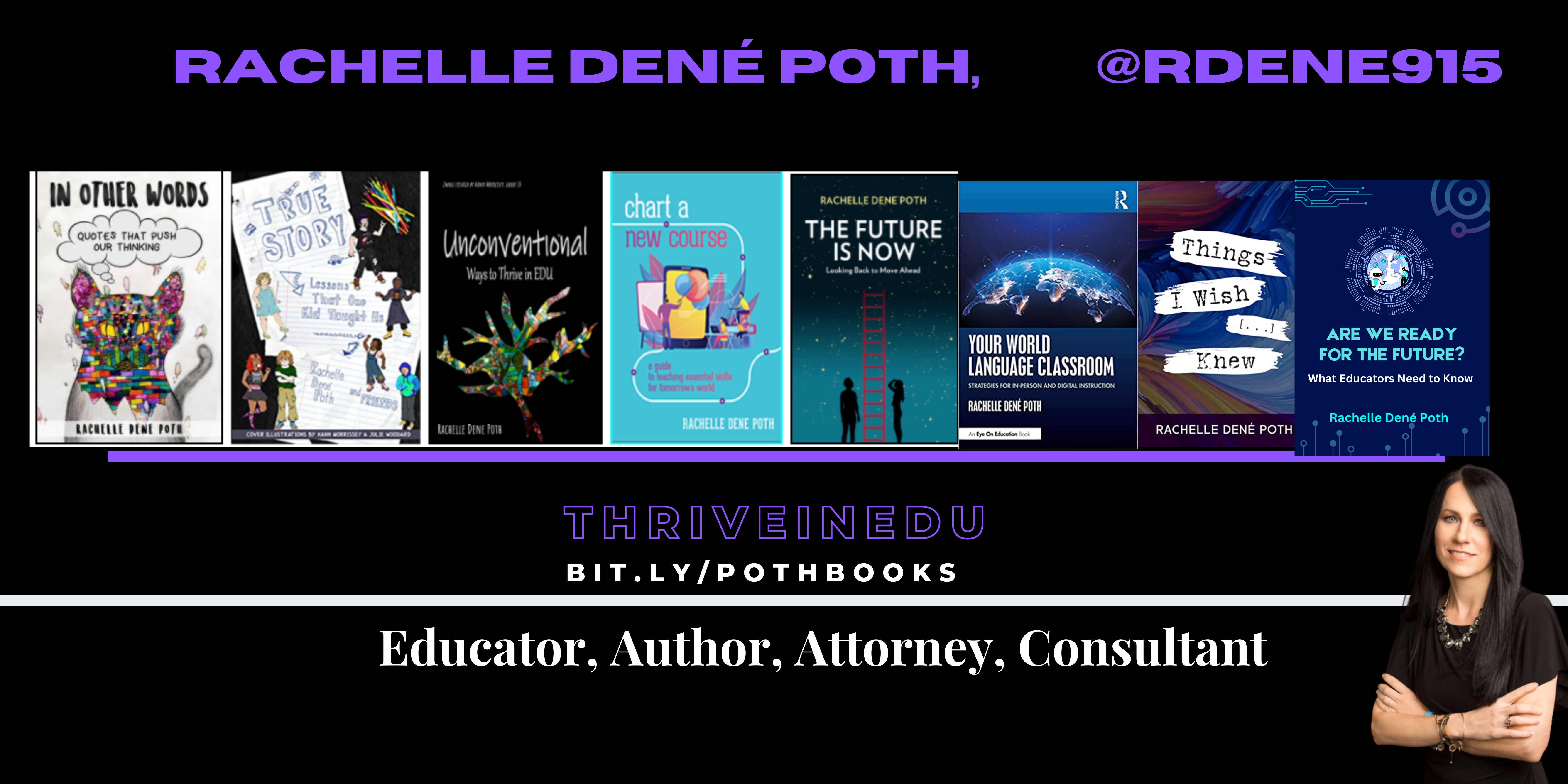
**Interested in writing a guest blog for my site? Would love to share your ideas! Submit your post here. Looking for a new book to read? Find these available at bit.ly/Pothbooks
************ Also check out my THRIVEinEDU PodcastHere!
Guest post by Dr. Amy Mathews-Perez, member of the Board of Directors for the Texas Council of Administrators of Special Education (TCASE) & a Director of Special Programs in a public school in Central Texas. Connect with Amy on X (formerly Twitter) at @drgrowtoknow and on Facebook at DrAmy MP.
While I know a few ladies named Grace, and they are all great ladies, the grace this blog is about is the NOUN. Our friend Merriam-Webster has many definitions for this word, but I’m going to combine a few of them so we can all be on the same page: Grace: a temporary exemption, the disposition or act of kindness, the state of being considerate, thoughtful.
Hopefully, each person reading this has experienced grace in ways that you can remember and still appreciate. I want to touch base with you about what I call a “mini-epiphany”; an idea that comes to me out of nowhere and brings me relevant insight that impacts multiple areas of my life. Figuring out that I am grateful for grace was one of these mini-epiphanies. To be transparent, I have very limited attention, and I am constantly pinging between tasks, thoughts, ideas, reminders, reflections, planning, and “what if” in my mind. As a part of this messy thought process, I recently became disappointed about how many friends’ birthdays, anniversaries, and other celebrations I have missed. Why did I miss them? Tons of reasons, all of which could be justified, including reasons like this: it was too late in the evening to call or text, the embarrassment of being late to celebrate, the forgotten or ignored reminder to do it, the failure (again) to put it in my calendar as a recurring event, and the list could go on. I was feeling guilty and telling myself that I am a less-than-stellar friend/sibling/coworker. I decided that late is better than never; late is better than the risk of the other person thinking I’m ignoring them or don’t care, so I texted a friend and celebrated a Twitter/X post that I had missed commenting on….and while this friend would never be mean or negative, she had every right to not respond to my text, make a joke about my lack of timeliness or just say, “Thanks.” However, within just a few minutes, this friend replied with this: “Thank you! 💙” It may seem silly, but that blue heart was forgiveness, appreciation, and kindness all wrapped into one emoji. That blue heart was grace being provided to me; it was grace I could see and feel.
After I took a few deep breaths and reflected on the wonderful blessing of this friendship, it dawned on me: How much grace have I been given that I haven’t seen? I am grateful for the grace I am given, both seen and unseen, known and unknown. I am grateful for the grace of friends and family that accept me and encourage me to be my quirky, forgetful, high-energy, low-memory self. I am equally grateful for the grace of people I may never meet or even see; grace that can include their choice to not respond to gossip or negativity that may involve my name, their effort to not point out every error I make – especially on social media, or the grace of their intention to support me, my work and my vision.
Being grateful for what you have may or may not be easy, but we all have visual reminders of reasons to have gratitude, such as not being the person who got COVID this time, not getting pulled over even though we know we were speeding, or watching our Parents age. By taking the time to first realize what “could be” that would negatively impact me and then reflect on why I have not endured those things, I was awakened to the many forms of grace. Life gets busy, and it is easy (natural, sometimes automatic) to take grace for granted. In writing this, I wanted to share that the time, energy, effort, and intention that it takes to tap into gratitude for grace for things known and unknown, seen and unseen, is worth the positive change it can make in your heart and mind. I am grateful for grace.
About Amy
Texas-born & raised, Amy is in her 32nd year of serving public education. General Ed. Teacher, SLP, Diagnostician, SPED Supervisor, Principal, Assistant Principal, and a Director of Special Education are roles she’s held. She is the CEO of Making Education Special for All (M.E.S.A), an LLC dedicated to training, consultation, and speaking engagements that revolve around providing information, motivation, and insights on why and how to make education special for all stakeholders.
Her passions are communication, joy, authenticity, and empowerment. “Life is short but our influence is never-ending,” and Amy is committed to connecting with others through service and collaboration. You can connect with Amy on X (formerly Twitter) at @drgrowtoknow and on Facebook at DrAmy MP.
Looking for PD for your school or keynotes for your conference? I provide in-person and virtual training on the following topics. If you want to learn more about and explore AI and ChatGPT, contact me to schedule! Rdene915@gmail.com or use the Book Me form on my website. bit.ly/thriveineduPD
**Interested in writing a guest blog or submitting a sponsored post for my site? Would love to share your ideas! Submit your post here. Looking for a new book to read? Find these available at bit.ly/Pothbooks
This will be the first post where I will share some different tools or resources to explore!
Each year, I like to take time and think about the digital tools we use in our classroom, the benefits, and how I might find new ways to use them. When I look to use technology in my classroom, I always start with the “purpose”Why” behind it. What will it help me to do better as a teacher? How can it help students to learn in more personalized or authentic ways? And what skills will students build as a result that traditional non-technology methods might not afford?
There are tools that I continue to use each year because they have added new features or they have integrated with other tools that we are using in our classroom. Here are six tools to check out as we start 2024! And one that is highly recommended to dive into AI in your classroom!
CoSpaces EDU is a virtual reality platform that became a favorite for some of my 8th-grade students this year. Whether creating a space in 360, designing a game, an interactive story, or an experiment, students will enjoy creating in VR and developing coding skills too. Another benefit is the Merge Cube add-on, which enables students to hold the space they have created in their hands! Students can even collaborate by working in teams to create a space together. With MergeEDU, educators can use the cube as an interactive tool to further engage students in learning about the earth, dissecting a frog, exploring a volcano, and more.
Gimkit, a game-based learning tool, has continued to be a favorite with my students because of the potential for increased content retention through repetitive questions and because of the different ways it can be played in the classroom. It enables students to develop strategies and have fun while learning. There are multiple ways to look at the student data and provide authentic and timely feedback. And there are always new modes to play, which helps to boost student engagement and gives us some laughter, too! Check out Blastball!
ISTE’s AI and STEM Explorations Network has created four free hands-on AI projects for the classroom guides, which are available for download from ISTE and GM. For elementary, secondary, electives, computer science courses, and a new guide on ethics, these guides offer various topics relevant to all content areas. The guides are available in English, Spanish, and Arabic.
Nearpod is a multimedia, interactive presentation tool that enables teachers to create engaging lessons that can include virtual trips and 3D objects. It offers lessons on topics such as digital citizenship, social-emotional learning, career exploration, English learner lessons, and professional development resources for teachers. Educators can create lessons with many options, including quizzes, polls, drawings, matching pairs, audio, video, and content from PhET Simulations, Desmos, BBC, YouTube, and more. Nearpod lessons can be done live in class or student-paced, and there is also the option for use as sub plans.
Wakelet is a content curation tool and so much more. I use it to curate blogs, videos, and other resources I want to access quickly to be a powerful tool for student learning. With Wakelet, teachers can provide blended learning experiences, use it for station rotations, have students create a digital portfolio, share class projects, create a scavenger hunt, and many other possibilities. It even offers the ability to record a Flip short video within the Wakelet collection. Educators and students can collaborate in a Wakelet collection and so much more!
Think about some of the tasks that might be taking up a lot of your time, or consider some issues or challenges you might be having. A few years ago, I noticed a decrease in student engagement and looked for ways to open up more choices for students to share their learning. Any of these tools can be suitable for addressing those concerns.
My Advice? Start thinking about your own personal goals and start with one thing. Try it and see how it goes, ask students or colleagues for feedback, and then make adjustments as needed.
Looking for PD for your school or keynotes for your conference? I provide in-person and virtual training on the following topics. If you want to learn more about and explore AI and ChatGPT, contact me to schedule! Rdene915@gmail.com or use the Book Me form on my website. bit.ly/thriveineduPD
**Interested in writing a guest blog or submitting a sponsored post for my site? Would love to share your ideas! Submit your post here. Looking for a new book to read? Find these available at bit.ly/Pothbooks
*AI is one of my favorite areas to work in and I love sharing ideas!
As a classroom teacher with almost six years of experience integrating AI into my teaching practice and training other educators, I have enjoyed exploring the possibilities through AI and engaging in conversations with students and teachers. Every educator needs to learn about AI and how we can leverage this technology to benefit our students and enhance our work. To best provide for our students, we need to understand how this technology will impact them and us.
Especially as we see such as increase in technology in education, it is essential that we embrace and understand emerging technologies, especially AI and how it can impact not only our work but the benefits it can offer for student learning. In my work as a classroom teacher and consultant, I enjoy helping other educators get started with AI.
Why Educators Need to Understand the AI Tools Available
Our roles as educators have continued to change over the years. Not only do we teach the content, but we serve as mentors, facilitators of learning, and co-learners with our students, especially as we embrace these emerging technologies. It is important that we explore the benefits and how it can help us to “work smarter, not harder” so that we have more time to work with students, build relationships and support them in their learning journey.
AI, ChatGPT, and other forms of generative AI have become some of the most talked about topics in education this past year. But with all technology comes some hesitancy, especially with something as powerful as AI. Schools need to provide opportunities for students to learn about this changing technology because of its impact on their future. Not only can AI tools enhance creativity and productivity, they can also provide educators with valuable insights into student learning and assist with some of the time-consuming tasks that educators have.
How to leverage some tools with benefits
I like to think of three key areas where AI can make an impact for educators and for students.
1. Personalized Learning: Through AI, educators can provide tailored learning experiences based on AI-driven analytics that provide valuable insights into student performance and learning trends. It can adapt to each student’s strengths, weaknesses, and learning pace.
2.Efficiency and Productivity: Another benefit of AI is greater efficiency. Educators may spend more time on clerical tasks that takes time away from working directly with students. The right AI tools can help to automate or streamline tasks uch as grading assignments or providing feedback, giving teachers more time with their students.
3. Creating and supplementing the content: Through AI-powered platforms, teachers can curate various educational resources for their students and their own professional learning. With generative AI in particular, quickly being able to create lessons, activities, assessments, prompts for discussion, and presentations by providing a short prompt with keywords, educators can create engaging lessons for students in far less time.
But how do we know where to begin?
Tools to Explore
With so many different tools becoming available or integrating AI into them, it can be hard to keep up. My recommendation is to select one or two to start with. Explore how they work and the content that is created. Take time to evaluate the accuracy of the information and even involve students in discussions about the benefits for their learning.
Here are five AI-powered tools that will help teachers with personalized learning, efficiency, and saving time. I have created and experimented with so many tools, and my students’ responses have always been positive. Embracing these tools also sparks curiosity for learning. Creating and sharing these resources with our students leads to rich conversations about AI’s benefits and the proper use of this technology for creating and learning. See below for an additional article link and my contact form to bring me to your school or provide coaching.
Curipod: Enables teachers to create interactive lessons in minutes using AI. Teachers simply type in a topic, and a ready-to-run lesson is generated with text, images, and activities such as polls, open-ended responses, word clouds, and more. There are even activities to build in that focus on SEL check-ins. Use my code CURIRACHELLE
Eduaide.Ai: An AI-assisted lesson development tool that provides educators with more than 100 resource types to choose from. It offers the ability to translate the generated content into more than 15 languages instantly. Educators can generate a syllabus and discussion prompts, use the Teaching Assistant to help with creating IEP plans, write emails, or even create a list of accommodations for students in addition to many other options. I enjoy using Eduaide for a variety of tasks, especially creating lesson and project outlines and testing out the feedback bot! Try some and then tag @eduaideAI and @Rdene915 in a tweet and win a book!
Quizizz: With Quizizz, teachers can design quizzes that create a personalized learning path in response to each student’s responses and based on their needs. Teachers can also create lessons with Quizizz, which now has AI enhancements that can adjust question difficulty, check grammar, redesign questions to reflect real-world scenarios, create a quiz from a URL or PDF, and more features on the way.
Slidesgo: Provides access to free templates via Google Slides and now has the AI Presentation Maker. With this new functionality, presentations can be created within minutes. Start by choosing a topic, selecting a tone such as casual, creative, or professional, making changes, and downloading your presentation. A time saver, for sure! I really enjoyed testing it out and creating some amazing presentations! Want to learn more? Be sure to check out their recent survey, which has great insights into AI and tools for education! Dive into exploring more today!
Also, head to my additional post via Edutopia for more AI tools to try here: 7 Tools
Do you want to learn more about AI and how to bring it into your classroom? I have six years of experience working with students and teachers and would love to work with your school, at your conference or individual coaching:bit.ly/thriveineduPD
Looking for PD for your school or keynotes for your conference? I provide in-person and virtual training on the following topics. If you want to learn more about and explore AI and ChatGPT, contact me to schedule! Rdene915@gmail.com or use the Book Me form on my website.
**Interested in writing a guest blog or submitting a sponsored post for my site? Would love to share your ideas! Submit your post here. Looking for a new book to read? Find these available at bit.ly/Pothbooks
These apps and websites can help teachers boost their productivity, personalize learning, and create lesson content.
Over the past five years, I’ve explored ways to integrate AI into my teaching practice—even before ChatGPT and other generative AI became some of the most talked-about topics in education. Every educator needs to learn about AI and how we can leverage this technology to benefit our students and enhance our own work. To best provide for our students, we need to understand how this technology will impact them and us. What better way than to explore new tools via AI in our teaching practice?
Rachelle Dené is a Spanish and STEAM: What’s Next in Emerging Technology Teacher at Riverview High School in Oakmont, PA. Rachelle is also an attorney with a Juris Doctor degree from Duquesne University School of Law and a Master’s in Instructional Technology. Rachelle is an ISTE-certified educator and community leader and served as president of the ISTE Teacher Education Network. She was named one of 30 12 IT Influencers to follow in 2021 and one of 150 Women Global EdTech Thought Leaders in 2022.
**Interested in writing a guest blog for my site? Would love to share your ideas! Submit your post here. Looking for a new book to read? Find these available at bit.ly/Pothbooks
************ Also check out my THRIVEinEDU PodcastHere!
Join my show on THRIVEinEDU on Facebook. Join the group here
Time and the capacity to use data and understand it are at the essence of making data-driven decisions in classrooms and schools (Rhoads, 2019; Mandinach 2012, U.S Department of Education, 2010). In my research focusing on data literacy for educators, time has always been the number one issue for educators to use data to make decisions as well as learn and practice data literacy skills. Yet, with what we are going to talk about today, I believe that this can change by leaps and bounds.
Ultimately, as the world of education becomes increasingly data-driven, teachers and school leaders face the daunting task of learning how to effectively analyze and apply this data. The role of technology software in gathering, transforming, and visualizing data is no longer optional—it’s a necessity as our classrooms and schools are collecting immense amounts of data that can be utilized to support student learning. But how can we bridge the gap between the data we have and the insights we need in a quick and efficient manner? Enter Code Interpreter, a revolutionary tool that’s changing the way we approach data in education. Let’s discuss how it can be utilized to support data-driven decision-making as I believe it can solve many of the time and capacity issues facing teachers and school leaders in using data to make important decisions for students and school systems.
Note: For information related to my research into data literacy, please check out my study and its summary found here.
Data is Everywhere in Classrooms and Schools
Data for teachers and school leaders can be drawn from various avenues such as the school’s Student Information System, Learning Management System, and EdTech tools. Many of these tools provide opportunities within themselves to review the data they collect in the form of visualizations and dashboards. Yet, these tools do not provide in-depth analysis that can help teachers and school leaders make data and evidence-informed decisions to the best of their abilities. As a result, the data will need to be extracted, and cleaned, and further analysis will need to take place to see deeper insights as to what the data is telling us as well as how it may relate to other strands of data we’ve collected. For example, take test scores, student SEL surveys, and attendance data from a period of time. What we can now do is easily place those data points onto a single Excel file to be analyzed by Code Interpreter to see if any relationships may exist. With this said the goal of this blog is to demonstrate how this can be done by teachers and school leaders as they begin harnessing this tool to support them in their data-driven decision-making.
Step-by-Step Process of Using Code Interpreter
Now, we will discuss its major features in supporting educators in making data-driven decisions. First, we will discuss the process of how it can be used. Secondly, we will outline how it can conduct important data preparation and analysis steps for us in order for the results to be computed in a way that is understandable during analysis as well as to stakeholders. Third, we will go into further applications of Code Interpreter that can be utilized by teachers and school leaders. Let’s get started!
Important Facets Code Interpreter Can Do Essential to the Data-Driven Process
Before discussing how to use Code Interpreter in a step-by-step process, we want to cover some important facets it can do in the data-driven process: Clean Data, Statistical Analysis, Visualizations, and Articulate Data Findings to Stakeholders. All of these facets are critical when utilizing Code Interpreter and conducting any form of data analysis.
Cleans Data
One of the major hurdles in data analysis is data cleaning, a time-consuming but critical process to ensure accurate results. Code Interpreter can automate this process, identifying errors, inconsistencies, and outliers in raw data. With its robust data cleansing capabilities, Code Interpreter can streamline this often laborious task, leaving more time for interpretation and decision-making.
Note: This video illustrates how Code Interpreter cleans data. Cleaning data is super important in order to have valid results from a data set you are working with.
Conducts Detailed Statistical Analysis with a High Degree of Accuracy
Beyond cleaning data, Code Interpreter shines in its ability to conduct detailed statistical analysis. It can handle a wide variety of statistical techniques and tests, delivering a high degree of accuracy. Even complex data practices, often daunting for non-expert users, become more accessible and understandable with GPT-4’s intelligent interpretation and simplification of statistical outputs.
Visualizes the Data Based On the Statistical Outputs You Desire
Visualizing data is a key element in understanding and communicating complex information. GPT-4 Code Interpreter can assist in creating visually engaging and informative graphs, charts, and dashboards based on the statistical outputs you need. This automated visual representation of data can support data-driven decision-making by making the findings more tangible and accessible.
Note: Below is an example of a visualization of data produced by Code Interpreter
Articulates the Data to be Presented to Stakeholders
Another challenge that Code Interpreter addresses is the communication of data insights. Often, complex statistical analyses can be difficult to convey to stakeholders in a clear, understandable manner. Code Interpreter can summarize complex findings, generate reports, and even make predictions based on the data, making it easier for stakeholders to understand and apply these insights in decision-making.
Example in Action – Using Code Interpreter for Educational Data Analysis
Let’s focus on the example we provided at the beginning of this blog post. It focuses on reviewing test scores, student SEL surveys, and attendance data. We will now walk you through the steps of how to use Code Interpreter to dive into this data and analyze it. This will be a four-step process, which can take between five and ten minutes to complete.
Step 1: Gathering the Data
Your first task involves gathering your data from various sources – this could be test scores, student Social-Emotional Learning (SEL) surveys, and attendance data. Let’s say for this example that the test scores, the SEL survey, and attendance data are for the entire 2022-2023 school year. The assessment scores for an elementary school are from the most recent state-wide summative assessment given. Data can be collected from the student information system, the state’s assessment database, and the survey provided to students on a local Google Form. This may be the most time-consuming step of the process as sometimes data extraction features are hard to find and selecting data to extract may also take time as well.
Note: Below is a video example demonstrating how to export data from I-Ready Onto an Excel File.
Step 2: Organizing the Data in an Excel File
Once collected, arrange all these data points on a single Excel spreadsheet. You might have columns for the grade levels, test scores, survey responses, and attendance records. Make sure your data is clean, accurate, and organized coherently for the best results. What an educator can do is copy and paste the columns from each of the extracted data sources onto a single spreadsheet. Then, they can prompt after uploading the data to Code Interpreter to clean the data (more on that later).
Note: This video demonstrates how to combine data from multiple data sets in four ways using Excel.
Step 3: Importing Your Data into Code Interpreter
Now it’s time to engage with the Code Interpreter. To do this, you’ll need to import your Excel file into the platform. In most cases, this is as simple as clicking the “Upload” button and selecting your file.
Step 4: Prompting the Code Interpreter to Conduct Descriptive Statistics
Start with some basic analysis. For descriptive statistics, you might instruct the Code Interpreter to compute measures such as the mean, median, or standard deviation for your various data columns.
Note: Before moving into statistical prompts to ask Code Interpreter, be sure to prompt Code Interpreter to Clean the Data. For example, prompt Code Interpreter to clean the data and organize it for analysis, which it will then conduct for you.
To do this, you could input something like:
“Compute the mean, median, and standard deviation for the ‘Test Scores’ column.”
The Code Interpreter will then return the requested statistical measures.
What’s great is that it can provide easy-to-understand results. You can further review and question the results as well. Additionally, in this same instance, prompting it to visualize these results into graphs is another important feature, which can help in the data articulation piece for when it’s presented formally to other educators and stakeholders.
Step 5: Conducting Multivariate Analysis
For a more in-depth understanding, you can instruct the Code Interpreter to conduct multivariate statistical analyses. For example, you might want to find out if there’s a correlation between attendance and test scores.
To do this, you could input something like:
“Calculate the correlation between ‘Attendance’ and ‘Test Scores’ columns.”
The Code Interpreter will return the correlation coefficient, providing insight into the relationship between these variables.
Step 6: Interpreting the Results
Code Interpreter not only conducts the analysis but also provides a simplified interpretation of the results. This is a vital step to help you understand and apply the insights from the data to your decision-making process. As with descriptive statistics, you can further prompt it to dive deeper into the analysis or ask it to provide graphs to visualize the data.
Note: Below is a video demoing Code Interpreter a wide variety of ways that follow this protocol.
Further Applications
Code Interpreter isn’t limited to basic data analysis—it’s a versatile tool with a multitude of applications that can revolutionize the way we engage with data in education. Let’s explore some of the ways in which this advanced tool can assist teachers and school leaders beyond basic statistical analysis:
Facilitating Data Dialogues: The Code Interpreter can serve as a valuable assistant in data dialogues, aiding in both data cleaning and providing alternate perspectives in analysis. It can efficiently present various statistical outputs, offering multiple ways to interpret the data and stimulate insightful conversations among educators.
Developing Action Plans: With its ability to produce comprehensive reports and detailed analyses, the Code Interpreter can facilitate the development of data-driven action plans. By linking analyzed data to practical steps, it can help formulate action plans tailored to improve student outcomes.
Improving Instruction: The Interpreter’s analysis can uncover patterns and trends that are invaluable for informing instructional strategies. By linking data findings with recommendations for instruction, it allows educators to make data-informed decisions that directly impact classroom practices.
Enhancing Processes: Beyond the classroom, the Code Interpreter can also support the optimization of broader school processes. For instance, patterns in attendance data can inform changes in scheduling or student support services.
Predictive Analysis: The Code Interpreter’s predictive analysis capabilities can help forecast future trends, enabling proactive planning. For instance, it could predict future test scores based on current student performance and engagement metrics.
Personalized Learning: The Code Interpreter can help tailor educational experiences to individual student needs. By analyzing data at the student level, it can inform personalized learning plans to cater to each student’s unique strengths and areas for improvement.
Conclusion and Data Literacy Skills Needed to Be Effective Using Code Interpreter
We’ve embarked on a journey today, exploring the potential of the Code Interpreter in transforming educational practices through effective data analysis within classrooms and schools. By harnessing the power of this tool, we can redefine how we approach data, decision-making, and action in our educational spaces to improve our instruction and school systems for our students, faculty, and community.
However, as we navigate this digital landscape, it’s important to remember that tools like the Code Interpreter are most effective when coupled with our own data literacy skills. As teachers and school leaders, enhancing our understanding of data management and analysis will be instrumental in maximizing the benefits of these technological advancements.
This includes the ability to merge and transform data on spreadsheets, and the knowledge of single and multivariate statistical analysis. A strong foundation in these areas not only amplifies our ability to use tools like the Code Interpreter but also empowers us to question, interpret, and apply data insights in meaningful and impactful ways.
While this may seem like a daunting task, take heart in the knowledge that the digital age brings with it a wealth of resources to help build these skills. Online courses, webinars, workshops, and even integrated tutorials within tools like the Code Interpreter are at your fingertips, ready to help you embark on this exciting learning journey. For those who want to practice, Kaggle provides datasets from many different industries. It’s a great way to practice as the datasets come pre-packaged and are easy to work with as you get started with using Code Interpreter.
So, let’s take this as a hopeful invitation to embrace the future of data in education. The road ahead is full of opportunities for growth, innovation, and enhanced understanding, all aimed at one noble goal – the betterment of our educational environments. Together, equipped with our growing data literacy skills and the powerful Code Interpreter, let’s step forward into this exciting future.
**Interested in writing a guest blog for my site? Would love to share your ideas! Submit your post here. Looking for a new book to read? Find these available at bit.ly/Pothbooks
************ Also check out my THRIVEinEDU PodcastHere!
Join my show on THRIVEinEDU on Facebook. Join the group here
During the fall, educators may notice a decrease in student engagement and also, that students are not retaining the content as well. With a few ideas to explore that get students more involved, we can hopefully also spark interest and excitement for learning to help students value the process of learning itself.
I always say that the beginning of the school year and throughout the fall are great times to try something new. To best provide for all students, opportunities that empower them to set their pace for learning, to choose areas of interest or the “how” to show learning, and to collaborate with classmates, make a difference. They will invest more in learning and become more curious.
So what are some ways that educators can do this? By choosing versatile methods that are not specific to the content area whether through choice boards or class playlists, STEM-related learning opportunities, or diving into PBL, we can help students in many ways. With these options, we can build content knowledge while also developing SEL skills to prepare students for the future and boost engagement in learning.
Boosting Engagement and Curiosity
When we create learning experiences that will more meaningfully engage students with the content, while also aiming to move them from being simply consumers to creators, it increases their interest and amplifies student achievement.
When students have the opportunity to provide input into the lesson brainstorm ideas and plan with us will also boost engagement and build a learning community in our classrooms.
As educators, it is important to continue to reflect on our practice and make time to learn about student interests so that we can better provide for them. With a variety of ways for students to show what they have learned, we will foster student agency, boost engagement, and increase student motivation in learning. Here are some ideas to explore:
Choice boards are a great way to include a variety of options for students to explore and practice the content in a meaningful and authentic way. It also helps teachers to differentiate instruction by providing students with multiple ways to process information and build their knowledge. A choice board can be created on paper or digitally.
Creativity tools:Buncee is a great option for multimedia presentations and interactive lessons. Another benefit is it offers Immersive Reader which promotes language accessibility for students and there are so many options to choose from for creating a visually engaging presentation! Another choice is Book Creator is a multimedia creativity tool to create books that can include audio, video, text, and images, and more. It also has features such as captions, translation in 120+ languages, and improved screen readers. Students can also collaborate on a book with a partner or as part of a class. Genially is a versatile option that can be used to create presentations or even make a class website, choice boards, newsletters, escape rooms, storybooks, and more.
Game-based learning: Students enjoy playing a variety of games whether traditional games, ones they make up, or participating in the many digital options available. These are great for teachers to gather feedback and be able to provide additional support for students. Some of our favorites include Blooket, Gimkit, Kahoot!, Quizizz, and Quizlet Live!
Interactive lessons:Formative has been a great option in my classroom for many years. It has a variety of options for students to complete quick activities or assessments or do a self-paced lesson. It helps teachers to track student progress, better understand the questions that students might have, and use it as a way to reflect on their own teaching practice.
Fun activities:Skribbl.io is a fun drawing game that I used in my Spanish classes and added my own list of vocabulary words. Students then have a code to join the game and then try to guess the word as it is drawn. Gimkit has a similar feature. Another favorite is Bingo Baker where you can generate bingo cards and print unique cards or have students use their devices. Bingo is always a fun way to review vocabulary and content!
Student input: Learning from students about their interests and gathering feedback is important. I have used LessonLoop, which enables educators to share anonymous student engagement surveys to gather feedback from students. The students’ responses help educators guide their next steps and better plan for instruction by valuing the input of every student.
STEM activities and problem-solving: Engaging students in STEM activities doesn’t need to only happen in a STEM-specific course or grade level. My students used Hummingbird robots from Birdbrain Technologies to create design challenges. CoSpacesEDU is an augmented and virtual reality platform that can be used with any grade level or content area. There are some easy-to-try STEM challenges that help students to build many essential skills. I recommend trying the Cup Tower Challenge, and the Straw Challenge. I recently learned about ImaginGO which is an instructional software that spurs creative and imaginative thinking. It engages students to invest and incorporate their own innovative ideas to solve complex problems and gets students up and moving more!
As teachers wrap up the content material or look for ways to review, perhaps for final exams in some courses or simply to take a break and try something different, these ideas have worked well to boost engagement in my classroom. And because these tools are not specific to one area of focus or grade level, hopefully, they provide new ideas for the end of the year that will lead to more meaningful and engaging learning experiences for all students!
Another key part of these types of activities or leveraging these tools is that they also help students to develop social-emotional learning (SEL) skills and promote more active learning. Students will enjoy and become excited about the learning process.
Continue exploring ways to create unique, authentic, and meaningful opportunities for students. Start class with a fun hook, try a new method, do something completely unconventional from what you might normally do or just ask students for their ideas. By cultivating a learning environment where students feel valued, it will have a positive impact on student learning and foster the development of many essential skills.
Taking risks with new methods is a great model to set for students and will better equip students with the essential skills that they will need moving forward.
About the Author
Rachelle Dené Poth is a Spanish and STEAM Educator at Riverview High School in Oakmont, PA. She is also an Attorney, Edtech Consultant, Speaker, and the Author of eight books about education and edtech. Rachelle is available to provide PD on Artificial Intelligence, Augmented and Virtual Reality, Coding, SEL and STEM.
Contact Rachelle to schedule sessions for your school about Artificial Intelligence, Coding, AR/VR, and more!
**Interested in writing a guest blog for my site? Would love to share your ideas! Submit your post here. Looking for a new book to read? Find these available at bit.ly/Pothbooks
************ Also check out my THRIVEinEDU PodcastHere!
Join my show on THRIVEinEDU on Facebook. Join the group here
Imagine a classroom where every essay, every homework assignment springs from the well of individual thought and effort. This is the academic ideal, but as AI technologies become ubiquitous classroom companions, the lines defining academic integrity are being redrawn. How do we uphold the honor of independent scholarship when students have access to tools that can generate a polished essay in seconds?
As we navigate the era of digital transformation, AI emerges as both a beacon of innovation and a test of our educational principles. The White House’s executive order recognizes AI’s “extraordinary potential for both promise and peril” (Executive Office of the President, 2023, p. 1), while the Department of Education’s report cautions us at this “inflection point” where we must choose to either diminish or bridge educational disparities (Department of Education, 2023, p. 6). In this climate, the academic integrity of our classrooms hangs in the balance, necessitating a nuanced approach to integrating AI in education.
The Call for Ethical AI:
In a unified call for ethical AI, both the executive order and the Department of Education’s report emphasize the necessity of human oversight and equitable use of AI technologies. These documents compel us to create AI policies that not only comply with ethical standards but also reflect a shared vision for high-quality, equitable education (Executive Office of the President, 2023, p. 2; Department of Education, 2023, p. 10). We must forge policies that are adaptable to the rapid advancements in AI, ensuring they remain relevant and effective.
To navigate this terrain, the following steps can serve as a compass for schools:
Assessment of Current GenAI Usage:
Begin by evaluating how students and teachers are currently engaging with generative AI tools. Understand the ethical, academic integrity, and privacy concerns that arise with their usage.
AI Literacy and Understanding:
Invest in building a comprehensive AI literacy program. Ensure that every member of the school community, from students to educators, understands the capabilities and limitations of GenAI.
Designing Clear Guidelines:
Devise clear, actionable guidelines for how students and teachers can use GenAI tools responsibly. These guidelines should encourage the ethical use of AI while also fostering academic integrity.
Stakeholder Partnerships:
Collaborate with a broad range of stakeholders—including students, parents, teachers, and tech experts—to create a policy that is inclusive and representative of the community’s values and needs.
Policy as a Living Document:
Recognize that an AI policy is not set in stone but is a living document that will evolve as new multimodal technologies come, and where insights and challenges emerge.
Stakeholder-Specific Examples:
Provide concrete examples that resonate with various stakeholders, illustrating the appropriate use of AI in a way that is relevant and understandable to each group.
The policy should explicitly address:
Appropriate Use Cases: Clearly define scenarios where generative AI can be used to assist with assignments, ensuring that the use enhances learning without compromising on integrity.
Citation and Tracking of Generative AI Use: Establish norms for how students should cite and track their use of GenAI, promoting transparency and accountability.
Data Privacy and Security: Set firm boundaries to safeguard the data privacy and security of students and teachers, aligning with the best practices in digital safety.
By considering common issues such as generative AI grading challenges, the proliferation of misinformation, and the risks of overreliance on AI, policies can be designed to preempt and address these concerns effectively.
Introducing the Policy:
Implementing the policy can be done through varied educational strategies. Engage the school community in faculty meetings, workshops, debates, and peer learning sessions to foster a deep understanding of the policy. Also, include student voice in the process and find ways to creatively communicate to parents and community members. This multi-faceted approach ensures that as AI tools become more integrated into the educational fabric, they are used in a manner that is safe, secure, and aligned with the ethos of academic excellence.
Drawing from the four foundations suggested by the Department of Education—centering people, advancing equity, ensuring safety and effectiveness, and promoting transparency—we can outline strategies that educators can implement to develop AI policies that foster integrity and inclusivity (Department of Education, 2023, p. 10).
The Double-Edged Sword of AI in Academic Honesty:
AI can be a powerful ally in education, offering personalized learning experiences and support. However, it can also inadvertently encourage shortcuts. AI-powered platforms that complete math problems or auto-generate essays can detract from the learning process. Conversely, AI that supports students in research, data analysis, and the exploration of multiple perspectives can enhance critical thinking and original work.
AI holds the power to both enhance personalized learning and inadvertently encourage academic shortcuts. The Department of Education underscores the need to ensure safety and effectiveness of AI tools (Department of Education, 2023, p. 10), aligning with the executive order’s directive for rigorous evaluations of AI systems (Executive Office of the President, 2023, p. 2).
Balancing Act: Case Studies and Hypothetical Scenarios:
Consider the use case of a school district that implemented an AI tool designed to help students learn how to structure essays. The tool was effective, but teachers noticed an uptick in nearly identical essay outlines. The district responded by updating their policy to specify that while AI can be used for learning and practice, all submitted work must be uniquely crafted by the student, ensuring the final product demonstrates individual learning and critical thinking. This approach aligns with the administration’s emphasis on equity, as articulated in the executive order: “My Administration cannot — and will not — tolerate the use of AI to disadvantage those who are already too often denied equal opportunity and justice.” (Executive Office of the President, p. 3)
A district’s use of AI for essays can help lead to policy updates ensuring student work remains original, mirroring the White House’s stand on equitable AI use (Executive Office of the President, p. 3). AI in assessments should aid educators, not supplant them, providing a detailed look at student performance across various tasks. Feedback on drafts and support for authentic, real-world tasks are where AI shines, but human judgment remains the most important aspect of assessment, and is crucial to the student-teacher relationship. This balanced approach to AI leverages its strengths while upholding academic integrity and educational values.
Conclusion:
As we stand at the intersection of innovation and tradition, the path forward requires a delicate balance. We must embrace the tools that propel our students toward a bright future while instilling the timeless values of honesty and effort. It is not just about teaching students how to use AI responsibly; it’s about nurturing a mindset that values the learning journey as much as the destination. Ensuring AI systems “function as intended, are resilient against misuse or dangerous modifications” (Executive Office of the President, p. 3) is paramount in this endeavor.
Engagement Poll:
What is your biggest concern regarding AI and academic integrity? Share your thoughts and let’s address these challenges together.
U.S. Department of Education, Office of Educational Technology. (2023). Artificial intelligence and the future of teaching and learning: Insights and recommendations. https://tech.ed.gov/ai-future-of-teaching-and-learning/
About Micah
District Administrator Instructional Technology & Social Studies at Maywood, Melrose Park, Broadview School District 89, American Consortium for Equity in Education Contributing Writer, Times 10 Publications Author
**Interested in writing a guest blog for my site? Would love to share your ideas! Submit your post here. Looking for a new book to read? Find these available at bit.ly/Pothbooks
************ Also check out my THRIVEinEDU PodcastHere!
Join my show on THRIVEinEDU on Facebook. Join the group here
This post may seem primarily for those who teach writing, as opposed to my usual posts that work for most content areas or teaching in general. However, even if you don’t teach writing, you might get a nugget by looking into how the analogy of fishing, coupled with some brain science (dual coding) or researched-based strategy (graphic organizer) can aid you in a way to present your content that makes sense to students when traditional ways may be failing. While graphic organizers can tap into the power of dual-coding merely by having shapes to which students then add words or text, when teachers (or students) also add images or clipart, it boosts the power of the learning so that it has a better chance of going from a student’s working memory to their long-term memory. I approach most of my activity creations with that in mind when students need something new from me to help them master the content.
DON’T YOU KNOW I’M STILL STANDIN’ BETTER THAN I EVER DID?
Recently, my last-period class of freshmen was struggling with creating an introductory paragraph as we dove head-first into our blended essay writing unit. It’s still early in the school year, so students are still getting into the learning mode as opposed to summer mode. As we discussed the parts of an introductory paragraph, we reminded them of the hook sentence, the bridge sentences, and then the thesis. Students generally understand and remember the hook, and they know they have to have a thesis, but generally speaking, students in several grade levels struggle with those bridge sentences. As mine struggled, I mentioned to the class that I needed a better word for them than bridge. Something that we could use in class that made more sense. A student in the back of the class responded, “Well, you have a hook, what about fish? A hook needs fish.” Okay, in my 28 years of teaching, why didn’t I ever think of that? The rest of the class period, we successfully had students writing hooks, fish sentences, and thesis statements.
LOOKIN’ LIKE A TRUE SURVIVOR, FEELIN’ LIKE A LITTLE KID
During my prep period the next day, I considered the analogy and modified it a bit as I created a graphic organizer for writing introductory paragraphs. While we have used outlines in the past, and those are great too, this class needed the information chunked, and I wanted to use research-based graphic organizers along with the learning or brain science of dual coding. I created a Google Slide that could be printed or used digitally to help students write good introductory paragraphs.
AND I’M STILL STANDIN’ AFTER ALL THIS TIME
That worked so well that I decided to carry the analogy further and do the entire essay. A quick, but possibly not super thorough, turned up nothing like my Fishing strategy for essay writing, so here you go. I asked ChatGPT for help on the title page so that educators know they can use it for free but should not sell it or take credit for it, and ChatGPT not only told me how to word it, but that I should get a Creative Commons (CC) or other license for it too, so I did. (PESA-Public Educator Service Announcement: ChatGPT can help you with areas outside of lesson planning and grading papers.)
I’M STILL STANDIN’ (YEAH, YEAH, YEAH)
Adapt it to fit your student’s needs. Instructions are in the gray non-printing areas for students completing it digitally. If you are using sheet protectors as whiteboards like I am, then these are great to print as a class set and put inside your DIY whiteboards to practice different parts of the essay. It works hand in hand with having students read a variety of texts too, without having to grade a lot of essays, in part or in whole, constantly. The practice and repetition with the essay structure will help students write organized essays, and these can be used throughout the year with any reading material, as long as you have or can create a question or prompt from the text. Use them for write/pair/shares (like think/pair/share but writing the thinking on the whiteboards or printed graphic organizers) too, and just like that, you have a valuable formative tool.
Feel free to grab the Fishing Essay Graphic Organizer template below. Specific permissions on how you can use it is explained on the first slide of the presentation.
**Interested in writing a guest blog for my site? Would love to share your ideas! Submit your post here. Looking for a new book to read? Find these available at bit.ly/Pothbooks
************ Also check out my THRIVEinEDU PodcastHere!
Join my show on THRIVEinEDU on Facebook. Join the group here
As instructional leaders and coaches, we have the incredible opportunity to elevate the effectiveness of teaching and cultivate a culture of continual growth in our schools. Embracing the new school year, review an array of high-impact instructional strategies that can truly ignite learning experiences within our classrooms. Each strategy presented in this post is accompanied by a practical application that can readily inspire teachers through an example and how coaches can support teachers in implementing these research-based strategies in their classrooms. Our mission is to empower teachers to incorporate these strategies into their lessons while providing them with supportive coaching along the way to build their confidence and instructional toolkit.
As a coach, focus on three to five of these strategies to start. Then, when you are on a coaching cycle with a teacher, focus on ONE of these strategies during a single coaching cycle interval. Additionally, each of these strategies can be done with or without technology integrated. It will depend on whether the lesson requires technology or if a teacher deems that technology may provide more opportunities for students to take in the content and skills learned to then put them into action in demonstrating their learning in a formative manner and summatively.
As instructional leaders and coaches, we hold the power to transform teaching and learning in our schools along with our teachers. By embracing these high-impact research-based instructional strategies throughout our classrooms, we can ignite profound learning experiences and cultivate a culture of growth in our classrooms for our students. Explore each strategy, classroom example, and coaching example to inspire and empower your work as you move into this school year!
Definition:Providing students with immediate and regular feedback aimed at effort, improvement, and mastery rather than relative performance. It involves both teacher and peer assessments. It can be done throughout an entire class session with formative assessment. Note: Be sure to provide feedback in a way that requires students to use the feedback in action as feedback without deliberate action of implementing the feedback is not as effective.
Classroom Example:In a science class, a teacher addresses a student’s misunderstanding about a chemistry concept right away during guided practice as the teacher presents the content during an interactive Pear Deck presentation as it embeds formative assessment throughout the presentation, instead of waiting until the end of the lesson. Additionally, key items from the lesson can be assessed when a teacher uses exit tickets to assess students’ grasp of the concept, providing opportunities for reteaching where necessary for the next time they will be focused on the content from this lesson.
Coaching Tip:Coaches can assist teachers in creating effective feedback mechanisms such as templates of interactive presentations, rubrics, and exit tickets. They can model through co-teaching or teach a lesson sequence with the teacher observing how to provide immediate, growth-focused feedback and how to structure peer assessments effectively.
Strategy 2: Retrieval Practice Techniques to Support Memory Recall
Definition:These techniques involve regular use of recall-based activities that enhance the retention and application of previously learned information. This can look like flashcards, formative assessments, or even activating prior knowledge based on an image or video that was about what was learned in a previous lesson. Note: Retrieval practice, formative assessment, and facilitating feedback are strategies that can be sequenced together during lessons.
Classroom Example: An English teacher begins each class with warm-up questions from previous lessons – like matching vocabulary terms with their definitions. Also, concept checks are embedded throughout the lesson such as the use of formative assessment using either mini-whiteboards or interactive slides such as Pear Deck, Nearpod, or Canva whiteboard, prompting students to recall key ideas and providing necessary feedback, if needed, before proceeding.
Coaching Tip: Coaches can support teachers in creating recall-based activities such as quizzes, brain dumps, or concept checks. They can also advise on how to incorporate these into lessons and homework assignments effectively.
Strategy 3: Generative Learning Strategiesto Process and Reorganized Learning Information
Definition: These strategies involve students actively processing and reorganizing information. They can include tasks like explaining concepts in their own words, creating examples or diagrams, and making predictions. Note: Be sure students have quite a bit of background knowledge in the content you will want to utilize for this strategy before implementing it.
Classroom Example: A history teacher asks students to explain a historical event “as if I don’t know it.” The students create their own diagrams to represent their understanding and compare similar events. This can be done with or without tech. Sketchnoting, word webs, or even student-created videos or podcasts discussing the historical event could all be examples of how this is done by students.
Coaching Tip:Coaches can demonstrate how to incorporate generative tasks into lessons and can provide feedback on the quality of tasks teachers have created. They can also suggest ways to scaffold these tasks for students at different ability levels.
Strategy 5: Spacing and Interleaving Techniquesto Improve Practice of Concepts and Skills Taught In Class
Definition: These techniques involve distributing practice over multiple sessions and mixing different types of content or problems within a single session. This can be done through practice problems given during independent practice. Note: We do not need to give our students hundreds of practice problems for them to improve their skills.
Classroom Example: A math teacher spreads out practice on a particular concept over multiple short sessions and interleaves different types of problems within a practice set. An example would be five addition problems followed by two subtraction problems and one addition problem at the end of the problem set.
Coaching Tip:Coaches can help teachers design their curriculum to incorporate spacing and interleaving. They can also suggest how to balance the rotation of old and new content. Coaches can build a template or calendar of how practice problem sets should be built and then distributed throughout the week. Then, they can support teachers by monitoring the practice they give students and at what intervals the practice is happening to support teachers in building this as a routine in their classroom.
Strategy 6: Scaffolding
Definition: Scaffolding refers to providing temporary support to students as they learn new concepts. Teachers can gradually decrease this support as students develop the skills and understanding to work independently.
Classroom Example: In a writing class, a teacher may initially provide a detailed writing template as the mentor text. Over time, the teacher might reduce the level of detail in the template, eventually only providing a simple outline, and finally asking students to create their own outline from scratch.
Coaching Tip: Coaches can support teachers by sharing effective scaffolding methods and resources. They can also help in determining when and how to reduce scaffolding based on students’ progress. For example, a coach can support teachers in reviewing their assessment data to then determine what support they may need to provide students. Additionally, they can also support a teacher in evaluating when they can begin to gradually release support over time during a given lesson or unit.
Strategy 7:Gradual Release Model (I Do, We Do, You Do)
Definition: The Gradual Release Model is an effective method of instruction that moves from teacher-centered to student-centered learning. The process involves three stages: “I do” (teacher demonstrates), “We do” (teacher and students work together), and “You do” (students work independently). Note: Scaffolding and gradual release tend to go together in tandem during an instructional sequence.
Classroom Example: In a math lesson, the teacher first demonstrates a problem-solving method (I do). The class then works through several similar problems together (We do). Finally, students solve similar problems independently or in small groups (You do). In this sequence, using mini-whiteboards or an interactive digital slideshow is helpful as then a teacher can see student progress over the course of this instructional sequence.
Coaching Tip: Coaches can assist teachers in structuring their lessons around the Gradual Release Model. This might include providing guidance on how to effectively demonstrate new concepts and techniques, facilitate collaborative work, and support independent student work. Coaches can also model how this looks in a teacher’s class as well as then plan a lesson with a teacher and observe the teacher practicing this strategy in action and then provide feedback.
Strategy 8: Modeling Content or Skills During Direct Instruction
Definition: Modeling is an instructional strategy in which the teacher demonstrates a new concept or skill to students in a step-by-step process. The teacher models the thought process as well as the actions so that students can see the “how” and the “why” of what they’re learning. This strategy is part of the gradual release of responsibility model, where the responsibility for task completion shifts gradually from the teacher to the student.
Classroom Example: In a writing lesson, a teacher could use modeling to teach students how to craft a compelling introduction for an essay. The teacher might write an introduction on the board, explaining their thought process out loud—why they chose specific words, how they structured their sentences, what information they included to hook the reader, etc.
Coaching Tip: Instructional coaches can support teachers by providing examples of effective modeling and giving feedback on their modeling techniques. Coaches can also model the modeling process—for instance, they might model a mini-lesson or co-teaching alongside the teacher they are working with, demonstrating not just the content, but also their thought process during the modeling sequence. This meta-modeling can be a powerful way to help teachers understand and apply effective modeling techniques in their own classrooms depending on the content and skills they are teaching their students.
Strategy 9:Formative Assessmentthroughout Lessons
Definition: Formative assessment is a range of formal and informal assessment procedures conducted by teachers during the learning process to modify teaching and learning activities. These assessments aim to improve student attainment throughout a lesson sequence. They serve as practice for students, check-ins for both student and teacher and a guide for teachers in planning future instruction and interventions in real-time or for a lesson in the future. Note: Mini-whiteboards, interactive slides, and short multiple-choice assessments tend to be some of the easiest mechanisms to deliver formative assessments.
Classroom Example: A science teacher could conduct a formative assessment by giving a short quiz on the material covered in that week’s lessons at the beginning and at the end of the class period. This allows the teacher to see which concepts students have understood and which they might be struggling with. The teacher can then use this information to adjust their lesson plans, providing additional instruction or practice on difficult concepts.
Alternatively, formative assessment can be as informal as a class discussion or a “thumbs up, thumbs down” quick check for understanding. The key is that the information gathered is used to inform instruction.
Coaching Tip: Instructional coaches can guide teachers in using formative assessments effectively by helping them design assessments that are aligned with learning objectives, providing feedback on the use of assessment data, and suggesting modifications or additional supports based on assessment results.
Strategy 10: Reduce Cognitive Load
Definition: Cognitive Load Theory (CLT) is an instructional design theory that uses the science of how the human brain processes information to inform the design of learning materials so they are easy to comprehend and remember. In essence, it emphasizes the importance of understanding and optimizing the cognitive load — the total amount of mental effort used in the working memory — during learning. Note: Many of the strategies discussed can reduce cognitive load, such as modeling in chunks, scaffolding, and gradual release sequences.
Classroom Example: A teacher introducing a complex concept, like photosynthesis, might first present the overall process in a simplified way, then progressively introduce details about each part. They might also use diagrams and real-life examples to help illustrate each part by chunking the information. By doing this, the teacher is intentionally managing students’ cognitive load, ensuring they’re not overwhelmed with too much information at once. Other examples include using only pertinent information in all displays of information to students. Reducing any extraneous information is helpful in managing cognitive load.
Coaching Tip: Coaches can support teachers in managing cognitive load by helping them to break down complex topics into manageable chunks. They can also support teachers in developing a variety of engaging, multimodal resources and teaching strategies, such as using visuals, analogies, and real-world examples, to support students’ understanding and reduce cognitive overload. Additionally, coaches can provide teachers with feedback related to how much extraneous information they may need to be watchful during their lessons – such as cutting out irrelevant information related to the topic during direct instruction.
Conclusion – Think Less is More and Sustainability
As coaches, we need to model why less is more and what sustainable teaching looks like to the teachers we are coaching. As mentioned at the beginning of this post, we need to focus on only one major strategy at once. Then, during our coaching sessions with teachers, model how that strategy looks, and how it can be incorporated into lessons, and then provide co-teaching and feedback opportunities to the teacher to support them in practicing the strategy over time in their classrooms. Last, focus on how teachers can use these strategies in a sustainable manner. What this means is developing the classroom routines and workflow in planning that allow these strategies to be readily utilized and practiced. Additionally, ensure teachers that not every lesson needs to have each of these strategies – it’s a matter of having these strategies in their toolkit to be used throughout the week is what ultimately matters most.
References
Agarwal, P. K. (2019). Powerful teaching: Unleash the science of learning. John Wiley & Sons. (Retrieval Practice Techniques)
Archer, A. L., & Hughes, C. A. (2011). Explicit instruction: Effective and efficient teaching. Guilford Press. (Modeling Strategy)
Black, P., & Wiliam, D. (1998). Assessment and Classroom Learning. Assessment in Education: Principles, Policy & Practice, 5(1), 7-74. (Formative Assessment Strategy)
Brookhart, S. M. (2017). How to give effective feedback to your students. ASCD. (Strategies for Facilitating Feedback)
Brown, P. C., Roediger III, H. L., & McDaniel, M. A. (2014). Make it stick: The science of successful learning. Belknap Press. (Retrieval Practice Techniques)
Cepeda, N. J., Pashler, H., Vul, E., Wixted, J. T., & Rohrer, D. (2006). Distributed practice in verbal recall tasks: A review and quantitative synthesis. Psychological Bulletin, 132(3), 354. (Spacing and Interleaving Techniques)
Fisher, D., & Frey, N. (2008). Better learning through structured teaching: A framework for the gradual release of responsibility. ASCD. (Gradual Release Strategy)
Fisher, D., & Frey, N. (2014). Better learning through structured teaching: A framework for the gradual release of responsibility. ASCD. (Gradual Release Strategy)
Fiorella, L., & Mayer, R. E. (2015). Learning as a generative activity: Eight learning strategies that promote understanding. Cambridge University Press. (Generative Learning Strategies)
Gibbons, P. (2014). Scaffolding language, scaffolding learning: Teaching second language learners in the mainstream classroom. Heinemann. (Scaffolding Strategy)
Hattie, J., & Timperley, H. (2007). The Power of Feedback. Review of Educational Research, 77(1), 81-112. (Strategies for Facilitating Feedback)
Kirschner, P. A., & Hendrick, C. (2020). How learning happens: Seminal works in educational psychology and what they mean in practice. Routledge.
Kirschner, P. A., & Hendrick, C. (2023). How teaching happens: Applying the science of learning in the classroom. Routledge.
Mayer, R. E. (2011). Applying the science of learning. Pearson. (Generative Learning Strategies)
OpenAI’s GPT-4 (2023, July 25). Personal communication. Instructional Coaching and Instructional Strategies.
Pearson, P. D., & Gallagher, M. C. (1983). The instruction of reading comprehension. Contemporary Educational Psychology, 8(3), 317-344. (Gradual Release Strategy)
Rohrer, D., Dedrick, R. F., & Stershic, S. (2015). Interleaved practice improves mathematics learning. Journal of Educational Psychology, 107(3), 900. (Spacing and Interleaving Techniques)
Roediger, H. L., & Karpicke, J. D. (2006). Test-enhanced learning: Taking memory tests improves long-term retention. Psychological Science, 17(3), 249-255. (Retrieval Practice Techniques)
Sweller, J., Ayres, P., & Kalyuga, S. (2011). Cognitive load theory (Explorations in the learning sciences, instructional systems and performance technologies). New York, NY: Springer.
Vygotsky, L. (1978). Mind in society: The development of higher psychological processes. Harvard University Press. (Scaffolding Strategy)
Wittrock, M. C. (1974). A Generative Model of Mathematics Learning. Journal for Research in Mathematics Education, 5(4), 181. (Generative Learning Strategies)
Wong, H. K., & Wong, R. T. (2009). The first days of school: How to be an effective teacher. Harry K. Wong Publications. (I Do, We Do, You Do Strategy)
Interested in guest blogging or learning more about Rachelle’s work?
Contact Rachelle to schedule sessions for your school about Artificial Intelligence, Coding, AR/VR, and more! Follow her on Twitter and Instagram at @Rdene915
**Interested in writing a guest blog for my site? Would love to share your ideas! Submit your post here. Looking for a new book to read? Find these available at bit.ly/Pothbooks
************ Also check out my THRIVEinEDU PodcastHere!
Join my show on THRIVEinEDU on Facebook. Join the group here