Making Math Usable for Young Learners

Guest post by:

Sharon A. Edwards

Sai Gattupalli

University of Massachusetts Amherst

Everyone wants to improve math learning for elementary school-age children. Computation, calculation, and problem-solving skills are essential tools for young learners to have. Each builds the mathematical foundations, conceptual building blocks, for future understandings of math instruction in middle school, high school, college, and careers. But national test scores are lower than pre-pandemic as are interest and engagement of many young learners.

To develop tools to support math learning for students, teachers, and families, we and our University of Massachusetts Amherst colleague Robert Maloy, are developing a free open for use online system called Usable Math:

https://usablemath.org/

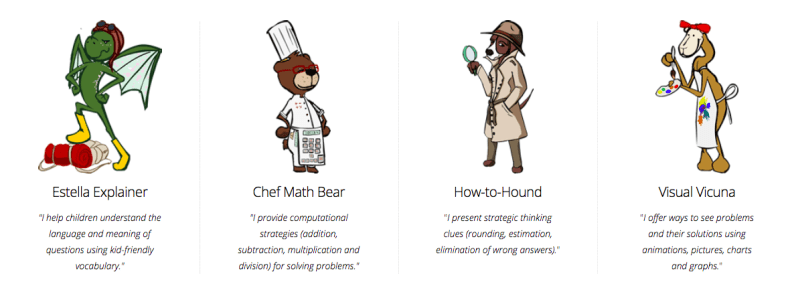
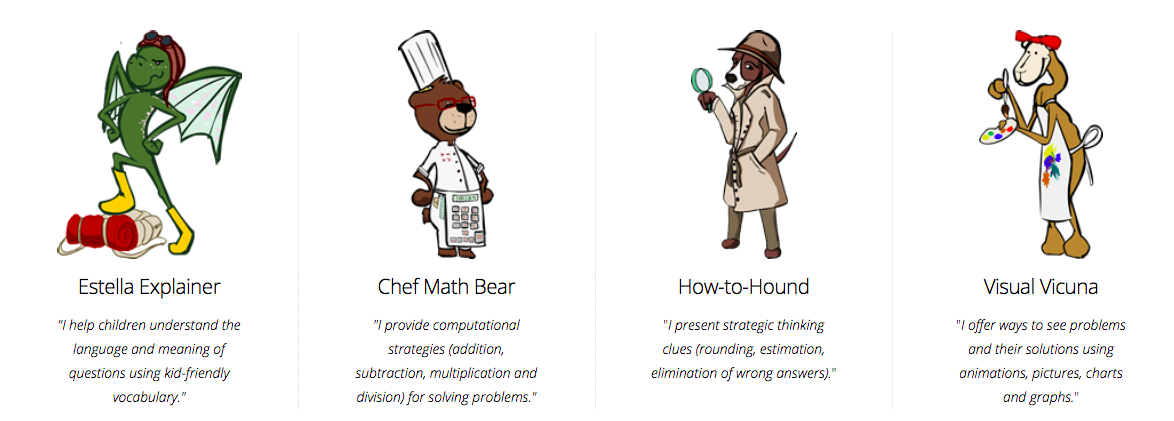
Usable Math provides a unique interactive problem-solving model of activities for youngsters learning mathematical reasoning and computation skills with word problems. Using computers, tablets, smartphones, students, and teachers can access standardized test questions from the Massachusetts MCAS tests and receive multiple learning strategies from four virtual coaches we call learning coaches. Estella Explainer, Chef Math Bear, How-to Hound, and Visual Vicuna are the characters offering words, images, pictures, charts, graphs, animations, and gifs to engage students’ thinking as they read, compute, and strategically solve word problems. The model supports estimating, comparing, understanding vocabulary, and identifying ways to be math solvers seeking right answers in different ways.
To date, we have published interactive modules about fractions, addition, rounding/estimation, geometry, money, data analysis, measurement, and more are on the way.

The name Usable Math encompasses our goals and purposes for the system design:

  • U Able meaning you (every young math learner) can be a math problem solver.
  • Us Able meaning together all of us (students, teachers, and family members in classrooms and homes) can be a team of math problem solvers.
  • Usable meaning anyone (young or older) is able to develop their math problem-solving skills with curiosity, practice, and clues for thinking from the online coaches. For this reason, the system is open and free and works on multiple digital devices, including desktops, laptops, tablets, and smartphones.

Usable Math is designed so users control the process of what learners see and how quickly they see each problem, the coaching clues, answer choices and the answer to the problem. A click-to-see approach lets children and adults use a mouse or a tap to reveal the inner workings of the math word problems one step at a time. Each click of the mouse or return key reveals additional strategies for youngsters to use in solving math problems strategically.

Click-to-see proceeds like this. With the first click, a problem appears on the screen, some with and others without their answer choices being shown depending on what the problem is asking learners to do. In this example, seeing the answers is necessary to problem-solving it.
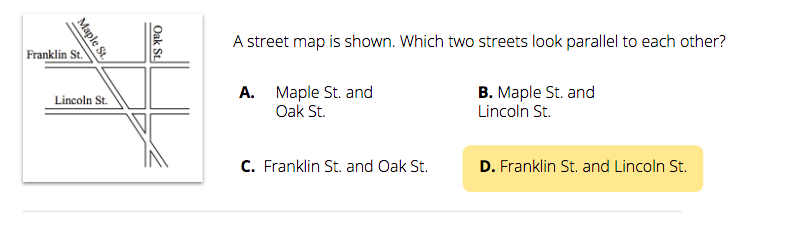
Click a second time and the system displays Estella Explainer’s hint, a reading strategy intended to reframe the math question in more straightforward, kid-accessible language. The math problem continues to display at the top of the screen, while each hint appears in the bottom section of the screen. The idea is to engage children in actively conversing about the problem from the lens of Estella Explainer’s scaffolding hint.

With another click, Chef Math Bear offers a computational strategy. With another click, a strategic thinking idea appears from How-to-Hound. And with another click, a hint in the form of a movie, chart, graph, or picture appears from Visual Vicuna. In each instance, students and adults have opportunities to analyze and discuss with one another what they think or know, or have learned from the coaches to help them answer the question. When all of the coaching hints are visible on the screen below the question, another click either shows the answer choices or if those are part of the question already, highlights the solution to the problem from among the answer choices. Then before continuing to the next word problem, a motivational statement (“You know parallel lines when you see them” or “You SOLVED the puzzle”) appears along with a surprising visual, a gif, or an image to elicit smiles or delight or laughter to emphasize the accomplishment and encourage viewing the next problem.

Enabling children and adults to choose how quickly or slowly they see information when analyzing problem-solving strategies from the coaches is a deliberate different practice from expectations in many classroom settings. In math, youngsters have mistakenly been taught that being “smart” with math means being the first or one of the first to answer questions correctly or to complete practice worksheets swiftly. By not taking the time needed to read and think through possible problem-solving strategies, students make mistakes, confuse key concepts, and begin to believe that math is a skill only some are competent to learn.

We want Usable Math to be different for several reasons. First, the design of the system makes it possible for children and adults to have productive collaborative problem-solving discussions before choosing an answer. They can “work” the problem, discussing what each puzzle teaches and how it might be solved using different ways. This focuses on the math concepts of the problem and the illustration instead of immediately identifying a procedure to use to find an answer.

Second, the presence of four coaches, with their own problem-solving points of view or perspectives offers choice for students. They can, and do, find a coach who becomes their math friend whose ideas help them to approach problem-solving with confidence. The use of animations and visuals allows the coaches to offer information along with surprising, engaging learning. Children keep coming back to see what the coaches have to say and do. Engagement produces learning.

Third, youngsters and adults discover how math is really about all maths. Look again at that term “maths.” Putting the “s” on math broadens its meaning and changes how it is to be taught and learned. While maths is a term used by educators throughout the world, it is not used or thought of often in classrooms in this country. Maths indicates that there is not one single subject called math, but many ways to think about mathematical topics and concepts. Maths urges children and adults to think like solvers of problems, not recallers of formulas. Maths stresses conceptual understanding with procedural knowledge.

It is our goal to have Usable Math promote maths learning for students, teachers, and families in all topics of maths. We welcome your thoughts and responses and your suggestions for how to revise this coaching system in the future.

Sharon A. Edwards is a Clinical Faculty in the College of Education at the University of Massachusetts Amherst. Retired from public school teaching, she taught primary grades for 32 years at the Mark’s Meadow Demonstration Laboratory School, a public school in Amherst, Massachusetts.

Sai Gattupalli is a Learning Sciences doctoral student in the College of Education at the University of Massachusetts Amherst. His research interests are broadly focused on learner culture, learning through game play, and game design.

**Interested in writing a guest blog for my site? Would love to share your ideas! Submit your post here. Looking for a new book to read? Find these available at bit.ly/Pothbooks
************ Also check out my THRIVEinEDU Podcast Here!

Join my weekly show on Fridays at 6pm ET THRIVEinEDU on Facebook. Join the group here
MTSS Part Two: Essential Components of MTSS

Guest post by Bonnie Nieves, in collaboration with Class Composer

In the previous blog, I outlined the first step of initiating Multi-Tiered System of Supports (MTSS), a framework designed to meet the needs of each and every learner in a school district. When your school community has completed its inventory of instructional tools and supports for academic, behavioral, and social-emotional learning, it is time to move on to putting these resources into action. 

The next steps include planning for three essential components of MTSS: 

  • Instruction that includes academic, behavioral, and SEL learning opportunities for all students.
  • Assessment tools that measure the effectiveness of this instruction.
  • Ensuring that your master schedule has space for per diem support for students.

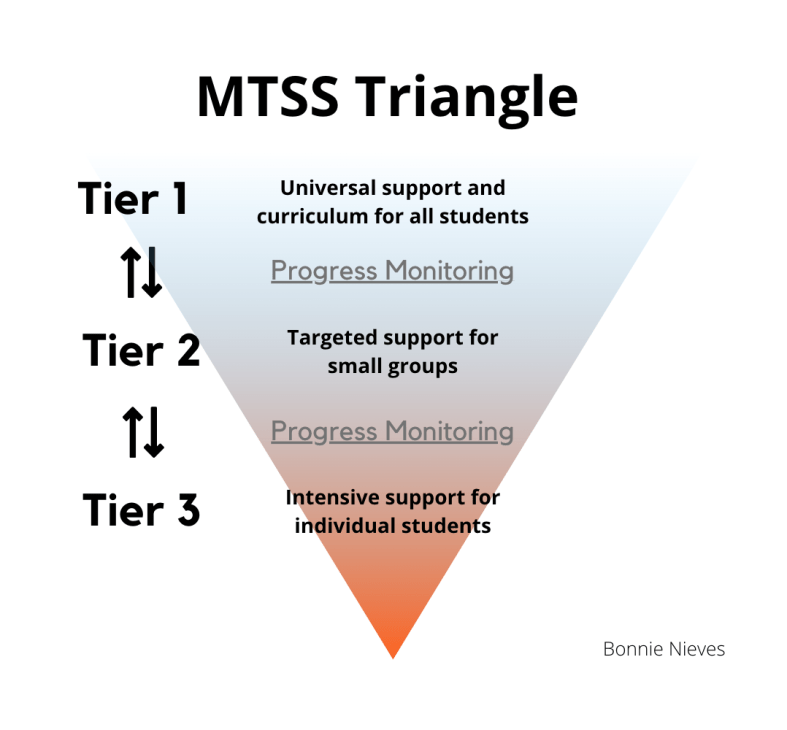
MTSS is typically represented as a pyramid with Tier 1 universal supports being the foundation. It can be accurately represented as a triangle or funnel. 

All students receive universal supports and transition between tiers 1, 2, and 3 based upon progress monitoring data monitored according to a reliable universal tool at predetermined intervals. These tools do not need to be school-wide standardized tests. According to the American Institutes of Research (2021), high-fidelity screening is universal, accurate, and conducted at least quarterly.

Most students will remain in tier 1, some will transition to tier 2, and fewer will move to tier 3. If a school community finds that a large number of students are in need of tier 2 support, it would be prudent to investigate the evaluation tools and quality of the universal curriculum being used.

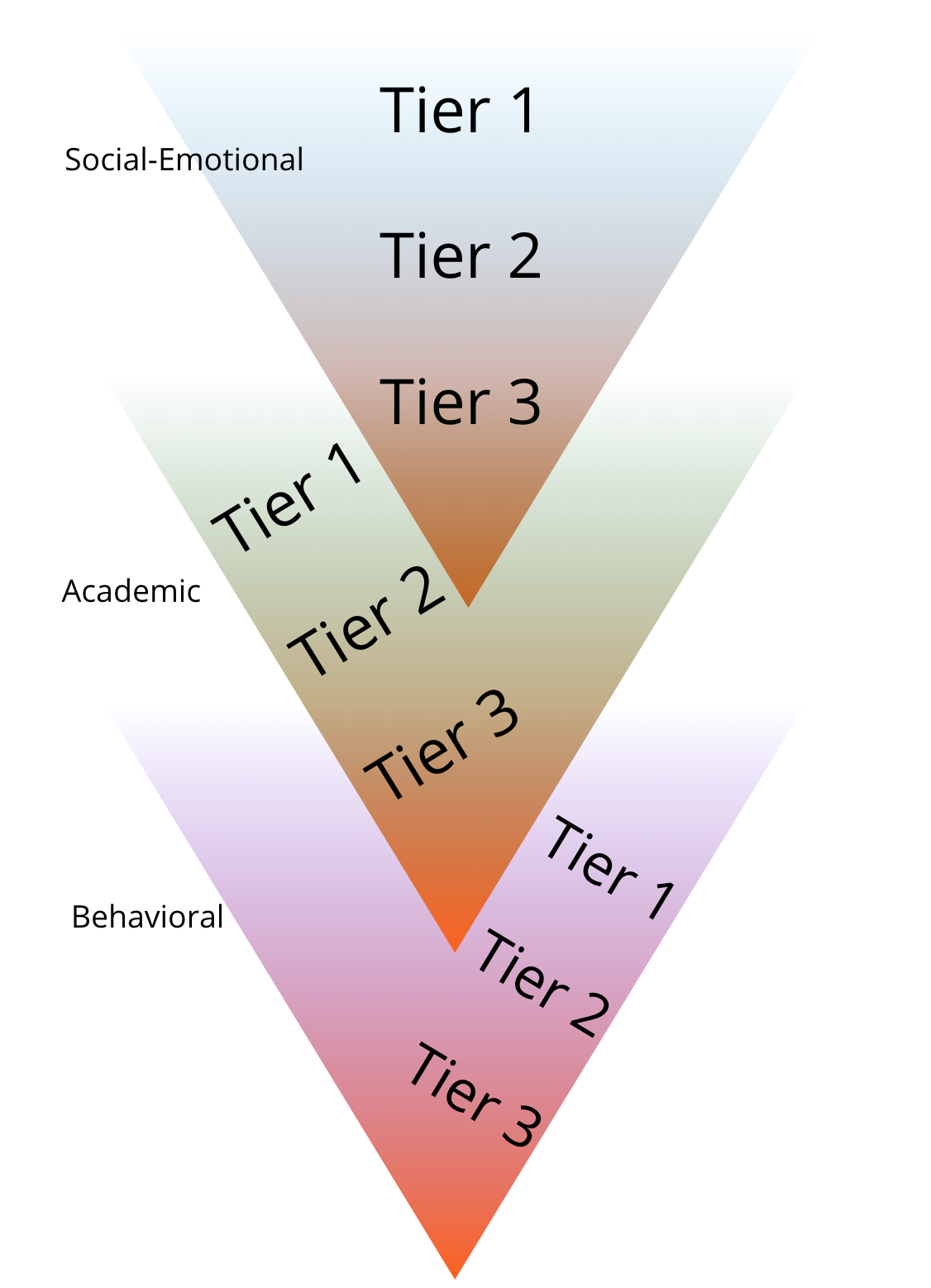
Now, envision a system of three triangles, one for each indicator: academic, behavioral, and SEL. Students may be at any of the three tiers for each of the three instructional areas (academic, behavioral, social-emotional) at any one time. For example, a student may be receiving tier 1 instruction for academics, tier 2 targeted support for behavioral instruction, and tier 3 for social-emotional instruction.

When teachers work with all of this information, academic, behavioral, and social-emotional, it can require a great deal of time and organization. Providing for all students is essential and each of these represents important data points that teachers need to focus on in order to provide the best for students. However, there needs to be a more effective and efficient way to do this.

MTSS and Class Composer 

Class Composer provides everything that teachers need to be able to monitor student progress and is readily accessible to anyone, at any time. It enables all teachers to access the information they need about each individual student when they need it. Easy to track and record student growth toward individualized goals.  Simplify how you manage all the assessment data collected! With progress monitoring, teachers can easily track student progress and provide the right supports.

Having access to all this information in one space enables teachers to create a supportive learning community for students. These teacher-student connections lead to the development of the essential relationships that need to exist for all students to be successful.

Give Class Composer a try today using their sandbox. You will experience a simpler, more streamlined experience when in the easily accessible, data-driven platform that promotes student academic achievement and the development of essential SEL skills.

Head to Class Composer to learn more!

Coming up next:

The final part of my MTSS blog series will elaborate on two essential components: assessment tools and instructional resources. Assessment tools that can help your school community provide common experiences without impacting teachers’ ability to use Universal Designed for Learning (UDL) planning tools. Instructional resources for each of the three tiers for academic, behavioral, and social-emotional instruction.

About the Author

Bonnie Nieves is the author of “Be Awesome on Purpose” and has over a decade of experience as a high school science teacher. She has a Master’s Degree in Curriculum, Instruction, and Educational Leadership. Her passion for creating immersive and authentic experiences that fuel curiosity and creating student-centered, culturally responsive learning spaces that promote equity and inclusion has led her to establish Educate On Purpose Coaching.

In addition to being an award-winning educator, Bonnie works to ensure equitable and engaging education for all through her work as a copy editor at EdReports and Classroom Materials and Media reviewer for The American Biology Teacher journal. She serves on the MassCUE board of directors and enjoys connecting with educators through social media, professional organizations, conferences, Twitter chats, and edcamps. Bonnie is a member of the National Association of Biology Teachers, the Teacher Institute for Evolutionary Science, and the National Science Teaching Association. She encourages you to connect with her on Twitter @biologygoddess, Instagram @beawesomeonpurpose, Clubhouse @biologygoddess, and LinkedIn.

Please visit www.educateonpurpose.com for information about her current projects.

**Interested in writing a guest blog for my site? Would love to share your ideas! Submit your post here. Looking for a new book to read? Find these available at bit.ly/Pothbooks

************ Also check out my THRIVEinEDU Podcast Here!

Join my weekly show on Fridays at 6pm ET THRIVEinEDU on Facebook. Join the group here

Take A Knee

 BY BRIAN-KULAK

I beat Colin Kaepernick to the knee by a cool twenty-six years. 

Before the former 49ers quarterback literally took a knee during the national anthem to raise awareness about police brutality and social injustice, I had already begun the practice, albeit for a far less political purpose. 

As a waiter at a local Pizza Hut, I started the unorthodox practice of taking a knee when I took orders. Regardless of who was in front of me, I just thought it was easier, and more comfortable, to take a knee and write the orders on my pad while leaning against the table. For me, it was about ergonomics because standing and writing were awkward, and because I have terrible handwriting, I needed to lean on something to ensure I would be able to understand what I wrote minutes later. 

At one point, my boss called me over and asked why I took a knee. I explained, and he just looked at me and said, “But it looks weird. I’d rather you stand up.” 

Now, at 19, I wasn’t about to make a stink. He was my boss, and I needed the part-time job. Still, as I look back on it, what difference did it make? I would argue my customers appreciated me meeting them on their level instead of making them look up at me like some deranged, pizza-wielding, megalomaniac. 

A few years later, as I started my teaching career, I took a knee all the time. When I would stop by a student’s desk to offer feedback, redirect, or check in, I would take a knee. Now, in year twenty-four, I still find myself on bent knee, despite one of them being ravaged by arthritis and a torn meniscus, and I make sure to start on day one. 

Whenever I meet our new kindergarteners during summer meet-and-greets, I always take a knee when I offer my hand to introduce myself. The action has become as involuntary as a sneeze; the reaction from kids invariably features disarmed smiles and enthusiastic high-fives.

As conversations in education continue to focus on equity and access, we need to be mindful that our students first associate equity with their access to us. Providing a model of those two complex concepts ensures kids can see and feel each Immediately. 

But it’s much more powerful than that when you consider that children are forced to look up to grown ups as a matter of course, their little necks perpetually craned to get our attention. Taking a knee flips that script in such a way that balances power, something children experience rarely. 

Ultimately, we are all just grown-up versions of the children who once had to look up to people all day. Some of us still do. But no one should have to. 

Take a knee. 

**Interested in writing a guest blog for my site? Would love to share your ideas! Submit your post here. Looking for a new book to read? Find these available at bit.ly/Pothbooks

************ Also check out my THRIVEinEDU Podcast Here!

Join our weekly show on Fridays at 6pm ET THRIVEinEDU on Facebook. Join the group here.

Change Your Bat Angle

Guest post by Brian Kulak

K-5 Principal at Tatem Elementary School in NJ

@Bkulak11

Brian’s Book: Level Up Leadership: Advance Your EduGame

Read this blog long enough and you’ll realize how obsessed I am with baseball. Inevitably there will be posts devoted to baseball, anecdotes will center around baseball, and metaphors will be drawn from baseball.

Barguments often focus on which sport is the most difficult to play, the most demanding physically and mentally, the most failure heavy. As a lover of all sports, I can appreciate that an argument can be made for each of the four major sports: baseball, basketball, football, and hockey but, to me, there’s really only one answer.

Baseball.

Because of the physics (round ball, round bat), the variables (pitcher, weather), and the psychology (streaks, slumps), there is nothing more difficult than hitting a baseball consistently. A monster game at the plate can just as easily be followed by a soul-crushing slump of weeks, or months, the time in between at-bats seeming equal parts interminable and immediate as you perseverate on what went wrong.

As a 41-year-old weekend warrior, I only get a chance to play games on Sunday mornings. While my preparation for each game often dictates some midweek tee work or live batting practice, I’m still only playing once a week. Admittedly, I take baseball too seriously, but part of me doesn’t apologize for that because I don’t understand why folks would set out to do anything poorly, so I want to play as well as I can each week.

A few years ago I suffered through my worst season ever, and I’m including my high school playing days, during which I hit a paltry .179. During that summer, getting on base was such an anomaly that I could recall when I did reach base because it was only a handful of times. That ain’t good.

Deflated but undaunted, I continued to work that offseason because I was not going to return to my team the same player. At one point, I sent a video of myself taking swings off the tee to a friend of mine who is a hitting tactician. In seconds, he responded with a diagnosis and, ultimately, saved my swing.

“Dude, look at how far you’re wrapping the bat around your head. Change the bat angle to 1 o’clock before you load, and you’ll be quicker to the ball.”

Change. Your. Bat. Angle.

No amount of work on my own would have led me to that conclusion because, though I would have been working hard, I would have been working incorrectly. There was no way for me to self-diagnose my own flaw, so I had to ask for help.

Now, I “change my bat angle” all the time.

When I’m struggling with a certain colleague, I change my bat angle.

When I’m trying to convince my five-year-old that he can, in fact, put on his own socks, I change my bat angle.

When my early morning writing process stalls, I change my bat angle.

As you approach the upcoming school year, I challenge you to change your bat angle. Reflect intentionally on that which you have done the same way each year and change it.

  • Experiment with flexible seating and let the kids help you design the classroom’s layout
  • Revolutionize your “Back to School Night” by asking parents to leave their kids a video via Flipgrid
  • Reframe your instructional walkthroughs to focus on the kids, even a specific kid, in each room, and then write those kids a note of appreciation
  • Flip and hang old posters and allow kids to recreate them using their own words and images
  • Print, laminate, and hang Tweets or blog post excerpts about which you want your staff and students to think
  • Use a mobile desk so you’re in the hallways more and in your office less
  • Take time for yourself each day, even if it’s five minutes of nothing but sitting and breathing

Baseball is a game of failure, and in many ways, so is education. In each, the best players make adjustments all the time in order to best help their team. In each, those who refuse to make adjustments all the time don’t often have teams for long.

Change your bat angle.

**Interested in writing a guest blog for my site? Would love to share your ideas! Submit your post here. Looking for a new book to read? Find these available at bit.ly/Pothbooks

************ Also check out my THRIVEinEDU Podcast Here!

Join my weekly show on Mondays and Fridays at 6pm or 6:30 pm ET THRIVEinEDU on Facebook. Join the group here
Reflective Teaching and Powerful Professional Learning with LessonLoop

Reflective Teaching and Powerful Professional Learning with LessonLoop

Educators are always looking for new ideas to boost student engagement in the classroom. To do so, they need to understand student interests and needs and also be intentional about reflecting on their teaching practice. While teachers want to understand the impact of their instructional methods and tools on students’ learning, they often don’t have time to solicit feedback from individual students, and students are afraid to provide honest feedback when they feel saying the wrong thing could impact their grade. Yet students need to be part of the conversation, because not only is student voice a powerful tool that can be used to engage students in their learning, but student feedback surveys are better predictors of academic growth than principal observation and teacher self-ratings (Hanover Research 2013). 

As Alex Isaacs, an 8th-grade math teacher notes, “LessonLoop allows me to quickly conduct a survey with great questions built-in where I can quickly push this out to my students to better inform my practice.” 

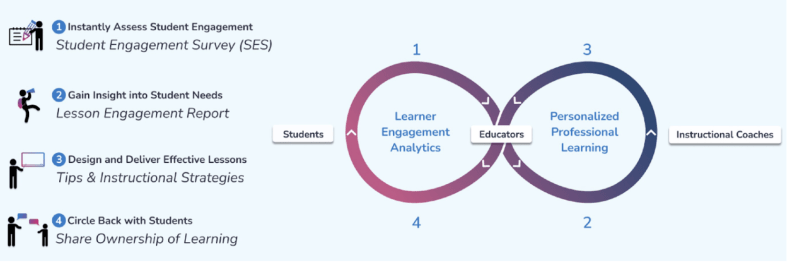
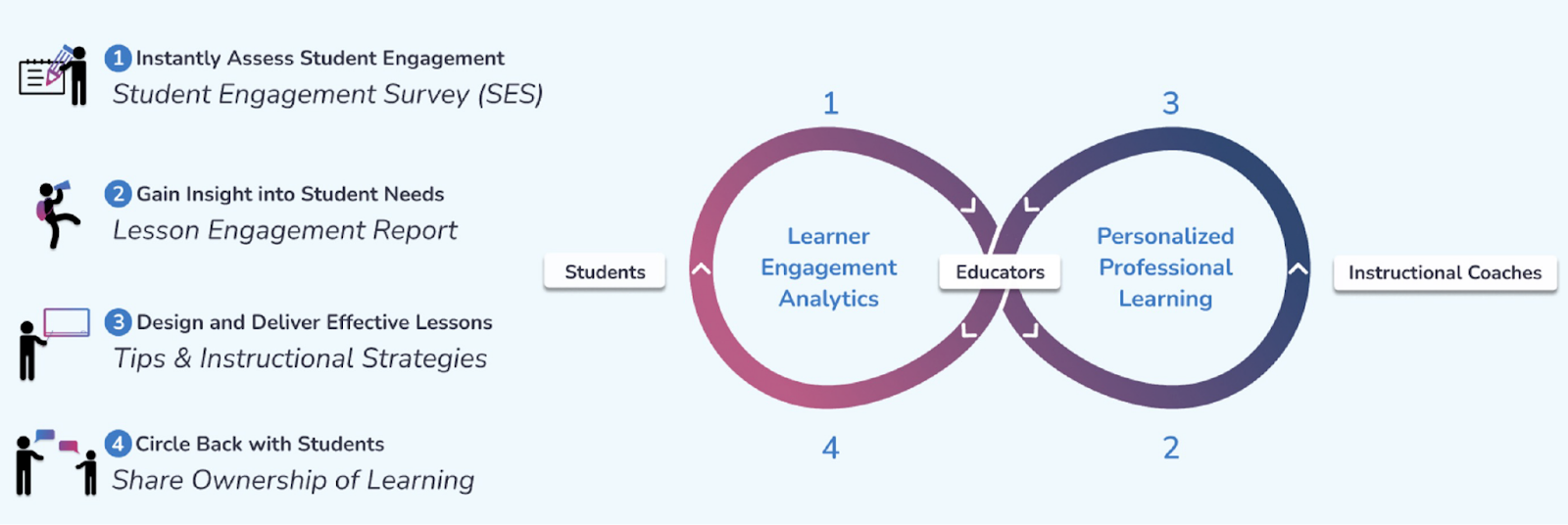
LessonLoop instantly shows you how engaged your students are with a class lesson so you can gain immediate insights and adjust your instruction in real-time to help them learn better. As shown below, LessonLoop works through the four simple steps of:

1. Anonymously survey students, 

2. Review instant actionable lesson engagement reports, 

3. Receive personalized instructional recommendations, 

4. Discuss results with students so learners feel seen and heard. 

How LessonLoop Works

How do the surveys guide teachers about their practice?

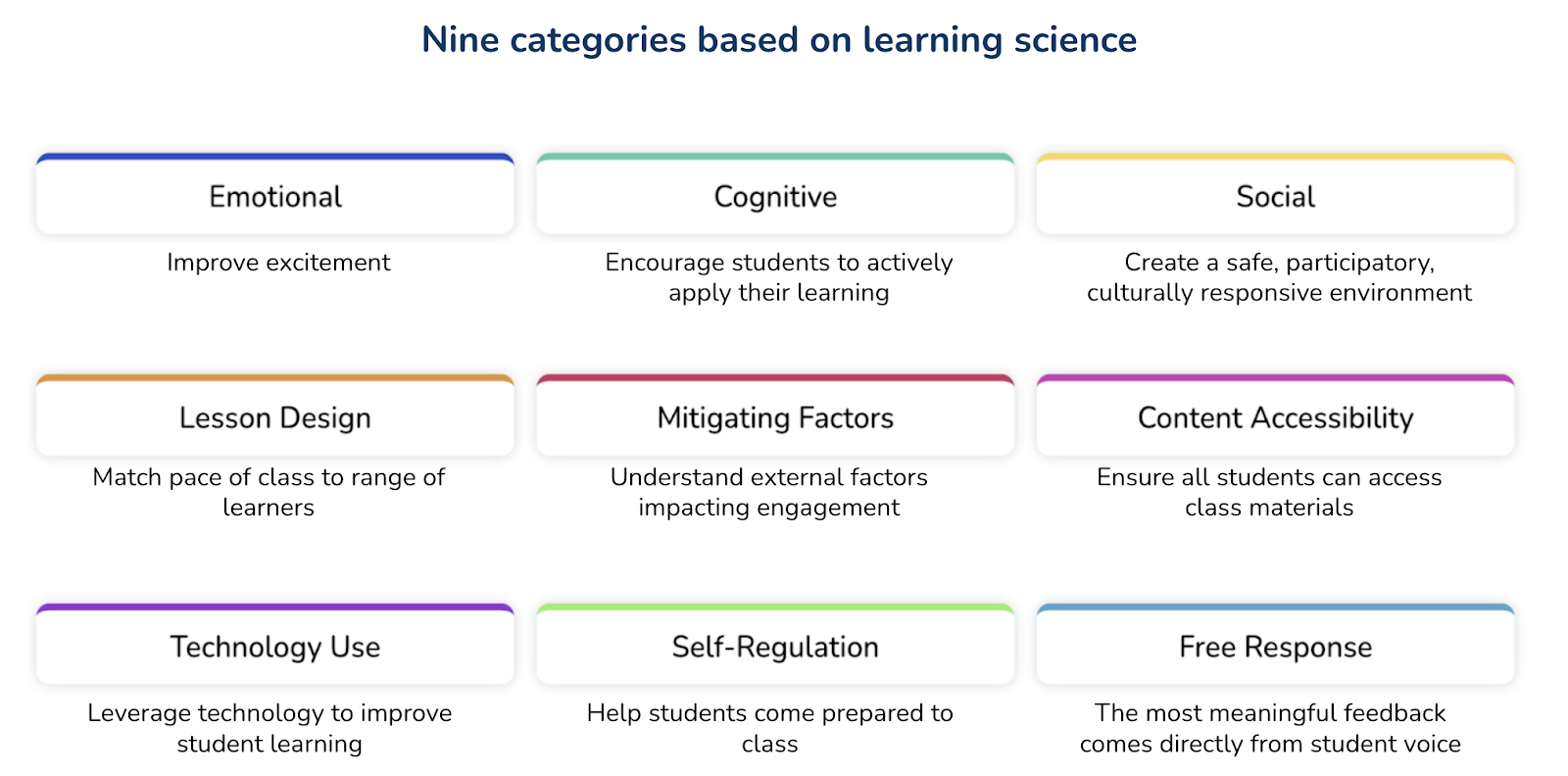
LessonLoop measures student engagement in nine actionable categories (see below) that provide you with insight on how to calibrate your instruction to support active learning at each student’s just-right instructional level. With these categories, teachers have better ways to focus on the specific needs and interests of their students. Especially for social-emotional learning (SEL) and determining student progress in class, the categories and questions provide tremendous insight for teachers with information not easily accessible in any other way. 

With the information the surveys provide, teachers have many ways to evaluate, analyze and then act upon authentic student feedback to improve their practice. Working with LessonLoop’s instructional coaches/Tip Masters, they can explore new methods and tools to help address some of the areas indicated in the survey.

Sample Lesson Engagement Report

What can we learn about student engagement from using LessonLoop?

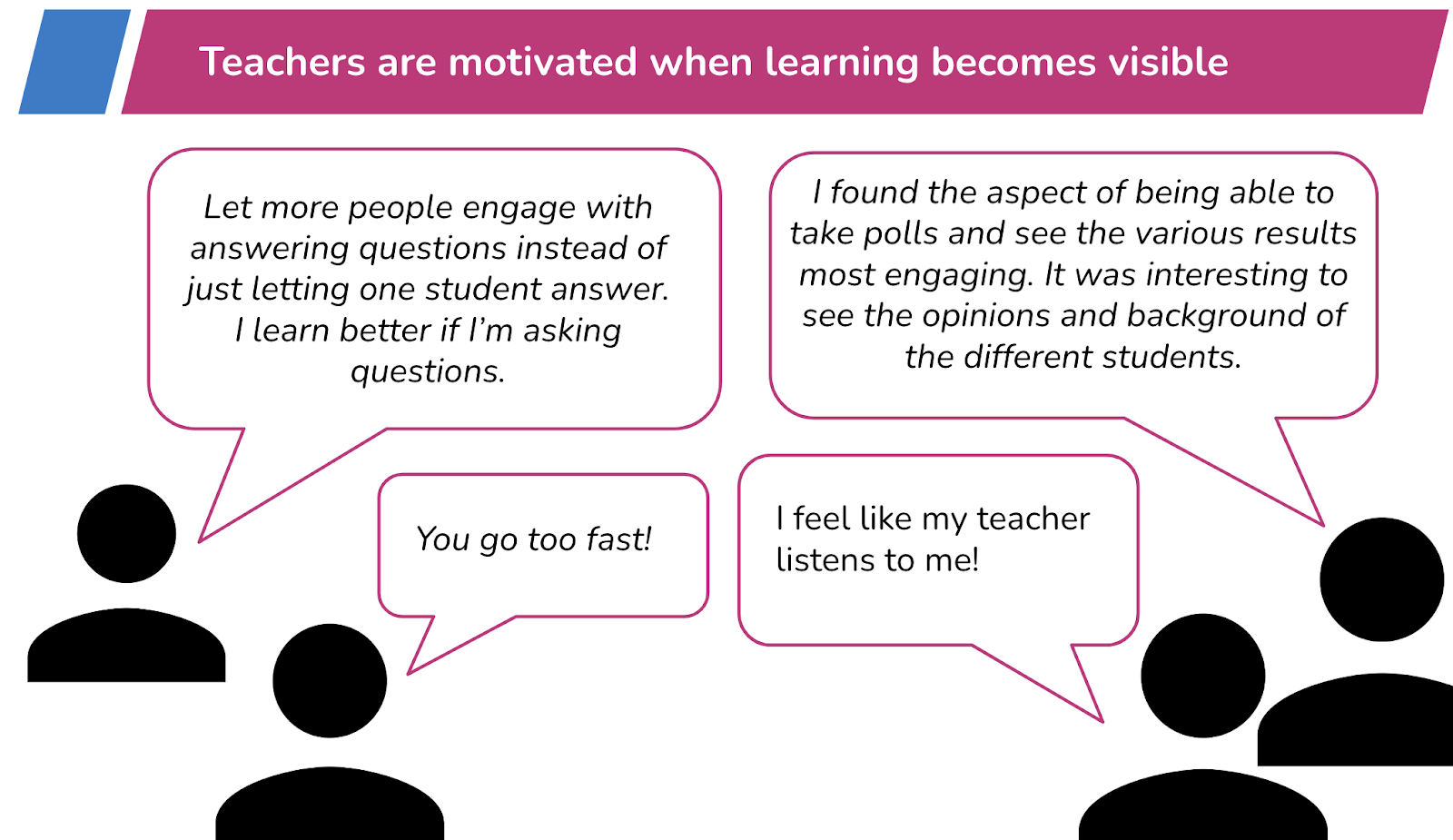
Through lesson embedded feedback, teachers better understand the impact of their instructional strategies and how students experience the learning environment. By reviewing the responses, especially the free responses, teachers receive feedback that promotes reflective practice. Using the survey results, Tip Masters work with each teacher to find strategies and tools that will increase active student learning.

Sample LessonLoop Student Free Responses

How does LessonLoop facilitate getting to know students? 

LessonLoop provides opportunities for every student to share their perspective on their immediate environment and how they are experiencing a lesson. Incorporating student voice allows students to experience a sense of respect and empowerment from their teacher. With LessonLoop, students can provide valuable feedback to their teacher and all feedback is provided through an anonymous survey, which promotes more honest feedback. Students feel comfortable responding to the survey, and because their opinions are heard, they feel more connected to and comfortable in their classroom community. When teachers circle back and discuss how to improve a lesson with students, students feel their voice is impactful and are empowered to take ownership of their learning. Students that feel seen and heard have greater motivation for and engagement in learning because they feel like an impactful member of the classroom community. 

How does the gamification aspect of LessonLoop lead to better and more authentic, honest feedback from students?  

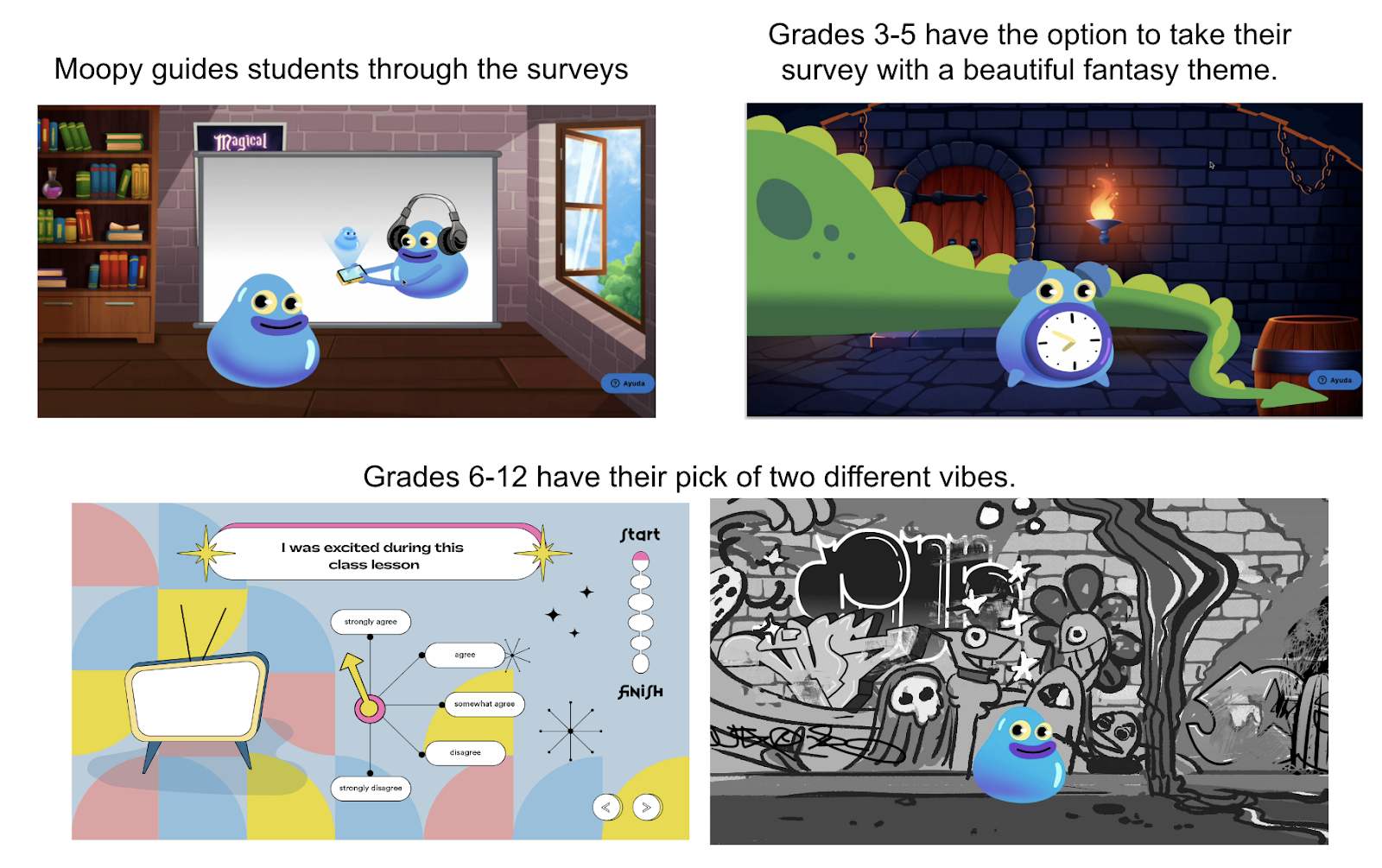
LessonLoop incorporates gamification elements through our fun, animated surveys (see pictures below). According to Dr. Shawn Clybor, “These gamification elements keep students more alert, more active in engagement, and therefore more likely to read the questions and think about their answers.”  LessonLoop is designed to be a robust platform that informs instruction and involves students in their learning experiences. It is also meant to “encourage joyfulness, to be fun, to be funny,” says Clybor.  Using it becomes its own experience, building bonds between teachers and students.

LessonLoop Gamified Surveys

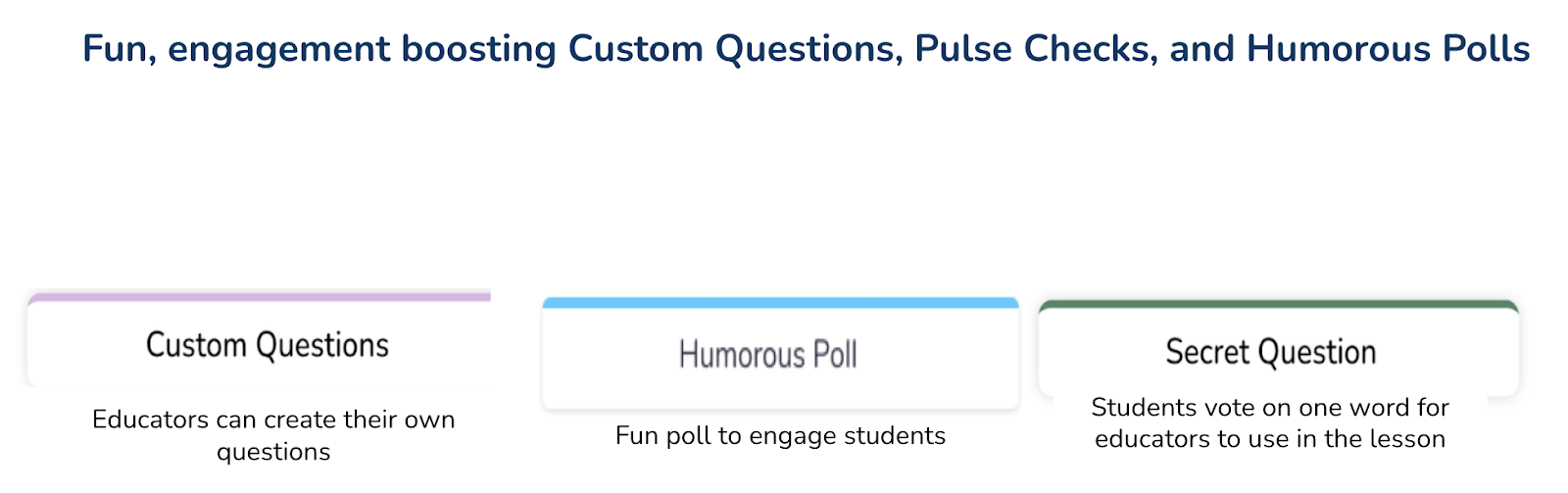
In addition to the gamified surveys, LessonLoop provides educators the ability to ask custom questions and generate two new games (humorous poll and secret word) with one click. These games focus on student engagement at the beginning of class, serve as a pick-me-up if attention is flagging mid-class, or are a fun way to end a student engagement survey.

What professional learning comes with LessonLoop?

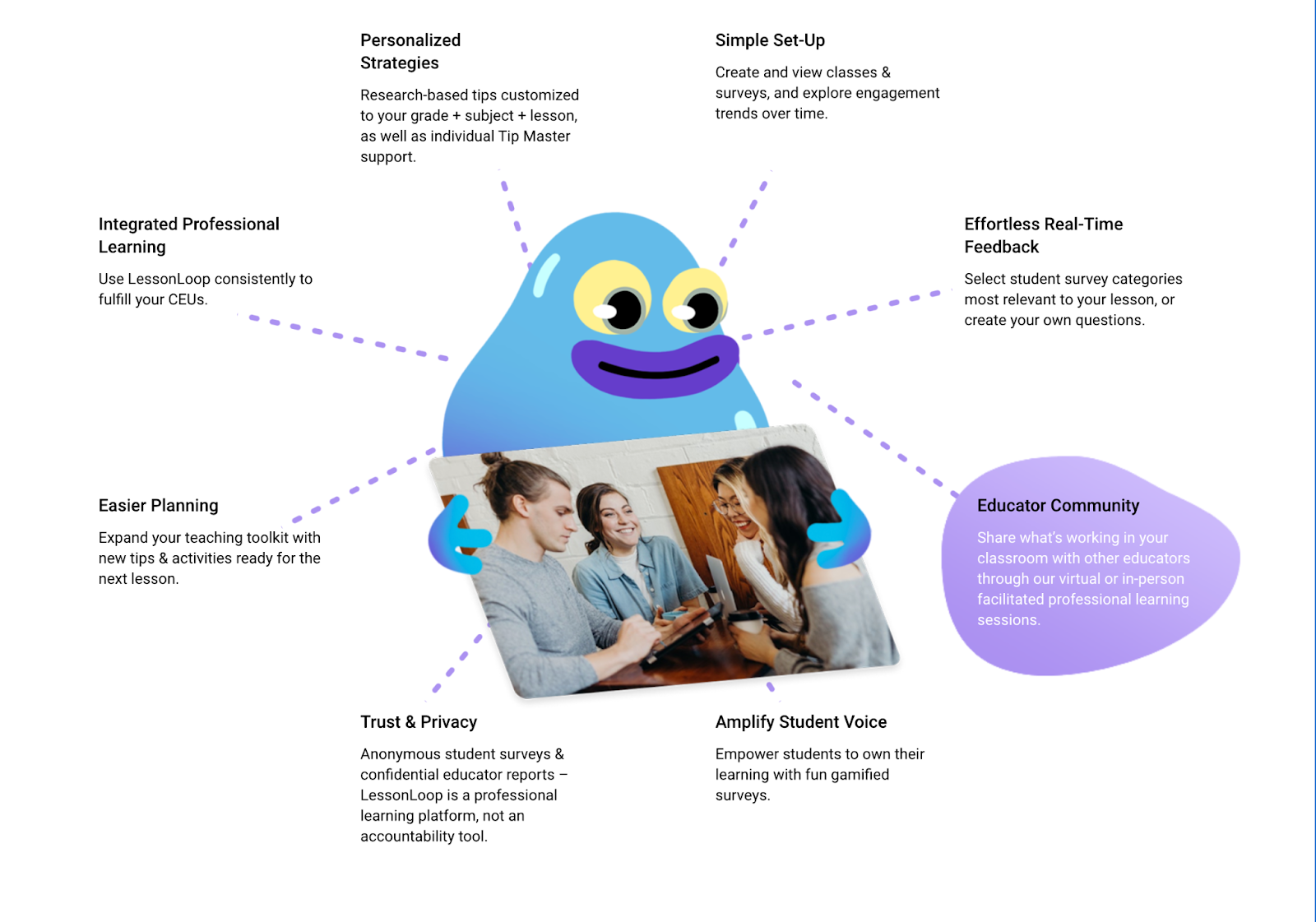
LessonLoop provides personalized data-driven professional learning for teachers.  While all teachers have access to a knowledge base of free tips, with a paid tips subscription, every teacher is assigned an experienced Tip Master to help with reviewing their surveys and finding strategies and tools to try. The real-time lesson-embedded feedback helps educators better connect their instruction to students and be more reflective in their practice. Professional Learning Communities (PLCs) also benefit as all teachers receive instructional recommendations from subject-area specialists and coaches! PLCs can be organized around student-centered data for engagement and professional learning. Within the PLCs, teachers can share ideas and provide support to one another which then enhances the learning experience for all students. In addition, educators accumulate continuing education units (CEUs) based on minutes of use of the platform aligned with Learning Forward and/or Charlotte Danielson standards.

What to expect with LessonLoop

So many benefits!

Student Engagement Surveys: 

  • Amplify student voice through anonymous surveys
  • Strong predictor of academic outcomes 
  • Provide missing actionable data on why students aren’t learning 
  • Provide daily feedback on the delivery of the curriculum with a clear focus on social-emotional learning (SEL),  critical thinking and collaboration, and culturally responsive instruction.

We are offering free trials of LessonLoop to educators who provide feedback on our new gamified student surveys. Click here for a free trial!  And if you missed our webinar, here is the link!

Follow Rachelle on Twitter @Rdene915 and on Instagram @Rdene915. Rachelle has a podcast, ThriveinEDU available at https://anchor.fm/rdene915

**Interested in writing a guest blog for my site? Would love to share your ideas! Submit your post here. Looking for a new book to read? Find these available at bit.ly/Pothbooks

************ Also check out my THRIVEinEDU Podcast Here!

Turning Towards Focus in Schools

Guest post in collaboration with Focusable @getfocusable

Engagement is a concept that really has a hold on us, and it’s not just educators. Social media and game designers obsess about maximizing it. Enterprise software companies espouse the value of it towards team performance. Heck, our banking app tracks our session duration and tries to increase it. 

It’s likely accurate to say that the majority of educators have chosen engagement as the goal of their work. Overall, this is a good thing. It has helped move teaching methods beyond compliance and remain relevant. Engaged students are an unequivocally good thing. 

But recently we started to ask ourselves some questions about engagement. What does it really mean to be engaged? Both from the teacher’s perspective, and from the students’. Further, does it matter how engagement gets created? Or is all engagement the same? And if every experience you have across society is also aiming to maximize engagement, is it the right thing for educators to be doing? Or should educators be taking a left-hand turn…

We dug into the education literature on the topic. There are countless informative and thoughtful sources. What was most interesting to us was what our research didn’t reveal – a clear definition. Frankly, the more we dug, the more confused we got. There is a huge range of definitions. And not all of them agree. Here’s just a sampling. Engagement is paying attention. It is purposeful learning. It’s curiosity. It’s interaction (or action). It’s immersion in a task. It’s flow. It’s exhibiting a passion for learning. It’s excitement. It’s just compliance but with another name. There are scaffolds trying to integrate and make sense of all the disparate definitions. 

How does a teacher even know what engagement is and how to create it with this lack of definitional clarity? 

As we stated in our first post, our goal is to figure out how to set the conditions for an optimal learning experience, or flow, in education. We know this has the greatest potential for both academic performance and enjoyment of the experience for students. Our research into engagement was fueled by trying to understand how we can leverage the concept better towards this goal. But if we’ve learned anything about flow so far, the details matter in how you approach it. Deplete dopamine too much or avoid the struggle of balancing brain chemistry, and you simply never get there. 

The more we thought about it, the lack of clarity around engagement started to feel more like a hurdle than a concept for educators to leverage.

One early realization that we had was that engagement is an exhibited trait or behavior. This stands in contrast with flow, which speaks to inner experience. This introduces the potential for at least some disconnect. 

For example, do you look engaged when you are in flow? This must be true sometimes, but is it always true? And do the actions that set the conditions for flow look like engagement, too? Or do they look different? How do you know the difference between the two? And worse, what if what looks like engagement actually represents an internal state that interferes with flow (ie, overstimulation)? 

Our sense is that to strive for optimal, we need to work with terms that have more precise definitions, clearer look-fors, and less potential dualities. 

In our last post, we attempted to build a scaffold to help us seek this clarity. We already have some tweaks and improvements in mind based on the feedback we got that we’ll publish soon. 

In the meantime, we’ll turn our attention to the term focus. 

If you are interested in something, you will focus on it, and if you focus attention on anything, it is likely that you will become interested in it.MIHALY CSIKSZENTMIHALYI, AUTHOR OF FLOW, THE PSYCHOLOGY OF OPTIMAL EXPERIENCE

Focus is a term that we all know, or at least think we know. And it’s surely something that almost anyone would agree is essential to learning if you asked. But as we found in our last Twitter chat, it is not a hot topic with many educators (likely due to the emphasis of engagement). 

Focus is often equated with the words attention and concentration. In scientific circles, attention is the most clearly defined of this group. The neuroscientific definition of attention is a cognitive process of selectively concentrating on one thing while ignoring other things. Attention comes from a rather complicated interaction between several brain networks (the default mode and task-directed networks). Interestingly, ADHD and other attentional conditions are differences in how these two brain networks interact.

The definition of focus is more varied and less scientific. It is often described as the center of attention. But for educators, this definition isn’t as enabling as it could be. A more useful definition is to think of it as the control of attention. 

Why is control of attention a useful definition to educators? Most scientific findings support the idea that attention isn’t fixed. It varies. It varies between individuals and contexts. And importantly, it can change. You can improve it. Even those with ADHD can show progress with time, behavioral changes and yes, medication. It is both accurate and useful to think of it as a skill. Control of attention is a definition that captures this important fact. 

This means that not only is focus practically helpful towards things like managing classrooms, it is also a skill that you are developing through the learning experiences you create.

So what is the relationship between focus and flow? Flow can be defined succinctly as ordered consciousness. This is in contrast to normal consciousness which is usually disordered (distracted, out of our control, etc).  So it follows somewhat logically that control of attention is the very foundation. Some definitions for flow even use the words intense focus. But the two shouldn’t be directly conflated. Focus itself is not flow. Focus requires effort to get started. There is no loss of self, as there is with flow. Finding focus can provoke all sorts of reactions, often negative. Frankly, it’s a struggle. Flow is none of those things. Flow is what happens when your neurochemistry finds balance while struggling to focus and starts to feed further action more naturally. 

It is worth stating that you will never experience flow if you cannot control your attention.

It is also worth noting that focus is a useful skill beyond the purposes of finding flow. Most of the predictions about the future of jobs, and the skills educators should be aiming for in response, are misguided at this point. We can say this with confidence, because frankly, we have a horrible track record as a society of seeing the capabilities of technology in advance. 

But there is one aspect we are 100% confident in, and it is this: there will be more, and more sophisticated, experiences to control your attention with each passing year. It’s already a huge problem, as we all know. And it’s only going to get worse. Controlling your attention is just about the only ‘skill of the future’ we’d bet our life savings on. 

Control means you can direct, or redirect your attention at will. You can stop doing one thing, and start doing another. You are aware of where your attention is and where it isn’t. It is often a struggle, but in this case, visible struggle might be a positive sign. A sign that the skill of focus is being worked on. 

A lack of control, then, is distractibility. It is the inability to switch from one task to another. It is a lack of awareness of what you are doing. It could be a lack of struggle, or even just over-excitability. 

If you were to try to observe whether a student is focused, or not, these would be some of the things you would look for. 

While we recognize, again, that some definitions of engagement might match up – it’s really the ones that don’t that have us most concerned. They incent teachers to skip over the development of the skill of focus in the interest of more obvious interaction. And to us, this is a short-term gain for the long-term loss of the potential for flow, as well as interfering with the development of an essential skill. 

Perhaps moving away from engagement is the left-hand turn educators should consider.

**Interested in writing a guest blog for my site? Would love to share your ideas! Submit your post here. Looking for a new book to read? Find these available at bit.ly/Pothbooks

************ Also check out my THRIVEinEDU Podcast Here!

Join my weekly show on Mondays and Fridays at 6pm or 6:30 pm ET THRIVEinEDU on Facebook. Join the group here

Adult SEL and Why it Matters

In Collaboration with Peekapak

Social-emotional learning (SEL) is an area that we need to intentionally focus on in our classrooms. As we reflect on the challenges experienced this past year, we must closely focus on our own well-being and make sure we can provide the right support for our students. For many educators, SEL has become a new addition to planning for each day. We need to be intentional in facilitating opportunities for our students to build their SEL skills each day and to do so, we need access to the right resources and support.

In our classrooms, it is crucial that we model SEL skills for our students. For example, the importance of building and maintaining positive relationships, developing self-awareness and social awareness are essential for everyone. And as we have experienced this year, being able to manage stress, making decisions and focusing on self-care practices are vital for us as educators and in our daily lives. Educators need access to the right professional development to know how to bring SEL curriculum into every classroom. With Peekapak, schools have access to structured and easy to use curriculum for students and SEL workshop resources for educators.

Research shows that teacher well-being has a substantial effect on school climate. If educators are experiencing burnout and elevated levels of stress and do not have the right strategies to push through, it will negatively impact students. To prevent this, we need to establish routines, work with colleagues and with students, and build trust with each other.

Building Our SEL competencies

To learn more about SEL, there are many resources and professional learning opportunities available. Peekapak offers the SEL Summit which has been providing informative webinars each month full of valuable ideas and resources for getting started. These webinars have been a great opportunity to not only learn about how to build holistic and school-wide strategies, but also ways that educators can practice SEL skills and feel more confident to bring it to life in our classrooms. During these live sessions, it is also a great opportunity to ask questions and connect with other educators.

During the most recent June 15th “SEL Starts with Adults” SEL Summit, the panelists discussed the latest research and shared some best practices and tips for supporting educator SEL. You can access the recording here to learn how the panelists have been supporting SEL in their schools and what their plans are for the coming school year.

Here are a few of my favorite tips from the event, given the importance of starting the year with a focus on SEL. There was a “Turn off the Noise” suggestion from Dr. Salvatore, encouraging us to limit distractions and give yourself mind breaks when possible. Additionally, I found Dr. Grant’s “Caller #10” activity to be an intriguing way to not only show appreciation for staff, but to get the students excited for their teachers to call and possibly win a well-deserved prize. Some other strategies included icebreakers during meetings, creating activities during PD days, trying out “half smiles,” and providing opportunities for staff collaboration. This emphasis on self-care and mental health is essential for teacher wellbeing, and more schools need to provide such resources for educators that promote SEL, and in doing so, help design meaningful experiences for students.

You can access the June 15th recording here to learn in greater detail the different ways the panelists have been supporting SEL in their schools and what their plans are for the coming school year. I think that if we all recognize and work toward improving SEL for all of us it is going to benefit us as educators and we can nurture all students through the upcoming recovery in the years ahead.

Sign up for your free trial with Peekpak today!

____________________________________________________________________

____

_____

Designing Authentic Project Based Learning

Guest Post by Stephanie Rothstein, @Steph_EdTech

I hear it often, “Oh yeah, I do projects.” But doing a project is very different from Project Based Learning. Chairing a Design Thinking PBL pathway has changed me as an educator. I now look at all situations through a project application lens. A few years ago at a leadership conference, I went to a session on Project Design. The speaker explained that there are three ways to approach project design. 

When designing projects, you can be inspired by your content, you can be inspired by a real need in your own community, you can be inspired by an issue that impacts the world. 

I have thought back to this approach often as I approach project design. I find when I work with educators, that most approach projects trying to figure out how to apply their content to a project that helps students showcase their learning. But Project Based Learning means revamping this idea and essentially inverting it. So instead of a project at the end after doing the learning, it is through the project that students learn the concepts. It might not be in the order we would have planned for them, but they will learn it and in my experience will go deeper because they developed questions and created meaningful connections. 

So, what does this actually look like in the classroom? How does it actually work? I will take you through one of my English 9 projects to walk you through.

I have done Service Learning for 18 years but it was only about 8 years ago that I finally felt like this really became Project Based Learning. Based on a general interest survey on service topics, I split the class and bring them to 6 different locations. We learn about that service organization and volunteer. These students then come back and present to the class about the organization. Students in the class are able to ask questions to the student experts. After, students then pick their topic to focus on for the unit. 

Students are then organized into shared topic groups and together these students pick a non-fiction book. I have a suggested book list that has been made by local and global non-profit groups, teachers, and students. Groups are also encouraged to propose a new book. While reading their book, students hold their own book chats, record them and use them to create their own podcasts to submit to the NPR student podcast challenge. This is not “the project” and is just one part of the project design. Students also select their own individual research topic and use articles, the interview of an expert at their non-profit, and reflection on their time volunteering to help inform their research paper. 

The last part of this unit came because students asked me a question. They said, “I’m glad we volunteered 20 hours, interviewed someone, read, researched, wrote a paper, but shouldn’t we be doing something more? Shouldn’t we apply our learning and give back in some way?” After that, the real Project Based Learning opportunity was born. Students create a Give Back Opportunity that helps spread awareness, collects items to donate, or fundraises and must be based on the needs of that organization. These projects have brought about real impact. This year, being virtual has broadened my perspective on how to make an impact with this project and we will use Solve In Time Cards to Design Think their Give Back Opportunity and The Global Goals for Sustainable Development to help students think both locally and globally. This unit takes 14 weeks and closes with group presentations to the class and an invited group of non-profit panelists. 

This project approaches from all three focus areas: content, local, and global. I always knew for this project that I wanted to connect with local non-profits and that I wanted students to better understand non-fiction resources. The other layer to consider when building the unit plan is which tech skills will students build upon during this project. 

Project Based Learning is complex and is rooted in questions. It must begin with an entry experience. My “workshops” are based on student needs that they create at the start of the unit. These workshops may be for small groups or the entire class. Students still have deadlines, they still have goals, but project based learning means that groups may be at different stages of the project. I use a shared SCRUM board to help students track project progress so that I know where they are and the team understands where they are in the process. Topics for this project vary based on year and interests. And this is real life. I have had students who focus on Foster Care, Women’s Rights, LGBTQI, the Environment, Black Lives Matter, Food Insecurity, Animal Rights, Homelessness and more. It is the variety of topics that helps me know that my students are connecting individually and are able to teach something to their classmates and to me. They are all learning the skill of researching using articles, non-fiction books, interviews, and personal experiences. 

It keeps me on my toes and no year is ever the same but I am proud of the learning experiences created through deep Project Based Learning.

**Interested in writing a guest blog for my site? Would love to share your ideas! Submit your post here.

Looking for a new book to read? Many stories from educators, two student chapters, and a student-designed cover for In Other Words.

Find these available at bit.ly/Pothbooks  

Providing the Right Learning Spaces for Students to Explore and Create


When looking at the design and structure of classrooms today, they may look quite similar to the classroom setting that you experienced when you were a student. Structurally, students in most schools follow a set schedule each day and spend time in different classrooms throughout the building. Unlike years ago when I was a student and even as recently as five or 10 years ago, learning was still confined to the physical classroom space. However, through the capabilities we now have with technology, the opportunities to connect students with learning that takes them out of the classroom space are incredible.

For most students, learning took place in the classroom and on-the-job or real-world learning experience had to wait until the end of the school day or in some cases, after high school graduation. Of course, there were students enrolled in vo-tech or career and technical education programs outside of the school building, taking them to a new learning environment to interact and collaborate with students from other schools, learn from different teachers, explore ideas and strategies, and even different types of careers. These types of learning spaces helped students to better understand the skills they might need in the future. However, not all students had access. But today, we have the power to offer these opportunities to all students. With the resources that we now have, we owe it to our students to offer them learning experiences in as many different learning spaces as possible so that they have time to explore and build the skills that they will need when they leave our schools.

So where or how do we provide these different learning spaces for students? We start by making sure that we are connected in the right spaces ourselves. As educators, this means being connected in a space that goes beyond our school community. It means leveraging social media and different networks, attending conferences, reading blogs, listening to podcasts for ideas or picking up educational books on topics that we wish to learn more about. We must make sure that we have the right knowledge to stay current and relevant so that we can design the best learning experiences for our students. Not that we need to create everything for them; we just need to get them started so that they can take the initiative to design their learning path in the space they decide best fits their interests and needs.

How to Provide Space for Students to Explore

1. Project-based learning (PBL): By implementing PBL, we empower students to look for problems or challenges in their community and globally, try to find solutions, and focus more on learning as a process. Beyond just doing PBL in a class, there are schools opening which are PBL schools, like Gibson EK, a public high school located in Washington. The motto at Gibson EK is “Real World, Real Learning, Real Life.’” Students do not enroll in traditional courses, instead they “earn academic competencies through projects” and work with a mentor through internships two days per week. The school is designed on principles such as “Stop learning for school, start learning for life.” I truly believe that students need opportunities to explore their passions, design their own problems or challenges, and have the time to work through the learning process. To best prepare students for the future, whether college or career ready, they need to decide on their learning space, experience productive struggle, reflect, revise and continue on their path of learning.


2. Student Organizations: Schools that have student organizations like the Model United Nations empower students to build skills of advocacy, leadership, critical thinking, problem-solving, creativity, and self-confidence. In my school, I have seen remarkable growth in the students who have become involved in the Model UN under the leadership of Mr. Ken Kubistek, a history teacher, who has led this group through conferences and competitions for many years. Through work with the Model UN, students engage in authentic learning experiences that take them out of the classroom and connect them with real-world learning and global issues. Students develop their voice and build many vital skills for the future by exploring new learning spaces through organizations like the Model UN.


3. Media Creation. Students need opportunities to create their own space to show learning. Whether students create a YouTube channel and develop their own show, explore an emerging technology trend or prepare a solution to current event issues, there are many ways that students can create a different type of learning space for themselves and for others. Perhaps a student-created podcast using tools like Anchor or Synth, where they invite guests to discuss current issues, focus on themes for education or anything that interests them. A podcast designed with the goal to help educate not only classmates and members of their school community but the public at large. Opportunities like these promote more meaningful learning while also building digital literacy skills and empower students to find space that meets their interests.


4. School Community Connections: I recently gave a keynote about the future of education and how the look of school is changing.  I received a lot of great questions and comments and one suggestion that led me to think about the power of creating more community connections. The idea was to have students go to local senior care facilities where they can share some of the things they are learning in school, and engage in discussions with older adults to learn about each other’s experience in education, work, and life. I think this would have a great impact because of the connections that would form between students and members of the community. The learning space can be anywhere and it would be an authentic way to engage students with learning about the world around them. Build connections and greater understanding about what things used to be like, what things are like now, and make predictions for the future.


5. Brainstorming ideas: Push student thinking by asking them to brainstorm ideas for the top five or 10 challenges in a certain area of the world, maybe based on geography, a certain industry, or perhaps ask students to come up with a list of complaints or things they notice about the world around them. Give students space to develop plans for how to solve these challenges or how they could have solved them better. Another idea is to have students be part of project event management for planning. In my school, students can take an entrepreneurship course in which they design products, make sales pitches and plan large scale events. The course also takes students out into the Pittsburgh area to tour businesses and learn about different industries, where they can get that close view, ask questions and make connections. They begin in the classroom and then find the space to pursue new knowledge and explore.


There are many ways to expand where and how our students can learn. We have access to the world as our classroom and the more we can increase the learning space we provide the better prepared our students will be for the future.

**Interested in writing a guest blog for my site? Would love to share your ideas! Submit your post here.

Looking for a new book to read? Many stories from educators, two student chapters, and a student-designed cover for In Other Words.

Find these available at bit.ly/Pothbooks  

18 Resources to Get Students Coding This Year

Each year during December, there’s a focus on coding and computational thinking. Computer Science Education Week is happening December 7th-13th this year and there are a lot of great ways to get involved. A few years ago I first learned about the Hour of Code, and immediately referred to the Code.org website to find activities for my eighth grade STEAM class. Just getting started, I didn’t know much about the resources available and thought this was the best way to provide some activities for my students to join in during the week. It was fun to sign up to participate in the events of the day and see from where around the world other classrooms were joining in from. But beyond that one day, and actually, that one hour, we didn’t really do much more in my class. I asked colleagues and members of my PLN about their activities for the Hour of Code and coding throughout the year, and many stated that they didn’t know how to implement more in their classrooms. It was then that I recognized the need to provide more ways for students to learn about coding and computational thinking, and that as educators, we must actively look for opportunities for our students. We need to push past an Hour of Code and do more in our classrooms.

Preparing Ourselves

For some educators, topics like coding and computational thinking can seem challenging to bring into the classroom and for them to know enough to feel confident in teaching students about these topics. I was one of those educators. My comfort level changed when I had to create a game using Hopscotch for a master’s course and I struggled a lot. It was uncomfortable to not be able to fully understand the coding process, but it pushed me to keep learning and to start using Hopscotch with my eighth graders. I learned a lot from my students and it was a great opportunity to put myself in their place as they learn something new. Realizing that it is okay to not know all of the answers is a valuable lesson.

Another hurdle was to learn more about computational thinking, a topic that I had avoided because of a fear of not understanding it enough and thinking it did not apply to my role as a Spanish teacher. It was an area that intimidated me because I believed it to be so complex.

However, I recently took a Computational Thinking (CT) course provided by ISTE U, which definitely stretched me professionally and provided a solid foundation full of resources for doing more with these topics in my classroom. We need to find ways to give our students and ourselves an opportunity to learn about topics like coding and computational thinking and how they apply in our daily lives and how it could possibly benefit us in the future.

Where to Begin

There are so many resources out there that sometimes knowing exactly where to start presents the challenge. It is easy to get started by referring to the Code.org site or checking out CS First from Google and resources for educators. There are some apps and websites to get started with coding and computational thinking. Some of these can be used specifically with elementary students in grade bands pre-reader through two, three through five, and six plus, and others that are specific to middle school or high school. Several of these options offer ways to search based on topic, level or type of activity. What I like the most is that they are fun ways for educators to get started with coding and CT, with the ability to decide how to apply them to our own work.

Start with Code.org or CS First from Google, and then explore these 18 resources to check out what specifically to use during the Hour of Code and Computer Science Week, or take the time and try each of these out over the course of a couple of weeks. Have your students explore and continue learning right along with your students.

18 Sites to Explore

Artist. Use this as a way to have students begin coding with blocks to complete tasks to build their coding skills.

Code.org. Explore this link to find a list of resources and different activities and to sign up to participate in the Hour of Code. There are more than 500 one hour tutorials that are available in more than 45 languages.

Code Combat is a game based computer program for older students who want to learn about Javascript or Python. In Code Combat, students type in their code and see their characters respond in real-time.

Code Monster is an easy way to get younger students to learn more about code. Two boxes on the screen show the code and what the code does, with explanations popping up to show students what happens with each command.

CoSpacesEDU Robot Rattle. Students learn to operate a robot and the activity includes a tutorial video. Using blocks and drag and drops, students can write the instructions for the robot and then if devices are available, the robot can be seen performing the tasks as written in the code in virtual reality (VR).

Hopscotch is for use with iPads and has specific activities available for the Hour of Code but offers many options for students to create their own games or to remix games that are available.

Turtle Art. Students use block coding like Scratch but through the use of one turtle and mathematics to do the programming.  Students can create their own work of art or remix someone else’s painting.

Science

Explore Mars with Scratch. Students in grades three through eight can create a Mars exploration game using Scratch. Through this lesson, students work through activities and build their math, computational thinking, and problem-solving skills. There is also the option for an extension activity for students in grades K-12 to do an independent project.

Multi-topics

Code-it studio is for use with grades two and up and offers students the chance to program art and designs.

CodeSpark. Students up to grade five can design and code a video game using the self-paced activity available through this site.

Code an Unusual Discovery. Using Scratch and CS First from Google, students can work through on their own and create a story using code.

Khan Academy Code. For grades six and up students can watch an interactive talk-through, work through challenges or decide to do their own project. Everything that students need for coding is available directly through the website. Students can also learn to code by making a website in HTML tags and CSS.

Kodable. Activities for students in grades two through five, offering Javascript for students in upper elementary grades. There are activities for social studies, science, ELA, math and more with levels from beginning to advanced. Students can even choose their own adventure.

Minecraft Hour of Code. A free Hour of Code lesson was developed by Microsoft’s AI for Earth team. In the lesson, students in grades two and up use code to prevent forest fires. There is also a free online course for educators to learn how to run an Hour of Code lesson in their school.

Robo-Restaurant Decorator. Students in grade two and up can program a robot to paint a restaurant and the algorithms must be done correctly

Star Wars. The first activity we tried was working through the activities provided using the Star Wars theme. Activities are available for students in grades two and up. Learn to code with Blocks and Javascript.

Tynker offers a lot of activities for students to participate and learn about coding, specially curated for the Hour of Code. Activities are grouped for students in the ranges of K-two, three-five and six plus. Options available include text coding, STEM activities, and the new UN+ which is focused on ecological issues such as life on land, responsible consumption and affordable and clean energy.

VidCode is an online platform that offers opportunities for teachers to explore computer science curriculum or individual lessons related to coding. For the Hour of Code, explore the Climate Science coding activity.

Another option is to have students learn about the Hour of Code, its origin and different terms related to coding and then use some of the game-based learning tools out there like Kahoot! To help students develop a better understanding of the basics of coding. Try one of these ideas out for some fun ways to get students involved with coding and use the game as a starting point for class discussion.

TeacherCast Educational Network | Developing Standards-Based Instructional Technology Integration

Technology Integration - Instructional Coaching - Productivity Secrets for Educators

Leadership Liner Notes: Sean Gaillard

Built on Connection. Tuned for Impact.

Stories by Thomas Oppong on Medium

Dr. Rachelle Dené Poth @Rdene915 Educator, Consultant & Keynote Speaker, Author, Attorney #THRIVEinEDU

Hooked On Innovation

When Innovation slaps you in the face, we slap back.

Teach Better

Dr. Rachelle Dené Poth @Rdene915 Educator, Consultant & Keynote Speaker, Author, Attorney #THRIVEinEDU

BrianKulak.com

Dr. Rachelle Dené Poth @Rdene915 Educator, Consultant & Keynote Speaker, Author, Attorney #THRIVEinEDU

The Principal of Change

Stories of learning and leading

Mandy Froehlich

Dr. Rachelle Dené Poth @Rdene915 Educator, Consultant & Keynote Speaker, Author, Attorney #THRIVEinEDU

Katie Martin

Informed by research, refined by practice

#RocknTheBoat

Rocking today's classrooms, one teacher, student, and class at a time.

User Generated Education

Education as it should be - passion-based.

Learning as I go: Reflections & lessons learned

Dr. Rachelle Dené Poth @Rdene915 Educator, Consultant & Keynote Speaker, Author, Attorney #THRIVEinEDU

Serendipity in Education

Join me, Allyson Apsey, as I stumble upon the fortunes of learning, laughing, and celebrating alongside incredible people.