
Dear Stressed Me

Guest post by Dr. Amy Mathews-Perez, a Director of Special Programs in a public school in Central Texas. Connect with Amy on X (formerly Twitter) at @drgrowtoknow, on Facebook at DrAmy MP, or at her website dramyperez.com

I’m wondering how you read the title of this blog. Did you read it as Dear, Stressed Me (self pity-ish) or as the beginning of a letter? Either way works (and both apply at some point or another for all of us, right?) and serve as an opportunity to self-reflect on why you read it that way. The intention was that the title is the beginning of a note – to yourself.

We all get stressed out, no doubt. Stress is not a selective force – it impacts every one of us in different ways, at different times, for different reasons, for different lengths of time, and with different results/responses. If you have spent time reflecting, you’ve probably figured out (or are figuring out) how to talk yourself through these stressful times. There is a popular quote by Zig Ziglar: “The most influential person you will talk to all day is you.” There are also many varieties of this message floating around, but the point is the same: Self-talk is powerful.

The hard part about self-talk is easy to identify: judgment. We second guess ourselves, we feel silly, we want to do it “right.” However, I want to make you aware of two important things related to self-talk: (1) You already talk to yourself, whether out loud or just in your head -or both for some of us. When it is instinctive, we don’t pause to evaluate it, we just do it. Whether we are pumping ourselves up to do something challenging (EX: A job interview), calming ourselves down to get through something difficult (EX: Getting pulled over) or celebrating our success in getting something accomplished (EX: We got the job?). Here is your challenge: pay attention next time it happens, and then add to it with an intentional, positive phrase. The second thing I want to make you aware of is this: (2) There is no “right” or “perfect” way to do self-talk. You know yourself – or are learning about yourself. We figure out if we need a voice of rant, rage, encouragement, empowerment, cheer (or all of these). Some of us need a pep-talk, some of us need to be reminded to live up to our potential, some of us need to be remotivated with goals, some of us need a “no-excuses” approach, and some of us need empathy during times of stress.

We live, we learn; we stress, we recover; we breathe and continue going forward in learning.

Understanding the value of positive talk, encouragement and kindness, imagine if you could facilitate a positive outcome for someone else that is going through a stressful time. This blog provides a method for you to do that. Originally intended for leaders in work settings, this activity can be done with any group or person you choose.

Whatever your relationship (leader, friend, co-worker, etc.) I’m going to assume that you want to help others be their best; you do your best to meet the needs of others. There will be times when your support will be effective & that is awesome. However, other times, a person’s “self-talk” support can be more helpful than our support. A common situation we all face is that we get so busy we don’t take the time to think about motivating ourselves or others, much less by writing it down. So, here is an activity that capitalizes on creating that opportunity for others: it honors each person’s self-awareness/knowledge and allows you to support each person individually during stressful times. This is an activity that I’ve done with my staff for three years in a row and it has had multiple positive outcomes every time.

You pick the “Who” & the “When.”. Here is the “How” (then we’ll visit the benefits):

  • Give each person a blank note card & envelope. (have each person seated away from each other)
  • Have the person write their name on the envelope.
  • Ask each person to write themselves a “Dear Stressed Me” note. Assure them that this is 100% confidential; NO ONE will read their note.
  • Once they each complete the note, have them put it in the envelope that they put their name on – and seal the envelope.
  • Collect the envelopes and put them in a place you’ll remember.
  • During the school year, when you notice that one of those people is stressed out, hand-deliver their note to them. (If you want to give them a treat when you do that, that typically brings a smile; a Sonic drink, candy bar, favorite pen, etc., but this is not foundational to this activity)
  • When they say, “Thank you” (they typically do) you can respond with something like: “Don’t thank me, thank yourself.”

What they are really thanking you for is “seeing” them; acknowledging them, and showing care about them being stressed. Done with authenticity, this can build relationships, ease stress, and create a moment to take a breath. As an added benefit, it promotes the value of you being in tune with each person because YOU are going to give each person their own note….at a time that you notice they need it. Notice a need, share your care, and build resiliency.

I believe in positive intent, and I’m passionate about empowering and encouraging others. I hope that this has provided an easy action you can take, and, equally importantly, I hope you take time to validate yourself for the hard work you’ve done, the progress you’ve made, and your willingness to learn. If you use this activity & would like to share your outcomes, I’d appreciate the opportunity to connect. dramymp@gmail.com or on X @drgrowtoknow.

About Amy

Texas-born & raised, Amy is in her 32nd year of serving public education. General Ed. Teacher, SLP, Diagnostician, SPED Supervisor, Assistant Principal, Principal, and Director of Special Education are roles she’s held. She is the CEO of Making Education Special for All (M.E.S.A), an LLC dedicated to training, facilitation, consultation, and speaking engagements that revolve around information, motivation, and insights on why and how to make education special for all stakeholders. Her passions are communication, joy, authenticity, and empowerment. “Life is short but our influence is never-ending,” and Amy is committed to connecting with others through service and smiles.

Rachelle’s blog

Dr. Rachelle Dené Poth is a Spanish and STEAM: What’s Next in Emerging Technology Teacher at Riverview High School in Oakmont, PA. Rachelle is also an attorney with a Juris Doctor degree from Duquesne University School of Law and a Master’s in Instructional Technology. Rachelle received her Doctorate in Instructional Technology, and her research focus was on AI and Professional Development. In addition to teaching, she is a full-time consultant and works with companies and organizations to provide PD, speaking, and consulting services. Contact Rachelle for your event!

Rachelle is an ISTE-certified educator and community leader who served as president of the ISTE Teacher Education Network. By EdTech Digest, she was named the EdTech Trendsetter of 2024, one of 30 K-12 IT Influencers to follow in 2021, and one of 150 Women Global EdTech Thought Leaders in 2022.

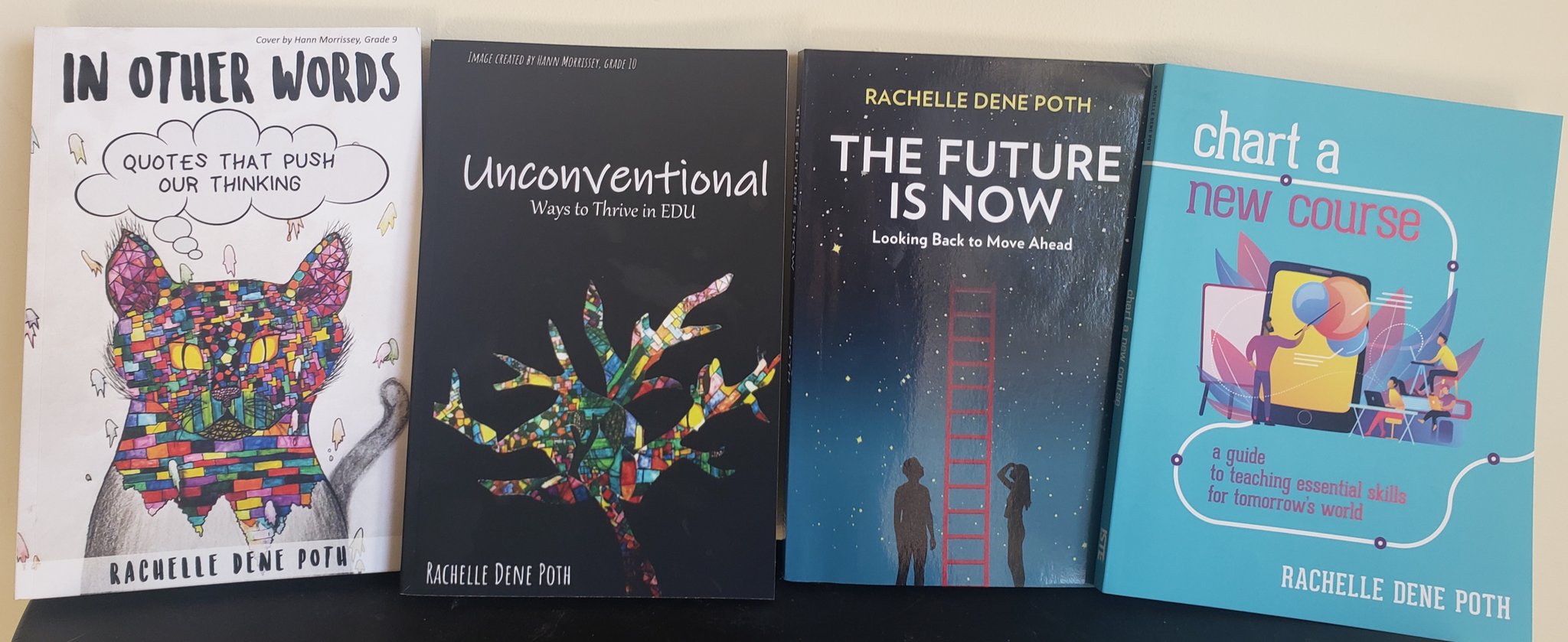
She is the author of nine books including ‘In Other Words: Quotes That Push Our Thinking,” “Unconventional Ways to Thrive in EDU,” “The Future is Now: Looking Back to Move Ahead,” “Chart A New Course: A Guide to Teaching Essential Skills for Tomorrow’s World, “True Story: Lessons That One Kid Taught Us,” “Things I Wish […] Knew” and her newest “How To Teach AI” is available from ISTE or on Amazon.

Contact Rachelle to schedule sessions about Artificial Intelligence, Coding, AR/VR, and more for your school or your event! Submit the Contact Form.

Follow Rachelle on Twitter(X) and Instagram at @Rdene915

**Interested in writing a guest blog for my site? Would love to share your ideas! Submit your post here. Looking for a new book to read? Find these available at bit.ly/Pothbooks

************ Also check out my THRIVEinEDU Podcast Here!

Join my show on THRIVEinEDU on Facebook. Join the group here.

Educators: 10 Ways to Make Time for Self-Improvement

Originally published on Getting Smart
As educators, we need to make more time for self-care. In order to bring our best selves to our classrooms and our schools, we must make time for our needs each day. Over the holiday breaks, making time to do some normal things like catching up with family and friends, and sleep in late, are good ways to recharge over the summer break.

When we have these breaks, it is easy to get into a new daily routine, finding time for all of the things that we wanted to do but couldn’t fit into our schedules throughout the year. It may take a few days to adjust, but I find that in a short amount of time, I am well into my winter break routine of catching up on some work and enjoying the extra time with family. The days are still filled but on a more relaxed schedule. Many take advantage of the extra time and lack of a set schedule to engage in personal and professional development. Whether it is a time to travel with family and friends or something more professional like attending conferences or taking a class, we all find ways to fill all of that extra time. We get used to a new routine, and likely feel pretty good about our improvement and feel some balance until August arrives and educators return to their classrooms, hopefully, recharged and excited for the new school year.

This has been a challenging year and educators can quickly become burnt out trying to prepare everything and keep up with the changes. We can struggle with finding balance and making time to keep up our personal and professional growth during the school year . So how can we still do ‘all the things’ and stay balanced and find enough time for ourselves?

Here are ten ways to add in more time for you and to be more productive each day:

  1. Connect. We are surrounded by so many people each day in the midst of thousands of interactions. But how many of those interactions are truly meaningful and give us the needed time to pause, lean in and really listen? Are we able to connect with family, friends, students, and Professional Learning Networks (PLN)? Find a way to connect every day. Make time for family first. Share a meal together, go for ice cream, take a walk, watch TV, or play a game. Family time is critical; remember to make time for your ‘school family,’ too. Whether it’s by greeting students at the door, spending time in the hallways or the teachers’ lounge, or using social media to connect through messaging, make time for those moments. Find at least one person to connect with each day. It helps to keep us grounded and gives us access to a constant support system.
  2. Have a routine. Sometimes it comes down to just having a little bit of consistency in each day. Maybe this means setting aside a specific time to read in the morning, listen to music, respond to emails, or simply reviewing your schedule for the day. Personally, I find that having these activities during the day is one way to keep myself in balance. Knowing what my day holds or starting each day with a certain task like reading a blog keeps me accountable for taking time for myself.
  3. Choose one. There are so many choices we have for activities that are worthwhile for our mental and physical well-being. Our days become quite full, and the worst thing we can do is overwhelm ourselves by trying to do everything. Some good advice I received from a friend is to simply choose one thing. Get outside and walk, meet up with family and friends, whether once a week or as often as your schedule allows. Try to pick one activity per day that will be good for your well being.
  4. Disconnect. We all stay connected by a variety of devices. Technology is amazing because it enables us to communicate, collaborate and access information whenever we need to. However, it disconnects us from personal connections, takes away a lot of our time, and can decrease our productivity. It’s beneficial for us to make time to truly disconnect. Whether you leave your device at home during a vacation or simply mute notifications for a period of time during the day, it’s important to take a break. Pause to reflect, and be fully present with family and friends. Personally, I struggle in this area but have been more intentional about taking a break from technology.
  5. Exercise and movement. Think about the students in our classrooms and the learning experiences we create for them. Do we have them stay seated in rows each day or are there opportunities to move and be active? Finding time for exercise and movement is important to our well-being. Go for a walk, have a dance party, or use an on-demand or online exercise program. Get up and moving with your students, and take learning outside whenever you can. Exercise has so many benefits that even setting aside 10 minutes a day is a great way to boost energy and mental wellness. Invite a friend or colleague to join you and hold each other accountable.
  6. Time to rest. Just like exercise, it’s also important to get enough rest. How many times do educators stay up late grading papers or writing lesson plans, and get up extra early to prepare for the day?  We can’t bring our best selves to our classroom if we are tired. Lack of sleep and quality rest will negatively impact our mental and physical health. Our students and colleagues will notice our lack of energy and possibly even mental clarity, so we need to ensure time for sleep to receive the positive benefits!
  7. Reflection. It is important that we model lifelong learning and the development of self-awareness and metacognition for our students. This involves setting aside a period of time where we reflect on our day, the progress we made, the challenges we faced, and even epic fails that we might have experienced.  Finding a way to capture these reflections whether in a blog or journal or using an audio recording to listen to later, are all great ways to track our progress. Then we can revisit our reflections and ask ourselves, “Am I a little bit better today than I was yesterday?”
  8. Learning. Education is changing every day. There are new topics, trends, and tools that make keeping up with everything tough. There are so many ways that we can learn today that don’t take up too much time, however. While traditional professional development training and in-person sessions are useful—especially for the opportunity to connect with other people—the reality is that carving out availability to do this on a regular basis is a challenge. Instead, find something that meets your schedule. Whether it’s listening to a podcast or participating in a Twitter chat once or twice a week, watching a webinar, reading a few blog posts, or joining a group on Voxer to discuss what’s on your mind and ask questions about education. There are many ways to learn on the go!
  9. Celebrate. Make time every day to celebrate something. Whether it’s a positive event in one of your classes, something one of your students did, recognizing a colleague, validating your own efforts or just a random celebration, focusing on the positives will impact your well-being in the long run. No matter how big or small, the steps toward success and achieving goals and even some mistakes should be embraced and even celebrated. Modeling a celebration of the learning process, especially from failures, sends a positive message and is a good model for students.
  10.  The power of no. It’s amazing how difficult it can be to say no. Educators are often asked or volunteer to assume additional responsibilities like sponsoring a club, joining a committee, chaperoning an event, or participating in other school events. There are so many things that comprise our role as educators and with our passion for teaching, it can be difficult to say no, especially when it comes to education and our students. But as hard as it is, sometimes it’s the best choice. Think about what is most important to you and the limited time that you have. I focus on why and how my participation or acceptance of whatever it is can benefit my students and the school community. Saying no is tough, but it is more than reasonable to say no sometimes. We have to do what is best for ourselves, so we can do what is best for our students.

These are just a few ways I’ve tried to maintain more balance and be more effective and productive in my work. We have to start each day with a focus on self-care, because that is how we can make sure that we are bringing our best selves into our classrooms, into our schools, and home to our families each day.

**Interested in writing a guest blog for my site? Would love to share your ideas! Submit your post here.

Looking for a new book to read? Many stories from educators, two student chapters, and a student-designed cover for In Other Words.

Find these available at bit.ly/Pothbooks  

JabuMind for Teacher Self-Care

Guest post by Erin Swanson, M.Ed,  JabuMind

Teachers are in crisis, suffering from compassion fatigue and burnout at an alarming rate. Tasked with adapting to the pandemic, protecting their students from school shootings, teaching to high-stakes state tests, juggling crushing workloads, working overtime for little pay, responding to their students’ trauma, and more—teachers need our help.

The JabuMind self-care app for teachers is here to help. JabuMind was designed by a group of teachers, coaches, artists, school principals, and mental health clinicians. We share a common goal of creating a safer, stronger, and more supportive classroom experience for both teachers and students. Our mission is to support teachers in their own social and emotional growth so that they, in turn, can help their students and school communities.

Why Teachers Need Self-Care

Teachers are overworked and overwhelmed. No doubt about it, teaching is one of the most stressful professions. An analysis by the National Foundation for Educational Research revealed that “one in five teachers (20 percent) feel tense about their job most or all of the time, compared to 13 percent of similar professionals.” In addition, The American Federation of Teachers found that “78% of teachers reported feeling physically and emotionally exhausted at the end of the day.”

Let’s not forget the additional weight placed on teachers during the pandemic. A March 2020 survey from Yale and the Collaborative for Academic, Social, and Emotional Learning (CASEL) showed that teachers’ top emotions regarding teaching during COVID included fearful, worried, overwhelmed, and sad.

One of teachers’ main stressors is compassion fatigue. Compassion fatigue is the experience of emotional and physical fatigue due to the chronic use of empathy. It is often used interchangeably with the terms secondary trauma and vicarious trauma.

As teachers, we care deeply for our students. When our students face trauma, we feel the weight of heartbreak, fear, uncertainty, and responsibility as their caretakers. Distraught over how to support a traumatized child, we might start experiencing the symptoms of compassion fatigue—anxiety, difficulty sleeping, exhaustion, hypervigilance, decreased motivation, trouble separating work from personal life, increased cynicism, or a sense of hopelessness.

Suffering from compassion fatigue is among the top reasons teachers leave the profession. No longer able to handle the pressure and heartbreak, they experience burnout. “Burnout is a state of emotional, physical, and mental exhaustion caused by excessive and prolonged stress. The negative effects of burnout spill over into every area of life—including your home, work, and social life. Burnout can also cause long-term changes to your body that make you vulnerable to illnesses like colds and flu.”

The Solution? Mindfulness

Fortunately, there is an antidote to the struggles teachers face. Research shows that teachers who participated in a mindfulness course had reductions in burnout and increases in self-compassion. Additional research proved that teachers who followed a mindfulness program developed resilience to stress and nonreactivity by practicing mindful awareness.

Even more, a study on mindfulness intervention and workplace productivity showed that mindfulness produced “increases in team and organizational climate and personal performance.” Meditation, in particular, activates the part of the brain associated with more adaptive responses to stressful and negative events.

JabuMind Brings Teachers Mindfulness and Self-Care

The JabuMind self-care app for teachers uses the iRest® method to support teacher self-care. Co-Founder of JabuMind, Jill Apperson Manly, explains why JabuMind chose the iRest® method of meditation for its app in this interview. We explain the 10 tools of iRest® and their connection to teacher wellness here.

Research shows that iRest® promotes better sleep, decreases stress, alleviates symptoms of PTSD, and enhances quality of life for school counselors.

The JabuMind app offers guided meditations, daily sleep and mood check ins, and professional development designed to meet teachers’ stressors. All premium app content is free through the pandemic to support teachers during this difficult time.

Jabu2Learn more about how the JabuMind app can support your self-care in these articles:
You might also enjoy our other resources to support teachers, such as:

Teachers—you, more than anyone, deserve self-care. In a career that asks you to be selfless, be the one to prove that self-care leads to better care for everyone.

**Interested in writing a guest blog for my site? Would love to share your ideas! Submit your post here.

Looking for a new book to read? Many stories from educators, two student chapters, and a student-designed cover for In Other Words.

Find these available at bit.ly/Pothbooks  

Serenity, Courage, Wisdom

Guest post by Charles Williams (@_cwconsulting)

I do not profess to be a religious man. A man of faith, yes? But not a man of religion. I could dive into my reasons but that is not the purpose of this reflection nor do I believe this is the proper space to have that discussion. Maybe another time in another place.

There are, however, three words that have consistently presented themselves to me during this pandemic. Three words taken from The Serenity Prayer written by the American theologian, Niebuhr (nee-bur), around 1932. Despite various renditions curated by various groups for their unique purposes, all centralize on three concepts.

Serenity. Courage. Wisdom.

I recently took my daughter to pick up her high school graduation items. It was a surreal experience as we drove along a nearly empty roadway through the school’s campus to various stations returning books and collecting items. Aside from the handful of teachers at each station, there were no crowds, there was no cheering, there was no … celebration. And, nearly as quickly as it started, it was over. The whole process lasted maybe 5 minutes.

Four years of high school. Four years of studying. Four years assignments and exams. Four years of late nights and early mornings. Four years culminated in five minutes.

As we drove away, my daughter sat in silence. When I asked if she was okay she replied that she never imagined that this is how it would have ended. She had held onto a feeble hope that maybe, somehow, this would all go away and that she would have a real graduation. After all, she had already lost prom and senior banquet.

I drove along contemplating how to best respond. Knowing my initial logical response void of emotion would only make the situation worse, I kept quiet while I attempted to formulate the right words. During that time, those same three words returned.

Serenity. Courage. Wisdom.

With them in mind, I delivered a response. I don’t know if it was the right one. I don’t know if it could have been better. She gave me that smile, you know the one. “Thanks Dad, I know you’re doing your best.”

So I will do my best to share those words with you. I know that there are other seniors out there dealing with the same frustrations, hurt, confusion, and sadness. I know that there are adults experiencing similar emotions for their respective situations. This is for you.

Serenity, the state of being calm, peaceful, and untroubled.

Seek to find peace in your troubles by letting go. I know that this is easier said than done but when you attempt to control the uncontrollable, you will find nothing more than additional stress. Accepting this fact is not easy. I know. As a leader it was one of the toughest lessons that I had to learn.

A story I share is one when I was still in the classroom. I was attempting to teach a lesson to a group of students who were particularly talkative that day. Few were paying attention and I was quickly growing aggravated. At some point, someone decided to stick a small piece of chalk into the automatic pencil sharpener resulting in a persistent drone. I attempted to remove the chalk by tapping the sharpener on the desk. Nothing.

Chatter, chatter, chatter. Buzz, buzz, buzz. Tap, tap, tap.

Nothing. I tried again. Harder this time.

Chatter, Chatter, Chatter. Buzz, Buzz, Buzz. Tap, Tap, Tap.

Nothing. I tried again. Even harder this time.

CHATTER, CHATTER, CHATTER. BUZZ, BUZZ, BUZZ. TAP, TAP, TAP.

Silence.

The students stopped. The buzzing stopped. The tapping stopped. I had smashed the sharpener on the desk.

I was embarrassed and ashamed. I had allowed my emotions to take over. I focused on something over which I had no control. And I failed myself and my students.

I encourage you to reflect on your situation and categorize the various aspects as controllable or not. What you will quickly realize is that a majority of the external factors are uncontrollable. You cannot control what others think or do. You cannot control the passage of time. You cannot control the outcomes of your actions. Your best hope is to influence.

What you can control is how you respond to situations. You can control your thoughts and actions. You can control your beliefs and attitude.

Find peace in focusing on those aspects over which you have control.

Courage, the ability to do something despite the presence of fear.

Fear takes many shapes and forms. It is present in many situations. It has the power to control us. It is imperative, however, that we find the means to not only face our fears but to overcome them.

For so many right now, there is a huge fear of the unknown. We don’t know what to expect in terms of this pandemic. Are things going to get better? Is it safe to begin reopening? Will we be returning to a sense of normalcy?

My daughter has been sitting on a huge decision. Should she attend Purdue or IU. She has been accepted to both. She has wonderful opportunities at both. She has friends that will be attending both. Outside of distance, the two are virtually identical. And yet, she has yet to make a decision. Why? Because she is scared. She has no idea what the future holds. She was accustomed to the fairly predictive nature of high school. This is different.

Stepping into courage is the first step of battling fear.

I sat on my podcast for years. I was scared that nobody would listen. I was scared that I wouldn’t have the knowledge or skill sets. But as I listened to other educators, I slowly grew more confident. I can recall listening to Jennifer Gonzalez from the Cult of Pedagogy and finding episode 130 – Tips for Starting a Podcast. I started getting excited. This sounded very possible. Then I started listening to Tim Cavey’s Teachers on Fire Podcast. I found elements of myself in nearly every guest and started realizing that I too had something to share. Then I connected with Mike Earnshaw from the Punk Rock Classroom. He and his co-host, Josh Buckley, shared their experiences from their unique perspectives as punk rock educators.

That was it. I sat down. I started recording. And now The Counter Narrative Podcast exists. I have no idea where this will go but I challenged my fear by stepping into courage.

Wisdom, the quality of having experience, knowledge, and good judgment.

Both serenity and courage rely on wisdom. You need to be able to identify situations over which you have no control and those in which you need to step into courage.

Wisdom requires experience. Knowledge in the absence of experience is little more than facts.

Unfortunately many students, like my daughter, have not yet had the opportunity to gain the wisdom that comes from making mistakes. Instead, they must rely on family, teachers, faith leaders, or others to guide them in the right direction. Even as adults we do not always have wisdom and must rely on the counsel of others.

It is a humbling experience to admit that you do not know and even more so to ask for assistance. It means that you are vulnerable and thus you should seek out this advice from someone you can trust.

In time, you will gain enough experience to differentiate between those situations in which you need to let go and those in which you need to step forward.

For all of you reading who are experiencing times of difficulty, know this. It is okay not to be okay (thank you Traci for that one). Don’t let anyone tell you otherwise.

What is not okay, however, is to give up. Giving up is not the answer.

Find peace with those things that you cannot control. Find the courage to deal with those things that you can. And find the wisdom so that you may know the difference.

Until next time.

_______________________________________________

**Interested in writing a guest blog for my site? Would love to share your ideas! Submit your post here.


Looking for a new book to read? Many stories from educators, two student chapters, and a student-designed cover for In Other Words.

Find these available at bit.ly/Pothbooks  


TeacherCast Educational Network

Technology Integration - Instructional Coaching - Productivity Secrets for Educators

Leadership Liner Notes: Sean Gaillard

Built on Connection. Tuned for Impact.

Stories by Thomas Oppong on Medium

Dr. Rachelle Dené Poth @Rdene915 Educator, Consultant & Keynote Speaker, Author, Attorney #THRIVEinEDU

Hooked On Innovation

When Innovation slaps you in the face, we slap back.

Teach Better

Dr. Rachelle Dené Poth @Rdene915 Educator, Consultant & Keynote Speaker, Author, Attorney #THRIVEinEDU

BrianKulak.com

Dr. Rachelle Dené Poth @Rdene915 Educator, Consultant & Keynote Speaker, Author, Attorney #THRIVEinEDU

The Principal of Change

Stories of learning and leading

Mandy Froehlich

Dr. Rachelle Dené Poth @Rdene915 Educator, Consultant & Keynote Speaker, Author, Attorney #THRIVEinEDU

Katie Martin

Informed by research, refined by practice

#RocknTheBoat

Rocking today's classrooms, one teacher, student, and class at a time.

User Generated Education

Education as it should be - passion-based.

Learning as I go: Reflections & lessons learned

Dr. Rachelle Dené Poth @Rdene915 Educator, Consultant & Keynote Speaker, Author, Attorney #THRIVEinEDU

Serendipity in Education

Join me, Allyson Apsey, as I stumble upon the fortunes of learning, laughing, and celebrating alongside incredible people.