Tag studentchoice
“The Summer Slide” and avoiding it
Technology Helps Students Avoid the “Summer Slide”
Published on CoSN: The Consortium for School Networking

Summer slide refers to a decrease or loss of academic skills over the summer break. As summer goes by, if students do not actively engage in learning experiences, the progress they had made throughout the school year will not only decrease, it can actually regress.
Avoiding this “summer slide” is easy if strategies are in place to help students stay fresh until the next school year. This is where digital tools and technology can step in and help students be ready for the start of the new school year.
Ways to avoid the slide
There are many digital options for helping students avoid this summer slide. With the rise of technology, students have access to diverse tools with many options for providing these learning extensions. Students have choices when given opportunities for practice and this will help them to return to school better prepared.
Regardless of the content area or level taught, teachers can recommend some great tools and apps that can easily be used by students to practice over the summer. Technology enables students to learn anytime and anywhere, so time conflicts are no longer a problem. It just requires students to set aside time to interact with these resources, and it can also be a good way to help students take ownership of their learning and even have fun in the process.
As a foreign language teacher and member of several professional committees on educational technology, I am always looking for new online platforms and strategies to stay connected with my students.
In my classes, we use Edmodo, a platform that allows teachers to share resources and connect with parents and administrators, and Celly, a platform that uses social media to help students, teachers and others connect and communicate. I can post links to resources using either of these throughout the summer, if I want to send students an activity to complete to practice the verbs or vocabulary, or if I find a new website or resource that I think they will enjoy.
Students have assignments and activities posted on Edmodo; for instance, they might be asked to complete a game of Quizizz or use Quizlet study cards, or to do something like write a blog post about their summer vacation, or to find some authentic resources and share them with the class.
My students also use the Duolingo app on their devices and can use this as a way to stay fresh and have fun learning and reviewing the language, on their own schedule and wherever they are at the time. I remind them to set aside a certain amount of time each week to review their skills.
For blogs, I use Kidblog, a platform that is secure and allows students to build their own pages and post blogs.
And when students go on vacation, I ask them to use their travels as an opportunity to engage in conversations with Spanish speakers.
Other ideas include using tools such as an LMS or a collaborative class website, and a messaging tool for communication, to help students and teachers stay connected over the summer. Digital tools can be shared and students can ask for help and have access to additional resources when needed. Maintaining a connection over the summer can keep students engaged and continue to foster those important student-teacher connections.
There are many opportunities available to help students stay involved and even build their skills over the summer. It just takes a little bit of investigating to find beneficial resources and setting aside the time to explore the many options available.
Rachelle Dene Poth teaches French and Spanish at Riverview Junior-Senior High School in Oakmont, Pennsylvania. She holds a law degree and Masters in Instructional Technology from Duquesne University.
– See more at: http://www.cosn.org/blog/technology-helps-students-avoid-%E2%80%9Csummer-slide%E2%80%9D#sthash.4p03rkG8.dpuf
New challenge in my classroom: Interactive Lessons
A New Challenge For My Classroom: Creating Interactive Video Lessons

Thank you Terry Heick and TeachThought for posting this on June 27, 2016
In my prior blog posts, I talked a lot about taking steps into integrating some type of technology into your classroom. I started with some general ideas about what you might consider and questions you might ask yourself to determine what might benefit your classroom. Thinking about the best ways to help your students is the first step, and also an important way to focus on what you can do that will also benefit your practice as a teacher.
The underlying premise is that all involved have to take some sort of a risk. The teacher has to risk trying something different and new that perhaps is way off from the traditional practice of their classroom or perhaps it’s just a minor change in how they deliver instruction, with a learning target in mind. The students have to take a risk because they are the ones that will be using this new technology. They will be trying a new tool, creating a project with a new presentation style, communicating and collaborating outside of the traditional classroom. And maybe even more importantly, stepping outside their comfort zone.
So it comes down to not only a change in thinking but also a willingness to expand one’s comfort zone and through collaboration, work on building something that can lead to many benefits for students and teachers in the learning environment.
The reason I decided on this topic is that while I have been talking about things I’ve been using in my classroom and how I got started, I also decided that I needed to branch out and try some new methods of delivering instruction. And even more important than my own risk in trying these things was the risk in getting the feedback from the students and learning what the impact was on them as well.
One of the things I love most about Twitter chats and reading blogs is that you get a lot of great ideas and feedback and I very much value the perspective of others. So when trying something new in my classroom, I truly want to know what the students think about it. Did they like it? Did they have problems accessing it? Did it enhance their learning or did it take away from something that would have been more beneficial? In other words, could it have been considered a total waste of valuable learning time.
Getting Started
A few months ago I decided to try Educanon (now Playposit). I have wanted to try it for a while, and since it was available as an app with Edmodo, I definitely wanted to try it with a group of my students. Over the past few years, I have been using some tools to flip my classroom and provide more blended learning experiences for my students.
In doing this, I also wanted a way to make them accountable for the activities that I was having them do outside of class. Without specific interactive tools, it can be difficult, aside from actually giving students a test or other assessment, to have proof that they watched a video; this was a risk for me.
I’m fortunate that my students are interested in learning new things and tolerant of the fact that I like to try new tools in our classroom and work to find a variety of engaging ways to help them learn. Playposit is integrated with several different Learning Management Systems, making that part easier.
I decided to take a small step and have Spanish II try it out first, chose a YouTube video and created a lesson. There were some initial glitches, most of which occurred because students did not follow my instructions and I had to troubleshoot, however the feedback was very positive and the students really enjoyed it. Another area which was challenging for me was that I would not necessarily be able to answer their questions, because it was new to me as well.
I had researched and learned as much as I could before assigning the first “bulb” which is a lesson. Other concerns I had were whether it would it be accessible to the students, would it indeed benefit their learning and how would they respond to yet another new tool. My goal was to find another way to connect the learning and engage students, and even more, transform their roles from learners to leaders in the classroom.
How Does It Work?
It is very user friendly to create your own “bulb.” You can select your video from YouTube, Vimeo, SchoolTube, TeacherTube, and Google Drive, and simply paste the URL into your lesson. You then can add a variety of questions, discussion, audio, images, equations and more for your lesson, even explanations and descriptions. Once you are finished, assign the lesson and the students can begin.
There are a lot of choices for analytics to see how the students are progressing, their answer selections, see if any questions were skipped or that students found confusing, and look for trends across the class. Several ways to share the lesson, either by having students sign up, upload a roster, or have it integrated with your LMS. There are diverse ways to create the lessons that will help to engage your students more and deliver lessons which provide more personalized learning experiences and give you the means to provide feedback to the students.
I have encouraged students to create presentations using tools like this, because I think it really helps them to learn the material, they can personalize it, it is interactive, they build on their technology skills, and they can see what it is like to be the teacher, to have the power to drive the learning in the classroom. Feeling valued and having input into the classroom, engages students more and enhances the learning opportunities for all.
As the teacher, I take part in their lesson and enjoy learning from them as well.
Conclusion
The nice thing about Playposit is that there are premade “bulbs” or public lessons already available, so if you don’t have a lot of time right now to build your own, take a look at what is already made and try it in your classroom. Talk to your students and see how they like it and how it impacts your learning environment.
There is nothing wrong with trying it out and seeing what others have done. Sharing leads to new ideas and it is all part of the growth process. The important thing is to just start somewhere, start small, and work your way up. It may go really well and it may not go as hoped, but it is an opportunity to learn, expand skills and involve students in the process.
Thinking about Improving Homework
Thanks Terry Heick and TeachThought for publishing this recent post on June 20, 2016.

The end of the school year can be challenging with so many changes occurring: the weather, spring sports, weeks of standardized testing, field trips and other activities lead to oftentimes, chaotic schedules. These changes can decrease motivation in students and in some cases, teachers as well, and result in a feeling that the school year is over before it really is.
I notice this gradual transformation each year, and do my best to mix things up, to keep learning going, and to stay strong until the end. This year seemed to be a more challenging year, although I cannot pinpoint why, but as I mentioned in my prior post, I decided to do something about it. I made the decision to try some new methods, reevaluate how I have been doing things in my classroom, and what could I be doing better.
The last grading period has been a time to test out some new tools, give students new opportunities, more choices and be a little less structured, allowing for some spontaneity in our learning. So as part of my “staying strong till the finish”, after mixing up the seating arrangements and receiving positive responses, I shifted my focus to a new area: Homework
What Is Homework, Anyway?
Recently I have been giving a lot of thought to homework. My focus has been on really looking at the types and the frequency of assignments I give. Over the past few years, I have changed my thinking and tried to move away from a “one size fits all” assignment and move toward a more personalized, authentic assignment. There have been several reasons for this change in thought.
Hearing from other educators at conferences, input from my students, and as a language teacher, also having to find ways to avoid student use of translators for assignments. These experiences, in addition to a little frustration from homework not being completed, have led me to really try some new methods in this area.
Some of the areas I considered when thinking about homework were: the types of assessments I use in my classroom, my students, the frequency of homework completion, the type of homework, and even more closely, a look at the individuals within each group of students that I am teaching. My goal is to continue to reflect on whether or not the type of instruction and the strategies I am using, are beneficial to them and if the homework I assign truly has value and builds their skills, or is it just busy work. A lot of the discussion out there now is about getting rid of homework assignments and traditional grading.
Why I Decided To Do Something Different
I have been teaching foreign languages for almost 20 years, and I notice how quickly time has passed, when I find myself teaching a concept and I feel like I just taught the same thing the day before. This “déjà vu” experience leads me to think about the progress I am making with the curriculum in the current school year, and how I have paced my instruction throughout the year. But what I have come to realize more this year than any other, is that it should not be the goal to be at the same point at the same time each year. In my mind, that simply should not be how it goes.
I think a lot of people consider teaching as a profession in which the same plans are used, lessons are taught at the same pace, the same assignments and tests are given each year. If we truly did that, then the profession of teaching would seem to be a rather easy and predictable one. However, that is not the way it is.
I had a conversation with someone that thought teachers simply used the same exact materials each year, with each class, and that teaching was a really easy profession. This conversation bothered me, and the last part about it being “easy” really hit me. So this inspired me to think about my teaching practice. What materials I was I using in class? How was I providing instruction for my students and was I using the same resources each year with each class? Had I been doing the same thing in my classroom every year? Did I simply pull out a folder to make copies or open up a computer to reprint what I had used each of the 19 years prior to this one?
Honestly, sometimes yes. I had. I had used the same worksheet, or a document for a part of a test over the years. I hadn’t done this because I was lazy. In some cases it was for providing a quick activity or assessment, and others it was because I thought the materials were valuable and would help the students to learn.
Thinking About Homework In Your Classroom
Ask yourself these same questions. What do you come up with? If you have been doing the same thing, then maybe it is time to make a few changes. Think about what would work best for and help your students. This means more than just looking at each individual class, it means really looking at the needs of each individual student. To do this requires that we get to know our students, and to know our students means we have to build relationships and understand where they’re coming from and what they’re interested in doing in class.
What helps them to learn the best? What do they want and need from us? So I decided to use this as an opportunity to take a bit of a risk and try some new methods during this final grading period. It made sense because then I could really think about it over the summer and start fresh in the fall.
The first homework experiment
Students have a lot of homework and I do believe in the value of homework. It is the way we help students to practice and figure out what they know and what they don’t know and how they can become better. It is one of many ways teachers can assess students and learn about their needs, provide instruction and valuable feedback. But I’ve changed my thinking about homework. I used to think that I had to give students homework every day. And I also thought that homework had to be the same for each student and each class. In part, my methods were a result of the experience I had as a high school student. I decided to change the daily homework assignments and make things more personal, let the students determine for themselves what they could do for homework, and have choices.
Just as a start, I assigned each student to be the teacher for the next class period. With a partner for example, we are working on the past tense in Spanish and in pairs, I let the students decide which verb tense they would like to teach their partner. The homework was to simply come to class the next day with a way to teach their partner the verbs. I said it could be something tangible in the form of a worksheet or any activity that they found, a website, a video, a game, or another resource. It really did not matter to me as long as whatever they had they could use in class and they could teach.
I believed that in the process the students would learn more and also develop collaborative learning skills.
What Did The Students Think?
While they taught, I moved around to interact with each group to see what it was they had prepared. There were worksheets found online, worksheets that students created, handwritten pages of notes, flashcards, some had found websites with games and others had found videos or had created a Kahoot or Quizizz game for their partner to play. But what was most important was that they sought out resources, they had an opportunity to teach someone else and their homework was personalized not only for them, but also for other students. It went well and they were enjoying it and learning.
I will admit that I was nervous about doing this. Not requiring a specific form or product for each student to show in class, and being open to any format the students brought in, was very different. It was a risk. But I was amazed at how creative they were, how engaged each group was, and the variety of “homework” that had been done.
Student feedback is very important for me and I value their input and regularly engage them in informal conversations or will have them complete a survey. I want to know their thoughts. What did they like? What did they not like? Did they learn? Was this an effective way to practice the material we were covering in class? We spent two days doing this first assignment, so each person could teach. And then I had them switch groups, and teach again. The end result was that students were teachers, the learning was personal, they were engaged, felt valued, and the experience was meaningful and beneficial to their learning.
It is a risk and when you don’t necessarily have the whole plan set out, and you just kind of go with it, you might be surprised at the results. Giving the students control, seeing their interactions, and knowing that this homework was the type that was beneficial to each of them, encouraged me to continue to find new ways to give more classroom control to the students. Giving up some control is not always easy, but in doing this, it opens up more opportunities for facilitating learning, providing individualized instruction and building those relationships which are the foundation of education.
Student voices, learners become leaders
Empowering Students To Find The Best Resources For Them
By Guest Author Rachelle Dene Poth
HS French and Spanish Teacher Rachelle Dene Poth argues for more student voice, choice, and leadership when finding the right materials for every student. One of her students, Cassy, a 9th grader in Spanish I, reflects on what she’s learned from that experience.
Resources Are Everywhere: Where Do We Start?
Teachers work hard to find diverse resources to help students learn. Supplemental materials can be found in textbooks and other resources, through a quick search online or implementation of teacher-created or student-made materials. An online search will result in a tremendous list of resources which includes webpages, images, documents, videos, and other media formats for a teacher to choose from. It seems simple enough, but it really isn’t quite that simple. The challenge is finding the right resource for each student. Being able to do this requires more than just conducting a simple online search. It requires that we truly know our students and understand their needs. Students do not all respond the same way when it comes to learning and feedback and developing these relationships will help teachers to provide the best learning opportunities. Finding something that will enable each student to have an opportunity to grow, receive personal feedback, to experience learning multiple ways, is something that teachers strive to provide for their student.
Choosing Tech Tools For Students Is A Good Starting Point…But What’s The Next Step?
Technology offers many ways for teachers to differentiate instruction through digital tools. The number of tools and the features available changes every day. Finding something that works for everyone may take a little bit of time, and it involves some risk taking, flexibility and reflection to truly find what works best for each student. And while teachers are good at determining what might work best for their students, it is important to hear from the students themselves. Asking the students directly what helps them to learn better, stay engaged, and feel challenged will enable teachers to differentiate instruction and provide appropriate opportunities for all students. Student voice in how they learn and their opinion of tools used in the classroom offers the teacher valuable information and different perspectives. So it is worthwhile to take the time to investigate some tools, ask the students to try new things and then see what they think.
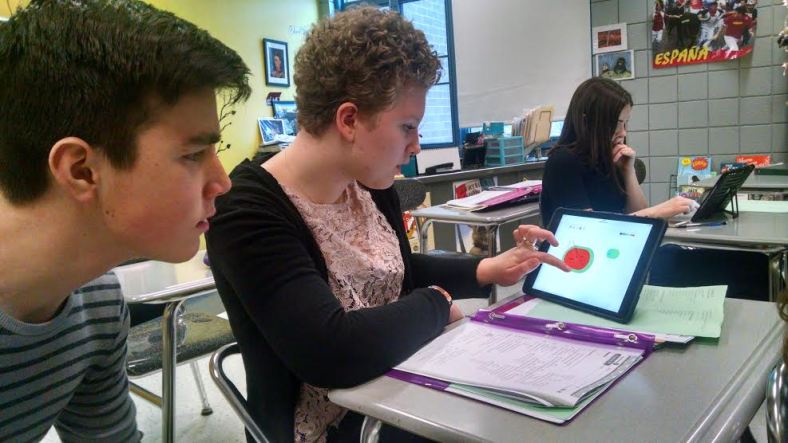
Rachelle’s students drawing a watermelon with our “Show Your Work” drawing tool!
Give Them Choices And Let Them Lead
So I wanted to know, what do students get from the choices they are given? Does it make a difference? What helps the students to learn? A few years ago I started giving the students different options for how to complete a project or an assignment. Other times, rather than assigning a worksheet for homework, they had other options such as creating a game, participating in a classroom discussion online, or even the use of blogging, all which made learning more personalized and meaningful for each student. I value the feedback that I receive from the students and when I try something new, I always want to know what they think of it. In order to learn more about student needs, I decided to have one of my students become the teacher, create a lesson using Formative, and share their thoughts about the new experience and the benefits.
Student Perspective On Edtech: Cassy Becomes The Teacher
Cassie getting ready to show tech tools that help her learning “catapult”.
Cassy: I believe technology is an important part of learning and is a great asset to teachers and to students. Technology allows students to have the freedom to choose how to do projects, homework assignments or other classroom activities. This freedom allows students to thrive and do the best they can. I know that I love the process of finding a new website, game, project or teaching tool that I can use to help my learning catapult. It is also fun to explore the possibilities of technology and what it offers me. I can be creative and innovative. Classes which integrate technology are completely different than those which do not, because they provide more opportunities for students to learn.
Formative is a great example of the infinite possibilities technology can offer students and teachers.Documents, websites, pictures, questions and drawings are integrated into this program which allows for differentiation and creativity in various ways. Also, many people can participate in one formative assignment. The teacher or creator of the formative can see individual responses and work with the student one on one and provide personal feedback. Formative creates an effective learning experience while keeping a fun atmosphere.
On May 16th, 2016, I participated with other students in the PAECT (Pennsylvania Association for Educational Communications and Technology) student technology showcase, where students from Pennsylvania showed how they use technology to its fullest potential. I made my own Formative and allowed others to try it, and highlighted all of the different uses and how effective it is for education. I enjoyed sharing how a digital tool like Formative can provide different learning activities, enhance how students learn and how teachers can teach.
“Formative is a great example of the infinite possibilities technology can offer students and teachers.”- Cassie
Why Having Tech Available In The Classroom Matters
I feel that making students turn off their phones or computers is not fair and is not smart choice. Teachers do that for their benefit, not for the students. The current generation of students is extremely involved and knowledgeable about technology. If all teachers could dive into the world of technology and understand its importance, significance and benefits, and then take the time to explore new ways to integrate some technology into class, it would make a huge difference in a student’s learning experience. I don’t know why more teachers don’t use technology to teach because it is a way to get the students more involved in the learning material.
What Do Students Want?
I want teachers to empower, engage and inspire me. I want teachers to give me the freedom to be creative while I am learning. I want teachers to make learning relevant to my time, and my life experience. Technology is the way to do that, to get students involved. It allows me to have my own voice and learn in the way that is best for me. I do not want to be held back from the infinite possibilities that technology offers any longer.
Student Voices: Listen To What They Say
Rachelle: It is clear that students have opinions about technology and its benefits. Having choices in how to learn, being exposed to different learning tools and styles, and receiving feedback are all benefits of technology integration and ones which positively impact students. When they have opportunities to work with technology and choose how they learn, including them in the conversation and asking for feedback empowers students even more. Since students are the group most affected by the technology used in the classroom, we need to hear what they have to say.