
The Importance of Reflective Practices

Making time for reflection as an educator is essential. Education is a field defined by personal and professional growth. Not just for educators, but also for students, the school community, and the systems involved, too. Growth doesn’t happen on its own. It requires intention, curiosity, and ongoing, consistent reflection. By looking back on our experiences, analyzing what worked and what didn’t, and identifying ways to improve, we build a solid reflective practice in our work. Reflection should not be considered as a routine, but rather as a mindset that transforms teaching into a continuous cycle of learning.

Why Reflection Matters

In classrooms filled with continuous changes, such as emerging technologies, alignment to varying standards, and working to best meet the needs of all learners, reflection helps to anchor us. It offers educators a chance to take a moment to pause and ask themselves questions such as, “Why did this lesson work? What could I do differently next time? What did my students need that I missed? How can I improve for tomorrow?

Reflection:

  • Encourages professional growth and lifelong learning.
  • Improves instructional decisions through ongoing thinking and self-evaluation
  • Builds self-awareness and resilience.
  • Strengthens the connection between teacher and learner experience.
  • Models metacognitive thinking for students.

As a huge fan of quotes, and having written one focused on quotes, I often think of this quote by John Dewey:

“We do not learn from experience… we learn from reflecting on experience.”

When we take the time to reflect on our experiences as educators, we transform them into opportunities for innovation, empathy, and personal growth.

The Cycle of Reflection

A simple way to frame reflection in education is through Gibbs’ Reflective Cycle, which includes six stages:

  1. Description – What happened?
  2. Feelings – How did you feel about it? How did it impact you?
  3. Evaluation – What was good or bad about the experience?
  4. Analysis – Why did things happen that way?
  5. Conclusion – What have you learned? What impact did it have?
  6. Action Plan – What will you do differently next time?

This framework helps teachers to pause, slow down, and analyze practice systematically, rather than relying solely on intuition or habit. It encourages educators to move from being reactive to becoming more intentional. When we do this, we make a shift and turn each lesson into a source of insight to better inform our practice.

Reflection Strategies for Educators

There are many ways to integrate reflective practice into our daily work. It can vary depending on teaching style, teaching and personal schedule, and even the school environment. Here are a few practical strategies that can help make reflection a part of your professional practice.

1. Journaling or Blogging

A reflective journal, whether digital or handwritten, or starting a blog, offers a space to explore thoughts about teaching, students, or school culture. Writing helps us identify or clarify patterns and challenges that we may otherwise be unaware of.

Try this:
At the end of each week, make a note of:

  • A success from the week
  • A challenge faced
  • A surprising moment
  • One thing you’ll try differently next week

This short routine will help to turn reflection into an intentional practice rather than an afterthought.

2. Peer Observation and Feedback

Invite a colleague to observe one of your classes or co-teach a lesson with you. These opportunities can provide new perspectives that deepen our reflection. While it can be uncomfortable at times, it is necessary. Having someone else with us can be insightful for identifying things we may overlook.

When working with a colleague and engaging in peer feedback, it shifts to a dialogue that, rather than being a solo conversation, becomes a dialogue that moves from focusing on what happened in a lesson to what happened, what it means, and what can I do now.

Try this:
After a peer observation, engage in a quick debrief with your colleague. Consider using prompts like:

  • “What did you notice about student engagement?”
  • “How did my questioning or feedback shape learning?”
  • “What assumptions might I have made during that lesson?”
  • “How was my pace during instruction?”
  • “Did I provide opportunities for students to lead more?”

3. Engage in Reflective Conversations with Students

I have found that asking my students for their thoughts is very helpful. I ask them what resonated with them, what confused them, how my class made them feel, and what ideas they can share about the impact of the strategies or teaching tools used in class.

Try this:
End a unit or project with a student reflection survey:

  • “What helped you learn most in this unit?”
  • “When did you feel most challenged?”
  • “What could I do differently to help you learn better?”

When we gain insights like these, they will not only inform instruction but also empower students to become reflective learners.

4. Video Reflection

Over the years, I have used a few different tools to reflect on my teaching practices. It can be uncomfortable at times, but by using video, it can be eye-opening for us. I have used Edthena Coaching for input, a Swivl, and through these, I have noticed several things. I quickly noticed patterns in my tone, pacing in lessons, student interactions, questioning practices, and more, that I often had overseen while teaching.

Try this:
Choose one aspect to focus on, such as questioning techniques, transitions, or body language (I tend to move my hands a lot!), and analyze that specifically. Small, focused reflection leads to meaningful improvement.

Reflection and Innovation

In our age of AI, digital learning tools, and evolving pedagogies, reflection is crucial to integrating innovation effectively. Reflective educators ask:

  • “Is this tool enhancing learning, or is it too much?”
  • “How are my students using technology to think critically, not just consume?”
  • “What role does empathy play in how I use data or AI to personalize learning?”

Reflection ensures that innovation stays human-centered and grounded in purpose, not just as a novelty.

Connecting Reflection to Student Growth

When teachers model reflection, students learn to think about their own thinking, they engage in a process known as metacognition. Reflective learners:

  • Understand their strengths and challenges.
  • Set personal goals.
  • Monitor their progress and adapt strategies.
  • Build self-awareness

Encouraging students to reflect, whether through the use of portfolios, self-assessments, or classroom discussions, cultivates ownership of learning. Reflection is powerful as it helps students to shift the focus of learning from grades to ongoing growth.

Building a Culture of Reflection

Creating a reflective classroom starts with modeling vulnerability. I’ve spoken about vulnerability a lot and often quote Dr. Brené Brown from her book Daring Greatly, in which she speaks of vulnerability in reference to Teddy Roosevelt’s speech, “The Man in the Arena” from 1910. Vulnerability is not a sign of weakness, but rather a sign of strength and willingness to grow. When teachers openly admit what they’re learning, they normalize growth and imperfection.

Try saying:

“I tried something new today, and it didn’t go as I expected. Let’s think about why.”

Transparency like this builds trust and shows students that reflection isn’t about failure. Reflection is about curiosity and continuous improvement.

When reflection becomes part of the culture, it deepens engagement and innovation at every level, from classrooms to leadership teams.

Reflective practice is at the heart of great teaching. It reminds us that education is an evolving journey that brings with it challenges and successes, both of which require reflection. Through reflection, we discover meaning in our work, develop empathy for our students, and gain clarity in our purpose for the work that we do.

The best educators are not those who have all the answers, but those who keep asking better questions.

About Rachelle

Dr. Rachelle Dené Poth is a Spanish and STEAM: What’s Next in Emerging Technology Teacher. Rachelle is also an attorney with a Juris Doctor degree from Duquesne University School of Law and a Master’s in Instructional Technology. Rachelle received her Doctorate in Instructional Technology, with a research focus on AI and Professional Development. In addition to teaching, she is a full-time consultant and works with companies and organizations to provide PD, speaking, and consulting services. Contact Rachelle for your event!

Rachelle is an ISTE-certified educator and community leader who served as president of the ISTE Teacher Education Network. By EdTech Digest, she was named the EdTech Trendsetter of 2024, one of 30 K-12 IT Influencers to follow in 2021, and one of 150 Women Global EdTech Thought Leaders in 2022.

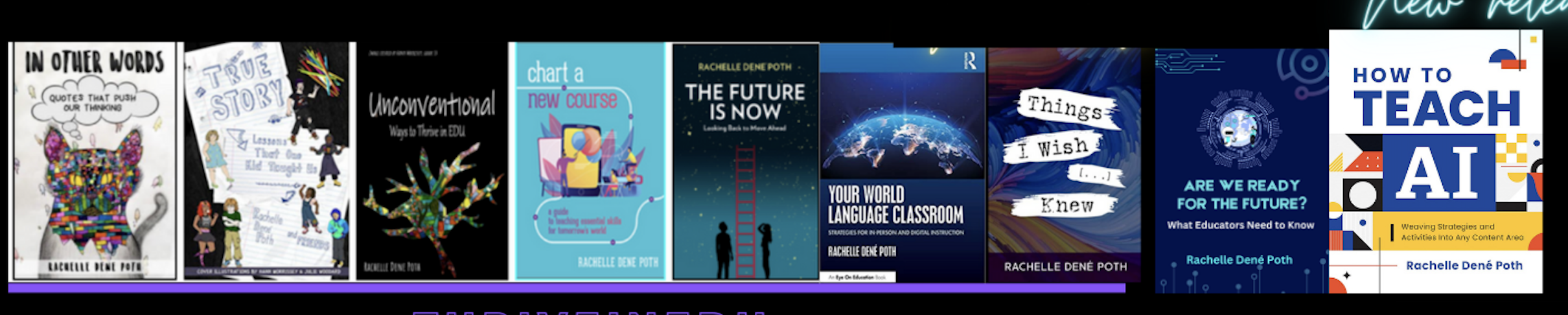
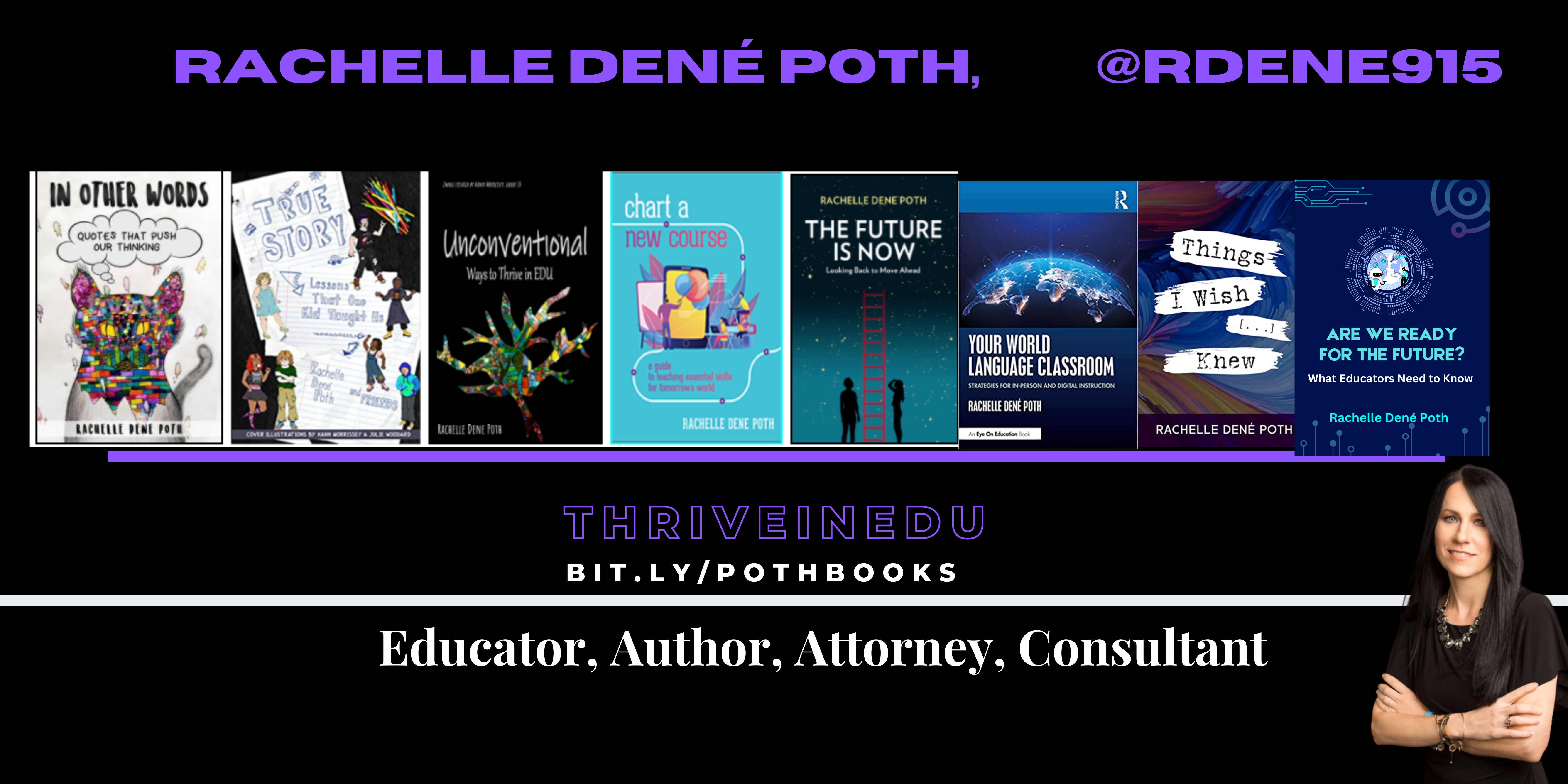
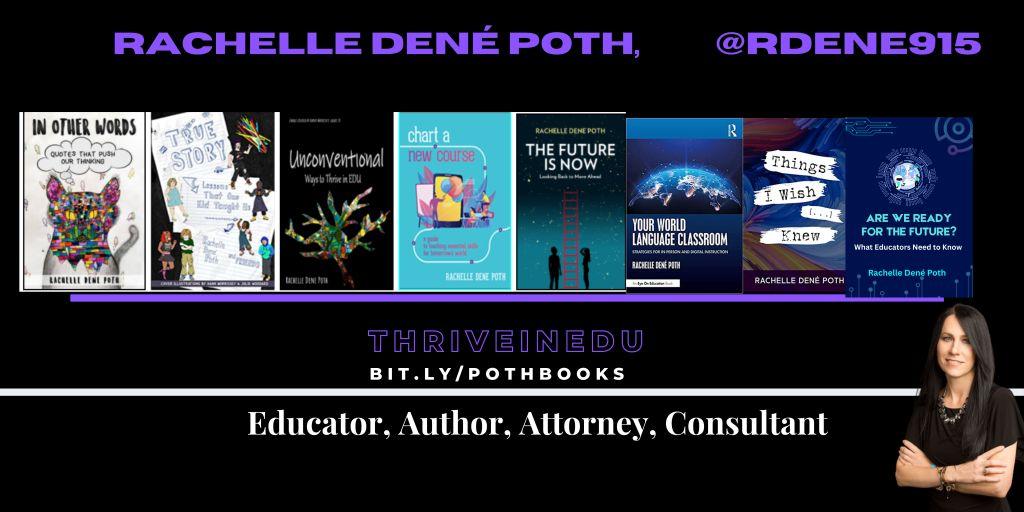
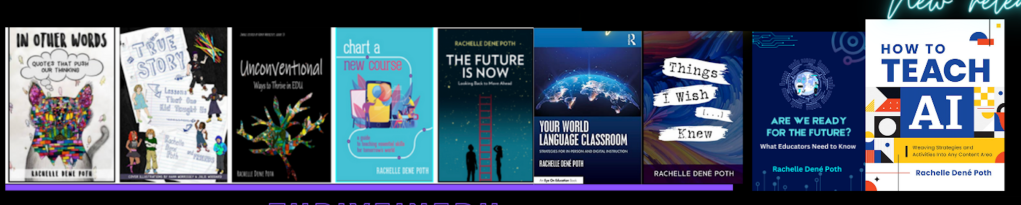
She is the author of ten books, including ‘What The Tech? An Educator’s Guide to AI, AR/VR, the Metaverse and More” and ‘How To Teach AI’. In addition, other books include, “In Other Words: Quotes That Push Our Thinking,” “Unconventional Ways to Thrive in EDU,” “The Future is Now: Looking Back to Move Ahead,” “Chart A New Course: A Guide to Teaching Essential Skills for Tomorrow’s World, “True Story: Lessons That One Kid Taught Us,” “Things I Wish […] Knew” and her newest “How To Teach AI” is available from ISTE or on Amazon.

Contact Rachelle to schedule sessions about Artificial Intelligence, AI and the Law, Coding, AR/VR, and more for your school or event! Submit the Contact Form.

Follow Rachelle on Bluesky, Instagram, and X at @Rdene915

**Interested in writing a guest blog for my site? Would love to share your ideas! Submit your post here. Looking for a new book to read? Find these available at bit.ly/Pothbooks
************ Also, check out my THRIVEinEDU Podcast Here!

Join my show on THRIVEinEDU on Facebook. Join the group here.
Tips for Using AI and for Talking to Students About It

My Prior post on Edutopia

AI isn’t coming—it’s already here. It has been embedded in the various educational platforms we use and the assessments we give. It’s likely involved in both the professional development we participate in and the writing and work that our students are doing.

As an educator, speaker, and advocate for technology integration, I’ve spent a lot of time researching, using, and teaching with AI so that I can prepare students and other educators. In my classroom, from using a variety of AI tools that help me save time so I can spend it working with students to integrating chatbots to support student learning, I see the value and impact of leveraging this technology. If we want our students to be ready for their future careers, we must start teaching them about AI. They need to move beyond being consumers of content and instead become creators and innovators.

Where Do We See AI?

For educators, many AI-powered platforms help us to target instruction, assess students, and find resources for our lessons.

Confidence building: Encouraging students to speak in class can be a challenge. At the end of 2023, I started to use SchoolAI with my students and created a “Sidekick” for them to have conversations in Spanish based on the content that I used for the prompt. They loved it—it not only helped them build language skills and confidence but also showed how AI can support their learning. MagicSchool AI is another great option, with a tutor function that helps students in areas where they need support. Both of these tools also have historical characters that students can chat with and other features to enhance learning. I love that I can monitor student responses, provide additional support, and adjust instruction as needed.

Using Eduaide, teachers can kick off a class debate with pros and cons and an outline to quickly get started, and they can also develop other collaborative and engaging activities for students.

For language learners, confidence matters. Snorkl enables students to practice speaking and receive real-time AI and teacher feedback. The AI gives real-time feedback on fluency and pronunciation, helping students grow as communicators and build confidence. Snorkl can be used with students starting in kindergarten, and it has a library full of ready-to-use activities. Throughout the times I have used Snorkl or one of the chatbots, the feedback provided has been tailored to each student’s responses and offered insights and examples to support their learning.

Continue reading the rest of this post on Edutopia.

About Rachelle

Dr. Rachelle Dené Poth is a Spanish and STEAM: What’s Next in Emerging Technology Teacher at Riverview High School in Oakmont, PA. Rachelle is also an attorney with a Juris Doctor degree from Duquesne University School of Law and a Master’s in Instructional Technology. Rachelle received her Doctorate in Instructional Technology, and her research focus was on AI and Professional Development. In addition to teaching, she is a full-time consultant and works with companies and organizations to provide PD, speaking, and consulting services. Contact Rachelle for your event!

Rachelle is an ISTE-certified educator and community leader who served as president of the ISTE Teacher Education Network. By EdTech Digest, she was named the EdTech Trendsetter of 2024, one of 30 K-12 IT Influencers to follow in 2021, and one of 150 Women Global EdTech Thought Leaders in 2022.

She is the author of ten books, including ‘What The Tech? An Educator’s Guide to AI, AR/VR, the Metaverse and More” and ‘How To Teach AI’. In addition, other books include, “In Other Words: Quotes That Push Our Thinking,” “Unconventional Ways to Thrive in EDU,” “The Future is Now: Looking Back to Move Ahead,” “Chart A New Course: A Guide to Teaching Essential Skills for Tomorrow’s World, “True Story: Lessons That One Kid Taught Us,” “Things I Wish […] Knew” and her newest “How To Teach AI” is available from ISTE or on Amazon.

Contact Rachelle to schedule sessions about Artificial Intelligence, AI and the Law, Coding, AR/VR, and more for your school or event! Submit the Contact Form.

Follow Rachelle on Bluesky, Instagram, and X at @Rdene915

**Interested in writing a guest blog for my site? Would love to share your ideas! Submit your post here. Looking for a new book to read? Find these available at bit.ly/Pothbooks

************ Also, check out my THRIVEinEDU Podcast Here!

Join my show on THRIVEinEDU on Facebook. Join the group here.
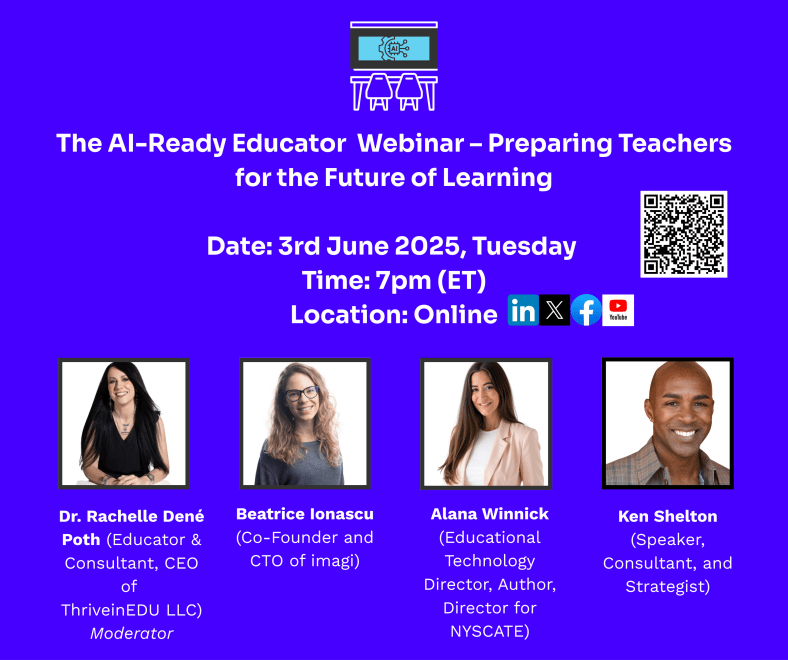
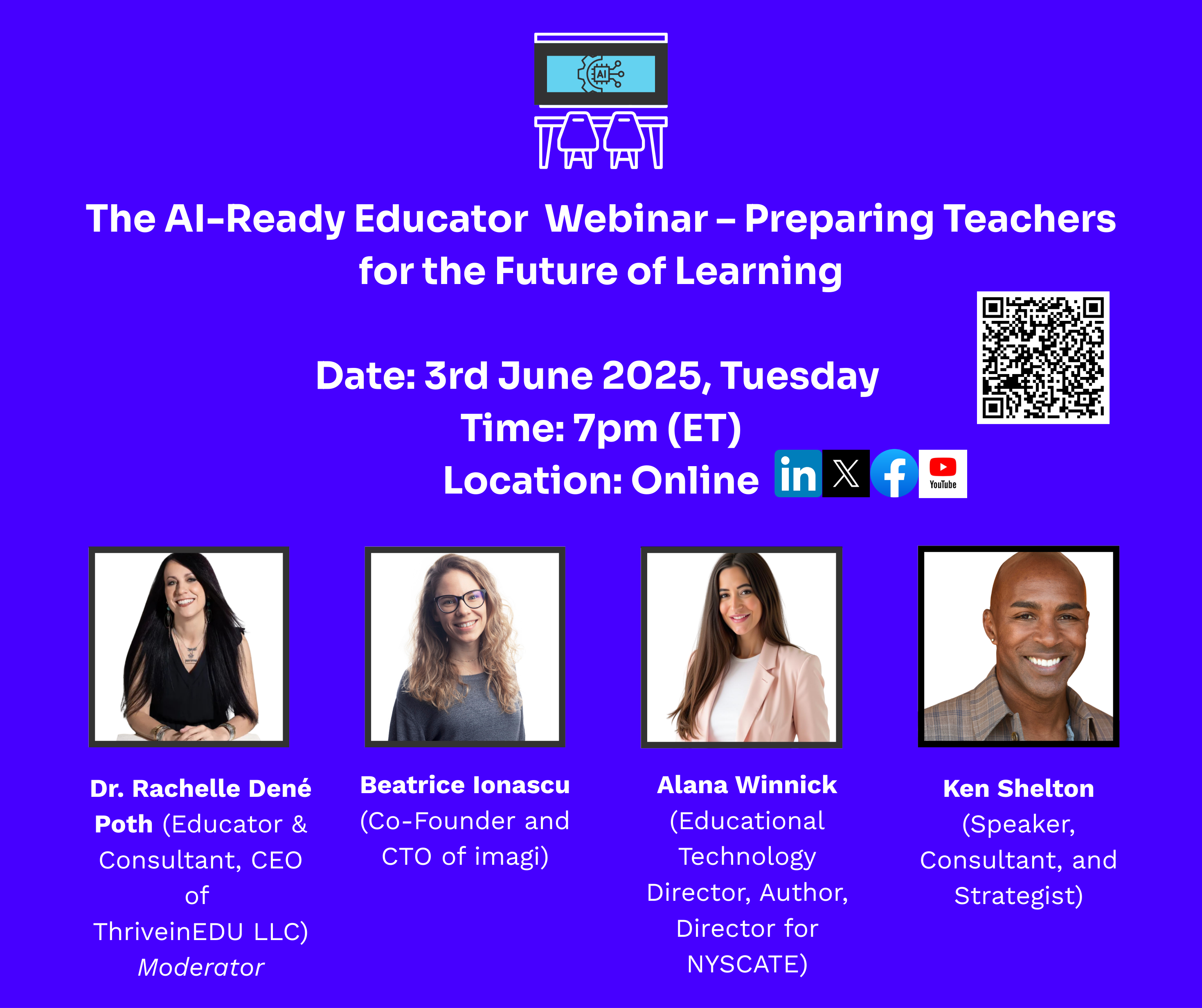
Imagi Webinar: AI-Ready Educators: Preparing Teachers for the Future of Learning

We had a great turnout for our recent webinar and a great panel! Read more here and check out the recording.

Artificial Intelligence is no longer a concept for the future—it’s transforming classrooms everywhere. The sudden and widespread availability of powerful AI tools has left many educators with a mix of excitement and apprehension. How can we, as educators, prepare our students for an AI-driven future? How do we harness the potential of these tools while carefully and consistently navigating their pitfalls?

These were the central questions addressed in a recent webinar, “The AI-Ready Educator: Preparing Teachers for the Future of Learning,” hosted by ThriveinEDU and Imagi-Labs. The session brought together a panel of experts, including educator, author, and attorney, Dr. Rachelle Dené Poth, who moderated a powerful conversation with panelists Alana Winnick, Beatrice Ionascu, and Ken Shelton about the intersection of computer science, computational thinking, AI, and ethics in modern education.

“We’re not here because we’re experts—we’re here because we’re learners,” said Poth, who has spent the past eight years working with AI in education. “This is a conversation. We’re figuring it out together.” This insightful conversation provided a roadmap for educators looking to become AI-ready.

Understanding the Fundamentals

Before exploring the practical applications of AI in the classroom, it’s essential to understand what AI is. As Beatrice explained, AI systems are designed to perform tasks that typically require human intelligence, such as pattern recognition, language processing, and decision-making, all of which are fueled by data. Ken Shelton further clarified that ‘not all AI is the same,” breaking it down into three types: reactive, predictive, and generative. While we’ve been interacting with reactive AI (like spell check and email spam filters) and predictive AI for years, it’s the recent explosion of generative AI that has captured our collective attention.

Understanding these distinctions is the first step toward developing a nuanced approach to AI in education. A blanket policy to “block all AI,” as Ken pointed out, is not only impractical but also counterproductive, as it would mean eliminating tools we rely on daily. Instead, the focus should be on using these systems effectively and responsibly.

From Educators to Empowerers

The panel opened with introductions from four leaders who are not only immersed in educational innovation but also actively working to shape its future.

Alana Winnick, Educational Technology Director and Data Protection Officer at Pocantico Hills Central School District in New York, emphasized the need for purpose-driven integration of AI. “I also started a program called Students for Innovation, which empowers students to advocate for change in their schools,” she shared. With a book and podcast on generative AI, Winnick has centered her work on amplifying student voices in tech spaces.

Beatrice Ionascu, co-founder and CTO of Imagi, echoed the importance of inspiring student curiosity. “I truly believe that technology education is the key to creating a better world,” she said. “At Imagi, our mission is to make computer science and AI literacy as essential and accessible as reading and math.” With a background in engineering, product design, and education, she brings a unique perspective to building tools that connect students, especially girls, to technology through creative coding.

The Imperative of AI Literacy

A recurring theme throughout the discussion was the concept of “AI literacy.” Ken Shelton offered a comprehensive definition: “AI literacy means knowing, understanding, and using AI in smart and safe ways. It helps people ask good questions about how AI works, how it helps or hurts others, and how it can change or impact the world around us.”

Alana Winnick provided a practical framework for fostering AI literacy in students, assigning them two critical roles: the “detective” and the “DJ”. As detectives, students must be on the lookout for bias and misinformation, understanding that AI is not a magical, infallible source of truth. This is a crucial skill, especially in a world where AI-generated content can be convincingly inaccurate. As DJs, students are encouraged to “remix” AI-generated content, infusing it with their own thoughts, ideas, and voice, ensuring that their work remains a reflection of their own learning and creativity.

The Irreplaceable Human Element

One of the most pressing concerns for educators is the fear that AI will render their roles obsolete. The panelists, however, were unanimous in their belief that the human element in teaching is not only irreplaceable but will become even more critical in an AI-integrated world. Beatrice painted a stark picture of a “dystopic future” where learners are isolated with machines, a vision that underscores the fundamental need for human connection in education.

Ken Shelton passionately argued that AI cannot and should not replace the meaningful interactions that are the bedrock of effective teaching and learning. He cautioned against “cognitively offloading” the human aspects of education to AI, emphasizing that these systems don’t know our students’ individual needs, dreams, and challenges. Alana added that AI, when used thoughtfully, can actually enhance the human element by automating tedious tasks, freeing up teachers to focus on what they do best: building relationships, fostering a positive classroom culture, and providing individualized support. Poth agreed that when using AI in her classroom, she guides students on how to use it for enhancing learning and engages in more conversations and interactions with students because of the time that can be saved when using these tools.

The Role of Computational Thinking

While discussing AI and various important topics, we also emphasized the importance of computational thinking (CT) as a foundational skill for AI readiness. CT includes logic, pattern recognition, decomposition, and abstraction—core elements that help students understand how computers “think” before they ever write a line of code.

Panelists agreed that you can’t fully understand AI without understanding the process of problem-solving that goes into it. Computational thinking is the gateway to coding and beyond.

Winnick added, “We’re seeing kids jump straight to AI tools, but they still need to understand how algorithms are structured, how data works, and how to identify problems worth solving. AI doesn’t replace thinking—it amplifies it when used responsibly.”

AI as a Tool for Creation—not Just Consumption

One key takeaway was that AI should be positioned as a tool that supports students as creators, not just consumers. This shift requires educators to rethink traditional computer science instruction.

“We want students to code, but also to see how AI can help them prototype faster, solve problems differently, or iterate creatively,” Ionascu explained. “That’s why we need to teach both the fundamentals and how to critically use AI tools.”

The panel discussed how students can use AI to generate code, explore new ideas, or debug faster—but only if they’ve first learned the structure and logic of programming.

Ethics Must Be Front and Center

Beyond skills and tools, panelists emphasized that students need to learn how to use AI responsibly, and this starts with intentional discussions about ethics.

“We can’t wait until something goes wrong to start talking about ethics,” said Winnick. “Students need to understand bias, privacy, and the societal impact of AI from the beginning.”

Ionascu added, “In our work at Imagi, we try to normalize conversations about ethics early on. It’s not a separate unit—it’s woven into every experience with technology. Students should be asking, ‘What could go wrong?’ Who is this helping? Who might it harm?”

Shelton also highlighted the role of educators in modeling ethical inquiry. “We don’t need to have all the answers, but we do need to show students how to ask the right questions.” Shelton’s work related to equity is well-known,  and his book “The Promises and Perils of AI in Education: Ethics and Equity Have Entered The Chat,” which he co-authored with Dee Lanier, is a great resource for educators.

Practical Strategies for Educators

The webinar also offered classroom-ready strategies to help educators bridge the gap between foundational computer science and AI-enhanced learning:

  1. Use block-based coding (like Scratch or Imagi) to introduce logic before jumping into text-based languages.
  2. Incorporate AI exploration tools (such as ChatGPT or Google’s Teachable Machine) to show how models are trained.
  3. Encourage journaling or reflection prompts about ethical dilemmas related to AI tools.
  4. Introduce AI early, but always in tandem with skill-building and reflection.

Poth emphasized, “It’s not about having a perfect curriculum. It’s about giving students opportunities to explore, experiment, and reflect.”

Preparing Educators to Prepare Students

At its core, the panel’s message was clear: educators themselves must become AI-literate if they’re going to prepare students for an AI-driven world.

“We have to do the work of learning ourselves,” said Winnick. “That means experimenting with tools, joining communities, reading critically, and being honest with students when we don’t know something yet.”

Ionascu reinforced this, noting that teacher curiosity is contagious. “When students see educators exploring and asking thoughtful questions, it empowers them to do the same.”

As the conversation closed, panelists left attendees with words of encouragement: It is an opportunity to rethink what we teach, how we teach it, and how we prepare students to lead in the future.

The message of the evening was one of hope, responsibility, and action. As AI continues to evolve, so too must our approach to teaching. By grounding our work in computational thinking, ethical reasoning, and curiosity, we can help students not only adapt to the future but shape it. To learn more about the panelists, see below the video. To sign up for our next webinar, register here.

Contact Information:

Consulting Dr. Rachelle Dené Poth: bit.ly/thriveineduPD

X, Instagram, Bluesky: @Rdene915 

LinkedInhttps://www.linkedin.com/in/rachelledenepoth/ 

Website/blog: www.Rdene915.com 

Relevant book: How To Teach AI 

LinkedIn: Beatrice Ionascu

Imagi Labs

Alana Winnick 

AlanaWinnick.com

GenerativeAge.com

Studentsforinnovation.org

Relevant book:  Generative AI

Ken Shelton 

LinkedIn https://www.linkedin.com/in/kenashelton/ 

Twitter  https://x.com/k_shelton 

Website https://kennethshelton.net/ 

Book The Promises and Perils of AI in Education: Ethics and Equity Have Entered The Chat.”

About Rachelle

Dr. Rachelle Dené Poth is a Spanish and STEAM: What’s Next in Emerging Technology Teacher at Riverview High School in Oakmont, PA. Rachelle is also an attorney with a Juris Doctor degree from Duquesne University School of Law and a Master’s in Instructional Technology. Rachelle received her Doctorate in Instructional Technology, and her research focus was on AI and Professional Development. In addition to teaching, she is a full-time consultant and works with companies and organizations to provide PD, speaking, and consulting services. Contact Rachelle for your event!

Rachelle is an ISTE-certified educator and community leader who served as president of the ISTE Teacher Education Network. By EdTech Digest, she was named the EdTech Trendsetter of 2024, one of 30 K-12 IT Influencers to follow in 2021, and one of 150 Women Global EdTech Thought Leaders in 2022.

She is the author of ten books, including ‘What The Tech? An Educator’s Guide to AI, AR/VR, the Metaverse and More” and ‘How To Teach AI’. In addition, other books include, “In Other Words: Quotes That Push Our Thinking,” “Unconventional Ways to Thrive in EDU,” “The Future is Now: Looking Back to Move Ahead,” “Chart A New Course: A Guide to Teaching Essential Skills for Tomorrow’s World, “True Story: Lessons That One Kid Taught Us,” “Things I Wish […] Knew” and her newest “How To Teach AI” is available from ISTE or on Amazon.

Contact Rachelle to schedule sessions about Artificial Intelligence, Coding, AR/VR, and more for your school or event! Submit the Contact Form.

Follow Rachelle on Bluesky, Instagram, and X at @Rdene915

**Interested in writing a guest blog for my site? Would love to share your ideas! Submit your post here. Looking for a new book to read? Find these available at bit.ly/Pothbooks

************ Also, check out my THRIVEinEDU Podcast Here!

Join my show on THRIVEinEDU on Facebook. Join the group here.

Address the “WHY,” not the “HOW.”

Guest post written By: Maurie Beasley, M.Ed. Counseling (Edited by Jim Beasley)

A student deciding what path to take. To cheat or not to cheat.

Cheating in school — it’s the topic that’s always been there, lurking in the shadows of every classroom and exam hall. For decades, we’ve known it happens, but we often look for the quickest explanation: students are lazy, technology makes it easier, end of story. But here’s the thing: cheating is not just a modern phenomenon, nor is it just about slacking off or taking advantage of new tools like AI. The real reasons why students cheat run much deeper, and if we’re serious about addressing the issue, we need to understand those reasons first.

Let’s be clear: cheating isn’t just some bad habit students picked up recently. It’s been around long before ChatGPT was on the mind of any engineer. And despite the attention AI has brought to the issue, the reasons students cheat are essentially the same as they’ve always been. So why does it persist, and what can we do about it? Let’s take a closer look at these reasons.

Pressure to Perform:

Students today are walking a tightrope, balancing academic expectations, extracurricular activities, and even part-time jobs. The pressure to perform is immense, and it’s no surprise that some students feel they can’t afford to fall.

Let me tell you about my daughter. She was the salutatorian of her high school class. She missed being valedictorian by a hair — a hair that could have been as little as a hundredth of a point. The only B she ever received was from a teacher who told her that grades don’t matter. Her response? “Great, then give me the one point I need to make an A in the class, or better yet, write me a letter explaining to the admissions board at UT Austin that grades don’t matter and being number 2 in my class is ok.” She knew that being valedictorian meant having your first year of college paid for in Texas. My daughter is honest, sometimes to a fault, but several times I was even tempted to tell her to “cheat” a little. That’s the kind of pressure students are under, and when the stakes are this high, cheating may seem like a way to stay on that tightrope, even if just barely.

Fear of Failure:

Beneath that pressure lies an even more pervasive issue: fear of failure. The fear of letting down parents, teachers, and even themselves can be overwhelming. When failure isn’t seen as an opportunity to learn but rather as a personal catastrophe, cheating becomes a tempting escape route. It’s not about cutting corners for the sake of it; it’s about avoiding the crushing weight of perceived inadequacy.

Beneath that pressure lies an even more pervasive issue: fear of failure. The fear of letting down parents, teachers, and even themselves can be overwhelming. When failure isn’t seen as an opportunity to learn but rather as a personal catastrophe, cheating becomes a tempting escape route. It’s not about cutting corners for the sake of it; it’s about avoiding the crushing weight of perceived inadequacy.

And this fear isn’t just hypothetical. As a counselor, I’ve seen it manifest in tragic ways. I’ve had to make Child Protective Service calls because parents have beaten their children for not performing well enough in school. When failure comes with such dire consequences, is it any wonder some students feel they have no choice but to cheat?

Read the full article on Medium*: [Address the Why, Not the How](https://medium.com/@jim0237/address-the-why-not-the-how-1a7e01d52d56

About Rachelle’s blog

Contact Rachelle to schedule sessions about Artificial Intelligence, AI and the Law, Coding, Cybersecurity, STEM, and more for your school or event! Available for in-person or virtual training, keynotes, and coaching. Submit the Contact Form.

Follow Rachelle on Twitter(X) and Instagram at @Rdene915

**Interested in writing a guest blog for my site? Would love to share your ideas! Submit your post here. Looking for a new book to read? Find these available at bit.ly/Pothbooks

************ Also, check out my THRIVEinEDU Podcast Here!

Join my show on THRIVEinEDU on Facebook. Join the group here.

Tips for Back-to-School

As we head back into our classrooms for a new school year, educators are thinking about class schedules, grading, lesson plans, school meetings, observations, and so much more. Getting back into the daily teaching schedule can be a challenge, especially after having the summer “off.”

However, many educators don’t take the summer off. Instead, they take advantage of the extra time to engage in professional learning. Whether by attending conferences, joining book studies, participating in online learning events, or even heading to their classroom to prepare for the new school year, being prepared for school is always on teachers’ minds. Having the summer off, even if only for a few weeks, is nice because it provides time to relax and recharge and also time to be better prepared than the year before.

No matter how many years of experience an educator has, a new school year can be stressful. I think it is important to start the year with goals and use our prior experiences to set clear focus points for ourselves and our students.

For many years, I remember conversations with colleagues about how they couldn’t sleep the night before the first day of school. Attributing it to being excited and nervous about starting a new school year and doing it right. In my experience, I always slept well and never really worried about being prepared for the first day of school. For me, it was always the second day and every day after that. For me, the first day of school was simply the time to introduce myself to students, talk about what they could expect in my class, and provide any materials they needed to take home for their families. I started each year with rules and procedures. Unfortunately, I did not realize that the content could wait. I should have placed more importance on creating a supportive classroom community and focusing on building relationships first. Now that I know better before the year starts, there are some questions that I ask myself:

Did I reflect enough on my teaching practice, and have I identified areas I want and need to work on?

Am I prepared with new ideas, whether different methods or digital tools, to bring into my classroom to help engage students in learning?

What are some ways that we can build relationships and get to know one another?

How can I create a welcoming classroom space that fosters creativity and curiosity for learning?

Many more questions cross my mind and likely cross the minds of educators everywhere. It comes down to thinking about and reflecting on what we learned about our practice and methods used during the past school year. What activities and methods have made an impact not only on student learning but also on building essential social-emotional learning (SEL) skills? Which methods or tools helped students feel more connected with their classmates and the content? Cultivating a learning environment where students have choices, feel comfortable, and become more confident amplifies their learning potential. It leads to a supportive classroom community.

As we head into a new school year, it is always the perfect time to try a few new ideas and see how the students respond and the impact on learning and then decide where to go from there. Teaching the content material is important, but finding ways to boost student engagement and foster the development of essential SEL skills is also important. With so many things to consider, I am choosing five focus points for starting the new school year:

  • Build Relationships: Starting on day one, we need to get to know our students and let them get to know us, too. When we create opportunities for students to connect with each other and build a collaborative and supportive space, we will see how it positively impacts the learning that happens in our classroom. By starting with relationship building, we will create a space where students feel comfortable making mistakes and know they are supported by us and their peers. Creating a comfortable, supportive space is essential for learning. Have students create an “About Me” or use icebreakers to get to know each other and make sure that you participate too.
  • Set goals and reflect: At the start of the school year, have students set some goals for themselves in your class. Not just students it’s also important that we set goals for ourselves and share them with our students. When we do this together, we hold each other accountable and provide the support that we all need in our classroom space. We know the importance of SEL and by setting goals and reflecting on them throughout the year, we will be focusing on self-awareness and self-management in particular, which are essential for student learning and being prepared for the future. Provide some questions for reflection, such as: How do I think it went? What would I change? Are there areas that I can improve upon?
  • Create a community: Students need to know how to access resources for the class and to be able to connect with the teacher and classmates. It is important to set up a space or have a system for being able to communicate with students. Sending an email every Friday with a recap of the week, using a messaging app, or designing a class website are all good ways to create a learning community. Having a space where students can interact and access the resources they need to be successful is important, and we have definitely learned how essential it is after our experiences over the past couple of years. Another thing to consider is how to involve students more in the design of the learning experiences in the classroom and have them truly be a part of the learning community.
  • Promote collaboration: In preparing students for the future, we know that one of the essential skills they need is the ability to communicate and collaborate with others. Students need opportunities to do this in the classroom as well as in a virtual space. Using different methods, like station rotations, where students can work with peers, or through digital tools like Padlet, we can promote collaboration. Students can build content area skills while also building digital citizenship skills and SEL skills.
  • Foster creativity and curiosity for learning: When we create a learning environment where students feel welcomed and supported, they will feel more comfortable participating in class activities, interacting with their peers, and taking risks with learning. Provide students with different choices for creating and sharing what they have learned. Use methods like Genius Hour or PBL to spark curiosity and promote student-driven learning. Offer choices in digital tools that foster creativity, such as Book Creator, Canva, Genially, Storybird or Storyboard That.

Start the year with some focus areas and involve students in the discussion. Get their feedback, ask for ideas, and enjoy the learning process together. Don’t be afraid to take some risks with new ideas or tools. With new ideas, we can boost student engagement and creativity, spark curiosity for learning, and student needs and interests are better met.

About the Author:

Dr. Rachelle Dené Poth is a Spanish and STEAM: What’s Next in Emerging Technology Teacher at Riverview High School in Oakmont, PA. Rachelle is also an attorney with a Juris Doctor degree from Duquesne University School of Law and a Master’s in Instructional Technology. Rachelle received her Doctorate in Instructional Technology, and her research focus was on AI and Professional Development. In addition to teaching, she is a full-time consultant and works with companies and organizations to provide PD, speaking, and consulting services. Contact Rachelle for your event!

Rachelle is an ISTE-certified educator and community leader who served as president of the ISTE Teacher Education Network. By EdTech Digest, she was named the EdTech Trendsetter of 2024, one of 30 K-12 IT Influencers to follow in 2021, and one of 150 Women Global EdTech Thought Leaders in 2022.

She is the author of nine books including ‘In Other Words: Quotes That Push Our Thinking,” “Unconventional Ways to Thrive in EDU,” “The Future is Now: Looking Back to Move Ahead,” “Chart A New Course: A Guide to Teaching Essential Skills for Tomorrow’s World, “True Story: Lessons That One Kid Taught Us,” “Things I Wish […] Knew” and her newest “How To Teach AI” is available from ISTE or on Amazon.

Contact Rachelle to schedule sessions about Artificial Intelligence, Coding, AR/VR, and more for your school or event! Submit the Contact Form.

Follow Rachelle on Twitter(X) and Instagram at @Rdene915

**Interested in writing a guest blog for my site? Would love to share your ideas! Submit your post here. Looking for a new book to read? Find these available at bit.ly/Pothbooks

************ Also check out my THRIVEinEDU Podcast Here!

Join my show on THRIVEinEDU on Facebook. Join the group here.

The Truth About Learning Styles

Guest Post by Grace Coderre, Renee Graczyk, Lucy Vician

Opinions expressed are those of the authors

“Learning styles” is a concept that perpetuates the idea that certain individuals learn better when information is presented in their preferred style of learning (e.g., visual, auditory, kinesthetic). Diagnosing and presenting information according to learning styles has been a prominent practice in K-12 through higher education learning environments for years. There is also a thriving industry devoted to producing learning styles materials, including learning style tests, guidebooks, and workshops, all designed to assist educators in understanding and effectively teaching to students based on their specific style.

Upon copious research, we have concluded that learning styles lack credible validity and should not continue in educational settings. There are serious implications from accepting learning styles as fact. First of all, schools are wasting valuable and limited time and resources dedicating their practice to this misconception. Teachers spend precious time and effort catering to children’s learning styles when they could otherwise be implementing strategies scientifically proven to help students learn. The use of learning styles also limits student’s ability to overcome obstacles and develop a growth mindset, a crucial aspect of resilience. Students who are taught and believe that they can only learn through one style may reject instruction that does not reflect their chosen mode.

Learning styles are commonly chosen based on the individual’s perceived favorable mode of receiving information. However, this self-report may not be accurate and neglects to address the issue that one learning style may not be applicable to the multitude of modes needed to teach the variety of subjects mandated by the curriculum. The fact stands that the modes of teaching are dictated by the subject being taught. For example, students who are being taught geography will benefit from visually seeing a map in order to understand the content. Self-proclaimed “auditory learners” will not better understand geography based on an auditory explanation of the content (Marshik, 2015).

One of the main issues with the concept of learning styles is that it does not encourage students to struggle with learning in different ways. In reality, students need to be able to adapt to learning in different ways. Students will face a diverse set of lessons in their schooling that use different modes of learning. At some point, students will come face to face with lessons that need them to focus on being kinesthetic, auditory, visual, or tactile learners, either individually or all at the same time. The joy of learning and education is that you can do it in so many ways, which begs the question of why are we subjecting students to only focus on one type? Instead of spending so much time on having students figure out which learning style suits them best and altering lessons to fit those results, teachers should aim to help students embrace all styles while keeping an open mind.

Theresa LeBlanc from Texas University did a study on this subject and concluded that “teaching students the cognitive processes and skills involved in learning—those strategies that help learners think, solve problems, and create meaning—can similarly empower students, not with a false sense that one can learn only one or two ways, but with an understanding that learning is multifaceted, reflecting different combinations of learning abilities that make us effective in different ways” (LeBlanc, 2018, p. 39).

Students will be much more effective learners if they can adapt to any style of teaching and learning. Teachers can promote this idea of learning style flexibility while also celebrating student differences. While learning styles don’t have sufficient evidence, it is true that students learn best in different ways. Teachers can help students notice these differences and embrace them as a way to celebrate the uniqueness of learning. This is a much better use of time and resources in school than promoting an idea that has no adequate evidence to back it up.

But why has this educational myth persisted for so long, and more importantly, how can we, as future teachers, examine popular teaching approaches through a critical lens? Researchers, including Riener and Willingham (2010), believe that the confirmation bias has given us reason to believe that one learning style works best for everyone. Reiner and Willingham stated that “when evaluating our own beliefs, we tend to seek out information that confirms our beliefs and ignore contrary information, even when we encounter it repeatedly. When we see someone who professes to be a visual learner excel at geography and an auditory learner excel at music, we do not seek out the information which would disprove our interpretation of these events” (p. 35). These scholars believe that, in order to critically examine popular teaching approaches which might not be based in evidence, or even worse, might be harming our students’ learning, we need to be able to challenge our existing beliefs rather than accept what others say at face value.

Author Bios:

Grace Coderre is majoring in Early Childhood Education and minoring in Psychology at the University of Massachusetts Amherst.

Renee Graczyk is a third year student at the University of Massachusetts Amherst, majoring in Early Childhood Education and minoring in Psychology.

Lucy Vician is majoring in Early Childhood Education and minoring in Psychology at the University of Massachusetts Amherst.

About Rachelle’s blog

Contact Rachelle to schedule sessions about Artificial Intelligence, Coding, AR/VR, and more for your school or your event! Submit the Contact Form.

Follow Rachelle on Twitter(X) and Instagram at @Rdene915

**Interested in writing a guest blog for my site? Would love to share your ideas! Submit your post here. Looking for a new book to read? Find these available at bit.ly/Pothbooks

************ Also check out my THRIVEinEDU Podcast Here!

Join my show on THRIVEinEDU on Facebook. Join the group here

References

LeBlanc, T. (2018). Learning styles: Academic fact or urban myth? A recent review of the literature. Journal of College Academic Support Programs, 1(1), 34–40. https://doi.org/10.36896/1.1fa4

Marshik, T. (2015). Learning styles and the importance of critical self-reflection [Video]. TEDxTalk. https://www.youtube.com/watch?v=855Now8h5Rs

Reiner, C. & Willingham, D. (2010). The myth of learning styles. Change,

42(5), 32–35. http://www.jstor.org/stable/25742629

Empowering Teachers with Conversational AI

In collaboration with Kyron Learning, All opinions are my own

As educators, we have access to a wide variety of digital tools to bring into our classrooms. We use these to enhance learning and provide new opportunities for students to build content knowledge, as well as help them to develop essential digital skills. With the right methods and tools, educators are able to achieve the goal of providing the most authentic, meaningful, and personalized learning experiences for all students. Leveraging these resources helps us to do this more efficiently and effectively and enables us to provide timely feedback and support to our students.

Now, with the power of generative AI, there are even more valuable resources available for educators to bring into their classrooms. We can use these tools to enhance the content being taught and also to support students so they learn how to interact with AI responsibly and safely.

Kyron Learning is a revolutionary interactive video learning platform that leverages conversational AI to transform the way educators can support their students. Kyron empowers teachers by saving them time, personalizing instruction, and providing valuable student data. With Kyron, students have access to a personal tutor who works with them as they build their skills in an engaging space. The power of AI helps teachers create interactive lessons that are student-paced and student-focused. As students work through a lesson, it truly feels like a one-on-one tutoring session with a real teacher. Students can ask and respond to questions, engage in further discussions, and receive immediate feedback, all made possible by Kyron’s AI assistant. The “conversational engine” listens to the student’s responses and selects the most appropriate pre-recorded video segment to play next. When you try a Kyron lesson for the first time, you will be amazed at how well it flows!

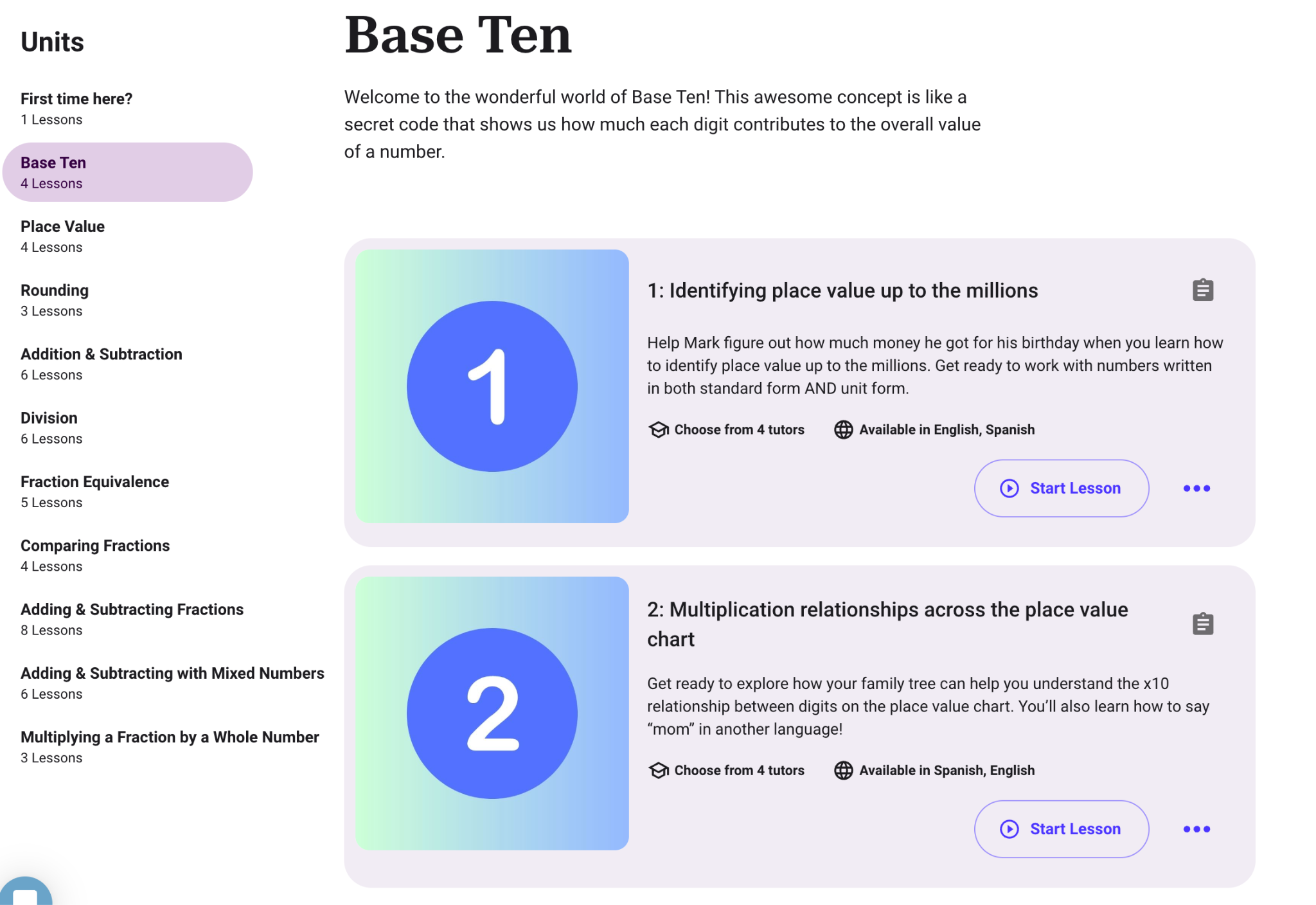
Using Kyron, teachers can provide additional opportunities for students that give them more individualized learning experiences. It is easy to get started by simply choosing from the many lessons already available for students. Are you teaching math? Explore the lessons available such as “Base Ten,” “Place Value,” or “Comparing Fractions.” You will see the objectives, the number of lessons, and the languages available. You can even choose your tutor! With Kyron, teachers also have access to resources such as blogs and other materials to get them started!

Kyron Studio

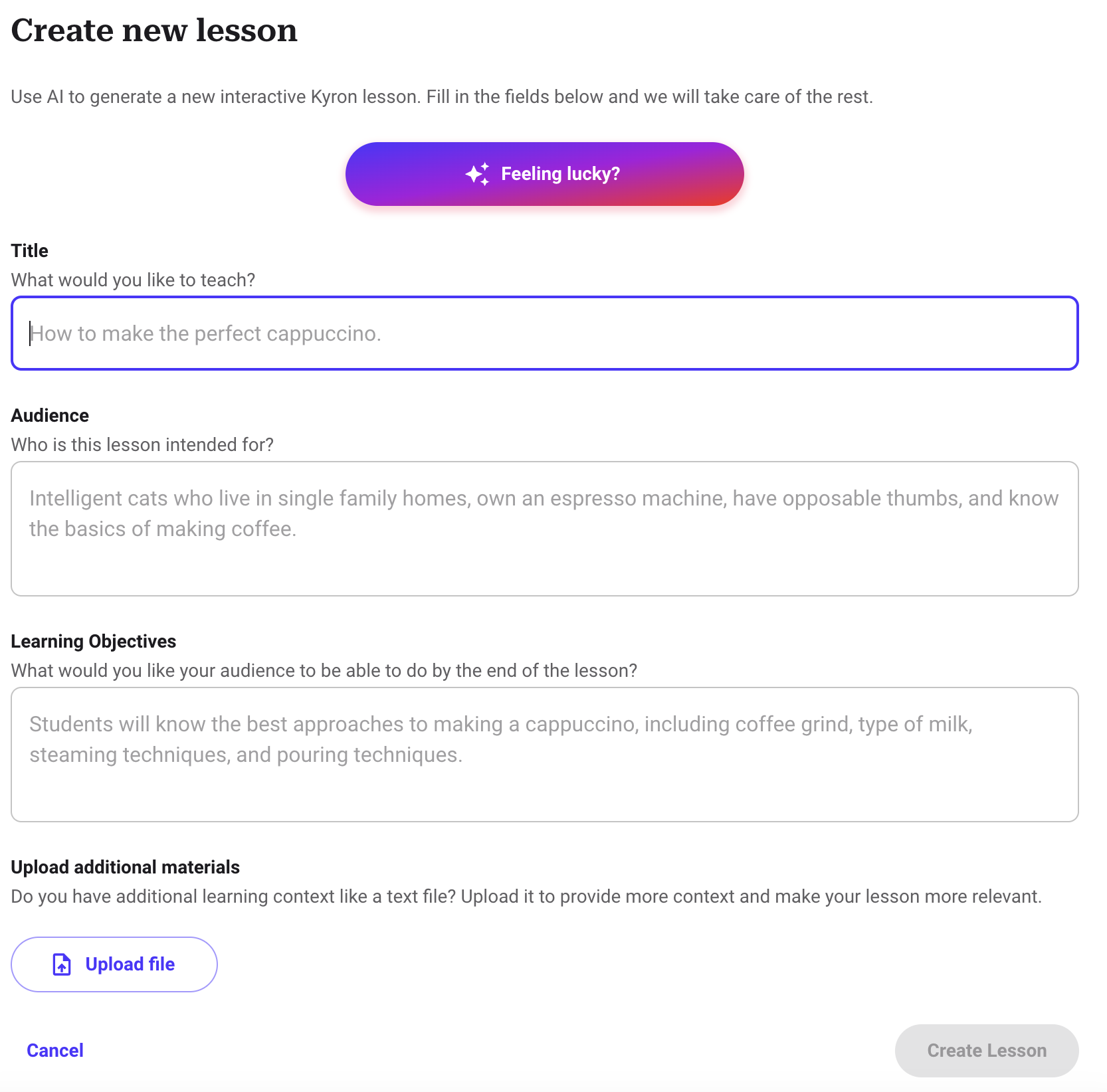
Newly available in March, teachers can now create their own lessons for students using Kyron Studio! In addition to what Kyron already provides, with Kyron Studio, teachers can become AI tutors! Educators are also able to share and collaborate on lessons, leveraging the collective expertise of the teaching community. In Kyron Studio, teachers can design multi-modal AI-facilitated tutoring sessions for their students and make them even more personalized.

The sessions can be customized based on each teacher’s curriculum and include videos and visuals. It is a learning experience that engages and helps every learner to understand a concept in an authentic way and at their own pace.

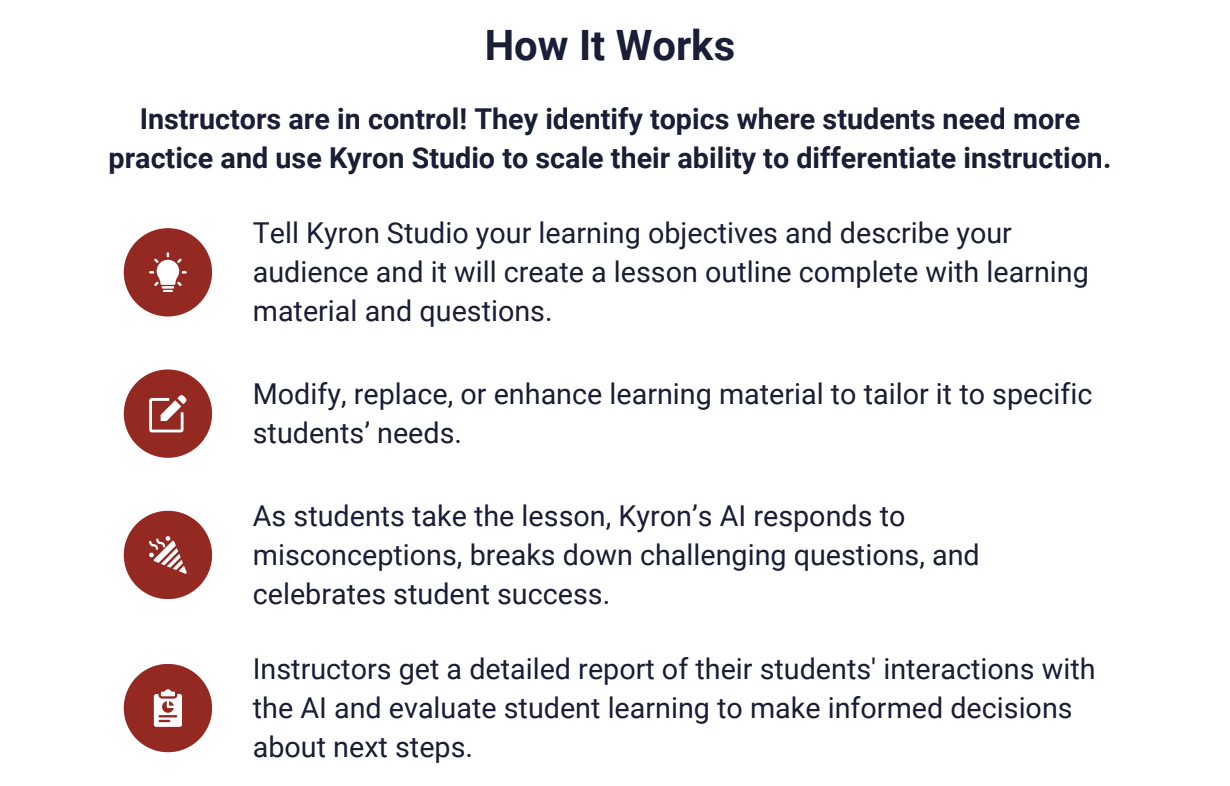
Getting started with Kyron Studio is easy! You simply enter your objectives and provide relevant information about your learners, and a lesson outline with materials and questions will be generated. Once the lesson is generated, teachers can make any changes to the AI-generated content.

Learning with Kyron is fun!

As students work through lessons, they experience those “aha” moments when they finally understand something, and you can see their excitement! It is an engaging learning experience for students and one that also teaches them about purposeful and safe uses of AI. It benefits teachers because they can see students’ progress and support them right when they need it! While we all know technology can’t replicate the relationships between a teacher and a student, Kyron aims to also provide a supportive digital environment where students feel seen and valued.

I worked through several lessons and really enjoyed the experience. It was very different from other interactive lessons and platforms that place students in the lead. To start, I spent time selecting a lesson to dive into and then was surprised that I was able to choose my tutor! I enjoyed testing how my tutor would respond to my answers and questions. I told my tutor that I was confused, entered incorrect answers, and asked for help and more clarification. Each time it responded to me in such a personalized way that helped me to understand. If I got an answer wrong, my tutor provided me with an explanation or another example. It was amazing to see how well it responded to my questions and adjusted similarly to how a teacher would with students in the classroom.

Some of the great features of Kyron are:

Multimodal Learning: Lessons can incorporate videos, images, and text, catering to diverse learning preferences and creating a more engaging experience.

Easy Lesson Creation: Kyron Studio offers an automated and user-friendly interface for educators to build custom AI-powered tutoring sessions.

Educator Choice: Educators control lesson content, can upload their own visuals, and curate the questions and answers, which makes it more authentic for students.

Assessment and Misconception Detection: Kyron identifies student misconceptions during lessons, providing valuable insights for educators to personalize and target instruction.

Focus on Safety and Ethics: Kyron prioritizes student safety by implementing controls and moderation layers to prevent inappropriate interactions.

Commitment to Transparency: User data is anonymized and used ethically to enhance the platform.

Supporting Educators and Students

In an increasingly digital world, especially with the rapid advancements in AI, what I value about Kyron is its approach when it comes to the use of AI and the creation of this platform. The key principles are:

  • Connect, Engage, Encourage: When students complete a lesson, they are supported and receive encouraging feedback during their learning journey.
  • Teach Through Dialogue: The lessons are interactive and fun for students to complete because they are involved in a conversation. Through prompts that promote critical thinking and problem-solving, students can build their skills in ways that meet their pace and specific needs.
  • Work in Concert with Teachers: Kyron provides high-quality, differentiated curriculum and gives teachers access to real-time student progress data. It helps teachers to target instruction and personalize instruction for every student.

There are so many great lessons available to start with, or just dive in and create your own lesson in very little time. I definitely recommend that you try some lessons to experience how unique Kyron is.

Ready to transform your classroom and empower your students? Visit Kyron Learning today at http://app.kyronlearning.com and see how Kyron can help you create a personalized and engaging learning experience for all students!

And if you want to learn more and connect with other educators, Kyron just launched a community for educators called the Visionaries! Educators can join at www.kyronlearning.com/visionaries. Explore the great resources such as tutorials and more!

About the Author:

Rachelle Dené is a Spanish and STEAM: What’s Next in Emerging Technology Teacher at Riverview High School in Oakmont, PA. Rachelle is also an attorney with a Juris Doctor degree from Duquesne University School of Law and a Master’s in Instructional Technology. Rachelle is currently finishing her doctorate with a focus on AI and Professional Development. In addition to teaching, she is a full-time consultant and works with companies and organizations to provide PD, speaking, and consulting services. Contact Rachelle for your event!

Rachelle is an ISTE-certified educator and community leader and served as president of the ISTE Teacher Education Network. She was named one of 30 12 IT Influencers to follow in 2021 and one of 150 Women Global EdTech Thought Leaders in 2022.

She is the author of eight books including ‘In Other Words: Quotes That Push Our Thinking,” “Unconventional Ways to Thrive in EDU,” “The Future is Now: Looking Back to Move Ahead,” “Chart A New Course: A Guide to Teaching Essential Skills for Tomorrow’s World, “True Story: Lessons That One Kid Taught Us,” and her newest book “Things I Wish […] Knew” is now available at bit.ly/thingsiwishedu.

Contact Rachelle to schedule sessions about Artificial Intelligence, Coding, AR/VR, and more for your school or your event! Submit the Contact Form.

Follow Rachelle on Twitter(X) and Instagram at @Rdene915

**Interested in writing a guest blog for my site? Would love to share your ideas! Submit your post here. Looking for a new book to read? Find these available at bit.ly/Pothbooks

************ Also check out my THRIVEinEDU Podcast Here!

Join my show on THRIVEinEDU on Facebook. Join the group here

10 High-Impact Instructional Strategies Instructional Leaders and Coaches Can Support Teachers With That Make a Huge Difference in Student Learning

Guest post byMatthew Rhoads, Ed.D. @MattRhoads1990

As instructional leaders and coaches, we have the incredible opportunity to elevate the effectiveness of teaching and cultivate a culture of continual growth in our schools. Embracing the new school year, review an array of high-impact instructional strategies that can truly ignite learning experiences within our classrooms. Each strategy presented in this post is accompanied by a practical application that can readily inspire teachers through an example and how coaches can support teachers in implementing these research-based strategies in their classrooms. Our mission is to empower teachers to incorporate these strategies into their lessons while providing them with supportive coaching along the way to build their confidence and instructional toolkit.

As a coach, focus on three to five of these strategies to start. Then, when you are on a coaching cycle with a teacher, focus on ONE of these strategies during a single coaching cycle interval. Additionally, each of these strategies can be done with or without technology integrated. It will depend on whether the lesson requires technology or if a teacher deems that technology may provide more opportunities for students to take in the content and skills learned to then put them into action in demonstrating their learning in a formative manner and summatively.

As instructional leaders and coaches, we hold the power to transform teaching and learning in our schools along with our teachers. By embracing these high-impact research-based instructional strategies throughout our classrooms, we can ignite profound learning experiences and cultivate a culture of growth in our classrooms for our students. Explore each strategy, classroom example, and coaching example to inspire and empower your work as you move into this school year!

Definition: Providing students with immediate and regular feedback aimed at effort, improvement, and mastery rather than relative performance. It involves both teacher and peer assessments. It can be done throughout an entire class session with formative assessment. Note: Be sure to provide feedback in a way that requires students to use the feedback in action as feedback without deliberate action of implementing the feedback is not as effective.

Classroom Example: In a science class, a teacher addresses a student’s misunderstanding about a chemistry concept right away during guided practice as the teacher presents the content during an interactive Pear Deck presentation as it embeds formative assessment throughout the presentation, instead of waiting until the end of the lesson. Additionally, key items from the lesson can be assessed when a teacher uses exit tickets to assess students’ grasp of the concept, providing opportunities for reteaching where necessary for the next time they will be focused on the content from this lesson.

Coaching Tip: Coaches can assist teachers in creating effective feedback mechanisms such as templates of interactive presentations, rubrics, and exit tickets. They can model through co-teaching or teach a lesson sequence with the teacher observing how to provide immediate, growth-focused feedback and how to structure peer assessments effectively.

Strategy 2: Retrieval Practice Techniques to Support Memory Recall

Definition: These techniques involve regular use of recall-based activities that enhance the retention and application of previously learned information. This can look like flashcards, formative assessments, or even activating prior knowledge based on an image or video that was about what was learned in a previous lesson. Note: Retrieval practice, formative assessment, and facilitating feedback are strategies that can be sequenced together during lessons.

Classroom Example: An English teacher begins each class with warm-up questions from previous lessons – like matching vocabulary terms with their definitions. Also, concept checks are embedded throughout the lesson such as the use of formative assessment using either mini-whiteboards or interactive slides such as Pear Deck, Nearpod, or Canva whiteboard, prompting students to recall key ideas and providing necessary feedback, if needed, before proceeding.

Coaching Tip: Coaches can support teachers in creating recall-based activities such as quizzes, brain dumps, or concept checks. They can also advise on how to incorporate these into lessons and homework assignments effectively.

Strategy 3: Generative Learning Strategies to Process and Reorganized Learning Information

Definition: These strategies involve students actively processing and reorganizing information. They can include tasks like explaining concepts in their own words, creating examples or diagrams, and making predictions. Note: Be sure students have quite a bit of background knowledge in the content you will want to utilize for this strategy before implementing it.

Classroom Example: A history teacher asks students to explain a historical event “as if I don’t know it.” The students create their own diagrams to represent their understanding and compare similar events. This can be done with or without tech. Sketchnoting, word webs, or even student-created videos or podcasts discussing the historical event could all be examples of how this is done by students.

Coaching Tip: Coaches can demonstrate how to incorporate generative tasks into lessons and can provide feedback on the quality of tasks teachers have created. They can also suggest ways to scaffold these tasks for students at different ability levels.

Strategy 5: Spacing and Interleaving Techniques to Improve Practice of Concepts and Skills Taught In Class

Definition: These techniques involve distributing practice over multiple sessions and mixing different types of content or problems within a single session. This can be done through practice problems given during independent practice. Note: We do not need to give our students hundreds of practice problems for them to improve their skills.

Classroom Example: A math teacher spreads out practice on a particular concept over multiple short sessions and interleaves different types of problems within a practice set. An example would be five addition problems followed by two subtraction problems and one addition problem at the end of the problem set.

Coaching Tip: Coaches can help teachers design their curriculum to incorporate spacing and interleaving. They can also suggest how to balance the rotation of old and new content. Coaches can build a template or calendar of how practice problem sets should be built and then distributed throughout the week. Then, they can support teachers by monitoring the practice they give students and at what intervals the practice is happening to support teachers in building this as a routine in their classroom.

Strategy 6: Scaffolding

DefinitionScaffolding refers to providing temporary support to students as they learn new concepts. Teachers can gradually decrease this support as students develop the skills and understanding to work independently.

Classroom ExampleIn a writing class, a teacher may initially provide a detailed writing template as the mentor text. Over time, the teacher might reduce the level of detail in the template, eventually only providing a simple outline, and finally asking students to create their own outline from scratch.

Coaching Tip: Coaches can support teachers by sharing effective scaffolding methods and resources. They can also help in determining when and how to reduce scaffolding based on students’ progress. For example, a coach can support teachers in reviewing their assessment data to then determine what support they may need to provide students. Additionally, they can also support a teacher in evaluating when they can begin to gradually release support over time during a given lesson or unit.

Strategy 7: Gradual Release Model (I Do, We Do, You Do)

Definition: The Gradual Release Model is an effective method of instruction that moves from teacher-centered to student-centered learning. The process involves three stages: “I do” (teacher demonstrates), “We do” (teacher and students work together), and “You do” (students work independently). Note: Scaffolding and gradual release tend to go together in tandem during an instructional sequence.

Classroom ExampleIn a math lesson, the teacher first demonstrates a problem-solving method (I do). The class then works through several similar problems together (We do). Finally, students solve similar problems independently or in small groups (You do). In this sequence, using mini-whiteboards or an interactive digital slideshow is helpful as then a teacher can see student progress over the course of this instructional sequence.

Coaching Tip: Coaches can assist teachers in structuring their lessons around the Gradual Release Model. This might include providing guidance on how to effectively demonstrate new concepts and techniques, facilitate collaborative work, and support independent student work. Coaches can also model how this looks in a teacher’s class as well as then plan a lesson with a teacher and observe the teacher practicing this strategy in action and then provide feedback.

Strategy 8: Modeling Content or Skills During Direct Instruction

Definition: Modeling is an instructional strategy in which the teacher demonstrates a new concept or skill to students in a step-by-step process. The teacher models the thought process as well as the actions so that students can see the “how” and the “why” of what they’re learning. This strategy is part of the gradual release of responsibility model, where the responsibility for task completion shifts gradually from the teacher to the student.

Classroom Example: In a writing lesson, a teacher could use modeling to teach students how to craft a compelling introduction for an essay. The teacher might write an introduction on the board, explaining their thought process out loud—why they chose specific words, how they structured their sentences, what information they included to hook the reader, etc.

Coaching Tip: Instructional coaches can support teachers by providing examples of effective modeling and giving feedback on their modeling techniques. Coaches can also model the modeling process—for instance, they might model a mini-lesson or co-teaching alongside the teacher they are working with, demonstrating not just the content, but also their thought process during the modeling sequence. This meta-modeling can be a powerful way to help teachers understand and apply effective modeling techniques in their own classrooms depending on the content and skills they are teaching their students.

Strategy 9: Formative Assessment throughout Lessons

Definition: Formative assessment is a range of formal and informal assessment procedures conducted by teachers during the learning process to modify teaching and learning activities. These assessments aim to improve student attainment throughout a lesson sequence. They serve as practice for students, check-ins for both student and teacher and a guide for teachers in planning future instruction and interventions in real-time or for a lesson in the future. Note: Mini-whiteboards, interactive slides, and short multiple-choice assessments tend to be some of the easiest mechanisms to deliver formative assessments.

Classroom Example: A science teacher could conduct a formative assessment by giving a short quiz on the material covered in that week’s lessons at the beginning and at the end of the class period. This allows the teacher to see which concepts students have understood and which they might be struggling with. The teacher can then use this information to adjust their lesson plans, providing additional instruction or practice on difficult concepts.

Alternatively, formative assessment can be as informal as a class discussion or a “thumbs up, thumbs down” quick check for understanding. The key is that the information gathered is used to inform instruction.

Coaching Tip: Instructional coaches can guide teachers in using formative assessments effectively by helping them design assessments that are aligned with learning objectives, providing feedback on the use of assessment data, and suggesting modifications or additional supports based on assessment results.

Strategy 10: Reduce Cognitive Load

DefinitionCognitive Load Theory (CLT) is an instructional design theory that uses the science of how the human brain processes information to inform the design of learning materials so they are easy to comprehend and remember. In essence, it emphasizes the importance of understanding and optimizing the cognitive load — the total amount of mental effort used in the working memory — during learning. Note: Many of the strategies discussed can reduce cognitive load, such as modeling in chunks, scaffolding, and gradual release sequences.

Classroom Example: A teacher introducing a complex concept, like photosynthesis, might first present the overall process in a simplified way, then progressively introduce details about each part. They might also use diagrams and real-life examples to help illustrate each part by chunking the information. By doing this, the teacher is intentionally managing students’ cognitive load, ensuring they’re not overwhelmed with too much information at once. Other examples include using only pertinent information in all displays of information to students. Reducing any extraneous information is helpful in managing cognitive load.

Coaching Tip: Coaches can support teachers in managing cognitive load by helping them to break down complex topics into manageable chunks. They can also support teachers in developing a variety of engaging, multimodal resources and teaching strategies, such as using visuals, analogies, and real-world examples, to support students’ understanding and reduce cognitive overload. Additionally, coaches can provide teachers with feedback related to how much extraneous information they may need to be watchful during their lessons – such as cutting out irrelevant information related to the topic during direct instruction.

Conclusion – Think Less is More and Sustainability

As coaches, we need to model why less is more and what sustainable teaching looks like to the teachers we are coaching. As mentioned at the beginning of this post, we need to focus on only one major strategy at once. Then, during our coaching sessions with teachers, model how that strategy looks, and how it can be incorporated into lessons, and then provide co-teaching and feedback opportunities to the teacher to support them in practicing the strategy over time in their classrooms. Last, focus on how teachers can use these strategies in a sustainable manner. What this means is developing the classroom routines and workflow in planning that allow these strategies to be readily utilized and practiced. Additionally, ensure teachers that not every lesson needs to have each of these strategies – it’s a matter of having these strategies in their toolkit to be used throughout the week is what ultimately matters most.

References

Agarwal, P. K. (2019). Powerful teaching: Unleash the science of learning. John Wiley & Sons. (Retrieval Practice Techniques)

Archer, A. L., & Hughes, C. A. (2011). Explicit instruction: Effective and efficient teaching. Guilford Press. (Modeling Strategy)

Black, P., & Wiliam, D. (1998). Assessment and Classroom Learning. Assessment in Education: Principles, Policy & Practice, 5(1), 7-74. (Formative Assessment Strategy)

Brookhart, S. M. (2017). How to give effective feedback to your students. ASCD. (Strategies for Facilitating Feedback)

Brown, P. C., Roediger III, H. L., & McDaniel, M. A. (2014). Make it stick: The science of successful learning. Belknap Press. (Retrieval Practice Techniques)

Cepeda, N. J., Pashler, H., Vul, E., Wixted, J. T., & Rohrer, D. (2006). Distributed practice in verbal recall tasks: A review and quantitative synthesis. Psychological Bulletin, 132(3), 354. (Spacing and Interleaving Techniques)

Fisher, D., & Frey, N. (2008). Better learning through structured teaching: A framework for the gradual release of responsibility. ASCD. (Gradual Release Strategy)

Fisher, D., & Frey, N. (2014). Better learning through structured teaching: A framework for the gradual release of responsibility. ASCD. (Gradual Release Strategy)

Fiorella, L., & Mayer, R. E. (2015). Learning as a generative activity: Eight learning strategies that promote understanding. Cambridge University Press. (Generative Learning Strategies)

Gibbons, P. (2014). Scaffolding language, scaffolding learning: Teaching second language learners in the mainstream classroom. Heinemann. (Scaffolding Strategy)

Hattie, J., & Timperley, H. (2007). The Power of Feedback. Review of Educational Research, 77(1), 81-112. (Strategies for Facilitating Feedback)

Kirschner, P. A., & Hendrick, C. (2020). How learning happens: Seminal works in educational psychology and what they mean in practice. Routledge.

Kirschner, P. A., & Hendrick, C. (2023). How teaching happens: Applying the science of learning in the classroom. Routledge.

Mayer, R. E. (2011). Applying the science of learning. Pearson. (Generative Learning Strategies)

OpenAI’s GPT-4 (2023, July 25). Personal communication. Instructional Coaching and Instructional Strategies.

Pearson, P. D., & Gallagher, M. C. (1983). The instruction of reading comprehension. Contemporary Educational Psychology, 8(3), 317-344. (Gradual Release Strategy)

Rohrer, D., Dedrick, R. F., & Stershic, S. (2015). Interleaved practice improves mathematics learning. Journal of Educational Psychology, 107(3), 900. (Spacing and Interleaving Techniques)

Roediger, H. L., & Karpicke, J. D. (2006). Test-enhanced learning: Taking memory tests improves long-term retention. Psychological Science, 17(3), 249-255. (Retrieval Practice Techniques)

Sweller, J., Ayres, P., & Kalyuga, S. (2011). Cognitive load theory (Explorations in the learning sciences, instructional systems and performance technologies). New York, NY: Springer.

Vygotsky, L. (1978). Mind in society: The development of higher psychological processes. Harvard University Press. (Scaffolding Strategy)

Wittrock, M. C. (1974). A Generative Model of Mathematics Learning. Journal for Research in Mathematics Education, 5(4), 181. (Generative Learning Strategies)

Wong, H. K., & Wong, R. T. (2009). The first days of school: How to be an effective teacher. Harry K. Wong Publications. (I Do, We Do, You Do Strategy)


Interested in guest blogging or learning more about Rachelle’s work?

Contact Rachelle to schedule sessions for your school about Artificial Intelligence, Coding, AR/VR, and more! Follow her on Twitter and Instagram at @Rdene915

**Interested in writing a guest blog for my site? Would love to share your ideas! Submit your post here. Looking for a new book to read? Find these available at bit.ly/Pothbooks

************ Also check out my THRIVEinEDU Podcast Here!

Join my show on THRIVEinEDU on Facebook. Join the group here

Take A Knee

 BY BRIAN-KULAK

I beat Colin Kaepernick to the knee by a cool twenty-six years. 

Before the former 49ers quarterback literally took a knee during the national anthem to raise awareness about police brutality and social injustice, I had already begun the practice, albeit for a far less political purpose. 

As a waiter at a local Pizza Hut, I started the unorthodox practice of taking a knee when I took orders. Regardless of who was in front of me, I just thought it was easier, and more comfortable, to take a knee and write the orders on my pad while leaning against the table. For me, it was about ergonomics because standing and writing were awkward, and because I have terrible handwriting, I needed to lean on something to ensure I would be able to understand what I wrote minutes later. 

At one point, my boss called me over and asked why I took a knee. I explained, and he just looked at me and said, “But it looks weird. I’d rather you stand up.” 

Now, at 19, I wasn’t about to make a stink. He was my boss, and I needed the part-time job. Still, as I look back on it, what difference did it make? I would argue my customers appreciated me meeting them on their level instead of making them look up at me like some deranged, pizza-wielding, megalomaniac. 

A few years later, as I started my teaching career, I took a knee all the time. When I would stop by a student’s desk to offer feedback, redirect, or check in, I would take a knee. Now, in year twenty-four, I still find myself on bent knee, despite one of them being ravaged by arthritis and a torn meniscus, and I make sure to start on day one. 

Whenever I meet our new kindergarteners during summer meet-and-greets, I always take a knee when I offer my hand to introduce myself. The action has become as involuntary as a sneeze; the reaction from kids invariably features disarmed smiles and enthusiastic high-fives.

As conversations in education continue to focus on equity and access, we need to be mindful that our students first associate equity with their access to us. Providing a model of those two complex concepts ensures kids can see and feel each Immediately. 

But it’s much more powerful than that when you consider that children are forced to look up to grown ups as a matter of course, their little necks perpetually craned to get our attention. Taking a knee flips that script in such a way that balances power, something children experience rarely. 

Ultimately, we are all just grown-up versions of the children who once had to look up to people all day. Some of us still do. But no one should have to. 

Take a knee. 

**Interested in writing a guest blog for my site? Would love to share your ideas! Submit your post here. Looking for a new book to read? Find these available at bit.ly/Pothbooks

************ Also check out my THRIVEinEDU Podcast Here!

Join our weekly show on Fridays at 6pm ET THRIVEinEDU on Facebook. Join the group here.

“Do you care about your students?”

Guest post Chris Stuchko @chrisstuchko

I have been a teacher for 15 years. I have been in 100s of meetings over that time span. It probably is closer to 1,000 really. I have been asked many off-the-wall questions and have had conversations that only Special Education teachers, like myself, could appreciate. But never have I been so flustered by a question from a parent during a meeting.

“Do you care about your students?”

In the middle of a Zoom meeting that filled all the required Brady Bunch squares – a supervisor, an assistant principal, a school counselor, regular education teachers, special education teachers, a parent and a student – I stammered and was taken back by the question.

I repeated her query out loud, using a classic stall technique, while quickly trying to process if this was indeed a trick question.

Had I not done something to help this student? Did I misrepresent myself as I was speaking about the student and the start of the school year?

After several stammers and some real thought, I gave an “eloquent” answer.

“Of course I care about my students.”

What teacher doesn’t care about their students, I quickly rationalized.

There really can’t be any other answer, right? That has to be the automatic response. Like the answer that follows the question, “How do I look in this dress?”

As every single one of us in our profession today struggles with our teaching reality, hybrid reality, or virtual reality, I know the one common thread amongst educators everywhere is the high level of care we have for all of our students. We are all trying to do the best we can given what we are up against.

But after my amazing, ground-breaking answer, I quickly learned that the parent wasn’t negatively questioning my care for her student.

Rather, she was trying to make a point about the student’s ability to understand and evaluate if his teachers really cared about him. Her point in that question was to reinforce a simple, yet oft overlooked advice for life: people will do things for those that have their back.

My co-teacher and I in that particular class don’t have a magic formula for how to reach kids. If you really want a listicle that will give the 10 most groundbreaking, 100-percent guaranteed tips on how to show students you care, feel free to click off of this story and go somewhere else. But if you have chosen to keep reading, just know that anything you do to reach out to students can make an impact.

Remaining positive with a student who hears only negative can make an impact.

Noticing that a student drinks tea every day at 7:31 AM during class can make an impact.

Complimenting a student on a newly painted ceiling after seeing it day after day can make an impact.

Making silly jokes to a room of teenagers with their microphones dutifully silenced following virtual meeting etiquette can make an impact.

Letting everyone in a classroom, including yourself, know that it is OK to not be OK can make an impact.

After finishing with that meeting, and realizing that my co-teacher and I were doing our best to pass the care test with that particular student, I returned back to our virtual class session and made it a point to talk with everyone about that thought-provoking question

“Do you care about your students?”

It was the end of our sixth week with students. My co-teacher and I had only seen them in person one time for less than an hour before our school went virtual. We are scheduled to come back together in a few weeks, but like many things since March of last year, the only certainty is uncertainty.

We had to let them know and remind them that yes, we do care. We wanted them to know that even though all of us got to know each other as small boxes on a computer monitor for weeks, we are attempting to build relationships. We are all learning together how to show others we care when all we can do is show it through the computer.

It is a challenge and we are all struggling. But as educators, we know it is all about making those connections. That is what ultimately matters in the end.

When was the last time you thought about the teacher who taught the amazing lesson on parts of a plant? But the teacher who reached out to you in a time of need or saw something special in you? For many of us, the person who made the connection is the reason we are in this profession today.

“Do you care about your students?”

Now, more than ever, we need to show and reinforce the answer to that question with our students, and not just reflexively say “Of course!”

**Interested in writing a guest blog for my site? Would love to share your ideas! Submit your post here.

Looking for a new book to read? Many stories from educators, two student chapters, and a student-designed cover for In Other Words.

Find these available at bit.ly/Pothbooks  

3  books.png