
Guest Post by Andrew Easton, @EastonA1, Personalized Learning Collaborator and Consultant, Westside Community Schools in Omaha, Nebraska
*Future DBC Inc. author on Personalized Learning, Spring 2020
Now that we are into November, it’s likely that at some point this year you’ve been asked the question, “So, do you have a pretty good group this year?” In my time in education, I’ve heard a myriad of answers to this question – some that I don’t want to repeat. Whether it’s right or wrong or not even a thing worth discussing, I do find it interesting to hear what a teacher has to say. And actually, there is one word in particular hat comes up rather consistently when this question is asked. One that on its own doesn’t completely address the question. The word “challenging.”
This year, I am redesigning our high school’s English 4 course and am teaching that class for the first time. When the teacher who had previously taught that course retired, she politely used the word “challenging” when describing to me the group of students that she typically supported in that course. She quickly followed that up with a “Good luck!” that felt more like a warning than words of encouragement.
English 4 is an appealing option for students who are simply looking to pass an English class to graduate and pick up a few helpful life hacks along the way. Many of our students have had significant struggles with learning in the past for a variety of reasons. Those reasons have made it hard for them to find consistent academic success. For these students, senior year has brought both the liberating promise of change once they reach the end of May but along with it the stinging reality that they have navigated their K-12 education to the 12 end of that spectrum and the experience has left them feeling like they have not taken much from a system that has helped some of their peers to thrive.
Planning over the summer was, well, challenging in its own right. I knew very little about this group that wasn’t second hand knowledge. But as I perused the gradebook and academic history for some of my students prior to the start of the year, I knew one thing: I had to give these learners the opportunity to feel what accomplishment feels like. There is a certain rhythm to success that has to be found and then felt before it starts to beat and almost swell from within. I guessed then and now know that many of these students have never heard, nor much less felt that beat, and I knew that I would be working against thirteen years of baggage if I tried to convince them, initially at least, to search for this experience in an academic setting. But I had an idea.
When I find myself feeling stagnant in my own motivation, I often start a #Five4Five Challenge. The #Five4Five challenge was created by Michael Matera, author of Explore Like a Pirate, in the spring of 2018. He posed this challenge through his Twitter and YouTube account, and I was immediately intrigued by the idea. The #Five4Five Challenge asks individuals to select one “thing to do” and do that thing each day for five days straight. What you decide to do is entirely up to you, but you have to do it once a day for each of the five days to succeed. I myself had done six #Five4Five Challenges before the school year began. I had created a vlog, done anonymous acts of kindness, set workout goals, even given up Starbucks for five days straight (that one was brutal). The goal itself doesn’t matter; it’s not about the goal. It’s about intentionality and filling your day with purpose and success. It seemed like the right fit for my learners, and so in the second week of school, I issued them all a challenge.
Now, if I’m being honest, I wasn’t exactly sure how they would respond to it. Would they laugh this off? Would they be into it for a week or two and then fade away as the grind of the semester progressed? Well, I’m happy to share that as I’m writing this, we just finished our fourth week of #Five4Fives (we go two weeks on, one week off), and the experience has not only gone well but it has exceeded all my expectations.
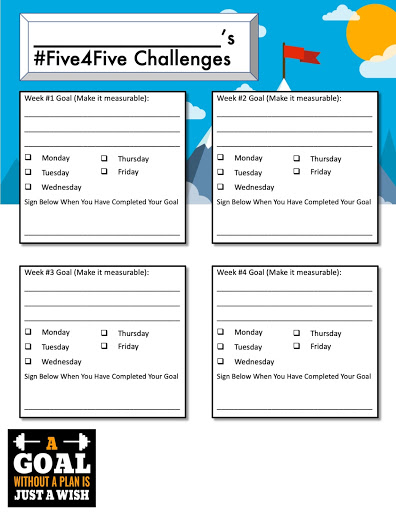
Our implementation has been pretty simple. We created a one-sided handout that has four boxes on it, one box for each of the first four weeks of the course. Each box contains a line for the learner to write out their goal for that week, the days of the week with a checkbox next to each day, and a place for the learner to sign their name if they complete the challenge by the end of the week.
This is not for a grade and we try to keep our daily commitment to discussing these goals to five minutes or less each class period. We don’t always open class with our #Five4Fives, but when we do, I really enjoy it. It’s captivating and powerful for class to begin with students openly sharing their passions and accomplishments. It’s been such a positive culture piece. It’s also been encouraging to watch students fail for a day and then keep going for that week. I’ve noticed too a greater sense of resilience in the students; in the first week, most would hang their head if they had to share about missing their goal the previous day, but now they confidently share their failures too. In those moments, I try to ask, “So are you going to get back on track tomorrow?” Most answer yes and at least make that goal for another day or two that week.
One month in, I’m really glad that we don’t require that the #Five4Five goals be education related. It’s funny, despite having the freedom to set any goal they wish, several students each week still choose a goal that has something to do with school. The goals that they set often speak to their values, their challenges, and desires for change; by offering them the freedom to create the goal that they want they are more willing to follow through with it. The only stipulation we have set for the goals is that they must be measurable.
Check out how we are doing! Here’s some of the data we have collected thus far…
#Five4Five Challenge: Number of Students Completing a Certain Number of Goals Per Week
| Completed One Goal | Completed Two Goals | Completed Three Goals | Completed Four Goals | Completed All Five Goals | |
| Week One | 4 Students | 5 Students | 4 Students | 10 Students | 25 Students |
| Week Two | 5 Students | 4 Students | 4 Students | 8 Students | 27 Students |
| Week Three | 1 Student | 2 Students | 7 Students | 2 Students | 36 Students |
Though I’m not sure that I needed this data to have a sense that this practice was having a positive influence on our learners, I’m very happy with the story these numbers seem to tell. I’ll leave you to draw your own conclusions from it.
A final piece of evidence that I would like to share comes from our weekly Flipgrid video reflections that students have gotten into the habit of recording. Every two weeks, the students create a video in which they reflect on their efforts in the course and with their #Five4Five goals. This reflection comes from a student named Luis. In week two, Luis chose to set an academic goal for himself, and I’m proud to say that Luis met his goal that week. Afterward he reflected on his experience saying, “…my goal was to do my homework for every class, and I was surprisingly successful. I picked it because junior year I was not good with homework at all and I just had so many missing assignments. And for senior year I want to be able to do all my homework and get some good grades because my grades were terrible last year. I just want to be able to see what I can do, and this goal has really helped me this week.”
Ugh, I love that!
So, the next time someone asks me, “Do you have a pretty good group this year?” I’m looking forward to shooting them a smirk and answering, “Yes, they are definitely… challenging.” Challenging themselves, challenging me to be a better teacher and a better person, and challenging the way I think about my responsibility to help them grow both as people and learners.
Andrew is the Host of the Westside Personalized Podcast (bit.ly/WPPodcast)
WestsidePersonalized.com
**Interested in writing a guest blog for my site? Would love to share your ideas! Submit your post here.
Looking for a new book to read? Many stories from educators, two student chapters, and a student-designed cover for In Other Words.
Find these available at bit.ly/Pothbooks





 Libraries might seem dated, but they are in fact one of the best-kept secrets. We got library cards for our kids as soon as they could write their names. Today, cards can be used to check out everything from audiobooks to new release movies. Apps like Hoopla and Overdrive are amazing. With a library card, these two sites offer thousands of books, movies, and music. Giving kids the opportunity to borrow a stack of books without any cost is ideal for many families. Taking advantage of MEL, the state’s interlibrary loan program, allows people to request books from all over the state of Michigan and have them sent right to your local library. Showing someone how to use the library unlocks a world of possibility. Anything can be learned by using the public library. And, using the library saves a lot of money. Surrounding kids with books is one of the best things you can do to get them reading. The library makes reading an inexpensive activity. I am not alone when it comes to using the library. Several
  A few years ago one of my boys really got into hockey. We found all of the Matt Christopher books about hockey in the library, and he eagerly read each one cover to cover. Last summer my daughter was obsessed with learning about swimming. We raided the library for any nonfiction book we could find on the topic. During the winter it was graphic novels, and today she loves to dive into anything related to fairy tales. Even though I have a pretty good idea about what each of my kids likes to read, I had experiences where I selected a book or two I thought might be perfect, only to have them not show an interest in what I picked out. I do not take it personally, since there is no cost associated with it, and know that as a reader I don’t read every book I take home from the library.
 When I first started teaching, I would ask the parents of my really motivated readers who seemed to always be reading, “Tell me how you did it? What do you think has made the difference in getting your child excited about reading?” Almost every time I was given the same answer, “I suppose he just sees me reading all the time, and it just seemed like the thing to do. My nose is always in a book”.
 Exposure to good literature and authors is one of the best gifts we can give our readers. I absolutely love sharing some of my favorites with kids. Just as we could taste cheese, wine, sauces, desserts, or other menu items, book tastings are a great way to try new things. I typically put a book in front of each place setting. Each child will get a chart to list the title he or she tasted along with the author, genre, and the likelihood that he or she might read the book. The tasting is timed to keep it moving. And so after a total of several, ninety-second tastings, kids are able to walk away with several new titles that could be considerations for future reading. This activity can be adapted to any size (I have had great success with it in the classroom).
 There are times that I find my kids book hopping, and not finishing titles. I have also seen my kids plateau as readers. It is fun when we all work together and focus on completing a challenge that encourages reading and celebrating the success of others. It works well for us to keep a running list of books read on the refrigerator. We set a goal for a number of books to be read and immediately start brainstorming how to we will celebrate our success. It is nice to focus on working together and cheering each other on.





 Learning as I go: Reflections & lessons learned