THOSE KIDS: A Connection Makes A Difference, but Does it Make THE Difference?

Guest post by 

Opinions expressed are those of the author.

I recently followed a chat that started from the claim that all a student needs to be is liked. That all they need is a connection or relationship or positive interaction with an adult. Initially I thought of course I agree, but after some time of that idea rattling around in my head I changed my mind. I don’t think I agree. I would still agree that connections can and do make a huge difference. I just don’t think they make THE difference.

20190517_123745702418090265244780.jpgI work in alternative education. I work with really challenging kids. THOSE KIDS. The ones who didn’t make it in other schools. The ones who know incarceration and the system. The ones who know trauma and abuse and pain and abandonment. The ones who know failure. These kids don’t like me when they enter my classroom. They don’t like anyone. They don’t care if I like them. They are quite used to no one liking them. They don’t care about grades and learning and futures. They don’t plan. They don’t have goals. They don’t dream. They don’t have hope.

So I have to connect with them and I have to do it fast. I have found that I relate to these kids. I get them. Maybe it’s my own quirkiness or off-beat sense of humor or stubborn streak or willingness to do about anything to make that connection – smile, laugh, sing, dance, tell jokes, laugh at bad jokes, pat backs, give hugs, and just never stop trying. They push me away, but I come back. Again. And again. And again. Until finally they push back a little less, and if I’m lucky, they stop pushing back at all. That is connection and it is the absolute first step. No question. It will be the foundation for everything that comes next.

Next. That is the thing that I think has gotten lost. It’s not the connection that’s the most important thing. It’s the next. Jump into any education chat or conversation and you will hear the word connection and relationships, but it’s becoming this idea that if I make a connection with my student then that is all they need. If I care enough or like them enough or love them enough or if we talk enough or have enough in common then that will make a difference to my students. And it will. It will make A difference, but I don’t think it’s enough to make THE difference.

We need the next. They need the next. Think about the process of building a house. When carpenters build a house they build the foundation first. It is what supports everything. But once they have a foundation, they keep going. They build the walls and 20191218_180417-16324819778329009069.jpgthe roof and they put in duct work and plumbing and electrical. It’s finished off with paint and flooring and appliances and décor. There are so many steps that come after the foundation. There are so many steps to building a completed house. If they stopped after the foundation, then they don’t have a house. They just have a piece of concrete.

We, as educators, we need to build the house for our students. Let’s build a foundation. Let’s work hard and quickly to make connections and build relationships, but then let’s not stop there. Let’s do something with that foundation. Let’s give them walls and a roof – a framework to support them. We can teach social skills and coping skills. How to enter a classroom and take turns and ask for help. How to approach tasks independently and with their peers. How to adjust to different procedures and expectations. How to make mistakes. How to celebrate successes. How to work through problems. How to find an answer. How to ask for help. How to be a successful student but also a successful member of society. Let’s give them all the systems inside that house – let’s bring that house to life. We can teach them academics. We can fill in the gaps while giving opportunities for new growth. It may look different than how other students learn and they may need to express what they know differently, but they will learn. They will learn mistakes aren’t failures. They will learn to try again. They will experience success. Knowledge is a powerful thing. So is confidence. Let’s decorate their house. Personalize it. Make it belong to each individual student. Let them be creative. Think outside the box. Celebrate individuality. Find their own unique strengths and weaknesses. Let’s make that house their own.

20191218_1806315978855054264078087.jpgLet’s do something with the connections we work so hard to make. Let’s use those foundations we’ve built. Let’s push our students out of their comfort zone. Let’s move past easy and complacent and good enough. Let’s set high expectations. Let’s push them to struggle and even fail. But then let’s teach them to persevere and to adapt and to overcome. It will be hard for them and us. We will all get tired and experience frustrations, but it’s what they need. And they will be okay because we will there. We will support them and guide them and believe in them and teach them. We use that connection that we created in the beginning to be our foundation to support everything we do next.


**Interested in writing a guest blog for my site? Would love to share your ideas! Submit your post here.


Looking for a new book to read? Many stories from educators, two student chapters, and a student-designed cover for In Other Words.

Find these available at bit.ly/Pothbooks  


3  books.png

Why Connections Matter

Guest Post by Sean Scanlon, @polonerd

Republished from his blog site, a great message about why we need to connect, and how to do so at conferences. 


On Tuesday night I returned from Summer Spark in Milwaukee. My head was still spinning and full from all of the great presentations and new ideas I heard, my heart was still racing from Joe Sanfelippo’s keynote, but most of all my heart was full from all of the love shared between friends at an Edtech conference.

This was the 4th year I’ve been to Spark (sorry to say I missed year 1) and every year my PLN grows but in different ways than just connecting with someone on Twitter or Facebook groups. At a mid-sized conference like Summer Spark you make awesome personal connections with people who have been in your PLN for months (maybe even years). You get to have dinner with people you haven’t seen in a year or more, or maybe people you’ve never even met before.

game night

It’s pretty clear when we go to dinner for game night on the first evening of the conference, and we turn 10 tables into one giant table so we can all sit together (until the table literally can’t grow anymore), this group is close and wants to learn more about what we’re doing in our classrooms, our schools, and even more about our future plans.

As far as game night goes, Jon Spike walks in with his bag of games, along with others who bring their favorite board games and let the fun begin. The fun and connections at this point are amazing and there are even some grudge matches from two years ago when it comes to CodeNames. Right Kristin?

Screen Shot 2019-06-20 at 11.27.05 AM

The conference is wonderful because Pam NosbuschChuck TaftMichael Matera, and so many others put their heart and soul into making it great. However, the true “Spark” we get in June is an uplifting of spirits and excitement from connecting with other inspiring educators, learning from them, and most importantly sharing with them what we do, what we want to do, and how they can help us get there.

All of this fun and all of these close relationships really go back to where it all started for many of us – Twitter. When we connect on Twitter, or any Social Media platform, we share what’s we’ve accomplished, we look to others for advice or ideas, and we ‘talk’ with each other about different topics in chats.

Who to Follow –When you find that first person you want to follow, click on their name and then click on where it says “Following”. Look at who those people follow because that is a choice they made to follow those people. You can glance at their profile and even see who those people follow – welcome to the most awesome rabbit hole.

Twitter Chats – If you haven’t done any Twitter chats, I’ve listed a few below but feel free to try ones that more closely tie into your content area or grade level. The chats are usually 30 or 60 minutes long and you’ll be connecting with educators from all over the country and possibly people from other parts of the world. Make sure you don’t pull a @GameBoyDrew and forget the #. If you don’t use the #, nobody else in the chat will know you’re saying anything.

122edchatgroup

Use Tweetdeck – Tweetdeck allows you to created columns based on a # or a particular user – plus other choices.  This makes it easier to track what people are talking about in that chat. You also have a notifications column so it makes it easier to see who ‘liked’ your post, replied to your post, or even just mentions you in possibly a different chat.

Simply put, get on Twitter and follow other educators. It’s polite and good practice to follow the people who follow you; except for the bots and the inappropriate accounts – check who they are and what they’ve posted before you follow someone. Check your feed occasionally and search some hashtags (#) to see what people are talking about.

Most of all, have fun connecting with other educators and don’t forget to introduce yourself when you meet them in person at awesome conferences like Summer Spark @usmspark #usmspark


Sign up for  Summer Spark, happening in June 2020!


What is YOUR Walk-Up Song?

The Impact

The Impact
Guest Post by Megan Reinke, Student at Iowa State University, @MissMeganR

Last spring I took CI 245. It’s a class focusing on classroom management and lesson plans. That isn’t why I loved it though.

 I loved it because my teacher was one of the most supportive, knowledgeable, caring, fun teachers. People say, “You don’t get that in teachers at big universities,” but oh no, I definitely did. She is such a role model to me as I continue into the field of education. She didn’t just share her successes and high points of teaching, but she also shared her lowest points and failures. I loved this about her because it taught me that it is okay to mess up. Teaching and life is hard. We are all going to make mistakes.

 In her final thoughts on the last day, she had our class calculate the number of students we would touch the lives of throughout our teaching careers.

 There were 24 students in our class, and if we each thought for roughly 42 years, and had 20 students in our class then…

 (24 times 42 times 20)

 20,160.

 20,160 students. Wow.

 She started crying. I started crying. My class started crying. She went on to express how much she loved us, is proud of us, is excited for us, and going to miss this class.

 Point is, we all get the chance to make a big impact. HUGE in fact. I don’t mean this in regarding to the size of group or number of lives we get to impact. That number could have came out to be way smaller and it still would give me a reason to be purposeful in the ways I am impacting lives. Whether you get the chance to impact 20,000 lives or 2 lives, you get the opportunity to leave a HUGE impact on someone in this world. GET EXCITED FOR THIS! What are you doing now to prepare for this? How are you treating people everyday?

 Be that positive light, that positive influence, that supportive role model. Just how my teacher did to me.

How to Read (in) Music

Guest Post by:

 Peg Grafwallner, Instructional Coach/Reading Specialist, Ronald Reagan IB High School, Erica Breitbarth, Music Teacher, Ronald Reagan IB High School

One of my favorite ways to spend the first block is to observe a music class. I am an
Instructional Coach and Reading Specialist at a large, urban high school. I collaborate with dozens of teachers by supporting them in embedding literacy into their classroom teaching with disrupting their learning objectives. This particular morning I observed Ms. B’s Beginning Chorus class. As students practiced their scales, Ms. B played the piano and offered instructions. She encouraged students to use Curwen hand signals to align to the notes. These hand signals offer a kinesthetic connection to the notes giving students the chance to, according to Ms. B, “visually and spatially represent the sound they are producing.”

As students were practicing their scales, I noticed explicit similarities between reading and music; and most notably, reading in music. Ms. B. prefaced the lesson’s song by offering background on the composer and the arranger. Frequently, the background of an artist can be directly related to the piece they create. Therefore, that background is often analyzed to make meaning from the piece. Likewise, when I introduce a short story, I always share with students the background of the author. Often, the author’s interesting life experiences is a hook to get students interested. As an example, the life of Edgar Allan Poe is as emotionally complex as his poem, “Annabelle Lee.” Therefore, it is beneficial to spend time on the connections between author and text and in this case, between the composer and the music.

6E56F311-72C8-4FAC-83B5-79D1E9CCAF0ANext, Ms. B asked her students to listen to the introduction of the song and try to predict
what it was about. What mood did the piece evoke? How did it make them feel? These questions encouraged students to imagine what the composer or musician is saying within the music. What do they want us to know, to feel, to understand? In addition, students were encouraged to apply music terminology to their explanations. Utilizing that terminology supports their practice of music language and inspires them to communicate as a musician. In a similar way, when I teach a new piece of text, I often “tease” students with the first couple of lines from the story (“It was the best of times; it was the worst of times,” A Tale of Two Cities) or the name of the main character (“Bigger Thomas,” Native Son) or the location of the setting (“Starkfield,” Ethan Frome). I ask them to predict what they think the story is about, or to anticipate the attitude of the character or to foresee the importance of the place. That conversation helps students to imagine the theme, the characters and the setting.

Next, Ms. B distributed the sheet music and asked students to take a few minutes to
“read” it over. She asked them to sing the rhythms on counts and encouraged them to keep reading the music even if they mixed up a rhythm, but to continue working on it both visually and aurally. As a reading specialist, I encourage students to keep reading if they get stuck on a word. I remind them of various “fix it” strategies to make meaning. As an example, can the student determine meaning from the prefix, the root word or the suffix? Is the student able to understand the gist of the reading without the word?
When students finished reading, Ms. B asked them to highlight their individual line so
that it would “stick out of the musical texture as you read.” This type of close reading, or
“musical annotation” is a valuable skill in all content areas. When students begin a new piece of text, even a brief close reading supports their annotation skills. By doing a close reading, students are asking questions, making comments and deciphering unknown vocabulary. This engagement with the text helps students for the challenge of reading and making meaning of what could be an unfamiliar topic.

2F7ECCC0-891D-4DF0-AE40-86521386832BAs students read and highlighted, Ms. B prepared a video of the song being performed by
an authentic ensemble, so students could “feel” the style and the spirit of the piece. This visual is critical in making an auditory connection. By listening to the music and watching the singers’ body language, the student is hearing and seeing the relationship between the singers and the music. Similarly, I often show a video or play a recording of an author reading a portion of their short story, poem or novel. I want students to see the author’s demeanor when reading and hear the tone and inflection of the author’s voice.
Finally, after a visual and spatial warm-up, an introduction of the artist, a prediction of
the piece, a detailed close-reading with annotation, and lastly, a visual and auditory opportunity to hear the music, Ms. B’s students were ready to practice the piece themselves.

In closing, it is essential to create scaffolded reading opportunities in all classes, not just
the four “core” where one would most expect them. To support students in reading, explicit and useful strategies are necessary to make meaningful reading connections, which in turn, highlights the value of reading in every single subject. Applying those specific reading strategies in music and all classes demonstrates the value of that discipline and the ability to transfer those strategies from one content area to the next.

References
Dickens, C. (1859). A tale of two cities. London: Chapman Hall.
Wharton, E. (1860). Ethan Frome. New York, Charles Scribner’s Sons.
Wright, R. (1911). Native son. New York, Harper.

Peg Grafwallner is the author of Ready to Learn: The FRAME Model for Optimizing Student Success, available now through Solution Tree.

EB9E4BE1-B0CE-4383-9A1D-316C6DF1DB91  Ready to Learn


**Interested in writing a guest blog for my site? Would love to share your ideas! Submit your post here.


Looking for a new book to read? Many stories from educators, two student chapters, and a student-designed cover for In Other Words.

Find these available at bit.ly/Pothbooks  


Books available

Teaching Can Be Challenging


Guest Post by Andrew Easton, @EastonA1, Personalized Learning Collaborator and Consultant, Westside Community Schools in Omaha, Nebraska

*Future DBC Inc. author on Personalized Learning, Spring 2020

Now that we are into November, it’s likely that at some point this year you’ve been asked the question, “So, do you have a pretty good group this year?” In my time in education, I’ve heard a myriad of answers to this question – some that I don’t want to repeat. Whether it’s right or wrong or not even a thing worth discussing, I do find it interesting to hear what a teacher has to say. And actually, there is one word in particular hat comes up rather consistently when this question is asked. One that on its own doesn’t completely address the question. The word “challenging.”

This year, I am redesigning our high school’s English 4 course and am teaching that class for the first time. When the teacher who had previously taught that course retired, she politely used the word “challenging” when describing to me the group of students that she typically supported in that course. She quickly followed that up with a “Good luck!” that felt more like a warning than words of encouragement.

English 4 is an appealing option for students who are simply looking to pass an English class to graduate and pick up a few helpful life hacks along the way. Many of our students have had significant struggles with learning in the past for a variety of reasons. Those reasons have made it hard for them to find consistent academic success. For these students, senior year has brought both the liberating promise of change once they reach the end of May but along with it the stinging reality that they have navigated their K-12 education to the 12 end of that spectrum and the experience has left them feeling like they have not taken much from a system that has helped some of their peers to thrive. 

Planning over the summer was, well, challenging in its own right. I knew very little about this group that wasn’t second hand knowledge. But as I perused the gradebook and academic history for some of my students prior to the start of the year, I knew one thing: I had to give these learners the opportunity to feel what accomplishment feels like. There is a certain rhythm to success that has to be found and then felt before it starts to beat and almost swell from within. I guessed then and now know that many of these students have never heard, nor much less felt that beat, and I knew that I would be working against thirteen years of baggage if I tried to convince them, initially at least, to search for this experience in an academic setting. But I had an idea.

When I find myself feeling stagnant in my own motivation, I often start a #Five4Five Challenge. The #Five4Five challenge was created by Michael Matera, author of Explore Like a Pirate, in the spring of 2018. He posed this challenge through his Twitter and YouTube account, and I was immediately intrigued by the idea. The #Five4Five Challenge asks individuals to select one “thing to do” and do that thing each day for five days straight. What you decide to do is entirely up to you, but you have to do it once a day for each of the five days to succeed. I myself had done six #Five4Five Challenges before the school year began. I had created a vlog, done anonymous acts of kindness, set workout goals, even given up Starbucks for five days straight (that one was brutal). The goal itself doesn’t matter; it’s not about the goal. It’s about intentionality and filling your day with purpose and success. It seemed like the right fit for my learners, and so in the second week of school, I issued them all a challenge.

Now, if I’m being honest, I wasn’t exactly sure how they would respond to it. Would they laugh this off? Would they be into it for a week or two and then fade away as the grind of the semester progressed? Well, I’m happy to share that as I’m writing this, we just finished our fourth week of #Five4Fives (we go two weeks on, one week off), and the experience has not only gone well but it has exceeded all my expectations.

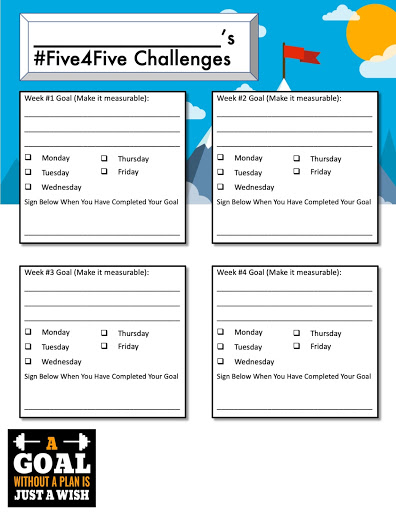
Our implementation has been pretty simple. We created a one-sided handout that has four boxes on it, one box for each of the first four weeks of the course. Each box contains a line for the learner to write out their goal for that week, the days of the week with a checkbox next to each day, and a place for the learner to sign their name if they complete the challenge by the end of the week. 

This is not for a grade and we try to keep our daily commitment to discussing these goals to five minutes or less each class period. We don’t always open class with our #Five4Fives, but when we do, I really enjoy it. It’s captivating and powerful for class to begin with students openly sharing their passions and accomplishments. It’s been such a positive culture piece. It’s also been encouraging to watch students fail for a day and then keep going for that week. I’ve noticed too a greater sense of resilience in the students; in the first week, most would hang their head if they had to share about missing their goal the previous day, but now they confidently share their failures too. In those moments, I try to ask, “So are you going to get back on track tomorrow?” Most answer yes and at least make that goal for another day or two that week.

One month in, I’m really glad that we don’t require that the #Five4Five goals be education related. It’s funny, despite having the freedom to set any goal they wish, several students each week still choose a goal that has something to do with school. The goals that they set often speak to their values, their challenges, and desires for change; by offering them the freedom to create the goal that they want they are more willing to follow through with it. The only stipulation we have set for the goals is that they must be measurable. 

Check out how we are doing! Here’s some of the data we have collected thus far…


#Five4Five Challenge: Number of Students Completing a Certain Number of Goals Per Week

Completed One Goal  Completed Two Goals Completed Three Goals  Completed Four Goals Completed All Five Goals 
Week One 4 Students 5 Students 4 Students 10 Students 25 Students
Week Two 5 Students 4 Students 4 Students 8 Students 27 Students
Week Three 1 Student 2 Students 7 Students 2 Students 36 Students


Though I’m not sure that I needed this data to have a sense that this practice was having a positive influence on our learners, I’m very happy with the story these numbers seem to tell. I’ll leave you to draw your own conclusions from it.

A final piece of evidence that I would like to share comes from our weekly Flipgrid video reflections that students have gotten into the habit of recording. Every two weeks, the students create a video in which they reflect on their efforts in the course and with their #Five4Five goals. This reflection comes from a student named Luis. In week two, Luis chose to set an academic goal for himself, and I’m proud to say that Luis met his goal that week. Afterward he reflected on his experience saying, “…my goal was to do my homework for every class, and I was surprisingly successful. I picked it because junior year I was not good with homework at all and I just had so many missing assignments. And for senior year I want to be able to do all my homework and get some good grades because my grades were terrible last year. I just want to be able to see what I can do, and this goal has really helped me this week.” 

Ugh, I love that! 

So, the next time someone asks me, “Do you have a pretty good group this year?” I’m looking forward to shooting them a smirk and answering, “Yes, they are definitely… challenging.” Challenging themselves, challenging me to be a better teacher and a better person, and challenging the way I think about my responsibility to help them grow both as people and learners.

Andrew is the Host of the Westside Personalized Podcast (bit.ly/WPPodcast)

WestsidePersonalized.com

httpslh4googleusercontentcomiqqmugjnikqwzg6btyvzwn8yfzsage9nrprlahpsorfcrl44eb5hzn2_pz8uaco2qnx61-0k67btfpht52z_t7oxezszosdt1zjtphib

**Interested in writing a guest blog for my site? Would love to share your ideas! Submit your post here.


Looking for a new book to read? Many stories from educators, two student chapters, and a student-designed cover for In Other Words.

Find these available at bit.ly/Pothbooks  


Books available

Three Trauma-informed practices to implement today

Guest Post by Jethro Jones

Twitter: @jethrojones http://twitter.com/jethrojones

Web site: http://transformativeprincipal.org

My name is Jethro Jones, and I am a principal in Alaska. I have helped three schools become trauma informed as a principal and many others through my podcast and Trauma course. I have worked long and hard to figure out some strategies that all school personnel can implement effectively. I’ve gone through a lot of trial and a lot of errors where I have really messed up and I’m going to share some of those secrets here.

Whether your school has created or attended a trauma-informed practices training or not, there are three things you can do to respond to situations in your school in a trauma-sensitive way. Implementing these strategies is simple enough that you can start implementing them today. They are powerful enough that you will see results almost immediately.

1. Ask Questions

Anytime you’ve got a kid who’s acting out or who’s struggling or whatever, instead of saying, “You need to be doing X,” ask the student questions.

This is really simple.

“How are you doing?”

“What are you working on?”

“Where are you heading?”

“What’s going on over here?”

“Can you help me understand…?”

Asking questions gives the student an opportunity to express him or herself in a way that allows them to deal with whatever’s going on.

The challenging part about asking questions is sometimes we as teachers turn questions into statements of condemnation!

For example, “Why are you running in the hall when you know you should be walking?” is more of a condemnation than a question.

We need to ask questions and figure out what is actually happening. Give them an opportunity to express themselves and deal with it. This is a hard thing for us. Because we have rules, we have expectations, we have policies and procedures.

And we as adults are very comfortable in those shoes.

And if we’re not comfortable, then it’s easier for us to say, Stop running. Stop doing that. Stop this. Stop that.

And that’s just not helpful to a child experiencing trauma. Because they’re not thinking–they’re only acting. We need to get them to slow down and think!

When you ask questions, you require the student to stop and think about what they are doing. Your voice doesn’t sound like a teacher in Charlie Brown when you ask a question.

Don’t turn questions into accusations, but make them clear, inquiring concern for the student.

You’ll get great results.

2. Don’t Take Things Personally

Every educator works hard and takes her job seriously and personally, and teachers put so much into their work.

And I don’t mean don’t take your work personally. What I mean is, don’t take the students actions towards you personally.

They’re most likely not a personal attack.

Yes, they will hurt. Yes, it will be uncomfortable. But you can’t take what they do, and think they’re acting out towards you to hurt you personally, that’s just not what is happening. Even when we feel like it is.

Kids desire to please the adults around them. Kids desire to make good choices.

The number of reasons that they have acting out is probably innumerable.

It’s rare when a student wakes up and says, boy, Mrs. Jones really is going above and beyond and helping me at school, I should totally do something that hurts her today. That’s not what kids do.

Sometimes, kids don’t know how to react to someone giving them positive attention, and they attempt to push them away. I once had a student who found out she was moving away from the school, and proceeded to destroy all the hard work her teachers had been putting in. When we talked to her, she was finally able to articulate that it was easier to leave with people mad at her so she didn’t feel like she was missing them as much, because you don’t miss people who are mad at you.

So there are two things you can do. Number one, ask, why is this kid doing this?

Number two, what can you do to deal with this behavior?

We as educators have to recognize that we can’t change anybody, every person has to make that choice for him or herself. We can certainly put things in place to help them make good choices, which we do all the time.

But we cannot change anybody. They need to change themselves.

We need to be sure that we are making choices that allow us to not take it personally like they’re attacking us, because even if they do attack us, it’s not personal. Kids are naturally kind, nice, wonderful, sweet, thoughtful little human beings. It’s when they’ve had these adverse childhood experiences, that they start acting differently.

And what our role is, is to help them to be successful even when they’ve had those experiences.

3 Know Your Role

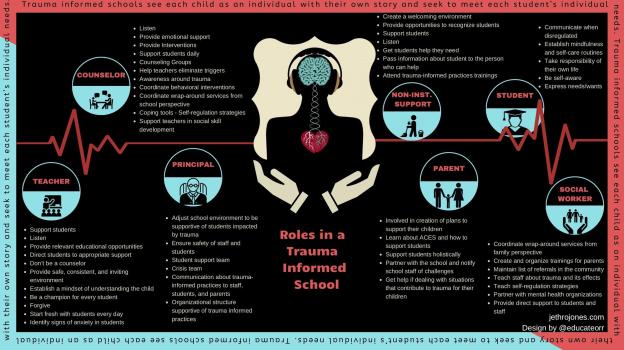
The image above is a powerful way to make sure that people know their role is in a school that is trauma informed. Get a printable version here that you can use as a handout.

You’re not a counselor or a social worker. You’re an educator. You shouldn’t try, and NOBODY should expect you to be anything you’re not.

Could you be a therapist, counselor, or social worker if you tried? Yes. Do you have what it takes? Absolutely!

When a student doesn’t know how to read, what do we do? We teach them.

When a student doesn’t know how to write, what do we do? We teach them.

When a student doesn’t know how to drive or swim, or do whatever, what do we do? We teach them,

When a student doesn’t know how to behave, what do we do? Usually we punish them, what we should do is teach them.

And so our role as educators is to teach and help kids learn.

Now, there are so many different ways to do this!

Our purpose here is not to discuss all the many ways we can teach them, but to emphasize that it is our role to teach them, regardless of how they come to us.

Now, I want to share an experience that is really powerful. In her book, Allison Apsey shares a very similar experience. There are certain students that take up all your time! You are constantly spending time with those students, recognizing that it is worth the time and effort to intentionally and proactively spend time with those students that take up all your time,

if you’re going to be spending time with them anyway, why not work with them to get support in advance, why not work with them to build that relationship?

I call this Proactive Teaching. Some call it check and connect, or check in check out.

These students that are really struggling need additional support. You’ve got to have good Tier 1 behavior expectations and practices in place, but you and I both know there are kids for whom that doesn’t work, and they are the kids that reside in Tier 3! They need the extra help.

Instead of waiting for this student to be sent down to the office, we proactively go teach this student how to make good choices. Don’t think you can do this with 100 kids! It won’t work.

Find those two (or maybe three) students and get with them before they cause the trouble. Take the initiative and connect with them before they can get into trouble. Get with them before they get overwhelmed and can’t perform. Get with them before they wreak havoc in your class!

I had one student who would have a meltdown nearly every day because he was so worried about his mom and young sister. Instead of waiting for his behavior to cause him to be taken out of class, I met up with him before he had a chance for that, and talked about how things were going and what I could do to help him. Then, when his meltdown would inevitably come, we already had a connection that day.

Did this take a lot of time? Yes.

Was it worth it? Yes, it was, because it was so much better to do that in a positive, preventive proactive way than it was to deal with the issues and problems that he was going to have after the fact. Because when he had a bad day, he wanted to get it out in an aggressive way that hurt other kids, and that just wasn’t going to work in our school.

So instead of spending the 30 minutes trying to calm him down after a problem out on the playground, we spent 20 minutes before and during recess to give him that support.

It wasn’t my role to help him deal with his issues at home. I needed to be a trusted adult who was teaching him how to deal with things at school. Of course, a counselor was involved to help him deal with the challenges he faced at home.

To recap:

1. Ask questions.

2. Don’t take it personally

3. Know your role.

These three strategies will help you out immediately with whatever challenges you are facing in your school. If you need additional help or support along the way, please reach out to me by email or at my web site: jethrojones.com/trauma


**Interested in writing a guest blog for my site? I would love to share your ideas! Submit your post here.


Looking for a new book to read? Many stories from educators, two student chapters, and a student-designed cover for In Other Words.

Find these available at bit.ly/Pothbooks  


Books available

ONE SIZE DOES NOT FIT ALL

Guest Post by Kristen Koppers, @Mrs_Koppers

Educator and Author of Differentiated Instruction in the Teaching Profession 

The movie Sisterhood of the Traveling Pants was one movie that brought together friendship through hardships. But a single pair of pants (no matter the size of each of the girls) fit perfectly to where they would wear the pants, write on them, and send them to each other throughout the summer.

We all know that wearing a pair of pants in one size does not mean that another pair of pants will fit even with the same size. The fact that one pair of pants can fit four different girls ‘perfectly’ who all have different body types is not realistic. Although the movie focused on the jeans, it was more about the friendship of the four girls during their personal problems they went through without each other.

The same idea goes for teaching and learning. While we hope that one size pair of pants (learning styles) would fit more than one student, we know that is not the case. Students come from a variety of backgrounds, cultures, schools, and learning abilities so we cannot think that one curriculum or one “pair of pants” can fit all. This goes the same for purchasing a Halloween costume or outfit where the tag says “one size fits most.” Someone who weighs 120 pounds wearing the same costume that a person who weighs 30 pounds more won’t fit the same way. While the outfit will fit both sizes, the look will be quite different.

ONE SIZE DOES NOT FIT ALL – What many forget is that teachers come from all backgrounds, cultures, educational institutions, and ethics. We cannot expect one teacher to teach the same way as other teachers. This is the same for students. It would be a perfect world if one style of teaching will reach all students. However, this is not the case. Differentiating work can be difficult as well to meet the needs of all students. In order to have that perfect pair of pants to fit all students, teachers must be willing to put their ego and pride aside and stretch the pants just a little wider so that not one size person but multiple sizes can fit.

The struggle is real. We all know how it is to try and fit into a fresh pair of washed jeans. The jeans that fit you the day before now feels tighter 24 hours later. If we think about how that one pair of jeans fit the day earlier and then the next day they don’t, this is how many students feel. One day they feel like they understood the information and then the next day nothing makes sense.

Using Differentiated Instruction is not about separating all students or creating one lesson plan for many. It’s about assessing student needs throughout the year. While one lesson plan will help several students at one point, another lesson plan may not work for the rest. Assessing students needs does not need to be cumbersome. It can be as simple as noticing non-verbal clues in the classroom to written work.

Recently, we were reading a novel by Gabriel Garcia Marquez. Students were intrigued by the reading and began to focus on the plot. It wasn’t until they were to share out what they learned to the class that everything unfolded. When I moved around the room, most groups were able to explain what they were thinking. However, between the individual group discussions and the informal presentation, something went wrong. This is where I used differentiated instruction. We discussed the lesson, the assignment, and guidelines. It was the connection from what they read to their knowledge that seemed ‘not to fit.’

As an educator of 16 years and instead of taking it as an insult to my teaching, I swallowed my pride of experience and began to learn how to fit into a pair of jeans that did not fit me. After a large group discussion, I was able to use differentiated instruction to meet the needs of all the abilities in my classroom. Students were given the choice to keep their grade or complete one of the two alternative assignments to replace the previous grade. Instead of making this decision, I let the students choose because, after all, they are the ones who truly know their own learning ability.

When one pair of pants does not fit, we shouldn’t just give them away and buy a larger or small pair, we need to stretch them a little to fit.

Follow Kristen on Twitter and Check out her book! Differentiated Instruction in the Teaching Profession

Teachers matter more

Guest post by Dave Schmittou, @daveschmittou #LastingLearning

via Teachers matter more

I am all about improvement. At the end of every year, I spend some time reflecting on what my strengths and struggles are so that I can make a plan for progress. At work, I spend time evaluating programs, processes, and people. One thing I have noticed recently in schools is that far too many of us say teachers matter more,  that the people make the difference, yet we spend so much of our time focusing our improvement efforts on programs and processes. We think of ways to circumvent those who matter more instead of diving deep to develop the real difference makers. We know teachers are the drivers of learning, but we pour money and time into software, classes, textbooks, and schedules instead of into the people who make it all happen.

8


As a sports fan, I often use athletics to try and illustrate my points, so I may as well do so again. Lebron James is considered by many people as one of the greatest basketball players of this era. He is dominant, he can shoot, dribble, pass, rebound, and play defense (when he chooses to). Pretend for a moment that you are a general manager of a team Lebron plays on and you have the task of making the team better. Your goal is to get wins and championships. You can do this by upgrading the concession stands at the arena. You can do this by bringing in new players to circumvent Lebron, players who will not pass him the ball or expect him to be great, or you can do this by bringing in players that complement his game and allow him to dominate. Each of these strategies has been tried on his teams. Some owners and GMs have attempted to distract the fans from what is happening on the court by upgrading the arena. Some have attempted to save Lebron by bringing in others to take the pressure off, and some have brought in players to complement him and make him even better. Only the latter has resulted in championships, however.

Often times in schools we get ourselves distracted by things that don’t matter at the expense of those that do. As a leader who has had the opportunity to help lead turn around efforts in a few schools and districts, I have learned that no program, no paint job, no software will ever impact a child like an amazing teacher. If you are a leader, all of your focus should be on making teachers better, not working around them.

If you have struggling students in your school (we all do), do not go on the hunt of the newest tech gadget to give to the kids. Look for ways to help a teacher work with those students more. If you have accelerated students in your school (we all do) do not look for activities and classes to fill a schedule. Look for ways to have teachers inspire and motivate innovation. Stop looking for ways to work around teachers and begin looking for ways to support teachers.

Support does not simply mean increasing pay. Support means, if you have the option between a new textbook or staff professional development, invest in the teachers. If you have a choice between painting a hallway or developing a teacher, choose the teacher. Always, choose the teacher/

Every research study available describes the effects that matter most for student learning point to teachers as the difference makers. Teachers matter more. Teachers provide feedback, establish the culture, set the expectations, develop the assessments, and plan for progress.  If you are a leader, spend your time building capacity in teachers and you will be amazed at the learning that results from your students.

Check out the podcast on this topic at https://anchor.fm/david-schmittou/episodes/Episode-12-Teachers-Matter-More-e2n3c4

Feel free to also check out Dave’s book:

It’s Like Riding a Bike: How to make learning last a lifetime


Want to write a guest blog for my website? Submit an idea here!

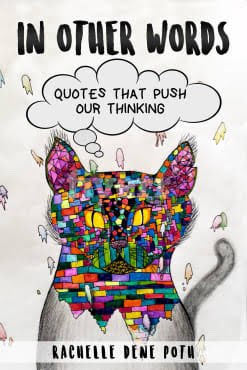
In Other Words: Quotes that Push Our Thinking

Teddy Roosevelt once said, “I am a part of everything I have read.” When I read his quote, it greatly resonated with me because of my love of quotes and the impact they can have in our lives. In Other Words is a book full of inspirational and thought-provoking quotes that have pushed my thinking, inspired me and given me strength when I needed it. The book shares stories around the importance of growing ourselves as educators, knowing our why, as well as learning from and embracing failures and taking risks with learning so we can become our best selves for those we lead and learn with.

Get your signed copy here: bit.ly/Inotherwordsbook

1553983585916_0601087574_47b12722

There are stories shared by educators with different backgrounds and different perspectives. My own experiences and interpretations and the educator vignettes shared by my PLN (Personal or Professional Learning Network) will hopefully push your thinking, inspire you, and provide whatever it is that you need. My hope is that by sharing our stories, it will inspire you to share yours.


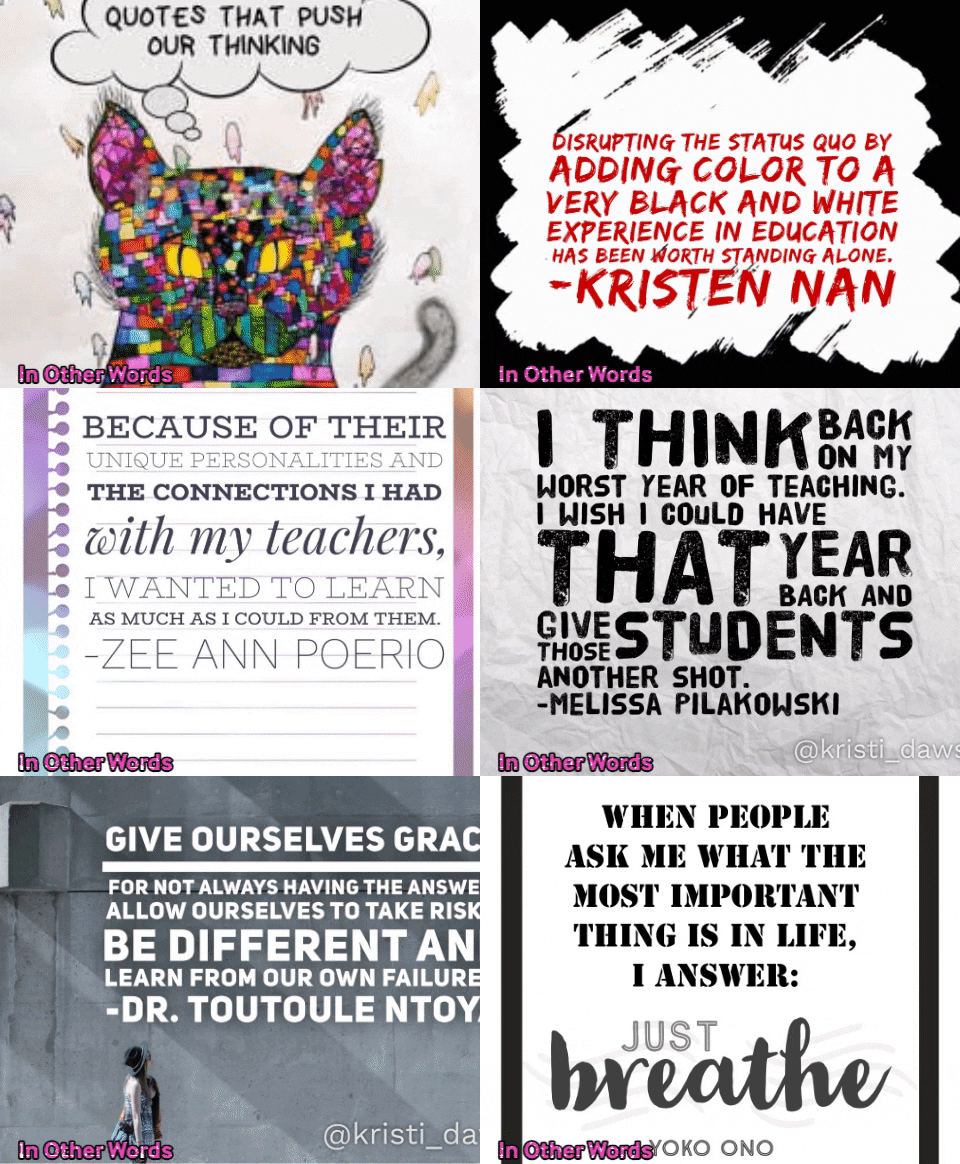
There were many people involved throughout this journey. I reached out to members of my PLN and friends to include as many educators and students as possible. I  wanted to share more than just my story, but rather many stories and experiences.   This book is one that can be read by anyone, not just people in education. There are many quotes, unique personal experiences, beautiful graphics and more.

About the book #Quotes4EDU

In this book, I share some of my experiences and reflections based on quotes. I have included the stories of different educators in the form of vignettes or guest chapters. One chapter was written by two of my students and my book cover was drawn by one of my 9th-grade students. The story behind the book cover is included at the beginning of the book.  The book is available on Kindle or in paperback: bit.ly/Inotherwords  A few of the stories are available for listening on Synth. gosynth.com/p/s/pyzbnm  

Chapter Authors
Dennis Griffin
Maureen Hayes
Holly King
Elizabeth Merce
Melissa Pilakowski
Laura Steinbrink
Amy Storer
Donald Sturm
Cassy DeBacco
Celaine Hornsby
Vignettes
Marialice B.F.X. Curran
Jon Craig

Kristi  Daws

Sarah Fromhold
Jeff Kubiak
Matthew Larson
Jennifer Ledford
Kristen Nan
Toutoule Ntoya
Paul O’Neill
Zee Ann Poerio
Rodney Turner
Heather Young
Graphics 
Michael Mordechai Cohen
Dene Gainey
Manuel Herrera
Shelby  Krevokuch
Amber McCormick
Dana Ladenburger
Heather Lippert
Scott Nunes
Chris Spalton
Tisha Richmond
Monica Spillman
Laura Steinbrink
Kitty Tripp
Julie Woodard
Animated GIF-downsized_large (5)

Thank you Kristi Daws for creating these images!!


This slideshow requires JavaScript.

TeacherCast Educational Network | Developing Standards-Based Instructional Technology Integration

Technology Integration - Instructional Coaching - Productivity Secrets for Educators

Leadership Liner Notes: Sean Gaillard

Built on Connection. Tuned for Impact.

Stories by Thomas Oppong on Medium

Dr. Rachelle Dené Poth @Rdene915 Educator, Consultant & Keynote Speaker, Author, Attorney #THRIVEinEDU

Hooked On Innovation

When Innovation slaps you in the face, we slap back.

Teach Better

Dr. Rachelle Dené Poth @Rdene915 Educator, Consultant & Keynote Speaker, Author, Attorney #THRIVEinEDU

BrianKulak.com

Dr. Rachelle Dené Poth @Rdene915 Educator, Consultant & Keynote Speaker, Author, Attorney #THRIVEinEDU

The Principal of Change

Stories of learning and leading

Mandy Froehlich

Dr. Rachelle Dené Poth @Rdene915 Educator, Consultant & Keynote Speaker, Author, Attorney #THRIVEinEDU

Katie Martin

Informed by research, refined by practice

#RocknTheBoat

Rocking today's classrooms, one teacher, student, and class at a time.

User Generated Education

Education as it should be - passion-based.

Learning as I go: Reflections & lessons learned

Dr. Rachelle Dené Poth @Rdene915 Educator, Consultant & Keynote Speaker, Author, Attorney #THRIVEinEDU

Serendipity in Education

Join me, Allyson Apsey, as I stumble upon the fortunes of learning, laughing, and celebrating alongside incredible people.