
Buncee Holiday Hugs


Have you heard about the Buncee Holiday Hugs? This is an absolutely amazing project that has taken place during the months of November and December. Through this project, students from around the world have created Buncees and shared their work on a Buncee Board for everyone to see. There are now 957 Buncees added to this Board!

So what are these Buncees being used for?


Buncee is partnering with children’s hospitals from around the world to share the Buncees that have been created for Holiday Hugs. These amazing Buncees will be shared with children who will be spending their time in the hospital during the holidays.

The Holiday Hugs project was started by Amy Storer with inspiration from Michael Drezek. The idea evolved from Amy’s own experience as she was spending time with her mother in the hospital over the holidays. The idea for Buncee Holiday Hugs then came to life through the connections with Amy and Marie Arturi, Creator of Buncee. Holiday Hugs is another wonderful project that follows past projects such as the Buncee Buddies (a penpal project that connects students globally to collaborate on different themes) and Miles of Smiles with Michael Drezek.

To learn more, watch this interview with Amy Storer and Brian Romero Smith in which they discuss this amazing Holiday Hugs project and their hopes for it during this holiday season.

Here are a few of the wonderful messages shared with the children. What I love the most is that the messages written on each of these Buncees can be enjoyed by everyone through the use of Immersive Reader. A fifth grade class created this Buncee story for their Holiday Hug and with Immersive Reader, not only can the language be translated, but the story can then be read to the children as well. Beyond simply sharing a wish for the holidays, students can tell stories, send messages, tell jokes, express themselves and it is accessible and can be enjoyed by everyone.

Each Buncee is uniquely different, adding in winter themes, specific holiday traditions and celebrations, animations and even video messages for the children.

Seeing each student share a story, a joke, offer encouragement, record videos, or share their picture to lift others up, truly is inspiring.

Each Holiday Hug is heartfelt from student to student.

With Buncee’s integration with Immersive Reader, students can write a message and share it with any child around the world for them to enjoy. The use of Immersive Reader in Buncee enables students to create multimedia content, improve language skills and build global awareness in authentic and meaningful ways.

Please take time to explore the Buncee Holiday Hugs and read more about this project and its incredible impact on the lives of so many children and on everyone who has participated.

Look at the different creations! I hope you will take some time to explore the Buncee Holiday Hugs and read more about this wonderful project and its incredible impact on the lives of so many children and on everyone who has participated.


Challenges, Connections, and Learning every day!

Recently I had a colleague ask me for some ideas for dealing with challenges when it comes to classroom management, student behaviors and just keeping up with the responsibilities of teaching in general. I’m always happy to have time to talk with other educators, there is so much to learn by connecting. I think sometimes there is an assumption that because someone may have been teaching for 10 or more years, or worked in the same school district for a long period of time, that’s there is a higher level of knowledge and skill held by a teacher that fits into this description. While of course the more that you teach, it might seem like you would have a lot of ideas and answers to share with younger or new to the school teachers, but the longer you have taught also means, I think, that you have that much more to learn.

Having taught for about the last 25 years, I’ve had a lot of different experiences, some good, some bad, some in-between and some just absolutely fantastic. I have been in the position where I needed to improve, and felt like no matter what I tried to do or could try to do, that I just would not succeed. That I would lose my job. I’ve also been at the opposite end where I felt like things were going well, I could feel more success and a change in how I had been teaching in the classroom and in my connections and relationships that I had built with the students and colleagues.


I think if you ask any educator, most can probably identify the best year they’ve had, and if they can’t, they just can’t yet. We always have room to grow and things take time. How do educators decide what makes it the best year? For some, is it a year without many challenges, the students are well-behaved, homework is complete, other clerical tasks and responsibilities held by the teacher are finished, observations went very well and teacher ratings are satisfactory or proficient or whatever the ranking may be? Maybe. But how do we truly define what would be the best year ever?

It takes time to build

I am fairly certain that last year was the best year I’ve had yet. I think because I changed a lot of things in my classroom, I stopped worrying so much about having every minute of every class accounted for and instead gave the students more possibilities to lead in the classroom and for me to have more opportunities to interact with them. Now it did not come without its challenges, some student behaviors that in some cases pushed me so far beyond frustration that I thought I reached my breaking point. I reacted in ways that I was not proud of, but I let the frustration get the best of me. I stopped seeing the student and only saw the behaviors. My “lens” had become clouded and it took some reflection and just not feeling very good about it for me to realize that I had to do something different.


The common feeling or response is when you feel like there is a lot to handle or come up with a plan for, can feel so isolating. you might feel lost or like others are judging you based on what you perceive to be your weak areas when it comes to instruction. And I’ve had a few people confide in me that they feel like they’re too different or too weird or they’re not normal enough to be teachers. Hearing those kinds of things breaks my heart because I don’t want to see teachers become disengaged or to lose their passion for doing the work that teachers do because of worrying about how others may or may not perceive them.

My response is always it’s good to be different, what does normal look like anyway? Does normal mean everybody gets and does the same thing? Does being normal mean you fit into some kind of mold, one that may or may not be who you truly are? I think the best that we can do for our students is to show them who we are because we want to know who they are.

We can’t hide behind some perceived idea or model of what a teacher should or should not look like. Nor should we compare ourselves to our colleagues or other teachers that we may have had in our own experience. When we do this we lose sight of something and I think it’s important for us to demonstrate and model for students. We need to worry about ourselves first and only compete with who we are today by judging it based on who we become tomorrow. Everyone has weaknesses, everybody struggles, everybody feels like they don’t belong at times, a friend once wrote about being in the land of misfits, I’m totally fine with that.


What can we do, regardless of what year we are in during our careers? New teachers have a lot to offer us veteran teachers, there are better pre-service teacher programs and more information available to current students that are seeking to get into the profession, than what is available to us veteran teachers, who may not have access to or may not even know they exist. And for the new teachers, when you are assigned to have a mentor in your school, I really don’t think you should consider it to be that you are the learner and that you must follow and adhere to all of the advice of your mentor. You have to decide who you want to be, what is your purpose, your why, your spark, your passion for doing what you’re doing?

It starts with us and it always starts with us to take that first step. We have to be okay with who we are and commit to doing whatever is best for our own personal and professional growth but being mindful of what that means and how it will impact those we lead and learn with.

So if at any time you feel down or lost or frustrated or like you’re becoming disengaged or that you don’t fit in, please send me a message. I’d love to talk to you and share some of my own experiences on my 25-year learning journey.


**Interested in writing a guest blog for my site? Would love to share your ideas! Submit your post here.
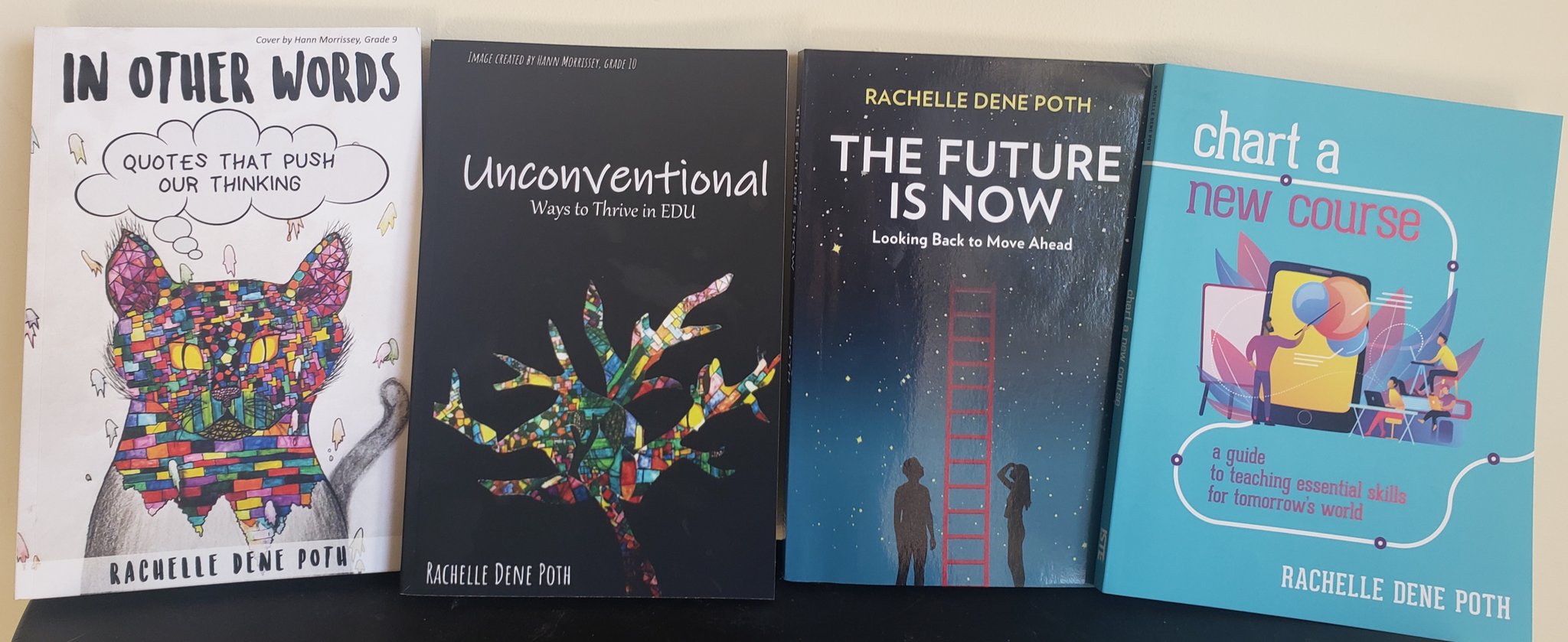
 

Looking for a new book to read? Many stories from educators, two student chapters, and a student-designed cover for In Other Words.

Find these available at bit.ly/Pothbooks  

Book4.png

A New Way of Looking At Student Created News

Guest post by Jason Clark, Innovation Specialist, Eagle Point School District 9, Eagle Point, Oregon     Twitter: @jpclark03    #Go3agles #epsd9 


Throughout my career as an educator and edtech enthusiast, one of my passions has been to use video to tell a story, or to deliver news. At every school that I have been at along my journey (elementary school), I have created a student news program. This started way back before digital video and personal devices, and that makes me feel like a fossil. I have created news programs that aired live through closed circuit cable every single day, and news programs that were pre-recorded and posted to our school webpage via youtube every day. It was always a huge hit with students and we found that it was a great way to reach our parents and community as well, once our shows were shared on youtube. That’s that magic of it, students reaching an audience to deliver a message in a fun creative way.

In my new role as an Innovation Specialist for my district, one of my goals is to begin student news programs in each school. Our district is a 1:1 iPad district which puts us in a very unique situation. Every single student from K-12 has a working studio in their hands, with the ability to reach a broad audience. That is powerful. Our high school just started a video production class this year and we’ve built a working studio that is based and focused on the iPad. We use Padcaster Studios along with our ipads to create two video news episodes a week that go out to students and the community. The episodes are fun and creative. However, it is very difficult for teachers to take time out of the day to watch the news with students. Time is always an issue.

One trend that I’ve noticed is that we aren’t generating the views that we had hoped to get.

How can we reach our high school students in a different way? The news and announcements are filled with important information that they need to know, but many are missing them because the don’t listen to the intercom announcements (I’m guilty as well) or get a chance, or the time to view our student video news (Eagle News) on youtube. Then it hit me.

There is a way to hit just about every student in our high school with the important news and information that they need to know. We are now taking a risk that many schools are not willing to take. We are using the platforms that the majority of high school aged students use regularly. We are pushing out our video news and announcements through Snapchat, Instagram, and Twitter. Our students are consumers of a constant bombardment of information, so watching a 3-4 minute news episode is unlikely to happen throughout their day. However, they check their Snap, Insta, and Twitter accounts between classes (never during class) and when they are away from school. We are meeting them where they are at. Our video students and leadership students are changing the way school news and announcements are sent and received. They are content creators of short bite-sized nuggets of news that will reach their peers and the community in multiple ways. We are evolving what school news can look like, and it’s exciting to see where it goes.

One thing to consider is building trust with students and the use of social media. They don’t necessarily want teachers to see what they are doing and posting on their social media accounts. The way that we build trust with our students is that our Eagle News accounts don’t follow anyone back. We are purely using the platforms to push out our content. All things said and done, our social media news does not replace our studio news. We still create our studio news episodes because even if we don’t have many viewers yet, the experience in a studio is vital to video production. What we have done is to mesh our created content together in multiple platforms to reach a greater audience.

Ask yourself this question: How do you get most of your news? Do you sit on your couch to watch the 6:00 pm news? Or do you get live updates from your local news station on Twitter or Facebook? As our world changes and technology changes, as educators, we need to pay careful attention to how our students view news so that we can adapt to meet them where they are. That place is usually one with a device close by.


**Interested in writing a guest blog for my site? Would love to share your ideas! Submit your post here.


Looking for a new book to read? Many stories from educators, two student chapters, and a student-designed cover for In Other Words.

Find these available at bit.ly/Pothbooks  


Books available

Game-ify Social Studies Learning & Current Event Learning with FANSchool.org

Opinions Expressed are those of the Author

Guest Post By: Gerald G. Huesken Jr, Social Studies Teacher – Elizabethtown Area High School, Elizabethtown, Pennsylvania

@MrHuesken

As someone who has been teaching high school social studies, particularly government and economics, for the better part of the last decade, a study from the Annenberg Public Policy Center at the University of Pennsylvania was quick to catch my eye. In this study, researchers found that American’s basic civic knowledge, as well as their basic understanding of current events around the world was startlingly lacking – only 26% of respondents could name all three branches of government compared to 37% of respondents naming a freedom protected by the First Amendment. Furthermore, researchers found that with this lacking basis of knowledge, respondents were even less likely to look at, consume, or engage in discussions about national or world events or understand their key significance. Quite shocking, to say the least.

While some of my colleagues would be quick to point out fundamental flaws in how we as teachers engage our students in basic civic education, we as educators do an equally flawed job of encouraging our students to read about and discuss current events and relate it to the broader issues of the day. Long seen as a “filler” in social studies classes, current events, in my opinion, serve a valuable purpose in relating course content to the real world for our students. Finding engaging and unique ways to get students making such connections and engaging with news media of all kinds is the real challenge. That is why I have become a believer in FANSchool.org.

Popularly referred to as “fantasy football for social studies and literacy standards,” FANSchool.org is an easy-to-use new learning site that attempts to “game-ify” current events consumption for students. Developed by Minnesota-based social studies teacher and FANSchool.org co-founder Eric Nelson, who was looking for a new way to engage his students in current events and the study of cultures around the globe.FANSchool.org (and its flagship games of Fantasy Politics & Fantasy Geopolitics) engages students in the study of current events in a new and different way, by turning it into a fantasy football-style experience. Students draft teams of countries or US states, follow those countries or states in the news, and get points for every time their countries or states are mentioned in assigned media outlines like The New York Times. The points are then tableted and posted on the FANSchool.org site. Using this game friendly system, teachers then have the flexibility (along with the network support of other educators using the FANSchool.org platform) to develop engaging activities, challenges, awards, and programs to engage their students more fully in the current events experience. The site also runs “March Madness-style” competitions for Presidential elections and the Olympic Games, pitting students from across the nation and the world in a knock-down current affairs slugfest for bragging rights and prizes.

In my classroom, I have used the Fantasy Geopolitics game as a way to further engage my Honors and on-level students in engaging with world events and international media, while promoting friendly academic competition. This November, FANSchool.org will roll out a new feature of their Fantasy Geopolitics game that includes the “drafting” of members of Congress along with US states, providing a new dimension of engagement for my Honors and on-level Government and Economics classes. Their Election Challenge game (provided every four years with the coming of a new Presidential election) also creates discussions of how the Electoral College will unfold and how Americans will vote for their next President, stimulating questions, discussion, and discovery of America’s political system. FANSchool.org’s devoted network of “Teacher-Commissioners” also provides a great opportunity for networking as well as a shared repository of activities, classroom ideas, and engaging projects. Have students write “Presidential briefs” of hot-current event topics to engage in civic or international action, or have them develop a podcast that discusses how the events of their game relates to the real world (like my students did with the Fantasy Geopolitics Podcast…)

With competition comes the quest for knowledge, and with knowledge comes true competency. That is the goal of FANSchool.org and this is why I would highly recommend fellow social studies educators check out this engaging and fun-filled current events tool for their social studies classroom.


**Interested in writing a guest blog for my site? Would love to share your ideas! Submit your post here.


Looking for a new book to read? Many stories from educators, two student chapters, and a student-designed cover for In Other Words.

Find these available at bit.ly/Pothbooks  


Books available

The Impact

The Impact
Guest Post by Megan Reinke, Student at Iowa State University, @MissMeganR

Last spring I took CI 245. It’s a class focusing on classroom management and lesson plans. That isn’t why I loved it though.

 I loved it because my teacher was one of the most supportive, knowledgeable, caring, fun teachers. People say, “You don’t get that in teachers at big universities,” but oh no, I definitely did. She is such a role model to me as I continue into the field of education. She didn’t just share her successes and high points of teaching, but she also shared her lowest points and failures. I loved this about her because it taught me that it is okay to mess up. Teaching and life is hard. We are all going to make mistakes.

 In her final thoughts on the last day, she had our class calculate the number of students we would touch the lives of throughout our teaching careers.

 There were 24 students in our class, and if we each thought for roughly 42 years, and had 20 students in our class then…

 (24 times 42 times 20)

 20,160.

 20,160 students. Wow.

 She started crying. I started crying. My class started crying. She went on to express how much she loved us, is proud of us, is excited for us, and going to miss this class.

 Point is, we all get the chance to make a big impact. HUGE in fact. I don’t mean this in regarding to the size of group or number of lives we get to impact. That number could have came out to be way smaller and it still would give me a reason to be purposeful in the ways I am impacting lives. Whether you get the chance to impact 20,000 lives or 2 lives, you get the opportunity to leave a HUGE impact on someone in this world. GET EXCITED FOR THIS! What are you doing now to prepare for this? How are you treating people everyday?

 Be that positive light, that positive influence, that supportive role model. Just how my teacher did to me.

Its 2019, and now I actually have a calculator (app) everywhere I go. Why do I need to learn math again?

Guest Post by Dan Haiem, @danclasscalcco1 

“But teacher, why do I need to learn this math stuff if I can just use my calculator app?”

Every teacher has heard this at some point. Most students have asked this at some point. Up until around 2007, teachers had a great answer that kinda-sorta worked, which went something like “You’re not going to always have a calculator everywhere you go, are you?”

The opposite of that, of course, became a reality when the iPhone became the most common tool found in any student’s pocket, and gave them access to powerful calculators like Desmos, Geogebra and our very own ClassCalc.

Here’s my opinion though – the old answer was never a good answer, and the ubiquity of iPhones has given us a golden opportunity to re-evaluate a very valid question. What’s the point of learning math if we have calculators that do math for us?

In the words of NYC’s (possibly) most high-energy math teacher, José Vilson, “Math shouldn’t be limited to a disconnected set of rules and jargon that doesn’t seem to mean much of anything.” If math really was about the rules and jargon, then a calculator could truly replace the need for learning it. Fortunately (for humans), it’s not.

For the sake of simplicity, and because this is my first blog post ever, here’s a short roadmap of this post’s approach to this topic:

  1. First, we’ll discuss how math helps students build tools and skills, and define the difference between the two:
    1. Tools: Spreadsheets, running an analysis, doing taxes.
    2. Skills: Good communication, emotional intelligence, problem-solving.
  2. Next, we’ll discuss how math has shifted from serving us as a tool, to helping us sharpen our skills – most important of which is problem-solving.
  3. Finally, we’ll take a look at an example of how a specific math problem helps us build a specific problem-solving skill called mental-triage, and how we might help students make that connection as well.

Onwards.

Math serves two primary purposes in education: it gives students the tools to play with numbers, and it serves as practice to sharpen certain mental skills that are important in life. To define the two:

  • Tools: Concrete things a person “knows.” Examples include: spreadsheets, coding, writing blog posts (a tool I clearly lack), social media advertisements, taxes, etc.

  • Skills: More abstract, broad abilities that are not particularly associated with executing a specific task – the kinds you always see in leadership charts. Examples include: Hard working, communicative, optimistic, honesty with self, problem-solving, etc.

*Credits to Business Simulations

In this sense, math falls into an interesting crossroads as both 1) part of the abstract skillset a person has, (ie: “problem-solving”) and 2) a tool that can be put to work (ie: part of your “toolkit” – like running a statistical analysis on two data sets).

It’s important to keep in mind though that:

Math will play a fundamentally different role for different students, and we need to bring that understanding into the classroom.

An engineer will likely benefit from math as both 1) an exercise in problem-solving (skill) and 2) a tool to accomplish certain tasks.

An artist might use the abstract side of problem-solving (skill) but – and this is especially applicable today, with all the calculators in our pockets – they probably will not have much use for math as a tool

Here’s a screenshot I grabbed off the might internet that summarizes the point (albeit, aggressively):

*drops mic*

I believe it’s important and ok to tell our students that not all of them will be using math as a tool. At this point, most people don’t need math to do taxes (here’s a calculator for that), split a tab (here’s a calculator for that) or accomplish any of the other tasks that might have required math as a “tool” before calculators were built.

To recap:

  • Math confers two types of skills: Abstract problem solving (skill) and an actual tool in your toolkit (tool)
  • Everyone can (probably) benefit from the problem-solving (skill) aspect. While some people (engineers, some scientists) benefit from having math in their toolkit (tool), most can get by with their super powerful pocket calculator.
  • So, for students not interested in pursuing a career that would require a math toolkit, we must focus on the abstract problem-solving (skill) aspect of math.

As brilliantly stated by Baltimore Ravens lineman and MIT mathematician John Urschel, we need “students to see that math extends far past the confines of the classroom and into everyday life.” What’s more “everyday life” in the 21st century than problem-solving?

Now the questions shifts to: How do we show students the relationship between learning math and developing this abstract ability to “problem-solve”?

I have two thoughts on this:

  1. One thing to consider is that skills and tools are actually mutually conducive. Google is a tool you learn to use. Being able to learn stuff on your own is a very important skill in today’s workforce. Knowing how to use the Google tool will help you build the learn-stuff-on-you-own skill. I think the same applies to math.

Although students may never use calculus directly, the mental exercises they go through in solving calculus problems might help improve the mental muscles required for peripherally related skills.

  1. We need to find good examples to demonstrate the above. I mean good examples. Not the “Well, don’t you want to know how to do this without your calculator?” type of answer and not the “Being able to do your taxes is very important” type of answer and not the “here’s an example of Timmy calculating the volume of the Earth by standing on a ladder and looking at the horizon (although that’s super cool)” type of example. These examples all focus on the tool aspect of math, which we know won’t be as relevant to all students. We need to focus on the skill aspect of mathematics.

So now the challenge becomes being able to demonstrate to students a link between learning math and learning how to problem-solve. A good approach might be to 1) Have your students break down what sub-skills are required to succeed in math 2) Have your students break down what sub-skills are required to problem-solve 3) Discuss the cross-overs.

One of my favorite examples is mental triage: the abstract skill of quickly finding the most efficient path through a challenge given a limited toolkit.

Here’s an example of a math problem that helps sharpen the sub-skill of mental triage:

  1. Math itself is a limited toolkit. You learn how to move numbers around. How to draw graphs etc. Each time you learn one of these new tools, you’re essentially learning a new way to play with numbers. When we approach a math problem, we subconsciously run an analysis that goes something like this: What do I want to make these numbers do? What tools do I have to move these numbers around? What tools am I not allowed to use? What is the most efficient tool path to an answer?
  2. As an example, let’s take the following problem, a favorite of the SAT:

  1. Here’s how my brain runs through my math toolkit.
    1. I gotta solve for x.
    2. Problem: x is in the exponent.
    3. Do I have any tools to get rid of an exponent?
    4. I can raise both sides to ^(1/4x) which would lead to:
      1. No good. Back to step c.
    5. How else can I get rid of the exponent? Logarithms, let’s try that:
      1. which simplifies to:
    6. Great, we got rid of x in the exponent. Onwards! Divide both sides by 4log(2):
    7. Plug into by handy dandy ClassCalc Calculator to get:
      1. x=1

There we have it: mental triage in math.

Finally, we’ll bring it full circle with a real-world example of mental-triage as a sub-skill of problem solving.

Teaching my high school students how to pick a college

It was the last day of my physics class last year, and my students were just about done with school. They had already taken the AP test and were ready for summer. Instead of squeezing in another physics lesson, I decided to tackle a more pressing concern of theirs – choosing a university.

In retrospect, my method for picking a university was suboptimal – I just asked my good friends where they were going and what they thought a good college was, and ended up at UCLA. Lucky for me, I met good people there and had an awesome experience, but many others who take the same approach are not. I wanted to teach my students how to be proactive and problem-solving-oriented in making life choices.

Rather than start with “I want to go to college” I wanted to help each one of them hear their inner voice, and begin a dialogue with it. Start for the bottom. Here was my approach:

Student: *Says something*

Me:

And this is what the conversation ended up sounding like:

  • Student: What college should I go to?
  • Me: Why do you want to go to college?
  • Student: I need to get an edu-
  • Me: Yes, but why do you need an education? What’s your goal?
  • Student: I want to make money. Goal number 1: Make money!
  • Me: Honest, but fair. What else? A lot of jobs will make you money.
  • Student: I want to become a doctor.
  • Me: Do you for sure 100% want to become a doctor? Have you had real exposure to medicine? Or is it alluring to you for other reasons?
  • Student: I’m not sure. I want to figure out what I want to become. Goal number 2: Explore career options!
  • Me: Ok, what else?
  • Student: I want to make good friends and party. Goal number 3: Have fun
  • And so on..

By the end, we put together a list of priorities for each student. I could see their perspective change drastically. Rather than listen to a parent’s friend’s suggestion, they were determined to go online and research.

Now, I am not necessarily saying that a better mathematician is going to be better at selecting a college, but certainly, the tools we learn in math can inform our decision-making process for the important choices we must all make in life, especially if we are aware that there is a problem-solving oriented approach to making these decisions. Our jobs, as teachers, is to help students form that awareness.

A good method for cultivating that awareness is with Miyagi Moment every so often. What’s a Miyagi Moment moment, you ask?

It’s a metaphor for when a teacher (or sensei) helps a student develop a crucial skill by practicing adjacently related skills that at first do not seem connected.

In the first gif below, we see the legendary Mr. Miyagi teaching Daniel San how to…wax a car. Not really relevant to fighting karate.

In a later scene, Daniel san gets angry, accusing Mr. Miyagi of wasting his time with chores, when he should be learning super cool action moves to take down the big bully Johnny. Right then and there, Mr. Miyagi throws a couple of HYAH punches and BAM. Daniel san blocks them – all the while shocked in disbelief that he had developed the skills to do so. That moment of disbelief in the newly developed skill is the Miyagi Moment!

In math, students will often be practicing skills that seem almost irrelevant to them in life. It is up to us teachers to remind our students every so often that that is not the case. The best way to show them that is with a Miyagi Moment. It is time away from teaching the next chapter or lesson, but it is time well-spent.

I think blogger and math teacher John Trout McCrann put it beautifully in writing “Deep understanding about the process of solving an equation helps everyone understand how to create systems to solve problems at work, in their families, in our world. The kinds of problem-solving strategies you might use to tackle a big project, develop a more efficient engine, or address an issue that’s arisen between you and your partner. Deep understandings about shapes help everyone understand how to reason spatially, a skill that you may one day apply as a designer or as you lay out the furniture in your first house or apartment.”

About Me (Daniel Haiem):

  • I love math and education.
  • I’m an ex-physics teacher
  • I founded and lead a company called ClassCalc – the lockdown calculator app that lets teachers lock students out of all outside distractions such as instagram, calls and texts, keeping students focused in class, and preventing cheating on tests. Our goal is 100% access to calculators for students across the planet by 2025.

**Interested in writing a guest blog for my site? Would love to share your ideas! Submit your post here.


Looking for a new book to read? Many stories from educators, two student chapters, and a student-designed cover for In Other Words.

Find these available at bit.ly/Pothbooks  


Books available

Digital Citizenship- Parents

Guest Post by Kimberly Tumambing Executive Assistant at Gorman Learning Charter Network

Digital Citizenship

Recently, I was visiting with my nine year old niece, when she proceeded to pull out her iPad and log into her Youtube account. She showed me the amazing little videos she is creating, editing and publishing. In the same evening, my twenty-six year old niece told me she just learned that she can open a .pdf on her phone. I laughed. The difference in digital presence and understanding is huge when you think about the fact that there is only a seventeen year gap between the two girls.

Today’s youth are faced with so many opportunities for success and achievement, but also with so many possibilities for failure and regret.

How can we help them to become better Digital Citizens, when so much of what they are experiencing is still new to us?

This is the question that has inspired me to help parents learn more about what it means to be a Digital Citizen and how you can help equip your children with the tools they need to navigate this new world.

Digital Citizenship is when a person utilizes Information Technology in order to engage in society, politics and government. Information Technology consists of computers, laptops, tablets, phones, and other devices.

So when I started this campaign, I asked myself, what would I tell my younger self, if I could send her a Facebook message. And what I came up with is this: once you put it on the internet, it is forever on the internet. Photos you wish had never existed, conversations you wish you hadn’t had, personal information, and so much more. So, younger me, how do you participate in this digital world without risking college scholarships, potential jobs, and possible legal ramifications? How do you keep yourself safe from predators, while engaging in social activities?

And I came up with this answer: by being well informed. We can’t shelter children from the dangers of being a Digital Citizen. But we can teach them what to share, and how to share, responsibly. But where can parents go for help? If I were to try and teach you everything I have learned, you would be reading this blog for the next three to four hours.

So instead, I’m going to share with you two of my greatest resources. My school has a go to website that we recommend for our families when parents call and ask about the dangers of certain websites or applications. The organization is called Common Sense Media. I recommend you start with the privacy and internet safety section for Parents. Did you know many of the applications your child is downloading will come with locations settings turned on? So everyone will know where your child is just by checking the background location indicator. But there is a way to turn this setting off and protect your child’s location. My hope is that this website will help you keep your students safe.

But what about their online etiquette? Everyone looks at a student’s online profile these days. Colleges and Universities are looking at possible athletic candidates and the photos they posted during their middle school and high school days. Future employers are looking to see what kind of language a person uses online, or what articles they favor, or if they fight over social media or maintain some kind of respectful dialogue. And they aren’t just looking at Facebook either. Twitter, LinkedIn, Twitch, Youtube, and personal blogs are great places for someone to learn everything they may want to know about your child.

To be a good digital citizen, your child also needs to realize they are not protected just because it wasn’t “said” in person. A student can be prosecuted in a court of law for digital threats, accusations, and “jokes.” Students who threaten to kill others, even if it is a “joke” on Twitter, can be prosecuted and face possible charges.

I also recommend the National Online Safety website. The resource section of this website has some great infographics describing websites and applications that students tend to favor. They even cover video games and chat rooms. They also have some helpful information about Social Media sites and the effect on your child’s mental health. And their infographics are updated regularly depending on what is trending amongst kids.

Parents, you don’t have it easy these days. You have to teach your children to be safe and polite in both the physical world and the digital one. You have to teach your children how to interact with people they are talking to face-to-face and people they are conversing with via instant messenger. My hope is that the websites I have provided to you will give you the information you need to train up strong, well informed, world changers who can travel between both worlds with ease.

Teaching Can Be Challenging


Guest Post by Andrew Easton, @EastonA1, Personalized Learning Collaborator and Consultant, Westside Community Schools in Omaha, Nebraska

*Future DBC Inc. author on Personalized Learning, Spring 2020

Now that we are into November, it’s likely that at some point this year you’ve been asked the question, “So, do you have a pretty good group this year?” In my time in education, I’ve heard a myriad of answers to this question – some that I don’t want to repeat. Whether it’s right or wrong or not even a thing worth discussing, I do find it interesting to hear what a teacher has to say. And actually, there is one word in particular hat comes up rather consistently when this question is asked. One that on its own doesn’t completely address the question. The word “challenging.”

This year, I am redesigning our high school’s English 4 course and am teaching that class for the first time. When the teacher who had previously taught that course retired, she politely used the word “challenging” when describing to me the group of students that she typically supported in that course. She quickly followed that up with a “Good luck!” that felt more like a warning than words of encouragement.

English 4 is an appealing option for students who are simply looking to pass an English class to graduate and pick up a few helpful life hacks along the way. Many of our students have had significant struggles with learning in the past for a variety of reasons. Those reasons have made it hard for them to find consistent academic success. For these students, senior year has brought both the liberating promise of change once they reach the end of May but along with it the stinging reality that they have navigated their K-12 education to the 12 end of that spectrum and the experience has left them feeling like they have not taken much from a system that has helped some of their peers to thrive. 

Planning over the summer was, well, challenging in its own right. I knew very little about this group that wasn’t second hand knowledge. But as I perused the gradebook and academic history for some of my students prior to the start of the year, I knew one thing: I had to give these learners the opportunity to feel what accomplishment feels like. There is a certain rhythm to success that has to be found and then felt before it starts to beat and almost swell from within. I guessed then and now know that many of these students have never heard, nor much less felt that beat, and I knew that I would be working against thirteen years of baggage if I tried to convince them, initially at least, to search for this experience in an academic setting. But I had an idea.

When I find myself feeling stagnant in my own motivation, I often start a #Five4Five Challenge. The #Five4Five challenge was created by Michael Matera, author of Explore Like a Pirate, in the spring of 2018. He posed this challenge through his Twitter and YouTube account, and I was immediately intrigued by the idea. The #Five4Five Challenge asks individuals to select one “thing to do” and do that thing each day for five days straight. What you decide to do is entirely up to you, but you have to do it once a day for each of the five days to succeed. I myself had done six #Five4Five Challenges before the school year began. I had created a vlog, done anonymous acts of kindness, set workout goals, even given up Starbucks for five days straight (that one was brutal). The goal itself doesn’t matter; it’s not about the goal. It’s about intentionality and filling your day with purpose and success. It seemed like the right fit for my learners, and so in the second week of school, I issued them all a challenge.

Now, if I’m being honest, I wasn’t exactly sure how they would respond to it. Would they laugh this off? Would they be into it for a week or two and then fade away as the grind of the semester progressed? Well, I’m happy to share that as I’m writing this, we just finished our fourth week of #Five4Fives (we go two weeks on, one week off), and the experience has not only gone well but it has exceeded all my expectations.

Our implementation has been pretty simple. We created a one-sided handout that has four boxes on it, one box for each of the first four weeks of the course. Each box contains a line for the learner to write out their goal for that week, the days of the week with a checkbox next to each day, and a place for the learner to sign their name if they complete the challenge by the end of the week. 

This is not for a grade and we try to keep our daily commitment to discussing these goals to five minutes or less each class period. We don’t always open class with our #Five4Fives, but when we do, I really enjoy it. It’s captivating and powerful for class to begin with students openly sharing their passions and accomplishments. It’s been such a positive culture piece. It’s also been encouraging to watch students fail for a day and then keep going for that week. I’ve noticed too a greater sense of resilience in the students; in the first week, most would hang their head if they had to share about missing their goal the previous day, but now they confidently share their failures too. In those moments, I try to ask, “So are you going to get back on track tomorrow?” Most answer yes and at least make that goal for another day or two that week.

One month in, I’m really glad that we don’t require that the #Five4Five goals be education related. It’s funny, despite having the freedom to set any goal they wish, several students each week still choose a goal that has something to do with school. The goals that they set often speak to their values, their challenges, and desires for change; by offering them the freedom to create the goal that they want they are more willing to follow through with it. The only stipulation we have set for the goals is that they must be measurable. 

Check out how we are doing! Here’s some of the data we have collected thus far…


#Five4Five Challenge: Number of Students Completing a Certain Number of Goals Per Week

Completed One Goal  Completed Two Goals Completed Three Goals  Completed Four Goals Completed All Five Goals 
Week One 4 Students 5 Students 4 Students 10 Students 25 Students
Week Two 5 Students 4 Students 4 Students 8 Students 27 Students
Week Three 1 Student 2 Students 7 Students 2 Students 36 Students


Though I’m not sure that I needed this data to have a sense that this practice was having a positive influence on our learners, I’m very happy with the story these numbers seem to tell. I’ll leave you to draw your own conclusions from it.

A final piece of evidence that I would like to share comes from our weekly Flipgrid video reflections that students have gotten into the habit of recording. Every two weeks, the students create a video in which they reflect on their efforts in the course and with their #Five4Five goals. This reflection comes from a student named Luis. In week two, Luis chose to set an academic goal for himself, and I’m proud to say that Luis met his goal that week. Afterward he reflected on his experience saying, “…my goal was to do my homework for every class, and I was surprisingly successful. I picked it because junior year I was not good with homework at all and I just had so many missing assignments. And for senior year I want to be able to do all my homework and get some good grades because my grades were terrible last year. I just want to be able to see what I can do, and this goal has really helped me this week.” 

Ugh, I love that! 

So, the next time someone asks me, “Do you have a pretty good group this year?” I’m looking forward to shooting them a smirk and answering, “Yes, they are definitely… challenging.” Challenging themselves, challenging me to be a better teacher and a better person, and challenging the way I think about my responsibility to help them grow both as people and learners.

Andrew is the Host of the Westside Personalized Podcast (bit.ly/WPPodcast)

WestsidePersonalized.com

httpslh4googleusercontentcomiqqmugjnikqwzg6btyvzwn8yfzsage9nrprlahpsorfcrl44eb5hzn2_pz8uaco2qnx61-0k67btfpht52z_t7oxezszosdt1zjtphib

**Interested in writing a guest blog for my site? Would love to share your ideas! Submit your post here.

 

Looking for a new book to read? Many stories from educators, two student chapters, and a student-designed cover for In Other Words.

Find these available at bit.ly/Pothbooks  


Books available

What made me better

Guest post by Deidre Roemer,  Director of Leadership and Learning West Allis, WI, @deidre_roemer


When I reflect on my skills as a teacher throughout my career, I can think of examples of what I did well and a million things I would have done differently.  I am teaching a class at a local university this semester and know confidently that I am a better teacher now than I was when I was in the classroom. The opportunity to see other teachers in action in my leadership role for the last several years is what has made me better.  I get to speak to educators and learners all the time about what is working well in their classrooms and what they would like to see grow. It includes spending time in many classrooms where we and others are getting it right and learners can articulate the process of their learning in order to create great things.

Professional development that is connected to a vision of our work with meaningful processing time to reflect is how we push teachers to move from single projects to true learner driven practice.  We take a lot of teachers and teams on site visits to schools in our area and across our country who are already doing the kind of work we are trying to do to see it in action. It is hard to find a large comprehensive system that is there yet, so we are often at small charters of specialty programs that are offshoots of schools.  The visits are always amazing as we are able to interact with teachers and learners and see learner driven practice, but often the most important part of the time is the meal after the visit or the long trip home where we can talk about what we saw, process, and plan for what parts we can implement within our system. The goal is not to replicate but to figure out how to ask the right reflective questions of ourselves and one another to tie what we saw to our personal passions and interests and figure out how to bring all of that together to shift the learner experience.

We also spend a lot of our time talking about how this is the kind of learning experience ALL learners should have.  It should not be reserved for some kids in special programs or special schools. The visits with the deep discussions are often the leverage point that takes an educator from trying a few things to a true shift of practice that is more inclusive.  It helps them to be more collaborative as they are often on these visits with other staff from across our district that they might not already know having a shared experience . The power in seeing some things we are already doing well and celebrating those helps us to not be overwhelmed when looking for ways to grow.  The key is to make the time, take the staff who are ready to take some bold steps, and then follow up with them multiple times throughout the year so they have support to keep going with the work.

On a recent site visit, I took a chance and messaged some of the teachers to join us off-site after the formal conference to continue our learning.  Fortunately, they were willing to take the opportunity to discuss their work with us over dinner. It was an impactful experience to listen to teachers that have been doing this work for some time engage in professional discourse about grading, telling their story and standards.  The teachers were open about their own growth over time and how our staff could take pieces of what they saw back to our schools to create a more equitable opportunities for all learners through empowerment. We went back to the site the next day with a new lens on what to look for in learner and teacher observations that we could do instead of being lost in the surface things like the physical set-up.  Things that may have looked idealistic the day before now looked possible. The modeling of professional discourse created space for our team to do the same and ask some great questions about how we can do this work and how it does not have to look the same across all our schools.  Encouraging staff to push boundaries and challenge one another’s thinking is how we look at someone else’s professional practice and find a way to make it our own.

A few things we discover each time we do a site visit became apparent:

  • This work is messy.  It takes deep dialogue on what is right for learners and how to give up control in a way that is not always natural for teachers.
  • Change is uncomfortable and unpredictable, but easier with the proper support.  People tend to say, “Change is hard.” There was a great article from the Harvard Business Review in January of 2008 that explained why that phrase becomes a self-fulfilling prophecy that permits us not to try.  We have to be able to think bigger than that.
  • We need to get more comfortable with professional discourse and open discussion about where we are now and where we can go that may push our thinking.
  • Teachers have to connect their own passion to their work in schools.  When it is authentic to the teachers, it becomes authentic with the learners.
  • Our teachers need to see the work in action often and learn how to get and give productive feedback.
  • The standards are always embedded in innovative, learner driven work.  They just aren’t always owned solely by the teacher.
  • Many times, the teacher in a learner driven classroom finds joy in their work.

We have evolved our district wide professional development to hopefully reflect all of these.  Our teachers will have time in small groups to learn their standards well enough to empower learners to take ownership of mastery of those standards within cross-curricular projects.  Staff will then have the opportunity to sign up to see another teacher modeling classroom practice that is learner driven. They will be our own internal site visits. We will use structured protocols to get and give feedback at each site to ensure we are using the time for genuine collaboration as we know that is what drives teacher practice.  We can’t make more time than we have, so we use the protocols from The School Reform Initiative as a way to restructure the time and make sure it is used for purposeful feedback and collaboration.

Our teachers hosting visits that day have been invited to participate for the first round as they are already trying new things, having success with learner empowerment and finding joy in their work.  It is not expected that anything that is “perfect” or a “show”.  It is meant for one teacher to share their experience and encourage others to try new things with an open dialogue about how and what supports they will need. Our goal is that our teachers engage with one another to see what’s possible, work together to get there for every learner and find joy in the work.


**Interested in writing a guest blog for my site? Would love to share your ideas! Submit your post here.


Looking for a new book to read? Many stories from educators, two student chapters, and a student-designed cover for In Other Words.

Find these available at bit.ly/Pothbooks  


Books available

Building a Culture of Readers

Guest Post by Liz Janusz, Instructional Coach in SD113A in Lemont, IL. @mrs_janusz

I know the end of the school year is near, but I can’t seem to stop thinking about next year already! I have many goals for next school year: get into some coaching cycles with our amazing teachers, share more professional development books, but my number one goal for next year is to begin to build a culture of readers in our school.

Creating a reading culture in a school is essential if we want to encourage students to become engaged and motivated readers. Reading for fun should be celebrated and encouraged throughout the school day! Developing a strong culture of readers takes time and commitment from all involved, which is why I’ve already started planning for next year!

What do you need to begin to build a culture of readers?

  • Everyone should have a clear understanding of why building a culture of readers is so important. Reading for pleasure is the BEST way to develop and strengthen literacy skills and improve academic achievement.
  • A shared vision of what your school’s reading culture means in real words.
  • Full support of all staff in the building, including custodians, PE teachers, paraprofessionals, etc.
  • Books, books, and more books!

What are some things I can do to start building a culture of readers?

  • Encourage students to book talk the book they just finished reading to the rest of the class. Most of the time, they will be able to hook their peers on a book better that we could! Peer recommendations are one of the most powerful ways we can get more books into the hands of students!
  • Offer book clubs during the lunch periods. Pick a few books from an award list (Caudill, Newbery, Monarch, etc) and offer the chance for students to come in during their lunchtime to discuss the book that everyone is reading. Picking a book from an award list, will more than likely will leave them wanting to read the rest of on the list!
  • Set up an area in the school library where teachers can leave book recommendations for students.
  • As you are walking around the hallways, try simply carrying a book with you. I’m shocked at how many kids stop me in the hallway when I am carrying a book! They want to either tell me that they are reading it too or want me to tell them what they book is about.
  • Make your classroom library and sacred and inviting space. Don’t just throw random books in tubs and be done with it. Get your students involved and be thoughtful about how you arrange your library so it would be most accessible for your class.
  • Make books available all throughout the building! Put some shelves in the hallways and make displays based on what grade levels are teaching about or highlight a certain genre.

How can I get ALL staff members involved?

  • Over the summer have students and staff take pictures of themselves reading and post them with a school hashtag. When school begins in the fall create a slidedeck with all the all different pictures so we can celebrate all of the summer reading!
  • Create “What I’m Currently Reading” signs for EVERY SINGLE staff member in your building. These can hang outside their classroom, office, lunchroom, gym etc. Staff members can update these every time they read a new book. Students can see that all staff members value reading for fun and will hopefully get them excited about their own reading.
  • Set up a book swap! Have all teachers look through their classroom libraries and select books that they would put in the swap. Other teachers and students could then come look through the books and decide which “new” books they would like in their library. Everyone gets “new” books for their library, without spending money!
  • Make sure your school has a wide variety of books! For example, there are a lot of great math books out there. Buy some for your math teachers to have in the classroom that they can read aloud or reference while teaching.


**Interested in writing a guest blog for my site? I would love to share your ideas! Submit your post here.


Looking for a new book to read? Many stories from educators, two student chapters, and a student-designed cover for In Other Words.

Find these available at bit.ly/Pothbooks  


Books available

TeacherCast Educational Network | Developing Standards-Based Instructional Technology Integration

Technology Integration - Instructional Coaching - Productivity Secrets for Educators

Leadership Liner Notes: Sean Gaillard

Built on Connection. Tuned for Impact.

Stories by Thomas Oppong on Medium

Dr. Rachelle Dené Poth @Rdene915 Educator, Consultant & Keynote Speaker, Author, Attorney #THRIVEinEDU

Hooked On Innovation

When Innovation slaps you in the face, we slap back.

Teach Better

Dr. Rachelle Dené Poth @Rdene915 Educator, Consultant & Keynote Speaker, Author, Attorney #THRIVEinEDU

BrianKulak.com

Dr. Rachelle Dené Poth @Rdene915 Educator, Consultant & Keynote Speaker, Author, Attorney #THRIVEinEDU

The Principal of Change

Stories of learning and leading

Mandy Froehlich

Dr. Rachelle Dené Poth @Rdene915 Educator, Consultant & Keynote Speaker, Author, Attorney #THRIVEinEDU

Katie Martin

Informed by research, refined by practice

#RocknTheBoat

Rocking today's classrooms, one teacher, student, and class at a time.

User Generated Education

Education as it should be - passion-based.

Learning as I go: Reflections & lessons learned

Dr. Rachelle Dené Poth @Rdene915 Educator, Consultant & Keynote Speaker, Author, Attorney #THRIVEinEDU

Serendipity in Education

Join me, Allyson Apsey, as I stumble upon the fortunes of learning, laughing, and celebrating alongside incredible people.