Building a strong home-to-school partnership with families is important throughout the school year. Students need to have consistent support both in and out of the classroom, and the best way to achieve this is by establishing relationships between the school community and the families and students that we support. I start the year by emailing families and students using our gradebook messaging system. I introduce myself and share my excitement for the new school year, provide some resources that we will use in class, and make sure that families know that I am available to support them and my students. Many times I receive an email from families right away and it is great to start forming those connections and learning about my students and their families.
Why the home-to-school partnership is essential
We want to engage families in their children’s day-to-day learning experiences. Establishing consistent collaboration with families will help us cultivate an environment for learning at home and at school.
Continue reading the rest of this article on Edutopia.
About the Author:
Dr. Rachelle Dené Poth is a Spanish and STEAM: What’s Next in Emerging Technology Teacher at Riverview High School in Oakmont, PA. Rachelle is also an attorney with a Juris Doctor degree from Duquesne University School of Law and a Master’s in Instructional Technology. Rachelle received her Doctorate in Instructional Technology, and her research focus was on AI and Professional Development. In addition to teaching, she is a full-time consultant and works with companies and organizations to provide PD, speaking, and consulting services. Contact Rachelle for your event!
Rachelle is an ISTE-certified educator and community leader and served as president of the ISTE Teacher Education Network. She was named the EdTech Trendsetter of 2024 by EdTech Digest, one of 30 K-12 IT Influencers to follow in 2021, and one of 150 Women Global EdTech Thought Leaders in 2022.
She is the author of nine books including ‘In Other Words: Quotes That Push Our Thinking,” “Unconventional Ways to Thrive in EDU,” “The Future is Now: Looking Back to Move Ahead,” “Chart A New Course: A Guide to Teaching Essential Skills for Tomorrow’s World, “True Story: Lessons That One Kid Taught Us,” “Things I Wish […] Knew” and her newest “How To Teach AI” is available from ISTE or on Amazon.
Contact Rachelle to schedule sessions about Artificial Intelligence, Coding, AR/VR, and more for your school or your event! Submit the Contact Form.
Follow Rachelle on Twitter(X) and Instagram at @Rdene915
**Interested in writing a guest blog for my site? Would love to share your ideas! Submit your post here. Looking for a new book to read? Find these available at bit.ly/Pothbooks
************ Also check out my THRIVEinEDU PodcastHere!
Join my show on THRIVEinEDU on Facebook. Join the group here
Guest post by Dr. Amy Mathews-Perez, a Director of Special Programs in a public school in Central Texas. Connect with Amy on X (formerly Twitter) at @drgrowtoknow, on Facebook at DrAmy MP, or at her website dramyperez.com
I’m wondering how you read the title of this blog. Did you read it as Dear, Stressed Me (self pity-ish) or as the beginning of a letter? Either way works (and both apply at some point or another for all of us, right?) and serve as an opportunity to self-reflect on why you read it that way. The intention was that the title is the beginning of a note – to yourself.
We all get stressed out, no doubt. Stress is not a selective force – it impacts every one of us in different ways, at different times, for different reasons, for different lengths of time, and with different results/responses. If you have spent time reflecting, you’ve probably figured out (or are figuring out) how to talk yourself through these stressful times. There is a popular quote by Zig Ziglar: “The most influential person you will talk to all day is you.” There are also many varieties of this message floating around, but the point is the same: Self-talk is powerful.
The hard part about self-talk is easy to identify: judgment. We second guess ourselves, we feel silly, we want to do it “right.” However, I want to make you aware of two important things related to self-talk: (1) You already talk to yourself, whether out loud or just in your head -or both for some of us. When it is instinctive, we don’t pause to evaluate it, we just do it. Whether we are pumping ourselves up to do something challenging (EX: A job interview), calming ourselves down to get through something difficult (EX: Getting pulled over) or celebrating our success in getting something accomplished (EX: We got the job?). Here is your challenge: pay attention next time it happens, and then add to it with an intentional, positive phrase. The second thing I want to make you aware of is this: (2) There is no “right” or “perfect” way to do self-talk. You know yourself – or are learning about yourself. We figure out if we need a voice of rant, rage, encouragement, empowerment, cheer (or all of these). Some of us need a pep-talk, some of us need to be reminded to live up to our potential, some of us need to be remotivated with goals, some of us need a “no-excuses” approach, and some of us need empathy during times of stress.
We live, we learn; we stress, we recover; we breathe and continue going forward in learning.
Understanding the value of positive talk, encouragement and kindness, imagine if you could facilitate a positive outcome for someone else that is going through a stressful time. This blog provides a method for you to do that. Originally intended for leaders in work settings, this activity can be done with any group or person you choose.
Whatever your relationship (leader, friend, co-worker, etc.) I’m going to assume that you want to help others be their best; you do your best to meet the needs of others. There will be times when your support will be effective & that is awesome. However, other times, a person’s “self-talk” support can be more helpful than our support. A common situation we all face is that we get so busy we don’t take the time to think about motivating ourselves or others, much less by writing it down. So, here is an activity that capitalizes on creating that opportunity for others: it honors each person’s self-awareness/knowledge and allows you to support each person individually during stressful times. This is an activity that I’ve done with my staff for three years in a row and it has had multiple positive outcomes every time.
You pick the “Who” & the “When.”. Here is the “How” (then we’ll visit the benefits):
Give each person a blank note card & envelope. (have each person seated away from each other)
Have the person write their name on the envelope.
Ask each person to write themselves a “Dear Stressed Me” note. Assure them that this is 100% confidential; NO ONE will read their note.
Once they each complete the note, have them put it in the envelope that they put their name on – and seal the envelope.
Collect the envelopes and put them in a place you’ll remember.
During the school year, when you notice that one of those people is stressed out, hand-deliver their note to them. (If you want to give them a treat when you do that, that typically brings a smile; a Sonic drink, candy bar, favorite pen, etc., but this is not foundational to this activity)
When they say, “Thank you” (they typically do) you can respond with something like: “Don’t thank me, thank yourself.”
What they are really thanking you for is “seeing” them; acknowledging them, and showing care about them being stressed. Done with authenticity, this can build relationships, ease stress, and create a moment to take a breath. As an added benefit, it promotes the value of you being in tune with each person because YOU are going to give each person their own note….at a time that you notice they need it. Notice a need, share your care, and build resiliency.
I believe in positive intent, and I’m passionate about empowering and encouraging others. I hope that this has provided an easy action you can take, and, equally importantly, I hope you take time to validate yourself for the hard work you’ve done, the progress you’ve made, and your willingness to learn. If you use this activity & would like to share your outcomes, I’d appreciate the opportunity to connect. dramymp@gmail.com or on X @drgrowtoknow.
About Amy
Texas-born & raised, Amy is in her 32nd year of serving public education. General Ed. Teacher, SLP, Diagnostician, SPED Supervisor, Assistant Principal, Principal, and Director of Special Education are roles she’s held. She is the CEO of Making Education Special for All (M.E.S.A), an LLC dedicated to training, facilitation, consultation, and speaking engagements that revolve around information, motivation, and insights on why and how to make education special for all stakeholders. Her passions are communication, joy, authenticity, and empowerment. “Life is short but our influence is never-ending,” and Amy is committed to connecting with others through service and smiles.
Rachelle’s blog
Dr. Rachelle Dené Poth is a Spanish and STEAM: What’s Next in Emerging Technology Teacher at Riverview High School in Oakmont, PA. Rachelle is also an attorney with a Juris Doctor degree from Duquesne University School of Law and a Master’s in Instructional Technology. Rachelle received her Doctorate in Instructional Technology, and her research focus was on AI and Professional Development. In addition to teaching, she is a full-time consultant and works with companies and organizations to provide PD, speaking, and consulting services. Contact Rachelle for your event!
Rachelle is an ISTE-certified educator and community leader who served as president of the ISTE Teacher Education Network. By EdTech Digest, she was named the EdTech Trendsetter of 2024, one of 30 K-12 IT Influencers to follow in 2021, and one of 150 Women Global EdTech Thought Leaders in 2022.
She is the author of nine books including ‘In Other Words: Quotes That Push Our Thinking,” “Unconventional Ways to Thrive in EDU,” “The Future is Now: Looking Back to Move Ahead,” “Chart A New Course: A Guide to Teaching Essential Skills for Tomorrow’s World, “True Story: Lessons That One Kid Taught Us,” “Things I Wish […] Knew” and her newest “How To Teach AI” is available from ISTE or on Amazon.
Contact Rachelle to schedule sessions about Artificial Intelligence, Coding, AR/VR, and more for your school or your event! Submit the Contact Form.
Follow Rachelle on Twitter(X) and Instagram at @Rdene915
**Interested in writing a guest blog for my site? Would love to share your ideas! Submit your post here. Looking for a new book to read? Find these available at bit.ly/Pothbooks
************ Also check out my THRIVEinEDU PodcastHere!
Join my show on THRIVEinEDU on Facebook. Join the group here.
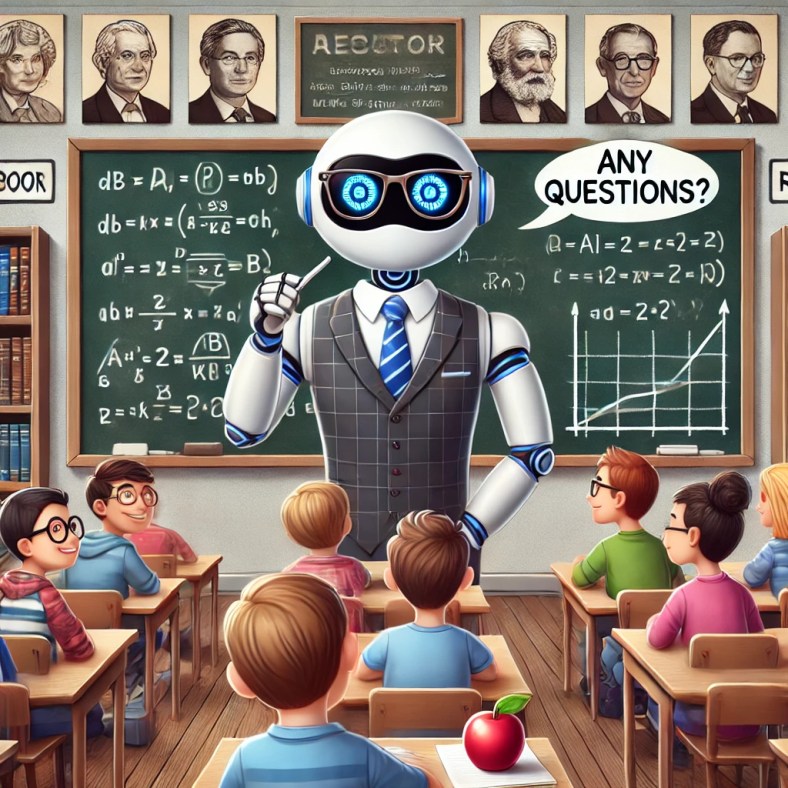
A slight update of my first post on AI in 2018. Image above generated by AI.
Over the past seven years, I have focused on learning more about artificial intelligence. Initially I thought I understood the meaning of AI. But I did not.
In early 2018, I noticed that AI was becoming an increasingly popular topic of discussion in the blogs that I was reading and in social media posts. When I first started thinking of AI, I had a flashback to the 2004 movie I, Robot, which starred Will Smith. In the movie, set in 2035, robots filled public service positions and were able to think like humans and take action. Then, I thought about virtual assistants such as Alexa and Siri. But what is AI, and how do we use it daily?
What is AI?
A quick Google search turns up more than 615 million results. AI is computer code that displays some form of intelligence, learning and problem-solving in what has been referred to as a “super intelligence.” AI “learns” on its own, and makes adjustments and improvements based on past iterations. As AI becomes “smarter,” its knowledge base grows, and it is able to complete more tasks. Digging a little deeper, I found #AskAboutAI, a research project launched by Getting Smart, which identified over 100 applications of AI.
Shehzad Najib, CEO and co-founder of Kinteract, told me a few years ago: “You shouldn’t notice that AI is working. You should notice that life is easier and you’re saving time.”
Keep that in mind. Here are a few ways that we interact with AI daily:
Communication: We all use email and receive a lot of spam. AI is used to streamline the amount of spam allowed through filters, and it continues to learn over time as you mark items as spam.
Travel: If you use driving apps such as Uber or Lyft, you have experienced machine learning, a form of AI that determines your estimated arrival time. In the airline industry, “human-steered” flight time is estimated to be about seven minutes, leaving the rest to autopilot, which is AI.
Social networks: Most people are engaging in some form of social media use. Years ago, Facebook shared results of how AI successfully detects spam but was not as successful at detecting hate speech or cyberbullying. When photos are used in social media, AI uses facial detection to suggest a name for photo tagging. If you’ve wondered how it recognizes your friends and family without even typing a name into the platform. It learns over time.
Shopping: Many people use Amazon and similar services. They are quite helpful, and who doesn’t appreciate it when suggestions are provided for other items of interest? AI analyzes your prior data and makes decisions based on your preferences over time.
Fraud protection: When making purchases online or in person, systems analyze your purchasing trends and locations and can immediately flag and send alerts for unusual transactions.
Were you familiar with all of these AI uses? Thinking back to Shehzad’s statement, these do save time and often go unnoticed because they are just performing what they have been programmed to do.
What can AI do for education?
One of the most interesting articles that I read during my initial research, came from an article in Forbes, which highlighted 10 ways to use AI in education. Looking at these, how much has changed? Remember, this article is from nearly 10 years ago, which was the original post before its update in 2017.
AI can automate basic activities in education, such as grading.
Educational software can be adapted to student needs.
AI can point out places where courses need improvements.
AI tutors can help support students.
AI-driven programs can give students and educators helpful feedback.
AI is altering how we find and interact with information.
AI could change teachers’ roles.
AI can make trial-and-error learning less intimidating.
Data powered by AI can change how schools find, teach, and support students.
AI could change where students learn, who teaches them, and how students acquire basic skills.
Regardless of the technology we choose to explore and use in education, we have to focus on the technology’s purpose. What are the benefits of using AI? Is it practical to use AI?
Time is always a consideration, and when it comes to providing authentic, meaningful, and personalized learning experiences for our students, we need to make the most of it. AI can make an impact here.
For example, students and teachers can connect and have instant access to resources that meet their specific needs. AI will make decisions based on responses and interactions.
AI can save teachers time in grading and help to provide differentiated instruction that adjusts as students continue to work through class materials. AI analyzes data faster, so teachers can act on it faster and, again, have more time to work with students.
We must actively explore the resources that are being shared in the education world today. There are many blogs, books, podcasts, webinars, and other learning opportunities for educators. We have so many digital tools available to choose from. Have fun exploring but be mindful of not just the possibilities, but always focus on our responsibilities as educators.
If you want to learn more, check out recent Edutopia and Getting Smart blogs. Many AI books are available, including my recent book. Keep on learning and growing, and don’t be afraid of not being the expert. We are all learning as we go!
About the Author:
Dr. Rachelle Dené Poth is a Spanish and STEAM: What’s Next in Emerging Technology Teacher at Riverview High School in Oakmont, PA. Rachelle is also an attorney with a Juris Doctor degree from Duquesne University School of Law and a Master’s in Instructional Technology. Rachelle received her Doctorate in Instructional Technology, and her research focus was on AI and Professional Development. In addition to teaching, she is a full-time consultant and works with companies and organizations to provide PD, speaking, and consulting services. Contact Rachelle for your event!
Rachelle is an ISTE-certified educator and community leader who served as president of the ISTE Teacher Education Network. By EdTech Digest, she was named the EdTech Trendsetter of 2024, one of 30 K-12 IT Influencers to follow in 2021, and one of 150 Women Global EdTech Thought Leaders in 2022.
She is the author of nine books including ‘In Other Words: Quotes That Push Our Thinking,” “Unconventional Ways to Thrive in EDU,” “The Future is Now: Looking Back to Move Ahead,” “Chart A New Course: A Guide to Teaching Essential Skills for Tomorrow’s World, “True Story: Lessons That One Kid Taught Us,” “Things I Wish […] Knew” and her newest “How To Teach AI” is available from ISTE or on Amazon.
Contact Rachelle to schedule sessions about Artificial Intelligence, Coding, AR/VR, and more for your school or your event! Submit the Contact Form.
Follow Rachelle on Twitter(X) and Instagram at @Rdene915
**Interested in writing a guest blog for my site? Would love to share your ideas! Submit your post here. Looking for a new book to read? Find these available at bit.ly/Pothbooks
************ Also check out my THRIVEinEDU PodcastHere!
Join my show on THRIVEinEDU on Facebook. Join the group here.
Over the past few years, we have seen many changes in education. We live in an increasingly digital world that involves rapid technological advancements through emerging technologies such as artificial intelligence (AI). The technologies are not only impacting our lives as educators, but they are impacting the world of work our students will enter.
To best prepare our students, educators must constantly adapt and evolve to keep up with these changes. However, there are challenges when it comes to these technologies: a lack of professional learning opportunities, not enough time to participate, and uncertainty about the best options for learning. Bringing in new technology can also feel like adding to an already overflowing plate.
Beyond the basic technology skills that educators need for every day teaching, they also need to be knowledgeable about emerging technologies, particularly AI, and how to bring them into their classrooms. With these technologies impacting our work, especially with the capabilities of AI to generate content and concerns about the impact of this technology on our work, it is essential that educators receive training. Over the past five years, my work has focused on collaborating with teachers to get them started with emerging technology including, more recently, AI. Here are some things that work when designing AI-related professional learning.
AI professional development for educators
Professional development focused on implementing classroom technology goes beyond simply training educators to use it and apply it to their curriculum. It requires rich and personalized learning experiences that will engage educators and enable them to see the possibilities for amplifying learning through educational technology.
Dr. Rachelle Dené Poth is a Spanish and STEAM: What’s Next in Emerging Technology Teacher at Riverview High School in Oakmont, PA. Rachelle is also an attorney with a Juris Doctor degree from Duquesne University School of Law and a Master’s in Instructional Technology. Rachelle received her Doctorate in Instructional Technology, and her research focus was on AI and Professional Development. In addition to teaching, she is a full-time consultant and works with companies and organizations to provide PD, speaking, and consulting services. Contact Rachelle for your event!
Rachelle is an ISTE-certified educator and community leader who served as president of the ISTE Teacher Education Network. By EdTech Digest, she was named the EdTech Trendsetter of 2024, one of 30 K-12 IT Influencers to follow in 2021, and one of 150 Women Global EdTech Thought Leaders in 2022.
She is the author of nine books including ‘In Other Words: Quotes That Push Our Thinking,” “Unconventional Ways to Thrive in EDU,” “The Future is Now: Looking Back to Move Ahead,” “Chart A New Course: A Guide to Teaching Essential Skills for Tomorrow’s World, “True Story: Lessons That One Kid Taught Us,” “Things I Wish […] Knew” and her newest “How To Teach AI” is available from ISTE or on Amazon.
Contact Rachelle to schedule sessions about Artificial Intelligence, Coding, AR/VR, and more for your school or your event! Submit the Contact Form.
Follow Rachelle on Twitter(X) and Instagram at @Rdene915
**Interested in writing a guest blog for my site? Would love to share your ideas! Submit your post here. Looking for a new book to read? Find these available at bit.ly/Pothbooks
************ Also check out my THRIVEinEDU PodcastHere!
Join my show on THRIVEinEDU on Facebook. Join the group here.
In collaboration with MatataStudio EDU, All opinions are my own
When it comes to STEAM courses (Science, Technology, Engineering, Arts, Mathematics), especially in the past year and a half, the integration of artificial intelligence (AI) and robotics has increased. AI can no longer be thought of as a passing fad or trend; instead, it is a necessity for students in all classrooms.
For many years, I didn’t think I could bring these opportunities to my students; however, I have realized that to best prepare all students, every educator needs to include activities that help students develop their skills in these growing areas.
As a Spanish and STEAM teacher, I bring in a variety of learning experiences for all students to engage in innovative learning opportunities. Over the past three years, we have really enjoyed working with the robots and coding resources from MatataStudio, and we were thrilled to get the newest model, the Nous AI Set! My motivation for selecting this was the focus on AI, one of my key areas of interest for the past seven years! I also love seeing how students respond to the new tools we use, how they dive in and collaborate, and what they create! Remember, we just need to get them started and then see where the learning journey takes them and learn from their experiences, too!
With Matata, we started by testing the Tale-Bot Pro, VinciBot, and now Nous AI Set. What I value the most is that there are tools for all learners of all levels. Even though I teach an 8th-grade STEAM class, we still explore the different robots to understand the students’ learning experience. Now, we are excited about the Nous AI Set and the variety of ways you can build and learn from it!
What is Nous AI?
The Nous AI Set is a modular AI educational tool that will revolutionize how educators teach their students about coding and AI. As an 8th-grade STEAM educator, I had the opportunity to explore this innovative tool. It is always fun to dive in and see the benefits and then share our learning with other educators. It helps others know what to expect and how to get started, answers some common questions, and hopefully provides some ideas, too! We will look at its capabilities, its educational value, and how it can be a game-changer in the classroom.
Benefits and Features
The Nous AI Set will support comprehensive AI education for both primary and secondary schools. It offers a wide range of AI technologies and functionalities. This robot is designed to be suitable for students aged 12 and up. The focus areas for working with the Nous AI Set are for developing computational and design thinking skills and problem-solving skills. In addition to these 21st-century and in-demand skills, it will also help students develop their digital literacy skills, which are essential in today’s advancing digital world.
Key Features and Capabilities of the Nous AI Set
Modular Design and Compatibility
At first, I did not realize the different options for creating the robot. With the Nous AI Set, multiple options are available. It has a highly modular design that is compatible with various structures and electronic modules. Through different options, it helps to spark creativity and allows students to build and program a wide range of projects. Whether students design simple robots or dive into creating more complex AI-driven tasks, the possibilities are endless! And student engagement and motivation in learning increases!
Programming that meets your needs!
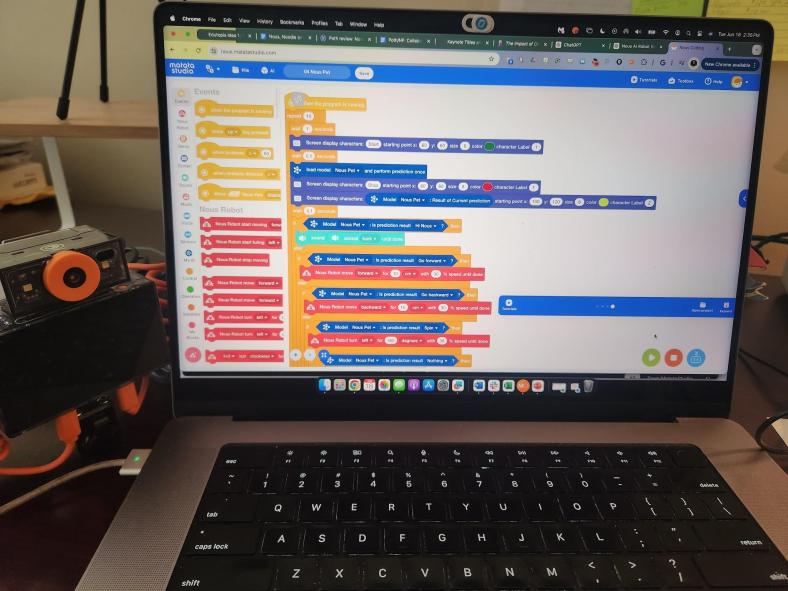
Something that I really appreciate about the Nous AI Set is its dual programming capability. Beginners can start with block-based programming (Blockly) to learn basic AI functions such as face detection and image classification. As they progress, students can transition to text-based programming (Python), exploring advanced AI concepts like machine learning, neural networks, and autonomous driving.
[We built it this way first]
Teach students about Machine Learning
MatataStudio’s Nous AI Set covers fundamental AI topics, including machine learning, computer vision, and speech recognition. It supports AI model training and data collection. When students learn through a more hands-on approach, they can connect with and understand complex AI concepts by engaging in practical application and meaningful and relevant learning. Working together, they develop these essential skills and have fun learning!
[Trying to figure out how to assemble it, letting students take the lead!]
The Right Resources!
MatataStudio provides extensive learning resources for all of its products. Educators know that they are supported through access to online tutorials, e-books, and even video-based courses. The resources are beneficial because not only do they support educators, but they also help guide students through the various functionalities of the robot, ensuring a comprehensive understanding of AI and programming.
Engaging in Design and Engineering Thinking
The Nous AI Set’s design encourages students to think, process information, solve problems, and think like engineers. Students can design and build their projects, test different solutions, and iterate on their designs. We want students to focus on the ongoing learning process rather than a finite product. This learning process promotes critical thinking and problem-solving skills, which are essential for future engineers, scientists, and other in-demand STEM-related fields.
What I love about the Nous AI Set is that there are so many choices available and tutorials to help you get started! See some examples below.
Improving Digital Literacy
Being digitally literate is crucial in today’s digital age. By using the Nous AI Set, students improve their digital literacy by engaging in programming and AI applications. They have opportunities to learn how to use technology creatively and responsibly, which will best prepare them for future digital challenges.
From passive to active learning!
The Nous AI Set offers a variety of interactive activities that make learning more engaging and fun. Students shift from being consumers of learning to becoming more active creators. Activities like MatataChat and MatataDraw allow students to explore basic computer vision and speech recognition. These activities lead to discussions between students and will spark curiosity about learning. The activities are not only educational but also highly engaging, keeping students motivated and interested.
[Working on a project and following the steps closely to see all of its capabilities.]
Real-World Applications
The Nous AI Set is not just a learning tool; it also provides students with insights into real-world AI applications. For instance, through activities involving image recognition, speech recognition, and autonomous driving, students can see how AI technologies are used in everyday life. This exposure helps them understand the relevance of what they are learning and inspires them to pursue careers in AI and technology.
Why should you explore Nous AI?
There are so many possibilities, and with the Nous AI Set, we will better prepare students for the future. As an educator who has seen the collaboration in building and the ideas that students generated, I recommend the Nous AI Set for any classroom looking to incorporate AI and robotics into their curriculum.
About the Author:
Dr. Rachelle Dené Poth is a Spanish and STEAM: What’s Next in Emerging Technology Teacher at Riverview High School in Oakmont, PA. Rachelle is also an attorney with a Juris Doctor degree from Duquesne University School of Law and a Master’s in Instructional Technology. Rachelle received her Doctorate in Instructional Technology, and her research focus was on AI and Professional Development. In addition to teaching, she is a full-time consultant and works with companies and organizations to provide PD, speaking, and consulting services. Contact Rachelle for your event!
Rachelle is an ISTE-certified educator and community leader who served as president of the ISTE Teacher Education Network. By EdTech Digest, she was named the EdTech Trendsetter of 2024, one of 30 K-12 IT Influencers to follow in 2021, and one of 150 Women Global EdTech Thought Leaders in 2022.
She is the author of nine books including ‘In Other Words: Quotes That Push Our Thinking,” “Unconventional Ways to Thrive in EDU,” “The Future is Now: Looking Back to Move Ahead,” “Chart A New Course: A Guide to Teaching Essential Skills for Tomorrow’s World, “True Story: Lessons That One Kid Taught Us,” “Things I Wish […] Knew” and her newest “How To Teach AI” is available from ISTE or on Amazon.
Contact Rachelle to schedule sessions about Artificial Intelligence, Coding, AR/VR, and more for your school or your event! Submit the Contact Form.
Follow Rachelle on Twitter(X) and Instagram at @Rdene915
**Interested in writing a guest blog for my site? Would love to share your ideas! Submit your post here. Looking for a new book to read? Find these available at bit.ly/Pothbooks
************ Also check out my THRIVEinEDU PodcastHere!
Join my show on THRIVEinEDU on Facebook. Join the group here.
As generative AI continues to evolve and reshape the way we work, the need for a workforce that can thrive in this new landscape is becoming increasingly apparent. How can we ensure that adult white-collar workers are equipped with the necessary digital, data, and AI literacy skills to meet the needs of businesses and communities? One promising solution lies in adult school CTE programs that focus on reskilling and upskilling adults for the AI-driven future. With an emphasis on lifelong learning and adaptability, these programs can serve as a catalyst for expanding adult education and bridging the skills gap.
The New Landscape of Adult Ed
As we navigate a world of AI, adult education has an opportunity to provide non-credit and credential programs that prioritize digital, data, and AI literacy. These programs can be in various forms, from short-term, intensive courses to flexible online, blended, and in-person learning options. What does this mean for adult learners? With an array of choices at their fingertips, they can now customize their learning experience to align with their needs, interests, and professional goals to meet the ever-evolving world, which will require consistent retooling and upskilling.
Let’s jump into one example of this that is happening now. The Los Angeles Valley College offers a “Data Science Bootcamp,” an intensive, hands-on program designed to equip adult learners with the skills needed to analyze, visualize, and interpret data in today’s data-driven world. Programs like this demonstrate the immense potential of adult education in preparing workers for the future.
Tailoring Programs to Local Communities
To maximize their impact, adult CTE programs must be tailored to the unique needs of local industries and communities. By understanding the specific demands of their region, adult education providers can design relevant and effective programs that truly resonate with learners.
Take, for instance, the partnership between the San Francisco Adult School and local tech companies. By collaborating with these businesses, the adult school has been able to create a curriculum that addresses the specific skills needed for employment in the thriving local tech industry. This close collaboration ensures that students gain the most relevant skills for their local job market while businesses benefit from a more skilled and prepared workforce.
Emphasizing Lifelong Learning in Adult Education
As the world of AI and technology continues to evolve at breakneck speed, becoming a lifelong learner is no longer a luxury – it’s a necessity. Adult CTE programs must prioritize fostering a growth mindset and a commitment to continuous learning among their students.
One way to achieve this is by creating learning environments that encourage curiosity, resilience, and adaptability. For example, an adult education program might incorporate real-world projects, mentorship, and peer collaboration into its curriculum, allowing students to learn from one another and apply their newly acquired skills in practical contexts.
Section 4: The Role of Adult Education in Bridging the Skills Gap
By reskilling and upskilling adults in digital, data, and AI literacy, adult CTE programs can play a critical role in bridging the skills gap in the workforce. The economic and social benefits of expanding adult education in this area are immense, but realizing this potential requires collaboration between adult education providers, businesses, and governments.
Take, for instance, the initiative launched by the state of California to invest in adult education programs aimed at equipping workers with the skills needed for in-demand jobs in the tech sector. This investment demonstrates the importance of collective efforts to support and invest in adult education as a key solution for the challenges ahead.
Conclusion: Navigating an AI-Driven Culture
As we navigate the AI-driven future, the importance of adult education cannot be overstated. Adult education providers have a unique opportunity to redefine and expand their role in this new landscape. By embracing this challenge, they can help to ensure that our workforce is prepared to thrive in the world of AI.
References
To brainstorm and develop various drafts of the blog, the following prompt was utilized on GPT-4 by Open AI. The AI Generative Response was edited and revised: I am an education innovator in adult education. I am writing a blog post on generative AI and how we will have to re-train the adult white collared workforce to meet the needs of our businesses and communities in the world of AI. The premise of the blog is that adult school CTE programs can offer a wide range of programs that integrate digital, data, and AI literacy to reskill adults in our communities to work in these new work environments. Additionally, we will need to have an emphasis on our programs to teach our students to be lifelong learners where they will have to reinvent themselves often to navigate the world we live in. Focus on how non-credit and credential programs we can offer locally can help solve this program for our local communities. Outline in-depth how this is a huge opportunity to expand adult education – keep this as the central theme.
About Rachelle:
Dr. Rachelle Dené Poth is a Spanish and STEAM: What’s Next in Emerging Technology Teacher at Riverview High School in Oakmont, PA. Rachelle is also an attorney with a Juris Doctor degree from Duquesne University School of Law and a Master’s in Instructional Technology. Rachelle received her Doctorate in Instructional Technology, and her research focus was on AI and Professional Development. In addition to teaching, she is a full-time consultant and works with companies and organizations to provide PD, speaking, and consulting services. Contact Rachelle for your event!
She is the author of nine books, and her newest, “How To Teach AI,” is available from ISTE or on Amazon.
Contact Rachelle to schedule sessions about Artificial Intelligence, Coding, AR/VR, and more for your school or your event! Submit the Contact Form.
Follow Rachelle on Twitter(X) and Instagram at @Rdene915
**Interested in writing a guest blog for my site? Would love to share your ideas! Submit your post here. Looking for a new book to read? Find these available at bit.ly/Pothbooks
************ Also check out my THRIVEinEDU PodcastHere!
Join my show on THRIVEinEDU on Facebook. Join the group here
We have experienced so many changes in the world of education and the world of work. Technology is constantly evolving, and skills in demand now may not be needed five years from now. Jobs are changing, technology is advancing rapidly, and careers that exist today may not exist in the future. We also have to remember that many jobs don’t exist yet that will need to be filled by the students in our classrooms today. How do we prepare for what we can’t truly know and understand?
Students must have opportunities to explore a variety of topics and careers. They need experiences that will guide them to learn about their areas of interest and themselves. We need to spark curiosity about learning and help students discover what they might actually be interested in.
Students must be active in learning and have time to explore the world around them. In some classrooms, students may experience passive learning and solely consume content rather than create it. To really enhance and transform learning for our students, we must create experiences that may even cause some good chaos. It might push us to shift from what has been a traditional classroom structure of our teaching practice. What I have learned by stepping out of my comfort zone and taking some risks is that learning can and should happen beyond our classroom space. We must embrace new learning models that promote student agency and spark student curiosity for learning. Using methods and creating opportunities that foster the development of essential SEL skills, we will best prepare students for the future through real-world learning opportunities. When they see the relevance of what they are learning and how that applies to the real world and careers that are available to them, it will boost interest and excitement for learning.
How do we prepare?
We have to consider which methods and tools will best meet the needs and interests of our students. In education, we have been focusing on developing “21st-century skills” for many years. We can’t possibly know everything about what the future holds for students when it comes to careers and specific skills, so to prepare, we must help students build a variety of skills, especially skills that are beneficial to many areas of work. Opportunities that support students as they learn how to adapt to changes and become flexible in learning and growing will prepare them for whatever the world of work will look like five, ten, or more years from now. I also recommend following the Job Skills Outlook Report shared by the World Economic Forum to look at the Top Ten Skills in Demand and gain insights into careers that are on the rise. In my STEAM class, we recently did some career research on areas such as Cybersecurity Experts, Ethical Hackers, Data Analysts, Smart City Developers and more.
Here are three more ways to spark curiosity for the future and engage students in career-focused learning:
CTE and Work-based learning: Students need to continue to learn about the career options that are available and how they may be changing. With CTE, work-based learning, and even job shadowing programs, students gain practical and real-world insights into different fields. Being able to experience what it is like in the work environment and interact with people working in careers of interest to students will have a bigger and more meaningful impact. By partnering with local businesses and professionals, inviting guest speakers, and involving students in real-world, hands-on projects, they will become more aware of the opportunities available. Through these experiences, they learn about what their interests are and how they can make an impact in the world.
Place-based learning: By shifting our focus from solely the content area, we can identify a geographical area or the culture of a place as a way to build content knowledge and help students develop SEL skills. Through place-based learning, we place students into the community to collaborate with local businesses, entrepreneurs, and other organizations. These experiences allow students to apply the content they are learning in the real world and see the impact. These experiences foster the development of student agency, boost engagement and excitement for learning, and enhance student awareness of the issues in the world around them. To further engage students, we can arrange field trips to local industries, invite guest speakers to our schools, and have students research local challenges and offer solutions.
Project-based learning (PBL): With PBL, students take the lead in deciding what they want to learn and how they want to learn it. With PBL, students choose an area of interest, design their own learning journey, and, throughout the experience, will see the “process” of learning rather than a finite endpoint. In our classroom, we explored a variety of student-chosen topics and also incorporated the United Nations Sustainable Development Goals (SDGs) into the projects. We can help students to become more globally aware and involved in finding solutions to challenges faced in the world. PBL helps students to become more independent in learning while developing essential SEL skills such as self-management and social awareness.
There are many more options available, but starting with just a few is the way to go. Think about your local community or reach to your global network. There are organizations available that help educators to provide these types of opportunities. While we may not know exactly which jobs will still exist, we do know that there are specific skills that will help students stay flexible and adapt to the changing landscape of learning and work. In real-world opportunities, students will make connections that will positively impact their learning and, hopefully, spark curiosity and excitement for learning!
About the Author:
Dr. Rachelle Dené Poth is a Spanish and STEAM: What’s Next in Emerging Technology Teacher at Riverview High School in Oakmont, PA. Rachelle is also an attorney with a Juris Doctor degree from Duquesne University School of Law and a Master’s in Instructional Technology. Rachelle received her Doctorate in Instructional Technology, and her research focus was on AI and Professional Development. In addition to teaching, she is a full-time consultant and works with companies and organizations to provide PD, speaking, and consulting services. Contact Rachelle for your event!
Rachelle is an ISTE-certified educator and community leader and served as president of the ISTE Teacher Education Network. She was named the EdTech Trendsetter of 2024 by EdTech Digest, One of 30 K-12 IT Influencers to follow in 2021 and one of 150 Women Global EdTech Thought Leaders in 2022.
She is the author of nine books including ‘In Other Words: Quotes That Push Our Thinking,” “Unconventional Ways to Thrive in EDU,” “The Future is Now: Looking Back to Move Ahead,” “Chart A New Course: A Guide to Teaching Essential Skills for Tomorrow’s World, “True Story: Lessons That One Kid Taught Us,” “Things I Wish […] Knew” and her newest “How To Teach AI” is available from ISTE or on Amazon.
Contact Rachelle to schedule sessions about Artificial Intelligence, Coding, AR/VR, and more for your school or your event! Submit the Contact Form.
Follow Rachelle on Twitter(X) and Instagram at @Rdene915
**Interested in writing a guest blog for my site? Would love to share your ideas! Submit your post here. Looking for a new book to read? Find these available at bit.ly/Pothbooks
************ Also check out my THRIVEinEDU PodcastHere!
Join my show on THRIVEinEDU on Facebook. Join the group here
It is essential in our schools that we focus on promoting responsible AI use in our classrooms and provide opportunities for students to become AI literate. With such increased use of artificial intelligence in the world and our classrooms, it has never been more important to involve students in learning how to use AI ethically, responsibly, and safely. As AI becomes even more common, students need to understand how AI works, its capabilities, and its limitations. They also need to explore how it is being used in the world.
With guided exploration and learning opportunities, we will promote responsible AI use; we can ensure that it is used to benefit students and help them develop “future-ready” skills. AI is a powerful tool, and therefore it requires responsible and informed users. There are special events that focus on developing AI literacy. In April, we recognized AI Literacy Day, designed as a day for learning about and exploring AI. Schools and classrooms hosted events, participated in learning, and had access to resources to support the development of AI literacy skills. AI Literacy Day is led by organizations such as EDSAFE AI, AIEDUCommon Sense Media, AI for Education, and The Tech Interactive, and provides resources that are helpful for educators, especially when there is some concern about the use of AI.
In my classroom, we use various AI-powered tools, and I always seek student feedback. Here are some thoughts after using Snorkl and SchoolAI.
“The chatbot was very helpful. Immersing yourself with technology that helps you learn Spanish or any other language can help a lot. You have real-time conversations, and the chatbot expands the conversation so you can learn even more about the language. It also helps you become more comfortable speaking!” – Lily Hood, 11th-grade student.
The Day of AI, a free event, occurs in May and was held on May 13th. Throughout the day, elementary, middle, and high school students had access to activities and curriculum. In my classroom, whether in my Spanish classes or my STEAM course for 8th graders, we talk a lot about AI. For over six years, I have explored resources to help students understand how and when AI should be used. By modeling the responsible use of different tools and having students interact with AI in the classroom, we will best prepare them for the changes this technology will bring. We often have discussions about the benefits and concerns of any tools that we explore.
When I use something in my classroom, I consider how the tool can enhance the learning experience. I share my thoughts with students before we explore and then ask for their feedback about the experience after. I greatly value their opinions and make time to ask them about what they think and the impact. Here are some student reflections:
Feedback after using SchoolAi to practice Spanish conversation
Antonio Boyer, 11th grade student
“It was so helpful for practicing the language. It knew my level, adjusted the questions to meet my specific needs, and gave me additional practice to help build my skills. It gets you to where you need to be.”
Grace Johnson, 10th grade student, after using Snorkl
“I was amazed when I submitted my response using Snorkl and instantly received feedback with comments about my speaking. It provided questions and explanations to help me understand the grammar more.”
Here are a few tools that students enjoy using. It gives them more insight into the benefits of AI and how it can be used as an enhancer rather than a replacement for doing our own work
Brisk Teaching: A free Chrome extension with four features: Create, Give Feedback, Inspect Writing, and Change Level. I have shown students how I can write something with Google and use the Give Feedback feature of Brisk to analyze my writing and receive feedback. I’ve also shown how I can quickly generate questions based on a video that we are watching in class or how I can quickly generate slides for my presentations.
Eduaide.Ai: A platform for AI-assisted lesson planning that offers more than 100 resources to help teachers create instructional materials. Eduaide has a Content Generator, Teaching Assistant, Feedback Bot, Free-form Chat, and an Assessment Builder. I have explored Eduaide a lot to create fun activities, a project outline, gamification, and also some of the assessment builder options.
Noodle Factory: For AI-driven personalized learning, automated grading and feedback, engaging and interactive lessons, Walter+ adapts to each student’s learning pace, helping to promote a more inclusive and effective learning environment. Noodle Factory offers Walter+, the AI teaching assistant designed for grades K through 12. Walter+ is designed to help educators enhance and transform the learning experiences they provide for students. I definitely recommend exploring Noodle Factory!
School AI: In Spanish classes, I have used it to create a ”Sidekick,” an assistant that engages students in conversations. I prompt the chatbot to focus on specific vocabulary or grammar patterns with my students. In this case, they interact individually, and the chatbot Sidekick adapts to their needs and provides them with feedback and continued questions based on their responses. I share with students what I can see in the teacher dashboard, and it helps them understand the importance of being mindful of the interactions and the information that they share online, specifically when using any generative AI.
Snorkl: An easy-to-use tool that gives students a space to talk through their thought processes while they are learning. Have students explain their learning, solve a problem, or complete any task that we give them. It records their screen and their audio, and we can set it to generate AI feedback for them and then provide feedback directly to them. Students were amazed at how quickly they received feedback and how helpful it was for their learning.
Whether at the end of a school year or exploring over the summer and diving in at the start of a new year, trying some of these tools in your classroom will provide a fun learning experience for your students and you! More importantly, it will help to promote AI literacy which is critical today!
About the Author:
Dr. Rachelle Dené Poth is a Spanish and STEAM: What’s Next in Emerging Technology Teacher at Riverview High School in Oakmont, PA. Rachelle is also an attorney with a Juris Doctor degree from Duquesne University School of Law and a Master’s in Instructional Technology. Rachelle received her Doctorate in Instructional Technology, and her research focus was on AI and Professional Development. In addition to teaching, she is a full-time consultant and works with companies and organizations to provide PD, speaking, and consulting services. Contact Rachelle for your event!
Rachelle is an ISTE-certified educator and community leader and served as president of the ISTE Teacher Education Network. She was named the EdTech Trendsetter of 2024 by EdTech Digest, one of 30 K-12 IT Influencers to follow in 2021 and one of 150 Women Global EdTech Thought Leaders in 2022.
She is the author of nine books including ‘In Other Words: Quotes That Push Our Thinking,” “Unconventional Ways to Thrive in EDU,” “The Future is Now: Looking Back to Move Ahead,” “Chart A New Course: A Guide to Teaching Essential Skills for Tomorrow’s World, “True Story: Lessons That One Kid Taught Us,” “Things I Wish […] Knew” and her newest “How To Teach AI” is available from ISTE or on Amazon.
Contact Rachelle to schedule sessions about Artificial Intelligence, Coding, AR/VR, and more for your school or your event! Submit the Contact Form.
Follow Rachelle on Twitter(X) and Instagram at @Rdene915
**Interested in writing a guest blog for my site? Would love to share your ideas! Submit your post here. Looking for a new book to read? Find these available at bit.ly/Pothbooks
************ Also check out my THRIVEinEDU PodcastHere!
Join my show on THRIVEinEDU on Facebook. Join the group here
Think of a problem you are currently experiencing. If you are like me, you have plenty of options to choose from. We are often stuck in a cycle of response when it comes to resolving challenges we regularly face resulting in the same problems cropping up again and again. In the book titled Upstream: the quest to solve problems before they happen, Chip and Dan Heath liken problem solving to a river – more solutions exist the farther upstream you are from the problem. What a great reminder that numerous solutions exist for every single challenge faced. However, if there are all of these solutions, how do I select the right one for my specific problem? Hence, the firefighting mindset!
Why firefighting?
The firefighting mindset is steeped in design thinking and comes from my work in the juvenile justice system. I have the privilege to work with educators and students in the juvenile justice system across the US. When traveling to secure schools, often located in detention centers and jails, I ask teachers how they are doing and typically get the same response, Oh you know, just putting out fires. This response led to the question, why are we always putting out the same fire or in other words, why are we always solving the same challenge? If we are stuck in a cycle of response, always putting out the same fire, then we are not actually solving the problem. If the Heath brothers are right and there are many solutions to each problem, how do we find them? We find them by changing our mindset toward the problems themselves. Firefighting becomes a metaphor for a way to see problems and challenges as opportunities for new ways of thinking and new solutions designed.
Putting Out Fires
Putting Out Fires as a mindset helps us to begin to understand problems at its core in order to truly end the problem with the most effective solution. Do you need a solution right now because you cannot take this problem for one more minute or this problem is harming students and must be stopped immediately? Or, do you have time to track data about the problem in order to effectively implement a solution? Not all problems are created equal and each deserves its own unique solution. We are often so busy that we try a one size fits all approach to problem solving. Instead, the firefighting mindset helps us to understand problems at their core and implement a solution designed specifically for the problem itself allowing us to truly end the cycle of response for that particular problem.
An example of the putting out fires mindset can be found in the use of metro turnstiles in Paris to create clean energy. Climate change is a rising issue across the globe. As each year brings more one-of-a-kind storms, wildfires, hurricanes, earthquakes, rising sea temperatures, and more, Paris began a groundbreaking project to harness green energy in an attempt to build a new energy source stopping the need for depleting the Earth of its natural resources. The solution is incredibly simple, “as commuters pass through the turnstiles, their movements spin the turbines, generating kinetic energy. Though each rotation produces a small amount of energy, the cumulative effect is significant due to the millions of daily commuters using the metro system” (TSUI, 2023). The use of turnstiles in Paris is the launching point of an innovative solution to creating clean energy. Imagine how much energy can be created from similar public transportation hotspots like airports, railway stations, office buildings, and more. “Initiatives that empower individuals to participate in the energy transition, even through daily activities, are vital in shaping a greener world” (TSUI, 2023).
This example embodies the firefighting mindset because the creators of this solution understood their specific problem, its root causes and symptoms, and designed a creative solution in a different area using a mundane action, going through the metro turnstiles, to create clean energy and help lessen the effects of climate change.
You can learn more about the firefighting approach to problem-solving by grabbing a copy of “Putting Out Fires: A Framework for Solving Problems in Your Classroom or School”. Releasing this summer, this book delves into the intricacies of the firefighting mindset, provides practical strategies for implementing creative solutions to problems you’re facing, and offers inspirational examples of problem solving at its finest just like the Paris metro turnstiles mentioned above. If this approach works for some of the most restrictive classrooms in the US, it can work for you too!
We all have challenges we face every single day. We can either allow the challenges to take over causing us to live in a consistent cycle of response. Or, you can take ownership of the problem, adjust your mentality, and design a unique solution to end the problem for good.
The fire alarm is ringing….let’s get started putting out those fires!
Kaylah Holland, Ed.D. Bio:
Dr. Kaylah Holland is passionate about empowering educators through professional development, one-on-one coaching, and innovative lesson design. She holds a Doctorate of Education in Instructional Design and Technology with extensive research in active learning environments. Driven by a passion for education, Dr. Holland consistently explores innovative methods to empower educators and champion student-centered classrooms. She is a Google Certified Innovator, Trainer, and Coach, a college professor, and an ISTE Community Leader. She was presented the “20 to Watch” award by ISTE in 2022 and was recognized by EdTech K-12 Magazine as a top 30 influencer in 2023. She was named a Featured Voice for ISTE in 2024. Dr. Holland is the author of Putting Out Fires: a Framework for Solving Problems in Your Classroom or School published in 2024. As the Director of Instructional Technology and Blended Learning for BreakFree Education, Kaylah empowers educators to foster innovative, sustainable, and active educational experiences inside juvenile justice facilities across the United States offering students held in confinement a path to success in school and life. She also works to empower educators across the globe as the founder of Go Teach Be Love, a nonprofit providing professional development to educators in developing countries, and the co-founder of Global Good Edu, a program recognizing the incredible impact educators are making around the world.
Contact Rachelle to schedule sessions about Artificial Intelligence, Coding, AR/VR, and more for your school or your event! Submit the Contact Form.
Follow Rachelle on Twitter(X) and Instagram at @Rdene915
**Interested in writing a guest blog for my site? Would love to share your ideas! Submit your post here. Looking for a new book to read? Find these available at bit.ly/Pothbooks
************ Also check out my THRIVEinEDU PodcastHere!
Join my show on THRIVEinEDU on Facebook. Join the group here
With the school year ending, it does not mean that learning has to stop. Throughout the summer, students and educators have time to relax and recharge, but it can also be a good opportunity to take advantage of some learning experiences. I think it is a fantastic time to dive into STEM learning, especially with having more time to get outside and explore! There are a lot of opportunities that promote engaging, hands-on activities for students and educators. Find some maker projects, ways to connect in the community and engage in place-based learning, or even participate in STEM camps or events that local organizations or schools may offer.
With a reported 3.5 million jobs requiring STEM skills by 2025, it is important to find opportunities that will help students learn about the possibilities in these fields and develop the essential skills that are in demand.
Here are three ideas to consider for the summer that might also be a great way to start the next school year!
1. DIY STEM Projects
Getting involved in STEM learning in the summer does not require many materials at all. When students and educators engage in “do-it-yourself “(DIY) STEM projects, it helps to fuel creativity and excitement in learning. The possibilities for DIY STEM projects are limitless. There are books and resources available online to explore. Dr. Jacie Maslyk shares many ideas in her blogs and books for STEM-focused learning. The benefits are that it allows students to consider different materials and problem-solve or create a design. DIY activities are great for encouraging students to find a solution to a local or global challenge and see the impact they can make when they develop their STEM skills! Projects like this will not only foster a sense of accomplishment but will encourage critical thinking, problem-solving, and innovation. Students can shift from simply being consumers to becoming creators and innovators!
2. Place-Based Learning
With additional time in the summer or even throughout the year, connecting students with opportunities for real-world learning in their community is essential. By volunteering or participating in place-based learning, students can connect with community members working in STEM careers, for example. These collaborations enable students to apply their knowledge in practical, real-world settings. Whether it’s working in a community organization that is focused on nature preservation, assisting with projects in the community, or taking advantage of internships and mentorship programs, students can get a glimpse into the professional world and build self-awareness of their interests in learning and future careers. We want our students to develop their global awareness, learn about the challenges being faced in the world, and then come up with solutions. Connecting with the community and engaging in place-based learning provides more authentic and real-world learning for students, which will promote student engagement and be more meaningful.
3. Virtual Programs and Online Courses
There are many tools available online for students to explore at their own pace and to find a topic of interest. Diving into programs to learn about coding and robotics, for example, offers many great benefits for students. Students can learn about programming languages, create their own software, or build robots or chatbots. With the resources available, students will develop computational thinking and problem-solving skills while also having the opportunity to boost their creativity.
Online courses and virtual programs provide flexibility, which enables students to learn at their own pace and explore topics of interest. Many of the programs and tools available offer interactive simulations, video tutorials, sample activities, and more, which help to engage students more in learning. Some sites such as Code.org, MIT, AIClub, Scratch, and Tynker provide interactive coding tutorials and projects suitable for beginners. I recommend exploring Minecraft Education and Hacking STEM to give even more choices. For some robots, check out MatataStudio products such as TaleBot Pro or Vinci Bot or check out Marty the Robot from Robotical! Interested in augmented and virtual reality, dive into CoSpaces Edu!
Code with Google is focused on closing equity gaps in computer science opportunities and offers free resources for students. For older students and educators looking for courses and more activities, websites like Khan Academy and Udemy have courses covering various STEM topics, allowing students to learn at their own pace and explore their interests.
Summer learning opportunities for STEM can offer students a transformative learning experience that will spark their curiosity for learning and cultivate STEM-focused careers. These opportunities not only enhance academic skills but also equip students with essential 21st-century competencies, such as critical thinking, collaboration, and adaptability.
About the Author:
Rachelle Dené is a Spanish and STEAM: What’s Next in Emerging Technology Teacher at Riverview High School in Oakmont, PA. Rachelle is also an attorney with a Juris Doctor degree from Duquesne University School of Law and a Master’s in Instructional Technology. Rachelle is currently finishing her doctorate with a focus on AI and Professional Development. In addition to teaching, she is a full-time consultant and works with companies and organizations to provide PD, speaking, and consulting services. Contact Rachelle for your event!
Rachelle is an ISTE-certified educator and community leader and served as president of the ISTE Teacher Education Network. She was named one of 30 12 IT Influencers to follow in 2021 and one of 150 Women Global EdTech Thought Leaders in 2022.
Contact Rachelle to schedule sessions about Artificial Intelligence, Coding, AR/VR, and more for your school or your event! Submit the Contact Form.
Follow Rachelle on Twitter(X) and Instagram at @Rdene915
**Interested in writing a guest blog for my site? Would love to share your ideas! Submit your post here. Looking for a new book to read? Find these available at bit.ly/Pothbooks
************ Also check out my THRIVEinEDU PodcastHere!
Join my show on THRIVEinEDU on Facebook. Join the group here








 Learning as I go: Reflections & lessons learned