

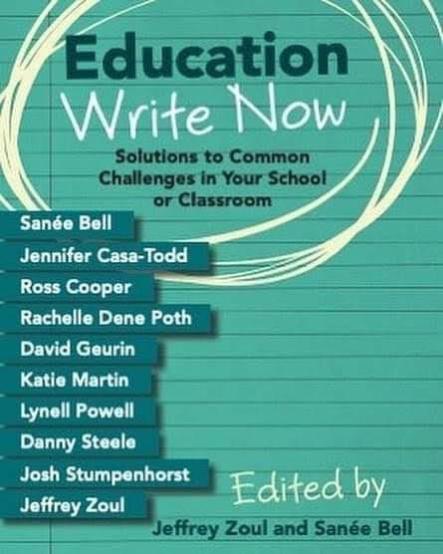
To say that the summer of 2019 was tremendous is an understatement. Besides having time to spend with family and friends, I enjoy having extra time in the summer to participate in professional learning opportunities and to connect with educators from around the world. As educators, it is important that we continue learning and involving ourselves in opportunities to build our own skills and also to contribute to the personal and professional growth of others. I am fortunate to have been asked to be one of the writers for this year’s Education Write Now book.
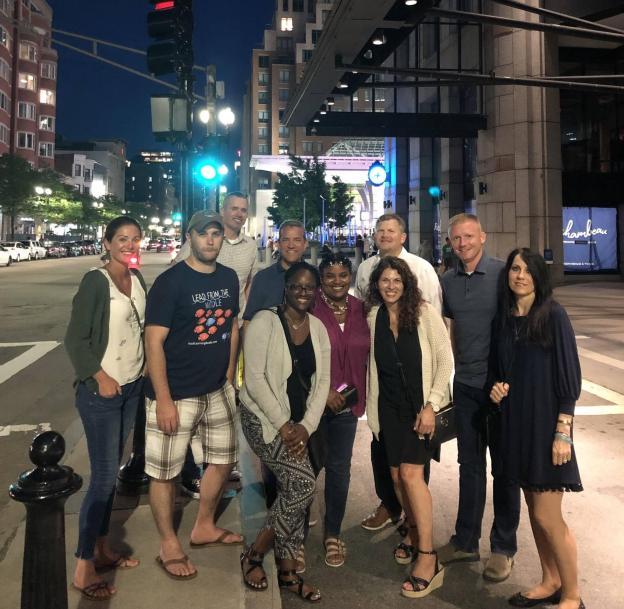
In July, ten of us met in Boston for three days to work on chapters that will become part of Volume 3 of Education Write Now, a book whose proceeds will go toward The Will to Live Foundation, a non-profit organization founded to support teen suicide prevention. The time together started with a welcome from Jeff, an introduction to what the organization does, and an opportunity to hear from John Trautwein, a father who lost his son to suicide. John created The Will to Live Foundation to honor his son and to provide support for other families and their children.
It was an honor to be a part of this project and work alongside and collaborate with Jeff Zoul, Sanee Bell, David Guerin, Josh Stumpenhorst, Jennifer CasaTodd, Danny Steele, Katie Marin, Ross Cooper, and Lynell Powell. It was a great experience, although initially, the thought of writing a chapter within a short period of time of two days was a little bit stressful. However, having that time to work together, have peer feedback time, to listen and share out what we were writing with the other collaborators, made all the difference. It just reaffirmed the importance of connections and building those professional relationships. We need to make time to share what we are doing in our classrooms, exchange ideas, solve problems together, and embrace risks and face the challenges that are part of education today, but to do so with a supportive network.
The theme for this year was “Solutions to Common Challenges in Your School or Classroom.” In thinking about this theme, I decided to write about teaching in isolation and sharing my own story of how I chose to be isolated for many of my years of teaching. In my chapter, I explore how isolation happens and offer ways for educators to escape what can sometimes become an isolating profession.

Here are a few excerpts from my chapter, Chapter 2: Choosing to teach in isolation is a choice to isolate our students from a world of learning opportunities.
Have you ever experienced any of the following?
You have to make your very first phone call home to a parent and you are worried that you won’t say the right thing.
You are going to be observed for the first or fifteenth time, and you are worried that you will make a mistake or not use the right instructional strategies. The class starts in five minutes.
How many of these statements can you relate to? For each one, think about if you reached out to someone or just kept it to yourself. Did you choose isolation rather than asking for help?
Clarity:
You are not alone
For years I struggled with classroom management and student behaviors. Rather than ask for advice, explore resources, or try to work it out by talking with my students, I kept it to myself and did my best to make it through each day. I hoped for improvement, but I did not actively try to make changes. I did not ask for help or even talk about the problems that I was having. I did not know where to begin but at that time, so I thought that I was better off keeping it to myself. My biggest mistake was hiding in my classroom and not reaching out to colleagues or other educator friends.
Isolation is not something new
Life as an educator, trying to complete everything that we need to can lead to a career spent in isolation if we let it.
Ten ways to break free or avoid isolation
There is so much potential for connecting regardless of where we are and the amount of time we have. We must take the first step and just start somewhere. We can leverage technology to check-in with colleagues, even if they teach next door to you. Sometimes seeing our neighbors does not happen on our busy days, which are most days. There are ways to stay connected while driving to and from school, taking a walk, wherever you are and on your schedule.
In the end
The most important thing to remember is that you are not alone.
You are not alone in feeling like you do, like the job is difficult, or there are too many things to remember, too many initiatives to keep up with.
We all understand the importance of asking for help; Those who achieve big things are the ones who accept it when it’s offered. Simon Sinek
The choice is now yours, how do you want to connect?
Be sure to check out next week’s post from Jennifer Casa-Todd, Chapter 3 “The Challenge: Broadening our Definition of Literacy.”


 Kim Weber is a Transformation Agent for LINC, the Learning Innovation Catalyst. Before joining LINC, Kim worked for 20 years as a public and private school teacher in California and New York City. She is a presenter and coach for schools across the country who are embarking on school transformation projects that focus on creating classrooms that put students at the center of learning and help teachers become pedagogical problem solvers.


 When you focus on a line, it closes the screen down to that one specific sentence, which you can also make narrower or thicker depending on your choice.


 Libraries might seem dated, but they are in fact one of the best-kept secrets. We got library cards for our kids as soon as they could write their names. Today, cards can be used to check out everything from audiobooks to new release movies. Apps like Hoopla and Overdrive are amazing. With a library card, these two sites offer thousands of books, movies, and music. Giving kids the opportunity to borrow a stack of books without any cost is ideal for many families. Taking advantage of MEL, the state’s interlibrary loan program, allows people to request books from all over the state of Michigan and have them sent right to your local library. Showing someone how to use the library unlocks a world of possibility. Anything can be learned by using the public library. And, using the library saves a lot of money. Surrounding kids with books is one of the best things you can do to get them reading. The library makes reading an inexpensive activity. I am not alone when it comes to using the library. Several
  A few years ago one of my boys really got into hockey. We found all of the Matt Christopher books about hockey in the library, and he eagerly read each one cover to cover. Last summer my daughter was obsessed with learning about swimming. We raided the library for any nonfiction book we could find on the topic. During the winter it was graphic novels, and today she loves to dive into anything related to fairy tales. Even though I have a pretty good idea about what each of my kids likes to read, I had experiences where I selected a book or two I thought might be perfect, only to have them not show an interest in what I picked out. I do not take it personally, since there is no cost associated with it, and know that as a reader I don’t read every book I take home from the library.
 When I first started teaching, I would ask the parents of my really motivated readers who seemed to always be reading, “Tell me how you did it? What do you think has made the difference in getting your child excited about reading?” Almost every time I was given the same answer, “I suppose he just sees me reading all the time, and it just seemed like the thing to do. My nose is always in a book”.
 Exposure to good literature and authors is one of the best gifts we can give our readers. I absolutely love sharing some of my favorites with kids. Just as we could taste cheese, wine, sauces, desserts, or other menu items, book tastings are a great way to try new things. I typically put a book in front of each place setting. Each child will get a chart to list the title he or she tasted along with the author, genre, and the likelihood that he or she might read the book. The tasting is timed to keep it moving. And so after a total of several, ninety-second tastings, kids are able to walk away with several new titles that could be considerations for future reading. This activity can be adapted to any size (I have had great success with it in the classroom).
 There are times that I find my kids book hopping, and not finishing titles. I have also seen my kids plateau as readers. It is fun when we all work together and focus on completing a challenge that encourages reading and celebrating the success of others. It works well for us to keep a running list of books read on the refrigerator. We set a goal for a number of books to be read and immediately start brainstorming how to we will celebrate our success. It is nice to focus on working together and cheering each other on.


 Learning as I go: Reflections & lessons learned