In Part I of this series, I shared the importance of distinguishing between “AI in Education” and “AI Education”, and why both must move forward together if we want to prepare students for a rapidly changing world.
That distinction is critical.
But it is not enough.
Across the conversations I continue to have with legislators, district leaders, and educators, the next question is becoming clearer:
What does this actually look like in practice?
Because the challenge right now is not awareness.
It is implementation.
Guidelines are being drafted. Policies are being written. Conversations are happening at leadership levels.
But in classrooms, the reality is often very different.
Teachers are still asking:
What should I allow? How do I design lessons so that students are still thinking and not reliant on AI? What should I do if students use AI in ways I did not anticipate? How do I explain responsible use to students and families?
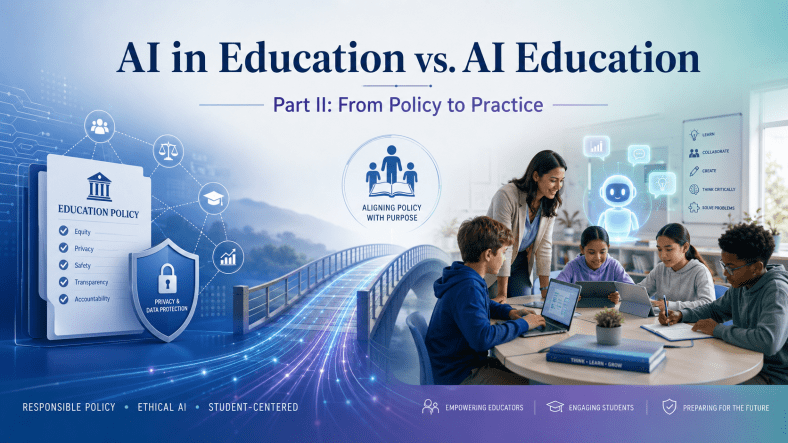
This gap between policy and practice is one of the most important challenges we face. Policies can set direction, but practice determines the impact.
A policy may explain what is permitted, restricted, or expected. However, educators still need support to translate those expectations into lesson design, assessment, classroom conversations, and decisions about student use. I’ve mentioned this before in my Leading Forward in AI series, and I share it again. We need consistency, a shared language, and a classroom connection. Without that connection, even well-written policies may have little effect on classroom practice.
What I’m Seeing in Classrooms
In the schools I work with, students are already using AI tools—often more than adults realize. Students are:
brainstorming ideas
asking questions
exploring concepts
testing tools independently
And it is happening now, so this is not a future issue. And it is no longer a question of whether students will use AI, but rather whether they will be guided in how to use it responsibly.
Without guidance, students experiment in isolation and rely on AI too much, and possibly for the wrong reasons. With guidance, they learn to question outputs, verify information, protect their data, acknowledge their use of AI, and recognize when a tool is supporting their thinking rather than replacing it.
That difference matters.
Moving From Restriction to Responsibility
One of the most common responses to emerging technology has been restriction. Conversations about blocking access, limiting use, and controlling the learning environment of students have been happening even more.
In some situations, restrictions are necessary. Schools must consider student privacy, age requirements, academic integrity, instructional purpose, accessibility, and whether a tool has been properly vetted. But restriction cannot be the entire strategy.
We know that students will use AI outside of the classroom. While approaches that focus on restriction may be in the best interest of protecting students, they do not prepare students for long-term success.
In the future, students will use AI in higher education, the workplace, and in everyday decision-making, which is why they need guidance. By focusing only on restrictions, we miss out on the opportunity to teach responsibility. And responsibility prepares students for real-world environments.
With opportunities in our classrooms, we can support students as they learn about AI. Students need to know how to evaluate AI-generated information, disclose when they have used a tool, protect personally identifiable information (PII), recognize bias, and understand when AI use is appropriate.
What Effective Implementation Requires
From my experience working with districts across the country, successful implementation does not come from a single policy or a single training. It comes from strategic alignment.
I help schools and other organizations (law firms, healthcare professionals, business owners) implement AI responsibly through policy guidance, professional learning, and classroom-ready strategies grounded in both instructional practice and legal insight.
My sessions focus on helping teams:
• understand what AI can and cannot do
• recognize responsible-use considerations
• build confidence using emerging tools
•align implementation with organizational priorities
If your school, district, or organization is beginning conversations or looking to dive in and learn more about AI policy, professional learning, or responsible implementation, I’d welcome the opportunity to support your next steps through leadership workshops, keynote sessions, or strategic planning partnerships.
Preparing people is what makes AI implementation successful. Contact me via bit.ly/thrivineduPD for my training and speaking services.
Over the past year, I’ve had the tremendous opportunity of working with district leaders, educators, students, families, and even policymakers across the country. Throughout this work, one question has come up repeatedly:
Is there a difference between AI in education and AI education?
I will pause…to let you consider.
For me….
My answer is always yes.
Although the terms are often used interchangeably, they represent two distinct priorities. AI in education focuses on how artificial intelligence is being implemented in teaching, learning, and school and district operations.
AI education focuses on helping students understand artificial intelligence itself. They know how it works, how it generates information, how it influences decisions, and understand that it will shape their futures. These two phrases are not the same, and not having a clear distinction creates gaps in policy, instruction, and student preparedness.
When people hear “AI in education,” they often think about tools and how they are being used. One example I have shared is a student using AI to generate a first draft of an essay. AI in education asks: What classroom expectations and policies should guide this use?
AI education asks: Does the student understand how the AI generated that response, what biases may exist, and how to evaluate its accuracy?
In my work, I’ve come up with a series of questions as starting points for conversations:
How are schools using AI platforms?
What tools are allowed, and who is vetting them?
How are educators integrating AI into instruction?
What policies are in place or are needed to guide its use?
These are just a few of the important questions that need to be considered and answered specifically for AI implementation. However, there is another conversation that is equally important to have in our schools, and the focus is on AI education.
AI education is more than tools. It is about preparing students to understand artificial intelligence, how it works, how it processes and generates information, how it influences decisions, and how it will impact their future.
Both are important, and from the many opportunities I’ve had to work with educators and speak with students, it seems there is confusion. We need to align on the meaning of these terms so we can fully provide the learning support our students and schools need.
What I’ve Seen in Schools
Across the districts I have supported, interest in artificial intelligence has increased. During the past year, I’ve seen the mindset shift from one of hesitation to exploration.
Educators are curious. Students are experimenting. Leaders are asking thoughtful questions and also seeking guidance for their schools.
But when it comes to AI implementation, whether school- or district-wide, it is not always consistent, and consistency matters.
Some schools are exploring AI tools without clear guidance, while others are restricting its use out of caution. And some are writing policies without fully understanding and addressing classroom realities. And this is why I recommend that administrators involve educators, students, and families in the conversations or create a task force specific to AI. By doing this, schools can better understand how AI is being used, the support students receive at home and at school, and what their needs are. Because in many places, students are using AI outside of school without learning how to use it responsibly, which creates yet another gap.
It creates a gap between access and understanding and between use and responsibility. However, by establishing a policy and ensuring consistent implementation, we can work toward closing the gap and making meaningful progress in an increasingly AI-surrounded world.
This Also Matters for Legislators
Artificial intelligence is not a future issue. It is a present reality shaping:
How students learn
How educators teach
How information is created and consumed
How future work will be defined
Legislators throughout the country are increasingly being asked to make decisions about data privacy, student protection, AI tool access, digital equity, and workforce readiness. These are important decisions that carry real implications for classrooms.
But having an effective policy requires more than regulation. It requires understanding how AI is actually being used and how it should be used in educational environments.
I’ve reached out to and spoken with legislators from different states over the past six months, and some of the common thoughts around policies are:
-Policies that focus only on restrictions will fall short.
-Policies that ignore implementation will create confusion.
And policies that fail to address AI education will leave students unprepared.
Why Does This Matter for Educators
Educators are at the center of the shift in classroom instruction, especially now with AI. Educators are adjusting to technological changes, navigating new tools, fielding student questions, balancing innovation with responsibility, and working to support student learning in real time.
My own research showed that many educators are being asked to adapt without the necessary guidance or support. I’ve been asked many times:
“Do I need to teach about AI?”
“What should I allow in my classroom?”
“How do I know if students are using AI appropriately?”
“How do I design lessons where students are still doing the thinking and not having AI do the work for them?”
These are not simple questions with simple answers. They are instructional, ethical, and professional questions. And these questions require communication and preparation, and not just policy. It is a process and an iterative one.
The Risk: Where Do We Focus?
If we focus only on AI in education, we risk:
over-reliance on tools
inconsistent expectations
unclear boundaries for educator and/or student use
missed opportunities for deeper learning
If we focus only on AI education, we risk:
teaching theory without application
disconnecting learning from real-world tools
failing to prepare students for how AI is actually used now and the future possibilities
The solution? It’s not about choosing one over the other, but rather finding a way to align both in our schools, because that is how we guide students toward success.
What Alignment Looks Like in Practice
Across the districts I support, I see the most progress when schools intentionally connect AI in education with AI education. Schools making progress have:
Clear Expectations for Use: Students and educators understand when and how AI can be used, and what responsible use looks like.
Instruction That Builds Understanding: Students are not just using AI. They are learning how it works, the importance of questioning it, and how to evaluate its outputs.
Professional Learning for Educators: Teachers have the time, support, and guidance to meaningfully integrate AI into instruction. And this is consistent and ongoing throughout the year.
Policy That Reflects Practice: Policies are designed with classroom realities in mind and focus on guidance rather than restriction. Schools have committees or task forces to be better informed and able to adjust as needed.
Ongoing Conversations: Schools engage students, educators, and families in discussions about AI, digital wellness, and responsible technology use.
AI Literacy Is Workforce Literacy
The students graduating now will enter a workforce shaped by automation, intelligent systems, and rapidly evolving expectations regarding their skill sets.
According to global workforce trends and the World Economic Forum’s Top 10 Skills for 2030, technological literacy, AI understanding, and cybersecurity awareness are among the most in-demand skills for the coming decade.
And when it comes to AI literacy, we must remember that it is not just about technical knowledge. It is about:
critical thinking
ethical decision-making
information evaluation
adaptability
communication
These are the essential, in-demand skills that must be intentionally taught in our classrooms through a variety of learning opportunities and supports.
We Share Responsibility
Preparing students for an AI-shaped future requires collaboration between:
Educators
School leaders
Policymakers
Families
Communities
Each group plays a role in preparing students and guiding them toward future success.
Legislators can create frameworks that support responsible implementation and that focus on protecting students.
Educators can design learning experiences that build understanding and confidence and model appropriate and safe use of AI for students in their classrooms.
School leaders can align systems, expectations, and communication.
When everyone is involved in navigating the AI space together, it creates coherence.
Artificial intelligence is changing education. It is moving fast, however, when it comes to our work, the most successful systems are not those that move the fastest. Success comes with clarity. Clarity about expectations. Clarity about purpose. Clarity about how technology supports learning rather than replacing it.
Across the country, I have seen schools and districts working to build that clarity and consistency. They are asking questions and working together to find answers as a start. They are not seeking perfection, just ongoing progress.
Preparing students for the future
We cannot prepare students for the future by focusing only on the tools they use today. We must also prepare them to understand the systems shaping their world.
And the decisions we make now, at both the classroom and policy level, will determine whether students are ready not just to use technology, but to think critically, act responsibly, and lead in a world where artificial intelligence is part of everyday life.
That is the work ahead, and it is definitely the work worth doing.
AI in education matters, but AI education matters just as much. Think about your school and district. Are these distinctions clear? Stay tuned for part II in the series, with actionable strategies, and contact me to provide training for your school.
I help schools and other organizations (law firms, healthcare professionals, business owners) implement AI responsibly through policy guidance, professional learning, and classroom-ready strategies grounded in both instructional practice and legal insight.
My sessions focus on helping teams:
• understand what AI can and cannot do
• recognize responsible-use considerations
• build confidence using emerging tools
•align implementation with organizational priorities
If your school, district, or organization is beginning conversations or looking to dive in and learn more about AI policy, professional learning, or responsible implementation, I’d welcome the opportunity to support your next steps through leadership workshops, keynote sessions, or strategic planning partnerships.
Preparing people is what makes AI implementation successful. Contact me via bit.ly/thrivineduPD for my training and speaking services.
Guest post by Tessa Dodson. Opinions expressed are those of the writer.
Educators are all too familiar with “workshop fatigue,” the feeling of sitting through another mandated training session that feels disconnected from the realities of their classroom. To move beyond a compliance-based model of professional development (PD) for teachers, district leaders must explore what educators need to grow. The shift to an empowering, continuous learning model is a crucial strategy for boosting teacher motivation, efficacy, and retention in an increasingly demanding field.
The Disconnect Between Intentions and Training Needs
The default model of professional development has been the one-off workshop or conference. While often well-intentioned, this approach frequently fails to produce lasting change in instructional practice or improve teacher motivation. The core issue lies in a fundamental gap between what research identifies as effective and what is most commonly practiced in schools.
This discrepancy creates a significant challenge for leaders trying to support their faculty. While sustained job-embedded learning is more effective, many teachers still attend short-term workshops, as these are often the most accessible and available options provided by their districts. The result is a cycle of ineffective professional learning that fails to translate into meaningful classroom improvements.
“One-Size-Fits-All” Agendas
A common pitfall of traditional PD is selecting a single topic for an entire district or school. This approach rarely meets the nuanced needs of individual teachers. The challenges faced by a kindergarten teacher are vastly different from those of a high school physics instructor. A seasoned educator requires a different type of support than a novice. When PD is not tailored, it feels irrelevant and fails to honor each teacher’s unique classroom context.
One-Off Workshops
Learning that is not sustained over time is rarely integrated into practice. One-off workshops lack the essential follow-up, coaching, and collaborative feedback loops required for true skill development. Without ongoing support to implement new strategies, troubleshoot challenges, and refine their approach, teachers are likely to revert to their established routines, and the growth potential is lost.
A Lack of Choice
Giving teachers choices goes beyond simply letting them select from a preapproved menu of workshops. True empowerment means inviting them to be active participants in the entire process. Teachers can work together to identify problems in their own classrooms and the school, and then they can co-design learning experiences to address those specific challenges.
Limited Time and Trust
Two of the most valuable resources leaders can provide are time and trust. Effective professional learning cannot be an add-on. Instead, it requires dedicated time within contract hours for teachers to collaborate, observe peers, conduct research, and reflect on their practice. This must be paired with a culture of trust, where leaders have confidence that their faculty will use this time professionally and effectively to improve their instruction and, ultimately, student outcomes.
What Teachers Really Want From Professional Development
The most effective frameworks for teachers’ professional development are built on a foundation of empowerment. This involves a profound shift in mindset, from viewing teachers as recipients of training to recognizing them as professionals who can and should guide their own learning. When school structures are designed to foster teacher autonomy, the impact on professional growth is significant.
A 2023 study found thatteachers’ autonomous behavior predicted professional development at work. The study identified key structural factors, such as “empowering teachers” and the “decentralization of responsibilities,” as crucial to creating an environment in which this autonomy could flourish. By trusting teachers to take ownership of their professional growth, leaders can unlock their intrinsic teacher motivation and capacity for innovation.
A landmark report from the Learning Policy Institute outlines seven widely shared features of effective PD, focusing on content, active learning, collaboration, coaching, expert support, and sustained duration. From the teacher’s perspective, this framework translates into a few key training necessities.
Ongoing, Job-Embedded Coaching
Teachers value the opportunity to work with instructional coaches who can provide personalized support. Unlike a formal evaluation, coaching is a partnership focused on growth. A coach can co-plan a lesson, model a new strategy, observe, and provide feedback. Alternatively, a coach may serve as a sounding board in the teacher’s classroom.
Opportunities for Meaningful Collaboration
Educators’ most valuable resource is each other. Many teachers crave structured time to engage in meaningful collaboration with their peers. This can take many forms, including professional learning communities, study groups where teachers collectively plan and refine lessons, and peer mentorship programs. A well-designed teacher-to-teacher mentorship program can be a powerful driver of both individual and collective growth.
Direct Connections to Their Classroom Practice
Teachers want professional learning that is directly relevant and immediately applicable to their work. They are eager for strategies, tools, and knowledge that help them solve the real, everyday challenges they face with their students. When PD is grounded in classroom practice, it feels more like an essential tool for success than a requirement to simply check off.
How Leadership Can Build a Culture of Continuous Learning
School and district leaders are the primary architects of the environment in which teachers receive professional development. By shifting their approach, they can build a culture where teacher-led, continuous learning becomes the norm.
For example, Princeton Public Schools has found success with “Flex PD” programs, which provide staff with release time and resources to pursue professional learning of their choice. By treating teachers as professionals, the district fosters a sense of ownership and relevance that traditional models often lack.
Moving From Compliance to Collective Capacity
Instead of focusing on enforcing PD mandates, leaders should see their role as building their staff’s collective expertise. This requires trusting teachers to take ownership of school-wide goals and empowering them to find the best path to achieving them. When leaders shift their focus from compliance to cultivating collective capacity, they invest more effectively in the long-term growth of their entire school community.
Measuring Success Beyond Attendance Sheets
In a culture of continuous learning, success is measured differently. Instead of tracking seat time or completion certificates, leaders should look for authentic evidence of growth. This can include observing changes in instructional practice, noting increases in staff collaborative conversations, and measuring the impact on student engagement and outcomes.
Taking the First Step Toward Meaningful Growth
The journey toward a more meaningful, empowering, and effective model of professional development for teachers begins with dialogue. By asking educators what they need to grow and trusting their answers, school leaders can take the first crucial step toward building a culture where both teachers and students can thrive.
About Tessa
Tessa Dodson is the Senior Writer of Classrooms.com, where she researches and covers educational policy, professional development, teacher support systems, and integration challenges that K-12 and higher education institutions may face. She aims to research and provide actionable insights for students, educators, school administrators, and other leaders.
About Rachelle’s work
I help schools and other organizations (law firms, healthcare professionals, business owners) implement AI responsibly through policy guidance, professional learning, and classroom-ready strategies grounded in both instructional practice and legal insight.
My sessions focus on helping teams:
• understand what AI can and cannot do
• recognize responsible-use considerations
• build confidence using emerging tools
•align implementation with organizational priorities
If your school, district, or organization is beginning conversations or looking to dive in and learn more about AI policy, professional learning, or responsible implementation, I’d welcome the opportunity to support your next steps through leadership workshops, keynote sessions, or strategic planning partnerships.
Preparing people is what makes AI implementation successful. Contact me via bit.ly/thrivineduPD for my training and speaking services.
About Rachelle
Dr. Rachelle Dené Poth is a Spanish and STEAM: What’s Next in Emerging Technology Teacher. Rachelle is also an attorney with a Juris Doctor degree from Duquesne University School of Law and a Master’s in Instructional Technology. Rachelle received her Doctorate in Instructional Technology, with a research focus on AI and Professional Development. In addition to teaching, she is a full-time consultant and works with companies and organizations to provide PD, speaking, and consulting services. Contact Rachelle for your event!
Rachelle is an ISTE-certified educator and community leader who served as president of the ISTE Teacher Education Network. By EdTech Digest, she was named the EdTech Trendsetter of 2024, one of 30 K-12 IT Influencers to follow in 2021, and one of 150 Women Global EdTech Thought Leaders in 2022.
She is the author of ten books, including ‘What The Tech? An Educator’s Guide to AI, AR/VR, the Metaverse and More” and ‘How To Teach AI’. In addition, other books include, “In Other Words: Quotes That Push Our Thinking,” “Unconventional Ways to Thrive in EDU,” “The Future is Now: Looking Back to Move Ahead,” “Chart A New Course: A Guide to Teaching Essential Skills for Tomorrow’s World, “True Story: Lessons That One Kid Taught Us,” “Things I Wish […] Knew” and her newest “How To Teach AI” is available from ISTE or on Amazon.
How do we build sustainable professional learning systems for educators?
In the first six partsof this series, I shared what I’ve been learning from working with district leadership teams across the country as they navigate artificial intelligence, digital wellness, and purposeful technology use. Over the course of my Leading Forward Series, I’ve shared what I’ve been learning from working with district leadership teams across the country as they navigate artificial intelligence, digital wellness, and purposeful technology use.
We’ve explored:
curiosity over fear
educator readiness
leadership and systems
measuring what matters
trust as the foundation
designing for thinking
true partnerships
These conversations led to a bigger question, which is how do we build systems that last? Because the goal is not to have one answer and end the conversations, it is to prepare schools to adapt continuously to be ready to meet the changing educational landscape.
After reviewing my notes, reflecting on conversations, and gathering insights from surveys, I noticed some key takeaways.
One-time Training Is Not a Strategy
One of the most common concerns expressed was that professional development is often seen as a one-time event. Sometimes it is a workshop, maybe a keynote, or a specific training session focused on a new platform or a mandate. These are all valuable learning experiences, but they are not enough, especially with the rapidly changing technologies we are seeing in education and the world.
Artificial intelligence is evolving so fast, new tools are emerging constantly, and expectations are frequently changing or, at times, may be inconsistent. A single session is not enough to prepare educators to adapt to ongoing changes. Schools need sustainable systems for learning.
What Sustainable Professional Learning Looks Like
In the districts I support, I have noticed several common characteristics that have positively impacted the educators and ultimately students and families.
1. Learning is ongoing, not just an event.
It is embedded in the school year. Educators have regular opportunities to explore new tools, reflect on practice, share strategies, and learn from one another. It should also be a time for educators to explore new ideas in the classroom and partner with students to gather additional feedback and to learn together.
2. Learning Is Collaborative
Powerful learning does not happen in isolation. It happens when educators work in teams, have opportunities to observe one another, take time to share successes and challenges, and build collective understanding. Collaboration like this leads to system-wide progress and better outcomes for educators and students.
If Your Organization Is Beginning This Workand is Seeking Consistent Support, Contact me:
I help schools and other organizations (law firms, healthcare professionals, business owners) implement AI responsibly through policy guidance, professional learning, and classroom-ready strategies grounded in both instructional practice and legal insight. I also deliver keynotes and provide small-group coaching.
My sessions focus on helping teams:
• understand what AI can and cannot do
• recognize responsible-use considerations
• build confidence using emerging tools
•align implementation with organizational priorities
If your school, district, or organization is beginning conversations or looking to dive in and learn more about AI policy, professional learning, or responsible implementation, I’d welcome the opportunity to support your next steps through leadership workshops, keynote sessions, or strategic planning partnerships.
Preparing people is what makes AI implementation successful. Contact me via bit.ly/thrivineduPD for my training and speaking services or reach out via email, Rdene915@gmail.com.