
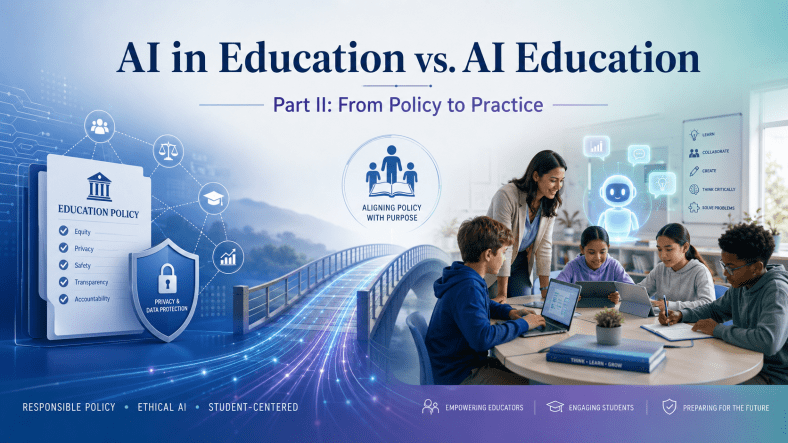
What Must Happen Next
In Part I of this series, I shared the importance of distinguishing between “AI in Education” and “AI Education”, and why both must move forward together if we want to prepare students for a rapidly changing world.
That distinction is critical.
But it is not enough.
Across the conversations I continue to have with legislators, district leaders, and educators, the next question is becoming clearer:
What does this actually look like in practice?
Because the challenge right now is not awareness.
It is implementation.
Guidelines are being drafted. Policies are being written. Conversations are happening at leadership levels.
But in classrooms, the reality is often very different.
Teachers are still asking:
What should I allow? How do I design lessons so that students are still thinking and not reliant on AI? What should I do if students use AI in ways I did not anticipate? How do I explain responsible use to students and families?
This gap between policy and practice is one of the most important challenges we face. Policies can set direction, but practice determines the impact.
A policy may explain what is permitted, restricted, or expected. However, educators still need support to translate those expectations into lesson design, assessment, classroom conversations, and decisions about student use. I’ve mentioned this before in my Leading Forward in AI series, and I share it again. We need consistency, a shared language, and a classroom connection. Without that connection, even well-written policies may have little effect on classroom practice.
What I’m Seeing in Classrooms
In the schools I work with, students are already using AI tools—often more than adults realize. Students are:
- brainstorming ideas
- asking questions
- exploring concepts
- testing tools independently
And it is happening now, so this is not a future issue. And it is no longer a question of whether students will use AI, but rather whether they will be guided in how to use it responsibly.
Without guidance, students experiment in isolation and rely on AI too much, and possibly for the wrong reasons. With guidance, they learn to question outputs, verify information, protect their data, acknowledge their use of AI, and recognize when a tool is supporting their thinking rather than replacing it.
That difference matters.
Moving From Restriction to Responsibility
One of the most common responses to emerging technology has been restriction. Conversations about blocking access, limiting use, and controlling the learning environment of students have been happening even more.
In some situations, restrictions are necessary. Schools must consider student privacy, age requirements, academic integrity, instructional purpose, accessibility, and whether a tool has been properly vetted. But restriction cannot be the entire strategy.
We know that students will use AI outside of the classroom. While approaches that focus on restriction may be in the best interest of protecting students, they do not prepare students for long-term success.
In the future, students will use AI in higher education, the workplace, and in everyday decision-making, which is why they need guidance. By focusing only on restrictions, we miss out on the opportunity to teach responsibility. And responsibility prepares students for real-world environments.
With opportunities in our classrooms, we can support students as they learn about AI. Students need to know how to evaluate AI-generated information, disclose when they have used a tool, protect personally identifiable information (PII), recognize bias, and understand when AI use is appropriate.
What Effective Implementation Requires
From my experience working with districts across the country, successful implementation does not come from a single policy or a single training. It comes from strategic alignment.
Continue reading on LinkedIn
If Your Organization Is Beginning This Work
I help schools and other organizations (law firms, healthcare professionals, business owners) implement AI responsibly through policy guidance, professional learning, and classroom-ready strategies grounded in both instructional practice and legal insight.
My sessions focus on helping teams:
• understand what AI can and cannot do
• recognize responsible-use considerations
• build confidence using emerging tools
•align implementation with organizational priorities
If your school, district, or organization is beginning conversations or looking to dive in and learn more about AI policy, professional learning, or responsible implementation, I’d welcome the opportunity to support your next steps through leadership workshops, keynote sessions, or strategic planning partnerships.
Preparing people is what makes AI implementation successful. Contact me via bit.ly/thrivineduPD for my training and speaking services.


