
Over the past few months, I’ve written two different series to share what I’ve been learning about AI in education. First, in my seven-part “Leading Forward in AI” series, I reflected on what I was seeing and hearing, the questions being asked, the challenges educators and leaders were facing, and the areas where greater clarity and support were needed, learned through my work with schools and districts across the country last year through the ISTE+ASCD and Pinterest initiative.
More recently, in my five-part “AI in Education vs. AI Education” series, I focused on an important distinction: implementing AI in our schools is not the same as educating students about AI.
I explored what is involved in the shift from policy to practice. It requires preparing educators, building AI literacy, rethinking assessment, and creating more intentional approaches to AI use.
As I finished those 12 posts and reflected on the comments and feedback I received, another question emerged: Are we focusing too much on technology and not enough on the people making decisions about its use? That question led me to this new series, “Beyond the Tools.”
Rather than focusing on the newest platforms or AI capabilities, I want to consider what successful AI implementation requires from the people involved, including educators, students, leaders, families, and others across the school community.
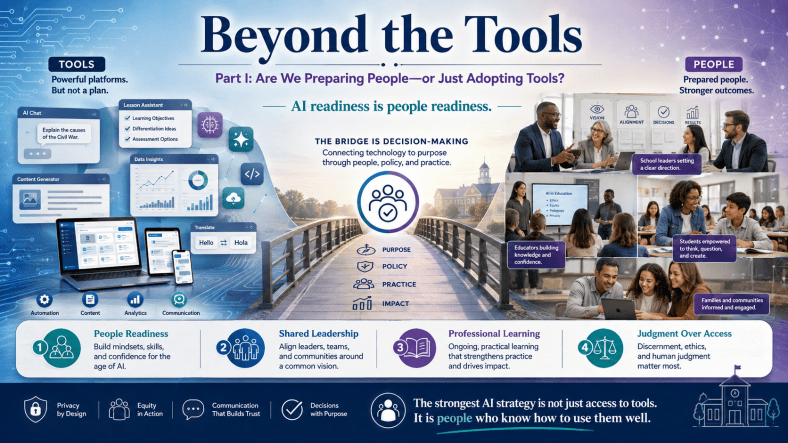
Beyond the Tools, Part I: Preparing People or Just Adopting Tools?
Artificial intelligence continues to move quickly in education. There are new tools, new AI features, new capabilities. Schools are tasked with complex work when it comes to evaluating products and determining what should be permitted, restricted, or encouraged.
I think back to my doctoral research that focused on the need for professional development for educators, especially when it comes to AI. Before focusing on the technology, are we doing enough to prepare the people who will be using it?
Because successful AI implementation is not determined by how many platforms a school has access to, but whether or not those using them understand what they are doing and why.
Learning the Tool Is Only the Beginning
Learning how to enter a prompt or generate a lesson plan is often the easier part. Knowing when to use AI and when not to is much harder. Some examples:
- Recognizing when an output is inaccurate requires judgment.
- Determining whether AI adds to or reduces a meaningful learning experience requires pedagogical knowledge and good instructional practices.
- Knowing what information should not be entered into a platform requires awareness of privacy and security.
- Helping students understand when AI is supporting their thinking rather than replacing it requires more than showing students how to use a tool.
These are just a few of the reasons why I have spoken about making sure that educators and students are ready first before considering what specific technology to use. AI readiness is about people readiness.
Educators Need More Specific Training
Something I continue to notice when providing professional development is the questions being asked. Some of the first questions asked are typically:
- What tool(s) should I use?
- What prompt(s) should I try?
- What can this platform create?
These are important questions, but we also need to ask:
- What problem are we trying to solve?
- Should we use AI for this learning experience?
- What should students still do independently?
- Are there any risks I should consider?
- How do I evaluate the information AI provides?
- How will students demonstrate their own understanding?
Educators do not need to become AI experts, but they need enough knowledge to make informed decisions, which takes time.
Leadership is key
Continue reading on LinkedIn.
Please subscribe to my ThriveinEDU newsletter to stay informed. And contact me for more information.
If Your Organization Is Beginning This Work
I help schools and other organizations (law firms, healthcare professionals, business owners) implement AI responsibly through policy guidance, professional learning, and classroom-ready strategies grounded in both instructional practice and legal insight.
My sessions focus on helping teams:
• understand what AI can and cannot do
• recognize responsible-use considerations
• build confidence using emerging tools
• align implementation with organizational priorities
If your school, district, or organization is beginning conversations or looking to dive in and learn more about AI policy, professional learning, or responsible implementation, I’d welcome the opportunity to support your next steps through leadership workshops, keynote sessions, or strategic planning partnerships.
Preparing people is what makes AI implementation successful. Contact me via bit.ly/thrivineduPD or email Rdene915@gmail.com, for my training and speaking services.


