How Do We Build Trust Around AI?
In the first two parts of this series, I explored how successful AI implementation depends primarily on human readiness and shared leadership. I also focused on the importance of defining what core capabilities students must retain independently. Building on those foundations, Part III focuses on how schools can foster trust across the entire community so that AI implementation is transparent, intentional, and human-centered.
As schools continue to integrate artificial intelligence, the conversations focus on purpose, capability, and whether or not we should use it. Some questions that come up often focus on specific tools and include:
- What can the tool do?
- How can educators use it?
- How can students use it?
These are valid and common questions. But answering them does not guarantee successful AI implementation. Successful implementation depends on something much harder to build and much easier to lose: trust.
Students need to trust educators.
Families need to trust schools.
Educators need to trust leadership.
Schools need to be able to trust the tools they adopt.
And everyone needs enough understanding to recognize that AI itself should never be trusted without thorough investigation, ongoing evaluation, and reflection.
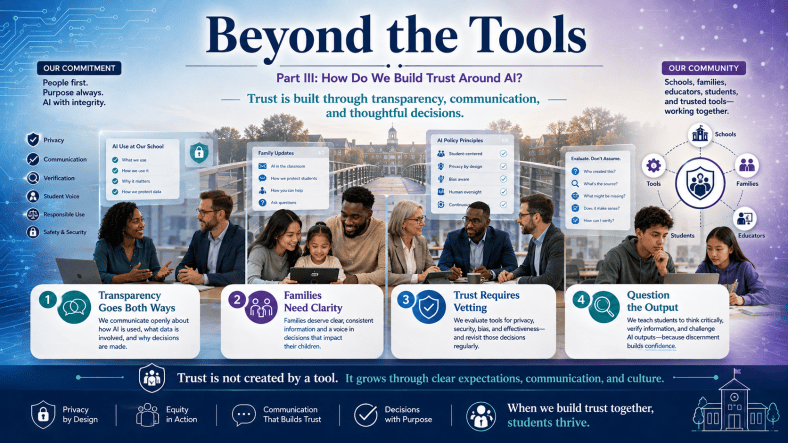
Mutual Transparency Builds Shared Trust
Over the past year, through my work with ISTE+ASCD and Pinterest, one word surfaced repeatedly in conversations with students, educators, families, and school communities: transparency. I have emphasized that transparency must be a shared responsibility, regardless of a person’s role in education. Educators want to know:
- Did the student use AI?
- Did they disclose it?
- Did they cite it?
Those are reasonable expectations. But I’ve also listened to students, and they are asking important questions. They want to know:
- Are their teachers using AI, and how?
- Are educators using it to generate feedback?
- Are schools using it to analyze information?
- Are tools collecting student data?
- What happens to information entered into a platform?
Students should not be expected to practice transparency in a system that is not transparent with them.
Trust works both ways.
This need for mutual openness extends beyond the classroom walls and applies equally to how schools engage with families.
Bridging the Gap Between Policy and Practice for Families
Through conversations with educators and student focus groups across the country, I noticed a recurring disconnect. Information about AI use, screen time, and cell phone expectations was not always communicated clearly between school and home. Families also need clear and consistent information.
A lengthy AI policy may satisfy a school district requirement, but it does not necessarily help a parent understand what is happening with AI in a classroom.
Families need access to clear answers to practical questions such as:
- What AI tools are students using?
- Why are they being used?
- What student information is being collected?
- How are tools vetted?
- What expectations apply to student use?
- What happens when those expectations are violated?
- Who do families contact with questions?
The clearer those answers are, the less likely uncertainty is to turn into mistrust.
Trust Requires Vetting
There is also a tendency to focus on what an AI tool can do before asking what happens behind the scenes.
Schools need processes for examining privacy, security, accessibility, age requirements, data use, contracts, and instructional purpose before adopting AI tools.
An impressive platform does not necessarily mean it belongs in a classroom, and this is why collaboration matters.
- Technology teams understand infrastructure.
- Educators understand instructional purpose and classroom context.
- Administrators understand organizational priorities.
- Legal and privacy professionals understand risk.
- Students and families understand how decisions affect them.
No single perspective is enough. Trust grows when people understand not only what decisions are being made, but how and why those decisions were reached.
Questioning the Output: Why Blind Trust Fails
There is another form of trust students need to understand:
- AI outputs should not automatically be trusted.
- A confident answer can still be wrong.
- A polished response can still contain bias.
- A citation can still be fabricated.
- An image can look authentic and still be synthetic.
Students need practice questioning, verifying, and evaluating information rather than simply accepting it. Ask:
- Where did this information come from?
- Can I verify it?
- What perspective may be missing?
- What assumptions are being made?
- Does another reliable source agree?
- What evidence supports this response?
Those habits are part of AI literacy, but they are also part of broader information literacy.
Build a Culture, Not a Compliance Checklist
Trust is not created by publishing an AI policy.
Continue reading on LinkedIn and subscribe to my newsletter.
I would love if you would subscribe to my ThriveinEDU newsletter and follow my podcast and YouTube channel to check out some interviews and other learning opportunities.
If Your Organization Is Beginning This Work
I help schools and other organizations (law firms, healthcare professionals, business owners) implement AI responsibly through policy guidance, professional learning, and classroom-ready strategies grounded in both instructional practice and legal insight.
My sessions focus on helping teams:
• understand what AI can and cannot do
• recognize responsible-use considerations
• build confidence using emerging tools
• align implementation with organizational priorities
If your school, district, or organization is beginning conversations or looking to dive in and learn more about AI policy, professional learning, or responsible implementation, I’d welcome the opportunity to support your next steps through leadership workshops, keynote sessions, or strategic planning partnerships.
Preparing people is what makes AI implementation successful. Contact me via bit.ly/thrivineduPD or email Rdene915@gmail.com for my training and speaking services.