
Considerations for the conversations
In part II of the series, I shared my thoughts about what I’ve been learning from working with district leadership teams across the country, and the work is focused on AI, digital wellness, and innovation. In part II, I shared my thoughts on preparing educators in these areas and why it means preparing school leaders first. This work has provided me with meaningful opportunities to learn with and work alongside educators, students, and families, and I am noticing common conversations and concerns in the schools.
Screen time
Students talk about it. Families ask about it. Teachers notice it. Administrators are expected to respond to it. What do we do about the devices?
But what I have learned from working with schools is that the most important leadership question is not simply how much time students spend on screens. The more important question is: What are students doing while they are on those screens?
As technology continues to evolve in our schools and in the world, we need to move beyond conversations that focus only on limits and restrictions. We need to focus on purpose, guidance, and readiness.
Moving From Screen Time to Purposeful Use
Conversations about student technology use have primarily focused on recommended amounts and on setting limits. The American Pediatric Association had recommendations for some of the most common questions: How many hours per day? How often should devices be used? When should students disconnect?
Although the conversation has shifted away from specific time limits, those guiding questions still matter. But today’s learning environments require something more intentional and thoughtful, and should bring in different perspectives about what the common uses are. We need to better understand how students are using technology and whether that use supports learning, connection, creativity, and growth. From my conversations, I have learned that students are using devices to:
- Interact with friends and family
- collaborate with classmates
- create original work
- communicate with teachers
- design presentations
- explore complex ideas
- interact with artificial intelligence tools
Continue reading via my newsletter on LinkedIn and subscribe. Also, subscribe to my newsletter for events, resources, and more.
If Your Organization Is Beginning This Work
I help schools and other organizations (law firms, healthcare professionals, business owners) implement AI responsibly through policy guidance, professional learning, and classroom-ready strategies grounded in both instructional practice and legal insight.
My sessions focus on helping teams:
• understand what AI can and cannot do
• recognize responsible-use considerations
• build confidence using emerging tools
•align implementation with organizational priorities
If your school, district, or organization is beginning conversations or looking to dive in and learn more about AI policy, professional learning, or responsible implementation, I’d welcome the opportunity to support your next steps through leadership workshops, keynote sessions, or strategic planning partnerships.
Preparing people is what makes AI implementation successful.
About Rachelle
Dr. Rachelle Dené Poth is a Spanish and STEAM: What’s Next in Emerging Technology Teacher. Rachelle is also an attorney with a Juris Doctor degree from Duquesne University School of Law and a Master’s in Instructional Technology. Rachelle received her Doctorate in Instructional Technology, with a research focus on AI and Professional Development. In addition to teaching, she is a full-time consultant and works with companies and organizations to provide PD, speaking, and consulting services. Contact Rachelle for your event!
Rachelle is an ISTE-certified educator and community leader who served as president of the ISTE Teacher Education Network. By EdTech Digest, she was named the EdTech Trendsetter of 2024, one of 30 K-12 IT Influencers to follow in 2021, and one of 150 Women Global EdTech Thought Leaders in 2022.
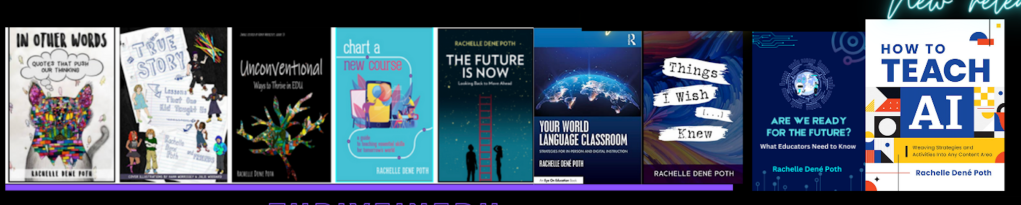
She is the author of ten books, including ‘What The Tech? An Educator’s Guide to AI, AR/VR, the Metaverse and More” and ‘How To Teach AI’. In addition, other books include, “In Other Words: Quotes That Push Our Thinking,” “Unconventional Ways to Thrive in EDU,” “The Future is Now: Looking Back to Move Ahead,” “Chart A New Course: A Guide to Teaching Essential Skills for Tomorrow’s World, “True Story: Lessons That One Kid Taught Us,” “Things I Wish […] Knew” and her newest “How To Teach AI” is available from ISTE or on Amazon.
Contact Rachelle to schedule sessions about Artificial Intelligence, AI and the Law, Coding, AR/VR, and more for your school or event! Submit the Contact Form.
Follow Rachelle on Bluesky, Instagram, and X at @Rdene915