Kindness and Equity in Our Science Classrooms

Guest Post by Kathy Renfrew (@krsciencelady), previously published on Middle Web

A while back I bought the novel Wonder. As with many good intentions, life got in the way and as the days turned into weeks the book sat lonely on my nightstand.

Finally, in August, with a new school year starting soon, it seemed an opportune time to finally jump into the text on my nightstand.

I dove in head first and was instantly smitten by the characters in this multi-award winning book and began to see the many ways to apply the learning in Wonder to my work in the classroom.

While reading I began to wonder how I might ‘choose kind’ if I had been a character in Auggie Pullman’s story. What would 9 or 11-year old Kathy have done? Would I have chosen to befriend Auggie?

start-joy-09-09-19

As our school focused on “choosing kind” to foster students’ social-emotional learning, I went in search of additional resources to use along side this brilliant text in my daily work. Resources like this one from the Teaching Channel shared tips that I would be able to enact instantly.

What do students think?

As posters of #choosekind appeared in the hallways of my school, I was curious to know what students across the country thought choosing kind might look like? Moreover, I was curious to learn how the idea of choosing kind transferred to the three-dimensional learning we teach in science classrooms.

Leveraging the power of our global professional learning network (PLN) through social media, I shared this question across my twitter PLN and a fourth grade teacher in Michigan, Jennifer Ladd, responded.

Click to enlarge

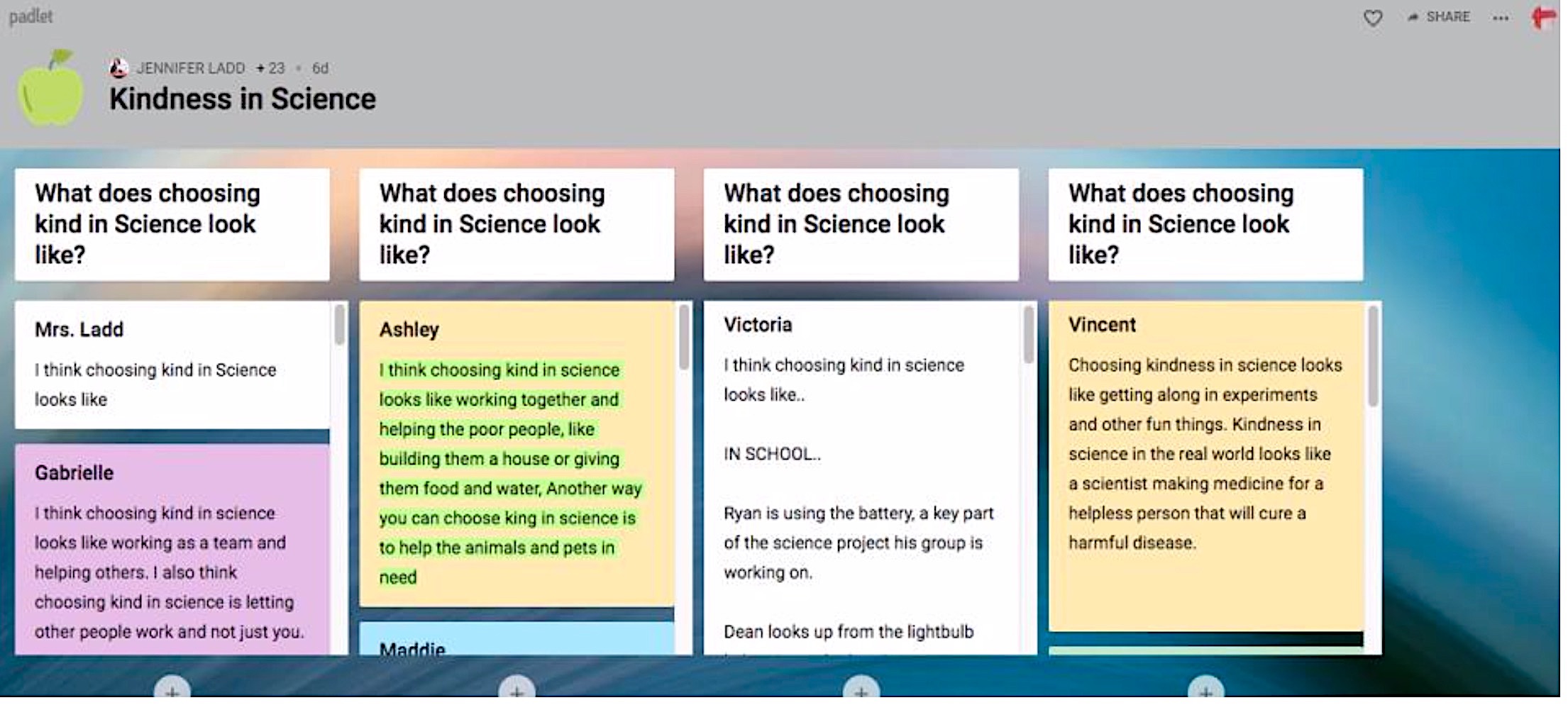
Ladd likes to use one of my favorite learning tools, Padlet, and asked her students to respond to some prompts. Their answers were both inspiring and thought provoking.

Students instantly identified attributes of the 4 C’s including collaboration and communication. For instance Ryan shared, “I think choosing kind in science looks like when someone has a question you don’t say ‘oh that question is not smart’ you try to work together and figure it out and include people.”

Students shared general and specific strategies for choosing kind in science classrooms from the ideas of teamwork and friendship to how to ensure all learners have access to tools for success.

Ashlyn wrote, “I think choosing kind in science looks like teamwork and friendship. Science always should look like what teamwork is. Teamwork and friendship is like people passing around the batteries and wires. Teamwork accomplishes big things.”

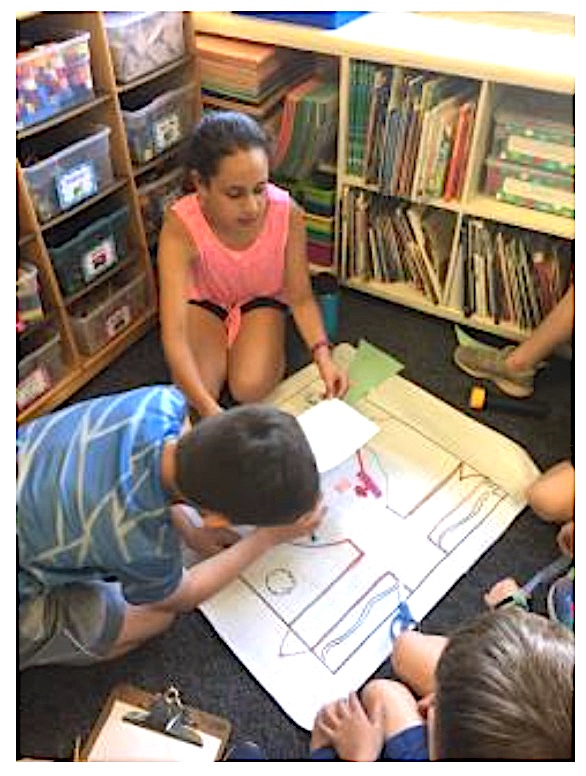
Inspired by these fourth grade learners, I began observing students in the classroom to see what they were talking about to their first reading buddies. The fourth grade and the first grade had partnered together to create a shade structure in the outdoor classroom.

In one observation I heard a student choose kind when she said to her group, “I will do the math, all the adding, and you work on the structure. Tim, will you please help Joe with the tape on the structure.”

After hearing from my PLN nationwide and visiting classrooms, I decided to reach out to friends to see how they foster kindness in their science classrooms.

Fellow squadster and teacher laureate Meg Richards shared how “choosing kind in my science classroom has students being open to new experiences and new ways of thought.”

“We spend time talking about how science is a place to wonder, where right answers can always get better if we are open to them,” Meg says.

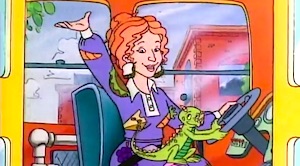
“After all, in the wise words of Miss Frizzle (of Magic School Bus fame), ‘If you keep an open mind you never know who might walk in.’”

Moving with kindness to equity

#Choosingkind is a great start in acknowledging the small steps we can each take towards creating a more equitable and just world. But it is just the first step. How do we move beyond kindness to include equity where all learners have access to the tools they need to find success?

What are some tools we can implement right now that will help us create kind, safe, and equitable communities in science and across the school building?

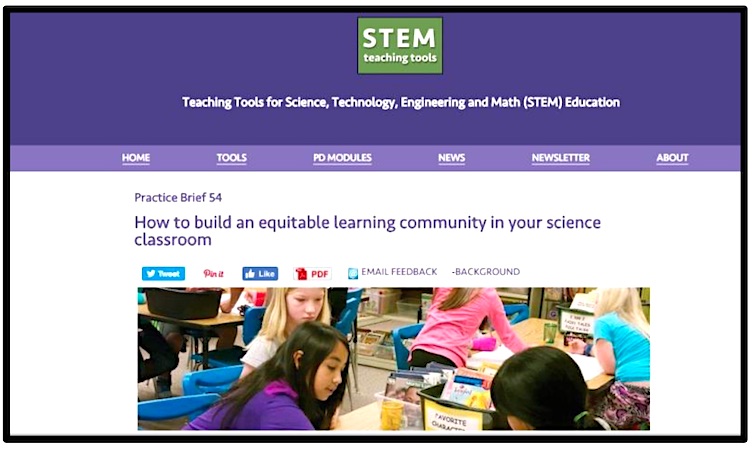
One tool that may launch these conversations is called STEM Teaching Tool #54 from the Institute of Science + Math Education. This tool helps us better understand exactly what an equitable classroom is and provides some ideas of how to move forward.

For instance, resources such as the Story of a Name teach respect for each person’s choice of name which helps learners and educators honor their colleagues and students, resulting in greater respect and collaboration. Other options include The Shoe Game – Equity versus Equality (exploring the value of differentiation) and Pictures of Our Lives (sharing stories of our diverse experiences).

Students may also opt to use a Science Journal Quest to foster effective classroom talk together. Intentionally engaging with resources like the STEM Teaching Tool and others are small steps toward a much larger goal of equity and mindfulness in the classroom.

If we have the goal of building equitable learning communities, we are making a step in the right direction. In this way we are modeling for our students, our colleagues, and our community what it means to be kind and just, and maybe, just maybe, #choosingkindness will become a part of who we all are.

Edutopia has an article by Sarah Kesty about the use of the engineering design process to foster collaboration and kindness, called Social And Emotional Learning in Science Class. I found I was using this article to stimulate my thinking around this topic.

I also connected with a story from EdWeek which talked about some work a middle school was doing to really think about the whole child and find opportunities to integrate Social and Emotional Learning into what they were already teaching rather than have another siloed subject to teach. See: How One District Is Spreading Social-Emotional Learning Across All Its Schools.

Keeping SEL out front in science class

During this school year, I’m going to be thinking a lot about how we can keep social and emotional learning out front – something that’s always important for us to be thinking about. How can we make our children feel safe and yet very excited about learning? I think we need to remember that our children live in a world that can sometimes be very scary.

After writing and reflecting on this article, I see that the implementation and implications of the student-centered New Generation Science Standards offer us many avenues to help our students feel safe and enjoy learning again. I think the title of my next blog will be something like “How Phenomenon-Driven Instruction Can Make Our Classrooms More Equitable Places for Learning.” I believe by focusing on questions like this, we’ll find even more ways to incorporate social and emotional learning into our science classrooms.


**Interested in writing a guest blog for my site? Would love to share your ideas! Submit your post here.


Looking for a new book to read? Many stories from educators, two student chapters, and a student-designed cover for In Other Words.

Find these available at bit.ly/Pothbooks  


3  books.png

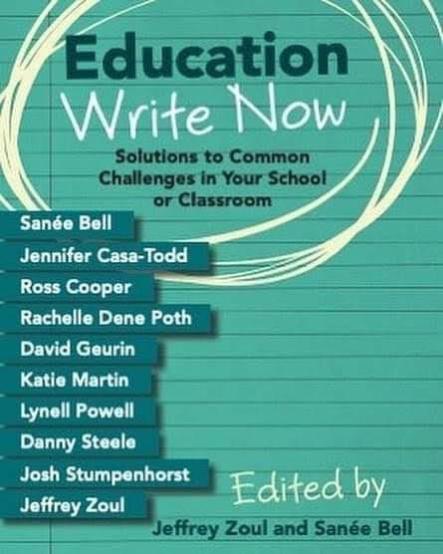
Education Write Now: An Amazing Experience

To say that the summer of 2019 was tremendous is an understatement. Besides having time to spend with family and friends, I enjoy having extra time in the summer to participate in professional learning opportunities and to connect with educators from around the world. As educators, it is important that we continue learning and involving ourselves in opportunities to build our own skills and also to contribute to the personal and professional growth of others. I am fortunate to have been asked to be one of the writers for this year’s Education Write Now book.

In July, ten of us met in Boston for three days to work on chapters that will become part of Volume 3 of Education Write Now, a book whose proceeds will go toward The Will to Live Foundation, a non-profit organization founded to support teen suicide prevention. The time together started with a welcome from Jeff, an introduction to what the organization does, and an opportunity to hear from John Trautwein, a father who lost his son to suicide. John created The Will to Live Foundation to honor his son and to provide support for other families and their children.

It was an honor to be a part of this project and work alongside and collaborate with Jeff Zoul, Sanee Bell, David Guerin, Josh Stumpenhorst, Jennifer CasaTodd, Danny Steele, Katie Marin, Ross Cooper, and Lynell Powell. It was a great experience, although initially, the thought of writing a chapter within a short period of time of two days was a little bit stressful. However, having that time to work together, have peer feedback time, to listen and share out what we were writing with the other collaborators, made all the difference. It just reaffirmed the importance of connections and building those professional relationships. We need to make time to share what we are doing in our classrooms, exchange ideas, solve problems together, and embrace risks and face the challenges that are part of education today, but to do so with a supportive network.

The theme for this year was “Solutions to Common Challenges in Your School or Classroom.” In thinking about this theme, I decided to write about teaching in isolation and sharing my own story of how I chose to be isolated for many of my years of teaching. In my chapter, I explore how isolation happens and offer ways for educators to escape what can sometimes become an isolating profession.

Here are a few excerpts from my chapter, Chapter 2: Choosing to teach in isolation is a choice to isolate our students from a world of learning opportunities.

Have you ever experienced any of the following?

You have to make your very first phone call home to a parent and you are worried that you won’t say the right thing.

You are going to be observed for the first or fifteenth time, and you are worried that you will make a mistake or not use the right instructional strategies. The class starts in five minutes.

How many of these statements can you relate to? For each one, think about if you reached out to someone or just kept it to yourself. Did you choose isolation rather than asking for help?

Clarity:

You are not alone

For years I struggled with classroom management and student behaviors. Rather than ask for advice, explore resources, or try to work it out by talking with my students, I kept it to myself and did my best to make it through each day. I hoped for improvement, but I did not actively try to make changes. I did not ask for help or even talk about the problems that I was having. I did not know where to begin but at that time, so I thought that I was better off keeping it to myself. My biggest mistake was hiding in my classroom and not reaching out to colleagues or other educator friends.

Isolation is not something new

Life as an educator, trying to complete everything that we need to can lead to a career spent in isolation if we let it.

Ten ways to break free or avoid isolation

There is so much potential for connecting regardless of where we are and the amount of time we have. We must take the first step and just start somewhere. We can leverage technology to check-in with colleagues, even if they teach next door to you. Sometimes seeing our neighbors does not happen on our busy days, which are most days. There are ways to stay connected while driving to and from school, taking a walk, wherever you are and on your schedule.

In the end

The most important thing to remember is that you are not alone.

You are not alone in feeling like you do, like the job is difficult, or there are too many things to remember, too many initiatives to keep up with.

We all understand the importance of asking for help; Those who achieve big things are the ones who accept it when it’s offered. Simon Sinek

The choice is now yours, how do you want to connect?


Be sure to check out next week’s post from Jennifer Casa-Todd, Chapter 3 “The Challenge: Broadening our Definition of Literacy.”


Abre

This post is sponsored by Abre. Opinions expressed are my own.

The story behind Abre

Beyond knowing what a particular tool does or how a platform works and the benefit for educators, families, and schools, I enjoy getting to know the people behind the tools. Understanding their story and motivation for creating their product helps to make a more authentic connection with them. I had the chance to speak with Damon Ragusa, CEO of Abre and Don Aicklen, VP of Sales, to learn more about the platform and what it offers for education.

What is Abre?

Abre is a platform that grew out of a need to help schools provide more for educators, students and the school community at large. Chris Rose and Zach Vander Veen, co-founders of Abre, noticed that there were so many different apps and tools being used in education that it was becoming challenging to keep everyone informed consistently. The concern was that staff, students and parents were using multiple tools which led to an increase in confusion and the amount of time needed to manage them. Chris and Zach then created this platform for use within school districts.

Why Abre?

Parents, educators, administrators, and students need to be able to exchange important school information, access school data, track student progress, and facilitate communication between home and school efficiently. The challenge with multiple apps and tools being used throughout one school system is that it becomes more difficult to keep everyone connected as they need to be. Now school districts have a better way to solve the disconnect and provide more streamlined communication, school news, access to critical information like student data and software solutions to carry out the daily work. The answer is Abre.

How does Abre help?

Abre offers so much within one platform that it resolves many of those challenges initially identified by the founders and that are still faced by many schools and districts. Without having to manage multiple logins and learn a variety of single-purpose systems, Abre helps educators to save time, reduce paper, create digital workflows and offer a highly efficient way to exchange information. The value in Abre is through the connected software apps, which makes it easier for teachers to use tools that will positively benefit students and learning. In addition to the teacher, there are many other benefits for school- and district-based usage. Abre provides easy access to a wide variety of student data in one place for staff and parents to obtain information directly from school, without the need for multiple tools and extra time. It also provides students and parents with exactly what they need to feel connected to the school community via announcements and headline features. Administrators can explore how Abre promotes a better workflow and enhances collaboration within the school community for a typical school day.

Comprehensive and Consolidated

Abre provides a single hub for all school and school-home related communication for staff, students and parents. It streamlines many of the important and required tasks that need to happen in schools and helps to reduce the number of apps being pushed out and the time required to become familiar with a new system. Using Abre, parents will be more connected to the school and have access to information when they need it. With one consolidated platform, it resolves the problem of knowing where to find information or keeping up with multiple apps used in different classes and by the school.

Single Sign-On and Integrations

It is easy to sign-in to the Abre platform whether using Google or Microsoft or even Facebook for parents. Once logged in, Abre users are automatically signed into many of the apps provided to them via the Abre platform.

Privacy

When deciding on a digital tool or a platform to use in our schools, it is important to first verify that it is in compliance with COPPA and FERPA. Abre is compliant with both.

Teacher Benefits

There are many integrations available within the platform to enhance student learning. As a classroom teacher, several of these apps caught my attention and are tools that I use in my class such as Duolingo, Flipgrid, and Quizlet. Being able to use these within one platform would save time and I believe encourage other teachers to implement more digital tools in the classroom. For schools using Learning Management systems like Moodle or Schoology, Abre can connect to and enhance these tools as well as replace functionality. Teachers have access to everything they need to enhance workflow for curriculum planning and instruction as well as professional learning and much more.

Consistency is important

Personally, I have used anywhere between four and six different apps and websites to complete a variety of tasks for attendance, grading, assessments, communication, and student projects. Abre provides solutions with all of this functionality. My next post will speak to the main solutions, beyond the hub, that Abre provides.

To learn more, check into Abre and get started with a demo today!