The Importance of Reflective Practices

Making time for reflection as an educator is essential. Education is a field defined by personal and professional growth. Not just for educators, but also for students, the school community, and the systems involved, too. Growth doesn’t happen on its own. It requires intention, curiosity, and ongoing, consistent reflection. By looking back on our experiences, analyzing what worked and what didn’t, and identifying ways to improve, we build a solid reflective practice in our work. Reflection should not be considered as a routine, but rather as a mindset that transforms teaching into a continuous cycle of learning.

Why Reflection Matters

In classrooms filled with continuous changes, such as emerging technologies, alignment to varying standards, and working to best meet the needs of all learners, reflection helps to anchor us. It offers educators a chance to take a moment to pause and ask themselves questions such as, “Why did this lesson work? What could I do differently next time? What did my students need that I missed? How can I improve for tomorrow?

Reflection:

  • Encourages professional growth and lifelong learning.
  • Improves instructional decisions through ongoing thinking and self-evaluation
  • Builds self-awareness and resilience.
  • Strengthens the connection between teacher and learner experience.
  • Models metacognitive thinking for students.

As a huge fan of quotes, and having written one focused on quotes, I often think of this quote by John Dewey:

“We do not learn from experience… we learn from reflecting on experience.”

When we take the time to reflect on our experiences as educators, we transform them into opportunities for innovation, empathy, and personal growth.

The Cycle of Reflection

A simple way to frame reflection in education is through Gibbs’ Reflective Cycle, which includes six stages:

  1. Description – What happened?
  2. Feelings – How did you feel about it? How did it impact you?
  3. Evaluation – What was good or bad about the experience?
  4. Analysis – Why did things happen that way?
  5. Conclusion – What have you learned? What impact did it have?
  6. Action Plan – What will you do differently next time?

This framework helps teachers to pause, slow down, and analyze practice systematically, rather than relying solely on intuition or habit. It encourages educators to move from being reactive to becoming more intentional. When we do this, we make a shift and turn each lesson into a source of insight to better inform our practice.

Reflection Strategies for Educators

There are many ways to integrate reflective practice into our daily work. It can vary depending on teaching style, teaching and personal schedule, and even the school environment. Here are a few practical strategies that can help make reflection a part of your professional practice.

1. Journaling or Blogging

A reflective journal, whether digital or handwritten, or starting a blog, offers a space to explore thoughts about teaching, students, or school culture. Writing helps us identify or clarify patterns and challenges that we may otherwise be unaware of.

Try this:
At the end of each week, make a note of:

  • A success from the week
  • A challenge faced
  • A surprising moment
  • One thing you’ll try differently next week

This short routine will help to turn reflection into an intentional practice rather than an afterthought.

2. Peer Observation and Feedback

Invite a colleague to observe one of your classes or co-teach a lesson with you. These opportunities can provide new perspectives that deepen our reflection. While it can be uncomfortable at times, it is necessary. Having someone else with us can be insightful for identifying things we may overlook.

When working with a colleague and engaging in peer feedback, it shifts to a dialogue that, rather than being a solo conversation, becomes a dialogue that moves from focusing on what happened in a lesson to what happened, what it means, and what can I do now.

Try this:
After a peer observation, engage in a quick debrief with your colleague. Consider using prompts like:

  • “What did you notice about student engagement?”
  • “How did my questioning or feedback shape learning?”
  • “What assumptions might I have made during that lesson?”
  • “How was my pace during instruction?”
  • “Did I provide opportunities for students to lead more?”

3. Engage in Reflective Conversations with Students

I have found that asking my students for their thoughts is very helpful. I ask them what resonated with them, what confused them, how my class made them feel, and what ideas they can share about the impact of the strategies or teaching tools used in class.

Try this:
End a unit or project with a student reflection survey:

  • “What helped you learn most in this unit?”
  • “When did you feel most challenged?”
  • “What could I do differently to help you learn better?”

When we gain insights like these, they will not only inform instruction but also empower students to become reflective learners.

4. Video Reflection

Over the years, I have used a few different tools to reflect on my teaching practices. It can be uncomfortable at times, but by using video, it can be eye-opening for us. I have used Edthena Coaching for input, a Swivl, and through these, I have noticed several things. I quickly noticed patterns in my tone, pacing in lessons, student interactions, questioning practices, and more, that I often had overseen while teaching.

Try this:
Choose one aspect to focus on, such as questioning techniques, transitions, or body language (I tend to move my hands a lot!), and analyze that specifically. Small, focused reflection leads to meaningful improvement.

Reflection and Innovation

In our age of AI, digital learning tools, and evolving pedagogies, reflection is crucial to integrating innovation effectively. Reflective educators ask:

  • “Is this tool enhancing learning, or is it too much?”
  • “How are my students using technology to think critically, not just consume?”
  • “What role does empathy play in how I use data or AI to personalize learning?”

Reflection ensures that innovation stays human-centered and grounded in purpose, not just as a novelty.

Connecting Reflection to Student Growth

When teachers model reflection, students learn to think about their own thinking, they engage in a process known as metacognition. Reflective learners:

  • Understand their strengths and challenges.
  • Set personal goals.
  • Monitor their progress and adapt strategies.
  • Build self-awareness

Encouraging students to reflect, whether through the use of portfolios, self-assessments, or classroom discussions, cultivates ownership of learning. Reflection is powerful as it helps students to shift the focus of learning from grades to ongoing growth.

Building a Culture of Reflection

Creating a reflective classroom starts with modeling vulnerability. I’ve spoken about vulnerability a lot and often quote Dr. Brené Brown from her book Daring Greatly, in which she speaks of vulnerability in reference to Teddy Roosevelt’s speech, “The Man in the Arena” from 1910. Vulnerability is not a sign of weakness, but rather a sign of strength and willingness to grow. When teachers openly admit what they’re learning, they normalize growth and imperfection.

Try saying:

“I tried something new today, and it didn’t go as I expected. Let’s think about why.”

Transparency like this builds trust and shows students that reflection isn’t about failure. Reflection is about curiosity and continuous improvement.

When reflection becomes part of the culture, it deepens engagement and innovation at every level, from classrooms to leadership teams.

Reflective practice is at the heart of great teaching. It reminds us that education is an evolving journey that brings with it challenges and successes, both of which require reflection. Through reflection, we discover meaning in our work, develop empathy for our students, and gain clarity in our purpose for the work that we do.

The best educators are not those who have all the answers, but those who keep asking better questions.

About Rachelle

Dr. Rachelle Dené Poth is a Spanish and STEAM: What’s Next in Emerging Technology Teacher. Rachelle is also an attorney with a Juris Doctor degree from Duquesne University School of Law and a Master’s in Instructional Technology. Rachelle received her Doctorate in Instructional Technology, with a research focus on AI and Professional Development. In addition to teaching, she is a full-time consultant and works with companies and organizations to provide PD, speaking, and consulting services. Contact Rachelle for your event!

Rachelle is an ISTE-certified educator and community leader who served as president of the ISTE Teacher Education Network. By EdTech Digest, she was named the EdTech Trendsetter of 2024, one of 30 K-12 IT Influencers to follow in 2021, and one of 150 Women Global EdTech Thought Leaders in 2022.

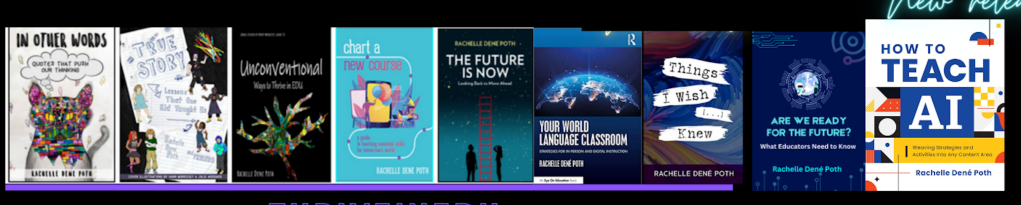
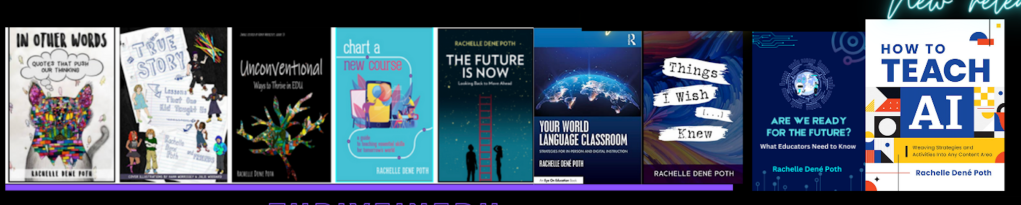
She is the author of ten books, including ‘What The Tech? An Educator’s Guide to AI, AR/VR, the Metaverse and More” and ‘How To Teach AI’. In addition, other books include, “In Other Words: Quotes That Push Our Thinking,” “Unconventional Ways to Thrive in EDU,” “The Future is Now: Looking Back to Move Ahead,” “Chart A New Course: A Guide to Teaching Essential Skills for Tomorrow’s World, “True Story: Lessons That One Kid Taught Us,” “Things I Wish […] Knew” and her newest “How To Teach AI” is available from ISTE or on Amazon.

Contact Rachelle to schedule sessions about Artificial Intelligence, AI and the Law, Coding, AR/VR, and more for your school or event! Submit the Contact Form.

Follow Rachelle on Bluesky, Instagram, and X at @Rdene915

**Interested in writing a guest blog for my site? Would love to share your ideas! Submit your post here. Looking for a new book to read? Find these available at bit.ly/Pothbooks
************ Also, check out my THRIVEinEDU Podcast Here!

Join my show on THRIVEinEDU on Facebook. Join the group here.
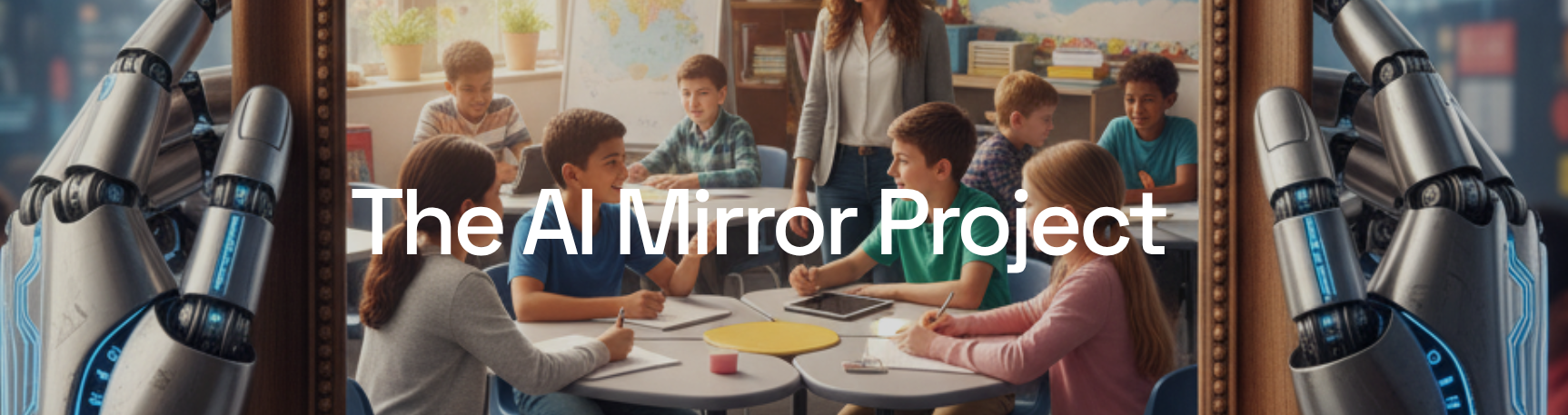
Introducing the AI Mirror Project

Guest post by Brian Baker. Opinions expressed are those of the guest blogger.

In a sense, the disruption genAI has caused – regardless of whether you see it as a net positive or negative – has held up a mirror to education, giving us new perspectives into known issues and exposing ones that were under the surface.

That opportunity for novel insights and increased awareness spurred 24th Century Education, an Oregon-based consulting firm, to launch the AI Mirror Project. The project seeks to capture the voices of those living this unique moment in education by asking:

What has the introduction of genAI taught us about critical issues within the education system?

The project will progress through three phases:

  • Hearing from you: Through December 19, 2025, our website will collect submissions from educators, students, caregivers, the most enthusiastic AI evangelists, the most critical skeptics – anyone who is involved in any way with the education system and has reflected on these issues.
    You are welcome to capture your thoughts in text, images, video, audio, or whatever format allows you to best share your voice.
  • Analysis & research synthesis: We will look for themes among the perspectives that are shared, then synthesize those with available research to better understand the issues identified.
  • Final report: 24th Century Education will compile and share our findings, hoping to use this disruptive moment as a means to better understand our current reality and work towards our goal of building a better future.

(Gemini, 2025)

While the education system has learned and is continuing to learn many valuable lessons about genAI since its introduction, this project instead focuses on what the introduction of and reaction to these tools has shown us about existing issues and challenges, such as…

  • Safety and privacy
  • Assessment
  • Human connection
  • Student engagement and relevance of learning experiences
  • Individual and systemic bias
  • The interaction between education and other large systems (government, industry, economy)
  • Education’s role in maintaining democracy
  • The influence of tech companies
  • Media literacy and misinformation
  • Mental health and digital well-being
  • Anthropomorphization
  • The role of education and the balance between preparing students for working in the existing economy versus equipping them to shape a more just system
  • The vital role of teachers
  • Student agency
  • Critical thinking and cognitive offloading

… along with any other topic that genAI’s introduction into education has made you consider.

There are many, often competing narratives about AI’s role in education. 24th Century Education is hoping to cut through that discourse and instead dive deeper into some of the existing challenges that have, in some cases, been highlighted by genAI’s impact, and that in others have been obscured by it.

To accomplish that, please share your voice and let us know how this moment has exposed existing issues within education.

AI’s introduction and use have touched on nearly every financial, instructional, and social-emotional function of schools. It has implications for equity, well-being, and the health of our democracy, environment, and economy. It has vast implications for education, a system that binds today’s learning to tomorrow’s reality.

At 24th Century Education, we are fueled by the belief that humanity needs an environment, economy, and society where all people can thrive, and that we must use education today to help students develop the knowledge, skills, and dispositions that they need to create that tomorrow.

We believe understanding the present is essential to building the better future we envision for the education system, and we hope that this project contributes to that mission.

You can visit and make a contribution to the AI Mirror Project here. If you have any questions, please contact 24th Century Education’s Chief Learning Officer, Brian Baker – brian@24thcenturyeducation.com.


About Rachelle

Dr. Rachelle Dené Poth is a Spanish and STEAM: What’s Next in Emerging Technology Teacher at Riverview High School in Oakmont, PA. Rachelle is also an attorney with a Juris Doctor degree from Duquesne University School of Law and a Master’s in Instructional Technology. Rachelle received her Doctorate in Instructional Technology, and her research focus was on AI and Professional Development. In addition to teaching, she is a full-time consultant and works with companies and organizations to provide PD, speaking, and consulting services. Contact Rachelle for your event!

Rachelle is an ISTE-certified educator and community leader who served as president of the ISTE Teacher Education Network. By EdTech Digest, she was named the EdTech Trendsetter of 2024, one of 30 K-12 IT Influencers to follow in 2021, and one of 150 Women Global EdTech Thought Leaders in 2022.

She is the author of ten books, including ‘What The Tech? An Educator’s Guide to AI, AR/VR, the Metaverse and More” and ‘How To Teach AI’. In addition, other books include, “In Other Words: Quotes That Push Our Thinking,” “Unconventional Ways to Thrive in EDU,” “The Future is Now: Looking Back to Move Ahead,” “Chart A New Course: A Guide to Teaching Essential Skills for Tomorrow’s World, “True Story: Lessons That One Kid Taught Us,” “Things I Wish […] Knew” and her newest “How To Teach AI” is available from ISTE or on Amazon.

Contact Rachelle to schedule sessions about Artificial Intelligence, AI and the Law, Coding, AR/VR, and more for your school or event! Submit the Contact Form.

Follow Rachelle on Bluesky, Instagram, and X at @Rdene915

**Interested in writing a guest blog for my site? Would love to share your ideas! Submit your post here. Looking for a new book to read? Find these available at bit.ly/Pothbooks

************ Also, check out my THRIVEinEDU Podcast Here!

Join my show on THRIVEinEDU on Facebook. Join the group here.
Tips for Using AI and for Talking to Students About It

My Prior post on Edutopia

AI isn’t coming—it’s already here. It has been embedded in the various educational platforms we use and the assessments we give. It’s likely involved in both the professional development we participate in and the writing and work that our students are doing.

As an educator, speaker, and advocate for technology integration, I’ve spent a lot of time researching, using, and teaching with AI so that I can prepare students and other educators. In my classroom, from using a variety of AI tools that help me save time so I can spend it working with students to integrating chatbots to support student learning, I see the value and impact of leveraging this technology. If we want our students to be ready for their future careers, we must start teaching them about AI. They need to move beyond being consumers of content and instead become creators and innovators.

Where Do We See AI?

For educators, many AI-powered platforms help us to target instruction, assess students, and find resources for our lessons.

Confidence building: Encouraging students to speak in class can be a challenge. At the end of 2023, I started to use SchoolAI with my students and created a “Sidekick” for them to have conversations in Spanish based on the content that I used for the prompt. They loved it—it not only helped them build language skills and confidence but also showed how AI can support their learning. MagicSchool AI is another great option, with a tutor function that helps students in areas where they need support. Both of these tools also have historical characters that students can chat with and other features to enhance learning. I love that I can monitor student responses, provide additional support, and adjust instruction as needed.

Using Eduaide, teachers can kick off a class debate with pros and cons and an outline to quickly get started, and they can also develop other collaborative and engaging activities for students.

For language learners, confidence matters. Snorkl enables students to practice speaking and receive real-time AI and teacher feedback. The AI gives real-time feedback on fluency and pronunciation, helping students grow as communicators and build confidence. Snorkl can be used with students starting in kindergarten, and it has a library full of ready-to-use activities. Throughout the times I have used Snorkl or one of the chatbots, the feedback provided has been tailored to each student’s responses and offered insights and examples to support their learning.

Continue reading the rest of this post on Edutopia.

About Rachelle

Dr. Rachelle Dené Poth is a Spanish and STEAM: What’s Next in Emerging Technology Teacher at Riverview High School in Oakmont, PA. Rachelle is also an attorney with a Juris Doctor degree from Duquesne University School of Law and a Master’s in Instructional Technology. Rachelle received her Doctorate in Instructional Technology, and her research focus was on AI and Professional Development. In addition to teaching, she is a full-time consultant and works with companies and organizations to provide PD, speaking, and consulting services. Contact Rachelle for your event!

Rachelle is an ISTE-certified educator and community leader who served as president of the ISTE Teacher Education Network. By EdTech Digest, she was named the EdTech Trendsetter of 2024, one of 30 K-12 IT Influencers to follow in 2021, and one of 150 Women Global EdTech Thought Leaders in 2022.

She is the author of ten books, including ‘What The Tech? An Educator’s Guide to AI, AR/VR, the Metaverse and More” and ‘How To Teach AI’. In addition, other books include, “In Other Words: Quotes That Push Our Thinking,” “Unconventional Ways to Thrive in EDU,” “The Future is Now: Looking Back to Move Ahead,” “Chart A New Course: A Guide to Teaching Essential Skills for Tomorrow’s World, “True Story: Lessons That One Kid Taught Us,” “Things I Wish […] Knew” and her newest “How To Teach AI” is available from ISTE or on Amazon.

Contact Rachelle to schedule sessions about Artificial Intelligence, AI and the Law, Coding, AR/VR, and more for your school or event! Submit the Contact Form.

Follow Rachelle on Bluesky, Instagram, and X at @Rdene915

**Interested in writing a guest blog for my site? Would love to share your ideas! Submit your post here. Looking for a new book to read? Find these available at bit.ly/Pothbooks

************ Also, check out my THRIVEinEDU Podcast Here!

Join my show on THRIVEinEDU on Facebook. Join the group here.
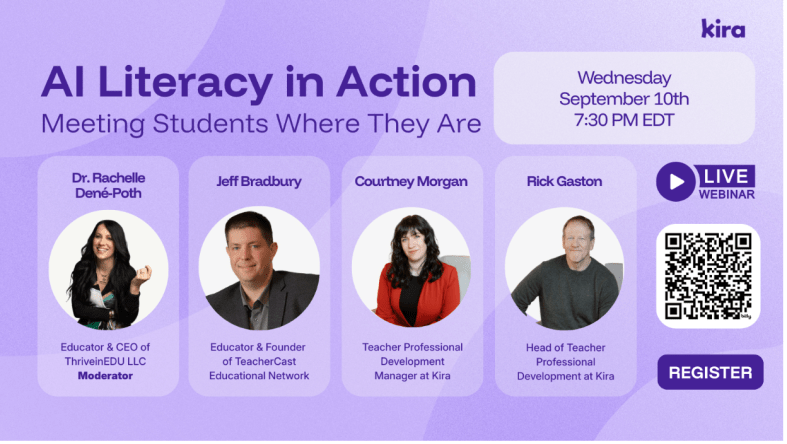
From Curiosity to Confidence: Building AI Literacy Together

In collaboration with Kira

“Where are you with AI today—curious, testing, using weekly, or all in?”

That’s how we opened our recent panel on AI literacy for educators. Whether you feel energized, overwhelmed, or skeptical, you’re not alone, and that’s exactly why having conversations around AI and how to bring it into our schools matters.

Why AI Literacy, Why Now?

I enjoyed the opportunity to serve as the panelist for this great discussion about AI Literacy. We had so much engagement from attendees from more than 25 countries around the world!

The panelists engaged in rich discussion and offered insight into our role as educators and how we can help our students and ourselves better understand: What do we need to be doing when AI-powered tools surround us?” How does learning change?

Literacy isn’t about knowing how to navigate AI platforms, but rather it is about habits of mind. Asking better questions, evaluating outputs, knowing how to evaluate sources, understanding the limitations of AI, and aligning use with learning goals, ethics, and policy. AI is something that we need to consider and how it is involved in our planning, teaching, assessment, and reflection. And being able to determine whether something is real or not, something that I thought more about after reading the book Futureproof, by Kevin Roos, two years ago. Shifting from digital literacy to discernment is key.

The Skepticism Is Real (and Reasonable)

We started our discussion with what we called initial skepticism. Many teachers are hesitant to introduce AI into their classrooms, schools, or even their own workflows. As Jeff Bradbury put it:

“There are educators out there trying to figure this out, but they are not yet sure how to do it. There are educators out there who are scared. And then you have educators on the other side of the innovation curve… How do you work with all of those at the same time?”

He continued: “That question hits home. In every district I visit, I meet the AI All-Ins, the Cautious Curious, and the Not-Now crowd. Suppose this is your staff, good, because having discussions with educators who have these different viewpoints is key. It means you have internal mentors and internal skeptics—the two groups you need most to build something responsible and resilient, especially when the topic is AI”.

Some ideas shared: Start with a common language or practices. Define “AI literacy” and what that means. Identify how to best use AI (lesson planning, differentiation, feedback drafting) and some ways where you want to avoid the use of AI or be more cautious (grading without verification, sensitive data, replacing teacher judgment). Establishing clear guardrails reduces anxiety and helps to ensure that AI implementation in our schools is consistent and purposeful.

The “Aha” That Changes Everything: Specificity

Jeff told a story about a colleague—a music teacher—who tried AI “seven or eight different ways” to create a budget and concluded, “I hate this thing.” The pivot came with one question: “Were you specific?” Did he tell the AI it was for a middle school music program? The approximate budget? The categories? The constraints?

“You didn’t fail eight ways,” Jeff said. “You found eight ways the system didn’t have enough to listen to you.”

The quality of your prompt is not about clever “hacks”—it’s about context, criteria, and constraints.

Prompting is a pedagogy: We are modeling for students how to ask precise questions, set criteria, and iterate. That is AI literacy.

Meet Teachers Where They Are

Rick Gaston and Courtney Morgan from Kira emphasized a simple, human truth: people learn faster when they feel safe and seen.

“We like to meet teachers where they’re at to help them begin with AI,” Rick said. “Start with lesson content they’re comfortable with and have them experience how quickly AI can provide new ideas in that content area.”

“We believe in learning by doing,” Courtney added. “We facilitate that process so teachers can experience that our AI tools can be their teaching buddies.”

I love that phrase: teaching buddies. Not a shortcut. An assistant or collaborator who drafts, riffs, and reframes so that educators can focus on the human aspects of teaching, such as relationships, feedback, and instructional decision-making.

Time: The Gift Teachers Actually Feel

Jeff’s coaching mantra resonated with the chat: “What is the one thing I can give you that no one else can? Time.” When AI saves a teacher 30 minutes tonight, their stance moves from skeptical to curious. When it saves them three hours before conferences, they become advocates.

Concrete time-savers that build trust:

  • Parent emails: Draft a positive progress update with two examples of growth and one specific next step—translated into Spanish and English.
  • Rubric remix: Convert a long analytic rubric into a student-friendly checklist; add “I can” statements.
  • Formative checks: Generate two exit tickets (one multiple-choice, one open-ended) targeting the same standard; include an answer key/rubric slice.

When teachers see the time they can save and then shift to students or colleague interactions, they’re more willing to explore deeper integrations of AI into their practice.

Additional insights from participants (courtesy of Kira)

About Kira

Kira is an AI-powered teaching & learning platform built to save teachers time, personalize instruction, and keep teachers in control. During the panel discussion, attendees had the chance to learn more about the platform and the AI Tutor. “This is just a quick preview of the Kira platform,” said Courtney, “and why we keep mentioning the built-in AI Tutor we’re really proud of.”

At its core, the AI Tutor is designed to coach, rather than simply provide answers. Students can highlight any passage and ask a question, or simply discuss it directly with the tutor. “You’re going to see me try to make it solve the problem for me,” Courtney joked, “but it won’t. Instead, it walks you through highly scaffolded steps.” That means support questions, targeted hints, and extra practice. The Tutor will work at nudging learners toward the how and why, not just the what. You can adjust the support level and reading level per student. It never gives direct answers and provides context-aware, course-specific feedback.

The AI Tutor is subject-agnostic and works across K–12 courses, math included. It’s available to both teachers and students, and it’s been a game-changer for first-time teachers who lean on it to deepen their own understanding while teaching. The message is clear: AI as a teaching buddy, not a replacement.

Differentiation is built in. Teachers can adjust the tutor’s level of support if students are over-relying on it, or increase it for learners who need more targeted assistance, including those with IEPs or language-learning needs. The goal is precision teaching: the right help, to the right student, at the right moment.

Getting started is easy. Kira offers ready-to-use courses, including AI Demystified for students, answering the big questions, “What is AI? What is it doing? How do I use it responsibly?”—and AI 101 for Educators, which builds teacher AI literacy. Looking to be part of a learning community?

Join the upcoming AI 101 for Educators cohort starting in October. Learn more and express your interest here! It is a short, self-paced PD (about 2 hours) for any subject area that builds confidence using AI in real classrooms.

It will cover:

What is AI, and what AI tools are helpful for educators?

How can I teach my students to use AI responsibly?

How can I use AI tools to enhance my students’ critical thinking?

How can I reduce risks and maximize the benefits of using AI in the classroom?

Once you fill out the form, the team at Kira will follow up with more details.

Learn more about their AI 101 PD cohort here.

About Rachelle

Dr. Rachelle Dené Poth is a Spanish and STEAM: What’s Next in Emerging Technology Teacher at Riverview High School in Oakmont, PA. Rachelle is also an attorney with a Juris Doctor degree from Duquesne University School of Law and a Master’s in Instructional Technology. Rachelle received her Doctorate in Instructional Technology, and her research focus was on AI and Professional Development. In addition to teaching, she is a full-time consultant and works with companies and organizations to provide PD, speaking, and consulting services. Contact Rachelle for your event!

Rachelle is an ISTE-certified educator and community leader who served as president of the ISTE Teacher Education Network. By EdTech Digest, she was named the EdTech Trendsetter of 2024, one of 30 K-12 IT Influencers to follow in 2021, and one of 150 Women Global EdTech Thought Leaders in 2022.

She is the author of ten books, including ‘What The Tech? An Educator’s Guide to AI, AR/VR, the Metaverse and More” and ‘How To Teach AI’. In addition, other books include, “In Other Words: Quotes That Push Our Thinking,” “Unconventional Ways to Thrive in EDU,” “The Future is Now: Looking Back to Move Ahead,” “Chart A New Course: A Guide to Teaching Essential Skills for Tomorrow’s World, “True Story: Lessons That One Kid Taught Us,” “Things I Wish […] Knew” and her newest “How To Teach AI” is available from ISTE or on Amazon.

Contact Rachelle to schedule sessions about Artificial Intelligence, AI and the Law, Coding, AR/VR, and more for your school or event! Submit the Contact Form.

Follow Rachelle on Bluesky, Instagram, and X at @Rdene915

**Interested in writing a guest blog for my site? Would love to share your ideas! Submit your post here. Looking for a new book to read? Find these available at bit.ly/Pothbooks

************ Also, check out my THRIVEinEDU Podcast Here!

Join my show on THRIVEinEDU on Facebook. Join the group here.

Leading with AI: Practical Ideas for School and District Administrators

I started researching artificial intelligence in July 2017. I dove into the topic so that I could write a blog post for Getting Smart in January 2018. I had no idea at that point, thinking ahead, how much time I would invest in learning about AI and how much I would invest in working with students and educators over the past 7 1/2 years.

I love working with students in my classroom and also, I am very much aware of the ethical and legal considerations that we have to think about when it comes to any technology, but more specifically AI. Over the past two years, I have challenged myself to go beyond the training that I have done related to AI and different tools, and now I have also been focusing on AI and the law, working with administrators to evaluate policies, create opportunities to provide professional development for the educators in their school systems, and so much more. I am always looking for more opportunities to work within schools.

And with all these opportunities, things have changed a lot from seven years ago when I started presenting, compared with nearly 2 years ago when ChatGPT came out, and even this year. Artificial intelligence isn’t just a buzzword anymore—it’s becoming a tool that education leaders can no longer ignore. As an educator and consultant who works at the intersection of AI, law, and learning, I’ve seen how quickly AI is reshaping classrooms and professional practices. But what about those leading from an administrator’s viewpoint?

For administrators, AI is not just about the tools students or teachers use; it’s about strategy, policy, and shaping the future of learning in your schools. So how can you, as an education leader, leverage AI effectively and responsibly? Here are some ideas and practical tips to help you get started.

1. Streamlining Administrative Work

One of the most immediate uses of AI is in reducing the workload that often takes administrators away from instructional leadership. AI-powered tools can:

  • Draft communications: If you spend time writing newsletters to families, updates to the school board, or memos for staff, AI can help you to generate polished drafts that you can refine and personalize.
  • Summarize long reports: Instead of sifting through dozens of pages, AI can condense state policy updates, research articles, or professional learning reports into actionable takeaways.
  • Automate scheduling: Tools now exist that can suggest meeting times, analyze calendar patterns, and even help coordinate professional development sessions.

💡 Reminder: Always add your authentic voice and context when using AI for communication. AI should be used as an assistant, not as a replacement for the work we do.

2. Using AI for Data-Informed Decisions

Administrators are constantly making decisions based on data. They focus on assessment results, attendance records, and even budgetary considerations. AI can help to identify patterns and provide insights more quickly. For example:

  • Equity checks: AI can highlight disparities in discipline, participation, or achievement data that might otherwise be hidden.
  • Enrollment predictions: Some districts are already using AI to forecast shifts in student numbers and staffing needs.
  • Resource allocation: Imagine tools that analyze spending trends and suggest areas where funds could be more impactful.

💡 Tip: AI should not replace your own judgment. Use it as a lens to see trends and then combine those insights with your leadership expertise and community input.

3. Supporting Teachers with AI

Your role is so important, especially for supporting teachers:

  • Lesson planning: Teachers can use AI to brainstorm activities aligned with standards or to differentiate for diverse learners.
  • Assessment support: AI-powered graders can provide fast feedback on essays or projects, giving teachers more time to focus on deeper feedback.
  • Professional growth: AI-driven platforms can recommend resources or communities based on teachers’ needs and interests.

💡 Tip: Encourage and support teachers as they experiment with AI. Promote ideas like generating quiz questions or creating rubrics. Building confidence and trust is key.

4. Enhancing Communication and Community Engagement

Administrators recognize that clear communication with families and the broader school community is crucial. AI can assist in many ways:

  • Translation tools: AI-driven translators are becoming increasingly accurate, enabling schools to connect with families in their native languages. Promoting accessibility and inclusivity is absolutely essential.
  • Chatbots for FAQs: Districts can set up AI-powered bots on websites to answer common parent questions about schedules, policies, or enrollment.
  • Sentiment analysis: Some tools can gauge community concerns by analyzing feedback surveys or social media mentions.

💡 Reminder: Being transparent helps to build trust. If you’re using AI to engage families, be clear about what it is and how it works.

5. Keeping Students Safe and Supported

Administrators have a responsibility to ensure that AI tools support—not endanger—student well-being. This means looking at both opportunities and risks:

  • Early warning systems: AI can help flag attendance or behavioral patterns that may indicate a student is at risk.
  • Cybersecurity monitoring: With cyber threats on the rise, AI can help IT teams detect unusual activity more quickly.
  • Digital citizenship: As students use AI themselves, administrators can help set the tone for safe, ethical, and responsible use.

💡 Tip: Always vet AI tools for compliance with laws like FERPA and COPPA, and check with legal teams before large-scale implementation. I am available to help you with policy creation and evaluation for your school!

6. Building an AI-Ready Culture

Perhaps the most critical role for administrators is shaping culture. AI is somewhat new(in the sense that GenAi is new and it can be intimidating, but it’s also full of promise. Leaders can set the tone by:

  • Modeling use: Share examples of how you use AI to save time or make decisions.
  • Creating professional learning opportunities: Dedicate PD sessions to exploring AI tools and their classroom applications.
  • Starting conversations: Make space for teachers, students, and families to share questions and concerns.

7. Policy and Ethical Leadership

AI brings with it new challenges in ethics and policy. Administrators should be proactive in:

  • Drafting AI guidelines: Develop policies for teachers and students that encourage innovation while addressing risks.
  • Evaluating vendors: Not every AI tool is created equal. Ask about how tools protect student data, align with standards, and support equity.
  • Monitoring impact: Establish checkpoints to evaluate whether AI tools are meeting their intended goals.

💡 Tip: Create a small task force of teachers, tech staff, and even students to help monitor AI use in your school or district. Shared ownership builds stronger policies.

Planning Ahead

As an administrator, it’s okay to not have all the answers about AI. You just need to be willing to ask the right questions. Over the past seven+ years, I have seen the most success when educators approach AI with curiosity, caution, and courage.

Curiosity allows you to explore the potential of AI without fear.
Caution keeps you grounded in ethics, equity, and student safety.
Courage helps you lead your community into a future that is still unfolding.

AI can be a powerful tool to help administrators focus on what matters most: supporting teachers, empowering students, and building thriving school communities.

The question isn’t whether AI belongs in education leadership—it’s how you, as an administrator, will guide its use. By starting small, asking thoughtful questions, and keeping your community at the center, you can ensure AI becomes an asset rather than a distraction.

About Rachelle

Dr. Rachelle Dené Poth is a Spanish and STEAM: What’s Next in Emerging Technology Teacher at Riverview High School in Oakmont, PA. Rachelle is also an attorney with a Juris Doctor degree from Duquesne University School of Law and a Master’s in Instructional Technology. Rachelle received her Doctorate in Instructional Technology, and her research focus was on AI and Professional Development. In addition to teaching, she is a full-time consultant and works with companies and organizations to provide PD, speaking, and consulting services. Contact Rachelle for your event!

Rachelle is an ISTE-certified educator and community leader who served as president of the ISTE Teacher Education Network. By EdTech Digest, she was named the EdTech Trendsetter of 2024, one of 30 K-12 IT Influencers to follow in 2021, and one of 150 Women Global EdTech Thought Leaders in 2022.

She is the author of ten books, including ‘What The Tech? An Educator’s Guide to AI, AR/VR, the Metaverse and More” and ‘How To Teach AI’. In addition, other books include, “In Other Words: Quotes That Push Our Thinking,” “Unconventional Ways to Thrive in EDU,” “The Future is Now: Looking Back to Move Ahead,” “Chart A New Course: A Guide to Teaching Essential Skills for Tomorrow’s World, “True Story: Lessons That One Kid Taught Us,” “Things I Wish […] Knew” and her newest “How To Teach AI” is available from ISTE or on Amazon.

Contact Rachelle to schedule sessions about Artificial Intelligence, Coding, AR/VR, and more for your school or event! Submit the Contact Form.

Follow Rachelle on Bluesky, Instagram, and X at @Rdene915

**Interested in writing a guest blog for my site? Would love to share your ideas! Submit your post here. Looking for a new book to read? Find these available at bit.ly/Pothbooks

************ Also, check out my THRIVEinEDU Podcast Here!

Join my show on THRIVEinEDU on Facebook. Join the group here.

Acceleration Academies are Serving the Students Society Wrote off

A guest post by Kelli Campbell

I grew up in a small town in rural Illinois. Neither of my parents has a high school diploma, so I am a first-generation high school graduate. Having that diploma opened a world of possibilities to me that would otherwise have been closed, including going on to earn a college degree, which then led to a terrific career and becoming the CEO of Acceleration Academies.

It was my high school diploma that put me on that path to giving back through a career dedicated to improving education. I began decades ago working on products that brought online educational video into the classroom. Now, I have the privilege of helping young people who, like me, face and overcome barriers impeding their education.

I love telling the story about growing up in rural Illinois to graduation candidates attending our Acceleration Academies. Because I want every young person to know they have a path open to them achieving their own dreams, I say to them, “I am a first-generation high school graduate, and now I’m a CEO. You can be anything you want to be!”

Reconnecting Students Who Have Been Pushed Out

At Acceleration Academies (AA), we focus on students who are disengaged. Usually, that means they have dropped out, but we find that more often than not, these students feel like they were pushed out by a traditional approach to schooling that wasn’t supporting their needs. They may have to work full-time to support their families, or they may already have a little one of their own. They may struggle with mental health, such as paralyzing anxiety about attending a school with 1,000 other students. Some students drop out because of bullying or fall behind because of food insecurity. There are so many challenges students can face that have nothing to do with their ability or drive. Instead, it is a school environment that doesn’t work with the circumstances of their lives.

We partner with local school districts to overcome that barrier by providing an alternative school environment where students get all kinds of support, no matter the challenges they face. They get a second chance at a high school diploma with no cost to them. The districts benefit by graduating more students and recovering the funding they lost when students disenrolled.

‘Content Coaches’ and ‘Graduation Candidates’

Creating a different environment is so central to our model that it even filters into the language we use. Our students are called “graduation candidates” to remind them that they are there to complete a goal – a goal, we tell them, that they are 100 percent capable of reaching. Our teachers are called “content coaches” because they help students work through their classes and assignments. We even have staff who will call students who have trouble waking up to their alarm to make sure they get out the door. Our staff will even help them find a job with an employer who will accommodate their school schedule and prioritize their education.

A Different Environment

All of this, our entire model, is about removing barriers and adding in support to help students overcome obstacles. That includes the setting. Our schools offer a cafe-style environment with wide open spaces, varied seating and working areas, several small rooms for meetings, and enclosed workspaces for students who prefer a more private setting.

Students take one class at a time, generally taking about three to four weeks per class, so their content coaches can guide them one subject at a time. We offer a hybrid format that allows them to learn in-person and online. There’s flexible scheduling for everyone so students who have obligations during traditional school hours can come in during the evenings or on weekends. Pacing is up to the student, guided and encouraged by coaches.

We also operate on a 12-month schedule, rather than the traditional nine-month academic calendar. Many of our students are behind grade level, and they need extra months to get back on track. We’ve also found that students lose connection with school during longer breaks and are less likely to continue with their education when they haven’t attended for even a couple of weeks.

A Win-Win-Win for Everyone

Each AA site is a program of choice within the partner district, which makes it a win-win-win. The district recovers funding when students re-enroll and their graduation rate improves as we matriculate students. Young people get back on track to earn a diploma and all the educational and career opportunities that come with it. Their immediate family and even their communities benefit from the increased economic potential each graduate earns as well.

It’s a win for students who have a variety of reasons for needing something different. For example, those who are mostly on the right track, but get into a little trouble, can continue working at their district’s AA site and then either return to their traditional school or continue with us. It is as much a win for the students who are struggling academically or socially as it is for those who want (or need) to graduate faster. See several inspiring student stories here.

A Gwinnett County Public Schools student told me her story recently. She had been depressed, unable to get out of bed and attend school because she felt afraid, almost paralyzed at school. She enrolled at Acceleration Academies after about three months at her parents’ urging. For the first six weeks, she told me she would come to school and go straight to one of the low-stimulus rooms we offer and wouldn’t talk to anyone. Little by little, she began to feel safe.

A few months later, this student walked with me – who was once, to her, a scary adult – around her school. Now, she is confident and sure of her surroundings. She is able to communicate, to advocate for herself, to tell a painful story about a hard time in her life to a stranger. This young woman is still a graduation candidate in our school, and I hope she earns her diploma. Even if she doesn’t, I’m proud to be a part of an organization that helped her find her confidence and reconnect with her goals and her community.

At every graduation I attend, someone will approach me, maybe a teacher, a caregiver, or a graduate, to tell me their personal story and thank me for Acceleration Academies. Every time, when I ask who wants to stay in school, every one of those students who had been labeled as a dropout raises their hands. It really is such meaningful work we are able to do here, and the only reason I am able to do it is because years ago I overcame my own barriers to earn a diploma. I want every graduation candidate to have the same opportunity to improve their communities, and that means removing every barrier we find with student-centered support.

About Kelli

Kelli Campbell is a first-generation high school graduate and a first-generation college graduate. She is the CEO of Acceleration Academies.


About Rachelle

Dr. Rachelle Dené Poth is a Spanish and STEAM: What’s Next in Emerging Technology Teacher at Riverview High School in Oakmont, PA. Rachelle is also an attorney with a Juris Doctor degree from Duquesne University School of Law and a Master’s in Instructional Technology. Rachelle received her Doctorate in Instructional Technology, and her research focus was on AI and Professional Development. In addition to teaching, she is a full-time consultant and works with companies and organizations to provide PD, speaking, and consulting services. Contact Rachelle for your event!

Rachelle is an ISTE-certified educator and community leader who served as president of the ISTE Teacher Education Network. By EdTech Digest, she was named the EdTech Trendsetter of 2024, one of 30 K-12 IT Influencers to follow in 2021, and one of 150 Women Global EdTech Thought Leaders in 2022.

She is the author of ten books, including ‘What The Tech? An Educator’s Guide to AI, AR/VR, the Metaverse and More” and ‘How To Teach AI’. In addition, other books include, “In Other Words: Quotes That Push Our Thinking,” “Unconventional Ways to Thrive in EDU,” “The Future is Now: Looking Back to Move Ahead,” “Chart A New Course: A Guide to Teaching Essential Skills for Tomorrow’s World, “True Story: Lessons That One Kid Taught Us,” “Things I Wish […] Knew” and her newest “How To Teach AI” is available from ISTE or on Amazon.

Contact Rachelle to schedule sessions about Artificial Intelligence, Coding, AR/VR, and more for your school or event! Submit the Contact Form.

Follow Rachelle on Bluesky, Instagram, and X at @Rdene915

**Interested in writing a guest blog for my site? Would love to share your ideas! Submit your post here. Looking for a new book to read? Find these available at bit.ly/Pothbooks

************ Also, check out my THRIVEinEDU Podcast Here!

Join my show on THRIVEinEDU on Facebook. Join the group here.

AI Isn’t Replacing Teachers — It’s Helping Us Teach Better

Guest blog post by Matthew Mawn,@matthew_mawn

If you’ve ever heard the phrase “AI is coming for your job,” you’re not alone. That may be true in some professions. But when I hear it applied to education, I think back to 2020–2021, when the world learned from kitchen tables and bedroom desks. We all saw, in real time, how irreplaceable teachers are, and the immense value they bring to millions of students every day.

Will AI replace teachers? Not from what I can see. Will it help them reach more students and raise achievement for all learners while saving them time on the backend? Absolutely.

Time Saved is Time Invested in Students

What do teachers want? MORE TIME! When do they want it? NOW!

Ask any teacher what they wish they had more of (besides a higher salary), and the answer is almost always the same: time. Time to prepare lessons, to modify materials for all learners, to provide meaningful feedback, to take a full 30-minute lunch break, and actually enjoy it.

U.S. teachers work an average of 53 hours per week, far beyond their contracted hours. Much of that time is consumed by planning, grading, paperwork, and administrative tasks, exactly the kind of work that pulls teachers away from direct interaction with students. It’s such a recognized problem that the New Jersey Department of Education created a grant program called Expanding Innovations in Teacher Climate and Culture, with the sole goal of finding ways to reduce these burdens.

The world of AI is evolving daily, with new tools designed to take these repetitive tasks off teachers’ plates. AI can generate draft lesson plans, create differentiated practice questions in seconds, summarize student performance data into actionable insights, and even draft parent emails. Teachers who use AI at least once a week report saving an average of 5.9 hours each week, adding up to the equivalent of six full weeks over a standard 37.4-week school year.

Take the math teacher who went from spending 90 minutes a week creating Do Now and Closure Google Forms for her three different preps to crafting them in under 10 minutes, letting the AI do the heavy lifting while she simply reviewed, edited, and published. This saved time not only allowed her to do more with less, it also helped alleviate the burnout that comes from teaching multiple preps day in and day out, all while trying to differentiate and create high-quality materials for every learner. AI gives teachers more time both in and outside the classroom, helping restore the work–life balance that’s so hard to maintain during the school year and providing the breathing room they need to give their all to their students.

Turning Time Saved Into Better Learning

AI can save teachers time, but what can that time be used for (besides taking a breath)? For most of us, it means redirecting energy into the parts of teaching that made us want to pursue this profession in the first place: connecting with our students and helping them grow academically.

Differentiation

Every classroom has students with different readiness levels, language needs, and learning preferences. AI tools like Diffit or MagicSchool can instantly create multiple versions of a passage or assignment, differentiated by grade level, complexity, or language. This allows every student to engage with the same core concept, moving together as one cohesive class. Instead of spending an evening retyping and rephrasing, teachers can review and tweak AI drafts in minutes, ready for the next lesson.

Feedback

Timely, specific feedback drives learning but can easily consume hours of a teacher’s time. AI tools such as FeedbackFruits or Rooted Learning can summarize student work or auto-grade Google Forms and release feedback instantly. Teachers can then refine and personalize those comments, giving students actionable guidance while avoiding burnout.

Relationship Building

Extra time also means more one-on-one moments with students and far fewer late nights creating instructional materials for the next day. Will this also mean less coffee consumption? That’s up for debate.

AI isn’t just saving time, it’s giving teachers the capacity to teach better, connect more deeply, and respond to students’ needs in ways that matter most.

Guardrails for Responsible AI Use

AI is making headlines in every industry, but it’s important to remember that not every tool is created equal, and not every use is risk-free. When evaluating AI tools, pay close attention to your students’ data privacy. Many of these tools request student names, work samples, or other information that could violate FERPA or district policies. Always review the privacy policy before moving forward with a tool.

Accuracy is another factor. AI can and does make mistakes, so it’s essential to review the work before sharing it with students. AI is a great starting point, but the final product always needs a teacher’s eyes.

AI is here to stay, and it has the ability to remove time drains, expand access to differentiated materials, and give teachers the time they need to get back to what matters most, their students. It’s not about replacing teachers, it’s about giving them more room to thrive.

About Matt

Matt Mawn, EdD, is the founder of Rooted Learning, an AI-powered platform that generates standards-aligned, differentiated assessments in minutes. He has over 13 years in K–12 leadership, higher education, and edtech. Connect with him on X or visit Rooted Learning.


About Rachelle

Dr. Rachelle Dené Poth is a Spanish and STEAM: What’s Next in Emerging Technology Teacher at Riverview High School in Oakmont, PA. Rachelle is also an attorney with a Juris Doctor degree from Duquesne University School of Law and a Master’s in Instructional Technology. Rachelle received her Doctorate in Instructional Technology, and her research focus was on AI and Professional Development. In addition to teaching, she is a full-time consultant and works with companies and organizations to provide PD, speaking, and consulting services. Contact Rachelle for your event!

Rachelle is an ISTE-certified educator and community leader who served as president of the ISTE Teacher Education Network. By EdTech Digest, she was named the EdTech Trendsetter of 2024, one of 30 K-12 IT Influencers to follow in 2021, and one of 150 Women Global EdTech Thought Leaders in 2022.

She is the author of ten books, including ‘What The Tech? An Educator’s Guide to AI, AR/VR, the Metaverse and More” and ‘How To Teach AI’. In addition, other books include, “In Other Words: Quotes That Push Our Thinking,” “Unconventional Ways to Thrive in EDU,” “The Future is Now: Looking Back to Move Ahead,” “Chart A New Course: A Guide to Teaching Essential Skills for Tomorrow’s World, “True Story: Lessons That One Kid Taught Us,” “Things I Wish […] Knew” and her newest “How To Teach AI” is available from ISTE or on Amazon.

Contact Rachelle to schedule sessions about Artificial Intelligence, Coding, AR/VR, and more for your school or event! Submit the Contact Form.

Follow Rachelle on Bluesky, Instagram, and X at @Rdene915

**Interested in writing a guest blog for my site? Would love to share your ideas! Submit your post here. Looking for a new book to read? Find these available at bit.ly/Pothbooks

************ Also, check out my THRIVEinEDU Podcast Here!

Join my show on THRIVEinEDU on Facebook. Join the group here.
Professional Development on AI

Prior post on Edutopia

Over the past few years, we have seen many changes in education. We live and teach in an increasingly digital world that involves rapid technological advancements through emerging technologies such as artificial intelligence (AI). The technologies are not only impacting our lives as educators, but they are also impacting the world of work that our students will enter.

To best prepare our students, educators must constantly adapt and evolve to keep up with these changes. However, there are challenges associated with these technologies, including a lack of professional learning opportunities, insufficient time to participate, and uncertainty about the best options for learning. Bringing in new technology can also feel like adding to an already overflowing plate. 

Beyond the basic technology skills that educators need for everyday teaching, they also need to be knowledgeable about emerging technologies, particularly AI, and how to bring them into their classrooms. Over the past five years, my work has focused on collaborating with teachers to get them started with emerging technology—including, more recently, AI. Here are some things that work when designing AI-related professional learning.

AI Professional Development for Educators

Professional development (PD) focused on implementing classroom technology goes beyond simply training educators in how to use it and apply it to their curriculum. It requires rich and personalized learning experiences that will engage educators and enable them to see the possibilities available for amplifying learning through educational technology. 

Building knowledge in an area such as AI and other emerging technologies takes time with consistent and guided exploration. It also requires that educators be able to explore a variety of resources to find what best meets their specific needs. Without support, teachers are less likely to dive into these new technologies, especially if they do not see the relevance to their content area. 

Continue reading this post on Edutopia

About Rachelle

Dr. Rachelle Dené Poth is a Spanish and STEAM: What’s Next in Emerging Technology Teacher at Riverview High School in Oakmont, PA. Rachelle is also an attorney with a Juris Doctor degree from Duquesne University School of Law and a Master’s in Instructional Technology. Rachelle received her Doctorate in Instructional Technology, and her research focus was on AI and Professional Development. In addition to teaching, she is a full-time consultant and works with companies and organizations to provide PD, speaking, and consulting services. Contact Rachelle for your event!

Rachelle is an ISTE-certified educator and community leader who served as president of the ISTE Teacher Education Network. By EdTech Digest, she was named the EdTech Trendsetter of 2024, one of 30 K-12 IT Influencers to follow in 2021, and one of 150 Women Global EdTech Thought Leaders in 2022.

She is the author of ten books, including ‘What The Tech? An Educator’s Guide to AI, AR/VR, the Metaverse and More” and ‘How To Teach AI’. In addition, other books include, “In Other Words: Quotes That Push Our Thinking,” “Unconventional Ways to Thrive in EDU,” “The Future is Now: Looking Back to Move Ahead,” “Chart A New Course: A Guide to Teaching Essential Skills for Tomorrow’s World, “True Story: Lessons That One Kid Taught Us,” “Things I Wish […] Knew” and her newest “How To Teach AI” is available from ISTE or on Amazon.

Contact Rachelle to schedule sessions about Artificial Intelligence, Coding, AR/VR, and more for your school or event! Submit the Contact Form.

Follow Rachelle on Bluesky, Instagram, and X at @Rdene915

**Interested in writing a guest blog for my site? Would love to share your ideas! Submit your post here. Looking for a new book to read? Find these available at bit.ly/Pothbooks

************ Also, check out my THRIVEinEDU Podcast Here!

Join my show on THRIVEinEDU on Facebook. Join the group here.

Transform Public Speaking with Yoodli: Your AI Coach

Guest post by Paula Johnson, see Paula’s other blogs here and subscribe!

Public speaking. Just reading those two words probably made your palms sweat a little. Whether you’re a student giving a book report, a teacher presenting at a PD (with no AC and bad coffee), or someone just trying to sound confident in a meeting, speaking clearly and effectively is a real skill, and one that usually comes with years of awkward ums and cringey filler words.

Enter Yoodli, your friendly-but-firm AI-powered speech coach. Think of it like Toastmasters… if Toastmasters lived inside your laptop and never interrupted you

🧰 What Is Yoodli?

Yoodli is an AI tool designed to help users improve their public speaking skills. It analyzes your speech in real-time or after a recording and gives you feedback on things like:

  • Filler words (“um,” “like,” “you know”)
  • Pacing (Are you sprinting or sedating your audience?)
  • Word choice and sentence complexity
  • Eye contact and body language (with video)
  • And yes, even your “uhhh” to actual word ratio

Yoodli gives you a transcript and a confidence score, plus suggestions that range from helpful to brutally honest. It’s basically Simon Cowell with AI ethics and a smiley face interface.

🏫 Classroom Uses: From the Speech Team to the Math Teacher

Yoodli is one of those tools that sneaks up on you with its usefulness. Here’s how educators can integrate it meaningfully across content areas:

💬 1. Speech & Debate or Language Arts

The most obvious use case. Have students record their speeches or presentations, then analyze their own pacing, tone, and use of filler words using Yoodli. Students can track their growth over time, which is far more helpful (and less awkward) than just watching themselves on video.

🎤 2. ELL/ESL Support

For multilingual students, Yoodli provides private, low-stakes speaking practice. It doesn’t judge accents; it focuses on clarity, pacing, and fluency. Students can speak into the tool and get instant feedback, helping build confidence without the pressure of speaking in front of the class.

🧠 3. Teacher PD & Self-Reflection

Want to see how you really sound during that lesson on quadratic equations? Use Yoodli to record part of your instruction or PD session. You might be surprised how often you say “so yeah” (guilty). This can also be helpful for instructional coaches working with teachers on presentation or communication skills.

🧪 4. Science Fairs and Project-Based Learning

Anytime students are explaining a process or presenting their thinking, Yoodli can give them that extra polish. It encourages students to reflect on how they communicate their ideas, not just what they say, but how they say it.

💻 5. Interview Practice and Career Readiness

Mock interviews? Elevator pitches? College essays turned spoken narratives? Yoodli is ideal for helping students practice for real-world moments where confidence and clarity are key.

🧠 The AI Behind the Tool

Yoodli uses automatic speech recognition (ASR) and natural language processing (NLP) to analyze spoken words in real time. Think of it as a very nerdy parrot that listens, transcribes, and then gently tells you you’re rambling.

Some quick nerd notes:

  • Speech recognition turns your words into text (transcription)
  • NLP analyzes your speech for filler words, tone, sentiment, and repetition
  • Yoodli can detect your pace and word variety over time

Importantly, Yoodli doesn’t train its model on your data without consent. Users can opt into saving their data for progress tracking, but educators should check settings for student accounts. They’ve made good strides toward ethical design—no surprise, since one of the co-founders used to work at Google AI but left to build tech that was more human-focused.

Data privacy tip: Make sure to read the privacy policy if you’re using it with students under 18, and consider creating class-specific accounts or using it in “demo mode” with no login required.


🧪 Try It Out: Tips for Teachers

Here’s how to get rolling without needing a 47-slide training deck:

  • Start small: Have students practice a 1-minute talk on any topic. Favorite food. Least favorite math concept. Why dogs are better than cats. (Yoodli is cat-neutral.)
  • Use the transcript: Yoodli gives a full transcript of each session, great for writing reflection, peer feedback, or revision activities.
  • Gamify it: Who can lower their filler word count the most in one week? Who has the smoothest pacing? Instant leaderboard.
  • Model it: Record yourself first and share the feedback you got. Vulnerability builds classroom trust (and shows that even grown-ups say “like” too much).
  • Be intentional: Don’t let Yoodli become a surveillance tool. Use it for growth, not gotchas. Let students control their recordings and reflection.

👩‍🏫 Final Thoughts: AI Coaching That Doesn’t Need Coffee

Yoodli isn’t replacing speech teachers or taking over your drama class—it’s a supplement, not a substitute. But it is an amazing, low-barrier way to help students hear themselves and improve one of the most universally useful skills: effective communication.

Plus, unlike your coworker in the next room, Yoodli never interrupts you mid-sentence to ask if you’ve “seen the new attendance policy.” So that’s a win.

I believe educators deserve access to tools, knowledge, and support that empower them to do their best work. If my content has helped you, inspired you, or made your day a little lighter, supporting me on Ko-fi helps me continue creating resources that support teachers who are changing the world one student at a time.

If this work supports you, you can support it too: ko-fi.com/paulajohnsontech

About Rachelle

Dr. Rachelle Dené Poth is a Spanish and STEAM: What’s Next in Emerging Technology Teacher at Riverview High School in Oakmont, PA. Rachelle is also an attorney with a Juris Doctor degree from Duquesne University School of Law and a Master’s in Instructional Technology. Rachelle received her Doctorate in Instructional Technology, and her research focus was on AI and Professional Development. In addition to teaching, she is a full-time consultant and works with companies and organizations to provide PD, speaking, and consulting services. Contact Rachelle for your event!

Rachelle is an ISTE-certified educator and community leader who served as president of the ISTE Teacher Education Network. By EdTech Digest, she was named the EdTech Trendsetter of 2024, one of 30 K-12 IT Influencers to follow in 2021, and one of 150 Women Global EdTech Thought Leaders in 2022.

She is the author of ten books, including ‘What The Tech? An Educator’s Guide to AI, AR/VR, the Metaverse and More” and ‘How To Teach AI’. In addition, other books include, “In Other Words: Quotes That Push Our Thinking,” “Unconventional Ways to Thrive in EDU,” “The Future is Now: Looking Back to Move Ahead,” “Chart A New Course: A Guide to Teaching Essential Skills for Tomorrow’s World, “True Story: Lessons That One Kid Taught Us,” “Things I Wish […] Knew” and her newest “How To Teach AI” is available from ISTE or on Amazon.

Contact Rachelle to schedule sessions about Artificial Intelligence, Coding, AR/VR, and more for your school or event! Submit the Contact Form.

Follow Rachelle on Bluesky, Instagram, and X at @Rdene915

**Interested in writing a guest blog for my site? Would love to share your ideas! Submit your post here. Looking for a new book to read? Find these available at bit.ly/Pothbooks

************ Also, check out my THRIVEinEDU Podcast Here!

Join my show on THRIVEinEDU on Facebook. Join the group here.

Increasing Cybersecurity

Schools have experienced an increase in the number of cyberattacks over the past year. Cybersecurity attacks can include data breaches, ransomware, and phishing, all of which disrupt learning. These can result in compromised sensitive personal information, disrupt the learning environment, and, at times, bring a high financial burden due to the need to investigate the attack, add network security, restore files, or make payments to recover the encrypted files stolen in a ransomware attack. We are all susceptible to these attacks and risk having our personally identifiable information (PII) shared with others without even knowing.

With these challenges, schools must take steps to safeguard data and implement policies and best practices for cybersecurity. This can involve everyone in the school:

  • Administrators and IT can work together to create comprehensive cybersecurity policies that outline expectations for staff and students. These policies should include topics like password strength, data protection, and acceptable use of technology.
  • Schools should provide ongoing training for all staff on cybersecurity best practices and incident response procedures.
  • Classroom teachers can guide students in creating strong passwords and teach them about the risks of phishing, malware, and other risks.
  • Students can protect themselves by creating strong passwords, closely evaluating sites and links, and asking for help if they are unsure about an email or a website.

By having clear policies in place and conducting regular audits of digital tools, educators can protect themselves, students, and students’ families from these risks. 

Continue reading the article on Edutopia, where it was originally posted.

About Rachelle

Dr. Rachelle Dené Poth is a Spanish and STEAM: What’s Next in Emerging Technology Teacher at Riverview High School in Oakmont, PA. Rachelle is also an attorney with a Juris Doctor degree from Duquesne University School of Law and a Master’s in Instructional Technology. Rachelle received her Doctorate in Instructional Technology, and her research focus was on AI and Professional Development. In addition to teaching, she is a full-time consultant and works with companies and organizations to provide PD, speaking, and consulting services. Contact Rachelle for your event!

Rachelle is an ISTE-certified educator and community leader who served as president of the ISTE Teacher Education Network. By EdTech Digest, she was named the EdTech Trendsetter of 2024, one of 30 K-12 IT Influencers to follow in 2021, and one of 150 Women Global EdTech Thought Leaders in 2022.

She is the author of ten books, including ‘What The Tech? An Educator’s Guide to AI, AR/VR, the Metaverse and More” and ‘How To Teach AI’. In addition, other books include, “In Other Words: Quotes That Push Our Thinking,” “Unconventional Ways to Thrive in EDU,” “The Future is Now: Looking Back to Move Ahead,” “Chart A New Course: A Guide to Teaching Essential Skills for Tomorrow’s World, “True Story: Lessons That One Kid Taught Us,” “Things I Wish […] Knew” and her newest “How To Teach AI” is available from ISTE or on Amazon.

Contact Rachelle to schedule sessions about Artificial Intelligence, Coding, AR/VR, and more for your school or event! Submit the Contact Form.

Follow Rachelle on Bluesky, Instagram, and X at @Rdene915

**Interested in writing a guest blog for my site? Would love to share your ideas! Submit your post here. Looking for a new book to read? Find these available at bit.ly/Pothbooks

************ Also, check out my THRIVEinEDU Podcast Here!

Join my show on THRIVEinEDU on Facebook. Join the group here.