How to Read (in) Music

Guest Post by:

 Peg Grafwallner, Instructional Coach/Reading Specialist, Ronald Reagan IB High School, Erica Breitbarth, Music Teacher, Ronald Reagan IB High School

One of my favorite ways to spend the first block is to observe a music class. I am an
Instructional Coach and Reading Specialist at a large, urban high school. I collaborate with dozens of teachers by supporting them in embedding literacy into their classroom teaching with disrupting their learning objectives. This particular morning I observed Ms. B’s Beginning Chorus class. As students practiced their scales, Ms. B played the piano and offered instructions. She encouraged students to use Curwen hand signals to align to the notes. These hand signals offer a kinesthetic connection to the notes giving students the chance to, according to Ms. B, “visually and spatially represent the sound they are producing.”

As students were practicing their scales, I noticed explicit similarities between reading and music; and most notably, reading in music. Ms. B. prefaced the lesson’s song by offering background on the composer and the arranger. Frequently, the background of an artist can be directly related to the piece they create. Therefore, that background is often analyzed to make meaning from the piece. Likewise, when I introduce a short story, I always share with students the background of the author. Often, the author’s interesting life experiences is a hook to get students interested. As an example, the life of Edgar Allan Poe is as emotionally complex as his poem, “Annabelle Lee.” Therefore, it is beneficial to spend time on the connections between author and text and in this case, between the composer and the music.

6E56F311-72C8-4FAC-83B5-79D1E9CCAF0ANext, Ms. B asked her students to listen to the introduction of the song and try to predict
what it was about. What mood did the piece evoke? How did it make them feel? These questions encouraged students to imagine what the composer or musician is saying within the music. What do they want us to know, to feel, to understand? In addition, students were encouraged to apply music terminology to their explanations. Utilizing that terminology supports their practice of music language and inspires them to communicate as a musician. In a similar way, when I teach a new piece of text, I often “tease” students with the first couple of lines from the story (“It was the best of times; it was the worst of times,” A Tale of Two Cities) or the name of the main character (“Bigger Thomas,” Native Son) or the location of the setting (“Starkfield,” Ethan Frome). I ask them to predict what they think the story is about, or to anticipate the attitude of the character or to foresee the importance of the place. That conversation helps students to imagine the theme, the characters and the setting.

Next, Ms. B distributed the sheet music and asked students to take a few minutes to
“read” it over. She asked them to sing the rhythms on counts and encouraged them to keep reading the music even if they mixed up a rhythm, but to continue working on it both visually and aurally. As a reading specialist, I encourage students to keep reading if they get stuck on a word. I remind them of various “fix it” strategies to make meaning. As an example, can the student determine meaning from the prefix, the root word or the suffix? Is the student able to understand the gist of the reading without the word?
When students finished reading, Ms. B asked them to highlight their individual line so
that it would “stick out of the musical texture as you read.” This type of close reading, or
“musical annotation” is a valuable skill in all content areas. When students begin a new piece of text, even a brief close reading supports their annotation skills. By doing a close reading, students are asking questions, making comments and deciphering unknown vocabulary. This engagement with the text helps students for the challenge of reading and making meaning of what could be an unfamiliar topic.

2F7ECCC0-891D-4DF0-AE40-86521386832BAs students read and highlighted, Ms. B prepared a video of the song being performed by
an authentic ensemble, so students could “feel” the style and the spirit of the piece. This visual is critical in making an auditory connection. By listening to the music and watching the singers’ body language, the student is hearing and seeing the relationship between the singers and the music. Similarly, I often show a video or play a recording of an author reading a portion of their short story, poem or novel. I want students to see the author’s demeanor when reading and hear the tone and inflection of the author’s voice.
Finally, after a visual and spatial warm-up, an introduction of the artist, a prediction of
the piece, a detailed close-reading with annotation, and lastly, a visual and auditory opportunity to hear the music, Ms. B’s students were ready to practice the piece themselves.

In closing, it is essential to create scaffolded reading opportunities in all classes, not just
the four “core” where one would most expect them. To support students in reading, explicit and useful strategies are necessary to make meaningful reading connections, which in turn, highlights the value of reading in every single subject. Applying those specific reading strategies in music and all classes demonstrates the value of that discipline and the ability to transfer those strategies from one content area to the next.

References
Dickens, C. (1859). A tale of two cities. London: Chapman Hall.
Wharton, E. (1860). Ethan Frome. New York, Charles Scribner’s Sons.
Wright, R. (1911). Native son. New York, Harper.

Peg Grafwallner is the author of Ready to Learn: The FRAME Model for Optimizing Student Success, available now through Solution Tree.

EB9E4BE1-B0CE-4383-9A1D-316C6DF1DB91  Ready to Learn


**Interested in writing a guest blog for my site? Would love to share your ideas! Submit your post here.


Looking for a new book to read? Many stories from educators, two student chapters, and a student-designed cover for In Other Words.

Find these available at bit.ly/Pothbooks  


Books available

Teaching Can Be Challenging


Guest Post by Andrew Easton, @EastonA1, Personalized Learning Collaborator and Consultant, Westside Community Schools in Omaha, Nebraska

*Future DBC Inc. author on Personalized Learning, Spring 2020

Now that we are into November, it’s likely that at some point this year you’ve been asked the question, “So, do you have a pretty good group this year?” In my time in education, I’ve heard a myriad of answers to this question – some that I don’t want to repeat. Whether it’s right or wrong or not even a thing worth discussing, I do find it interesting to hear what a teacher has to say. And actually, there is one word in particular hat comes up rather consistently when this question is asked. One that on its own doesn’t completely address the question. The word “challenging.”

This year, I am redesigning our high school’s English 4 course and am teaching that class for the first time. When the teacher who had previously taught that course retired, she politely used the word “challenging” when describing to me the group of students that she typically supported in that course. She quickly followed that up with a “Good luck!” that felt more like a warning than words of encouragement.

English 4 is an appealing option for students who are simply looking to pass an English class to graduate and pick up a few helpful life hacks along the way. Many of our students have had significant struggles with learning in the past for a variety of reasons. Those reasons have made it hard for them to find consistent academic success. For these students, senior year has brought both the liberating promise of change once they reach the end of May but along with it the stinging reality that they have navigated their K-12 education to the 12 end of that spectrum and the experience has left them feeling like they have not taken much from a system that has helped some of their peers to thrive. 

Planning over the summer was, well, challenging in its own right. I knew very little about this group that wasn’t second hand knowledge. But as I perused the gradebook and academic history for some of my students prior to the start of the year, I knew one thing: I had to give these learners the opportunity to feel what accomplishment feels like. There is a certain rhythm to success that has to be found and then felt before it starts to beat and almost swell from within. I guessed then and now know that many of these students have never heard, nor much less felt that beat, and I knew that I would be working against thirteen years of baggage if I tried to convince them, initially at least, to search for this experience in an academic setting. But I had an idea.

When I find myself feeling stagnant in my own motivation, I often start a #Five4Five Challenge. The #Five4Five challenge was created by Michael Matera, author of Explore Like a Pirate, in the spring of 2018. He posed this challenge through his Twitter and YouTube account, and I was immediately intrigued by the idea. The #Five4Five Challenge asks individuals to select one “thing to do” and do that thing each day for five days straight. What you decide to do is entirely up to you, but you have to do it once a day for each of the five days to succeed. I myself had done six #Five4Five Challenges before the school year began. I had created a vlog, done anonymous acts of kindness, set workout goals, even given up Starbucks for five days straight (that one was brutal). The goal itself doesn’t matter; it’s not about the goal. It’s about intentionality and filling your day with purpose and success. It seemed like the right fit for my learners, and so in the second week of school, I issued them all a challenge.

Now, if I’m being honest, I wasn’t exactly sure how they would respond to it. Would they laugh this off? Would they be into it for a week or two and then fade away as the grind of the semester progressed? Well, I’m happy to share that as I’m writing this, we just finished our fourth week of #Five4Fives (we go two weeks on, one week off), and the experience has not only gone well but it has exceeded all my expectations.

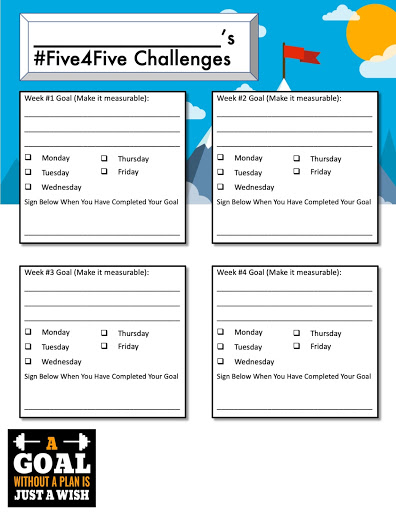
Our implementation has been pretty simple. We created a one-sided handout that has four boxes on it, one box for each of the first four weeks of the course. Each box contains a line for the learner to write out their goal for that week, the days of the week with a checkbox next to each day, and a place for the learner to sign their name if they complete the challenge by the end of the week. 

This is not for a grade and we try to keep our daily commitment to discussing these goals to five minutes or less each class period. We don’t always open class with our #Five4Fives, but when we do, I really enjoy it. It’s captivating and powerful for class to begin with students openly sharing their passions and accomplishments. It’s been such a positive culture piece. It’s also been encouraging to watch students fail for a day and then keep going for that week. I’ve noticed too a greater sense of resilience in the students; in the first week, most would hang their head if they had to share about missing their goal the previous day, but now they confidently share their failures too. In those moments, I try to ask, “So are you going to get back on track tomorrow?” Most answer yes and at least make that goal for another day or two that week.

One month in, I’m really glad that we don’t require that the #Five4Five goals be education related. It’s funny, despite having the freedom to set any goal they wish, several students each week still choose a goal that has something to do with school. The goals that they set often speak to their values, their challenges, and desires for change; by offering them the freedom to create the goal that they want they are more willing to follow through with it. The only stipulation we have set for the goals is that they must be measurable. 

Check out how we are doing! Here’s some of the data we have collected thus far…


#Five4Five Challenge: Number of Students Completing a Certain Number of Goals Per Week

Completed One Goal  Completed Two Goals Completed Three Goals  Completed Four Goals Completed All Five Goals 
Week One 4 Students 5 Students 4 Students 10 Students 25 Students
Week Two 5 Students 4 Students 4 Students 8 Students 27 Students
Week Three 1 Student 2 Students 7 Students 2 Students 36 Students


Though I’m not sure that I needed this data to have a sense that this practice was having a positive influence on our learners, I’m very happy with the story these numbers seem to tell. I’ll leave you to draw your own conclusions from it.

A final piece of evidence that I would like to share comes from our weekly Flipgrid video reflections that students have gotten into the habit of recording. Every two weeks, the students create a video in which they reflect on their efforts in the course and with their #Five4Five goals. This reflection comes from a student named Luis. In week two, Luis chose to set an academic goal for himself, and I’m proud to say that Luis met his goal that week. Afterward he reflected on his experience saying, “…my goal was to do my homework for every class, and I was surprisingly successful. I picked it because junior year I was not good with homework at all and I just had so many missing assignments. And for senior year I want to be able to do all my homework and get some good grades because my grades were terrible last year. I just want to be able to see what I can do, and this goal has really helped me this week.” 

Ugh, I love that! 

So, the next time someone asks me, “Do you have a pretty good group this year?” I’m looking forward to shooting them a smirk and answering, “Yes, they are definitely… challenging.” Challenging themselves, challenging me to be a better teacher and a better person, and challenging the way I think about my responsibility to help them grow both as people and learners.

Andrew is the Host of the Westside Personalized Podcast (bit.ly/WPPodcast)

WestsidePersonalized.com

httpslh4googleusercontentcomiqqmugjnikqwzg6btyvzwn8yfzsage9nrprlahpsorfcrl44eb5hzn2_pz8uaco2qnx61-0k67btfpht52z_t7oxezszosdt1zjtphib

**Interested in writing a guest blog for my site? Would love to share your ideas! Submit your post here.


Looking for a new book to read? Many stories from educators, two student chapters, and a student-designed cover for In Other Words.

Find these available at bit.ly/Pothbooks  


Books available

Core Solutions Provided through the Abre Platform

This post is sponsored by Abre, all opinions are my own.

Abre provides a set of solutions for schools looking to manage and consolidate the different software apps and websites used for student attendance, assessments, communication, student data and much more. Abre offers a robust platform that enables you to choose specific solution areas to get started and then add to it over time, continuing to build additional features of Abre into your school.

Communication

With Abre, you can facilitate faster and better communication within the district, schools, and between home and school. Abre offers a consistent and reliable way to streamline the numerous communications happening within the school and school district. Having a consolidated and reliable platform helps to foster and build home-to-school relationships, promote better communication, and student success.

Learning Management Solution

Abre provides one space where teachers can access the resources necessary for classroom instruction and teaching responsibilities. Included within the Learning Management solution are a group of web apps such as Class. A teacher uses Class to communicate and manage all classroom activity, do grading, post homework and generally manage instruction. The Assessment App allows for easy creation, delivery, and analysis of formative and summative assessments. Schools can organize the curriculum, including pacing guides, for all their classes with the Curriculum App. For tracking progress through a lesson, the Learn App delivers on that. To make sure students are staying on task with their devices, the Focus App ensures that the browser is only being used for teacher-defined websites and documents.

Data Management & Integrations

Abre is all about consolidating data to help administrators, teachers, and students improve. Abre integrates with a large and growing number of other software providers. They even integrate with products that provide competitive solutions to theirs. The Students App is the centerpiece of this solution and provides a clear view of student progress and makes it easy to find all relevant student data in one place. It also saves paper! Rather than students and parents having to fill out and exchange multiple papers, they access forms right from Abre. Some options such as an Acceptable Use Policy (AUP), medical forms, and athletic forms, which are easily accessible within the Abre platform. Individual student plans are also accessible in the Student app. Again, this provides a single place for staff and parents to easily find all their student’s information.

Administrators can access all student data and track growth over time, look at state and local assessments to analyze trends in academic performance. Parents can access student data which includes academic performance, behavior, forms completed, attendance, and state assessments. Access to this vital data is made simple with one platform!

Teacher Professional Learning Solution

For districts looking for better professional development options for teachers, through Abre, teachers can create their own staff and individualized professional development plan for use over an extended time. Abre offers a more flexible solution making it easier for administrators and teachers to create, deliver, and track professional development activities. Abre can integrate schools’ digital courseware and customized courses for delivering staff development.

For completing courses online or in face-to-face environments, districts can offer teachers opportunities to earn badges, micro-credentials, and engage in gamified professional development. This is great for building professional portfolios, as teachers can use these activities to receive CEU credits or hours awarded based on state requirements for continued professional development.

School Management Solution

Similar to Learning Management, Abre provides great functionality for staff to manage day-to-day school requirements. The Behavior App helps with the workflow, easy documentation and tracking student data when either positive or negative behavior needs to be documented. The workflow features are especially helpful for office referrals where other administrators are needing to get involved and having transparency for parents is important. Abre Behavior takes on a significant portion of this manual work.

  • Easy to understand graphs and plots for tracking student progress.
  • Teachers can see details in terms of specific consequences as a result of any behaviors and referrals. The bar graph represents conferences, detentions, in-school and out-of-school suspensions.
  • The behavior app links directly to the student information so everything is readily accessible which leads to a better understanding of each student and their needs.

Beyond behavior, the School Management Solution allows admins and teachers to easily create and manage individual student and teacher plans. Rather than students and parents having to fill out and exchange multiple papers with the school, they access forms right from Abre. Some options such as an Acceptable Use Policy (AUP), medical forms, and athletic forms, are easily accessible within the platform. Whether teachers need to create an IEP, a gifted education plan, behavior or Response to Intervention (RTI) plan, teachers can build exactly what they need and have it live in Abre. And Abre provides a clear view of student progress and makes it easy to find all relevant student data in one place.

Likewise, administrators can work with teachers to create professional development plans using the same solution. It makes sense to have one platform that provides all of these options. For teachers, students, parents and administrators, having access to student data and other information is vital for promoting and tracking student growth. This solution really saves a lot of paper.

Connected Community Solution

Abre sees connecting schools with the communities they serve as critical to student growth. The Connected Community solution facilitates the exchange of important information, data and communications between students and administrators and members of their community. Abre allows a school’s learning partners to register in the Abre platform, roster the students in their programs back to the school, and enable the safe exchange of student attendance and other data. This is critical for schools to evaluate all of the influences that are growing their students. And for learning partners, it is how they can better understand whether their programs are meeting the needs of the students.

As an example, looking toward the future of learning and work, it’s important that we provide options for our students to engage in real-world learning experiences. One outstanding feature coming from the Partners App is where districts can add local businesses into the platform and facilitate connections between students and members of the community. The goal is to manage, track and capture quality attendance data when students take advantage of opportunities for place-based learning, experiential learning, CTE, and service-based learning.

Abre also lets students and staff create digital portfolios based on the work they’ve done. These portfolios are a powerful way of demonstrating, beyond the test scores, what they have learned and the skills they have acquired. Schools can then choose to allow these portfolios to be shared with others such as businesses, other schools, or organizations.

Privacy

Abre is FERPA compliant. The student information is only released with parental permission.

Using Abre is quite simple and I find that it is easy to navigate, which makes it a great choice for all users, whether they are beginners or advanced when it comes to implementing technology. By using a robust tool like Abre, educators and parents have immediate access to a lot of data. Abre is a multi-purpose platform with capabilities to facilitate communication, collaboration, and much more. It provides benefits for teachers for tracking PD, administrators looking to provide a comprehensive and consolidated platform to meet the needs of their schools and students, parents looking to stay connected with student learning and be informed of important information regarding their child’s education.

Buncee: Getting to know our students

One of the things that I love the most about Buncee is that it can be used in so many different ways, not only for instruction in our classrooms but also in life. I have used Buncee to create cards for family and friends, personal business cards, graphics for Twitter chats and webinars, quote graphics for my books, invitations, and more. When I decide to use digital tools in my classroom, I want students to practice the content in a more authentic and engaging way, while developing skills such as collaboration, critical thinking, problem-solving, and creativity that can be transferred to their future. In using digital tools like Buncee, my hope is that they will also use them in other classes, for personal use, and will share them with family too.

Each year, I continue to explore new ideas to have students create with the content, rather than doing the exact same project or using traditional worksheets or other assessment methods. For years, I assigned students to complete very rigid projects in the same format and left little up to student choice. Now, after seeing the benefits of being more flexible with my instructional methods, I’d rather open it up more to student choice and see what students come up with.

Finding time to explore new resources can be a challenge because our lives as educators becomes quite busy and we may find ourselves lacking in time to really explore a variety of options for use in our classroom. This is another one of the reasons that I choose Buncee and appreciate the team’s investment in offering more than just one way for students to create. It truly has become a go to multi-purpose platform that can do so much, that I feel pretty comfortable in saying that the possibilities really are endless when it comes to creation with Buncee.

Learning about students and pushing them to explore

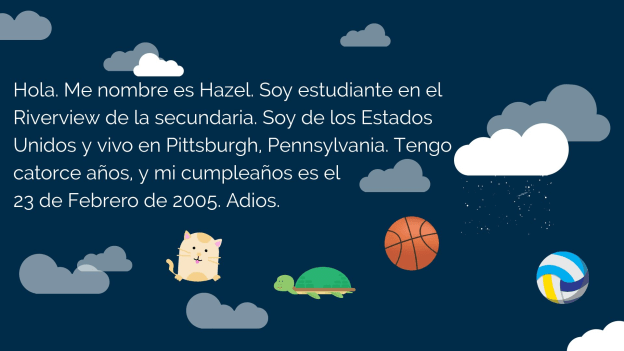
At the start of each school year, I focus my efforts on student relationships, learning about my students and also providing opportunities for them to learn about one another. In the past I have done this by using activities in our classroom such as ice breakers or having students work together on different review games and other in class collaborations like that. But this year I decided to do something a little bit differently to not only engage students in learning about the Spanish language and culture but to engage more in learning about one another. I came up with a project focused on using the “About Me” template in Buncee. I wanted students to share who they were and create one slide to show this using words, animations, stickers, and other add-ins. My hope was that by looking at each student’s slide, we would understand one another better and relate to each other based on similarities and differences.

I also thought this would be a good opportunity for them to choose and learn a little about a place where Spanish is spoken and create an “About_(country)_____” to share that information with the rest of the class. But I also realize that there are many students who are visual learners like me and I wanted to encourage students to be able to quickly look at and process information and represent it in a different way. Rather than simply restating the same content, push them to apply it at a higher level or find a different way to demonstrate an understanding of a concept.

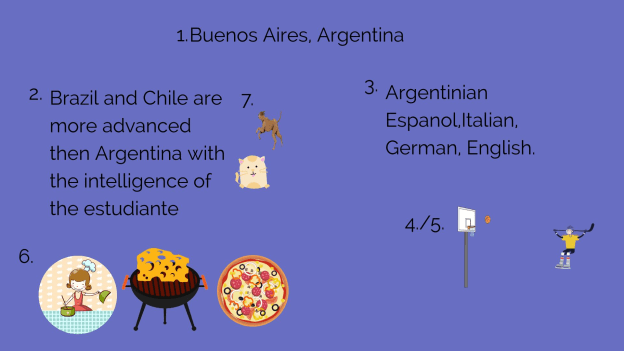
I also wanted students to choose a Spanish speaking country and I placed a limit on the number of actual words they could use because I wanted them to represent what they had learned about the place that had chosen using the Buncee features. The topics they had to include were: languages spoken, school subjects, foods, activities, and other information like that that they could display using Buncee.

How did it go?

It was a fun activity and I learned so much about them and they learned about each other and what life is like in countries where Spanish is spoken. We shared them on a Buncee board which made it easy to access and created a colorful display of students and their creativity. Students shared their slides and gave a brief description in Spanish about themselves and made connections with their classmates. We had good conversations exchanging our likes, dislikes, and learning about our backgrounds. For the second slide, students

were able to get a quick glimpse of different Spanish-speaking countries and begin to understand the culture of some of the places they would be studying. It was fun that they could only include 3D objects, animations, stickers or emojis, to represent the information for each country. So for visual learners, being able to choose the right object to use to share this information made the learning stick a little bit more. Students who enjoy creating but not drawing really enjoyed the activity.

One other feature that I thought was important to share with students was the new Immersive Reader and how it works. We enjoyed looking at all of the capabilities with it and using Buncee for learning!


**Interested in writing a guest blog for my site? I would love to share your ideas! Submit your post here.


Looking for a new book to read? Many stories from educators, two student chapters, and a student-designed cover for In Other Words.

Find these available at bit.ly/Pothbooks  


Books available

Three Trauma-informed practices to implement today

Guest Post by Jethro Jones

Twitter: @jethrojones http://twitter.com/jethrojones

Web site: http://transformativeprincipal.org

My name is Jethro Jones, and I am a principal in Alaska. I have helped three schools become trauma informed as a principal and many others through my podcast and Trauma course. I have worked long and hard to figure out some strategies that all school personnel can implement effectively. I’ve gone through a lot of trial and a lot of errors where I have really messed up and I’m going to share some of those secrets here.

Whether your school has created or attended a trauma-informed practices training or not, there are three things you can do to respond to situations in your school in a trauma-sensitive way. Implementing these strategies is simple enough that you can start implementing them today. They are powerful enough that you will see results almost immediately.

1. Ask Questions

Anytime you’ve got a kid who’s acting out or who’s struggling or whatever, instead of saying, “You need to be doing X,” ask the student questions.

This is really simple.

“How are you doing?”

“What are you working on?”

“Where are you heading?”

“What’s going on over here?”

“Can you help me understand…?”

Asking questions gives the student an opportunity to express him or herself in a way that allows them to deal with whatever’s going on.

The challenging part about asking questions is sometimes we as teachers turn questions into statements of condemnation!

For example, “Why are you running in the hall when you know you should be walking?” is more of a condemnation than a question.

We need to ask questions and figure out what is actually happening. Give them an opportunity to express themselves and deal with it. This is a hard thing for us. Because we have rules, we have expectations, we have policies and procedures.

And we as adults are very comfortable in those shoes.

And if we’re not comfortable, then it’s easier for us to say, Stop running. Stop doing that. Stop this. Stop that.

And that’s just not helpful to a child experiencing trauma. Because they’re not thinking–they’re only acting. We need to get them to slow down and think!

When you ask questions, you require the student to stop and think about what they are doing. Your voice doesn’t sound like a teacher in Charlie Brown when you ask a question.

Don’t turn questions into accusations, but make them clear, inquiring concern for the student.

You’ll get great results.

2. Don’t Take Things Personally

Every educator works hard and takes her job seriously and personally, and teachers put so much into their work.

And I don’t mean don’t take your work personally. What I mean is, don’t take the students actions towards you personally.

They’re most likely not a personal attack.

Yes, they will hurt. Yes, it will be uncomfortable. But you can’t take what they do, and think they’re acting out towards you to hurt you personally, that’s just not what is happening. Even when we feel like it is.

Kids desire to please the adults around them. Kids desire to make good choices.

The number of reasons that they have acting out is probably innumerable.

It’s rare when a student wakes up and says, boy, Mrs. Jones really is going above and beyond and helping me at school, I should totally do something that hurts her today. That’s not what kids do.

Sometimes, kids don’t know how to react to someone giving them positive attention, and they attempt to push them away. I once had a student who found out she was moving away from the school, and proceeded to destroy all the hard work her teachers had been putting in. When we talked to her, she was finally able to articulate that it was easier to leave with people mad at her so she didn’t feel like she was missing them as much, because you don’t miss people who are mad at you.

So there are two things you can do. Number one, ask, why is this kid doing this?

Number two, what can you do to deal with this behavior?

We as educators have to recognize that we can’t change anybody, every person has to make that choice for him or herself. We can certainly put things in place to help them make good choices, which we do all the time.

But we cannot change anybody. They need to change themselves.

We need to be sure that we are making choices that allow us to not take it personally like they’re attacking us, because even if they do attack us, it’s not personal. Kids are naturally kind, nice, wonderful, sweet, thoughtful little human beings. It’s when they’ve had these adverse childhood experiences, that they start acting differently.

And what our role is, is to help them to be successful even when they’ve had those experiences.

3 Know Your Role
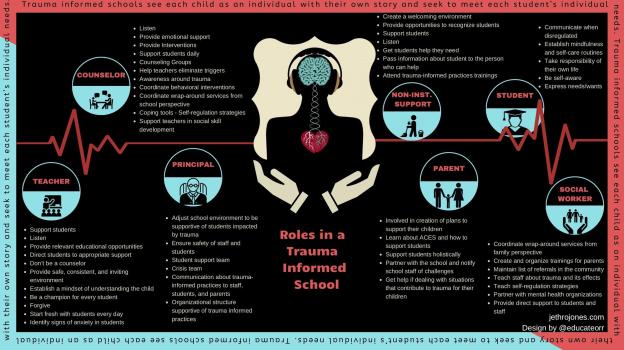
The image above is a powerful way to make sure that people know their role is in a school that is trauma informed. Get a printable version here that you can use as a handout.

You’re not a counselor or a social worker. You’re an educator. You shouldn’t try, and NOBODY should expect you to be anything you’re not.

Could you be a therapist, counselor, or social worker if you tried? Yes. Do you have what it takes? Absolutely!

When a student doesn’t know how to read, what do we do? We teach them.

When a student doesn’t know how to write, what do we do? We teach them.

When a student doesn’t know how to drive or swim, or do whatever, what do we do? We teach them,

When a student doesn’t know how to behave, what do we do? Usually we punish them, what we should do is teach them.

And so our role as educators is to teach and help kids learn.

Now, there are so many different ways to do this!

Our purpose here is not to discuss all the many ways we can teach them, but to emphasize that it is our role to teach them, regardless of how they come to us.

Now, I want to share an experience that is really powerful. In her book, Allison Apsey shares a very similar experience. There are certain students that take up all your time! You are constantly spending time with those students, recognizing that it is worth the time and effort to intentionally and proactively spend time with those students that take up all your time,

if you’re going to be spending time with them anyway, why not work with them to get support in advance, why not work with them to build that relationship?

I call this Proactive Teaching. Some call it check and connect, or check in check out.

These students that are really struggling need additional support. You’ve got to have good Tier 1 behavior expectations and practices in place, but you and I both know there are kids for whom that doesn’t work, and they are the kids that reside in Tier 3! They need the extra help.

Instead of waiting for this student to be sent down to the office, we proactively go teach this student how to make good choices. Don’t think you can do this with 100 kids! It won’t work.

Find those two (or maybe three) students and get with them before they cause the trouble. Take the initiative and connect with them before they can get into trouble. Get with them before they get overwhelmed and can’t perform. Get with them before they wreak havoc in your class!

I had one student who would have a meltdown nearly every day because he was so worried about his mom and young sister. Instead of waiting for his behavior to cause him to be taken out of class, I met up with him before he had a chance for that, and talked about how things were going and what I could do to help him. Then, when his meltdown would inevitably come, we already had a connection that day.

Did this take a lot of time? Yes.

Was it worth it? Yes, it was, because it was so much better to do that in a positive, preventive proactive way than it was to deal with the issues and problems that he was going to have after the fact. Because when he had a bad day, he wanted to get it out in an aggressive way that hurt other kids, and that just wasn’t going to work in our school.

So instead of spending the 30 minutes trying to calm him down after a problem out on the playground, we spent 20 minutes before and during recess to give him that support.

It wasn’t my role to help him deal with his issues at home. I needed to be a trusted adult who was teaching him how to deal with things at school. Of course, a counselor was involved to help him deal with the challenges he faced at home.

To recap:

1. Ask questions.

2. Don’t take it personally

3. Know your role.

These three strategies will help you out immediately with whatever challenges you are facing in your school. If you need additional help or support along the way, please reach out to me by email or at my web site: jethrojones.com/trauma


**Interested in writing a guest blog for my site? I would love to share your ideas! Submit your post here.


Looking for a new book to read? Many stories from educators, two student chapters, and a student-designed cover for In Other Words.


Find these available at bit.ly/Pothbooks  


Books available

Education Write Now: An Amazing Experience

To say that the summer of 2019 was tremendous is an understatement. Besides having time to spend with family and friends, I enjoy having extra time in the summer to participate in professional learning opportunities and to connect with educators from around the world. As educators, it is important that we continue learning and involving ourselves in opportunities to build our own skills and also to contribute to the personal and professional growth of others. I am fortunate to have been asked to be one of the writers for this year’s Education Write Now book.

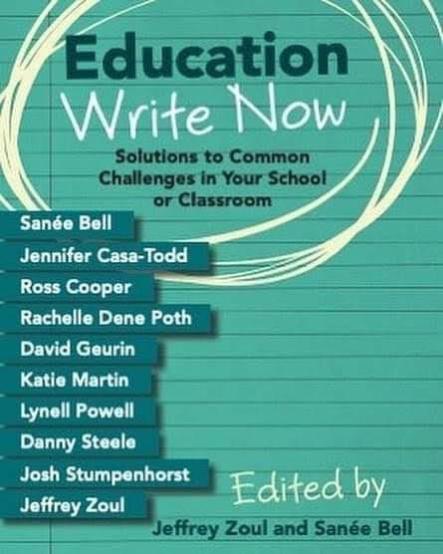
In July, ten of us met in Boston for three days to work on chapters that will become part of Volume 3 of Education Write Now, a book whose proceeds will go toward The Will to Live Foundation, a non-profit organization founded to support teen suicide prevention. The time together started with a welcome from Jeff, an introduction to what the organization does, and an opportunity to hear from John Trautwein, a father who lost his son to suicide. John created The Will to Live Foundation to honor his son and to provide support for other families and their children.

It was an honor to be a part of this project and work alongside and collaborate with Jeff Zoul, Sanee Bell, David Guerin, Josh Stumpenhorst, Jennifer CasaTodd, Danny Steele, Katie Marin, Ross Cooper, and Lynell Powell. It was a great experience, although initially, the thought of writing a chapter within a short period of time of two days was a little bit stressful. However, having that time to work together, have peer feedback time, to listen and share out what we were writing with the other collaborators, made all the difference. It just reaffirmed the importance of connections and building those professional relationships. We need to make time to share what we are doing in our classrooms, exchange ideas, solve problems together, and embrace risks and face the challenges that are part of education today, but to do so with a supportive network.

The theme for this year was “Solutions to Common Challenges in Your School or Classroom.” In thinking about this theme, I decided to write about teaching in isolation and sharing my own story of how I chose to be isolated for many of my years of teaching. In my chapter, I explore how isolation happens and offer ways for educators to escape what can sometimes become an isolating profession.

Here are a few excerpts from my chapter, Chapter 2: Choosing to teach in isolation is a choice to isolate our students from a world of learning opportunities.

Have you ever experienced any of the following?

You have to make your very first phone call home to a parent and you are worried that you won’t say the right thing.

You are going to be observed for the first or fifteenth time, and you are worried that you will make a mistake or not use the right instructional strategies. The class starts in five minutes.

How many of these statements can you relate to? For each one, think about if you reached out to someone or just kept it to yourself. Did you choose isolation rather than asking for help?

Clarity:

You are not alone

For years I struggled with classroom management and student behaviors. Rather than ask for advice, explore resources, or try to work it out by talking with my students, I kept it to myself and did my best to make it through each day. I hoped for improvement, but I did not actively try to make changes. I did not ask for help or even talk about the problems that I was having. I did not know where to begin but at that time, so I thought that I was better off keeping it to myself. My biggest mistake was hiding in my classroom and not reaching out to colleagues or other educator friends.

Isolation is not something new

Life as an educator, trying to complete everything that we need to can lead to a career spent in isolation if we let it.

Ten ways to break free or avoid isolation

There is so much potential for connecting regardless of where we are and the amount of time we have. We must take the first step and just start somewhere. We can leverage technology to check-in with colleagues, even if they teach next door to you. Sometimes seeing our neighbors does not happen on our busy days, which are most days. There are ways to stay connected while driving to and from school, taking a walk, wherever you are and on your schedule.

In the end

The most important thing to remember is that you are not alone.

You are not alone in feeling like you do, like the job is difficult, or there are too many things to remember, too many initiatives to keep up with.

We all understand the importance of asking for help; Those who achieve big things are the ones who accept it when it’s offered. Simon Sinek

The choice is now yours, how do you want to connect?


Be sure to check out next week’s post from Jennifer Casa-Todd, Chapter 3 “The Challenge: Broadening our Definition of Literacy.”


Abre

This post is sponsored by Abre. Opinions expressed are my own.

The story behind Abre

Beyond knowing what a particular tool does or how a platform works and the benefit for educators, families, and schools, I enjoy getting to know the people behind the tools. Understanding their story and motivation for creating their product helps to make a more authentic connection with them. I had the chance to speak with Damon Ragusa, CEO of Abre and Don Aicklen, VP of Sales, to learn more about the platform and what it offers for education.

What is Abre?

Abre is a platform that grew out of a need to help schools provide more for educators, students and the school community at large. Chris Rose and Zach Vander Veen, co-founders of Abre, noticed that there were so many different apps and tools being used in education that it was becoming challenging to keep everyone informed consistently. The concern was that staff, students and parents were using multiple tools which led to an increase in confusion and the amount of time needed to manage them. Chris and Zach then created this platform for use within school districts.

Why Abre?

Parents, educators, administrators, and students need to be able to exchange important school information, access school data, track student progress, and facilitate communication between home and school efficiently. The challenge with multiple apps and tools being used throughout one school system is that it becomes more difficult to keep everyone connected as they need to be. Now school districts have a better way to solve the disconnect and provide more streamlined communication, school news, access to critical information like student data and software solutions to carry out the daily work. The answer is Abre.

How does Abre help?

Abre offers so much within one platform that it resolves many of those challenges initially identified by the founders and that are still faced by many schools and districts. Without having to manage multiple logins and learn a variety of single-purpose systems, Abre helps educators to save time, reduce paper, create digital workflows and offer a highly efficient way to exchange information. The value in Abre is through the connected software apps, which makes it easier for teachers to use tools that will positively benefit students and learning. In addition to the teacher, there are many other benefits for school- and district-based usage. Abre provides easy access to a wide variety of student data in one place for staff and parents to obtain information directly from school, without the need for multiple tools and extra time. It also provides students and parents with exactly what they need to feel connected to the school community via announcements and headline features. Administrators can explore how Abre promotes a better workflow and enhances collaboration within the school community for a typical school day.

Comprehensive and Consolidated

Abre provides a single hub for all school and school-home related communication for staff, students and parents. It streamlines many of the important and required tasks that need to happen in schools and helps to reduce the number of apps being pushed out and the time required to become familiar with a new system. Using Abre, parents will be more connected to the school and have access to information when they need it. With one consolidated platform, it resolves the problem of knowing where to find information or keeping up with multiple apps used in different classes and by the school.

Single Sign-On and Integrations

It is easy to sign-in to the Abre platform whether using Google or Microsoft or even Facebook for parents. Once logged in, Abre users are automatically signed into many of the apps provided to them via the Abre platform.

Privacy

When deciding on a digital tool or a platform to use in our schools, it is important to first verify that it is in compliance with COPPA and FERPA. Abre is compliant with both.

Teacher Benefits

There are many integrations available within the platform to enhance student learning. As a classroom teacher, several of these apps caught my attention and are tools that I use in my class such as Duolingo, Flipgrid, and Quizlet. Being able to use these within one platform would save time and I believe encourage other teachers to implement more digital tools in the classroom. For schools using Learning Management systems like Moodle or Schoology, Abre can connect to and enhance these tools as well as replace functionality. Teachers have access to everything they need to enhance workflow for curriculum planning and instruction as well as professional learning and much more.

Consistency is important

Personally, I have used anywhere between four and six different apps and websites to complete a variety of tasks for attendance, grading, assessments, communication, and student projects. Abre provides solutions with all of this functionality. My next post will speak to the main solutions, beyond the hub, that Abre provides.

To learn more, check into Abre and get started with a demo today!

7 Ways to Get Kids Reading

Guest Post by Laura McDonell@lmcdonell14

A look at What Actually Worked for Me

david-lezcano-1xzSAlZUVSc-unsplash

Reading is one of those things that I go to the wall on.  Growing up, reading was something I struggled with. As a teacher, I see how critical it is to overall success as a student.  Today, one of the reasons my life is so incredibly rich has to do with the books I read. As a parent, I am determined to give my kids opportunities to find success with reading. As with everything in life, some days everything comes together, connects and makes a beautiful picture.  However, there are other weeks or years where the struggle is real and seems like it is never going to end.

It doesn’t matter where my kids are starting from (I can still remember checking out different copies of the Dick and Jane anthology because it worked, and my middle son needed repetition.  While all three of my kids have grown up in the same environment, they have all been unique in regards to what works best for each of them as readers.  Overall the key is persistence, and never giving up no matter how challenging it might seem. I have found success as a parent by visiting the library often, allowing them to change their minds about what they like, becoming their personal assistant, reading and talking about books in front of them, using audiobooks, hosting a book tasting and celebrating accomplishments.

  1. Visit the Library Often.

jaredd-craig-HH4WBGNyltc-unsplashLibraries might seem dated, but they are in fact one of the best-kept secrets.  We got library cards for our kids as soon as they could write their names. Today, cards can be used to check out everything from audiobooks to new release movies.   Apps like Hoopla and Overdrive are amazing. With a library card, these two sites offer thousands of books, movies, and music. Giving kids the opportunity to borrow a stack of books without any cost is ideal for many families.  Taking advantage of MEL, the state’s interlibrary loan program, allows people to request books from all over the state of Michigan and have them sent right to your local library. Showing someone how to use the library unlocks a world of possibility.  Anything can be learned by using the public library. And, using the library saves a lot of money. Surrounding kids with books is one of the best things you can do to get them reading. The library makes reading an inexpensive activity. I am not alone when it comes to using the library.  Several financial enthusiasts highly recommend it.

2.  Allow them to Change Their Mind Often. 

When my middle son was in first grade, he loved the Nate the Great series. The books were right at his reading level, and I thought I had struck gold since there were several of them in the library.  I requested every copy I could find. After reading about 10 of the books, one day he said, “I don’t really want to read Nate the Great anymore.”  At first, I was a little sad since there were still books to be read, but after thinking about it, I was excited that he was willing to be honest about what he wanted to read.  Minutes later, I realized had a new challenge. I had to help him find his next book, and do it quickly so that he did not lose momentum to continue reading. Humans are always evolving.

matthew-fournier-G971e4EFKtA-unsplashA few years ago one of my boys really got into hockey. We found all of the Matt Christopher books about hockey in the library, and he eagerly read each one cover to cover. Last summer my daughter was obsessed with learning about swimming.  We raided the library for any nonfiction book we could find on the topic. During the winter it was graphic novels, and today she loves to dive into anything related to fairy tales. Even though I have a pretty good idea about what each of my kids likes to read, I had experiences where I selected a book or two I thought might be perfect, only to have them not show an interest in what I picked out.  I do not take it personally, since there is no cost associated with it, and know that as a reader I don’t read every book I take home from the library.

3. Be their Personal Assistant.  

Kids need to be taught skills to thrive on their own. However, when they are starting out, they need someone to guide them:  like a coach, or a personal assistant.  The personal assistant does not do the work but instead sets a person up for success.

If we want to raise a reader, the more times children can be successful will improve the overall possibility of them sticking with reading early on, and then eventually becoming adults who are drawn to books.

Personally assisting a child, looks like helping him or her find books, help them find books that are just right for their level, challenging them, suggesting new authors, reading a chapter aloud, placing books in their path, and helping them organize their schedule to support reading time. As an adult, I have read a lot of books and heard hundreds of titles and authors, and because of it I am in a great position to offer guidance.  Scrolling through Bestseller Lists helps me to find current and high-interest reading material.  As my kids get older, I have started to transfer this responsibility. However, it is still important for young adults to have help in selecting books. My husband even enjoys it when I pick out a book for him tailored to his interests.

Reading aloud the first chapter of a book can help a child get into a story.  I knew my middle son would love John Grisham’s Theodore Boone Kid Lawyer books.  I was also aware that some of the terminology, setting, and background given in the first chapter could be very new, and confusing.  So I offered to read the first chapter to him. After hearing and then talking about the chapter, he was hooked and settled in for a great series of books.

4.  Read in Front of Them.  And Talk about Your Books.

dan-dumitriu-3w1XBUGj4ds-unsplash.jpgWhen I first started teaching, I would ask the parents of my really motivated readers who seemed to always be reading, “Tell me how you did it?  What do you think has made the difference in getting your child excited about reading?” Almost every time I was given the same answer, “I suppose he just sees me reading all the time, and it just seemed like the thing to do.  My nose is always in a book”.

If you expect your kids to read, you have to also be a reader.  You gain credibility when you pick up a book on a regular basis.

It is also important to be a “Real reader”, and model what it is like to struggle with something in a book, fall in love with a new series, or make the choice to abandon a book because you cannot get into it.  It is helpful for kids to know that they are not alone in how they think about books.

5.  Use Audio Books

When my kids were really little, I would get audio CDs with the corresponding picture book from the library.  It helped me to team parent with myself, as I could catch a break where my kids could listen to a story and follow along with the words.  As my kids have grown older, they continue to enjoy audiobooks. We listen to them on vacation in the car, and two of my three kids absolutely love hanging out in their room listening to a book while putting together Legos or doing chores.  We have found that they are awesome for the kids to fall asleep listening to.

Lastly, as a Spanish student, I remember being able to listen at a higher level than I could read or speak.  One of the coolest things about audiobooks is that students can comprehend at higher levels than they can speak or read.  Plus, audiobooks give kids practice listening to correctly pronounce words, perfected grammar, and give them the opportunity to work on fluency as a reader.

6. Do a Book Tasting.

hannah-busing-0BhSKStVtdM-unsplashExposure to good literature and authors is one of the best gifts we can give our readers.  I absolutely love sharing some of my favorites with kids. Just as we could taste cheese, wine, sauces, desserts, or other menu items, book tastings are a great way to try new things.  I typically put a book in front of each place setting. Each child will get a chart to list the title he or she tasted along with the author, genre, and the likelihood that he or she might read the book.  The tasting is timed to keep it moving. And so after a total of several, ninety-second tastings, kids are able to walk away with several new titles that could be considerations for future reading. This activity can be adapted to any size (I have had great success with it in the classroom).

7.  Celebrate Success as a Family.

daniel-olah-VUGAcY35Ubw-unsplashThere are times that I find my kids book hopping, and not finishing titles.  I have also seen my kids plateau as readers. It is fun when we all work together and focus on completing a challenge that encourages reading and celebrating the success of others.  It works well for us to keep a running list of books read on the refrigerator. We set a goal for a number of books to be read and immediately start brainstorming how to we will celebrate our success.  It is nice to focus on working together and cheering each other on.

Maybe some of these ideas will work for you. What works well one day to encourage reading, might not work as well the next.  Plus, reading is personal. Everyone is motivated differently. But, the important thing is as a parent or teacher, you never stop trying.  Persistence is so important. Sometimes it is really tough to find the perfect author or series for a child. But, there is always one more book, genre, author, or method to try.  It won’t necessarily be easy, but it will be worth it.


Read more from Laura: Her blog site

***Interested in writing a guest blog for my site? Would love to share your ideas! Submit your post here.


Looking for a new book to read? Many stories from educators, two student chapters, and a student-designed cover for In Other Words.

Find these available at bit.ly/Pothbooks  


Books available

bit.ly/Pothbooks


Reaching All Learners

Guest Post by  Laurie Guyon, @smilelearning

If you have met me at a conference, a workshop, or in a school, you would consider me an extrovert. I’m friendly, always smiling, and comfortable talking to anyone.  Even as a self-proclaimed chatterbox, I get anxious in certain social situations. One on one conversations makes me nervous. My mind reels with thoughts like “will I talk too much” or “will I overshare” or “will I say something stupid” or “what if there is a lapse in the conversation’.  These thoughts have caused me to avoid what might have been a wonderful conversation. I try to step outside my comfort zone and engage in these moments more often. I know that these thoughts and ‘what ifs’ are part of being human.

“I restore myself when I am alone.” – Marilyn Monroe

While reflecting on these moments, I thought about my teenage daughter.  She is a self-proclaimed introvert. Her anxiety in social settings is completely the opposite of mine.  She is fine one on one, but crowds get her inner thinkings reeling. She hates public speaking and will avoid group situations whenever possible.  She once told me that my teaching style would give her hives because I like a loud and active classroom. She prefers quiet and independent work. In our classrooms, we have students with all different communication abilities and fears.  How do we foster an environment that can support all learners and communicators?


In the TED talk about introverts by Susan Cain, she defines shyness as fear of social judgment.  She states that introversion is more about how you respond to stimulation.  In the classroom, there is a multitude of stimulation. These can be visual noise, people, and expectations.  How each of our students responds to this stimulation tells us if they are comfortable or not. We may even discipline students based on their behaviors.  But, what if we are pushing students outside of their social norms?


Bob Dillon and Rebecca Louise Hare ask educators to make sure that there are spaces for all learners in their book, “The Space: A Guide for Educators”.  They mention creating areas that give students a chance to learn and work so they can thrive. When I taught 6th grade, I created a variety of learning spaces.  I then asked my students to choose the spots in the room where they feel they could learn best. I learned so much about my students by giving them the agency to choose.  I utilized choice boards to give students autonomy. Students were more likely to create quality work when given a choice on how they would showcase what they learned.

Have you ever gone to a presentation or a workshop and the presenter asks you to do something you don’t want to do?  For example, I was in one recently where they asked us to do charades. I am not a fan of playing that game for a variety of reasons, but we had to.  I did everything I could to be the guesser and never have to act it out. Then, at ISTE I lead a mini engagement session with the amazing MCE Melody McAllister and Nearpod.  In the session, we had to lead the participants in a rousing game of charades. Once again, I was outside of my comfort zone. The energy of Melody, the Nearpod team, and engaged educators allowed me to participate in the activity.  It was the support and encouragement that allowed me to be successful.

“The greatest art is to sit, wait and let it come.” – Yogi Bhajan

To reach all learners, we need to think about our learning spaces.  We need to think about the amount of agency we give our students and give them a chance to be inside their own heads.  We also need to encourage them to try and do what may not be in their wheelhouse. We can support them with encouragement and time to build on their comfort level.

We want to maximize talent and success for all our students.  This does not need to always be group work and active activities.  Sometimes, the best activity is in speaking softly or to work alone in silence.  But sometimes, it’s using our talents as part of a community that can make us successful.  Finding this balance is what will help us reach all learners.  


Interested in writing a guest blog for my site? Would love to share your ideas! Submit your post here.


Books available

bit.ly/Pothbooks


ONE SIZE DOES NOT FIT ALL

Guest Post by Kristen Koppers, @Mrs_Koppers

Educator and Author of Differentiated Instruction in the Teaching Profession 

The movie Sisterhood of the Traveling Pants was one movie that brought together friendship through hardships. But a single pair of pants (no matter the size of each of the girls) fit perfectly to where they would wear the pants, write on them, and send them to each other throughout the summer.

We all know that wearing a pair of pants in one size does not mean that another pair of pants will fit even with the same size. The fact that one pair of pants can fit four different girls ‘perfectly’ who all have different body types is not realistic. Although the movie focused on the jeans, it was more about the friendship of the four girls during their personal problems they went through without each other.

The same idea goes for teaching and learning. While we hope that one size pair of pants (learning styles) would fit more than one student, we know that is not the case. Students come from a variety of backgrounds, cultures, schools, and learning abilities so we cannot think that one curriculum or one “pair of pants” can fit all. This goes the same for purchasing a Halloween costume or outfit where the tag says “one size fits most.” Someone who weighs 120 pounds wearing the same costume that a person who weighs 30 pounds more won’t fit the same way. While the outfit will fit both sizes, the look will be quite different.

ONE SIZE DOES NOT FIT ALL – What many forget is that teachers come from all backgrounds, cultures, educational institutions, and ethics. We cannot expect one teacher to teach the same way as other teachers. This is the same for students. It would be a perfect world if one style of teaching will reach all students. However, this is not the case. Differentiating work can be difficult as well to meet the needs of all students. In order to have that perfect pair of pants to fit all students, teachers must be willing to put their ego and pride aside and stretch the pants just a little wider so that not one size person but multiple sizes can fit.

The struggle is real. We all know how it is to try and fit into a fresh pair of washed jeans. The jeans that fit you the day before now feels tighter 24 hours later. If we think about how that one pair of jeans fit the day earlier and then the next day they don’t, this is how many students feel. One day they feel like they understood the information and then the next day nothing makes sense.

Using Differentiated Instruction is not about separating all students or creating one lesson plan for many. It’s about assessing student needs throughout the year. While one lesson plan will help several students at one point, another lesson plan may not work for the rest. Assessing students needs does not need to be cumbersome. It can be as simple as noticing non-verbal clues in the classroom to written work.

Recently, we were reading a novel by Gabriel Garcia Marquez. Students were intrigued by the reading and began to focus on the plot. It wasn’t until they were to share out what they learned to the class that everything unfolded. When I moved around the room, most groups were able to explain what they were thinking. However, between the individual group discussions and the informal presentation, something went wrong. This is where I used differentiated instruction. We discussed the lesson, the assignment, and guidelines. It was the connection from what they read to their knowledge that seemed ‘not to fit.’

As an educator of 16 years and instead of taking it as an insult to my teaching, I swallowed my pride of experience and began to learn how to fit into a pair of jeans that did not fit me. After a large group discussion, I was able to use differentiated instruction to meet the needs of all the abilities in my classroom. Students were given the choice to keep their grade or complete one of the two alternative assignments to replace the previous grade. Instead of making this decision, I let the students choose because, after all, they are the ones who truly know their own learning ability.

When one pair of pants does not fit, we shouldn’t just give them away and buy a larger or small pair, we need to stretch them a little to fit.

Follow Kristen on Twitter and Check out her book! Differentiated Instruction in the Teaching Profession