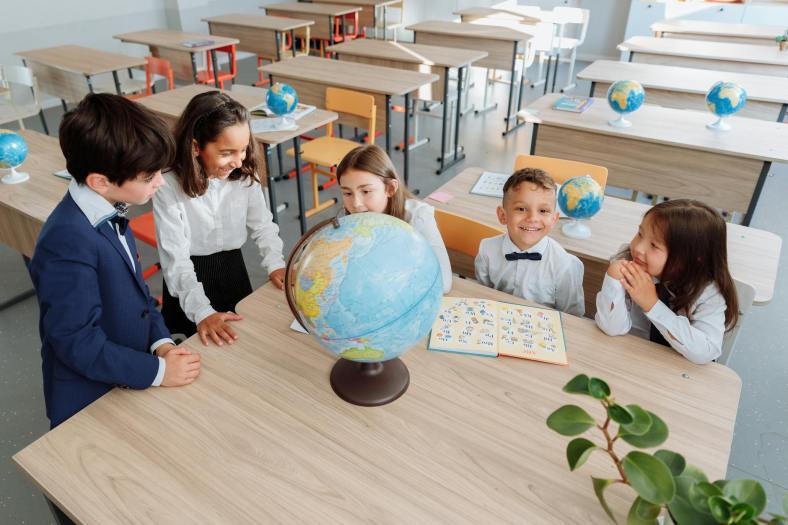
Fostering collaboration among students and educators enhances learning, builds essential skills, prepares students for the future, and more! Explore practical methods to enhance collaboration, such as project-based learning, game-based learning, and leveraging digital tools to align technology with students’ needs and goals, leading to meaningful engagement.
One thing that I have focused on a lot more over the past couple of years is creating more opportunities for students to collaborate with each other and also, for my own learning, to be able to collaborate with other educators. As we moved through changing learning environments, from fully remote to hybrid and, fortunately, back in person, there were a lot of challenges, and being able to collaborate was definitely one of them. One of the essential skills that employers seek is teamwork, which grows from opportunities to collaborate and build relationships. As we consider how to best prepare our students with the essential skills they need, there are many ways that we can foster meaningful collaboration in and beyond our classroom spaces. Not only will these opportunities benefit students’ learning and growth, but they will also greatly benefit our work and getting to know our students.
As students collaborate more, they can engage more meaningfully in learning and have fun. Brainstorming ideas together, providing feedback, working through learning challenges, and even teaching each other benefit their growth and learning journey. They will also build confidence in the classroom and feel more confident speaking in front of and working with their peers. This will impact them far beyond the physical classroom space.
What are some quick ideas for boosting collaboration?
We can select different methods to have students work together in or outside our classrooms. Some methods, such as project-based learning (PBL) or problem-based learning, or through STEM-related activities, for example, provide students with opportunities to work independently and collaboratively towards a common goal or to solve a problem. These student-driven methods foster greater connections with the content knowledge, offering more learning choices and leading to more active learning. In my classroom, when students have designed their own PBL experience, it empowers them with more choices and helps them to develop self-management skills when setting goals. Some students may need help with choices during student-driven, independent work such as PBL and setting goals. However, having classmates to support them will help them to further develop these essential skills such as self-management skills. Exploring something more authentic, such as a personal interest or a curiosity, also promotes student agency in learning.
I recently spoke with several tech coaches who had audited digital tools in their buildings—they found more than 400 tools being used in their schools! I know a lot about technology, yet I still struggle to strike the right balance of technology in the classroom. Avoiding overreliance on technology in our highly digital world can be challenging. One solution is to “unplug.”
Integrating into your classroom unplugged activities that do not require technology can offer many benefits, including helping students develop a variety of skill sets. Although each of these ideas can also be implemented with technology, there are ways to use these without the tech and that help amplify the learning experience for students. Having an unplugged classroom does not always require a lot of planning or materials. When I notice a decrease in student engagement in my classroom, I shift to trying new methods and mixing up the activities to promote student choice and more active learning.
Ways to Unplug
1. Genius hour. Students select a topic of interest and have time to develop a presentation. They may refer to resources such as books, videos, or internet research, but their presentation must be done without the use of technology. Students can create a visual display, such as a poster, a replica, or a demo of their topic, and then deliver a presentation to their classmates.
2.Place-based learning. Opportunities to explore the community while connecting content to the real world make learning experiences more valuable and meaningful for students. One year, my students did an outdoor project about childhood, and they visited a local park and playground for research.
Students in a history class could visit local historical sites to better understand the content they are learning. Science classes such as biology or ecology can have students explore local areas, learn about the ecosystem, and participate in projects to clean up the community or learn about and present solutions to environmental concerns. Place-based learning boosts student engagement, fosters student agency, and helps students develop a greater understanding of their impact on the community and even the world.
Dr. Rachelle Dené Poth is a Spanish and STEAM: What’s Next in Emerging Technology Teacher at Riverview High School in Oakmont, PA. Rachelle is also an attorney with a Juris Doctor degree from Duquesne University School of Law and a Master’s in Instructional Technology. Rachelle received her Doctorate in Instructional Technology, and her research focus was on AI and Professional Development. In addition to teaching, she is a full-time consultant and works with companies and organizations to provide PD, speaking, and consulting services. Contact Rachelle for your event!
Rachelle is an ISTE-certified educator and community leader who served as president of the ISTE Teacher Education Network. By EdTech Digest, she was named the EdTech Trendsetter of 2024, one of 30 K-12 IT Influencers to follow in 2021, and one of 150 Women Global EdTech Thought Leaders in 2022.
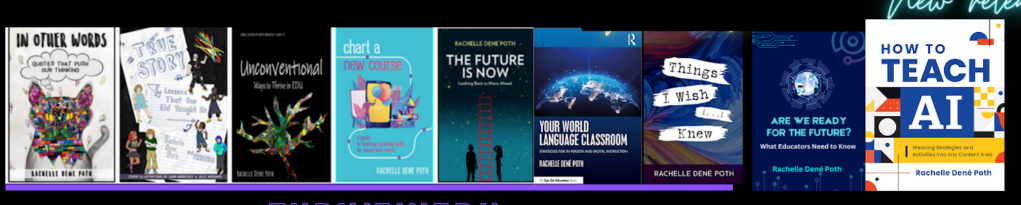
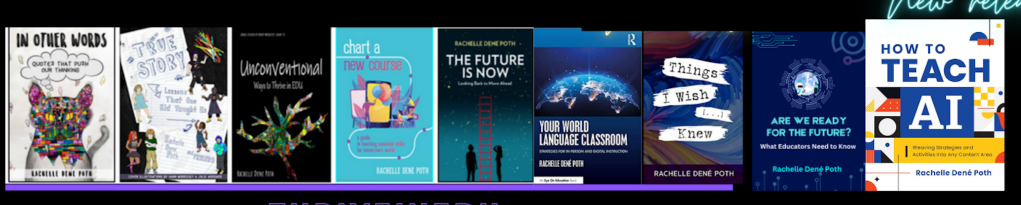
She is the author of nine books including ‘In Other Words: Quotes That Push Our Thinking,” “Unconventional Ways to Thrive in EDU,” “The Future is Now: Looking Back to Move Ahead,” “Chart A New Course: A Guide to Teaching Essential Skills for Tomorrow’s World, “True Story: Lessons That One Kid Taught Us,” “Things I Wish […] Knew” and her newest “How To Teach AI” is available from ISTE or on Amazon.
Contact Rachelle to schedule sessions about Artificial Intelligence, Coding, AR/VR, and more for your school or event! Submit the Contact Form.
Follow Rachelle on Twitter(X) and Instagram at @Rdene915
**Interested in writing a guest blog for my site? Would love to share your ideas! Submit your post here. Looking for a new book to read? Find these available at bit.ly/Pothbooks
************ Also check out my THRIVEinEDU PodcastHere!
Join my show on THRIVEinEDU on Facebook. Join the group here.
Guest post by Dr. Amy Mathews-Perez, a Director of Special Programs in a public school in Central Texas. Connect with Amy on X (formerly Twitter) at @drgrowtoknow, on Facebook at DrAmy MP, or at her website dramyperez.com
Legacy, Purpose, and In Between
It is very common to hear phrases, mottos, and comments about “purpose.” A few examples include finding your purpose and having a sense of purpose and purpose of life. It seems to have become so common that people may gloss over the words, dismiss it, or find it so daunting that they avoid all of the “How To” advice. Often this word also implies that a person’s purpose is a singular thing. We won’t launch into the grammar of it all, but in this blog, I’ll share a strategy that has helped me refocus on my purpose, and my hope is that it can help you get closer to figuring out yours.
An important thing to know is that your purpose can change. It is not like a New Year’s resolution that you either conquer or quit; purpose is fluid because it evolves as you grow and change; also, it typically impacts multiple levels of your preferences, your actions, your emotions, your interactions with others, your mindset and more which leads to more growth and change.
Also, your purpose doesn’t need to be something huge, life-changing, or change the world. If you are committed to it and true to it, your purpose will facilitate change that is needed. Some of these changes you’ll be lucky enough to know about, but many will happen as a ripple effect.
Now, let’s talk about the word “legacy.” It makes some people think of obituaries and inheritance, while others use it in reference to the “rich and famous.” The definition I am referring to for the purpose of this blog is this: the sum of the personal values, accomplishments, contributions, and actions that resonate and impact others in ways that yield change in character, progress, and/or learning. Everyone has a legacy, but not everyone recognizes it. Often, those who can see their legacy rarely accomplish it due to a lack of self-trust, intention, drive, and focus.
In 2024, I was honored to be a guest on Chip Baker’s podcast, “The Success Chronicles.” You can check out all of his episodes at https://www.youtube.com/c/ChipBakerTheSuccessChronicles. I highly recommend Chip Baker- he is authentic, hard-working, and truly wants you to succeed through learning. Although my episode has not yet been published, we talked about many things, including “legacy.” Chip Baker said, “…it all starts with your perspective and your heart posture.” We shared personal examples and were on the same page about legacy being more about the impact than the person.
Since then, I have been reflecting and processing the terms “legacy” and “purpose,” and my big “Ah-ha!” moment was this: I was working backwards. I was languishing over my purpose and what kind of legacy that would leave. I switched up my strategy and very quickly gained clarity, which provided me with alignment between my actions, mission, focus, and goals. Things are not perfect, but they are significantly better.
Here is what I discovered: In spending quality time reflecting on what I want my legacy to be, my purpose reveals itself (not all at once for me.) The “in-between” stuff is our everyday life; our choices, actions, values, words, and more – including what you put your energy into. Chip Baker described it as being “intentional about doing the right thing each moment of each day.”
As I continue my journey, I am collaborating with specific people that I trust to build on ideas and provide me authentic feedback. This is key in squashing self-doubt, the inner-critic and the “just give up” voice when things get hard, messy, or unclear.
You are a wonderfully unique person. This strategy is not a guarantee, but it is an idea for you to consider. If you give yourself enough time and grace, I am 100% confident that you’ll discover more about yourself, your legacy, and your purpose.
About Amy
About Amy Texas-born & raised, Amy is in her 34th year of serving public education. General Ed. Teacher, SLP, Diagnostician, SPED Supervisor, Assistant Principal, Principal, and Director of Special Education are roles she’s held. She is the CEO of Making Education Special for All (M.E.S.A), an LLC dedicated to training, facilitation, consultation, and speaking engagements that revolve around information, motivation, and insights on why and how to make education special for all stakeholders as well as leadership. Her passions are communication, joy, authenticity, and empowerment. “Life is short, but our influence is never-ending,” Amy is committed to connecting with others through service and smiles.
About Rachelle
Dr. Rachelle Dené Poth is a Spanish and STEAM: What’s Next in Emerging Technology Teacher at Riverview High School in Oakmont, PA. Rachelle is also an attorney with a Juris Doctor degree from Duquesne University School of Law and a Master’s in Instructional Technology. Rachelle received her Doctorate in Instructional Technology, and her research focus was on AI and Professional Development. In addition to teaching, she is a full-time consultant and works with companies and organizations to provide PD, speaking, and consulting services. Contact Rachelle for your event!
Rachelle is an ISTE-certified educator and community leader who served as president of the ISTE Teacher Education Network. By EdTech Digest, she was named the EdTech Trendsetter of 2024, one of 30 K-12 IT Influencers to follow in 2021, and one of 150 Women Global EdTech Thought Leaders in 2022.
She is the author of nine books and a blogger and podcaster.
Contact Rachelle to schedule sessions about Artificial Intelligence, Coding, AR/VR, and more for your school or event! Submit the Contact Form.
Follow Rachelle on Twitter(X) and Instagram at @Rdene915
**Interested in writing a guest blog for my site? Would love to share your ideas! Submit your post here. Looking for a new book to read? Find these available at bit.ly/Pothbooks
************ Also, check out my THRIVEinEDU PodcastHere!
Join my show on THRIVEinEDU on Facebook. Join the group here.
Let’s say you wanted to explain the term “Artificial intelligence” to an elementary school student using words that student would be most likely to understand. Would any of the following explanations help you do so?
What a computer has learned to do.
Something made by humans to look like something made by nature
Teaching a computer to think and learn like a person.
The left side and middle text were written by two of the authors of this blog post; the right hand side text was generated by Estella AI, a chatbot we programmed to produce kid-accessible definitions of words. Our goal was to give adults (teachers, parents, family members, and tutors) options for explaining math, computer, and AI words in terms kids could readily understand.
Language matters! As Sal Khan’s latest book Brave New Words (2024) explains, AI-based terms are becoming commonly used in our daily lives and society. There are terms like “chatbot” (from the words chatter and robot); “hallucination” (computer-generated falsehoods), “algo” (a computer algorithm), and many others that are being used frequently in the media and even in our daily conversations.
Youngsters are hearing, reading, and seeing AI words and they want to understand them. Recently, in a national survey, 66% of 9-17 year-olds said they had some knowledge of what GenAI tools do, and 72% wanted adult support in learning how to use AI correctly and confidently (National 4-H Council, 2023).
Researchers broadly agree that young learners need to hear and use a word multiple times (ranging from 6 to 20) before that term becomes an understood part of their vocabulary (Uchihara, et.al., 2019). But printed and online dictionary definitions do not always teach youngsters to incorporate new and unfamiliar words accurately in communications with other people. For example, the Merriam-Webster Dictionary defines artificial intelligence as “the capability of computer systems or algorithms to imitate intelligent human behavior,” which includes several words and terms students might not completely understand.
To support young learners in attaining AI knowledge through AI vocabulary, we began by creating an alphabet of AI words!
An Alphabet of AI Words for Students
To build a list of AI words, we first used our own ideas, then asked students in our college classes, consulted online lists, prompted two AI chatbots, and came up with the following as a start:
A: Algorithm
B: Bias
C: Chatbot
D: Data
E: Ethics
F: Facial recognition
G: Glitch
H: Hallucination
I: Internet
J: Job automation
K: Keyword
L: Literacy
M: Machine learning
N: Neural network
O: Open source
P: Parameter
Q: Query
R: Robot
S: SIRI
T: Turing test
U: URL
V: Voice recognition
W: WIFI
X: eXploration
Y: You
Z: Zeroes and ones
Writing Kid-Accessible Definitions in Kid-Friendly Language
To define these terms, we wanted to explain new words in what can be called “kid-friendly” or “kid-accessible” language. “Kid-friendly” is another way of saying easily understandable vocabulary. Students gain meaning and understanding from language that makes sense to them.
We have created kid-friendly terms to teach youngsters about written language by focusing attention on the role or function various terms play in written language. An exclamation point can be an “excitement mark”; an interrogative sentence is a “question-asking sentence.”
We tried writing our own kid-accessible definitions for selected AI words:
Algorithm = the steps you take to solve a problem.
SIRI = A machine voice on your computer or phone that answers questions and helps you do things
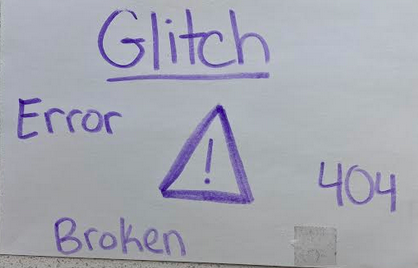
Then we asked college students in our weekly Tutoring in Schools class to create a kid-friendly, student-accessible dictionary/pictionary definition of AI words from our list or choose an Internet/computer term college students imagine youngsters need to know. On a large index card, the college students wrote a definition and drew an image to accompany the definition. Here is the card for the term ”glitch” drawn by one of the co-authors.
An error a machine makes, not you.
AI-Generated Kid-Friendly Definitions
To compare AI-generated definitions with our own and the college students’ creations, we next asked Estella Explainer Math Bot 2, a fine-tuned AI chatbot we built in ChatGPT as part of our Usable Math open online math tutoring platform (https://usablemath.org/) for elementary school students, teachers and families.
Estella Bot is a reading and vocabulary coach for use by teachers and tutors, trained to generate explanations of math word problems and terms at the “easy reading” level as measured on the Flesch/Kincaid Reading Ease scale. It also can produce kid-accessible definitions of AI words. When asked to define the term algorithm, the Estella Bot replied: “An algorithm is like a recipe. It’s a list of steps that you follow to solve a problem or do something, like baking a cake or finding a toy. Computers use algorithms to know what to do.”
Using AI to Learn about AI
Using AI to learn about AI was a remarkable experience for us. While we were initially unsure how to convey complex AI terms clearly to young learners, by writing our own definitions and then getting phrases and ideas from Estella Bot, we saw how AI could provide more ideas and language for teachers, tutors, and other adults. Rather than thinking in terms of accepting or rejecting one definition or another, here is an opportunity to blend all suggestions and possibilities to support young learners in learning about AI.
We even tried asking Estella Bot to generate a fictional math and AI story using “algorithm” and the chatbot responded with “The Treasure Hunt Algorithm,” an adventure students could act out, illustrate as a comic story, or continue to expand further with more characters and plots.
The Treasure Hunt Algorithm
It was a sunny afternoon, and Maya and her friends gathered at the park for a treasure hunt. Maya held up the treasure map, which had a note at the top: Follow the algorithm to find the treasure.
“What’s an algorithm?” asked Jake, scratching his head.
“It’s just a fancy word for a list of steps we need to follow,” Maya explained. “Like when we follow steps to bake cookies, but this time, it’s for finding treasure!”
The group leaned in as Maya read the steps out loud:
Start at the big oak tree.
Walk 10 steps north to the red bench.
Turn right and take 15 steps to the fountain.
Look under the rock with the painted star.
“Let’s try it!” said Emma, grabbing the map.
They all ran to the oak tree, counting their steps out loud. At the red bench, they argued for a moment about which way was right, but Maya pointed to her compass. “Algorithms work best if we stick to the directions exactly,” she said.
When they reached the fountain, they spotted the painted rock. Jake lifted it, and underneath was a small box with shiny stickers, candies, and a note that said, Congratulations, you followed the algorithm!
“This was fun!” said Emma.
With its capacity to provide kid-understandable explanations of complex AI language terms, Estella Bot functions as an always-available learning resource. While some of its explanations may not make sense to every youngster, adults can remix, revise, or create their own explanations based on Estella Bot’s definitions. And the bot’s story writing offers another way to help young learners build their vocabulary while making learning relevant and meaningful.
It can be helpful, though, for adults to start, as we did, in trying to create their own kid-accessible definitions and explanations before turning to an AI chatbot. Beginning with one’s own ideas first turns AI into a tool that users control and a resource that users can adopt and adapt according to the learning goals they want to achieve. Give it a try and let us know what happens. Many AI alphabets for kids are waiting to be created.
About the authors
Robert W. Maloy is a senior lecturer in the College of Education at the University of Massachusetts Amherst.
Sharon A. Edwards is a retired elementary school teacher and clinical faculty member in the College of Education at the University of Massachusetts Amherst.
Jane Cusson is a January 2025 graduate of the University of Massachusetts Amherst who is beginning her career in speech pathology.
Chenyang XU is a doctoral candidate in Learning, Media and Technology at the University of Massachusetts Amherst.
Torrey Trust is a Professor of Learning Technology in the College of Education at the University of Massachusetts Amherst.
About Rachelle
Dr. Rachelle Dené Poth is a Spanish and STEAM: What’s Next in Emerging Technology Teacher at Riverview High School in Oakmont, PA. Rachelle is also an attorney with a Juris Doctor degree from Duquesne University School of Law and a Master’s in Instructional Technology. Rachelle received her Doctorate in Instructional Technology, and her research focus was on AI and Professional Development. In addition to teaching, she is a full-time consultant and works with companies and organizations to provide PD, speaking, and consulting services. Contact Rachelle for your event!
Rachelle is an ISTE-certified educator and community leader who served as president of the ISTE Teacher Education Network. By EdTech Digest, she was named the EdTech Trendsetter of 2024, one of 30 K-12 IT Influencers to follow in 2021, and one of 150 Women Global EdTech Thought Leaders in 2022.
She is the author of nine books including ‘In Other Words: Quotes That Push Our Thinking,” “Unconventional Ways to Thrive in EDU,” “The Future is Now: Looking Back to Move Ahead,” “Chart A New Course: A Guide to Teaching Essential Skills for Tomorrow’s World, “True Story: Lessons That One Kid Taught Us,” “Things I Wish […] Knew” and her newest “How To Teach AI” is available from ISTE or on Amazon.
Contact Rachelle to schedule sessions about Artificial Intelligence, Coding, AR/VR, and more for your school or event! Submit the Contact Form.
Follow Rachelle on Twitter(X) and Instagram at @Rdene915
**Interested in writing a guest blog for my site? Would love to share your ideas! Submit your post here. Looking for a new book to read? Find these available at bit.ly/Pothbooks
************ Also check out my THRIVEinEDU PodcastHere!
Join my show on THRIVEinEDU on Facebook. Join the group here.
Principal Turnover is a Real Problem. Let’s Do Something About it
It seems that every day, there’s a new education survey, a new report, or some new finding, with its authors begging for our attention – a new or ongoing challenge that merits action.
If you’re in any way like me, most of those surveys earn not much more than a nod, a modest affirmation of the issue under scrutiny. Most of the time, we know already. And honestly, the issues rarely change. The investment and attention lines have been drawn in roughly the same places for some time.
But every once in a while, a new survey comes out that truly opens my eyes or refocuses my attention on critical issues in education.
As a preamble, the report repeated some sobering statistics about school administration retention, which we may have known but warrants repeating. For example, according to research from 2019, in the United States, “principal tenure averages four years.”
That was before the pandemic. I cannot imagine that it has improved.
If you’re reading this, I don’t need to explain why an average principal tenure of just four years is a serious problem and that is where the Arizona information comes back in.
In their survey of nearly 300 administrators and principals in K12 schools, the organizations wrote that while principals found their work meaningful, they also “noted high levels of job-related stress.” According to the survey, “High levels of stress and poor work-life balance are major factors pushing administrators to consider leaving.”
Administrators also told the survey makers that “Top stressors … included heavy workload, staffing shortages, the political climate in Arizona, and lack of resources/funding.” And that “Overall, administrators rated their work-life balance between poor and fair.”
None of that may be entirely surprising. But none of that is good, either.
We founded NetSupport nearly 36 years ago specifically to make educators’ jobs easier. By educators, we included and focused on IT professionals and school administrators, although we do have products used exclusively by teachers. Our products have been designed, installed, and updated across more than 22 million users worldwide because they reduce the burdens on education professionals in organizing and managing the technology in their schools. Over many years, countless school leaders have told us how our products and services make their jobs better and less stressful.
So, being reminded of the extremely limited tenure of principals in the U.S. and seeing the dismal results from Arizona was a bit of a shock. It was, however, not a surprise. I think we all know how stressful and draining education work is. But seeing this dramatic rate of turnover was a rude reminder that we all must do more to make the work of running a school less stressful, to move the needle on work-life balance to at least fair. If we cannot, we are – we will continue to be – experiencing unhealthy and unproductive high turnover among school leaders.
It’s well worth remembering that we can invest all the time, treasure, and technology we wish in classroom interventions and innovations. Yet, if the administrative layer in a given school is constantly in transition, overwhelmed, or otherwise ineffective, we are wasting those investments.
Likewise, we can create all the school policies we want at the federal, state, or district level, and it won’t matter one bit if the corps of school-level leadership is degraded by “high levels of job-related stress.”
The Arizona report offered several recommendations, such as implementing support programs that “Develop comprehensive wellness programs that address both personal and professional wellbeing” and to “advocate for policies that reduce administrative burdens and provide adequate funding for schools.”
That sounds great. And I understand that very few of us can do much about getting the state or other education overseers to create and fund wellness efforts. We also probably can’t do much on funding. But the part about reducing administrative burdens – we can do something about that.
AI and other technologies are getting too good, too fast to continue to leave such a vital part of our education leadership under these burdens, to allow them to roll these burdens and stresses and eventually into professional flight.
All of us in the education technology ecosystem have to be better, faster, and more intentional in making solutions that include principals. Even if new products are aimed, for example, at personalized learning or managing offsite activities, they should all consider how they will contribute to easing administrative burdens on principals. Any edtech product that does not is only doing half the job.
At the same time, those of us who have solutions that can help administrators need to move from raising our hands to energetically waving them about. The ongoing strain and its consequences are too important for professional modesty.
I realize that there are many issues with, and serious threats to, education. But this one – the stress burden we’re placing on principals – needs moving up a notch or two. So do the solutions that can help.
About Al Kingsley
Al Kingsley, the CEO of NetSupport, Inc., writes about school innovation and education technology. He serves in several capacities in local schools and has published four books about education, leadership, technology, and school governance.
Want to submit a guest blog or work with Rachelle?
Contact Rachelle to schedule sessions or keynotes about Artificial Intelligence, AI and the Law, Cybersecurity, Coding, AR/VR, and more for your school or event! Submit the Contact Form.
Follow Rachelle on BlueSky, Twitter(X) Instagram at @Rdene915
**Interested in writing a guest blog for my site? Would love to share your ideas! Submit your post here. Looking for a new book to read? Find these available at bit.ly/Pothbooks
************ Also check out my THRIVEinEDU PodcastHere!
Join my show on THRIVEinEDU on Facebook. Join the group here.
Guest post by Dr. Amy Mathews-Perez, a Director of Special Programs in a public school in Central Texas. Connect with Amy on X (formerly Twitter) at @drgrowtoknow or her website dramyperez.com
Lead With Curiosity…..Follow With Learning
No matter your role, if you want to create or improve relationships, there are lots of ways to do that. Whether it is personal or professional, relationships matter. Relationships influence us in ways that are obvious (when we get into an argument with someone and stay mad until we decide to forgive, forget, or just quit giving it energy) and ways that are less than obvious, like the way we feel when we think of someone, our anticipation (or dread) of running into/meeting with a person, or the way our choices are influenced by someone (whether intentional or not). One example of that last thing – choices being influenced – is a tradition I follow at work. I have a small team of great people that I am lucky enough to coordinate. Each year I take each person to lunch with the intention of quality one-on-one time talking about anything but work. I always order what they order for lunch. I love to try new things, and while mirroring their decision is an intentional choice for me, the impact on that person and our relationship is subtle. It validates that person, and it provides a topic of conversation (whether I’ve had that meal before or not, why they like it, etc.).
This blog is about two specific ways you can improve relationships: (1) Lead with curiosity and (2) Follow with learning. First things first: the assumption behind this blog is that you want to create positive relationships or improve the ones you already have.
Most of us have probably heard the phrase, “Lead with curiosity.” Many people think that means asking a lot of questions. While that is a reasonable interpretation of the phrase, let’s consider purpose and timing when leading with curiosity. The purpose of your curiosity is to learn more about the other person, so asking questions is a great start. However – being intentional about the purpose of your questions will guide the conversation and validate the other person. Asking questions that do NOT yield “Yes/No” responses will yield only that: one-word answers, which does not perpetuate authentic conversation. Asking questions with the intention of discovering what the other person enjoys talking about is where the magic is.
The next strategy is to “Follow with learning.” Once you are in a conversation with someone and you discover something, learn it. Seeking to understand is powerful in creating trust.Follow up in ways that confirm for the other person that you are learning from them/about them. This can be accomplished through phrases (like “I didn’t know that…”, “I’m learning so much from you/about you.” Or “Let me get this straight [state back what you just learned]…..” are examples of such phrases. Your intention is to validate their input by learning it, repeating it and/or linking it to something you relate to about it. If you really want to solidify this learning, mention the learning to them at another time or mention it to someone else while this person is present.
Each one of these strategies is important, but for maximum impact, use them both: Lead with curiosity, then immediately follow with learning. Same strategies as mentioned above, but combine them in the conversation. Ultimately, your goal is to suspend your ego, eliminate your “I” voice (talking about yourself without relevance to the conversation), and focus on the other person/people in the conversation through your questions and your learning.
CHALLENGE: Have a conversation with a good friend and a new acquaintance. Have your friend count how many times you say “I” – if it is more than you expected, don’t be surprised. We are all guilty of defaulting to “I” when we run out of things to say, get uncomfortable, or can’t handle silence. There is no magic number about how frequently you say “I” – this challenge is simply a way to raise your awareness. It makes it hard to build authentic relationships with others if we mostly talk about ourselves.
I encourage you to be intentional by leading with curiosity and following that with learning and seeing how your relationships improve in-depth, authenticity, and positivity. Fair warning, though: it is harder than it seems, but remember that “better” is the result of intentional decisions. Bottom line: I believe you can do it. You’ve got this!
About Amy
Texas-born & raised, Amy has served public education for over 30 years. General Ed. Teacher, SLP, Diagnostician, SPED Supervisor, Assistant Principal, Principal, and Director of Special Education are the roles she has held. She is the CEO of Making Education Special for All (M.E.S.A), an LLC dedicated to training, facilitation, consultation, and speaking engagements that revolve around information, motivation, and insights on why and how to make education special for all stakeholders as well as leadership. Her passions are communication, joy, authenticity, and empowerment. “Life is short, but our influence is never-ending,” and Amy is committed to connecting with others through service and smiles.
About Rachelle
Dr. Rachelle Dené Poth is a Spanish and STEAM: What’s Next in Emerging Technology Teacher at Riverview High School in Oakmont, PA. Rachelle is also an attorney with a Juris Doctor degree from Duquesne University School of Law and a Master’s in Instructional Technology. Rachelle received her Doctorate in Instructional Technology, and her research focus was on AI and Professional Development. In addition to teaching, she is a full-time consultant and works with companies and organizations to provide PD, speaking, and consulting services. Contact Rachelle for your event!
Rachelle is an ISTE-certified educator and community leader who served as president of the ISTE Teacher Education Network. By EdTech Digest, she was named the EdTech Trendsetter of 2024, one of 30 K-12 IT Influencers to follow in 2021, and one of 150 Women Global EdTech Thought Leaders in 2022.
She is the author of nine books including ‘In Other Words: Quotes That Push Our Thinking,” “Unconventional Ways to Thrive in EDU,” “The Future is Now: Looking Back to Move Ahead,” “Chart A New Course: A Guide to Teaching Essential Skills for Tomorrow’s World, “True Story: Lessons That One Kid Taught Us,” “Things I Wish […] Knew” and her newest “How To Teach AI” is available from ISTE or on Amazon.
Contact Rachelle to schedule sessions about Artificial Intelligence, Coding, AR/VR, and more for your school or event! Submit the Contact Form.
Follow Rachelle on Twitter(X) and Instagram at @Rdene915
**Interested in writing a guest blog for my site? Would love to share your ideas! Submit your post here. Looking for a new book to read? Find these available at bit.ly/Pothbooks
************ Also check out my THRIVEinEDU PodcastHere!
Join my show on THRIVEinEDU on Facebook. Join the group here.
Guest post written By: Maurie Beasley, M.Ed. Counseling (Edited by Jim Beasley)
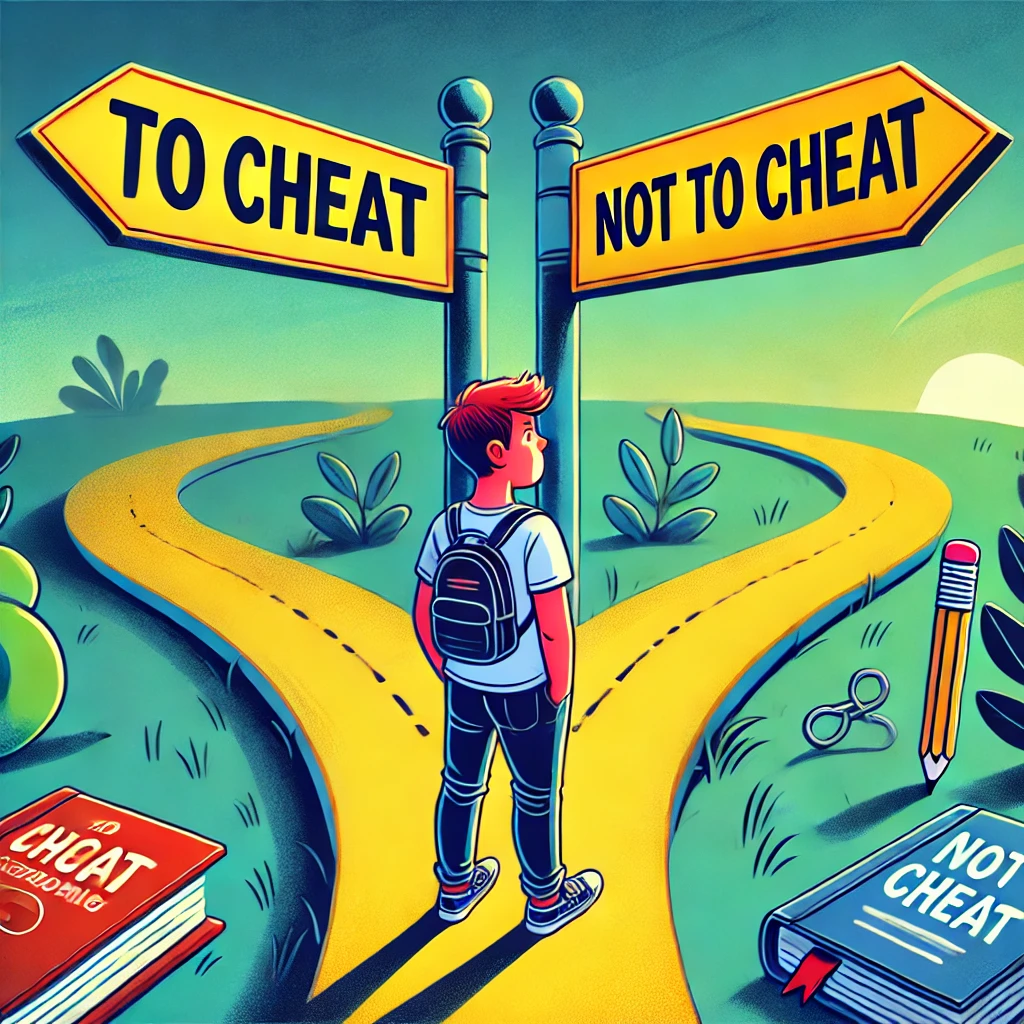
Cheating in school — it’s the topic that’s always been there, lurking in the shadows of every classroom and exam hall. For decades, we’ve known it happens, but we often look for the quickest explanation: students are lazy, technology makes it easier, end of story. But here’s the thing: cheating is not just a modern phenomenon, nor is it just about slacking off or taking advantage of new tools like AI. The real reasons why students cheat run much deeper, and if we’re serious about addressing the issue, we need to understand those reasons first.
Let’s be clear: cheating isn’t just some bad habit students picked up recently. It’s been around long before ChatGPT was on the mind of any engineer. And despite the attention AI has brought to the issue, the reasons students cheat are essentially the same as they’ve always been. So why does it persist, and what can we do about it? Let’s take a closer look at these reasons.
Pressure to Perform:
Students today are walking a tightrope, balancing academic expectations, extracurricular activities, and even part-time jobs. The pressure to perform is immense, and it’s no surprise that some students feel they can’t afford to fall.
Let me tell you about my daughter. She was the salutatorian of her high school class. She missed being valedictorian by a hair — a hair that could have been as little as a hundredth of a point. The only B she ever received was from a teacher who told her that grades don’t matter. Her response? “Great, then give me the one point I need to make an A in the class, or better yet, write me a letter explaining to the admissions board at UT Austin that grades don’t matter and being number 2 in my class is ok.” She knew that being valedictorian meant having your first year of college paid for in Texas. My daughter is honest, sometimes to a fault, but several times I was even tempted to tell her to “cheat” a little. That’s the kind of pressure students are under, and when the stakes are this high, cheating may seem like a way to stay on that tightrope, even if just barely.
Fear of Failure:
Beneath that pressure lies an even more pervasive issue: fear of failure. The fear of letting down parents, teachers, and even themselves can be overwhelming. When failure isn’t seen as an opportunity to learn but rather as a personal catastrophe, cheating becomes a tempting escape route. It’s not about cutting corners for the sake of it; it’s about avoiding the crushing weight of perceived inadequacy.
Beneath that pressure lies an even more pervasive issue: fear of failure. The fear of letting down parents, teachers, and even themselves can be overwhelming. When failure isn’t seen as an opportunity to learn but rather as a personal catastrophe, cheating becomes a tempting escape route. It’s not about cutting corners for the sake of it; it’s about avoiding the crushing weight of perceived inadequacy.
And this fear isn’t just hypothetical. As a counselor, I’ve seen it manifest in tragic ways. I’ve had to make Child Protective Service calls because parents have beaten their children for not performing well enough in school. When failure comes with such dire consequences, is it any wonder some students feel they have no choice but to cheat?
Contact Rachelle to schedule sessions about Artificial Intelligence, AI and the Law, Coding, Cybersecurity, STEM, and more for your school or event! Available for in-person or virtual training, keynotes, and coaching. Submit the Contact Form.
Follow Rachelle on Twitter(X) and Instagram at @Rdene915
**Interested in writing a guest blog for my site? Would love to share your ideas! Submit your post here. Looking for a new book to read? Find these available at bit.ly/Pothbooks
************ Also, check out my THRIVEinEDU PodcastHere!
Join my show on THRIVEinEDU on Facebook. Join the group here.
Digital Citizenship Week is celebrated in October each year. The focus is on building digital citizenship skills, and there is a designated digcit week with events planned for schools to join in and learn more. These are concepts that teachers and schools should focus on throughout the year as well. With the increased use of digital tools in our classrooms and the amount of technology used in everyday life and work, we must consistently provide learning opportunities for students to develop “digcit” skills.
Being a responsible digital citizen means that all individuals are able to use technology ethically, responsibly, and effectively. It is important to develop an understanding of the impact that one’s digital actions can have on other individuals and on society as a whole. Students and teachers must be able to keep themselves safe, know how to protect their privacy, learn how to critically analyze information, and engage in respectful interactions online.
Teaching digital citizenship skills
Privacy and security: With increased data collection and online tracking of websites we use and how our information is shared, understanding how to safeguard our privacy is key. With more students using digital tools and at a younger age, it is essential to build in activities that will help students to better understand how to protect themselves and to respect the privacy of others as well. For instance, teaching students how to create unique passwords is key for securing personal information. With the increase in cybersecurity attacks over the past few years, updating passwords and even using two-factor authentication (TFA) will help to keep everyone safer.
Communication: With the variety of social media platforms available and how quickly we can post and respond, providing opportunities for students to practice responsible posting is an area that we need to focus on regularly. Even with young students, simulating a Twitter (X) chat or other online discussion can be done using Post-it notes, for example. Depending on grade level, another option is to use a tool like Padlet to help students learn how to properly post and interact with one another.
Dr. Rachelle Dené Poth is a Spanish and STEAM: What’s Next in Emerging Technology Teacher at Riverview High School in Oakmont, PA. Rachelle is also an attorney with a Juris Doctor degree from Duquesne University School of Law and a Master’s in Instructional Technology. Rachelle received her Doctorate in Instructional Technology, and her research focus was on AI and Professional Development. In addition to teaching, she is a full-time consultant and works with companies and organizations to provide PD, speaking, and consulting services. Contact Rachelle for your event!
Rachelle is an ISTE-certified educator and community leader who served as president of the ISTE Teacher Education Network. By EdTech Digest, she was named the EdTech Trendsetter of 2024, one of 30 K-12 IT Influencers to follow in 2021, and one of 150 Women Global EdTech Thought Leaders in 2022.
She is the author of nine books including ‘In Other Words: Quotes That Push Our Thinking,” “Unconventional Ways to Thrive in EDU,” “The Future is Now: Looking Back to Move Ahead,” “Chart A New Course: A Guide to Teaching Essential Skills for Tomorrow’s World, “True Story: Lessons That One Kid Taught Us,” “Things I Wish […] Knew” and her newest “How To Teach AI” is available from ISTE or on Amazon.
Contact Rachelle to schedule sessions about Artificial Intelligence, Coding, AR/VR, and more for your school or event! Submit the Contact Form.
Follow Rachelle on Twitter(X) and Instagram at @Rdene915
**Interested in writing a guest blog for my site? Would love to share your ideas! Submit your post here. Looking for a new book to read? Find these available at bit.ly/Pothbooks
************ Also check out my THRIVEinEDU PodcastHere!
Join my show on THRIVEinEDU on Facebook. Join the group here.
Building a strong home-to-school partnership with families is important throughout the school year. Students need to have consistent support both in and out of the classroom, and the best way to achieve this is by establishing relationships between the school community and the families and students that we support. I start the year by emailing families and students using our gradebook messaging system. I introduce myself and share my excitement for the new school year, provide some resources that we will use in class, and make sure that families know that I am available to support them and my students. Many times I receive an email from families right away and it is great to start forming those connections and learning about my students and their families.
Why the home-to-school partnership is essential
We want to engage families in their children’s day-to-day learning experiences. Establishing consistent collaboration with families will help us cultivate an environment for learning at home and at school.
Continue reading the rest of this article on Edutopia.
About the Author:
Dr. Rachelle Dené Poth is a Spanish and STEAM: What’s Next in Emerging Technology Teacher at Riverview High School in Oakmont, PA. Rachelle is also an attorney with a Juris Doctor degree from Duquesne University School of Law and a Master’s in Instructional Technology. Rachelle received her Doctorate in Instructional Technology, and her research focus was on AI and Professional Development. In addition to teaching, she is a full-time consultant and works with companies and organizations to provide PD, speaking, and consulting services. Contact Rachelle for your event!
Rachelle is an ISTE-certified educator and community leader and served as president of the ISTE Teacher Education Network. She was named the EdTech Trendsetter of 2024 by EdTech Digest, one of 30 K-12 IT Influencers to follow in 2021, and one of 150 Women Global EdTech Thought Leaders in 2022.
She is the author of nine books including ‘In Other Words: Quotes That Push Our Thinking,” “Unconventional Ways to Thrive in EDU,” “The Future is Now: Looking Back to Move Ahead,” “Chart A New Course: A Guide to Teaching Essential Skills for Tomorrow’s World, “True Story: Lessons That One Kid Taught Us,” “Things I Wish […] Knew” and her newest “How To Teach AI” is available from ISTE or on Amazon.
Contact Rachelle to schedule sessions about Artificial Intelligence, Coding, AR/VR, and more for your school or your event! Submit the Contact Form.
Follow Rachelle on Twitter(X) and Instagram at @Rdene915
**Interested in writing a guest blog for my site? Would love to share your ideas! Submit your post here. Looking for a new book to read? Find these available at bit.ly/Pothbooks
************ Also check out my THRIVEinEDU PodcastHere!
Join my show on THRIVEinEDU on Facebook. Join the group here
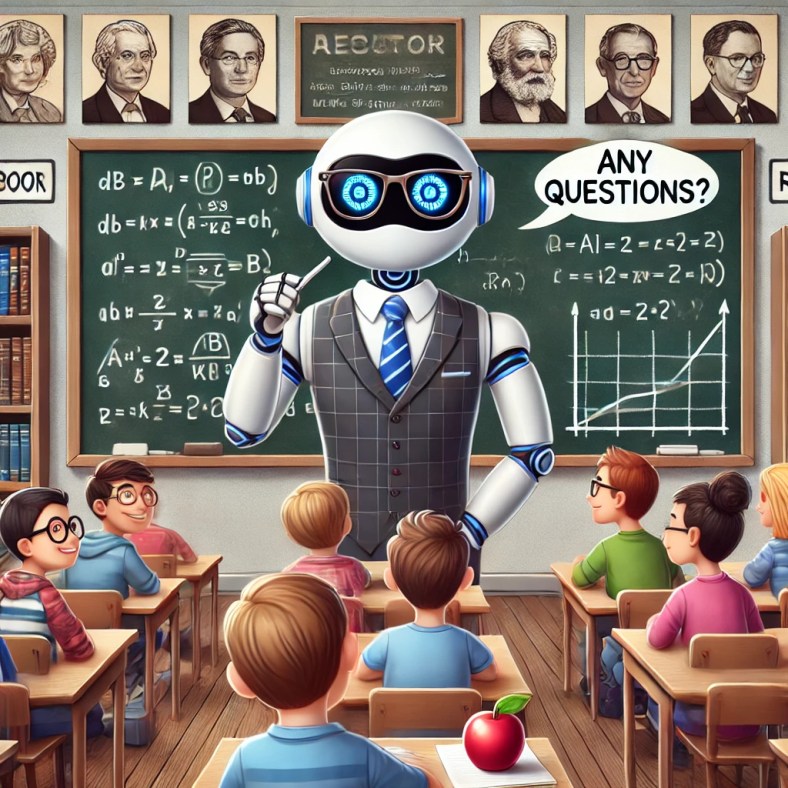
A slight update of my first post on AI in 2018. Image above generated by AI.
Over the past seven years, I have focused on learning more about artificial intelligence. Initially I thought I understood the meaning of AI. But I did not.
In early 2018, I noticed that AI was becoming an increasingly popular topic of discussion in the blogs that I was reading and in social media posts. When I first started thinking of AI, I had a flashback to the 2004 movie I, Robot, which starred Will Smith. In the movie, set in 2035, robots filled public service positions and were able to think like humans and take action. Then, I thought about virtual assistants such as Alexa and Siri. But what is AI, and how do we use it daily?
What is AI?
A quick Google search turns up more than 615 million results. AI is computer code that displays some form of intelligence, learning and problem-solving in what has been referred to as a “super intelligence.” AI “learns” on its own, and makes adjustments and improvements based on past iterations. As AI becomes “smarter,” its knowledge base grows, and it is able to complete more tasks. Digging a little deeper, I found #AskAboutAI, a research project launched by Getting Smart, which identified over 100 applications of AI.
Shehzad Najib, CEO and co-founder of Kinteract, told me a few years ago: “You shouldn’t notice that AI is working. You should notice that life is easier and you’re saving time.”
Keep that in mind. Here are a few ways that we interact with AI daily:
Communication: We all use email and receive a lot of spam. AI is used to streamline the amount of spam allowed through filters, and it continues to learn over time as you mark items as spam.
Travel: If you use driving apps such as Uber or Lyft, you have experienced machine learning, a form of AI that determines your estimated arrival time. In the airline industry, “human-steered” flight time is estimated to be about seven minutes, leaving the rest to autopilot, which is AI.
Social networks: Most people are engaging in some form of social media use. Years ago, Facebook shared results of how AI successfully detects spam but was not as successful at detecting hate speech or cyberbullying. When photos are used in social media, AI uses facial detection to suggest a name for photo tagging. If you’ve wondered how it recognizes your friends and family without even typing a name into the platform. It learns over time.
Shopping: Many people use Amazon and similar services. They are quite helpful, and who doesn’t appreciate it when suggestions are provided for other items of interest? AI analyzes your prior data and makes decisions based on your preferences over time.
Fraud protection: When making purchases online or in person, systems analyze your purchasing trends and locations and can immediately flag and send alerts for unusual transactions.
Were you familiar with all of these AI uses? Thinking back to Shehzad’s statement, these do save time and often go unnoticed because they are just performing what they have been programmed to do.
What can AI do for education?
One of the most interesting articles that I read during my initial research, came from an article in Forbes, which highlighted 10 ways to use AI in education. Looking at these, how much has changed? Remember, this article is from nearly 10 years ago, which was the original post before its update in 2017.
AI can automate basic activities in education, such as grading.
Educational software can be adapted to student needs.
AI can point out places where courses need improvements.
AI tutors can help support students.
AI-driven programs can give students and educators helpful feedback.
AI is altering how we find and interact with information.
AI could change teachers’ roles.
AI can make trial-and-error learning less intimidating.
Data powered by AI can change how schools find, teach, and support students.
AI could change where students learn, who teaches them, and how students acquire basic skills.
Regardless of the technology we choose to explore and use in education, we have to focus on the technology’s purpose. What are the benefits of using AI? Is it practical to use AI?
Time is always a consideration, and when it comes to providing authentic, meaningful, and personalized learning experiences for our students, we need to make the most of it. AI can make an impact here.
For example, students and teachers can connect and have instant access to resources that meet their specific needs. AI will make decisions based on responses and interactions.
AI can save teachers time in grading and help to provide differentiated instruction that adjusts as students continue to work through class materials. AI analyzes data faster, so teachers can act on it faster and, again, have more time to work with students.
We must actively explore the resources that are being shared in the education world today. There are many blogs, books, podcasts, webinars, and other learning opportunities for educators. We have so many digital tools available to choose from. Have fun exploring but be mindful of not just the possibilities, but always focus on our responsibilities as educators.
If you want to learn more, check out recent Edutopia and Getting Smart blogs. Many AI books are available, including my recent book. Keep on learning and growing, and don’t be afraid of not being the expert. We are all learning as we go!
About the Author:
Dr. Rachelle Dené Poth is a Spanish and STEAM: What’s Next in Emerging Technology Teacher at Riverview High School in Oakmont, PA. Rachelle is also an attorney with a Juris Doctor degree from Duquesne University School of Law and a Master’s in Instructional Technology. Rachelle received her Doctorate in Instructional Technology, and her research focus was on AI and Professional Development. In addition to teaching, she is a full-time consultant and works with companies and organizations to provide PD, speaking, and consulting services. Contact Rachelle for your event!
Rachelle is an ISTE-certified educator and community leader who served as president of the ISTE Teacher Education Network. By EdTech Digest, she was named the EdTech Trendsetter of 2024, one of 30 K-12 IT Influencers to follow in 2021, and one of 150 Women Global EdTech Thought Leaders in 2022.
She is the author of nine books including ‘In Other Words: Quotes That Push Our Thinking,” “Unconventional Ways to Thrive in EDU,” “The Future is Now: Looking Back to Move Ahead,” “Chart A New Course: A Guide to Teaching Essential Skills for Tomorrow’s World, “True Story: Lessons That One Kid Taught Us,” “Things I Wish […] Knew” and her newest “How To Teach AI” is available from ISTE or on Amazon.
Contact Rachelle to schedule sessions about Artificial Intelligence, Coding, AR/VR, and more for your school or your event! Submit the Contact Form.
Follow Rachelle on Twitter(X) and Instagram at @Rdene915
**Interested in writing a guest blog for my site? Would love to share your ideas! Submit your post here. Looking for a new book to read? Find these available at bit.ly/Pothbooks
************ Also check out my THRIVEinEDU PodcastHere!
Join my show on THRIVEinEDU on Facebook. Join the group here.











 Learning as I go: Reflections & lessons learned