Tool, Companion, or Supplemental Brain? What AI Will Be Depends on YOU!

Guest post by Robert W. Maloy and Torrey Trust

What are GenAI technologies, and what do we want them to become? Right now, GenAI is an educational chameleon, aggressively marketed as an indispensable learning companion, an academic partner, and a labor-saving tool; and at the same time, widely critiqued as a dangerous source of misinformation and biased responses, an environmental degrader, and a privacy invader. Since GenAI is all of these things and more, how do we use these tools appropriately and thoughtfully?

What GenAI is and what it will become depends on YOU – how you think about its roles, use it in your teaching and learning, and describe its functions to others.

Let’s look at two currently popular descriptions and uses of GenAI: 1) GenAI as a companion; 2) GenAI as a productivity-enhancing tool.

First, GenAI is widely described and used as a supportive “companion” or helpful “partner.” The Harvard Business Review (2025) reported that therapy/companionship was the number one way people were using GenAI in 2025. An alarming number of teens acknowledge that GenAI chatbots are their virtual companions, even though this technology can exploit youngsters’ emotional needs in ways that lead to self-harm and other risks (Common Sense Media report, Robb & Mann, 2025). One of the key problems here is that GenAI is NOT human, and it is not even intelligent (at least in the way humans perceive and describe intelligence).

The Key Takeaway: Using terms like “partner” or “companion” to describe GenAI technologies humanizes tools that are not designed to provide the support, guidance, and level of intelligence that actual humans can provide.

Second, GenAI technologies are widely presented as productivity-enhancing, time-saving, efficiency-increasing tools for people to use to improve their lives. “Use ChatGPT to make life easier,” declared a recent email advertisement, where all one had to do was “just tap a chat to start.” Personal and professional productivity is also one of the top ways people are using GenAI technologies – from writing emails and reports, to planning vacations and meals, to studying for exams; and it is certainly true that GenAI technologies can do all these things and so much more really fast. Yet, personal autonomy, creativity, and agency is lost when one uses GenAI technologies to automate activities they formerly did without it.

The key takeaway: Avoid talking about GenAI as automating work and think directly about how it can augment or supplement your activities as a teacher and a learner.

So If not a human-like companion or a productivity-enhancing automation tool, then how can we think about the role of GenAI in education? We believe that GenAI is best used when it augments teaching and learning, kind of like the way a caddie in golf enhances the golf experience. As such, we offer a metaphor of GenAI as a caddie; but again remind you that it is not an actual caddie and we are not trying to humanize this tool.

Professional golfers and their caddies on the LPGA, PGA, and more than 20 professional golf tours worldwide offer a metaphor for thinking about, describing, and using GenAI. Each pro golfer has a caddy who carries their clubs and walks alongside them when they play competitive tournaments. sharing ideas and information about the shots they are playing. For instance, until recently, LPGA player Brooke Henderson’s caddy was her older sister, Brittany; PGA player Xander Schauffele’s caddy is Austin Kaiser (his college golf teammate at San Diego State University).

Caddies have detailed information about the course and provide suggestions and feedback about what shots to hit with which clubs. They help keep track of the pace of play and how conditions of the course may be changing due to wind, weather, and time of day. However, it is the golfer who remains totally in charge of the outcomes of the game. Caddies do not hit the golf ball; golfers do not always do what the caddy suggests. It is the golfer who must make decisions, hit the shots, and deal with consequences, both positive and negative, in terms of performance and score. Caddies are there to augment the golf experience and outcome.

When it comes to teaching and learning, GenAI can be that source of information, ideas, or inspiration like a caddie; and it is the teacher who must determine what to do with that information. They have the expertise; they understand their classroom dynamics and contexts; they know their students, their topic, their grade level, and their community.

The key is for the teacher to resist the temptation to automate their work by turning it entirely over to a GenAI technology, because in this case GenAI is in control of the shots, rather than the teacher. It is as if professional golfers let their caddies choose the club and then hit the ball for them. This is even more problematic when it comes to using GenAI to automate tasks. In our metaphor, the caddie is a human who has expertise and has played golf before; however, GenAI is not a teacher, has never taught, and has no idea what teaching is. Turning over any tasks to a tool that does not have any expertise in education can become really problematic. Teachers must maintain agency and exert control, deciding when to accept, when to reject, and when to modify whatever ideas and information the GenAI provides.

So, returning to our original statement, what GenAI is and what it will become depends on YOU – how you think about its roles, use it in your teaching and learning, and describe its functions to others. What do YOU want GenAI to be?

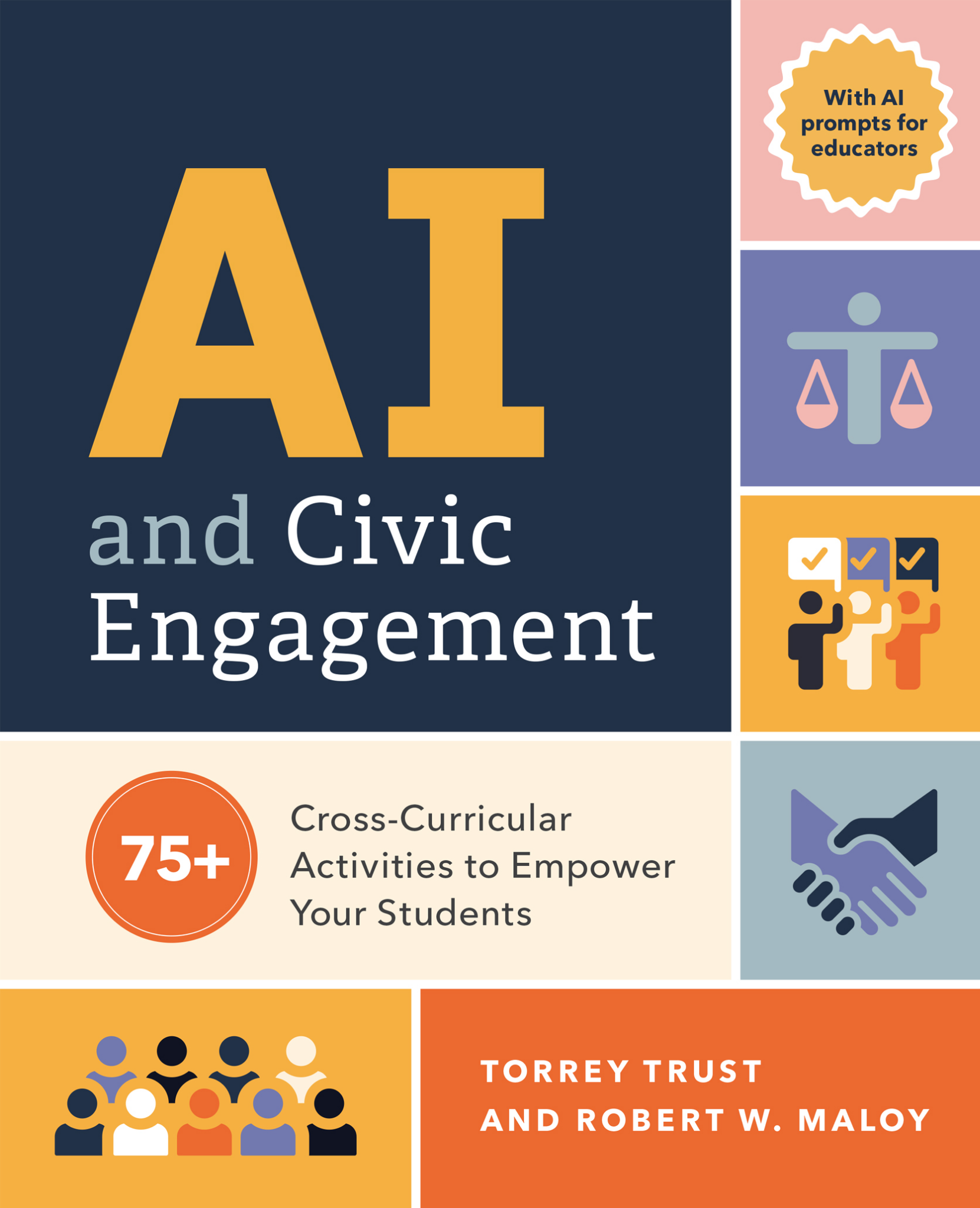
If you’re looking for ways to use GenAI to augment teaching and learning, check our the free online companion of our new book: GenAI and Civic Engagement: 75+ Cross-Curricular Activities to Empower Your Students published by ISTE (International Society for Technology in Education) or explore the bonus learning plans we’ve published on this blog: Learning Plans for Supporting Student Agency in the Age of AI & Learning Plans for Exploring Civic Issues with GenAI.

Nearly 50 years ago, at the outset of the computer revolution in schools, Seymour Papert asked: Will computers program the child, or will educators create the conditions where children program computers? For Papert then, as for us today in the age of GenAI, using technology remains a question of human control and user agency. GenAI can provide amazing resources, but it is essential that you retain your decision-making and personal creativity. Only then will the results be truly yours.

Torrey Trust, Ph.D., is a Professor of Learning Technology in the College of Education at the University of Massachusetts Amherst. Her work centers on empowering educators and students to critically explore emerging technologies and make thoughtful, informed choices about their role in teaching and learning. Dr. Trust has received the University of Massachusetts Amherst Distinguished Teaching Award (2023), the College of Education Outstanding Teaching Award (2020), and the International Society for Technology in Education Making IT Happen Award (2018), which “honors outstanding educators and leaders who demonstrate extraordinary commitment, leadership, courage, and persistence in improving digital learning opportunities for students.” More recently, Dr. Trust has been a leading voice in exploring GenAI technologies in education and has been featured by several media outlets in articles and podcasts, including Educational Leadership, U.S. News & World Report, WIRED, Tech & Learning, The HILL, and EducationWeek. www.torreytrust.com

Robert W. Maloy is a senior lecturer in the College of Education at the University of Massachusetts Amherst, where he coordinates the history teacher education program and co-directs the TEAMS Tutoring Project, a community engagement/service learning initiative through which university students provide academic tutoring to culturally and linguistically diverse students in public schools throughout the Connecticut River Valley region of western Massachusetts. His research focuses on technology and educational change, teacher education, democratic teaching, and student learning. He is co-author of AI and Civic Engagement: 75+ Cross-Curricular Activities to Empower Your Students, Transforming Learning with New Technologies (4th edition); Kids Have All the Write Stuff: Revised and Updated for a Digital Age; Wiki Works: Teaching Web Research and Digital Literacy in History and Humanities Classrooms; We, the Students and Teachers: Teaching Democratically in the History and Social Studies Classroom; Ways of Writing with Young Kids: Teaching Creativity and Conventions Unconventionally; Kids Have All the Write Stuff: Inspiring Your Child to Put Pencil to Paper; The Essential Career Guide to Becoming a Middle and High School Teacher; Schools for an Information Age; and Partnerships for Improving Schools.

About Rachelle

Dr. Rachelle Dené Poth is a Spanish and STEAM: What’s Next in Emerging Technology Teacher. Rachelle is also an attorney with a Juris Doctor degree from Duquesne University School of Law and a Master’s in Instructional Technology. Rachelle received her Doctorate in Instructional Technology, with a research focus on AI and Professional Development. In addition to teaching, she is a full-time consultant and works with companies and organizations to provide PD, speaking, and consulting services. Contact Rachelle for your event!

Rachelle is an ISTE-certified educator and community leader who served as president of the ISTE Teacher Education Network. By EdTech Digest, she was named the EdTech Trendsetter of 2024, one of 30 K-12 IT Influencers to follow in 2021, and one of 150 Women Global EdTech Thought Leaders in 2022.

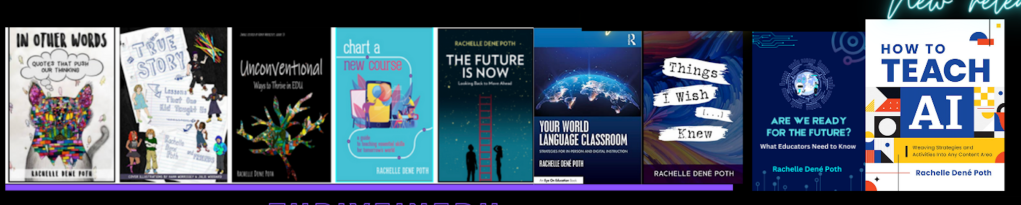
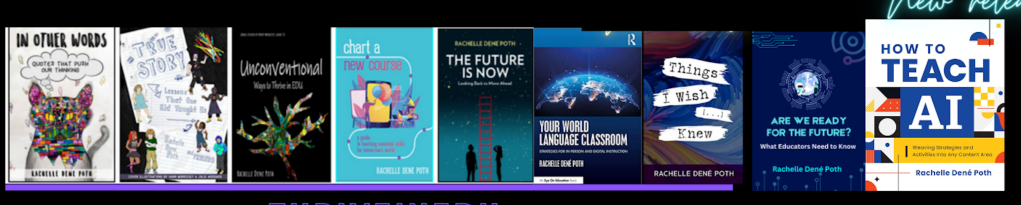
She is the author of ten books, including ‘What The Tech? An Educator’s Guide to AI, AR/VR, the Metaverse and More” and ‘How To Teach AI’. In addition, other books include, “In Other Words: Quotes That Push Our Thinking,” “Unconventional Ways to Thrive in EDU,” “The Future is Now: Looking Back to Move Ahead,” “Chart A New Course: A Guide to Teaching Essential Skills for Tomorrow’s World, “True Story: Lessons That One Kid Taught Us,” “Things I Wish […] Knew” and her newest “How To Teach AI” is available from ISTE or on Amazon.

Contact Rachelle to schedule sessions about Artificial Intelligence, AI and the Law, Coding, AR/VR, and more for your school or event! Submit the Contact Form.

Follow Rachelle on Bluesky, Instagram, and X at @Rdene915

**Interested in writing a guest blog for my site? Would love to share your ideas! Submit your post here. Looking for a new book to read? Find these available at bit.ly/Pothbooks
************ Also, check out my THRIVEinEDU Podcast Here!

Join my show on THRIVEinEDU on Facebook. Join the group here.

Students, Teachers, and Chatbots:Learning Plans for Exploring Civic Issues with GenAI

Robert Maloy

Torrey Trust

Welcome to “Students, Teachers, and, Chatbots: Learning Plans for Exploring Civic Issues with GenAI!” In this monthly series, you will find classroom-ready learning plans to use as you explore different civic engagement issues and topics with students. Each learning plan is connected to one of the ISTE (International Society for Technology in Education) Standards for Students.

You can find more of these learning plans in our free online companion for our new book, AI and Civic Engagement: 75+ Cross-Curricular Activities to Empower Your Students. We hope you will find these plans engaging, and we welcome your ideas and suggestions.

AI-Enhanced Learning Plan: Democracy vs Algocracy

Imagine you have to vote in a school, local organization, community, state, or national election about a much debated and highly controversial issue. Someone proposes that instead of engaging in lengthy and potentially bitter debates, the group just let AI decide for them. What would be your response?

The question is no longer hypothetical. There are groups and government organizations in other countries that are turning over decisions about policies to AI chatbots. There is even a term for AI decision-making called “Algocracy” or government by algorithm.

Will chatbots make better decisions than elected political leaders or citizen voters? Many people now believe so. Across people in 35+ countries and speaking seven different languages, those surveyed were 30 percent more likely to see chatbots acting in their best interest and making better policy decisions on their behalf (Tech and Social Cohesion, 2025).

Letting chatbots make public policy decisions is known as “Algocracy” or “government by algorithm” (Thompson, 2022). The appeal of this idea is not hard to understand. People in country after country express distrust of politicians and political systems while also believing in the objectivity and efficiency of computer programs. Since chatbots are already proving they can make medical decisions at rates that can exceed those of human doctors, why wouldn’t chatbots do a better job of deciding where to spend money and allocate scarce resources?

Critics of algocracy are quick to point out that chatbots are not neutral tools. They function based on the datasets on which they have been trained, and that information has been shown to have alarmingly large amounts of misinformation and deep cultural, gender, racial, ability, and language biases (learn more).

Moreover, chatbots are “black boxes,” meaning users do not know how the systems actually make decisions. While how chatbots make decisions is invisible, the actions of elected representatives are matters of public record. Online and in print, you can research how your senator, representative, town or city council member, mayor, or other elected officials voted on the issues and you can write to them to express your views, for or against, their actions.

So what role, if any, should AI play in making decisions in democratic settings? Two former Google executives have proposed “rather than replace democracy with A.I., we must instead use A.I. to reinvigorate democracy, making it more responsive, more deliberative and more worthy of public trust” (Schmidt & Sorota, 2025, para. 3). This activity explores ways that AI can promote democracy and democratic decision-making while strengthening people’s participation in government and society.

Learning Goal

Students will build their civic knowledge by exploring the real world issue of Algocracy.

  • ACTIVITY 1: Using GenAI to Make Decisions for a Day (or an Hour)
    • Pick one day, one class, or one hour, and let GenAI make all the decisions for the class about what to do.
      • Example Prompt: “Respond yes or no and explain your reasoning for the following question from my 7th-grade students: Should we read Hamlet today or play Roblox?”
    • At the end of the day, class, or hour, invite students to reflect on their initial response to the student engagement question (“If a decision needs to be made, would you rather vote on it or have an AI chatbot decide?”) and whether they would change their response based on their experience asking GenAI to make decisions for them.
    • Then, have students research the concept of algocracy and current examples of AI decision-making by elected officials.
    • Finally, invite students to write a letter to their local town or state government in favor of, or in opposition to, this concept.
  • ACTIVITY 2: Critical Analysis of AI Decision-Making in Government
    • Invite students to research and then discuss the following questions:
      • How could the biases embedded in data shape political decision-making from AI systems?
      • How might AI-generated hallucinations affect governmental decision-making?
      • Who might benefit from AI decision making in government or an algocracy?
      • Who might be harmed from AI decision-making in government or an algocracy?
      • How might AI decision-making shift power dynamics within government? Who gains new forms of authority, and who loses it?
      • If an AI system makes an unjust or harmful decision, who should be held accountable (e.g., AI system developer? government officials?)
      • Who is more trustworthy? A politician or an AI system? Why?
    • Then, based on their research and discussion,

Reflection Questions

  • What role do you think AI systems will play in governmental decision-making 30 years from now? What about 100 years from now?
  • How might AI-driven governance shape or reshape democracy?
  • Would you vote for an AI candidate over a human candidate? Why or why not?
  • Could heavy reliance on AI governance discourage civic engagement or participation? Why or why not?

AI Literacy Questions

  • If you were to build an AI system to make decisions for the government, what data would you use to train the system? How would you reduce hallucinations? What safeguards would you put in place? What other ethical considerations would guide your design?
  • If GenAI systems can process far more information than humans, does that make it a better decision-maker? Why or why not?

ISTE Knowledge Constructor Criteria Addressed

  • 1.3.a Effective Research Strategies. Students use effective research strategies to find resources that support their learning needs, personal interests, and creative pursuits.
  • 1.3.b Evaluate Information. Students evaluate the accuracy, validity, bias, origin, and relevance of digital content.
  • 1.3.d Explore Real-World Issues. Students build knowledge by exploring real-world issues and gain experience in applying their learning in authentic settings.

References

Citizens.IS. (2025). Better Reykjavik. https://www.citizens.is/portfolio_page/better_reykjavik/

National Council of State Legislatures. (2022, January 4). Initiative and Referendum Overview and Resources. https://www.ncsl.org/elections-and-campaigns/initiative-and-referendum-overview-and-resources

Nwanevu, O. (2025). The right of the people: Democracy and the case for a new American founding. Penguin Random House.

Schmidt, E. & Sorota, A. (2025, November 16). This is no way to rule a country. The New York Times Sunday Opinion, p. 4).

Schofield, M. (2025, November 27). Ten ballot questions clear key hurdles. Greenfield Recorder, pp. A1, A10.

Tech and Social Cohesion. (2025, September 13). More people trust chatbots than elected leaders. https://techandsocialcohesion.substack.com/p/more-people-trust-chatbots-than-elected

Thompson, J. (2022, November 28). Algocracy would replace politicians with algorithms. Should we try it? Big Think. https://bigthink.com/thinking/algocracy-algorithm-government/

Resources

Apertus Isn’t (yet), the Win You Think It Is. Maxime Grenu. LinkedIn (September 2, 2025).

  • Assesses Switzerland’s efforts to build an ethical large language model for the public good, trained on only publicly available content.

Author Bios

Torrey Trust, Ph.D. is a Professor of Learning Technology in the College of Education at the University of Massachusetts, Amherst. Her work centers on empowering educators and students to critically explore emerging technologies and make thoughtful, informed choices about their role in teaching and learning. Dr. Trust has received the University of Massachusetts Amherst Distinguished Teaching Award (2023), the College of Education Outstanding Teaching Award (2020), and the International Society for Technology in Education Making IT Happen Award (2018), which “honors outstanding educators and leaders who demonstrate extraordinary commitment, leadership, courage, and persistence in improving digital learning opportunities for students.” More recently, Dr. Trust has been a leading voice in exploring GenAI technologies in education and has been featured by several media outlets in articles and podcasts, including Educational Leadership, U.S. News & World Report, WIRED, Tech & Learning, The HILL, and EducationWeek. http://www.torreytrust.com

Robert W. Maloy is a senior lecturer in the College of Education at the University of Massachusetts Amherst where he coordinates the history teacher education program and co-directs the TEAMS Tutoring Project, a community engagement/service learning initiative through which university students provide academic tutoring to culturally and linguistically diverse students in public schools throughout the Connecticut River Valley region of western Massachusetts. His research focuses on technology and educational change, teacher education, democratic teaching, and student learning. He is co-author of AI and Civic Engagement: 75+ Cross-Curricular Activities to Empower Your Students, Transforming Learning with New Technologies (4th edition); Kids Have All the Write Stuff: Revised and Updated for a Digital Age; Wiki Works: Teaching Web Research and Digital Literacy in History and Humanities Classrooms; We, the Students and Teachers: Teaching Democratically in the History and Social Studies Classroom; Ways of Writing with Young Kids: Teaching Creativity and Conventions Unconventionally; Kids Have All the Write Stuff: Inspiring Your Child to Put Pencil to Paper; The Essential Career Guide to Becoming a Middle and High School Teacher; Schools for an Information Age; andPartnerships for Improving Schools.

About Rachelle

Dr. Rachelle Dené Poth is a Spanish and STEAM: What’s Next in Emerging Technology Teacher. Rachelle is also an attorney with a Juris Doctor degree from Duquesne University School of Law and a Master’s in Instructional Technology. Rachelle received her Doctorate in Instructional Technology, with a research focus on AI and Professional Development. In addition to teaching, she is a full-time consultant and works with companies and organizations to provide PD, speaking, and consulting services. Contact Rachelle for your event!

Rachelle is an ISTE-certified educator and community leader who served as president of the ISTE Teacher Education Network. By EdTech Digest, she was named the EdTech Trendsetter of 2024, one of 30 K-12 IT Influencers to follow in 2021, and one of 150 Women Global EdTech Thought Leaders in 2022.

She is the author of ten books, including ‘What The Tech? An Educator’s Guide to AI, AR/VR, the Metaverse and More” and ‘How To Teach AI’. In addition, other books include, “In Other Words: Quotes That Push Our Thinking,” “Unconventional Ways to Thrive in EDU,” “The Future is Now: Looking Back to Move Ahead,” “Chart A New Course: A Guide to Teaching Essential Skills for Tomorrow’s World, “True Story: Lessons That One Kid Taught Us,” “Things I Wish […] Knew” and her newest “How To Teach AI” is available from ISTE or on Amazon.

Contact Rachelle to schedule sessions about Artificial Intelligence, AI and the Law, Coding, Cybersecurity, STEM, AR/VR, and more for your school or speaking event! Submit the Contact Form.

Follow Rachelle on Bluesky, Instagram, Threads, and X at @Rdene915

**Interested in writing a guest blog for my site? Would love to share your ideas! Submit your post here. Looking for a new book to read? Find these available at bit.ly/Pothbooks

************ Also, check out my THRIVEinEDU Podcast Here!

Join my show on THRIVEinEDU on Facebook. Join the group here.