How do we build sustainable professional learning systems for educators?
In the first six partsof this series, I shared what I’ve been learning from working with district leadership teams across the country as they navigate artificial intelligence, digital wellness, and purposeful technology use. Over the course of my Leading Forward Series, I’ve shared what I’ve been learning from working with district leadership teams across the country as they navigate artificial intelligence, digital wellness, and purposeful technology use.
We’ve explored:
curiosity over fear
educator readiness
leadership and systems
measuring what matters
trust as the foundation
designing for thinking
true partnerships
These conversations led to a bigger question, which is how do we build systems that last? Because the goal is not to have one answer and end the conversations, it is to prepare schools to adapt continuously to be ready to meet the changing educational landscape.
After reviewing my notes, reflecting on conversations, and gathering insights from surveys, I noticed some key takeaways.
One-time Training Is Not a Strategy
One of the most common concerns expressed was that professional development is often seen as a one-time event. Sometimes it is a workshop, maybe a keynote, or a specific training session focused on a new platform or a mandate. These are all valuable learning experiences, but they are not enough, especially with the rapidly changing technologies we are seeing in education and the world.
Artificial intelligence is evolving so fast, new tools are emerging constantly, and expectations are frequently changing or, at times, may be inconsistent. A single session is not enough to prepare educators to adapt to ongoing changes. Schools need sustainable systems for learning.
What Sustainable Professional Learning Looks Like
In the districts I support, I have noticed several common characteristics that have positively impacted the educators and ultimately students and families.
1. Learning is ongoing, not just an event.
It is embedded in the school year. Educators have regular opportunities to explore new tools, reflect on practice, share strategies, and learn from one another. It should also be a time for educators to explore new ideas in the classroom and partner with students to gather additional feedback and to learn together.
2. Learning Is Collaborative
Powerful learning does not happen in isolation. It happens when educators work in teams, have opportunities to observe one another, take time to share successes and challenges, and build collective understanding. Collaboration like this leads to system-wide progress and better outcomes for educators and students.
If Your Organization Is Beginning This Workand is Seeking Consistent Support, Contact me:
I help schools and other organizations (law firms, healthcare professionals, business owners) implement AI responsibly through policy guidance, professional learning, and classroom-ready strategies grounded in both instructional practice and legal insight. I also deliver keynotes and provide small-group coaching.
My sessions focus on helping teams:
• understand what AI can and cannot do
• recognize responsible-use considerations
• build confidence using emerging tools
•align implementation with organizational priorities
If your school, district, or organization is beginning conversations or looking to dive in and learn more about AI policy, professional learning, or responsible implementation, I’d welcome the opportunity to support your next steps through leadership workshops, keynote sessions, or strategic planning partnerships.
Preparing people is what makes AI implementation successful. Contact me via bit.ly/thrivineduPD for my training and speaking services or reach out via email, Rdene915@gmail.com.
Throughout this series, I’ve shared what I’ve learned from working alongside district leadership teams across the country as they navigate artificial intelligence, digital wellness, and purposeful technology use.
We’ve explored:
why curiosity is replacing fear
why educator readiness is the foundation
why leadership and systems matter
But there is another critical question schools must answer:
How do we know if it’s working? Because implementation is not the goal. Impact is.
The Problem With Measuring the Wrong Things
Screen time and effective use of technology are hot topics in conversations happening in schools across the country. In many districts, success with technology has typically been measured by:
number of devices available, so all students can participate in learning
tool adoption rates
platform usage
logins and activity
These metrics are easy to track. But they don’t tell the full story. I’ve said it many times in various ways, but a classroom full of students using devices does not automatically mean that impactful, meaningful learning is happening. Nor does it show true student engagement just by the use of devices.
More technology use does not automatically lead to deeper learning.
More screen time does not equal greater engagement or better outcomes
So we have to really think about what we are measuring. If we continue measuring what is easy, we risk missing what matters most. And we might miss providing the best learning experiences for students.
What Should We Be Measuring Instead?
Across the districts I work with, the leadership teams are beginning to shift their focus.
The districts making the most progress are beginning to ask different kinds of questions:
Are students thinking more deeply?
Are students asking better questions?
Are students able to evaluate information more critically?
Do students understand when and how to use AI responsibly?
Are students being guided in how to use technology and why they are using it?
Do educators feel confident in their instructional decisions?
Are they supported as technology changes?
These are harder to measure, but they are far more meaningful and provide greater insight that schools can act upon.
Indicators Schools Are Moving in the Right Direction
There are some clear indicators I have seen and read about that show schools are moving in the right direction.
1. Student Thinking Is Visible
Students are not simply submitting AI-generated responses. They are explaining their thinking, reflecting on their process, questioning outputs, and making revisions. They are being guided and understand how to use AI as support, not a replacement.
2. Educators Are Making Intentional Decisions
Teachers are not asking whether they can use a certain tool or platform. Instead, they are questioning when they should and what the impact will be. This shift shows greater confidence in the purposeful use of technology and in intentional lesson design. Quality over quantity.
Continue reading the rest and subscribe to my newsletter on LinkedIn.
I help schools and other organizations (law firms, healthcare professionals, business owners, psychologists) implement AI responsibly through policy guidance, professional learning, and classroom-ready strategies grounded in both instructional practice and legal insight.
My sessions focus on helping teams:
• understand what AI can and cannot do
• recognize responsible-use considerations
• build confidence using emerging tools
•align implementation with organizational priorities
If your school, district, or organization is beginning conversations or looking to dive in and learn more about AI policy, professional learning, or responsible implementation, I’d welcome the opportunity to support your next steps through leadership workshops, keynote sessions, or strategic planning partnerships.
Preparing people is what makes AI implementation successful.
Contact me to work with you or speak at your event.bit.ly/thriveineduPDSee testimonials about my work via my website.
In my last article, I shared what I’ve been learning from working with district leadership teams across the country as they navigate questions about artificial intelligence, digital wellness, and purposeful technology use. That work has provided me with insightful information and meaningful opportunities to learn from educators, students, and families.
Throughout these conversations, one message continues to stand out:
We cannot begin, and we cannot stay focused only on the tools and the tech.
We must move forward.
The Shift Schools Must Make Now
In Part II, I emphasized that educator readiness is the foundation of successful AI implementation. Schools that prioritize supporting educators are the ones seeing the most progress. And it starts with leadership and consistency. But readiness alone is not enough.
What I have learned from working with school Task Forces across the country is that they have had many conversations around AI, screen time, and tech use. They have explored the possibilities and understand the urgency with these topics, but they also have a similar question.
What do we do now? And this is where I believe that leadership matters most.
Moving From Conversations to Systems
Across the districts I continue to work with, I see a clear difference between schools that are talking about AI and schools that are leading with AI. I also see a difference between AI in education and AI Education. I recently met with a State Representative in Pennsylvania, and we had this conversation as well. The difference I’ve noticed and that we discussed is not just access to tools. It is about the presence of a system. Schools making meaningful progress are not relying on isolated efforts when they find time. Instead, they are building structures with a lens on consistency, clarity, and sustainability.
The system they are developing is focused on having:
clear expectations for the responsible use of all technology
consistent messaging across classrooms and grade levels
ongoing professional learning opportunities with follow-up support
shared language for students, staff, and families
opportunities for student voice and feedback
When these are part of the conversation, AI implementation becomes less about individual decisions, which leads to inconsistency, and becomes more about a goal for collaborative and collective progress.
Consistency Builds Confidence
One of the most common challenges I have been hearing from both educators and students is inconsistency. I’ve met with student groups, interviewed educators, spoken with parents, and heard similar comments from educators and parents across the country.
In one classroom, the use of technology, and specifically AI, is encouraged. In another, it is restricted. In one classroom or school, the expectations are clear and known to all. In another, they are undefined or inconsistent.
Continue reading on LinkedIn and subscribe to my newsletter there as well.
If your school, district, or organization is beginning conversations or looking to dive in and learn more about AI policy, professional learning, or responsible implementation, I’d welcome the opportunity to support your next steps through leadership workshops, keynote sessions, or strategic planning partnerships.
Preparing people is what makes AI implementation successful.
Contact me to work with you or speak at your event.bit.ly/thriveineduPDSee testimonials about my work via my website.
About Rachelle
Dr. Rachelle Dené Poth is a Spanish and STEAM: What’s Next in Emerging Technology Teacher. Rachelle is also an attorney with a Juris Doctor degree from Duquesne University School of Law and a Master’s in Instructional Technology. Rachelle received her Doctorate in Instructional Technology, with a research focus on AI and Professional Development. In addition to teaching, she is a full-time consultant and works with companies and organizations to provide PD, speaking, and consulting services. Contact Rachelle for your event!
Rachelle is an ISTE-certified educator and community leader who served as president of the ISTE Teacher Education Network. By EdTech Digest, she was named the EdTech Trendsetter of 2024, one of 30 K-12 IT Influencers to follow in 2021, and one of 150 Women Global EdTech Thought Leaders in 2022.
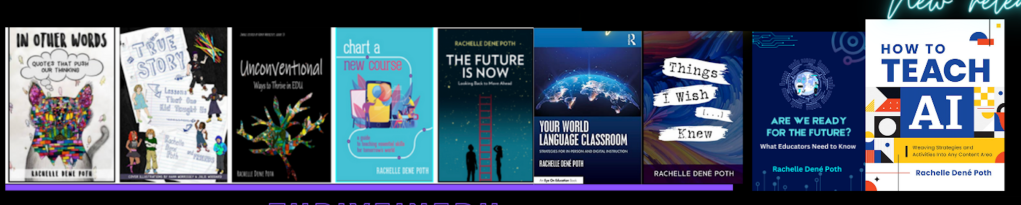
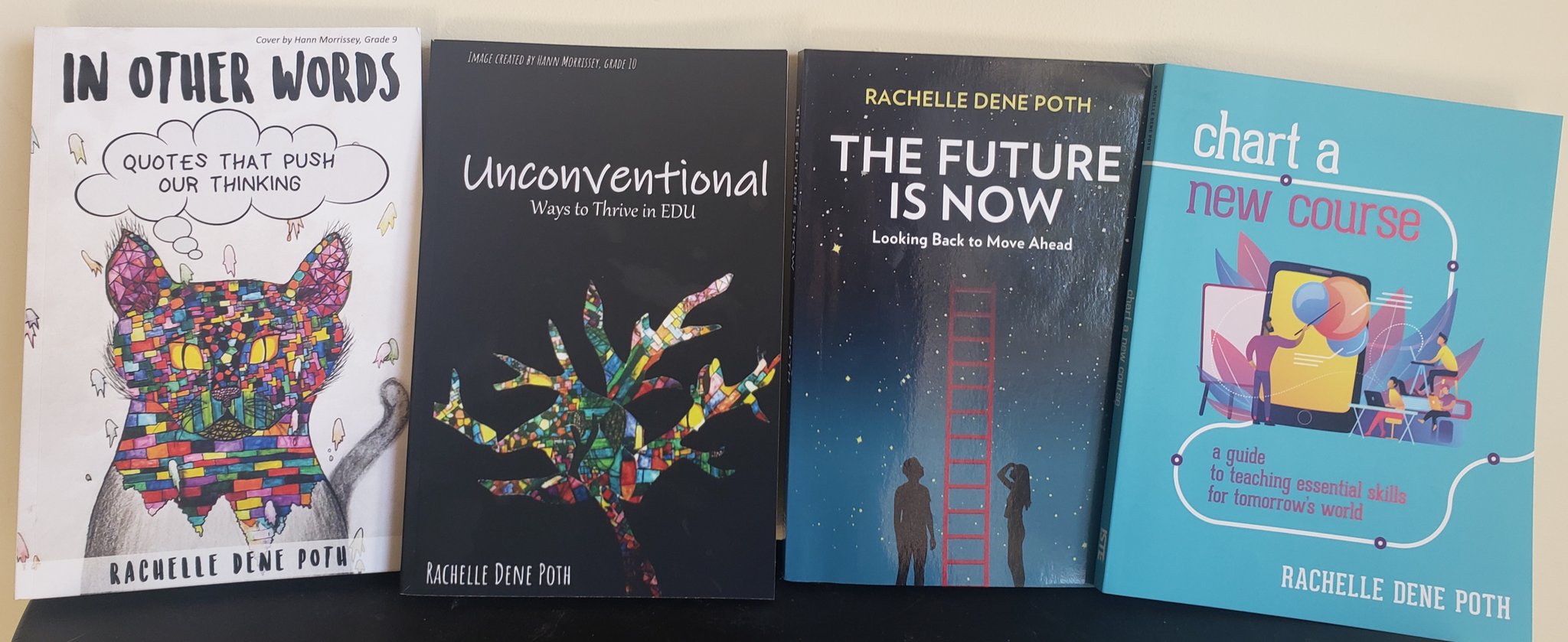
She is the author of ten books, including ‘What The Tech? An Educator’s Guide to AI, AR/VR, the Metaverse and More” and ‘How To Teach AI’. In addition, other books include, “In Other Words: Quotes That Push Our Thinking,” “Unconventional Ways to Thrive in EDU,” “The Future is Now: Looking Back to Move Ahead,” “Chart A New Course: A Guide to Teaching Essential Skills for Tomorrow’s World, “True Story: Lessons That One Kid Taught Us,” “Things I Wish […] Knew” and her newest “How To Teach AI” is available from ISTE or on Amazon.
In part IIof the series, I shared my thoughts about what I’ve been learning from working with district leadership teams across the country, and the work is focused on AI, digital wellness, and innovation. In part II, I shared my thoughts on preparing educators in these areas and why it means preparing school leaders first. This work has provided me with meaningful opportunities to learn with and work alongside educators, students, and families, and I am noticing common conversations and concerns in the schools.
Screen time
Students talk about it. Families ask about it. Teachers notice it. Administrators are expected to respond to it. What do we do about the devices?
But what I have learned from working with schools is that the most important leadership question is not simply how much time students spend on screens. The more important question is: What are students doing while they are on those screens?
As technology continues to evolve in our schools and in the world, we need to move beyond conversations that focus only on limits and restrictions. We need to focus on purpose, guidance, and readiness.
Moving From Screen Time to Purposeful Use
Conversations about student technology use have primarily focused on recommended amounts and on setting limits. The American Pediatric Association had recommendations for some of the most common questions: How many hours per day? How often should devices be used? When should students disconnect?
Although the conversation has shifted away from specific time limits, those guiding questions still matter. But today’s learning environments require something more intentional and thoughtful, and should bring in different perspectives about what the common uses are. We need to better understand how students are using technology and whether that use supports learning, connection, creativity, and growth. From my conversations, I have learned that students are using devices to:
Interact with friends and family
collaborate with classmates
create original work
communicate with teachers
design presentations
explore complex ideas
interact with artificial intelligence tools
Continue reading via my newsletter on LinkedIn and subscribe. Also, subscribe to my newsletter for events, resources, and more.
If Your Organization Is Beginning This Work
I help schools and other organizations (law firms, healthcare professionals, business owners) implement AI responsibly through policy guidance, professional learning, and classroom-ready strategies grounded in both instructional practice and legal insight.
My sessions focus on helping teams:
• understand what AI can and cannot do
• recognize responsible-use considerations
• build confidence using emerging tools
•align implementation with organizational priorities
If your school, district, or organization is beginning conversations or looking to dive in and learn more about AI policy, professional learning, or responsible implementation, I’d welcome the opportunity to support your next steps through leadership workshops, keynote sessions, or strategic planning partnerships.
Preparing people is what makes AI implementation successful.
About Rachelle
Dr. Rachelle Dené Poth is a Spanish and STEAM: What’s Next in Emerging Technology Teacher. Rachelle is also an attorney with a Juris Doctor degree from Duquesne University School of Law and a Master’s in Instructional Technology. Rachelle received her Doctorate in Instructional Technology, with a research focus on AI and Professional Development. In addition to teaching, she is a full-time consultant and works with companies and organizations to provide PD, speaking, and consulting services. Contact Rachelle for your event!
Rachelle is an ISTE-certified educator and community leader who served as president of the ISTE Teacher Education Network. By EdTech Digest, she was named the EdTech Trendsetter of 2024, one of 30 K-12 IT Influencers to follow in 2021, and one of 150 Women Global EdTech Thought Leaders in 2022.
She is the author of ten books, including ‘What The Tech? An Educator’s Guide to AI, AR/VR, the Metaverse and More” and ‘How To Teach AI’. In addition, other books include, “In Other Words: Quotes That Push Our Thinking,” “Unconventional Ways to Thrive in EDU,” “The Future is Now: Looking Back to Move Ahead,” “Chart A New Course: A Guide to Teaching Essential Skills for Tomorrow’s World, “True Story: Lessons That One Kid Taught Us,” “Things I Wish […] Knew” and her newest “How To Teach AI” is available from ISTE or on Amazon.
Contact Rachelle to schedule sessions about Artificial Intelligence, AI and the Law, Coding, AR/VR, and more for your school or event! Submit the Contact Form.
Follow Rachelle on Bluesky, Instagram, and X at @Rdene915
Subscribe to my ThriveinEDU newsletter to stay informed. (If you receive my newsletter, you may have read this, but just in case…here is part I)
Over the past eight months, I’ve had the opportunity to work with educators, school leaders, and district teams from twelve districts across the country as they navigate one of the biggest shifts education has experienced in decades: the arrival of artificial intelligence in everyday teaching and learning. This work is part of a national digital wellness and innovation initiative supporting districts as they develop responsible approaches to emerging technologies.
I work with a Task Force from each district to evaluate policies, create resources for families, and decide when and how to begin teaching students about AI, as well as how best to support educators. And some of these Task Forces include students and parents. We have had many conversations about digital wellness, digital citizenship, screentime, and, of course, AI.
The conversations about AI included shared concerns, questions, and challenges. However, what has stood out the most in these conversations with these schools is not fear. It’s curiosity.
In classrooms, teachers are asking thoughtful questions about how AI can support student thinking rather than replace it. Administrators are working to align emerging tools with existing priorities such as digital citizenship, academic integrity, and student wellness. District teams are exploring how policy can move beyond restriction toward responsible guidance. Some are even completely rewriting their policies to align with these changes and make sure that a common language is used.
Recently, my work has included:
• Supporting district digital wellness and AI implementation planning
• Leading professional learning sessions on responsible AI use
• Presenting on AI and the law for educators
• Visiting classrooms to observe how students are already interacting with AI tools
• Collaborating with leadership teams and developing next-step strategies for staff support
• Designing activities for administrators and educators to evaluate policies and effective AI use
One consistent theme continues to emerge:
Districts, educators, and students are ready to lead.
Educators are not waiting for perfect answers to the big AI questions. They are considering the best pedagogical practices for using AI that protect students while expanding opportunities.
The most successful districts I’m working with right now are focusing on three priorities:
Supporting educator confidence: They need clarity, examples, and time to explore.
Creating shared expectations for responsible use across classrooms and grade levels
Preparing students to think critically about AI-generated information.
Artificial intelligence isn’t just a technology conversation.
It’s a leadership conversation.
And I’m excited to continue working with and learning alongside school districts as they move forward with clarity, purpose, and a strong commitment to keeping human relationships at the center of innovation.
Providing the training
Artificial intelligence is changing expectations across nearly every profession. Schools are not the only organizations preparing for this shift.
In my work as an educator, attorney, and national presenter on responsible AI implementation, I support organizations as they explore how AI connects to decision-making, ethics, communication, and everyday professional practice.
I help schools and other organizations (law firms, healthcare professionals, business owners) implement AI responsibly through policy guidance, professional learning, and classroom-ready strategies grounded in both instructional practice and legal insight.
My sessions focus on helping teams:
• understand what AI can and cannot do
• recognize responsible-use considerations
• build confidence using emerging tools
•align implementation with organizational priorities
If your school, district, or organization is beginning conversations or looking to dive in and learn more about AI policy, professional learning, or responsible implementation, I’d welcome the opportunity to support your next steps through leadership workshops, keynote sessions, or strategic planning partnerships.
Preparing people is what makes AI implementation successful.
About Rachelle
Dr. Rachelle Dené Poth is a Spanish and STEAM: What’s Next in Emerging Technology Teacher. Rachelle is also an attorney with a Juris Doctor degree from Duquesne University School of Law and a Master’s in Instructional Technology. Rachelle received her Doctorate in Instructional Technology, with a research focus on AI and Professional Development. In addition to teaching, she is a full-time consultant and works with companies and organizations to provide PD, speaking, and consulting services. Contact Rachelle for your event!
Rachelle is an ISTE-certified educator and community leader who served as president of the ISTE Teacher Education Network. By EdTech Digest, she was named the EdTech Trendsetter of 2024, one of 30 K-12 IT Influencers to follow in 2021, and one of 150 Women Global EdTech Thought Leaders in 2022.
She is the author of ten books, including ‘What The Tech? An Educator’s Guide to AI, AR/VR, the Metaverse and More” and ‘How To Teach AI’. In addition, other books include, “In Other Words: Quotes That Push Our Thinking,” “Unconventional Ways to Thrive in EDU,” “The Future is Now: Looking Back to Move Ahead,” “Chart A New Course: A Guide to Teaching Essential Skills for Tomorrow’s World, “True Story: Lessons That One Kid Taught Us,” “Things I Wish […] Knew” and her newest “How To Teach AI” is available from ISTE or on Amazon.
Contact Rachelle to schedule sessions about Artificial Intelligence, AI and the Law, Coding, AR/VR, and more for your school or event! Submit the Contact Form.
Follow Rachelle on Bluesky, Instagram, and X at @Rdene915
In my previous post, I focused on reflection. Thinking about it, if 2025 was a year of recalibration in education, the year ahead feels like it might shift toward a more intentional direction.
After slowing down, reflecting, and identifying what felt misaligned, educators now face an important decision. One is to thoughtfully consider what we continue with as we move forward. What should we keep because it makes sense and makes an impact? Or two, to decide whether there is something we need to leave behind so we can make an impact.
The future of education is not about moving faster, adopting more tools, or trying to keep up with all the changes, because that is not reasonable nor purposeful. And in full transparency, that is exactly what I thought years ago. After ongoing reflection, I now know that I should focus on how I can align and drive innovation with purpose, humanity, and care. Especially focusing on humanity.
As we look to the future and do our best to plan and prepare, several themes have emerged with greater clarity, at least in the experiences I have had. More focus on artificial intelligence, wearable technology, digital wellness, AI literacy, and a greater focus on student agency. Each of these generates opportunities to learn and continue to grow. Educators and students should engage in ongoing reflection, and, for educators, this requires asking better questions before making decisions about what is best for our classrooms.
Progress Without So Much Pressure
One of the greatest hopes I have for education now and in the future is that the progress made does not come at the expense of people. We need “humans in the loop,” as we have heard many times and will probably continue to hear. Schools are involved in so many initiatives that at times, it is absolutely exhausting. And that is for any educator, regardless of how long they have been in education.
Sometimes we invest our time and effort into an initiative, spending hours, days, weeks, only to have it disappear from the conversation either that same school year or in the not-too-distant future. The time we spend working on these initiatives takes us away from the truly impactful work that we could be doing instead. Initiatives are important and, in many instances, required; however, focusing on initiatives can lead to reactive decision-making and technology-first thinking rather than proactive decision-making, which negatively impacts what truly matters: our students and our own learning. The goal should not be to hesitate when it comes to innovation, but instead, to integrate intentionally, transparently, carefully, and responsibly.
AI in Education: From Capability to Responsibility
Artificial intelligence is the number one in-demand skill. Look at the World Economic Forum and the prediction for skills and jobs in demand, and you will see. AI will continue to shape education in many ways this year and in upcoming years, and of course, continue to evolve as technology advances. There are some things that I think about when considering AI and other technologies that are on the rise.
Sometimes I think that rather than thinking about what AI can do, maybe we should ask:
What should AI do?
When does AI support thinking, and when does it replace it?
How do we ensure AI is used ethically, transparently, and equitably?
A Few Predictions for AI in Education
AI should and hopefully will become more embedded in everyday tools rather than standing alone as an extra or an add-on, or time-consuming for educators and students to use.
Schools will shift from banning AI, and I hope to shift to supporting educators as they teach responsible use and attribution.
AI will support feedback, differentiation, and accessibility, especially for multilingual learners and students with disabilities or diverse learning needs.
There will be greater emphasis on process over product, requiring students to be more accountable for how they answer a question. And they will know why that matters.
My hope is that AI is, or will be, considered a thought partner, not a replacement for the work we do. I hope that educators feel empowered to shape its role in their work, rather than react to it, because that removes the opportunity for learning and growing.
Wearable Technology
Wearable technology is something that many people may not be aware of, yet it has become so common for some. Examples include smart watches, fitness trackers, and biometric tools, all of which will continue to be part of the conversations about learning, health, and attention. Many conversations that I have had around digital wellness have brought some of these technologies up, and educators are trying to determine whether they are draining or beneficial, or is it a mix?
While these tools offer potential insights into movement, focus, and well-being, the use of and reliance on them also raise important concerns about privacy, data ownership, and surveillance, which are serious concerns when it comes to emerging technology.
Predictions for Wearable Tech in Education
Increased discussion around student consent and data ethics.
Wearables are used more for self-awareness and personal growth tracking, which is beneficial.
Stronger guardrails are in place to protect any data that is collected
Greater integration and connections made with digital wellness initiatives rather than performance monitoring.
The goal should not be to track students and their habits without ongoing support, but instead to empower students to understand their attention, habits, and how they use and rely on technology in healthy ways.
AI Literacy: Fundamental, not supplemental
One of the most important goals for the year ahead is recognizing AI literacy as a fundamental, not a supplemental skill.
AI literacy is not just technical knowledge. It includes:
Understanding how AI systems work at a high level
Recognizing bias, limitations, and hallucinations
Knowing when AI is appropriate and when it isn’t
Practicing ethical use, attribution, and transparency
Developing critical thinking in AI-supported environments
Predictions for AI Literacy
AI literacy will begin appearing across disciplines—not just in computer science.
Educators will focus more on questioning, evaluating, and reflecting than on tool mastery.
Students will be asked to justify decisions made with AI support.
Schools will prioritize human skills such as judgment, empathy, and creativity, along with the development of technical fluency.
The goal should be that students will graduate and know how to use AI, and also how to think with discernment in an AI-shaped world.
Guiding Questions
As schools plan for the remainder of the 2025-2026 school year, the most important tool may not be a new platform or site, but rather some guiding questions to push reflective thinking.
When Evaluating AI Tools
Does this tool enhance or amplify learning or simply replace thinking?
How transparent is the AI about its limitations?
What skills do students still need to demonstrate independently, and that hold them accountable?
How are we teaching ethical use and attribution?
Considering Innovation
Does it(the tech) align with our values?
Does it support student well-being?
Does it simplify learning, or does it make it more complex?
Are educators provided with time and voice in its implementation? What about students?
These are just a few questions that I have considered, and I think can help shift decisions from being reactive to proactive and reflective.
As educators look ahead, reflection remains essential to our work and should not require educators to do more, but instead, guide us to focus on what matters most.
About Rachelle
Dr. Rachelle Dené Poth is a Spanish and STEAM: What’s Next in Emerging Technology Teacher. Rachelle is also an attorney with a Juris Doctor degree from Duquesne University School of Law and a Master’s in Instructional Technology. Rachelle received her Doctorate in Instructional Technology, with a research focus on AI and Professional Development. In addition to teaching, she is a full-time consultant and works with companies and organizations to provide PD, speaking, and consulting services. Contact Rachelle for your event!
Rachelle is an ISTE-certified educator and community leader who served as president of the ISTE Teacher Education Network. By EdTech Digest, she was named the EdTech Trendsetter of 2024, one of 30 K-12 IT Influencers to follow in 2021, and one of 150 Women Global EdTech Thought Leaders in 2022.
She is the author of ten books, including ‘What The Tech? An Educator’s Guide to AI, AR/VR, the Metaverse and More” and ‘How To Teach AI’. In addition, other books include, “In Other Words: Quotes That Push Our Thinking,” “Unconventional Ways to Thrive in EDU,” “The Future is Now: Looking Back to Move Ahead,” “Chart A New Course: A Guide to Teaching Essential Skills for Tomorrow’s World, “True Story: Lessons That One Kid Taught Us,” “Things I Wish […] Knew” and her newest “How To Teach AI” is available from ISTE or on Amazon.
Contact Rachelle to schedule sessions about Artificial Intelligence, AI and the Law, Coding, AR/VR, and more for your school or event! Submit the Contact Form.
Follow Rachelle on Bluesky, Instagram, and X at @Rdene915
**Interested in writing a guest blog for my site? Would love to share your ideas! Submit your post here. Looking for a new book to read? Find these available at bit.ly/Pothbooks
************ Also, check out my THRIVEinEDU PodcastHere!
Join my show on THRIVEinEDU on Facebook. Join the group here.
Many are eloquently making the case for enhancing students’ social capital – access to human connections that support a students’ career goals.
Traditionally, one might think that the best way to do this is via in-person activities like mentoring programs and career events. It is indeed a shame that many in-person activities are curtailed due to COVID-19. Many are rightfully in survival mode trying to get by during these difficult times. Experiences that might be a bit outside the box are put on the backburner.
My message for you is simple: now is a better time than ever to expose your students to individuals who can support a students’ career goals. Overall, many successful business people are more willing to give back to society. Many empathize with the situation that educators are being tasked with during these times. Hopefully, you might sense and experience a greater appreciation for teachers and school administrators.
There are surely many ways to do this. I wanted to share with you one way to accomplish this: have you students do interviews with innovators and entrepreneurs, both within your school community (alumni, local leaders, etc.) and beyond. Then have the students create content based on this interview, whether it is a video posted online, a podcast or a written article.
I put together a process that focused on the writing aspect through Interview an Innovator, an experiential, eight-module online course that is part of my Global Innovators Academy initiative.
Six different college students and one high school senior have gone through this experience over the summer by interviewing different professionals and entrepreneurs aligned to the student’s particularly interest. I have seen first-hand how their social capital has been impacted through the process of conducting interviews and then publishing their work on the Global Innovators Academy website. Here is a recap
1. Motivation
Imagine you are a college student interested in working in the fashion industry. You interview an entrepreneur who started a clothing retail brand that now has over 100 stores around the country. You engage in a meaningful conversation with this entrepreneur before writing an article online highlighting this individual’s journey, advice for young people and your key takeaways. This is exactly what Haley Panessa, a student at Rollins College, experienced when she interviewed Kevin McLaughlin, the co-founder of the clothing retail brand J.McLaughlin (here is the article).
“This gave me the confidence and knowledge as to how I can work on my professional growth during these early stages of my life,” she said.
Cali Carper is an aspiring community leader who used the course experience to interview two different political leaders in her home state of Wisconsin.
“The opportunity to interview different leaders and write a story offers the potential to imagine our future,” she explained. “The journey starts with curiosity. Then, our imagination motivates us to create new connections, ask thoughtful questions and form new beliefs. We have to imagine a future for ourselves and our work and then ensure we find the proper steps to make that vision a reality!”
It is hard to fathom any sort of typical in-class lecture or presentation that can generate such student feedback.
2. Digital networking
Many reading this have probably experienced the benefit of doing an informational interview – “picking the brain” of a professional over coffee. I consider the process of connecting with a professional and then writing an article online to be the “informational interview 2.0”. By publishing an article online, the student practices real life communications skills and showcases their work to a public audience. The individual who is interviewed reaps the benefits of positive exposure, and thus is more likely to take part.
Anybody who has ever created content online has probably benefited from new connections. This has certainly been the case for the students I worked with this summer. The articles are highlighted on the students’ individual LinkedIn profiles, liked on Facebook and retweeted on Twitter. Many of the interviewees promote their articles through online platforms, and the Global Innovators Academy’s social media channels also shine a spotlight on the students’ content. As a result, the students connect to many new individuals. Just as important, if any future recruiter searches any of these students online, they would come across thoughtful, well-written content that showcases their different skills and aspirations.
“I had the pleasure to speak with a successful businesswoman,” said Ashley Gunter, a junior at Rollins College. “I wrote an article about this experience which not only aids in self-promotion and networking but also serves as a resource for others.”
“Students and young professionals need to consider how they can enhance their marketability on a digital platform,” added Carper. “I used to think it was daunting to market myself online. The experience of interviewing an innovator gave me confidence and taught me important content marketing principles, interview best practices and professional communication tactics.”
3. Global connection Yejin Sohn, a senior at Perry High School in Arizona, went through the course experience. She did an interview and wrote an article about an entrepreneur literally located halfway around the world in Seoul, Korea.
Andrey Alipov, a student at Penn State University, is currently in Russia and is in the process of writing two different articles based on interviews with U.S.-based entrepreneurs whose businesses are in the video production space, an area that he would like to work in one day.
We certainly need to educate students to be global citizens. Giving students the means to interview individuals who are located in other parts of the world gives them the opportunity to hear different perspectives.
In addition, providing a platform for students to publish content potentially provides a global audience. As opposed to just a teacher evaluating a student’s work, now an audience located anywhere in the world is able to consume the content and provide feedback.
COVID-19: An Opportunity to Facilitate Connection
Never in our lives has there been as much uncertainty about the future of education. We can be sure that online learning will increasingly be part of education.
We put so much emphasis on what a student knows. Without the proper networks, such skills and knowledge can’t be deployed in an optimal way. A world of connections waits at our fingertips. Let’s use the disruptions caused by the pandemic to provide students with meaningful experiences to connect with other individuals they aspire to be like one day.
This is an adapted version of an article that was originally published on the Getting Smart blog.
During Winter Break, I read three amazing and thought-provoking books. Each one provided me with new ideas, takeaways and made me examine my practice. The last book I finished was Innovate Inside The Box by George Couros and Katie Novak. As I began reading Part Three: You Are The Change You Seek of this book, George issues this challenge, ” We can consume pages and hours of great content, but until we do something with it, we have no ownership over the process of learning. He then asked the reader to reflect on these three questions based on our reading
1. What has challenged you?
2. What has been reaffirmed?
3. What will you do moving forward?
When I began to consider what challenged me from my reading, I really had to stop and think. Having already read Innovator’s Mindset last year and having prior experience with UDL, so much of what I read in this book resonated with me.
As I returned to school on Monday, several ideas from my reading kept bubbling up in my mind.
1. Shifting our focus and practice to be learner-driven and evidence-focused
2. What does risk mean?
3. Encouraging problem-finding and not just problem solving
Learner-Driven, Evidence Focused
In chapter 2 of the book, George Couros describes how he dislikes the term data-driven. Working in a model PLC school, there is no doubt that we spend a lot of time on data- in fact, some months, with increased testing, it feels like all we do is collect data. So when I read this, it gave me pause. Are we truly learner centered? Are we telling the story of the whole child? Are we preparing students for their futures or to meet benchmarks and goals based on our school improvement plans?
This section really led me to question our practices as educators. It made me examine why we do things the way we do, why I do things the way I do? Is the support I provide “opening doors” to the future? If so, are there any ways that I can further tweak this to make it more learner centered?
Risk-takers
In chapter 5, George and Katie discuss risk-taking, which is one of the characteristics of the Innovator’s Mindset. As I read this, their definition of risk caught my attention and made me look at risk through a different lens. I have always called myself a risk-taker, an early adopter, but reading this definition made the WHY behind it so clear. “Risk is moving from a comfortable average in pursuit of an unknown better.“Looking at risk through this lens took the negative connotation usually associated with this word away. It equated risk with innovation.
As a tech coach, I am constantly not only taking risks, but modeling it for all my learners. How can I better empower my learners through the use of UDL to develop more agency and risk-taking.
Problem Finders- Solvers
Chapter 6 shares how when we act as problem finders-solvers, we demonstrate an Innovator’s Mindset. In the district I work in, we have been heavily immersed in PBL or Project/Problem Based Learning. In late November and early December, one of our PBL Leads even came to our CLTs to help us plan upcoming PBL units. I love the idea of PBL and giving our students authentic purposes for their learning.
So when the idea of being a problem finder was introduced, I looked a little closer. I love this idea; it reminds me of 20% time and Passion Projects. It sounds amazing, but once again, time seems to be a culprit. How can we provide time for students to cultivate such endeavors while covering the curriculum? Could we involve students more in planning our PBLs beyond just the “Need to Knows?”
Reading this book reaffirmed so many things for me especially as I CHALLENGE myself this year to establish healthier habits and take more risks.
In chapter 3, as George and Katie described the importance of empowerment and shared how it leads to ownership and agency. It reminds me of how Ron Ritchart emphasized the importance of language when I attended WISSIT19 this summer.
In chapter 4, George and Katie share the importance of not only being a master educator, but also a master learner. If I have learned anything this break, it has been what a dramatic impact that reading 10-15 minutes a day can make in my learning. “In a profession where learning is the focus of our job, growth is essential and the target is always moving.” We all need to embrace that mantra and model being lifelong learners for our colleagues and students
So as I look towards the future, what will I do moving forward? The first thing that came to my mind was reflection. As part of #myoneword2020, I CHALLENGE myself to journal regularly. Journaling is such a huge component of reflection. George shares, “Reflection is what links our performance to our potential.” As I journal and monitor my goals daily, I am focused on my goals and making progress towards them. Linked to that is the idea of self care. ” When our job is about serving other people, we have to not forget to serve ourselves.” Moving forward, I CHALLENGE myself to be committed to healthier eating, regular exercise, doing activities that fill my bucket such as blogging, reading and writing. Dedicating time each morning to this pursuit has been so inspirational so far.
“Is there a better way?” Sometimes there is and we need to take a risk. Other times, we need to examine if what we are currently doing meets our students’ needs. But behind it all, there are so many ways we can take our learners and the relationships we build with them and empower them for an amazing future. I am ready to take the CHALLENGE, are you?
Guest Post by Kim Weber, LINC Transformation Agent,@mskimbaweb
Throughout my work in schools as a LINC Coach, there is a concern consistently expressed by teachers; one that results in the biggest deterrent for those who are beginning to transform their teaching practice by leveraging technology: What do I do when students misuse or break the rules for technology?
Just about any teacher who is using technology has encountered this in one form or another. For those of us at the early stages of implementing blended learning, this can be the roadblock that stops us in our tracks. We spend hours (at home) finding and figuring out the perfect digital tool that will enhance students’ learning. We introduce it with so much gusto, it sounds like we’re about to announce the winner of the lottery. We are well-prepared: all devices are charged, apps loaded, logins created, and we even have an offline back-up plan. We get the kids up and running, and are all set to work with a small group on targeted instruction, and you hear it…the giggling. You see it…the repeated covert glances at you. And you immediately know, they’ve broken the trust and digital contract that you and the students thoughtfully created to be the foundation of this type of learning. Most likely they’ve gone to an inappropriate website, broken a cell phone rule, vandalized classmates’ work on a shared document, or any other creative, disruptive shenanigans they’ve concocted. (Student innovation in this department is legendary.)
What comes next varies, but it often goes like this:
Stop the entire class.
Lecture everyone about the rules that were broken.
Close and collect all devices.
Switch to that offline (probably traditional) activity you had planned but didn’t really want to use.
Divvy out appropriate punishment to those who committed the transgression.
It is no surprise that many teachers feel uncertain about how to address these types of issues. According to a recent ISTE article,New OECD Report Shows Major Gap in Preparing Teachers to Use Technology Effectively, “In the U.S., only 45% of teachers stated that they were ‘well prepared’ or ‘very well prepared’ for the use of information and communication technology for teaching, the lowest rating of all dimensions ranked.”
I’ve developed some alternative approaches for addressing these difficult technology-related issues in our classrooms to help teachers feel more prepared:
First – View this as a teachable moment for the student(s) involved and the entire class. These are often the same kids who would find some other way to disrupt the learning in a traditional lesson. I once heard an educator explain it this way:
In the past, when a student would throw a pencil, a teacher would take the child aside and sternly explain that he/she could have poked someone’s eye out. Then, with the rise of a cautionary eyebrow, the teacher hands back the pencil back with a directive to get back to work. Conversely, our common reaction when students make poor choices with technology is to immediately confiscate the device and have the student “do something else.” Chances are that “something else” does not afford this student access to the same rich, personalized, engaging work you had planned.
I suggest you consider alternatives to removing technology as it may not be the most effective response. These transgressions are moments that lend themselves to restorative practices and require patience, flexibility, and thoughtful actions on our part. At the heart of a restorative practice approach, the person who makes the mistake has the opportunity to be held accountable for their actions and repair the harm. By using restorative practices, you create a safe space for students to develop critical life skills and learn from their mistakes. This is often more productive than a response that is punitive in nature and stops the student from having access to learning.
Second – It’s never too late to revisit the contract and shared visioning work you did before you introduced technology into your lessons. If you didn’t start your digital instruction with these student onboarding lessons, then now is the perfect time to hit the stop button and do this essential mindset work with students. The key is to first help them understand “the why” of blended learning and second to co-create rules and expectations that help them view technology as a tool and not a toy. LINCspring, our online professional development platform for educators, provides ideas, resources and lesson plan templates that will help you structure this important work. This might also be a good time to show students the technology features that allow you, the teacher, to monitor behaviors such as revision history in Google Docs or how an LMS identifies user names on posts.
Third – In these moments of frustration, I suggest you remember our commitment to preparing students for the world they are entering. Why did we begin blended learning in the first place? Is it something that we can stop doing and still meet our students’ needs? From my observations and personal experiences as a teacher, I have seen blended learning work in ALL learning environments for ALL students. I’ve seen students who were grade levels behind catch up and students who were completely disengaged, engage. Changing the way we teach is challenging work, and the stakes feel higher with technology. It is easy to revert back to methods we are more comfortable with due to fear and loss of control. For inspiration through the rough spots, look to places like Twitter or follow podcasts such as “Cult of Pedagogy.” Better yet, find someone in your school who can collaborate with you in this work. You can begin by creating PLCs to support one another. Just today, I was observing a blended learning classroom and another teacher walked in and proclaimed, “I want to do this too!”
If you have other strategies for addressing student mistakes with technology, please send me a note at kimweber@linc.education.
Kim Weber is a Transformation Agent for LINC, the Learning Innovation Catalyst. Before joining LINC, Kim worked for 20 years as a public and private school teacher in California and New York City. She is a presenter and coach for schools across the country who are embarking on school transformation projects that focus on creating classrooms that put students at the center of learning and help teachers become pedagogical problem solvers.
***Interested in writing a guest blog for my site? Would love to share your ideas! Submit your post here.
Looking for a new book to read? Many stories from educators, two student chapters, and a student-designed cover for In Other Words.
When people find out that I am a teacher, one of the first things they say is “it must be nice to have your summers off.” Yes, it is, but in all honesty, I would be fine if my school switched to year-round schooling. I enjoy being in the classroom and look forward to each day and what it brings, even the challenges that might pop up. More than anything, I love working with students and learning from them. My reason for loving the summer is not because I don’t have to go to work; it’s because it is an opportunity to have more time with family and friends and to take part in professional development and reflection.
Time for Reconnecting
Life gets so busy sometimes that before you know it, weeks and months pass by and you might find that you haven’t had a lot of time to spend with family and friends. Of course, technology helps us to stay connected more than we could before. Whether we use text messaging, different apps, FaceTime or even a hangout to see our family and friends, it’s not the same as time together in person. More days at home means more time for family and friends.
I’m also excited for conference season to be here and to have time to spend with some of my closest friends learning together and relaxing. It was an amazing week at ISTE 2019 in Philadelphia and it is hard to believe that it has already passed! Time to start prepping for ISTE 2020!
I presented several sessions while at ISTE, which is such a fantastic conference that brings so many educators from around the world together every year. We had so much fun and some of these pictures totally capture that well. It is great to spend time with my 53s and the 4OCFPLN and meet some PLN for the first time in person. I loved getting to finally meet (in person) Elisabeth Bostwick, Rich Czyz, Tamara Letter, Scott Nunes, David Lockett, Annick Rauch, Stacey Roshan, the Gimkit team of Josh and Jeff, and a few members of the 4OCFPLN that I only knew through Voxer!
Now I am prepping for the next learning adventure which is coming up in 2 weeks. I’m fortunate to be part of the EdWriteNow Volume 3 group of authors who will meet in Boston to write the book together. An added bonus is that I will get to spend extra time with my good friend Jennifer Casa-Todd while there. After Boston, a few of us are going on a writing retreat to Nashville. While each of us will be working on our respective books, it will be nice to spend time together!
Knowing that I will spend time with my core groups, the 53s and the #4OCFPLN, plus meet other members of my PLN for the first time, in real life, is one of my favorite things about the summer.
This slideshow requires JavaScript.
Time for Recharging
Summer is a time for a lot of things, one of the most important is self-care and recharging. So doing some normal summer things like sleeping in late, catching up with friends and family, going on vacations, ditching our devices and not worrying about setting the alarm are important for our self-care. Summer is also a valuable time for teachers to do even more on a personal and professional basis like think about their practice and take advantage of the opportunities that are out there for personal and professional development and growth. Attending conferences like ISTE give me a renewed excitement for the work that I do. My energy rarely dips when I am at these events, surrounded by friends and learning.
Time for Learning
A more flexible schedule for the summer means more time for attending conferences or webinars, joining in book studies or Voxer groups, or connecting within different learning communities. It might be easier to get involved in a Twitter chat, whatever it is during the school year that just doesn’t seem to fit as part of your routine, make it part of your summer routine.
There are lots of opportunities out there and my advice is to decide what is best for you. Do you want to be in one Voxer group or join one book study? Then make that your focus. Or maybe you want to start a blog or create a new website. It’s up to you because it is your time to decide how to spend your summer break. I’m thrilled to be part of the summer BookcampPD book study with my bookIn Other Words. Looking forward to discussing the six books included in the study and of course, the two weeks in July (July 15-28), when we get to talk about my book and share ideas and takeaways from it.
Enjoy yourself
Each summer gets better and better, and it’s not because I traveled and spent hours on beaches, or to the contrary, kept idle. It is because I have used the time to learn more, to read, to connect, to reflect and to prepare for the next year. My summer goal is to work so I can start stronger and be better than I was the year before. Whatever you do this summer, make time to recharge, connect and learn. And don’t set the alarm 🙂













 Kim Weber is a Transformation Agent for LINC, the Learning Innovation Catalyst. Before joining LINC, Kim worked for 20 years as a public and private school teacher in California and New York City. She is a presenter and coach for schools across the country who are embarking on school transformation projects that focus on creating classrooms that put students at the center of learning and help teachers become pedagogical problem solvers.