Over the past week, there has been a lot of conversation about what educators can do if schools need to close for a period of time, especially due to recent events related to the Coronavirus. Finding ways to extend the “space” of learning for our students has been a topic of discussion for many years, so it is not entirely something new. However, with the current situation, educators and schools are seeking to find the right resources that can be put into action right away.
Over the past few years, many schools have started to offer flexible learning days to deal with school closures due to weather conditions, environmental issues or something else entirely. Being able to keep learning going and have ways to collaborate without being in the same physical space is important. Having a specific platform or digital tool in place that all educators can use and making sure that all students will have access is very important. With so many choices out there, it can be tough to figure out exactly where to begin, especially when time is a factor.
As I’ve been talking with some friends this week, a large part of our conversation has focused on what to do if our schools were to close and even in the general sense, how can we also provide more for our students for times when we need to be out of the classroom? For times when I have not been able to be in class, whether due to illness or a pre-planned conference, I rely heavily on technology to be able to connect with my students so that they can ask questions and have the support they need. However, I also rely on it to provide them with rich learning experiences through versatile tools that they can work on independently wherever they are. With Buncee, we can work remotely and provide meaningful learning experiences that engage students in the digital space.
Buncee = Learning Anywhere
As I have been thinking about some of our recent Buncee projects, my 8th grade STEAM course has been working on a few activities. They have created an About Me Buncee, a few for gratitude and most recently, “Tech Over Time.” In the Tech Over Time project, students have been exploring the transformation of some digital tools or electronic devices over the past 10, 20, 30+ years and also making predictions for the future.
As students create, they can work from school, at home, or anywhere, and be able to share their work with me wherever I am. Teachers can assign fun projects for students or choose from the many ideas in the Buncee Ideas Lab.
We have used Buncee for years in all of my classes and through it I have been able to provide opportunities for my students to engage in more authentic and meaningful learning, to be creative and to drive their learning experience. Whether students use it to design a Buncee to share their experiences, engage in project-based learning, summarize a book they have read, explain a concept in math or science, for a few examples, the possibilities are endless for what students can create.
As teachers, we have so many choices for how we can use Buncee in our classrooms. It can be used to have students work through a Hyperdoc, or used as a model template for students to then create their own Buncee, make a timeline, solve word problems, and more. The idea is that we can leverage the tool to provide something that will connect with each student and it can be done from anywhere.
Ideas for your Classroom
1.Make an interactive book
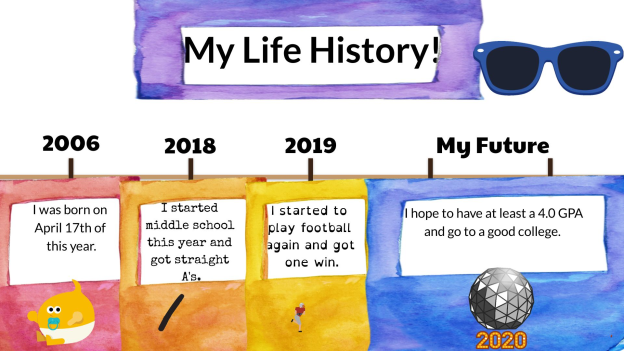
2. Create a timeline
3. Design a digital business card
4. Explain steps in a process
5. Teach a lesson, add audio and video
6. Book summary
7. Design classroom signs
8. Create study aids
9. Create an ebook
10. Recreate a moment from history, personal experience, or make a future prediction
Digital citizenship is a topic that educators must continue to be mindful of within their classrooms and our schools. Because so many tasks involve the use of technology, it is our responsibility to embed digital citizenship into our lessons so our students are prepared and knowledgeable about the responsibilities that exist and also expectations of them when it comes to digital learning. There is an increase in technology being used in our classrooms, students have more access to digital resources and global connections than ever before, so regardless of our roles in education, we must stay current with issues, trends, and resources related to this topic. Digital citizenship skills have to be a part of what we teach and model for students, especially because we ask our students to do research, to collaborate online and perhaps even use social media as part of our coursework.
There are many resources available to learn more about digital citizenship, ranging from participation in virtual or in-person learning events held throughout the year to websites, books, blogs, and more that bring attention to and inform about this important topic. When I first started teaching about digital citizenship, I recall myself telling students the things that they should not do rather than focusing on how to use the tools safely and responsibly and showing how they could enhance learning. I recognize this now as I’ve researched more and become more aware of the different resources available for use in education today and following the conversations happening in different educational networks. And along with what’s being done out there, I believe that we need to convey the message to our students of how to use digital tools, to interact responsibly, and also share the importance of knowing how to use these tools for good.
Building these skills is critical because they will transfer to the real world space as well. For some students, they build confidence and comfort by interacting with peers and become better collaborators in an online space first, then apply these to the physical classroom setting and the real-world.
Here are five resources to explore and which offer activities for students to explore on their own and construct their own knowledge and apply it.
1. Events Educators can participate in Digital Citizenship Week, happening from October 14th through the 18th online. During this week-long event, educators can participate by connecting with other classrooms globally, joining in a panel discussion organized through the DigCit Institute and EduMatch Tweet and Talk, or listening to a DigcitIMPACT talk. Sign up on the website and stay connected by following the #digcitsummit hashtag on Twitter.
2. Online resources There are many interactive ways for students to explore DigCit topics. Common Sense Education’s Digital Compass provides interactive lessons, tutorials, and fun activities for students to engage in to learn about digital citizenship. One of the many benefits is that students choose how to proceed through the interactive lessons, and can see the positive or negative effects of these choices. Digital Compass addresses topics such as cyberbullying, fake news, social media, and more that are in alignment with today’s trends. Be Internet Awesome by Google has students explore four lands and complete activities and games to build their digital citizenship skills. This is another good way to let students drive their learning, to become curious and develop their own understanding in a space that is safe and that we can support. 21 things for students offers 21 different lessons on topics related to digital citizenship, technology skills, cyberbullying and more. Nearpod offers interactive lessons on Social Media use and topics related to Digital Citizenship in addition to many other content areas and levels.
3. Books Three books that I recommend are Digital Citizenship in Action by Dr. Kristen Mattson, Digital Citizenship in Schools by Mike Ribble, and Digcit Kids: Lessons Learned Side by Side to Empower Others from Around the World by Marialice Curran and Curran Dee. Each of these books offer a wealth of resources for getting started with lessons on digital citizenship and they provide activities for use in our classrooms. Dr. Mattson’s book is also used for the ISTE U Course on Digital Citizenship.
4. Social Media Students are using more social media, especially Instagram and Snapchat, and need to develop an understanding of how to post, the type of information that is okay to share, and how to interact responsibly and respectfully in these spaces. Depending on student grade level, it can be helpful to have students participate in a simulated Twitter chat, create a Padlet wall, or use post-it notes and a space in the room to have students create posts and write responses. It is important to help students understand how social media works and how to properly post. We want to emphasize the safety of our students and knowing how to distinguish between reliable and unreliable sources.
5. Organizations ISTE (the International Society for Technology in Education) offers a Professional Learning Network (PLN) focused on Digital Citizenship for members. In PLNs such as this one, educators can find many resources for teaching about digital citizenship that match the grade level, content area, and specific needs of their students. Individuals can sign up to be a part of the #digcitcommit movement. DigCitCommit is a coalition with the mission of providing educators with the right resources for teaching students about digital citizenship. Educators can sign the pledge and become more involved in promoting digital citizenship around the world.
To provide the best possible opportunities for our students to learn their roles and responsibilities when it comes to digital citizenship, we simply need to start with one of these resources and include it in our daily activities. The idea is not that it’s something extra added onto the curriculum but rather becomes woven into our classrooms each day throughout the year.
*Interested in writing a guest blog for my site? Would love to share your ideas! Submit your post here.
Looking for a new book to read? Many stories from educators, two student chapters, and a student-designed cover for In Other Words.
Struggling in math has been my greatest asset as a math teacher. Remembering the pain of negative self-talk while feeling like giving up was my only option…well, math trauma is not easily forgotten. It’s why so many adults, decades after high school graduation, will still tell you they are bad at math. For me, the silver lining to that trauma has always been the ability to relate to my students, and even my own children, when they have math struggles. One of the greatest compliments students and former students have shared with me is that math finally made sense to them when they were in my class.
One thing I’ve never said, and will never say, to my children is that I was bad at math. Even as a new teacher, I asked parents not to say that to their children. Telling your children or students you are bad at math is like encouraging them to quit before they even begin.
Now, I have always told my students and children that I struggled in math. We all understand what struggle means, and the good news is that there is always the possibility of winning in a struggle! Every year, I tell them how I had to stay in at recess in first grade because I could not understand the concept of subtraction. Crazily enough, my teacher had no idea how to teach it in a new way that made sense to me. She tried to explain it repeatedly in the same way…and it didn’t make sense to me for the longest time. I also tell them about how in first grade I received a C in math and it made me feel terrible. I never wanted another C on my report card and made sure I never did again. That desire to make the Honor Roll (I was a middle child and wanted to stand out in some way, and academically was my route) kept me from quitting. Math was a struggle, but I found a way to understand. As early as seven years old, I realized that quitting was not an option. Finding math success was never easy for me, but through my school years, I found what worked for me. This is what I share with my students hoping it will help them, too.
Addressing the Struggle at the Beginning of the Year
First week of school when I say the word “math”I look around to see who dreads the very word itself. It’s not just about reading expressions, but I look for patterns of misbehavior and any kind of drama that might commence when that dreaded word is spoken. I always begin the year assuring my students that if they stick with me and trust me, as their math teacher, I will not leave them behind. I have promised that to my students for years, and I mean it with every fiber of my being. I explain that when they don’t quit, math can be fun like a puzzle.
What does it take to help children dig into math when they want to check out? It takes patience and time to do it to do it to do it to do it right, child, I got my mind set on math, I got my mind, set on math…
All singing aside (remember He gave me a melody *wink wink*), in a whole group lesson, the ones who get the concept easily, I normally allow them to begin the assignment and do it at their pace. The students who have questions stick with me and the ones who are lost become a small group.
Helping my own child, a fifth grader review geometry!
What does helping kids through math struggle look like?
Sitting next to a child who struggles is important. That nearness factor makes a difference. They know I won’t ignore them or allow them to pretend to work when really they are just doodling or trying to look busy. See, by the time they reach fifth grade, they’ve pretty much given up. They don’t want the attention! One of my students, who was desperately struggling, knew how to look busy, so sitting next to me kept him from trying to con me that he was actually trying to solve problems. He definitely tried to trick me, but I called him out. A few more times like this, and he knew I meant business. He stopped trying to look busy and started attempting the problems before him. Just attempting…finding a starting place to solve is huge when you struggle in math. I remember this from my own childhood.
When students have progressed to where they begin solving problems more easily, I still encourage them to ask for help, but I do not let them come to me unless they have attempted the problem. I can ask them, “What do you think you are going to do here?” or “Where do you think you should start?” They are so used to struggling and the teacher just giving them an answer that they often ask before even thinking about how/where they should begin. Getting them to dig in and try to understand the problem is foundational in developing grit and sticking with the problem. When solving math equations or word problems, it’s truly important to have a place to stick information to, so beginning the problem and attempting to solve it gives them something to add or learn from. If they don’t think through this first part, a teacher’s lesson is like throwing darts into the dark without any specific target that will reach their students.
I also coach my students while giving notes. At some point, they may stop understanding. I coach them to keep taking the notes I give them, but make a note to themselves that this is where they have stopped understanding. Again, I learned this from my own struggles. In fact, in my Algebra one course when the teacher was finished with the lesson and asked for questions, I was able to ask my questions clearly. To do this well, I had to turn off my negative self-talk. If I allowed my negative self-talk to take over, the only thing I heard from that point on was me telling me how stupid I was and how I was the only person not understanding. In place of negative self-talk, I encouraged myself to take a deep breath and remind myself that even though I didn’t understand the concept just then, I knew I would eventually if I didn’t shut down. That allowed me to keep paying attention and sometimes even cleared my confusion. When I shut down, this wasn’t possible.
Something else that helps students is allowing them to talk about patterns they notice. Whether they struggle or not, when they notice a math pattern, letting them talk it out with the rest of the class will help everyone!! Worst case, it’s also a way a teacher can help clear up misconceptions early on. The best math teachers for me were my peers. Sometimes students identify specific items that make a world of difference for their peers. My son is in third grade and has a more natural way of understanding math than his older sister. Whenever he notices a pattern, he stops and we have an entire conversation about it. He truly amazes me. We can, and should, help our students learn the patterns because often times when they figure it out for themselves, they feel more confident and the knowledge isn’t dumped after an assessment. My son talking about the patterns he sees also helps his older sister and younger sister think through that math pattern, too. That’s a win!!
It’s a Journey
For students who struggle in math, it is an emotional journey. When teachers stop and say, “I know you are struggling, and I’m here to help, and I won’t go on until you understand,” it’s a balm for our students’ insecure nerves. When they are fifth graders coming to me, they usually have three to four years of feeling left behind. Hoping to help my struggling students, my mindset is firm that their struggles stop with me and I do all in my power to get them to grow and decrease any learning gaps.
Over time, I have developed the wisdom necessary to see when students quit before even trying or when they are totally overwhelmed. It’s important to know the difference because both situations require different responses. The quit-before-trying-learner needs a firm reminder of not giving up and figuring out a place to start, while the overwhelmed learner needs to know they can take a break or use another method to help them.
Helping students dig into math struggles is such a beautiful way to help them learn perseverance and purpose. When they decide to lean into the struggle, they form a mental confidence that can’t be stolen from them. Can you see how facing their insecurity in math can help them in other areas of life, too? Having a teacher who will go the whole distance means everything for these students, and many times, changes a negative academic course into a new path of learning and goal setting! I have seen the glory! I have seen the joy of confidence from the same student who broke down and cried with me at one point. So yeah…when my students have told me that my fifth grade class was the first time math made sense to them, I feel like I’ve earned an Oscar!
Resources
Have you heard of the book written by Alice Aspinall called Everyone Can Learn Math? Recently, I read it with my five children and it sparked great discussion. My oldest, who is currently in fifth grade, found the main character, Amy, very “relatable.” Amy feels the math struggle deeply and so does her mom! I would recommend this book for every parent and educator to keep in their home or classroom library. I know we will be pulling it out to reread a lot. It’s also a good way to combine your academics. Author, Alice Aspinall also recommends Adding Parents to the Equation by Hilary Kreisburg and Matthew Bayranevand.
Also, have you heard of Nearpod and Flocabulary? When I went back into teaching public school a few years ago, they were the first technologies that I implemented in my lessons. My students and children love it. They can be personalized or differentiated for the different level of learning going on in your classroom. These resources are engaging and will definitely make a difference in small group learning. The coolest part is now they are together!!!
I’ve shared several times that as a Technology Integration Specialist, I do not have my own classroom of students. Nor do I have any kind of regular teaching schedule. This allows me to work with any teacher and any group of students! My goal is that anything/everything I do supports classroom instruction and I love when teachers come to me and ask me to work with students. Sometimes, what we set out to do morphs into something else … and it’s always a good thing!
At the beginning of March, Mrs. Laura Counts approached me to help a group of her students. These 5 students had read several books by Sandra Markle (@Sandra_Markle) and had decided they wanted to write their own book, in her style. Laura asked if I would help. Wow! They wanted to do the research, writing, AND the designing of the book!
The overall task was → the students were inspired after reading a non-fiction book to write their own book. As a group, they decided to research bird feet and each selected a bird that interested them. They would use their research to write in the style of Sandra Markle. Meanwhile, I would work with them to take their writings and make it into a book.
We set to work. I met with the students a couple times a week to work on the actual book design and on the other days, they would do their research. I had such fun talking through the design process … we had a LOT of decisions to make! Which tool do we use? Book Creator? Google Slides? Something else? We settled on Slides. Then we poured over every detail … the dimensions of the book (we literally pulled out a ruler to measure!); making the wooden sign; which font(s) to use – this was a BIG conversation … do we all use the same? does each author use a different one?; whose page goes first? last? order?; gathering the credits for the images we used; and many more! I have to hand it to these 5 kiddos. They did an AMAZING job! They put forth their very best. It really shows!
A very interesting conversation we had very early on was whether or not Ms. Markle would be “mad” they were writing this. One of the boys was worried she would be angry. I asked him why, and basically he was worried she would think we were copying her. I assured him we weren’t going to profit off of this and we would be giving her the credit. Mrs. Counts added that she thought Ms. Markle would be thrilled we were doing this. I offered to reach out to her. I did so, via Twitter – our world really isn’t as big as one would think! – and she responded very quickly! It was awesome to be able to show them that the author was proud of them.
We used several digital tools to help us create our book. One of our favorites is a website “Build Your Wild Self” from the Bronx Zoo (unfortunately, it doesn’t seem to be available anymore). Then we also used a couple of “digital scissors” — https://online.photoscissors.com/ (to be able to take the “wild self” and attach their specific bird legs) and https://www.remove.bg/ (for our author pages – not shown in the preview below because of the age of the students). Showing the students the power of a Google Slide was incredible! I don’t know who enjoyed it more, them or me!
I am happy to share the final version of their book! The attention to detail and the excitement of these students showed through this whole project is heartwarming. I’m not sharing their author pages due to their age, but several of them have commented on wanting to be authors! ……. I believe they already are!
*** Link to a published Slides that shares the majority of the book the students created.
**Interested in writing a guest blog for my site? Would love to share your ideas! Submit your post here.
Looking for a new book to read? Many stories from educators, two student chapters, and a student-designed cover for In Other Words.
I recently followed a chat that started from the claim that all a student needs to be is liked. That all they need is a connection or relationship or positive interaction with an adult. Initially I thought of course I agree, but after some time of that idea rattling around in my head I changed my mind. I don’t think I agree. I would still agree that connections can and do make a huge difference. I just don’t think they make THE difference.
I work in alternative education. I work with really challenging kids. THOSE KIDS. The ones who didn’t make it in other schools. The ones who know incarceration and the system. The ones who know trauma and abuse and pain and abandonment. The ones who know failure. These kids don’t like me when they enter my classroom. They don’t like anyone. They don’t care if I like them. They are quite used to no one liking them. They don’t care about grades and learning and futures. They don’t plan. They don’t have goals. They don’t dream. They don’t have hope.
So I have to connect with them and I have to do it fast. I have found that I relate to these kids. I get them. Maybe it’s my own quirkiness or off-beat sense of humor or stubborn streak or willingness to do about anything to make that connection – smile, laugh, sing, dance, tell jokes, laugh at bad jokes, pat backs, give hugs, and just never stop trying. They push me away, but I come back. Again. And again. And again. Until finally they push back a little less, and if I’m lucky, they stop pushing back at all. That is connection and it is the absolute first step. No question. It will be the foundation for everything that comes next.
Next. That is the thing that I think has gotten lost. It’s not the connection that’s the most important thing. It’s the next. Jump into any education chat or conversation and you will hear the word connection and relationships, but it’s becoming this idea that if I make a connection with my student then that is all they need. If I care enough or like them enough or love them enough or if we talk enough or have enough in common then that will make a difference to my students. And it will. It will make A difference, but I don’t think it’s enough to make THE difference.
We need the next. They need the next. Think about the process of building a house. When carpenters build a house they build the foundation first. It is what supports everything. But once they have a foundation, they keep going. They build the walls and the roof and they put in duct work and plumbing and electrical. It’s finished off with paint and flooring and appliances and décor. There are so many steps that come after the foundation. There are so many steps to building a completed house. If they stopped after the foundation, then they don’t have a house. They just have a piece of concrete.
We, as educators, we need to build the house for our students. Let’s build a foundation. Let’s work hard and quickly to make connections and build relationships, but then let’s not stop there. Let’s do something with that foundation. Let’s give them walls and a roof – a framework to support them. We can teach social skills and coping skills. How to enter a classroom and take turns and ask for help. How to approach tasks independently and with their peers. How to adjust to different procedures and expectations. How to make mistakes. How to celebrate successes. How to work through problems. How to find an answer. How to ask for help. How to be a successful student but also a successful member of society. Let’s give them all the systems inside that house – let’s bring that house to life. We can teach them academics. We can fill in the gaps while giving opportunities for new growth. It may look different than how other students learn and they may need to express what they know differently, but they will learn. They will learn mistakes aren’t failures. They will learn to try again. They will experience success. Knowledge is a powerful thing. So is confidence. Let’s decorate their house. Personalize it. Make it belong to each individual student. Let them be creative. Think outside the box. Celebrate individuality. Find their own unique strengths and weaknesses. Let’s make that house their own.
Let’s do something with the connections we work so hard to make. Let’s use those foundations we’ve built. Let’s push our students out of their comfort zone. Let’s move past easy and complacent and good enough. Let’s set high expectations. Let’s push them to struggle and even fail. But then let’s teach them to persevere and to adapt and to overcome. It will be hard for them and us. We will all get tired and experience frustrations, but it’s what they need. And they will be okay because we will there. We will support them and guide them and believe in them and teach them. We use that connection that we created in the beginning to be our foundation to support everything we do next.
**Interested in writing a guest blog for my site? Would love to share your ideas! Submit your post here.
Looking for a new book to read? Many stories from educators, two student chapters, and a student-designed cover for In Other Words.
A new year always brings a time of optimism, goal setting, and resolutions. Like millions of others I am no different, I am a goal setter. Not only am I a goal setter, I am a big one. I enjoy setting goals and putting together a plan to accomplish them. However big or small, they are fun and give me something to work for. One of the constant themes I have noticed is people making a goal to be more vulnerable.
Vulnerable is defined in the dictionary as, “susceptible to physical or emotional attack or harm.” There are other definitions, but this definition definitely does not align with this piece. Vulnerability for this piece is putting yourself out there and sharing personal information as a way to connect and grow. With 2020 less than 18 hours away this is a great time to share, connect, and grow as a person.
People that know me know I am a private person, and writing this piece is rather difficult.Those that know me know that kindness, love, compassion, and humility are greatly apart of my life. I share it as with as many people as I come across. It is a foundation of my classroom, and I have been rather successful with it. What very few people know about me is that. I have suffered from depression, at times deep, and severe anxiety for several years. It has taken me a while to accept and find coping practices that work, but I have found those and have accepted that it is perfectly ok to have depression and anxiety. Unfortunately millions of citizens including educators fight these battles. At times the most basic things seem insurmountable and having conversations with others feels like getting your teeth pulled.
I don’t know where my depression and anxiety came from. It could be a combination of losing a close family member to suicide last winter break, constant self doubt, shame of who I am, negative mindset, comparing myself to others, being a natural introspective person. The last one I believe is a major factor. I am a thinker and it is easy to get lost in your thoughts which can be a good and bad thing. It took until having a severe panic attack which I thought I was not capable of a 5 years ago to realize I needed help, and had to make some lifestyle changes.
Those that ask how I teach with depression and anxiety, well it is one of the easiest things I tackle. Understanding that our students battle these same things everyday. I have a deep compassion for what they go through and we are a team that grows and learns together. I also become self aware of what I go through, learn about depression and anxiety, and adopt different changes things that work for me. For example, I stay busy, I go for walks in the building during my prep, I check on my colleagues, and say hello to every student I come across, and I love going to school. I love being with my students, teaching, growing, and achieving together.
Outside of school I see a therapist regularly to organize my thoughts, I take medication, I am an avid weightlifter. I am pretty darn strong. I also read and write, and look for ways to continue to grow. I have grown to love challenges and change. What used to literally make me shake and bring tears to my eyes is now one of my favorites, and is a great learning experience. The biggest impact on myself was the adoption of a mindfulness lifestyle. I meditate everyday, practice yoga 3-5 times per week. I am quite talented with my balance poses, and I am a firm believer in what citizens such as the Dalia Lama share with others.
One of the biggest challenges was my shift in mindset, this change did not happen overnight. I was never a pessimistic person, but I needed to make changes for the benefit of my health. I have always wanted to help, guide, and love others. In years past anxiety crept up and made this area more difficult to achieve. I worried what others thought which held me back. Now, I couldn’t care less what others think about about me and what I believe in. I absolutely love helping others, spreading kindness, compassion, and love. These qualities are who I am as a person and who I want to surround myself with. I know the people who want to be a part of my life with gravitate in my direction.
Lastly, I have become a strong advocate for mental health, the stigma must stop. I suffer from mental health issues, and I am perfectly ok with it. I am in a great spot and have never felt better. Will it always be this way, no! Does that worry me, absolutely! I will take on that challenge, grow, and we will do this together. I am far from a finished product, I will have to battle this for the rest of my life, I can do this, and so can you.
If we are entrusted with taking care of our students we must take care of ourselves and each other. How can our students learn and grow as individuals if they don’t have a person to guide them through challenges they face. Our students need us and we all need each other.When someone wants to talk, listen, and listen with intention. Check in with your students, colleagues, and most importantly yourself. Everyone who reads this and shares it with others has so much value to this world. I am grateful for each and everyone of you.
It’s okay not to be okay, and we are here for you. Mental health is just as important as physical health and our community of compassion, love, understanding, and growth will only help remove the stigma, and accept each other for the faults and challenges we face. My attempt at vulnerability was this piece, and I am proud to share it with you.
WE ARE ONE TEAM
-Dustin
**Interested in writing a guest blog for my site? Would love to share your ideas! Submit your post here.
Looking for a new book to read? Many stories from educators, two student chapters, and a student-designed cover for In Other Words.
In education today, there have been a lot of discussions in regard to what skills students may need for the future. Many times we hear conversations about “21st-century skills” and how to best prepare students for life and work in the 21st century. Often these 21st-century references are followed by reminders that we are well into the 21st century. We are not only thinking of the future, but these are also the skills that our students need today.
According to Alan November, keynote speaker and international leader in educational technology, there are certain skills that students need and that teachers need to promote within the classroom. Students need to be taught “how” to learn and prepare for more than knowing the content, by developing skills that are transferable to multiple areas of life and work. During a keynote presentation, November stated: “I think we should begin to move more and more toward the skill side, because if we teach you to memorize and regurgitate content and your job is wiped out by technology, you’re not well prepared to reinvent yourself if you didn’t learn how to learn.”
November’s message reinforces the importance of students developing skills such as being able to communicate, collaborate, problem-solve, think critically, to name a few. These are some of the key skills that will enable students to be adaptable to whatever type of work they ultimately find or whatever the next steps are once they leave high school. They are skills they will need whether they enroll in college, seek employment, pursue specialized training, or even take a gap year to decide. With changes in technology and in the capabilities when it comes to learning and the future of work, we can’t truly know what employers will look for five years down the road. The best we can do is to give students access to the right tools to equip themselves with not only the content that we are teaching, but infuse the curriculum with choice through independent learning and exploration of interests that students have. An important goal in schools today should be for students to drive their own learning and develop skills that are authentic and meaningful for learning but at the same time are unique to them.
Changing the Look of Schools and Learning
We’ve heard about the “gig economy” and how students need to have the capability of working in different industries and with different types of work. In a gig economy, each job or work assignment is comparable to an individual “gig” or temporary employment. The generation do-it-yourself (DIY) ties into that same thinking. We need for students to do more than simply consume content, we need for them to create and beyond just creating with the content we have given them, they need to come up with their own questions and problems to be solved. Students need to be the designers of their learning journeys.
So what can we do to help our students become part of Generation DIY?
We need to give students the space to design their own learning path and to take charge of their education. There are a lot of instructional strategies that lend themselves to this “generation do-it-yourself” such as a genius hour, project-based learning, service-learning, experiential learning, and makerspaces, among others. As educators, what can we do to ensure that all students have an equal opportunity to explore and have access to whatever it is that they might need? How can we truly know what they will need in the future to enable us to help them? We can best prepare by giving and being open to options that diverge from the traditional look of schools and learning.
Schools around the country have started to offer more courses based on emerging trends and what the “predictions” are for future-ready skills. Some courses or components of courses available in schools, including my own, are entrepreneurship, web design, sports and entertainment management, and other courses with content and opportunities to help students develop the skills necessary to design their own learning journeys. Students need more real-world opportunities to engage in that connect them with their community and develop the skills to assess needs in the community and globally, and brainstorm ways to offer services that will be beneficial for others. It happens that educators often assume that students have certain skills, for example, they know how to use and leverage technology effectively because they have grown up in a technology-infused era. However, the reality is quite different. We need to make sure that students have time to learn basic skills and then can push themselves to go beyond. Students need time to learn to adapt and be flexible and move beyond the traditional format of school and move into more learning that does not necessarily have clear-cut specifications.
Options for Generation DIY
You might wonder what options exist for students in the Generation DIY. Here are a few ways for students to explore different choices after high school that would promote some of the skills they will need as they prepare for the uncertainty of the future of work and learning.
Schools can consider creating more opportunities for students through Career and Technical Education (CTE) programs. Through these programs, students can explore careers and work on building skills that are transferable to diverse types of work. When students have access to CTE programs, they get to look into emerging trends in the workforce, explore different careers and walk away with certifications that can increase their marketability in the workforce. For students who may be unsure of the next steps after graduation, CTE programs can offer them time to be curious by exploring possible career options, while developing their skills in high school.
Place-based education gives students the opportunity to explore their communities, learn about the geography and immerse more in authentic learning by stepping out into the “real-world” for more meaningful ways to develop skills in math, social studies, science, language arts, and other content areas. There are six design principles in PBE, which are not required as part of the place-based education, however, when they are included, lead to more authentic and higher quality experiences. The Place Network is a collaborative of rural K-12 schools which provides a wealth of resources for learning more about PBE and becoming a PBE school.
Service learning programs give students an opportunity to learn by exploring real-world issues, even investigating on a global scale and then taking action in their own community. Educators can implement methods such as project-based learning or inquiry-based learning to engage students more by addressing problems or challenges identified in their local environment. Involving students in service learning programs gives them the chance to build skills for the future and learn about their own interests in the process.
The Generation DIY Campaign is aimed at giving students the chance to “chart” their own course through high school and college by exploring different careers and developing diverse skills that are transferable to multiple areas of work. The Generation DIY toolkit provides information and resources for educators and students to get started and also includes personal stories about the process and impact of Generation DIY.
Artificial intelligence (AI) is a growing area in which students can design their own technologies to address issues they identify in the world. AI use is increasing and students can become the creators of AI that can possibly change the way students learn, by creating things like chatbots, or learn how to code and create a virtual assistant. There are many tools available for students to explore how AI is used in everyday life and design their own project based on AI. These technologies help students to build skills in problem-solving, critical thinking, collaboration, and creativity, to name a few, which are essential skills for whatever the future holds for them.
In the end, it comes down to the different choices that we make available for students in schools today. While we certainly cannot predict the jobs that will exist in 10 years, when the current kindergarten students will be entering their high school years, the best way to prepare is by having options in place and connecting school and community.
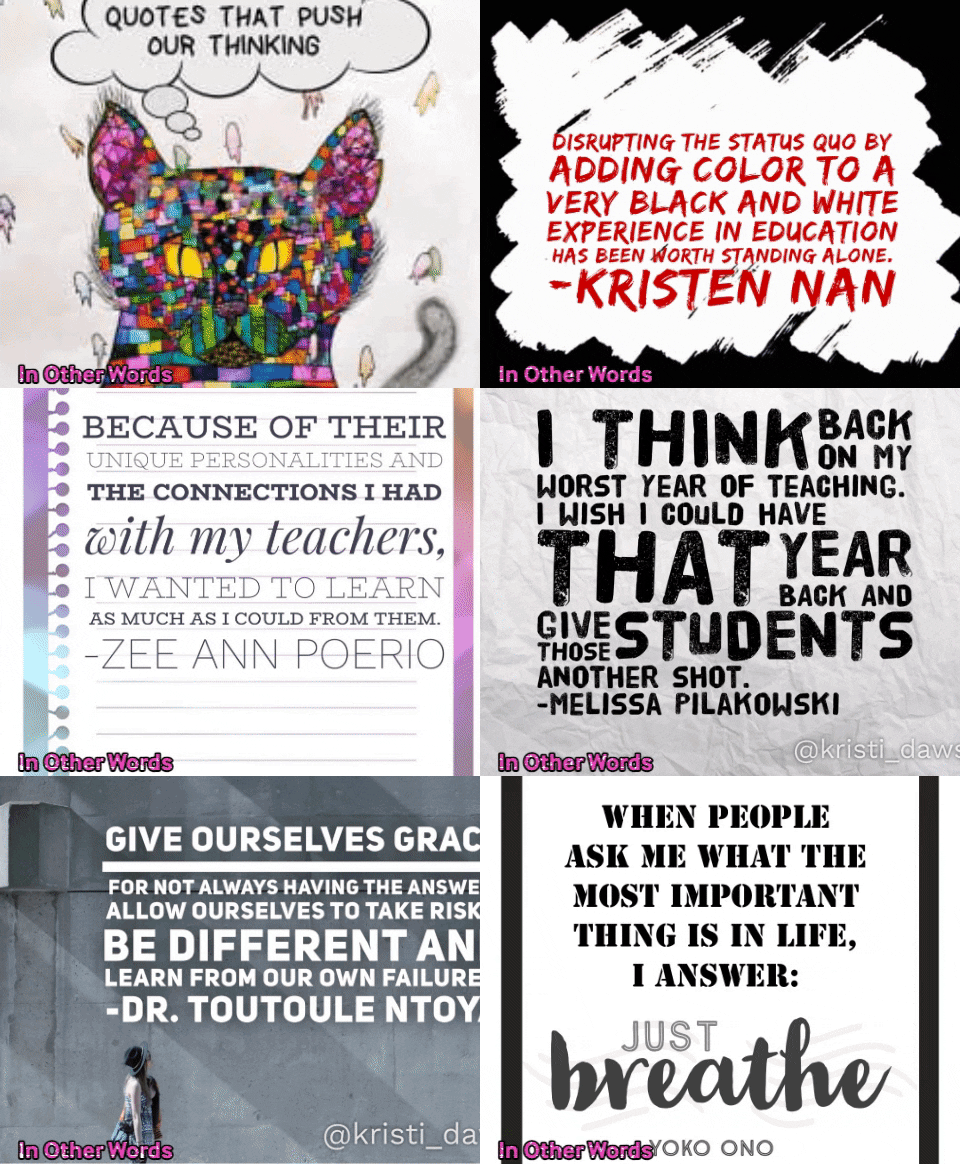
It has been quite a year. Three books published this year, looking back to one year ago as I was writing all three, very different books at the same time. But the book In Other Words came to me as I was preparing to work on The Future is Now. It stemmed from a quote:
Teddy Roosevelt once said, “I am a part of everything I have read.” When I read his quote, it greatly resonated with me because of my love of quotes and the impact they can have in our lives. In Other Words is a book full of inspirational and thought-provoking quotes that have pushed my thinking, inspired me and given me strength when I needed it. The book shares stories around the importance of growing ourselves as educators, knowing our why, as well as learning from and embracing failures and taking risks with learning so we can become our best selves for those we lead and learn with.
There are stories shared by educators with different backgrounds and different perspectives. My own experiences and interpretations and the educator vignettes shared by my PLN (Personal or Professional Learning Network) will hopefully push your thinking, inspire you, and provide whatever it is that you need. My hope is that by sharing our stories, it will inspire you to share yours.
There were many people involved throughout this journey. I reached out to members of my PLN and friends to include as many educators and students as possible. I wanted to share more than just my story, but rather many stories and experiences. This book is one that can be read by anyone, not just people in education. There are many quotes, unique personal experiences, beautiful graphics and more.
About the book #Quotes4EDU
In this book, I share some of my experiences and reflections based on quotes. I have included the stories of different educators in the form of vignettes or guest chapters. One chapter was written by two of my students and my book cover was drawn by one of my 9th-grade students. The story behind the book cover is included at the beginning of the book. The book is available on Kindle or in paperback: bit.ly/Inotherwords A few of the stories are available for listening on Synth. gosynth.com/p/s/pyzbnm
Chapter Authors
Dennis Griffin
Maureen Hayes
Holly King
Elizabeth Merce
Melissa Pilakowski
Laura Steinbrink
Amy Storer
Donald Sturm
Cassy DeBacco
Celaine Hornsby
Vignettes
Marialice B.F.X. Curran
Jon Craig
Kristi Daws
Sarah Fromhold
Jeff Kubiak
Matthew Larson
Jennifer Ledford
Kristen Nan
Toutoule Ntoya
Paul O’Neill
Zee Ann Poerio
Rodney Turner
Heather Young
Graphics
Michael Mordechai Cohen
Dene Gainey
Manuel Herrera
Shelby Krevokuch
Amber McCormick
Dana Ladenburger
Heather Lippert
Scott Nunes
Chris Spalton
Tisha Richmond
Monica Spillman
Laura Steinbrink
Kitty Tripp
Julie Woodard
What is your walk-up song? You know the one, the one you hear on the radio and immediately turn it up and begin to belt out even off tune a little bit? The one that you begin dancing , or swaying to, when you hear it . . . ever? My walk-up song is Don’t Stop Believing, by Journey. I always thought it was because it came out my 9th grade year in high school and it just stuck with me. However, when I look deep into the lyrics, I realize that it was a song putting me on the path to where I am today. Lonely World
The first line says a lot! “Just a small town girl, living in a lonely world.”I was a small town girl. I grew up in Twentynine Palms, California, a town of 5,000 people when you exclude the marine base population. We had a graduating class of about 100 students. Because we lived in a military town, students rotated through our high school each year; in with the newcomers, out with those that were transferring on so to speak. We were a close nit bunch, saying goodbye to some and welcoming the newbies. We clung to each other knowing that we were all we had. “Just a small town girl.” Small town girl I relate to! “Livin’ in a lonely world.”This was not me, but it is a place where my students live on a daily basis. My students come from dark places, lonely places, dirty places; places I can only imagine. I was not so surprisingly reminded of this just today when a student was in an escalated state, crying and yelling, “You don’t know how it feels not to see your brother or sisters. I’ve been in three foster homes in that last year! They shipped my sister out to another state to residential treatment. And my older brother and sister, I haven’t talked to in over a year. OCS (the Office of Children’s Services) has let me down over and over again and they want to send me out of state; I’m not crazy! I’m just going to do what I can to get out of this place.” He didn’t mean this in a good sense. He meant destroying every opportunity put in front of him. It broke my heart. He’s been stripped of all that he knows, his dad who’s health is failing, him mom who is an addict, and his nine brothers and sisters some adults, and some younger ones all in different foster homes. But I keep trying to open up his world from being lonely to know that we care for him now, and we will care for him always; this is how I want all my students to feel! Find Emotion
The line, “Streetlights, people, livin’ just to find emotion, hidin’ somewhere in the night,”says a lot about where I am day to day at Whaley School. Our students are trying to find emotions at our school. Some are escalated on a regular basis, some are escalated once in a while, and some are just trying to find their way, whether it’s cutting, stating they want to harm themselves, or trying to escape from life itself using drugs or alcohol. That same student I spoke about told me that the reason that he smokes weed and drinks is because he is trying to escape the real that is his life. I encourage him everyday to come to school so that we can get help for him; we have a therapeutic counselor here on site. I told him here he can get the care and love he needs while he’s working on himself to become strong and fight for what he needs and wants. He wants his family back together, he wants ‘normal’ again; he’s broken into a million pieces right now and I am just white space speaking at this point. Emotions, mostly negative, are seen everyday here at Whaley. Our staff tries to help our students to regulate their emotions in many ways. We have a calming room, a sensory room, enough staff to take a student for a walk, counting down, changing the scenery all together, and much, much, more. We are equipped to help. However, I’ve found that some students are not ready for that help, they’d rather be “hidin’ somewhere in the night.” The Movie Never Ends
Each day we come to work we could sing, “Some will win, some will lose, some were born to sing the blues; oh the movie never ends it goes on and on, and on, and on.” At Whaley, students who feel they will win are those that are getting their behaviors under control. But for me, the winners are every student in the building because they come to a caring and nurturing staff each day. Students have staff who help them to regulate behavior, make good decisions, and staff who just listen to them when they are in need of a ear that listens and understands.
Students who feel that they will lose are those still having major behaviors, not seeing the light at the end of the tunnel and/or not adapting to change. These are the students stuck in the movie thatnever ends. Or so they think. Actually, these are our students that may take a little longer to realize the caring staff that is there for them, or the behaviors that need to be changed are still interfering with their academic, social, and emotional learning.
Sometimes, staff, on the other hand, also feel like they are stuck in a “movie that never ends it goes on and on, and on and on.” This is due to our groundhog day effect. We work hard with our students every day to see little successes at times, little bits of progress, then send them home to sometimes unravel that success. But, we pick ourselves up by the bootstraps and start all over again the next day. We make sure that we are giving all students what they need each day using the Maslow before Bloom theory. Our students are not going to show any signs of success or progression (or little) unless we give them all of their basic needs when they enter our building. It’s a hard job each day, but we come back strong! Don’t Stop Believin’
I think that this is the best part of the song AND the best part of my job. I never stop believing in my students. . . ever. No matter the behavior, I’ll continue to work with students to find the best way to manage that behavior. In most all cases the behavior we see is the result of environmental or chemical reaction before, during or after the student was born. Kids do well if they can, right? We must always continue to believe, encourage, motivate and inspire our students each and every day toward progress and success; they deserve it! Don’t Stop Believin’ in your students- it’s why we’re here folks. . . and it’s my walk-up song!
**Interested in writing a guest blog for my site? Would love to share your ideas! Submit your post here.
Looking for a new book to read? Many stories from educators, two student chapters, and a student-designed cover for In Other Words.











 Candace Boehm @crazedladychron
 I work in alternative education. I work with really challenging kids. THOSE KIDS. The ones who didn’t make it in other schools. The ones who know incarceration and the system. The ones who know trauma and abuse and pain and abandonment. The ones who know failure. These kids don’t like me when they enter my classroom. They don’t like anyone. They don’t care if I like them. They are quite used to no one liking them. They don’t care about grades and learning and futures. They don’t plan. They don’t have goals. They don’t dream. They don’t have hope.
 the roof and they put in duct work and plumbing and electrical. It’s finished off with paint and flooring and appliances and décor. There are so many steps that come after the foundation. There are so many steps to building a completed house. If they stopped after the foundation, then they don’t have a house. They just have a piece of concrete.
 Let’s do something with the connections we work so hard to make. Let’s use those foundations we’ve built. Let’s push our students out of their comfort zone. Let’s move past easy and complacent and good enough. Let’s set high expectations. Let’s push them to struggle and even fail. But then let’s teach them to persevere and to adapt and to overcome. It will be hard for them and us. We will all get tired and experience frustrations, but it’s what they need. And they will be okay because we will there. We will support them and guide them and believe in them and teach them. We use that connection that we created in the beginning to be our foundation to support everything we do next.



 Learning as I go: Reflections & lessons learned