Only in our isolation and disconnectedness do we discover that everything and everyone is localized and connected. And, in this distancing, I am beginning to question what we deny.
Rebecca Solnit kept appearing in my daily consumption of media and I’m beginning to wonder if this is the work of a latent existential force drawing my attention to something I should have known or done long ago. I listened to her voice in an episode of On Being last week. She wrote, “When all the ordinary divides and patterns are shattered, people step up to become their brothers’ keepers…and that purposefulness and connectedness bring joy even amidst death, chaos, fear, and loss.” The unusual lilt of her voice and calm intellect still spin in my mind’s ear. And, this morning, I stopped scrolling my Twitter feed struck by this linguistic wisdom. She wrote,
“Inside the word ’emergency’ is ’emerge’; from an emergency new things come forth. The old certainties are crumbling fast, but danger and possibility are sisters.” #RebeccaSolnit
And then on Twitter, Gianpiero Petriglieri wrote that an “old therapist friend” told him why everyone was “so exhausted after video calls. It’s the plausible deniability of each other’s absence. Our minds tricked into the idea of being together when our bodies feel we’re not. Dissonance is exhausting. Our bodies process so much context…” I stopped to think about that wording, “plausible deniability”, and the more common legalistic use for one escaping criminal repercussions as a member of a corrupt organization or political power.
However, I couldn’t wrap my head around this experience of dissonance and the connotations of “plausible deniability” as something happening to us rather than something we choose to avoid like the truth or an injustice. According to Wikipedia“the expression was first used by the CIA” but the idea apparently has a longer history. I needed to understand the term, like Solnit explored “emergency”; it was an itch that pressed me, so I read further. “Plausible denial involves the creation of power structures and chains of command loose and informal enough to be denied if necessary”.
Then a thought struck me. What power structures are currently in place which I deny? What small almost imperceptible movements have made me complicit in this dance of distraction? Solnit reappeared during my longer moment of breakfast reading in The Guardian article entitled: “The impossible has already happened: what coronavirus can teach us about hope”. How marvelous and uplifting it is to read her vibrant words calling us to action and existence, to make the most of the worst.
While I cannot deny there is absence in my new-found isolation, I can also see that my thoughts attend a new experience. I am paying attention to moving about my house, to walking the dog, to gazing out the window with no real productivity pressure of this instant. And, yes, I am teaching remotely, but connecting, supporting personalized learning is my focus rather than a product on the line of academic factory life. This is where I cannot sense Petriglieri’s Tweet about “plausible deniability”. I am now working on processing the context of my daily life which I previously ignored in mind-numbing haste consumed by the blind goals of my own productivity or some socialized version of productivity.
My body is processing the context of my life in isolation and thinking about the actions needed for when we might connect again. I am trying not to deny my own physical interaction with and existence in the world.
**Interested in writing a guest blog for my site? Would love to share your ideas! Submit your post here.
Looking for a new book to read? Many stories from educators, two student chapters, and a student-designed cover for In Other Words.
Last week those of us in BC ed had no idea what this week would have in store for us. When I was a kid, “self-isolating” was humorously coined for those who rather not deal with the public, “social distancing” was something told to us by supervisors at teen dances, and “quarantining” was something learned in history units.
But like it or not, we have been hit in the face with a crisis of epic proportions. It’s been an emotional roller coaster navigating the slings and arrows of toilet paper hoarding, Bonnie Henry updates, and beachy trip cancellations.
And now, BC teachers are faced with uncertainty as to how we will continue teaching without students in our classrooms. Over the last few years, we’ve been besieged with a renewed curriculum and just started to understand how proficiency scales can be used in our classrooms. Some of us have been making waves by leading teachers on a gradeless mission. Since yesterday’s announcement, I cannot help but wonder if all the work we’ve done will now be undone. I could scream and cry at the same time.
I know it might seem like an unrealistic conundrum to be contemplating the fate of gradeless at a time like this. Like many of you, I’m hanging on pins and needles waiting for our school board to announce how, specifically, we will meet the needs of our students after spring break. I have so many questions from communication to assessment. I’m worried about my at-risk students and how my colleagues will weather this storm. How will my student LEARN at home?
Learn. Hmmm…
Learning is the focus of gradeless teaching and assessment. You’ve heard me explain so many times over that when we remove grades and focus on the individual child and their growth, a child will develop a growth mindset. When we put the needs of each individual child instead of comparing them to each other or categorizing them by grades, we build a culture of learners, not grade grabbers.
Amid this edu-crisis, do we have to stop? Should we still consider gradeless? In fact, isn’t now, more than ever, the time to rethink what our goals are for our students? Is uncertainty and anxiousness a reason to revert to old habits, like handing over packages of content heavy worksheets, and abandoning single point rubrics? Or is this an opportunity to practice…really practice putting learning before grades? Isn’t this the time to think about the needs of the child? Shouldn’t our focus be on how the child will learn instead of how will I teach under these different circumstances? So many questions!
One thing I know is, now more than ever, students do not need grade pressures. They don’t need us to hover a “here’s what you need to pass” over their heads because we’re worried about getting through “the curriculum.” At home, students are juggling feelings of isolation, parents being laid off, themselves being laid off, lack of technology, too much technology, empty grocery store shelves and empty cupboards, never mind the questions: When will we return to school? Will there be a grad ceremony? Why can’t I see my friends?
In my opinion, if the government (or school board, or whomever makes these decisions) is smart, they’ll deemphasize grades. This will reduce the burden on educators. But like letter grades, even discussions over pass/fail, if that becomes the new norm, should not be considered or discussed with students until the end of the year. We can, instead, focus our energy on creative ways to meet students’ social emotional needs, develop a distance classroom community, and give voice and choice. Teachers will need to let go of being an eyewitness to learning in their rooms and we’ll really need to let go of content. If we hand over miles of notes, worksheets and google-able essay topics, we’re asking for trouble in the form of disinterest, cheating and plagiarism, and crushing failure. We’ll need lots of time to settle into a new routine. Students will need time to adjust.
Ultimately, before we start teaching, we need to figure out a balance between Maslow and Bloom….for all stakeholders: students, parents, and us. We need to lower our expectations and big dreams for the perfect online or distance education course. We need to take care of ourselves and our families first, connect with students and their families second, and collaborate with colleagues on implementing curriculum third.
When we implement the curriculum, we need to use the skills that are the focal point of the BC curriculum as a platform for meeting student’s social-emotional needs. If we give students some voice and choice as to what they want to learn and how they want to learn it, it will feel less like us pushing our agenda on them, and more like welcoming students into this new learning environment and building trust. For example, an English teacher (well duh…of course I’m going to use an English example) might begin by asking students to journal every day from a series of prompts but use prompts that are flexible and open to interpretation. This will give teachers some insight into students’ social-emotional levels/needs as well as meeting curriculum requirements to foster reflection and thinking. Information from those journals could springboard into a project-based learning assignment. Creative writers could write a story, critical thinkers could research a topic, and visual learners could create a collage or PowerPoint. Content pieces can be slipped into to individualized projects to try to meet curriculum requirements.
I understand the pressure that content heavy courses like science and math have on teachers. This dilemma has been systemically ingrained in school culture for years. Right now, a math teacher is reading this blog and thinking that there is no way they can do PBL when they have X number of chapters to get through in the textbook by June. My hope is that teachers incorporate a bit of hands on learning in order to make learning in seclusion enjoyable and fun. The reality is, the content students do not learn this year, can be incorporated into next year’s curriculum. Yup it can. But that’s next year.
I’ve made a point to vocally de-emphasize prepping over spring break, but I know that recommendation has fallen on deaf ears. I cast no blame, for if I were to, that would draw attention to me as a proverbial finger-wagger instead of me the genuine worrier for the well-being of my colleagues around the province. I confess, I’ve been thinking a lot about how I will handle my own new teaching situation, as, but I lost sleep thinking about how my colleagues are handling the pressure. I already see the formation of chats and groups with sole purpose of collaborating on resources and expertise. While these groups have good intentions, I hope teachers are using this time to focus on themselves and their families.
Teachers wear their hearts on their sleeves. We want to do what is best for our students. We naturally lack patience when gaps of information are left without direction. We overthink. We care so much. We worry. We’re teachers. Heck, I’m writing a blog in order to manage my own stress. It’s how I roll. It’s how I cope.
It won’t be long and spring break will be over and we’ll return to school. It will look and feel different. We’ll have to collaborate virtually with our colleagues who work just next door. Staff meetings may very well take place in the theatre so that we can sit 2 meters away from each other. It will be weird. Nothing about this pandemic is familiar. It’s important that we don’t expect to recreate what was in our classrooms and in our buildings. It’s important to accept the feelings of uneasiness and frustration that will come. Pause. Breathe. Accept. Repeat.
Focus on yourself. When you are ready to focus on how you’ll teach your students in this new reality, make learning and the social emotionally well being of them the priority. They’ll be just fine. So will you. We are, after all, in this together.
#mygrowthmindset
**Interested in writing a guest blog for my site? Would love to share your ideas! Submit your post here.
Looking for a new book to read? Many stories from educators, two student chapters, and a student-designed cover for In Other Words.
Reflection is concerned with consciously looking at and thinking about our experiences, actions, feelings, and responses, and then interpreting or analyzing them in order to learn from them. That is a big statement and a hard topic for our students. So how are we as educators supposed to work towards helping our students reflect on their thinking / learning and that of others.
So first I ask, as teachers and educators do we spend time on self reflection. Do we have the time to look back at our day of learning and “reflect on the information we receive through observation, experience, and other forms of communication to solve problems, design products, understand events, and address issues.” Yes that quote is straight out of our core competencies for critical and reflective thinking.
Yes I know every teacher is doing their self reflection in some way whenever they can but ho do we help students learn this process and see the benefits of reflection.
As a high school STEM educator, I always had reflection as part of my labs. We use our three go to questions for every lab:
What worked the best?
What needs to be tweaked?
What could we do to make it better?
This became common place in my classes and extended to all our work. Students would reflect on their own learning and ask each other to assess their work based on these questions.
As the new BC curriculum came around, I started to look at the self reflection during our projects. We have always looked at the process as more important. Photo journals or design changed diagrams or written reports were used to show their journey. But now we wanted to add in more self reflection along the way. After classroom discussions, it was decided that we would do weekly self reflection on large projects as a journal, blog or vlog. Students used the 3 questions to show their progress. The learning became very evident and assessment of their learning process was easier too.
I feel we need to all use reflection as part of our classroom routines and it wont feel so daunting in the end. It will make our assessment for, of and as learning much easier.
**Interested in writing a guest blog for my site? Would love to share your ideas! Submit your post here.
Looking for a new book to read? Many stories from educators, two student chapters, and a student-designed cover for In Other Words.
During Winter Break, I read three amazing and thought-provoking books. Each one provided me with new ideas, takeaways and made me examine my practice. The last book I finished was Innovate Inside The Box by George Couros and Katie Novak. As I began reading Part Three: You Are The Change You Seek of this book, George issues this challenge, ” We can consume pages and hours of great content, but until we do something with it, we have no ownership over the process of learning. He then asked the reader to reflect on these three questions based on our reading
1. What has challenged you?
2. What has been reaffirmed?
3. What will you do moving forward?
When I began to consider what challenged me from my reading, I really had to stop and think. Having already read Innovator’s Mindset last year and having prior experience with UDL, so much of what I read in this book resonated with me.
As I returned to school on Monday, several ideas from my reading kept bubbling up in my mind.
1. Shifting our focus and practice to be learner-driven and evidence-focused
2. What does risk mean?
3. Encouraging problem-finding and not just problem solving
Learner-Driven, Evidence Focused
In chapter 2 of the book, George Couros describes how he dislikes the term data-driven. Working in a model PLC school, there is no doubt that we spend a lot of time on data- in fact, some months, with increased testing, it feels like all we do is collect data. So when I read this, it gave me pause. Are we truly learner centered? Are we telling the story of the whole child? Are we preparing students for their futures or to meet benchmarks and goals based on our school improvement plans?
This section really led me to question our practices as educators. It made me examine why we do things the way we do, why I do things the way I do? Is the support I provide “opening doors” to the future? If so, are there any ways that I can further tweak this to make it more learner centered?
Risk-takers
In chapter 5, George and Katie discuss risk-taking, which is one of the characteristics of the Innovator’s Mindset. As I read this, their definition of risk caught my attention and made me look at risk through a different lens. I have always called myself a risk-taker, an early adopter, but reading this definition made the WHY behind it so clear. “Risk is moving from a comfortable average in pursuit of an unknown better.“Looking at risk through this lens took the negative connotation usually associated with this word away. It equated risk with innovation.
As a tech coach, I am constantly not only taking risks, but modeling it for all my learners. How can I better empower my learners through the use of UDL to develop more agency and risk-taking.
Problem Finders- Solvers
Chapter 6 shares how when we act as problem finders-solvers, we demonstrate an Innovator’s Mindset. In the district I work in, we have been heavily immersed in PBL or Project/Problem Based Learning. In late November and early December, one of our PBL Leads even came to our CLTs to help us plan upcoming PBL units. I love the idea of PBL and giving our students authentic purposes for their learning.
So when the idea of being a problem finder was introduced, I looked a little closer. I love this idea; it reminds me of 20% time and Passion Projects. It sounds amazing, but once again, time seems to be a culprit. How can we provide time for students to cultivate such endeavors while covering the curriculum? Could we involve students more in planning our PBLs beyond just the “Need to Knows?”
Reading this book reaffirmed so many things for me especially as I CHALLENGE myself this year to establish healthier habits and take more risks.
In chapter 3, as George and Katie described the importance of empowerment and shared how it leads to ownership and agency. It reminds me of how Ron Ritchart emphasized the importance of language when I attended WISSIT19 this summer.
In chapter 4, George and Katie share the importance of not only being a master educator, but also a master learner. If I have learned anything this break, it has been what a dramatic impact that reading 10-15 minutes a day can make in my learning. “In a profession where learning is the focus of our job, growth is essential and the target is always moving.” We all need to embrace that mantra and model being lifelong learners for our colleagues and students
So as I look towards the future, what will I do moving forward? The first thing that came to my mind was reflection. As part of #myoneword2020, I CHALLENGE myself to journal regularly. Journaling is such a huge component of reflection. George shares, “Reflection is what links our performance to our potential.” As I journal and monitor my goals daily, I am focused on my goals and making progress towards them. Linked to that is the idea of self care. ” When our job is about serving other people, we have to not forget to serve ourselves.” Moving forward, I CHALLENGE myself to be committed to healthier eating, regular exercise, doing activities that fill my bucket such as blogging, reading and writing. Dedicating time each morning to this pursuit has been so inspirational so far.
“Is there a better way?” Sometimes there is and we need to take a risk. Other times, we need to examine if what we are currently doing meets our students’ needs. But behind it all, there are so many ways we can take our learners and the relationships we build with them and empower them for an amazing future. I am ready to take the CHALLENGE, are you?
Guest post by Charles Williams, @_cwconsultingOpinions expressed are those of the author.
Anthony* stormed into the office, marched past the front desk without acknowledging the startled office manager, and into my office where he dropped into a chair heaving deep breaths with a hint of moisture in his eyes. Calmly, I stopped working on whatever mind-numbing report I was completing and turned to him.
“Hey Anthony.What’s going on?” I asked as I took a tissue from my desk and handed it to him.
Wiping his face, he responded, “They never listen. They always get to talk but they never want to listen.”
I didn’t need to ask. I already knew to whom he was referring and it was something that I knew needed to be addressed. But how? How do we get teachers to actually listen to our students?
Recently I was introduced to the concept of Talking Circles through the book “Circle Forward: Building a Restorative School Community” by Carolyn Boyes-Watson and Kay Pranis. I was sharing my frustrations with a colleague and he immediately reached for the book. As I listened to his similar experiences I thumbed through the pages noting that it offered strategies for both students and staff both in the classroom and during meetings. Two days later, I had my own copy.
This past August we held our first Courageous Conversation as a staff during our back-to-school orientation week.
The first question asked was what led us to the field of education. We were surprised to find that many of us did not start in this field and thus brought an entirely different world of expertise that we could now tap into. We had chefs, engineers, and even artists. It was enlightening.
The second question asked was why we have remained in education. The stories varied but they all had the same central theme – we’re invested in our students. From those ah-ha moments to grieving with families through loss to providing for a family in need to celebrating a student’s graduation, we knew that our students had potential and that we were committed to helping them find it. It was emotional.
The final question asked about privilege. Some teachers reflected on how they struggled growing up, needing to figure out how to reach their goals with substantially less than some of their peers. Others talked about their appreciation for the ability to have access to resources and materials without worry. Some noted that they had forgotten what it was like to struggle now that they were financially secure. It was powerful.
There were several reasons that I wanted my staff to engage in these Courageous Conversations.
First, I wanted my staff to understand the power of listening. A central tenet of Talking Circles is that only one person at a time is allowed to speak. Furthermore, the other speakers are encouraged to share their own thoughts and are not expected to respond to someone else’s comments. Participants are, essentially, forced to listen to others.
Second, I wanted my staff to separate themselves from their titles. Talking Circles remove any form of hierarchy. During these conversations, no participant is more important than the other. The information being shared by all is equally valuable and should be treated and respected as such.
Third, and the biggest driving force, I wanted my staff to connect this experience with our students. I wanted them to see how they learned something new about a colleague and how that information may shape their interactions moving forward. I wanted them to readjust their perceptions from seeing our students as at-risk to budding successes. I wanted them to remember that our students come to school on a daily basis dealing with so much more than academic tasks.
My teachers were hooked and asked that this become a regular part of our staff meetings. It has.
More importantly, this practice has become common place in the school. It may be implemented differently from class to class – some start the week to get a pulse of the students’ after a weekend while some end to help students bring the week to a close while some use it when the vibe in the classroom isn’t quite right – and that is okay.
This simple yet powerful practice has had profound impacts on the school’s culture and climate. During the first two months of school, our referrals have dropped nearly 70%. Our attendance rating has soared to 97%. I now see teachers and students mutually engaged in honest conversations when issues arise to develop solutions.
And Anthony? Well, he still visits my office regularly. Only now its to check in on me and to take a peppermint.
Charles Williams is a professional educator with nearly 15 years of experience. Williams currently serves as a K-8 Principal in Chicago, IL. He is also a member of Great Expectations Mentoring and Men of Color in Education. Williams has presented at numerous conferences including the Statewide ESSA Conference, the Annual INCS Conference, and the CPS Leadership Institute. He has also started his own educational consulting firm, CW Consulting.
**Interested in writing a guest blog for my site? Would love to share your ideas! Submit your post here.
Looking for a new book to read? Many stories from educators, two student chapters, and a student-designed cover for In Other Words.
A new year always brings a time of optimism, goal setting, and resolutions. Like millions of others I am no different, I am a goal setter. Not only am I a goal setter, I am a big one. I enjoy setting goals and putting together a plan to accomplish them. However big or small, they are fun and give me something to work for. One of the constant themes I have noticed is people making a goal to be more vulnerable.
Vulnerable is defined in the dictionary as, “susceptible to physical or emotional attack or harm.” There are other definitions, but this definition definitely does not align with this piece. Vulnerability for this piece is putting yourself out there and sharing personal information as a way to connect and grow. With 2020 less than 18 hours away this is a great time to share, connect, and grow as a person.
People that know me know I am a private person, and writing this piece is rather difficult.Those that know me know that kindness, love, compassion, and humility are greatly apart of my life. I share it as with as many people as I come across. It is a foundation of my classroom, and I have been rather successful with it. What very few people know about me is that. I have suffered from depression, at times deep, and severe anxiety for several years. It has taken me a while to accept and find coping practices that work, but I have found those and have accepted that it is perfectly ok to have depression and anxiety. Unfortunately millions of citizens including educators fight these battles. At times the most basic things seem insurmountable and having conversations with others feels like getting your teeth pulled.
I don’t know where my depression and anxiety came from. It could be a combination of losing a close family member to suicide last winter break, constant self doubt, shame of who I am, negative mindset, comparing myself to others, being a natural introspective person. The last one I believe is a major factor. I am a thinker and it is easy to get lost in your thoughts which can be a good and bad thing. It took until having a severe panic attack which I thought I was not capable of a 5 years ago to realize I needed help, and had to make some lifestyle changes.
Those that ask how I teach with depression and anxiety, well it is one of the easiest things I tackle. Understanding that our students battle these same things everyday. I have a deep compassion for what they go through and we are a team that grows and learns together. I also become self aware of what I go through, learn about depression and anxiety, and adopt different changes things that work for me. For example, I stay busy, I go for walks in the building during my prep, I check on my colleagues, and say hello to every student I come across, and I love going to school. I love being with my students, teaching, growing, and achieving together.
Outside of school I see a therapist regularly to organize my thoughts, I take medication, I am an avid weightlifter. I am pretty darn strong. I also read and write, and look for ways to continue to grow. I have grown to love challenges and change. What used to literally make me shake and bring tears to my eyes is now one of my favorites, and is a great learning experience. The biggest impact on myself was the adoption of a mindfulness lifestyle. I meditate everyday, practice yoga 3-5 times per week. I am quite talented with my balance poses, and I am a firm believer in what citizens such as the Dalia Lama share with others.
One of the biggest challenges was my shift in mindset, this change did not happen overnight. I was never a pessimistic person, but I needed to make changes for the benefit of my health. I have always wanted to help, guide, and love others. In years past anxiety crept up and made this area more difficult to achieve. I worried what others thought which held me back. Now, I couldn’t care less what others think about about me and what I believe in. I absolutely love helping others, spreading kindness, compassion, and love. These qualities are who I am as a person and who I want to surround myself with. I know the people who want to be a part of my life with gravitate in my direction.
Lastly, I have become a strong advocate for mental health, the stigma must stop. I suffer from mental health issues, and I am perfectly ok with it. I am in a great spot and have never felt better. Will it always be this way, no! Does that worry me, absolutely! I will take on that challenge, grow, and we will do this together. I am far from a finished product, I will have to battle this for the rest of my life, I can do this, and so can you.
If we are entrusted with taking care of our students we must take care of ourselves and each other. How can our students learn and grow as individuals if they don’t have a person to guide them through challenges they face. Our students need us and we all need each other.When someone wants to talk, listen, and listen with intention. Check in with your students, colleagues, and most importantly yourself. Everyone who reads this and shares it with others has so much value to this world. I am grateful for each and everyone of you.
It’s okay not to be okay, and we are here for you. Mental health is just as important as physical health and our community of compassion, love, understanding, and growth will only help remove the stigma, and accept each other for the faults and challenges we face. My attempt at vulnerability was this piece, and I am proud to share it with you.
WE ARE ONE TEAM
-Dustin
**Interested in writing a guest blog for my site? Would love to share your ideas! Submit your post here.
Looking for a new book to read? Many stories from educators, two student chapters, and a student-designed cover for In Other Words.
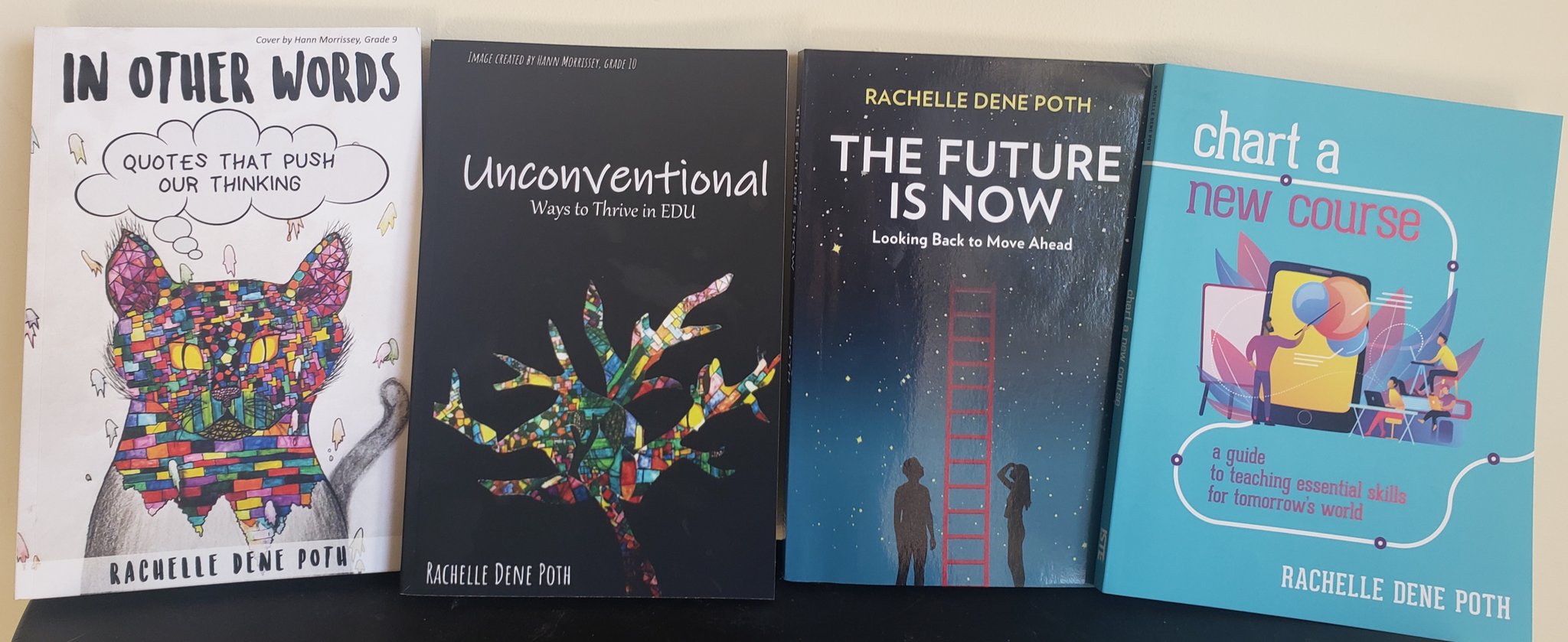
It has been quite a year. Three books published this year, looking back to one year ago as I was writing all three, very different books at the same time. But the book In Other Words came to me as I was preparing to work on The Future is Now. It stemmed from a quote:
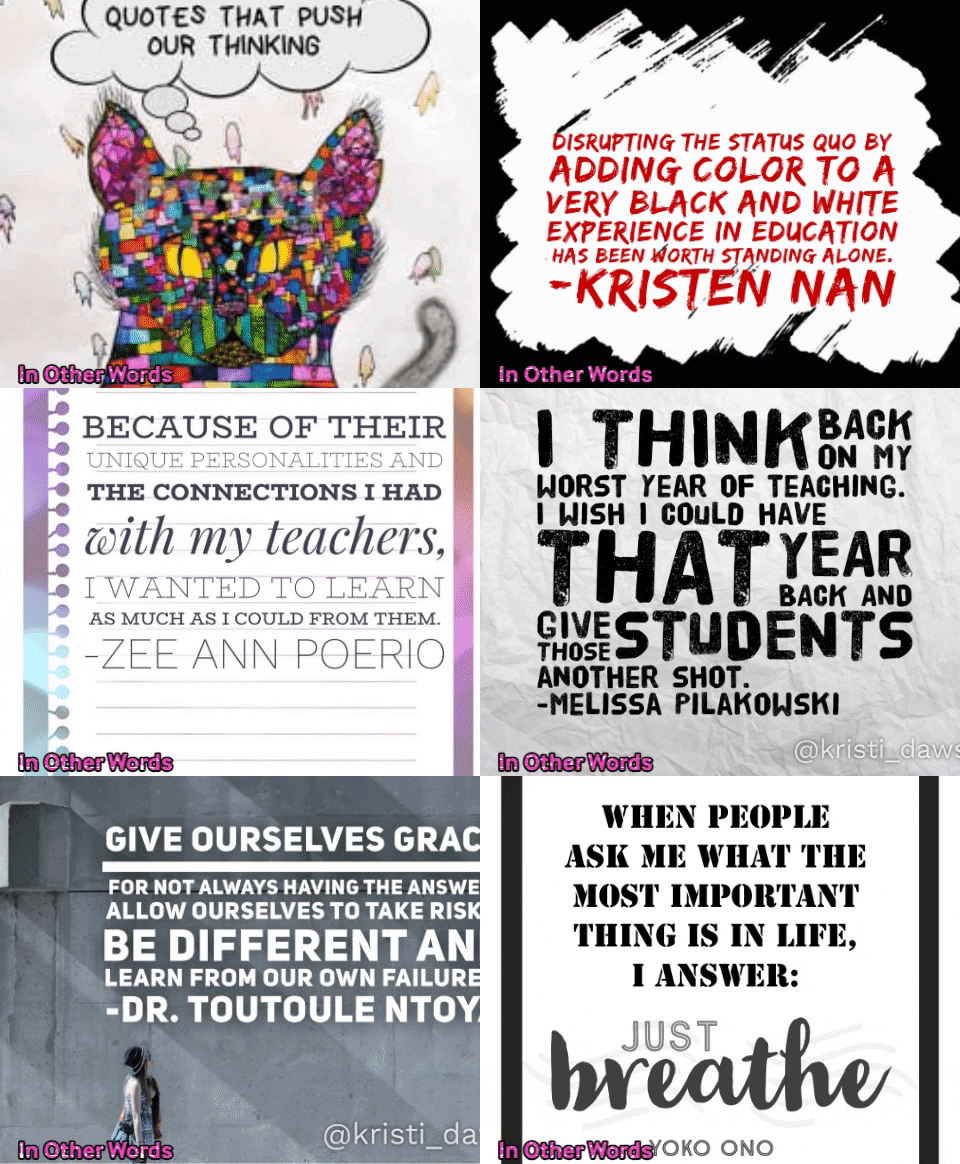
Teddy Roosevelt once said, “I am a part of everything I have read.” When I read his quote, it greatly resonated with me because of my love of quotes and the impact they can have in our lives. In Other Words is a book full of inspirational and thought-provoking quotes that have pushed my thinking, inspired me and given me strength when I needed it. The book shares stories around the importance of growing ourselves as educators, knowing our why, as well as learning from and embracing failures and taking risks with learning so we can become our best selves for those we lead and learn with.
There are stories shared by educators with different backgrounds and different perspectives. My own experiences and interpretations and the educator vignettes shared by my PLN (Personal or Professional Learning Network) will hopefully push your thinking, inspire you, and provide whatever it is that you need. My hope is that by sharing our stories, it will inspire you to share yours.
There were many people involved throughout this journey. I reached out to members of my PLN and friends to include as many educators and students as possible. I wanted to share more than just my story, but rather many stories and experiences. This book is one that can be read by anyone, not just people in education. There are many quotes, unique personal experiences, beautiful graphics and more.
About the book #Quotes4EDU
In this book, I share some of my experiences and reflections based on quotes. I have included the stories of different educators in the form of vignettes or guest chapters. One chapter was written by two of my students and my book cover was drawn by one of my 9th-grade students. The story behind the book cover is included at the beginning of the book. The book is available on Kindle or in paperback: bit.ly/Inotherwords A few of the stories are available for listening on Synth. gosynth.com/p/s/pyzbnm
Chapter Authors
Dennis Griffin
Maureen Hayes
Holly King
Elizabeth Merce
Melissa Pilakowski
Laura Steinbrink
Amy Storer
Donald Sturm
Cassy DeBacco
Celaine Hornsby
Vignettes
Marialice B.F.X. Curran
Jon Craig
Kristi Daws
Sarah Fromhold
Jeff Kubiak
Matthew Larson
Jennifer Ledford
Kristen Nan
Toutoule Ntoya
Paul O’Neill
Zee Ann Poerio
Rodney Turner
Heather Young
Graphics
Michael Mordechai Cohen
Dene Gainey
Manuel Herrera
Shelby Krevokuch
Amber McCormick
Dana Ladenburger
Heather Lippert
Scott Nunes
Chris Spalton
Tisha Richmond
Monica Spillman
Laura Steinbrink
Kitty Tripp
Julie Woodard
Recently I had a colleague ask me for some ideas for dealing with challenges when it comes to classroom management, student behaviors and just keeping up with the responsibilities of teaching in general. I’m always happy to have time to talk with other educators, there is so much to learn by connecting. I think sometimes there is an assumption that because someone may have been teaching for 10 or more years, or worked in the same school district for a long period of time, that’s there is a higher level of knowledge and skill held by a teacher that fits into this description. While of course the more that you teach, it might seem like you would have a lot of ideas and answers to share with younger or new to the school teachers, but the longer you have taught also means, I think, that you have that much more to learn.
Having taught for about the last 25 years, I’ve had a lot of different experiences, some good, some bad, some in-between and some just absolutely fantastic. I have been in the position where I needed to improve, and felt like no matter what I tried to do or could try to do, that I just would not succeed. That I would lose my job. I’ve also been at the opposite end where I felt like things were going well, I could feel more success and a change in how I had been teaching in the classroom and in my connections and relationships that I had built with the students and colleagues.
I think if you ask any educator, most can probably identify the best year they’ve had, and if they can’t, they just can’t yet. We always have room to grow and things take time. How do educators decide what makes it the best year? For some, is it a year without many challenges, the students are well-behaved, homework is complete, other clerical tasks and responsibilities held by the teacher are finished, observations went very well and teacher ratings are satisfactory or proficient or whatever the ranking may be? Maybe. But how do we truly define what would be the best year ever?
It takes time to build
I am fairly certain that last year was the best year I’ve had yet. I think because I changed a lot of things in my classroom, I stopped worrying so much about having every minute of every class accounted for and instead gave the students more possibilities to lead in the classroom and for me to have more opportunities to interact with them. Now it did not come without its challenges, some student behaviors that in some cases pushed me so far beyond frustration that I thought I reached my breaking point. I reacted in ways that I was not proud of, but I let the frustration get the best of me. I stopped seeing the student and only saw the behaviors. My “lens” had become clouded and it took some reflection and just not feeling very good about it for me to realize that I had to do something different.
The common feeling or response is when you feel like there is a lot to handle or come up with a plan for, can feel so isolating. you might feel lost or like others are judging you based on what you perceive to be your weak areas when it comes to instruction. And I’ve had a few people confide in me that they feel like they’re too different or too weird or they’re not normal enough to be teachers. Hearing those kinds of things breaks my heart because I don’t want to see teachers become disengaged or to lose their passion for doing the work that teachers do because of worrying about how others may or may not perceive them.
My response is always it’s good to be different, what does normal look like anyway? Does normal mean everybody gets and does the same thing? Does being normal mean you fit into some kind of mold, one that may or may not be who you truly are? I think the best that we can do for our students is to show them who we are because we want to know who they are.
We can’t hide behind some perceived idea or model of what a teacher should or should not look like. Nor should we compare ourselves to our colleagues or other teachers that we may have had in our own experience. When we do this we lose sight of something and I think it’s important for us to demonstrate and model for students. We need to worry about ourselves first and only compete with who we are today by judging it based on who we become tomorrow. Everyone has weaknesses, everybody struggles, everybody feels like they don’t belong at times, a friend once wrote about being in the land of misfits, I’m totally fine with that.
What can we do, regardless of what year we are in during our careers? New teachers have a lot to offer us veteran teachers, there are better pre-service teacher programs and more information available to current students that are seeking to get into the profession, than what is available to us veteran teachers, who may not have access to or may not even know they exist. And for the new teachers, when you are assigned to have a mentor in your school, I really don’t think you should consider it to be that you are the learner and that you must follow and adhere to all of the advice of your mentor. You have to decide who you want to be, what is your purpose, your why, your spark, your passion for doing what you’re doing?
It starts with us and it always starts with us to take that first step. We have to be okay with who we are and commit to doing whatever is best for our own personal and professional growth but being mindful of what that means and how it will impact those we lead and learn with.
So if at any time you feel down or lost or frustrated or like you’re becoming disengaged or that you don’t fit in, please send me a message. I’d love to talk to you and share some of my own experiences on my 25-year learning journey.
**Interested in writing a guest blog for my site? Would love to share your ideas! Submit your post here.
Looking for a new book to read? Many stories from educators, two student chapters, and a student-designed cover for In Other Words.
Guest post by Deidre Roemer, Director of Leadership and Learning West Allis, WI, @deidre_roemer
When I reflect on my skills as a teacher throughout my career, I can think of examples of what I did well and a million things I would have done differently. I am teaching a class at a local university this semester and know confidently that I am a better teacher now than I was when I was in the classroom. The opportunity to see other teachers in action in my leadership role for the last several years is what has made me better. I get to speak to educators and learners all the time about what is working well in their classrooms and what they would like to see grow. It includes spending time in many classrooms where we and others are getting it right and learners can articulate the process of their learning in order to create great things.
Professional development that is connected to a vision of our work with meaningful processing time to reflect is how we push teachers to move from single projects to true learner driven practice. We take a lot of teachers and teams on site visits to schools in our area and across our country who are already doing the kind of work we are trying to do to see it in action. It is hard to find a large comprehensive system that is there yet, so we are often at small charters of specialty programs that are offshoots of schools. The visits are always amazing as we are able to interact with teachers and learners and see learner driven practice, but often the most important part of the time is the meal after the visit or the long trip home where we can talk about what we saw, process, and plan for what parts we can implement within our system. The goal is not to replicate but to figure out how to ask the right reflective questions of ourselves and one another to tie what we saw to our personal passions and interests and figure out how to bring all of that together to shift the learner experience.
We also spend a lot of our time talking about how this is the kind of learning experience ALL learners should have. It should not be reserved for some kids in special programs or special schools. The visits with the deep discussions are often the leverage point that takes an educator from trying a few things to a true shift of practice that is more inclusive. It helps them to be more collaborative as they are often on these visits with other staff from across our district that they might not already know having a shared experience . The power in seeing some things we are already doing well and celebrating those helps us to not be overwhelmed when looking for ways to grow. The key is to make the time, take the staff who are ready to take some bold steps, and then follow up with them multiple times throughout the year so they have support to keep going with the work.
On a recent site visit, I took a chance and messaged some of the teachers to join us off-site after the formal conference to continue our learning. Fortunately, they were willing to take the opportunity to discuss their work with us over dinner. It was an impactful experience to listen to teachers that have been doing this work for some time engage in professional discourse about grading, telling their story and standards. The teachers were open about their own growth over time and how our staff could take pieces of what they saw back to our schools to create a more equitable opportunities for all learners through empowerment. We went back to the site the next day with a new lens on what to look for in learner and teacher observations that we could do instead of being lost in the surface things like the physical set-up. Things that may have looked idealistic the day before now looked possible. The modeling of professional discourse created space for our team to do the same and ask some great questions about how we can do this work and how it does not have to look the same across all our schools. Encouraging staff to push boundaries and challenge one another’s thinking is how we look at someone else’s professional practice and find a way to make it our own.
A few things we discover each time we do a site visit became apparent:
This work is messy. It takes deep dialogue on what is right for learners and how to give up control in a way that is not always natural for teachers.
Change is uncomfortable and unpredictable, but easier with the proper support. People tend to say, “Change is hard.” There was a great article from the Harvard Business Review in January of 2008 that explained why that phrase becomes a self-fulfilling prophecy that permits us not to try. We have to be able to think bigger than that.
We need to get more comfortable with professional discourse and open discussion about where we are now and where we can go that may push our thinking.
Teachers have to connect their own passion to their work in schools. When it is authentic to the teachers, it becomes authentic with the learners.
Our teachers need to see the work in action often and learn how to get and give productive feedback.
The standards are always embedded in innovative, learner driven work. They just aren’t always owned solely by the teacher.
Many times, the teacher in a learner driven classroom finds joy in their work.
We have evolved our district wide professional development to hopefully reflect all of these. Our teachers will have time in small groups to learn their standards well enough to empower learners to take ownership of mastery of those standards within cross-curricular projects. Staff will then have the opportunity to sign up to see another teacher modeling classroom practice that is learner driven. They will be our own internal site visits. We will use structured protocols to get and give feedback at each site to ensure we are using the time for genuine collaboration as we know that is what drives teacher practice. We can’t make more time than we have, so we use the protocols from The School Reform Initiative as a way to restructure the time and make sure it is used for purposeful feedback and collaboration.
Our teachers hosting visits that day have been invited to participate for the first round as they are already trying new things, having success with learner empowerment and finding joy in their work. It is not expected that anything that is “perfect” or a “show”. It is meant for one teacher to share their experience and encourage others to try new things with an open dialogue about how and what supports they will need. Our goal is that our teachers engage with one another to see what’s possible, work together to get there for every learner and find joy in the work.
**Interested in writing a guest blog for my site? Would love to share your ideas! Submit your post here.
Looking for a new book to read? Many stories from educators, two student chapters, and a student-designed cover for In Other Words.














 Learning as I go: Reflections & lessons learned