The Key to Reducing Burnout in K-12 Schools? Supporting Substitute Teachers

Guest post by Mike Teng, in collaboration with @SwingEDU

Teachers continue to experience high levels of burnout, at rates that are the highest of all industries. From lack of confidence to impacts on physical and mental health, we see signs of teachers at all stages of burnout in districts and schools across the country.

One acute challenge affecting teacher burnout is a limited pool of substitute teachers. With fewer people to relieve permanent teachers, K-12 leaders are left playing an increasingly challenging game of chess, moving students and staff around for continued coverage and learning.

The truth is that the same burnout teachers feel is hitting substitutes too. Being a substitute means living with unpredictability. They never know when an assignment will come, where it will be, or how long it will last. Then, when there is an opening they can fill, substitutes face more questions. Where do I park? Where can I keep my lunch? How long will it take me to get paid? Of course, many substitutes understand and accept the unknowns of their job. Quickly adapting to and learning in new environments is part of the package. But with the addition of stress from the COVID-19 pandemic, concerns about safety at school, and changes in students’ behaviors, among other factors, unpredictability is taking its toll.

The substitute shortage isn’t a new trend. Before the pandemic, districts struggled to find adequate coverage for absences. But according to a study from the Annenberg Institute, the problem has gotten worse. Today, 77 percent of districts have staffing problems because of unfilled substitute requests — up from about 20 percent pre-pandemic. Put those percentages in the context of nearly 600,000 substitute teachers covering 30 million teacher absences each year, and it’s easy to see the severity of the problem.

The challenge goes beyond the stress and anxiety of trying to find someone to fill a teacher’s spot for the day or week. Teachers remain one of the most important influences on student success, and unfilled absences can have a big impact on achievement. Schools may also be forced to have non-teaching staff to fill in, combine classrooms, or even group students in large spaces like the gym, cafeteria, or library with minimal supervision. In extreme cases, schools might have to close.

Better support for substitute teachers can help solve the problem. When substitutes are supported they are more likely to accept additional assignments, become quality placements, and stick with the profession over time offering more consistent relief to teachers. By adopting a few simple practices districts and schools can make their relationships with substitutes stronger.

Be welcoming

Substitute teachers are adept at stepping into new situations. Schools and districts often count on substitutes to be able to figure out information on their own, adapt on the fly, and keep their focus on providing students with quality instruction. But K-12 leaders can still meet substitutes halfway to create a more welcoming and supportive environment. A standard welcome packet can be something districts and schools make once and then use over and over with substitutes. Welcome packets could include information about parking, the teacher’s lounge, where to find lesson plans, contact information for key school staff, and timeframes for payments. Making digital PDF packets will make it easy to email the information as soon as a substitute accepts an assignment.

Provide peer connections

Most teachers and staff members in a building are friendly, but they’re also busy. If a substitute has a question during the day it can be hard to figure out who to ask. Assigning a peer to be a point of contact helps to eliminate the confusion. The point of contact’s role should not only be to answer questions but to make the substitute feel welcome. That could mean greeting the substitute when they arrive or checking in on them during the day. Creating peer connections for substitutes gives them a small dose of community support that can help them feel more confident during their assignment.

Show substitutes appreciation

It can be easy to see substitutes as only temporary staff members. But they are educators and important parts of students’ learning experiences. When we recognize substitute teachers and show them appreciation in ways we would for a permanent teacher it can build their confidence. One idea is to include a small note of appreciation in their welcome packet. Some leaders choose to follow up at the end of an assignment with a quick thank you email or give positive feedback during the day. For longer-term substitutes, including them in school-wide celebrations of educators and treating them the same as other staff members are effective steps.

Remove barriers to entry

Historically most substitutes were retired teachers or others in education who wanted to continue to give back. As fewer people choose the profession, we need different sources for substitutes. But the requirements to become a substitute teacher often create more barriers than doorways. We can make it easier for more people to become substitute teachers by building more pathways for people to enter the field. By finding better, more meaningful ways to assess instructional quality and classroom management skills, we can make substitute teaching more enticing to qualified people and simultaneously deepen the roster of available substitutes.

Caring for the well-being of substitute teachers is not only the right thing to do, but it also has a significant impact on the entire school community. When substitute teachers feel supported and valued, they are more likely to be reliable and committed, creating a more dependable pool of substitutes to draw on to fill absences. This, in turn, gives teachers the assurance that their class is in good hands and creates better retention of individual substitutes because they have confidence they’ll be welcome and supported at a school.

Mike Teng is the CEO and co-founder of Swing Education, a tech-enabled marketplace matching substitute teachers with schools in need. Before founding Swing, Mike was a software engineer in the private sector and then the tech director at a K-12 charter school network.

Learn more @SwingEDU

Blog of Rachelle Dené Poth

Looking for some PD for your school? I provide in-person and virtual training on the following topics. If you want to learn more about and explore AI and ChatGPT, contact me to schedule! Rdene915@gmail.com

**Interested in writing a guest blog or submitting a sponsored post for my site? Would love to share your ideas! Submit your post here. Looking for a new book to read? Find my books available at bit.ly/Pothbooks or via Amazon, Barnes and Noble, or EduMatch titles in bulk order.

Five ways to demonstrate learning

As educators, it is important that we provide a variety of options for students to develop their content area knowledge and skills in ways that meet their interests and needs. When choosing methods and tools to use, it is also important to create opportunities for students to develop social-emotional learning (SEL) skills as they are essential for personal and professional growth. 

Our decisions need to focus on helping students by designing assessments and ways for students to show what they have learned while also promoting voice and choice in learning. Depending on the types of methods and tools we use for our assessments, they must help students to identify where they are on their learning journey and provide us with evidence of student learning that we can use to provide feedback and additional resources for our students.  

Some questions to consider when deciding on methods or tools can be:

  • How can we promote more interactive and collaborative experiences for students?
  • Which tools assist us by providing access to real-time feedback?
  • What are some ways to promote more student choice in learning?

As educators had to seek new ways to assess students and provide opportunities for students to share what they were learning, ask questions, interact, and feel connected to a classroom community, many sought digital tools. Technology has provided many options for learning and enables educators to find something that meets each student’s needs and interests and sometimes even their comfort level.

It is important to convey to students why we choose a certain method or digital tool for use in our classroom and doing this helps us to stay clearly focused on our purpose. Consider how the method or tool will enhance learning or provide more benefits for students beyond being a way to practice the content or take an assessment.  The use of digital tools promotes collaboration, communication, creativity, and many more of the essential skills while also boosting student engagement in learning as they have the power of choice in how to share what they have learned.

Here are five ways for students to demonstrate learning. 

  1. Blogging: Blogging has been effective in my Spanish classes for years. With the digital tools available, it makes it easier for students to have a space to build their writing skills as they share ideas with their teacher and possibly their peers. Having students engage in blog writing also helps to promote the development of digital citizenship skills, especially if they have the opportunity to respond to classmates and provide feedback. One option that has been great to try with my students is Spaces. Using Spaces promotes communication and collaboration between teacher and student or it can be between students and include audio as well. 
  2. Data visualization: Being able to process information and create a representation of what has been learned helps students to better retain what they have learned. For visual learners, using tools to create a concept map or an infographic can help with processing a lot of information. With tools like Canva or Piktochart, students can choose from templates available to help them get started with designing an infographic. These tools and others like them to promote critical thinking skills and creativity as students decide how to best illustrate what they have learned. There are also options for students who prefer to not use technology such as drawing a concept map or creating a sketchnote to capture what has been learned. 
  3. Digital Storytelling: Whether at the beginning of a new unit or at the end, having students create something using one of the many digital tools available will help them to share their learning in authentic and meaningful ways. use of digital storytelling or making a video. My students enjoy using tools that offer multimedia options and libraries full of choices in characters, backgrounds, animations, and more to tell their story. Some of our favorites include BunceeBook CreatorGenially, and Story Jumper.  With several of these, students can even work together to create a presentation or a book to share with classmates. 
  1. Game-based assessments: Encourage practice and be able to provide feedback and more targeted lessons by using some of the digital tools available to do a pulse-check for where students are in the learning process. We can implement some hands-on games through flashcards, gestures, and conversations or leverage some of the game-based learning tools, such as Blooket, Gimkit, Kahoot!, Quizizz, and Quizlet Live!  Each of these offers a variety of question types or modes of play that will connect students with the content and provide us with real-time data to help plan our next steps and give meaningful feedback to our students.
  2. Interactive Lessons: Using tools that promote student engagement through the variety of content and activities that can be added to the lesson helps educators to better understand student progress and enables students to build self-awareness in learning. With tools like Edpuzzle, Formative, Nearpod, and Pear Deck, educators have many options for adding content and activities to help students to build their skills. What I really appreciate about tools like these is that we can provide students with a variety of ways to demonstrate their learning through open-ended responses, polls, multiple-choice questions, quizzes, and more, depending on the tool. Formative was a game changer in our classroom last year because I could use it to create lessons with videos and audio instructions that students could work through at their own pace. I could also use it in class for assessments which enabled me to provide timely feedback directly to students and adjust my lessons as needed. These options enable us to differentiate our instruction while promoting student choice in voice and learning. 

These are just some of the many ways that we can have our students demonstrate what they are learning. Whether through technology and the many tools available that facilitate communication, collaboration, and creativity, or using traditional methods, it is important to offer choices to our students. When we can provide options that promote agency in learning, it leads to more meaningful experiences that promote the development of essential skills for the future and empower students through self-driven learning.

Author

Rachelle Dené is a Spanish and STEAM Emerging Technology Teacher at Riverview Junior Senior High School in Oakmont, PA. Rachelle is also an attorney with a Juris Doctor degree from Duquesne University School of Law and a Master’s in Instructional Technology. Rachelle is an ISTE Certified Educator and serves as the past president of the ISTE Teacher Education Network.  She is the author of sevens books including ‘In Other Words: Quotes That Push Our Thinking,” “Unconventional Ways to Thrive in EDU” “The Future is Now: Looking Back to Move Ahead,” “Chart A New Course: A Guide to Teaching Essential Skills for Tomorrow’s World”, “True Story: Lessons That One Kid Taught Us,” “Your World Language Classroom: Strategies for In-person and Digital Instruction” and “Things I Wish [..] Knew.” All books are available on Amazon and at Barnes and Noble. 

I am available for PD sessions in-person and virtually on a variety of topics. Key focus areas are AI, ChatGPT, AR and VR, SEL, and STEM.

**Interested in writing a guest blog for my site? Would love to share your ideas! Submit your post here. Looking for a new book to read? Find these available at bit.ly/Pothbooks

************ Also check out my THRIVEinEDU Podcast Here!

Unfinished Business: A Different Peer Review Strategy

Guest post by laura steinbrink, posted in education

EVERY ROSE HAS ITS THORN

This strategy is based on Liz Lerman’s Critical Response Process, which has amazing potential even outside of its intended use. After reading her book on this process, I have been pondering ways to use this model with students of all ages, and with some restructuring according to the age or grade level of the student, I believe it is possible. To use this, students must be creating, writing, or have a product that is in progress or not complete, or maybe even a rough draft. Then, as students are in the process of creating, whether it be writing, artwork, research, project-based learning (PBL), presentation, etc., this process can help students refine their work with controlled peer feedback. There are three roles for this process, and if you have a small class, then you can do this whole group. For larger classes, you may need to conduct the process with the whole group as a model, and then break it up into smaller groups if necessary.

JUST LIKE EVERY NIGHT HAS ITS DAWN

The purpose of this strategy is not to “fix” the student’s work, but to provide questions to clarify areas that need more work and statements to point out strengths of the work in progress. This is actually the hardest part for me, as I am generally in “fix it” mode. This is also the part that needs to be addressed up front with the students the first time you do this with them. They are not to offer ways to fix any part that the creator is struggling with but to come up with questions to ask the creator about those issues that will help them come up with their own solution. In step 5 below, you could allow an opinion to contain a “here’s what I would do,” but the creator is still the one deciding whether or not to accept or act on those ideas.

JUST LIKE EVERY COWBOY SINGS HIS SAD, SAD SONG

What is particularly striking about this process or strategy is the potential for students to truly see that the process of creating is important, there’s usually more than one right way to do something, the class can truly be a learning community, and that revising work is a natural part of the creating process. Students often get into the rut of the “one and done” mode. We write a paper, create a product, paint a picture, and then turn it in and move on. This occurs even when we use our beloved rubrics. I have conducted workshops on how to effectively use rubrics, like the single-point rubric, and teachers have complained that they hand back a rubric and the student looks at it and tosses it in the trash. My question to all who have experienced this is, “Was there a grade on it?” If so, that’s the feedback the student wanted. No need to reflect. A teacher in my previous district pointed out that she handed back the rubrics and a student looked at it and crumpled it up, and that the student was my son. I asked him about it later, and he said, “It had a 100% on it. What did I need to look at or do with the rubric?” Right. No need to reflect at that point is a common student reaction. I encourage not putting grades on rubrics, instead, it is better to use them to guide instruction and feedback in the process of creating the work.

EVERY ROSE HAS ITS THORN

The Unfinished Business strategy can help students see that revising as we go is a common and productive practice. Research shows us that reflecting is a powerful learning strategy, so what better way to teach it than to have students reflect on feedback to find ways to improve and revise the work in progress? According to John Hattie and Helen Timperly, feedback is the “consequence of performance.” So to elicit strong feedback to help learners value the creation and revision process, try the strategy below and adjust as needed to fit your learners.

Role 1: Artist/Maker

Offers a work-in-progress for review and is prepared to examine the work critically in conversation with other people.

Role 2: Responder

Commits to the artist/maker’s intent to make excellent work. They question and respond to questions. They want the artist/maker to do their best work.

Role 3: Facilitator

Initiates each step, keeps the process and students on track, and works to help the artist/maker and responders frame useful questions and responses. The project rubric, if you have one, would be helpful here. Students can either form questions based on the criteria or you can have premade questions from the criteria that students can ask. Giving students a question to ask when first trying this or each time it is tried can really help get a productive conversation going. Those questions would be scaffolds for the responders. Most questions they will need to generate independently and need to be useful to the artist/maker.

Step 1: Artist/Maker shares the work in progress or a part of the work that they are struggling with or aren’t sure of at that moment in the creation process, or even after a draft or prototype has been completed.

Step 2: Responders then respond to what was meaningful, surprising, interesting, exciting, and/or striking in the work they have just witnessed, heard, read, etc. Each responder verbally or on a sticky note writes one positive response to the work. They cannot use “I like” or “I love” in the statement. Instead of saying/writing “I like the way you…” students write or say things like “Your thesis statement is strong and engaging” or “The color choice really complements the piece,” depending on the type of work being reviewed.

Step 3: The artist/maker then asks any questions they may have about the work. In answering, responders must stay on topic with the question and may only express opinions in direct response to the artist’s questions. This might be tricky, so after a practice round or two, determining a limit on the questions the artist/maker may ask might help with the facilitation. Time constraints in general mean that having the artist ask 1-3 questions would prevent the process from dragging on, which is important for the engagement of the responders. All responders should write down a response and the artist/maker can choose one or two to call on verbally. The artist receives all written responses also. On the same sticky note, (Use one or two per student responder for each session.)

Step 4: Responders write out neutral questions about the work on the same sticky note, and the artist chooses 1-3 students to ask their questions and then they respond to those questions.

Questions are neutral when they do not have an opinion added to them. This step is one of the most fundamental, challenging, and misunderstood steps of the Critical Response Process as noted by Liz Lerman. The questions are focused on anything unclear, confusing, complicated, or too simplistic about the work and should promote critical thinking among the responders. This part of the process is meant to provide the artist/maker with areas to consider for improving the work. The artist/maker has ultimate control over the end product, and responders are not there to “fix” the work, so they should not include solutions. The “fixers” in your classroom may struggle with this, so be prepared to help them suppress that instinct.

Step 5: (Optional-if time permits) Responders state opinions about the work in progress, given permission from the artist; the artist/maker considers the opinions but has the option to say no. Here is where you could include “fix it” ideas from those students who are your “fixers.” This round may be best if it is oral and not written down. The artist/maker calls on one or two responders, and again, the decisions lie with the artist/maker to accept one, some, all, or none of the proffered suggestions.

YEAH IT DOES

Students who are in the role of responder will still get a lot out of this process. The artist/maker will as well. This will provide the motivation to reflect on the work and then revise it. This is the beauty in this strategy for me, as there are times when getting students to review, edit, or revise their work is like Sisyphus rolling his rock up the hill each day. Again, revise this as needed for younger learners. This strategy can also promote an inclusive and safe learning environment when done properly (manage unhelpful criticisms), which can lead to students taking academic risks. Set up time in your pacing guide for this in place or in addition to any peer review feedback activities that are already built-in, and then do the strategy. It could work as a one-day weekly activity or as needed. The goal is for students to manage their own learning, and you will know you have achieved that goal when students start requesting the strategy to receive help with their work. Good luck, and tag me on Twitter or comment below if you find it useful.

Hattie, J., & Timperley, H. (2016). The Power of Feedback. Review of Educational Research. https://doi.org/10.3102/003465430298487

HEADINGS ARE PARTIAL LYRICS FROM EVERY ROSE HAS ITS THORN BY POISON.

Source: LyricFind
Songwriters: Bobby Dall / Bret Michaels / Bruce Anthony Johannesson / Rikki Rocket
Every Rose Has Its Thorn lyrics © Universal Music Publishing Group, Warner Chappell Music, Inc

**Interested in writing a guest blog for my site? Would love to share your ideas! Submit your post here. Looking for a new book to read? Find these available at bit.ly/Pothbooks

************ Also check out my THRIVEinEDU Podcast Here!

Join my weekly show on Fridays at 6pm ET THRIVEinEDU on Facebook. Join the group here

Spring Ideas to Boost Engagement!

The start of a new year is a great time to ​think about the progress we have made so far this year and consider trying some different methods and tools in our classrooms. Taking time to reflect on what has worked, what we have not tried, and areas, where we may be having some challenges, is important. We want to continue to reflect and implement new strategies and tools that will benefit our students and transform learning.

Just like at the beginning of a new school year, focusing on the continued building of relationships is essential year-round. To do so, we have to be intentional about evaluating our teaching practice and the opportunities that we provide for our students. For our personal and professional growth, we need to make time for ​reflecting on our daily work as ​​educators​. What are some areas that we notice where we have grown in our practice? Are there some methods or tools that we have on our list but have lacked the time to try? Have we asked students for feedback about their experiences in our classroom and what helps them to learn best? I think that this is important for our practice. Using surveys and having conversations with students makes a difference. There are even great tools available for educators to use such as LessonLoop, which helps teachers to better understand student engagement and their specific needs in our classrooms.  Another tool that helps educators to really focus on their methods and classroom interactions is Edthena, a virtual coaching platform. Teachers can record themselves teaching a lesson and then the AI Coach uses prompts to guide you about your lesson and what your perception of their effectiveness was. With videos, we can go back and focus on specific parts of our lesson, and our delivery and then use this to guide our reflection.

Taking time to reflect is important so that we can start the new year fresh. Now is the perfect opportunity to dive in and start the new year off with some fresh ideas! By choosing some methods or focus areas and then leveraging different tools, we can transform student learning and provide opportunities for building essential skills such as SEL. The power of choice not only helps students to build content area skills but also will lead them forward into their future careers with a variety of skill sets. With different tools and methods, we can spark curiosity for learning and foster creativity in learning!

For educators, this means we have to be willing to try new ideas, make mistakes and try again. Doing this sets a good model for our students. We want them to become more comfortable with learning and making mistakes and the process of learning itself.

Choosing methods in our classrooms that help to foster joy in learning and also foster the development of social-emotional learning (SEL) skills, will benefit students now and in the future. Being able to master the content while also developing skills that enable students to collaborate and develop strong and supportive relationships are important for future workplace success.

One thing to keep in mind is to find ways to streamline the workflow and the types of methods and tools that we are using. We want to provide choices but not overwhelm students in the process. Finding methods and tools that are versatile and applicable to different content areas and grade levels is key.  Here are four ideas to start with:

  1. Elementari is a tool we started to use this year and it has been fun seeing what the students create. There are many options available with Elementari, including the option for students to create an interactive story and build their skills in coding. There are more than 10,000 illustrations and sounds available to choose from.
  2. Genially can be used for genius hour, project-based learning (PBL), interactive lessons, and more. We have used it in my Spanish and STEAM classes for projects and I have used it personally for creating resumes, digital portfolios, and even presentations. Students can work individually or together on a collaborative presentation which also promotes digital citizenship skills too! Genially has thousands of templates to choose from with options for STEM and more.
  3. Spaces EDU is a great tool that teachers can use individually and create different types of “spaces.” There are individual, class, and group spaces through which teachers and students can collaborate and communicate using multimedia options. With an individual space, students can share their learning with teachers in a space where they are able to build confidence in learning. Individual spaces work well for methods like genius hour and PBL or for checking in with students.  A group space has been fun for doing activities in stations or a collaborative PBL or even something fun like a scavenger hunt. Spaces EDU also has curriculum tags and more that help teachers to connect the curriculum to the activities created in Spaces.
  4. STEM-related: There are some new resources we have explored this year including iBlocksPBL which helps educators to dive into PBL and students can learn about relevant topics related to the SDGs that help them to develop essential SEL skills, especially in the competencies of self-awareness and self-management. A few years ago I used Hummingbird Robots with my STEAM class and more recently, we used the Finch robots from Birdbrain Technologies. Teachers can use these tools in any content area and have students create something to reflect what they are learning in class while building coding skills and even learning about AI. These are just a few to explore in your classroom.  If you are interested in PBL, SEL, and STEM, any of these options would help to focus on those areas with the use of one tool. Involve students in the conversation and see what the impact is of using the different methods like genius hour or PBL or trying one of these tools. And for our own growth, using a survey created with Google or Microsoft Forms, or trying the LessonLoop student engagement survey, can help us to plan with our students’ interests in mind and continue to reflect on our practice. Taking risks and facing challenges along the way is a great model to set for students!

About the Author:

Rachelle Dené is a Spanish and STEAM: What’s nExT in Emerging Technology Teacher at Riverview High School in Oakmont, PA. Rachelle is also an attorney with a Juris Doctor degree from Duquesne University School of Law and a Master’s in Instructional Technology. Rachelle is an ISTE Certified Educator and serves as the past president of the ISTE Teacher Education Network. She was named one of 30 K-12 IT Influencers to follow in 2021.

She is the author of seven books including ‘In Other Words: Quotes That Push Our Thinking,” “Unconventional Ways to Thrive in EDU”, “The Future is Now: Looking Back to Move Ahead,” “Chart A New Course: A Guide to Teaching Essential Skills for Tomorrow’s World, “True Story: Lessons That One Kid Taught Us” and her newest book “Things I Wish […] Knew” is now available at bit.ly/thingsiwishedu.

Follow Rachelle on Twitter @Rdene915 and on Instagram @Rdene915. Rachelle has a podcast, ThriveinEDU available at https://anchor.fm/rdene915

**Interested in writing a guest blog for my site? Would love to share your ideas! Submit your post here. Looking for a new book to read? Find these available at bit.ly/Pothbooks

************ Also check out my THRIVEinEDU Podcast Here!

Join our weekly show on Fridays at 6pm ET THRIVEinEDU on Facebook. Join the group here

Response to Intervention (RTI): An Introduction

Guest post by Dr. Shelly Vohra in collaboration with @ClassComposer

Response to Intervention (RTI) is a strategy geared towards students who face learning challenges. Students struggle for a variety of reasons and it’s important to understand why these students are struggling and the best way to create a learning path so that they are successful and feel good about themselves. The premise behind “interventions” is to ensure that students receive the supports they need so that the gaps in learning are not exacerbated. It is important to note, however, that “gaps” should not be seen as deficits; rather gaps are areas of growth for students and each student has their own areas of growth based on a wide range of assessments. I, personally, have an issue with the term “gaps” but that is a topic of discussion for another time. It is also important to know that RTI is not a program; it is an approach that identifies student needs based on collecting data from various sources and in a variety of ways and then identifies and applies relevant instructional strategies to develop those skills in students.

Gathering and accessing data

When it comes to data, there are many sources available for educators to learn about the needs of individual students. Being able to gather all of this information, sort through it, share it with other teachers, and develop a plan can take time. Not having a streamlined space for this makes it challenging. With Class Composer, educators have everything they need to be able to monitor student progress. The information is readily accessible to anyone, at any time. It enables all teachers to access the information they need about each individual student when they need it.

With Class Composer, it is easy to track and record student growth toward individualized goals and share this information within your PLC to best provide for all students. Simplify how you manage all the assessment data collected!

Supporting teachers to support students

As it is, one of the most important parts of the RTI process is to build a team to effectively support students who are struggling. The team should include classroom teachers, administrators, teachers who support special education students and those students who are learning English, the school psychologist, speech-language therapist, and parents. Teachers provide targeted teaching and then use formative assessment practices to determine if the intervention strategies are working.

With Class Composer, it makes it easier for teachers to have access to all this information in one space. It enables teachers to create a supportive learning community for students. These teacher-student connections lead to the development of the essential relationships that need to exist for all students to be successful. The simplified space creates a better way for teams to collaborate and access the information they need when they need it.

If they are not working, the team must decide how they will adapt and modify their instructional practices to ensure that students are indeed learning and growing. A significant aspect to keep in mind is that formative assessments inform us of what we must do to ensure student success, not what the student needs to do. In other words, how are we adjusting our practice to best support students? Assessment informs instruction; it is our responsibility to continuously revise what we are doing so that students meet the learning goals related to curriculum standards and expectations.

Even though there is no one correct way to implement RTI, it is a three-tiered approach and you can think of it as a pyramid in which each tier increases in the intensity of support. They are:

(1) whole class

(2) small group, and

(3) intensive interventions.

Some school boards call this a multi-tiered system of supports or MTSS. Although there are many benefits to this approach, I also see several problems and issues arising from the basic foundation upon which RTI and MTSS were built.

I will be discussing these issues in future blog posts as well as digging deeper into this system of support and how to best implement this framework so that all students succeed, grow, and have positive self-worth.

About the Author

Dr. Shelly Vohra is an educator, coach, and consultant. Dr. Vohra teaches undergraduate and graduate level courses in Technology and Mathematics as well as working with students who are learning English. She holds an M.Ed in Adult Education & Distant Learning and a Ph.D. in Educational Technology. Dr. Vohra has over 20 years of experience in education (K-12) teaching various subject areas. Dr. Vohra has written several courses related to Indigenous Education, Multilingual Learners, and Mathematics.

Most recently, she was on a writing team that revised the Science Curriculum (K-8) for Ontario. She has presented at various conferences in Canada and the U.S.A. Dr. Vohra’s work includes designing learning experiences for students through an integrated curriculum lens that combines inquiry with equity. Her research interests include social media in education and blended learning, Dr. Vohra is currently writing a book on her journey. You can find her blog at https://techdiva29.wordpress.com/. Her website will also be launching in late Fall. You can also follow her on Twitter @raspberryberet3 and on Instagram @elevate_ed_21.

**Interested in writing a guest blog for my site? Would love to share your ideas! Submit your post here. Looking for a new book to read? Find these available at bit.ly/Pothbooks

************ Also check out my THRIVEinEDU Podcast Here!

Join my weekly show on Fridays at 6pm ET THRIVEinEDU on Facebook. Join the group here

Preparing students with essential skills

In preparing students for the essential skills they need for the future, we have different methods and digital tools that we can bring into our classroom space. But what skills do students really need? 

A great resource to explore is the skills outlook provided by the World Economic Forum. The top skills cited include emotional intelligence, collaboration, communication, creativity, critical thinking, and problem-solving.

What is important to note is that these skills align with the five core competencies of social-emotional learning (SEL) skills of self-awareness, social awareness, self-management, relationship building, and decision-making.  

Because of the changes that we experienced in the past year, I believe that it is important to have various options, whether teaching in-person, hybrid, or virtually. Choosing methods like Genius hour or project-based learning, activities such as scavenger hunts or learning stations, or selecting digital tools that promote more interaction with and between students will help foster the development of essential future-ready and SEL skills.

How to foster the development of future-ready skills

Educators might wonder how to build SEL activities into the classroom and whether it takes a lot of time. Depending on the methods or tools chosen, some of them do require more planning and preparation initially, but there are so many benefits that the time is definitely worth it.

Here are four methods to consider: 

Digital breakouts and Escape rooms

These have become more popular over the past few years. Even during virtual learning, they can be a great way to have students work together and build skills of collaboration, communication, problem-solving, and critical thinking. Using breakouts and escape rooms is also beneficial for the development of social-emotional learning skills as well. There are a lot of ready-to-use games available to get started with.


Read more: Fostering the development of SEL skills in your classroom


Genius hour

With Genius hour, students explore an interest or a passion. It is focused on inquiry-based and student-driven learning, and infuses more student choice and student agency. Students have a chance to “Share their genius” with classmates. Genius hour builds student curiosity, encourages collaboration, and will help students to become more confident as they explore on their own and share their knowledge.

Learning stations

When I changed my classroom a few years ago and changed the rows into stations, there were many benefits for students and my own practice. With stations, using a mix of hands-on materials and digital tools enables students to experience more personalized learning and promotes the development of SEL.

It enables educators to develop a better understanding of where each student is on the learning journey to better plan for their lessons. Using stations also creates a collaborative classroom community where students can engage in activities with their peers, which supports building self-awareness, social awareness, and peer relationships.

Project-based learning

With methods like project-based learning (PBL) or problem-based learning, students drive their own learning, leading them to become more independent and have choices that lead to more authentic and meaningful opportunities.

It helps them to develop self-management skills in particular when setting goals for their research and dealing with any that come with independent work like PBL. Giving students the chance to explore something of personal interest or curiosity, promotes independence in learning, builds student agency, and also helps us to learn about their passions and interests, which assist us in designing learning activities with them in mind. As educators, we must focus on connecting them with the world and preparing them for whatever they decide to do in the future.


Read more: 10 DOs and DON’Ts in Project-Based Learning


Using technology to build future-ready skills

Especially during the past school year, digital tools helped facilitate learning in many different settings. Choose one or two versatile tools that will promote student choice and empower them to move from content consumers to creators.

Here are three ideas using digital tools:

  1. Interactive lessons: With some of the platforms available, we can keep students engaged in learning by including a variety of activities that promote collaboration, discussion, and creativity in learning while they build skills in the content they are learning. Some of my favorites include using Formative, Google Jamboard, Nearpod, and Classkick, all of which are beneficial for connecting students in learning, whether in-person or remote, and which enable educators to have access to data or information about where students are in the learning process.
  2. Multimedia presentations: Students can develop vital technology and digital citizenship skills as they learn to create multimedia presentations to demonstrate learning. Our favorites include using tools that offer options for all students that meet their specific interests and comfort levels with technology. Check out Buncee, which has designed an SEL toolkit with ready-to-use template activities for grades K-6 and 7-12 in addition to having thousands of ideas for classroom use and more than 38,000 items in their media library. Using a tool like Wakelet enables students to include images, text, Flipgrid short videos, and other links to share with classmates and their teachers. It is simple to get started with, and it offers students the chance to create their own lesson or even a digital portfolio to show their learning journey. Book Creator is another option for having students collaborate on a book and include audio, video, text, images, and more and build SEL skills. Read more: 8 Digital tools for engaging classroom presentations
  3. Digital portfolios: Spaces offers a digital portfolio platform that assists teachers in better understanding students, their interests, and their needs in learning. Digital portfolios help students to develop SEL skills of self-awareness and self-management. Having students share their portfolios with classmates is also helpful for building relationships and social awareness. The benefits of portfolios are that students track their growth over time and can identify strengths and areas where they can set new goals.

There are many methods and tools to explore, but it’s important to focus on the why behind the choices we make for our students. The use of digital tools promotes collaboration, communication, creativity, and many more essential skills while also promoting the power of choice for students to share what they have learned.

**Interested in writing a guest blog for my site? Would love to share your ideas! Submit your post here. Looking for a new book to read? Find these available at bit.ly/Pothbooks

************ Also check out my THRIVEinEDU Podcast Here!

Join my weekly show on Fridays at 6pm ET THRIVEinEDU on Facebook. Join the group here

Close Your Eyes

Guest post by Brian Kulak @bkulak11

It’s a short list, but the older I get, the longer it becomes. 

Jeff Buckley’s “Last Goodbye.”

Pearl Jam’s “Release.”

James’s “Out To Get You.”

Regardless of where I am (except in the car; I’m not a lunatic) or what’s happening in my life, there are certain songs that make me close my eyes. A reaction both genuinely involuntary and intimately purposeful. A strange, dichotomous shutting off of one sense in favor of another, telling our eyes to sit this one out while our ears do the heavy lifting. 

And then there’s the goosebumps. The sensation, dubbed frisson, is triggered by a dopamine flood measuring 4-5 seconds associated with seeing, hearing, or experiencing something that triggers an emotional response. Interestingly, the brain elicits the same reaction to fear. 

I like to think about it as moment recognition. My conscious decision to dim everything else in an effort to brighten the experience of a deeply personal, infinitely resonant moment in my life. But in order for it to take hold, to really matter, I have to remember that moment, often at a random, unrelated or loosely connected time. 

So I do. 

And it works. 

Now, while I don’t walk around my school, eyes shut, meditating on moment recognition, the practice itself has made its way into my leadership. Instead of song lyrics, however, it’s small moments with kids, staff, and community. 

When a kindergartener found out he would be repeating this year, he said, “it’s okay. I love kindergarten, and Mr. Kulak is my best friend.” 

When I responded to a Twitter question about leadership catchphrases, a teacher chimed in that I often say, “I trust you” and don’t even realize it. Now, I do. 

During the promotion, a Tatem OG, whose final child was leaving, approached me sheepishly and asked for a hug. I told her to bring it in, and she cried while we hugged. 

Education, unlike any other profession, is a mosaic of these experiences. Without the predictability or isolation of other fields, we have daily opportunities to create and store these brief moments of zen. And the best part? They will always include other people.

So do it. Find small moments for which you close your eyes, literally or figuratively, and store them up. There will come a time, and it might be soon, when you want to close your eyes because of frustration or fatigue, and when you do, behind your eyelids and just within reach will be these moments of frisson. 

Close your eyes. 

**Interested in writing a guest blog for my site? Would love to share your ideas! Submit your post here. Looking for a new book to read? Find these available at bit.ly/Pothbooks

************ Also check out my THRIVEinEDU Podcast Here!

Join our weekly show on Fridays at 6pm ET THRIVEinEDU on Facebook. Join the group here

Creating a Learner-Centered Classroom

Guest blog by Kellie Bahri @Kbahri5

As a teacher in elementary school, I’m passionate about making the classroom a fun and engaging place where students can take charge of their own learning. The Learner-Centered approach puts students in the driver’s seat and encourages them to be more involved in their own education. This type of classroom is designed to fit each student’s needs, interests, and abilities.

Student-centered learning empowers students to take control of their own education by allowing them to explore topics, generate questions, and find answers on their own. This type of learning helps students develop critical thinking skills and encourages them to take an active role in their education. When students are given the freedom to direct their own learning, they are more likely to be engaged, motivated, and develop a deeper understanding of the material.

It has been demonstrated through research that a Learner-Centered Classroom can significantly enhance the motivation, engagement, and success of students. By adopting a student-focused approach, educators are able to facilitate the development of important skills such as critical thinking, problem-solving, and self-reflection in their students. With this student-centered approach, students will become more confident and empowered learners.

The implementation of seven key strategies can help the transformation of a conventional classroom into a student-driven learning environment, in which students are equipped with the skills necessary to take a lead role in their education.

Student-led discussions

I encourage my students to lead discussions in class by sharing their ideas and perspectives. I use strategies such as Think-Pair-Share or Socratic Seminar discussions to facilitate student-led conversations. During these types of discussions, students are given the opportunity to share their thoughts and engage in active listening with their peers. This type of student-led discussion promotes critical thinking and helps students develop strong communication skills.

Collaborative learning

 I encourage my students to work together in small groups or pairs on projects, assignments, or activities. Collaborative learning helps students develop important skills such as communication, teamwork, and problem-solving. I use techniques such as Jigsaw or Group Concept Mapping to encourage my students to collaborate and share ideas and I use online collaboration tools such as Google Classroom or Schoology to allow my students to work together on projects from anywhere. This type of learning not only promotes social and emotional growth but also helps students understand and retain information better through shared exploration and discussion.

Choice-based learning

 I believe in offering my students a range of learning options, allowing them to choose activities that interest them and align with their learning styles and passions. Choice-based learning is a student-centered approach that empowers students to take the lead in their learning. I use centers, stations, or choice boards to provide my students with a variety of options and let them choose what they want to work on. This type of learning creates a more engaging and personalized learning experience for each student and enhances student’s’ organizational skills. 

Inquiry-based learning

 Inquiry-based learning is a student-driven approach where students are encouraged to ask questions and engage in their own investigation to increase their critical thinking and problem-solving skills. I use prompts such as “I wonder…” or “How can we find out…” to support inquiry-based learning, and provide opportunities for students to engage in hands-on activities, simulations, and experiments to support their investigations. And to make the process even more meaningful, I encourage students to keep a student inquiry journal where they can jot down all their curious questions about the world around them. This journal not only helps them keep track of their progress, but it also gives them a sense of ownership over their own learning journey.

Project-based learning

Project-based learning, a hands-on method of education where students engage in real-world projects that showcase their knowledge and skills, can lead to a deeper understanding of the material and increased engagement in the learning process. By working on challenging projects that require critical thinking, problem-solving, and application of knowledge, students can see the relevance of their education and make connections to the world around them. This approach aligns with the Sustainable Development Goals (SDGs) as it promotes active, meaningful learning and the development of skills that are essential for success in the 21st century. Examples of project-based learning activities may include creating a podcast, designing a website, or constructing a model of a historical landmark.

Self-reflection

I encourage my students to reflect on their own learning process and to think about how they can improve. This type of self-reflection helps students to understand their strengths and weaknesses and to set goals for themselves. By regularly reflecting on their own learning, students can better understand how they learn and how they can become more effective learners.I use online journaling tools such as Flip, SeeSaw, or Kidblog for students to document and reflect on their learning experiences.

In-class projects

I assign in-class projects that allow my students to apply the concepts and skills they have learned in class in a hands-on and engaging way. These projects can involve independent or group work and can be used to reinforce the material covered in class. For example, a student might create a poster or model to demonstrate their understanding of a particular subject. In-class projects give students the opportunity to be creative and to showcase their learning in a tangible way. This type of project also helps students to develop important skills such as research, collaboration, and presentation skills.

Imagine being in a classroom where the focus is on you and your learning journey. It’s all about empowering students to make the most of their education, and helping them understand the importance of what they’re learning. That’s what makes a Learner-Centered Classroom so special. A learning space for students to actively participate and be engaged is key to inspiring students and sparking a lifelong love for learning.

Kellie Bahri is an experienced instructional specialist, teacher, and children’s book author. With over a decade of experience in education, she has successfully implemented innovative instructional strategies resulting in improved student performance and engagement. As Elementary Teacher of the Year for 2020-2022, her dedication to education and creative teaching methods are highly regarded. Kellie also uses her writing talent to inspire a love of learning in young readers through her children’s book. Her goal is to make a positive impact on children’s lives and help them reach their full potential.

About the Author

Kellie Bahri is an experienced instructional specialist, teacher, and children’s book author. With over a decade of experience in education, she has successfully implemented innovative instructional strategies resulting in improved student performance and engagement. As Elementary Teacher of the Year for 2020-2022, her dedication to education and creative teaching methods are highly regarded. Kellie also uses her writing talent to inspire a love of learning in young readers through her children’s book. Her goal is to make a positive impact on children’s lives and help them reach their full potential.

**Interested in writing a guest blog for my site? Would love to share your ideas! Submit your post here. Looking for a new book to read? Find these available at bit.ly/Pothbooks

************ Also check out my THRIVEinEDU Podcast Here!

Join my weekly show on Fridays at 6pm ET THRIVEinEDU on Facebook. Join the group here

Chicago by Hedreich Nichols

Guest post

Listen to Smallbites via Hedreich Nichols, @Hedreich

This week is part two of the SmallBites Black History series. It could aptly called “Beyond the Struggle”. When I think of June and Pride celebrations, there is so much joy. Yes, there is talk of Stonewall and the fight for human rights, but there is a joy that we are missing in February. I believe that comes from the focus on our civil struggle and a lack of knowledge about the many achievements of people from the African diaspora in America.

Let Your Students Do the Sleuthing

I invite everyone to take time, this month especially, to celebrate all that Black Americans have accomplished in the face of insurmountable odds. Did you know that most enslaved people were freed with no education, no restitution and no path to transition from enslavement to freedman in a hostile environment? And yet, there have been notable achievements in every sector, achievements that are not widely known. Since this month is dedicated to Black History, allow your students to research Black business owners, scientists, writers, inventors, choreographers, educators, politicians, generals, etc. Discuss who they find and allow your students to take the lead. I’m hoping that will be acceptable even in today’s climate.  There is so much to celebrate and Black achievement in the US is so much deeper than Civil Rights and Soul food.

Who Wants to Join Me??

If you do find someone especially interesting to celebrate, I’d love to interview one or two Black History super sleuths this month for SmallBites. Message me at 5smallbites@bluewin.ch.

You can read more about Bronzeville in one of 3 of my social justice titles for Cherry Lake Publishing, From Black Wall Street to Allensworth

You can read more about the humanitarian crisis of emancipation from Professor Downs’ book, Sick From Freedom.Post navigation

Check out the podcast here.

**Interested in writing a guest blog for my site? Would love to share your ideas! Submit your post here. Looking for a new book to read? Find these available at bit.ly/Pothbooks

************ Also check out my THRIVEinEDU Podcast Here!

Join my weekly show on Fridays at 6pm ET THRIVEinEDU on Facebook. Join the group here

MTSS Part Two: Essential Components of MTSS

Guest post by Bonnie Nieves, in collaboration with Class Composer

In the previous blog, I outlined the first step of initiating Multi-Tiered System of Supports (MTSS), a framework designed to meet the needs of each and every learner in a school district. When your school community has completed its inventory of instructional tools and supports for academic, behavioral, and social-emotional learning, it is time to move on to putting these resources into action. 

The next steps include planning for three essential components of MTSS: 

  • Instruction that includes academic, behavioral, and SEL learning opportunities for all students.
  • Assessment tools that measure the effectiveness of this instruction.
  • Ensuring that your master schedule has space for per diem support for students.

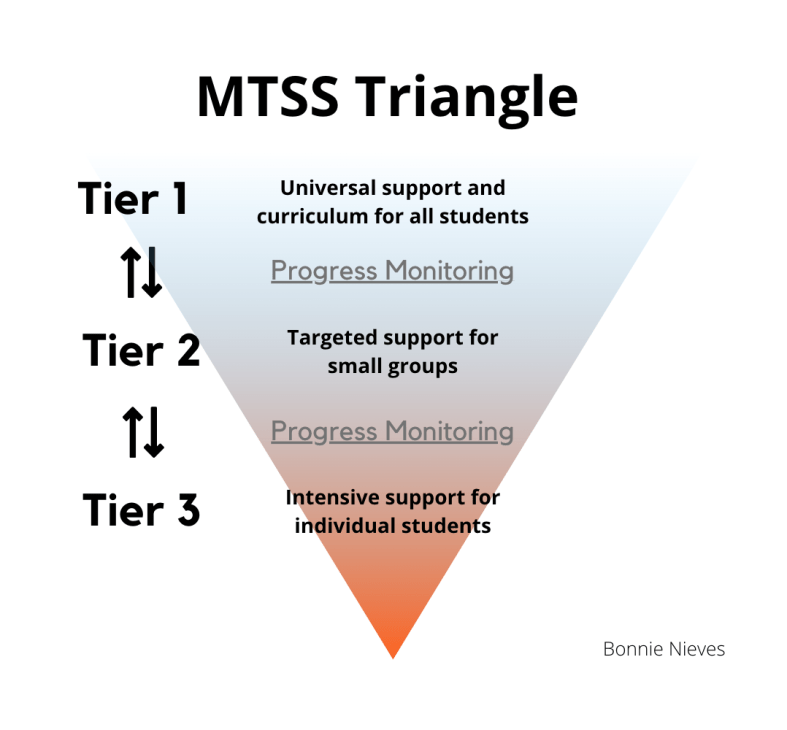
MTSS is typically represented as a pyramid with Tier 1 universal supports being the foundation. It can be accurately represented as a triangle or funnel. 

All students receive universal supports and transition between tiers 1, 2, and 3 based upon progress monitoring data monitored according to a reliable universal tool at predetermined intervals. These tools do not need to be school-wide standardized tests. According to the American Institutes of Research (2021), high-fidelity screening is universal, accurate, and conducted at least quarterly.

Most students will remain in tier 1, some will transition to tier 2, and fewer will move to tier 3. If a school community finds that a large number of students are in need of tier 2 support, it would be prudent to investigate the evaluation tools and quality of the universal curriculum being used.

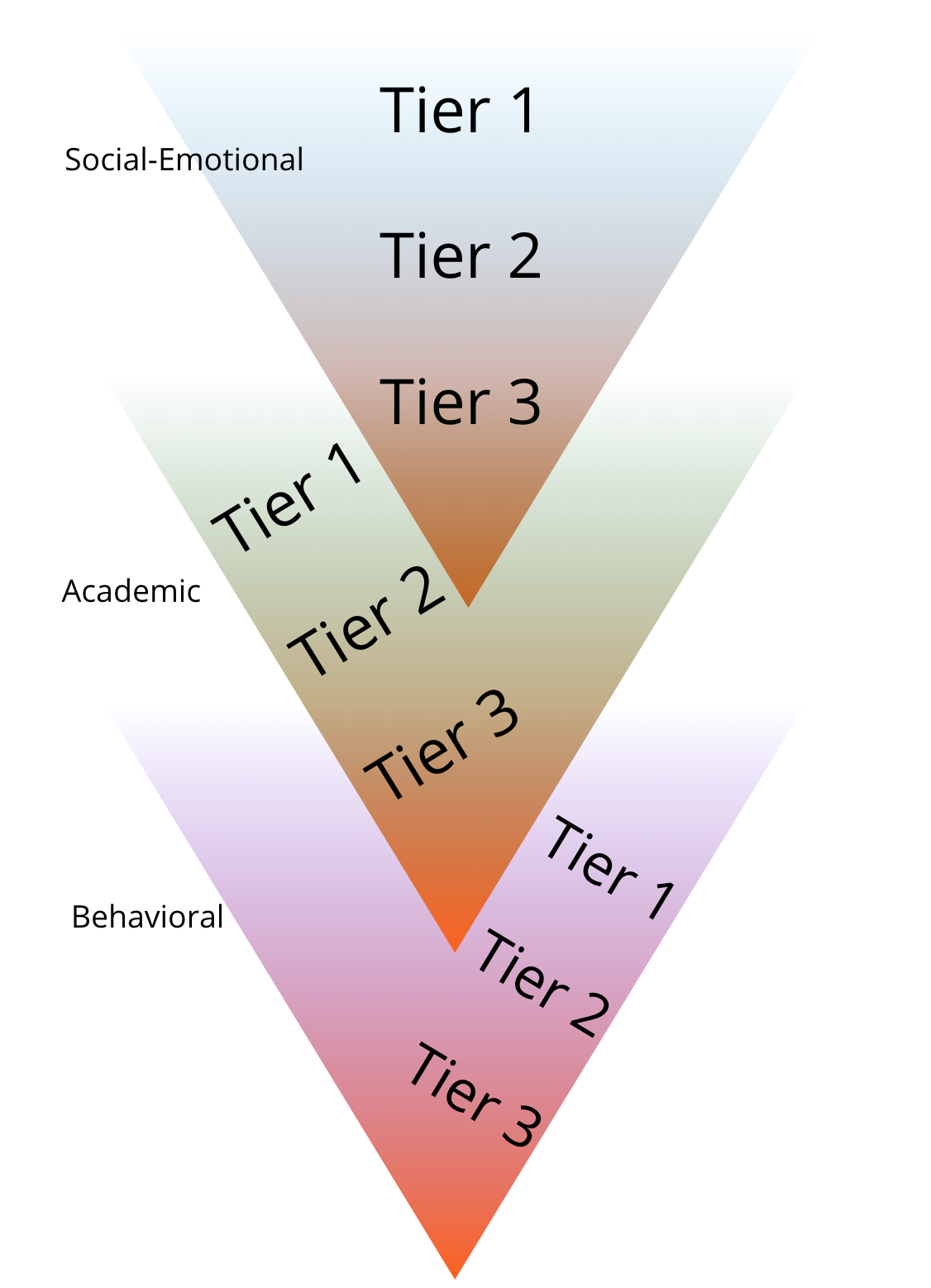
Now, envision a system of three triangles, one for each indicator: academic, behavioral, and SEL. Students may be at any of the three tiers for each of the three instructional areas (academic, behavioral, social-emotional) at any one time. For example, a student may be receiving tier 1 instruction for academics, tier 2 targeted support for behavioral instruction, and tier 3 for social-emotional instruction.

When teachers work with all of this information, academic, behavioral, and social-emotional, it can require a great deal of time and organization. Providing for all students is essential and each of these represents important data points that teachers need to focus on in order to provide the best for students. However, there needs to be a more effective and efficient way to do this.

MTSS and Class Composer 

Class Composer provides everything that teachers need to be able to monitor student progress and is readily accessible to anyone, at any time. It enables all teachers to access the information they need about each individual student when they need it. Easy to track and record student growth toward individualized goals.  Simplify how you manage all the assessment data collected! With progress monitoring, teachers can easily track student progress and provide the right supports.

Having access to all this information in one space enables teachers to create a supportive learning community for students. These teacher-student connections lead to the development of the essential relationships that need to exist for all students to be successful.

Give Class Composer a try today using their sandbox. You will experience a simpler, more streamlined experience when in the easily accessible, data-driven platform that promotes student academic achievement and the development of essential SEL skills.

Head to Class Composer to learn more!

Coming up next:

The final part of my MTSS blog series will elaborate on two essential components: assessment tools and instructional resources. Assessment tools that can help your school community provide common experiences without impacting teachers’ ability to use Universal Designed for Learning (UDL) planning tools. Instructional resources for each of the three tiers for academic, behavioral, and social-emotional instruction.

About the Author

Bonnie Nieves is the author of “Be Awesome on Purpose” and has over a decade of experience as a high school science teacher. She has a Master’s Degree in Curriculum, Instruction, and Educational Leadership. Her passion for creating immersive and authentic experiences that fuel curiosity and creating student-centered, culturally responsive learning spaces that promote equity and inclusion has led her to establish Educate On Purpose Coaching.

In addition to being an award-winning educator, Bonnie works to ensure equitable and engaging education for all through her work as a copy editor at EdReports and Classroom Materials and Media reviewer for The American Biology Teacher journal. She serves on the MassCUE board of directors and enjoys connecting with educators through social media, professional organizations, conferences, Twitter chats, and edcamps. Bonnie is a member of the National Association of Biology Teachers, the Teacher Institute for Evolutionary Science, and the National Science Teaching Association. She encourages you to connect with her on Twitter @biologygoddess, Instagram @beawesomeonpurpose, Clubhouse @biologygoddess, and LinkedIn.

Please visit www.educateonpurpose.com for information about her current projects.

**Interested in writing a guest blog for my site? Would love to share your ideas! Submit your post here. Looking for a new book to read? Find these available at bit.ly/Pothbooks

************ Also check out my THRIVEinEDU Podcast Here!

Join my weekly show on Fridays at 6pm ET THRIVEinEDU on Facebook. Join the group here