From Learning Gaps to Personalized Next Steps: What We Explored with Kira

In collaboration with Kira Learning

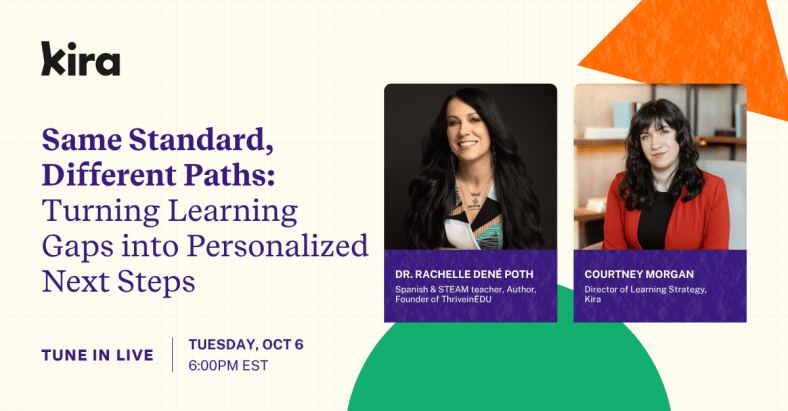
I was excited to host a recent livestream, “Kira: Turning Learning Gaps into Personalized Next Steps,” with Courtney Morgan, Kira’s Director of Learning Strategy. During the session, we discussed an important question that educators ask: How can we use what we learn about students to provide meaningful and personalized support while making the work more manageable for teachers?

As a longtime educator of languages and STEAM courses, I enjoy trying new ideas in the classroom, especially when it comes to using AI. Courtney is a former math and computer science teacher who taught for nine years and understands the challenges that can come with. Our conversation focused on classroom realities and included live demonstrations, authentic reflections, and engagement and excitement from educators joining us from around the world.

Seeing the specific need

For anyone who had not yet heard of Kira, Courtney introduced Kira as a platform that connects planning, lesson delivery, assessment, and next steps. Teachers can create lessons with AI, import existing materials, or build manually. Students can complete activities on the platform with an AI tutor enabled by their teacher. There are so many exciting possibilities for using Kira in the classroom.

But the part that really caught everyone’s attention was what happens once students complete the work. Courtney showed how lesson questions connect to standards and the skills within them. Through Student Atlas and Class Atlas, teachers can explore individual student learning needs and patterns across a class.

Courtney explained, “There might be skills that relate to that standard that they’re doing well with, and there might be others that they’re struggling with.” And this distinction matters. While a score can let us know that a student struggled, we also need to understand where they had difficulty so we can adjust our instructional strategies.

For the demo, learners had completed lessons on ratios and geometry proofs. The results showed different areas of need, which exemplified exactly what educators see as they review student work.

Moving from information to action

Differentiation takes time. As a language educator teaching multiple levels alongside a STEAM course, I know how much time is involved in creating resources to meet different students’ needs.

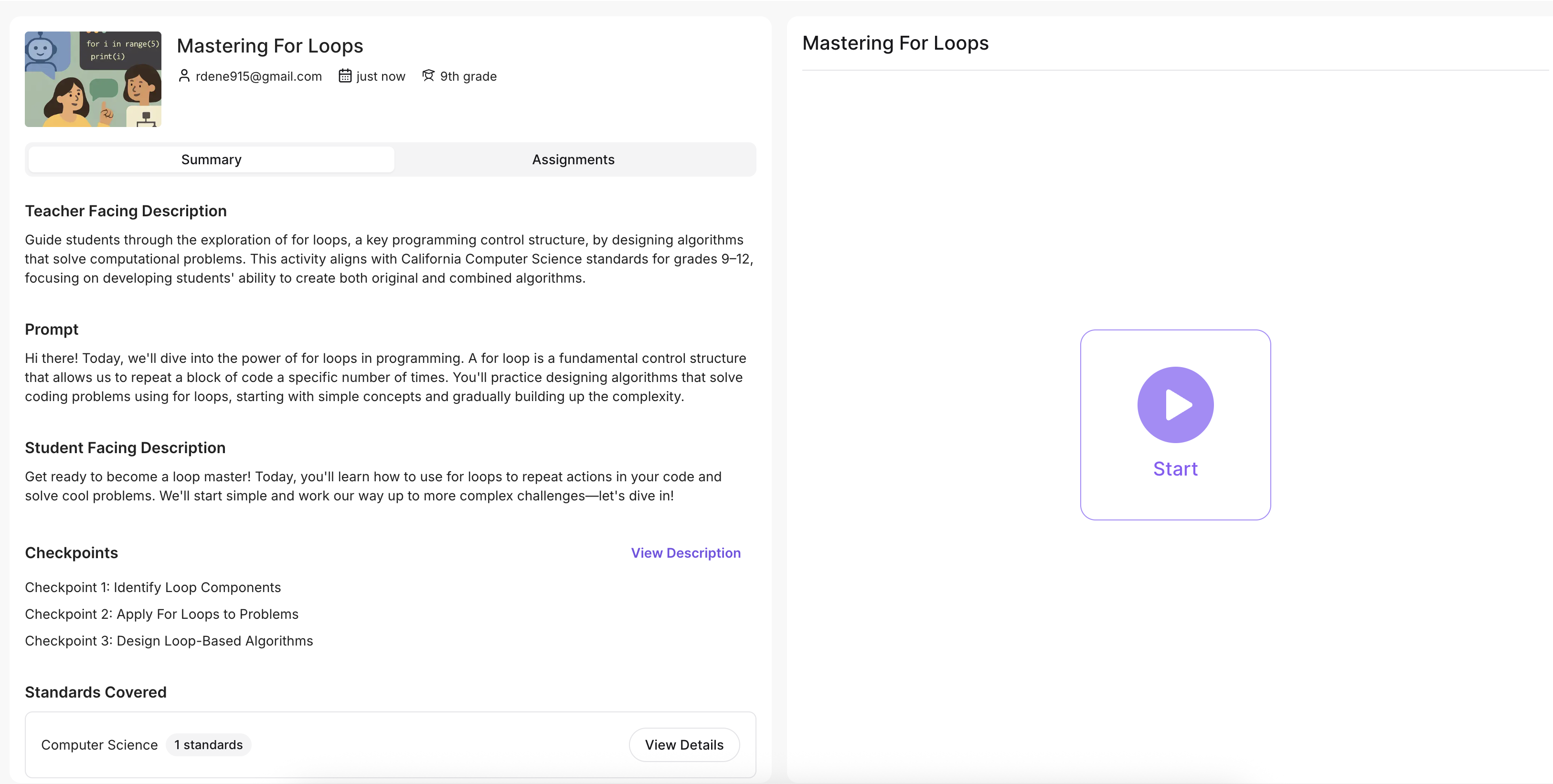
During the livestream, I asked which part takes the most time: identifying learning needs, creating resources, or checking whether the support worked. Courtney described the trade-offs that teachers make. Spending more time on one part can leave less time for another. But then she demonstrated a potential way to connect those steps. Using Class Atlas, Courtney asked Kira to create an individualized lesson for each learner focused on their biggest area of growth. She specified interactive activities that could be completed in about 25 minutes.

When Courtney opened one of the generated lessons, it addressed an issue in her earlier response: she had said that she multiplied without fully explaining her reasoning. The follow-up included a recap, a worked example, and additional practice.

In this example, we could see how the information about a learning gap better informed a specific next step. Courtney also explained that subsequent work feeds back into the learner’s profile, giving teachers updated evidence to refer back to when deciding what should come next.

Keeping the thinking with students

Geometry proofs brought out a personal connection for me. I shared that I struggled with them in high school before learning how to study and work through the process. Watching Courtney’s demonstration, I thought about how helpful those supports could have been back then for me, but how impactful they will be for students and teachers now.

Courtney showed how the lesson moved through scaffolded activities such as marking given information, matching reasons and statements, and writing on a digital whiteboard. Courtney demonstrated how the tutor can also interpret handwritten work.

The tutor was providing “support without giving away the answers.” And this is important to keep in mind and to also share with students when they are using AI. It should be an assistant rather than answering the questions. This is an important instructional goal that I share with educators and ask them to consider whether AI is used as support to help students think, practice, and explain.

Another highlight was learning about the progressive reveal setting that lets students move through steps gradually. For students, having a worked example is helpful, but being able to process it in more manageable pieces makes it more useful for their learning experience.

Confidence is part of the learning process

Another favorite of mine is using Kira’s ChatPods, which Courtney described as discussion-based activities.

In my language classes, students often hesitate to speak because they are afraid of answering incorrectly or mispronouncing a word. With Chatpods, students have a space to practice a conversation and receive guidance that helps them feel more prepared to participate. I have had students who were reluctant to raise their hands completely pivot and start contributing to class, and even help classmates. Those moments matter to me. Participation, confidence, and a willingness to try are what we hope to help students build along with content knowledge.

Courtney connected using the ChatPod to a very familiar classroom need. Teachers can work with a small group while other students have access to guided practice through the Chatpod that the teacher has set up for them. The value is in how the teacher uses that support to create more opportunities for learning and connection.
Start with one classroom challenge

There are a lot of options available! My recommendation is always the same. “Pick one thing to start with.”

Choose a concept students struggle with, a resource that takes hours to differentiate, or a discussion where learners need more practice. Explore how Kira can support that work, review what it creates, and use student responses to guide your next decision.

During the session, Courtney also introduced You Ask, Kira Builds, an invitation to submit a challenging lesson idea for possible selection and development by the team. This will be fun for the team to see what educators need, and then, of course, Kira will build it! Check out the previous sessions here!

Revisit the recording, choose one learning need, and try a focused next step. Then share what you notice: What helped students? What did you adjust? What would you try next? Those classroom experiences are how we learn together, and we would love to learn from you!


About Rachelle

Dr. Rachelle Dené Poth is a Spanish and STEAM: What’s Next in Emerging Technology Teacher. Dr. Rachelle Dené Poth is an edtech consultant, presenter, attorney, author, and teacher of Spanish and STEAM: Emerging Technology. Rachelle has a Juris Doctor degree from Duquesne University School of Law and a Doctorate in Instructional Technology. Rachelle’s focus was on the need for professional development for educators, specific to Artificial Intelligence. Rachelle specializes in Artificial Intelligence, AI and the Law, AI and Healthcare, Cybersecurity, and STEM. She has more than 8 years of experience teaching and presenting on AI in her classroom, as well as working with educators worldwide.

Rachelle is currently serving as the Grant Coach for an initiative through ISTE+ASCD and Pinterest. Rachelle works with a Task Force from 12 districts in the United States and assists with policy revision, professional development, and the design of digital wellness resources for students, educators, and families.

Rachelle provides professional development related to AI policy and implementation to school districts, universities, and organizations. She also presents and provides keynotes on AI at state, national, and international events and in schools. Rachelle also provides AI training for other industries, including business, healthcare, and legal fields.
Rachelle is an ISTE-certified educator and recipient of the ISTE Making IT Happen Award and several Presidential Awards for volunteer service to education. Rachelle received the EdTech Trendsetter Award from EdTech Digest in 2024 and 2026.

She is the author of ten books, including “What the Tech? An Educator’s Guide to AI, AR/VR, the Metaverse and More! and “How to Teach AI: Weaving Strategies and Activities Into Any Content Area.” She has written curricula and courses on AI for all levels.

She is also a blogger for Defined Learning, EdTech K12, Edutopia, Getting Smart, and Tech & Learning. She is the host of the ThriveinEDU podcast, ISTE’s Learning Unleashed podcast, and The Lift by Amazon on BAM Radio Network. Contact Rachelle for your event!

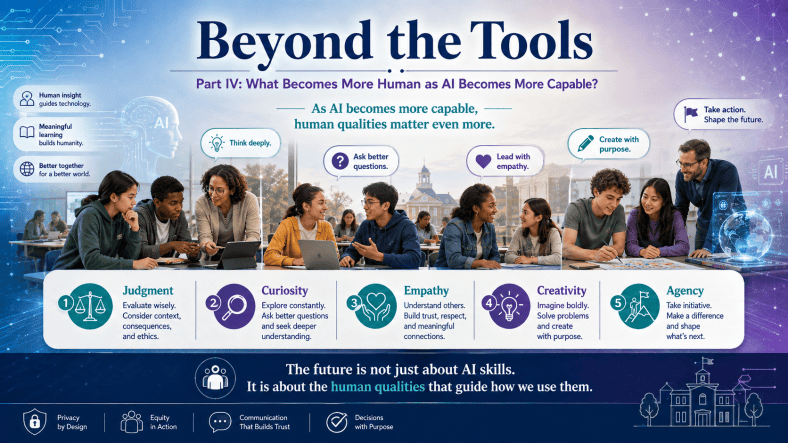
Image featuring Dr. Rachelle Dené Poth with her name, social media handle, and a selection of her book covers displayed along with a brief description of her roles as an educator, author, attorney, and consultant.

Beyond the Tools: Part IV

What Becomes More Human as AI Becomes More Capable?

In the first three parts of my “Beyond the Tools” series, I focused on the people and decisions behind responsible AI implementation. I explored why human readiness matters more than simply adopting new tools, what students should still be able to do independently, and how schools can build trust through transparency, communication, thoughtful vetting, and shared responsibility. In Part III, I focused specifically on how trust is built across the school community and why trust is essential for meaningful AI implementation. But once those foundations are in place, another question emerges, one that goes beyond implementation and gets to the heart of education itself.

The conversation around artificial intelligence often starts with capability.

  • What can AI do now?
  • What will it be able to do next?
  • Which jobs will change?
  • Which tasks will become automated?

Those are important questions.

But we should also be asking another one:

As AI becomes more capable, what becomes more important about being human?

Preparing students for an AI-shaped future cannot simply mean teaching them to use more AI or any technology. It also means helping students develop the human qualities that become even more valuable as technology becomes more capable.

Knowledge Still Matters, but So Does Judgment

Students will have access to more information than any generation before them. But access to information is not the same as understanding.

AI can produce options, but humans still have to decide.

AI can summarize perspectives, but humans still have to evaluate them.

AI can recommend a course of action, but humans still have to consider the consequences.

And this is what makes human judgment incredibly important.

Our students need opportunities to make decisions, explain their reasoning, defend their choices, reconsider them when needed, and take what they have learned to decide what happens next.

Curiosity Matters

There are many concerns about how AI may affect essential skills such as creativity, critical thinking, and problem-solving. AI makes answers easier to obtain, which makes asking good questions even more valuable.

We have to spark curiosity. Students who remain curious will be better prepared to explore possibilities that a generated answer may not provide. They will ask themselves:

  • Why did this happen?
  • What is missing?
  • What if we tried something different?
  • Whose perspective is not represented?
  • What problem should we actually be solving?

AI may help us investigate those questions, but the questions themselves begin with human curiosity. Curiosity can help students look beyond the first answer. Empathy helps them consider the people affected by the answers they find and the decisions they make.

Empathy Matters

AI can simulate conversation. It can generate supportive language. It can analyze patterns and identify trends.

But genuinely understanding another person requires more than the production of an appropriate response.

Students need opportunities to listen carefully, learn about and recognize perspectives different from their own, and understand how decisions may affect other people.

They need opportunities to:

  • listen with intention
  • recognize another person’s perspective
  • collaborate with people who may think differently
  • navigate disagreement respectfully
  • consider how decisions may affect individuals and communities

These qualities matter in our classrooms today, and as we continue to see the increased presence and use of AI, these qualities will matter even more in workplaces and communities.

Technology may help us communicate more efficiently, but empathy requires something more human: attention, perspective, connection, and care.

Human understanding also helps to shape creativity. The best ideas are not just new. They are meaningful, useful, and responsive to real needs.

Creativity Matters Differently

We have seen the many ways that AI can create. But even with all of its possibilities, it does not make human creativity irrelevant.

I’ve given it some thought and think perhaps creativity may become less about producing something entirely from scratch and more about imagining possibilities, dreaming big, directing ideas, combining perspectives, evaluating options, improving what already exists, and making meaning.

Students will need to ask themselves:

  • Is this idea interesting?
  • Is it useful? Why or why not?
  • Does it solve the right problem?
  • Does it reflect what I actually think or believe? Why or why not?
  • What could I create that is valuable or meaningful for someone else?

AI may help with generating possibilities, but students still need to be able to decide for themselves which ideas are worth pursuing and why they matter.

Creativity still requires human purpose. And purpose requires choice, and this is where agency becomes essential.

Agency May Matter Most

Continue reading on LinkedIn and subscribe to my newsletter!


I would love it if you would subscribe to my ThriveinEDU newsletter and follow my podcast and YouTube channel to check out some interviews and other learning opportunities.

If Your Organization Is Beginning This Work

I help schools and other organizations (law firms, healthcare professionals, business owners) implement AI responsibly through policy guidance, professional learning, and classroom-ready strategies grounded in both instructional practice and legal insight.

My sessions focus on helping teams:

• understand what AI can and cannot do

• recognize responsible-use considerations

• build confidence using emerging tools

• align implementation with organizational priorities

If your school, district, or organization is beginning conversations or looking to dive in and learn more about AI policy, professional learning, or responsible implementation, I’d welcome the opportunity to support your next steps through leadership workshops, keynote sessions, or strategic planning partnerships.

Preparing people is what makes AI implementation successful. Contact me via bit.ly/thrivineduPD or email Rdene915@gmail.com for my training and speaking services.

Beyond the Tools: Part III

How Do We Build Trust Around AI?

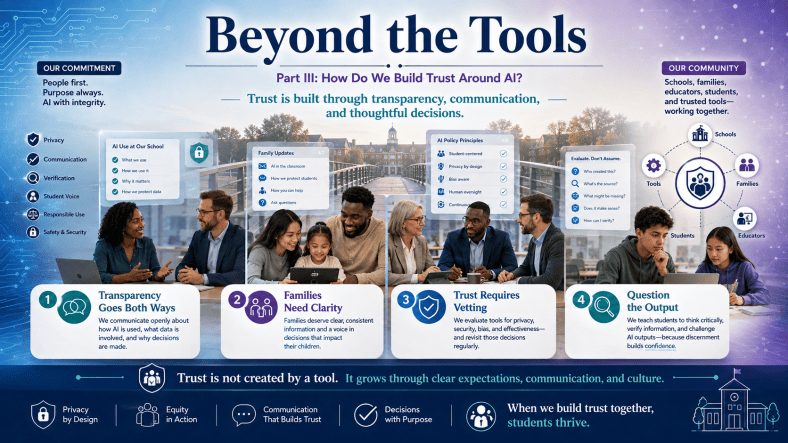
In the first two parts of this series, I explored how successful AI implementation depends primarily on human readiness and shared leadership. I also focused on the importance of defining what core capabilities students must retain independently. Building on those foundations, Part III focuses on how schools can foster trust across the entire community so that AI implementation is transparent, intentional, and human-centered.

As schools continue to integrate artificial intelligence, the conversations focus on purpose, capability, and whether or not we should use it. Some questions that come up often focus on specific tools and include:

  • What can the tool do?
  • How can educators use it?
  • How can students use it?

These are valid and common questions. But answering them does not guarantee successful AI implementation. Successful implementation depends on something much harder to build and much easier to lose: trust.

Students need to trust educators.

Families need to trust schools.

Educators need to trust leadership.

Schools need to be able to trust the tools they adopt.

And everyone needs enough understanding to recognize that AI itself should never be trusted without thorough investigation, ongoing evaluation, and reflection.

Mutual Transparency Builds Shared Trust

Over the past year, through my work with ISTE+ASCD and Pinterest, one word surfaced repeatedly in conversations with students, educators, families, and school communities: transparency. I have emphasized that transparency must be a shared responsibility, regardless of a person’s role in education. Educators want to know:

  • Did the student use AI?
  • Did they disclose it?
  • Did they cite it?

Those are reasonable expectations. But I’ve also listened to students, and they are asking important questions. They want to know:

  • Are their teachers using AI, and how?
  • Are educators using it to generate feedback?
  • Are schools using it to analyze information?
  • Are tools collecting student data?
  • What happens to information entered into a platform?

Students should not be expected to practice transparency in a system that is not transparent with them.

Trust works both ways.

This need for mutual openness extends beyond the classroom walls and applies equally to how schools engage with families.

Bridging the Gap Between Policy and Practice for Families

Through conversations with educators and student focus groups across the country, I noticed a recurring disconnect. Information about AI use, screen time, and cell phone expectations was not always communicated clearly between school and home. Families also need clear and consistent information.

A lengthy AI policy may satisfy a school district requirement, but it does not necessarily help a parent understand what is happening with AI in a classroom.

Families need access to clear answers to practical questions such as:

  • What AI tools are students using?
  • Why are they being used?
  • What student information is being collected?
  • How are tools vetted?
  • What expectations apply to student use?
  • What happens when those expectations are violated?
  • Who do families contact with questions?

The clearer those answers are, the less likely uncertainty is to turn into mistrust.

Trust Requires Vetting

There is also a tendency to focus on what an AI tool can do before asking what happens behind the scenes.

Schools need processes for examining privacy, security, accessibility, age requirements, data use, contracts, and instructional purpose before adopting AI tools.

An impressive platform does not necessarily mean it belongs in a classroom, and this is why collaboration matters.

  • Technology teams understand infrastructure.
  • Educators understand instructional purpose and classroom context.
  • Administrators understand organizational priorities.
  • Legal and privacy professionals understand risk.
  • Students and families understand how decisions affect them.

No single perspective is enough. Trust grows when people understand not only what decisions are being made, but how and why those decisions were reached.

Questioning the Output: Why Blind Trust Fails

There is another form of trust students need to understand:

  • AI outputs should not automatically be trusted.
  • A confident answer can still be wrong.
  • A polished response can still contain bias.
  • A citation can still be fabricated.
  • An image can look authentic and still be synthetic.

Students need practice questioning, verifying, and evaluating information rather than simply accepting it. Ask:

  1. Where did this information come from?
  2. Can I verify it?
  3. What perspective may be missing?
  4. What assumptions are being made?
  5. Does another reliable source agree?
  6. What evidence supports this response?

Those habits are part of AI literacy, but they are also part of broader information literacy.

Build a Culture, Not a Compliance Checklist

Trust is not created by publishing an AI policy.

Continue reading on LinkedIn and subscribe to my newsletter.

I would love if you would subscribe to my ThriveinEDU newsletter and follow my podcast and YouTube channel to check out some interviews and other learning opportunities.

If Your Organization Is Beginning This Work

I help schools and other organizations (law firms, healthcare professionals, business owners) implement AI responsibly through policy guidance, professional learning, and classroom-ready strategies grounded in both instructional practice and legal insight.

My sessions focus on helping teams:

• understand what AI can and cannot do

• recognize responsible-use considerations

• build confidence using emerging tools

• align implementation with organizational priorities

If your school, district, or organization is beginning conversations or looking to dive in and learn more about AI policy, professional learning, or responsible implementation, I’d welcome the opportunity to support your next steps through leadership workshops, keynote sessions, or strategic planning partnerships.

Preparing people is what makes AI implementation successful. Contact me via bit.ly/thrivineduPD or email Rdene915@gmail.com for my training and speaking services.

Beyond the Tools: Part II -What Should Students Still Be Able to Do Without AI?

In Part One of my new series, I emphasized that successful AI implementation in education is less about adopting new platforms and more about human readiness. While learning how different tools work is a starting point, true preparedness requires educators to develop deep pedagogical judgment, understand privacy and security issues, and make informed decisions about when to use AI and when not to. I believe that AI implementation is an organizational change process based on shared leadership with representation from the entire school community, rather than being just a technology project or a passing initiative.

As I think about AI in our classrooms, especially in light of recent decisions by NYCPS and LAUSD, regarding generative AI access for younger students, I continue to believe that we need to teach students how to use these tools responsibly.

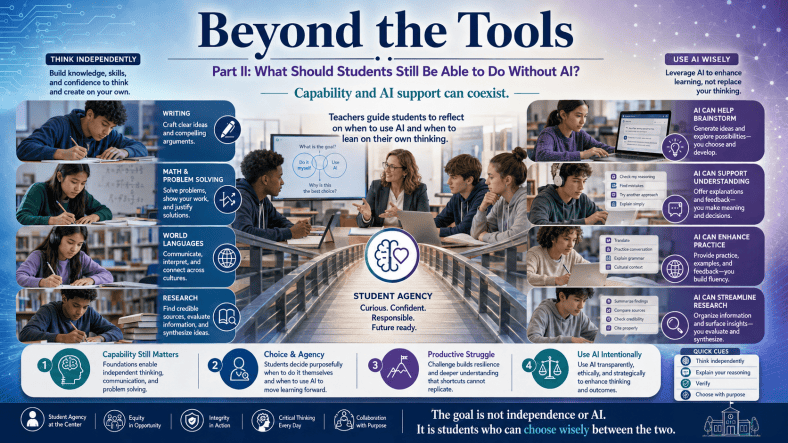
AI offers many possibilities that can assist with learning. It can help students write, brainstorm, translate, explain, research, summarize, create images, work through problems, and more. These capabilities offer enhanced learning opportunities, but they also raise an important question: What should students still be able to do without AI?

There are many conversations about technology happening in schools, but I believe how we prepare students to use AI responsibly is one of the most important. I don’t think the answer is to completely keep AI away from students. Preparing students to use technology responsibly also means preparing them to problem-solve, adapt, and make thoughtful decisions when technology is unavailable or when using it is not the right choice.

Capability Matters

We have been having versions of this conversation for years whenever new technology appears and changes how students learn. Calculators changed math. Google changed research. Spellcheck changed writing. Translation tools changed language learning.

Technology often changes how we perform a task. It can make work more efficient, expand access to information, reduce barriers, and create new learning opportunities. But the arrival of a new tool does not eliminate the need to understand the underlying skills that students need to be successful.

When ChatGPT came out at the end of November of 2022, the immediate concern was using it for cheating. There were immediate conversations about academic integrity, and familiar comparisons to calculators and Google quickly resurfaced.

AI presents a different challenge. AI goes beyond simply being an assistant for one part of a task or process because it can produce entire responses and so much more. I often compare what a student can produce with AI to what that student can independently explain or demonstrate afterward. Here are some examples:

  1. A student may generate a well-written explanation. But can they explain the concept on their own?
  2. A student may receive an accurate language translation. But can they communicate independently and engage in a conversation?
  3. A student may get a solution to a problem. But can the student explain the reasoning?
  4. A student may generate research summaries. But can the student evaluate whether the information is trustworthy?

Students need to understand that choosing to use AI does not remove their accountability for their learning. They should still be prepared to explain their thinking, demonstrate their skills, and show what they understand without relying on any tool.

Can Independence and Assistance Coexist?

I’ve been having more conversations with educators about whether or not AI belongs in all classrooms K through 12 or if it should be limited to the high school years. We have spoken about screen time, the use of technology in general, how much is too much and also trying to consider best pedagogical practices for when technology makes sense. I do not think the answer is to require students to complete all of their work without AI. That would ignore the world they are entering.

Students will use AI in college, careers, and their personal lives and so they need to learn how to use it effectively. Learning how to use it effectively does not mean that they need to use it frequently but they need to understand when and how to use it, while still being able to complete a task without the use of AI. Students need both capabilities. They need to be able to say “I can do this myself” and “I know when and how a tool can help me do it better.”  When this happens, students are demonstrating student agency.

Make the Thinking Visible

Educators can help students develop this awareness by asking them to explain their decisions and the thinking behind them. Some guiding questions might be:

  • Why did you use AI?
  • What part of the task did it support?
  • What did you do yourself?
  • What did you change and why?
  • What did you disagree with?
  • What information did you verify?
  • Could you explain your final work without the tool?

Using these guiding questions will shift the conversation away from catching students using AI and move it toward helping students understand their own use and be reflective in their learning experiences. This is a much more productive opportunity for students to truly understand responsible use of AI.

The Value in Struggle

Learning can be difficult, and I often remind my students that making mistakes is not only okay…it is expected. Understanding may not happen on the first, second, or even tenth attempt. That is part of learning. It is meant to be challenging, and students need to experience productive struggle, which can be uncomfortable at times. In their classes, students need:

  • moments when the answer does not come right away.
  • to try something that does not work.
  • to rethink an idea and sometimes disregard it and start over.
  • to figure out why the robot did not move.
  • to understand why the equation did not work, why their argument is weak, or why the translation does not make sense.

Productive struggle helps build confidence because students experience what it is like to overcome difficulty. AI can remove barriers, and it can be extremely valuable. We need to distinguish between a barrier that prevents learning and a challenge that produces learning.

Time to ask a different question

Continue reading on LinkedIn.

Please subscribe to my ThriveinEDU newsletter to stay informed. And contact me for more information.

If Your Organization Is Beginning This Work

I help schools and other organizations (law firms, healthcare professionals, business owners) implement AI responsibly through policy guidance, professional learning, and classroom-ready strategies grounded in both instructional practice and legal insight.

My sessions focus on helping teams:

• understand what AI can and cannot do

• recognize responsible-use considerations

• build confidence using emerging tools

• align implementation with organizational priorities

If your school, district, or organization is beginning conversations or looking to dive in and learn more about AI policy, professional learning, or responsible implementation, I’d welcome the opportunity to support your next steps through leadership workshops, keynote sessions, or strategic planning partnerships.

Preparing people is what makes AI implementation successful. Contact me via bit.ly/thrivineduPD or email Rdene915@gmail.com, for my training and speaking services.

Article content

Beyond The Tools: Part I

Over the past few months, I’ve written two different series to share what I’ve been learning about AI in education. First, in my seven-part “Leading Forward in AI” series, I reflected on what I was seeing and hearing, the questions being asked, the challenges educators and leaders were facing, and the areas where greater clarity and support were needed, learned through my work with schools and districts across the country last year through the ISTE+ASCD and Pinterest initiative.

More recently, in my five-part “AI in Education vs. AI Education” series, I focused on an important distinction: implementing AI in our schools is not the same as educating students about AI.

I explored what is involved in the shift from policy to practice. It requires preparing educators, building AI literacy, rethinking assessment, and creating more intentional approaches to AI use.

As I finished those 12 posts and reflected on the comments and feedback I received, another question emerged: Are we focusing too much on technology and not enough on the people making decisions about its use? That question led me to this new series, “Beyond the Tools.”

Rather than focusing on the newest platforms or AI capabilities, I want to consider what successful AI implementation requires from the people involved, including educators, students, leaders, families, and others across the school community.

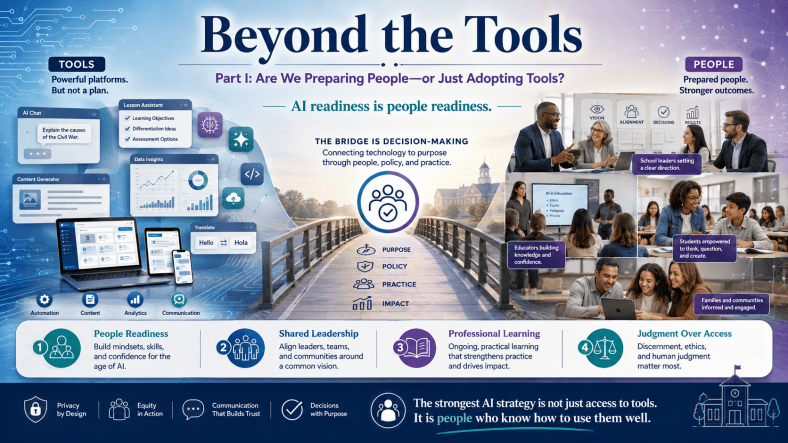
Beyond the Tools, Part I: Preparing People or Just Adopting Tools?

Artificial intelligence continues to move quickly in education. There are new tools, new AI features, new capabilities. Schools are tasked with complex work when it comes to evaluating products and determining what should be permitted, restricted, or encouraged.

I think back to my doctoral research that focused on the need for professional development for educators, especially when it comes to AI. Before focusing on the technology, are we doing enough to prepare the people who will be using it?

Because successful AI implementation is not determined by how many platforms a school has access to, but whether or not those using them understand what they are doing and why.

Learning the Tool Is Only the Beginning

Learning how to enter a prompt or generate a lesson plan is often the easier part. Knowing when to use AI and when not to is much harder. Some examples:

  • Recognizing when an output is inaccurate requires judgment.
  • Determining whether AI adds to or reduces a meaningful learning experience requires pedagogical knowledge and good instructional practices.
  • Knowing what information should not be entered into a platform requires awareness of privacy and security.
  • Helping students understand when AI is supporting their thinking rather than replacing it requires more than showing students how to use a tool.

These are just a few of the reasons why I have spoken about making sure that educators and students are ready first before considering what specific technology to use.  AI readiness is about people readiness.

Educators Need More Specific Training

Something I continue to notice when providing professional development is the questions being asked. Some of the first questions asked are typically:

  • What tool(s) should I use?
  • What prompt(s) should I try?
  • What can this platform create?

These are important questions, but we also need to ask:

  • What problem are we trying to solve?
  • Should we use AI for this learning experience?
  • What should students still do independently?
  • Are there any risks I should consider?
  • How do I evaluate the information AI provides?
  • How will students demonstrate their own understanding?

Educators do not need to become AI experts, but they need enough knowledge to make informed decisions, which takes time.

Leadership is key

Continue reading on LinkedIn.

Please subscribe to my ThriveinEDU newsletter to stay informed. And contact me for more information.

If Your Organization Is Beginning This Work

I help schools and other organizations (law firms, healthcare professionals, business owners) implement AI responsibly through policy guidance, professional learning, and classroom-ready strategies grounded in both instructional practice and legal insight.

My sessions focus on helping teams:

• understand what AI can and cannot do

• recognize responsible-use considerations

• build confidence using emerging tools

• align implementation with organizational priorities

If your school, district, or organization is beginning conversations or looking to dive in and learn more about AI policy, professional learning, or responsible implementation, I’d welcome the opportunity to support your next steps through leadership workshops, keynote sessions, or strategic planning partnerships.

Preparing people is what makes AI implementation successful. Contact me via bit.ly/thrivineduPD or email Rdene915@gmail.com, for my training and speaking services.

Article content