
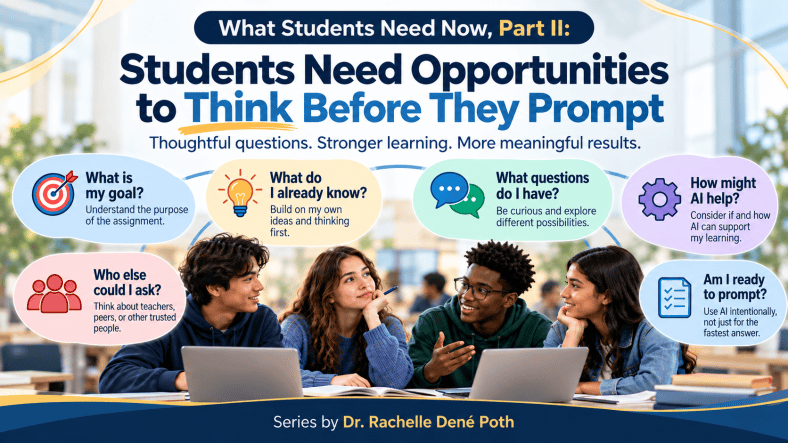
In Part I of my What Students Need Now series, I focused on the importance of clarity. Students need clear expectations, consistent communication, and a better understanding of what responsible AI use actually looks like in school. But once students understand the rules and expectations, the next step is just as important. We need to help them learn to pause and think before turning to AI.
In Part I of my What Students Need Now series, I focused on the importance of clarity. Students need clear expectations, consistent communication, and a better understanding of what responsible AI use actually looks like in school. But once students understand the rules and expectations, the next step is just as important. We need to help them learn to pause and think before turning to AI.
I want to focus on why students need opportunities to think first, because responsible AI use begins not with the prompt itself, but with the thinking that should come before using it.
When we talk about artificial intelligence in education, we tend to focus on what students can do with it. They can:
- Brainstorm ideas.
- Generate questions.
- Summarize information.
- Translate text.
- Create images.
- Explain concepts.
- Draft responses.
- Provide feedback.
And the list continues to grow. But there is another consideration:
What happens to student thinking when turning to AI becomes the first step rather than one of many possible steps?
Students need opportunities to develop their own ideas, ask questions, work through uncertainty, and decide what they already know before prompting a tool to do something for them.
When Faster Becomes the Goal
One of the biggest benefits of AI is efficiency. It can help us complete certain tasks faster. For educators, that might include using AI to generate discussion questions, organize ideas, create or update a rubric, or brainstorm ways to differentiate a lesson.
For students, using AI may be a way to get feedback, brainstorm ideas, explain a difficult concept, or identify possible starting points for a project.
This is something that I have spoken with students about, and tried to convey that learning takes time. Sometimes we can solve a problem or find a resource in a short time span, but there is no guarantee that it is long-lasting. Thinking about your own learning experiences or what you may model for students in your classroom. For example:
- Reading something again because we did not understand it the first time.
- Trying an approach that does not work.
- Revising something because our first attempt was not strong enough.
- Sitting with a question before knowing the answer.
- Struggling to find the right words.
- Talking through an idea with another person.
- Changing our minds.
When any of these happen, they may feel inefficient or like time has been lost.
But these are often the moments when a great deal of learning occurs.
Productive Struggle Is Important
We have been talking about productive struggle in education for years. Students need to experience challenges in learning, but the challenge needs to be purposeful and appropriate. If a task is so difficult that a student cannot access the learning, then we need to provide support. But taking away each difficult moment is not the answer.
I have said it many times: sometimes working through the struggle is part of the learning. And I think that becomes even more important for students to understand when they have access to AI.
- If a student experiences difficulty and immediately turns to a chatbot for an answer, they may lose the opportunity to work through the problem and feel success on their own.
- If AI generates ideas for students every time, how will they develop their creativity, critical thinking, problem-solving, and other essential skills independently?
- If AI immediately rewrites a paragraph for them, will the student understand why the revision was made?
- If AI solves the problem for them, can they explain the reasoning when asked?
And these are not meant to be arguments against AI but rather things to consider when using AI. Is it assistance or replacement?
That distinction matters.
What Are We Modeling?
Students are also paying attention to how we use AI.
Our students are paying attention to how we use AI. If we constantly emphasize how much time AI saves us, what is that teaching our students? If educators talk about using AI to get through tasks faster, students might assume that the goal is to eliminate as much effort as possible. And these are not the lessons they should be learning.
When it comes to using AI for efficiency, it should be because efficiency gives us time back for the things that matter. More time to talk with students. More ways to differentiate in the classroom. The technology should support the work rather than replacing the thought process that gives the work value. When we model the difference for our students, they will learn how to use AI in the right way.
But efficiency can become a problem if we begin to equate faster with better.
Effort Is Not the Same as Doing Everything the Hard Way
As I have been thinking through this, there is another side to the conversation.
While productive struggle is something learners need to experience, that does not mean they should complete every task in the most difficult way simply because that is how it has always been done.
Think about changes in tools and technologies over the years.
We use calculators.
Spellcheck.
Search engines.
Accessibility tools.
Translation tools.
Voice typing.
Text-to-speech.
Technology can remove unnecessary barriers and make learning more accessible. And that is how I try to frame my thinking around the use of AI. Rather than focusing on whether the student struggled enough, I try to identify the task and the level of their own thinking involved.
What do we want them to work through on their own, and why?
- If the learning goal is evaluating evidence, maybe AI can help students organize information so they can focus on evaluating it.
- If the goal is to develop students’ writing skills, they may need to do more of the drafting themselves.
- If the goal is learning another language, the use of translation or generative AI may need to be more limited so students can build their language skills independently.
- If a student needs accessibility support, AI may remove a barrier without removing the learning.
We always have to come back to purpose.
Students Need to Understand the Difference
From my work last year with 12 districts across the United States, I had opportunities to sit down and talk with students in different grade levels.
I asked them what they wished their teachers knew and what they wanted from their teachers. I heard repeatedly that students wanted their teachers to understand that they were not simply using AI to cheat. They wanted adults to teach them appropriate ways to use it. That matters. And it is one of the reasons simply telling students that AI is permitted or prohibited is not enough.
Students need to understand the reasons behind the expectations.
They should be able to ask themselves:
- What am I supposed to learn from this task?
- What part of the thinking needs to be mine?
- Where might AI help without doing the learning for me?
- Am I using AI because it supports my learning, or because I am trying to avoid something difficult?
- Will I be able to explain what I learned without the tool?
- Am I still making the decisions?
Questions like these help students develop awareness of their own learning.
I have asked students similar questions, and they have openly admitted that there are times when they rely on AI because they are afraid of making a mistake or because they think something will take too long to complete. That honesty is important.
When students have guiding questions that encourage reflection, they can begin to make better decisions about how and when AI belongs in the learning process.
Think Before You Prompt
One of the habits I think we should help students build is simple:
Think before you prompt.
Before students turn to AI, they should have opportunities to pause and consider what they already know.
- What ideas do I have?
- What questions do I have?
- What am I confused about?
- What have I already tried?
- Who else could I ask?
- Do I actually need AI for this task?
That does not mean students always have to complete everything independently before using AI.
It means AI should not automatically become the first place they go simply because it is available.
Students need to experience what it feels like to develop an idea of their own.
To struggle with a question.
To make a mistake.
To revise their thinking.
To ask another person.
To try again.
Those experiences help build confidence and independence.
And when students do decide to use AI, they are then more prepared to evaluate what it gives them because they are bringing some of their own thinking into the interaction.
Thinking Before Prompting
As schools introduce AI, we have an opportunity to teach students that technology can provide support without replacing their responsibility for learning.
Students need to understand that:
- efficiency has value, but so does persistence.
- struggling briefly with a problem is not failure.
- asking another person for help may sometimes be better than asking AI.
- knowing when not to use AI is part of AI literacy.
- their own ideas and thinking should still have a place in the learning process.
Some of the most meaningful learning happens because it requires thought, effort, revision, questioning, and persistence.
That does not mean students should never use AI.
It means AI should not automatically become the first step.
Before students prompt, they need opportunities to pause and ask:
What do I already know? What do I think? What questions do I have? And do I actually need AI for this?
Helping students develop that habit may be one of the most important things we can do to prepare them for an AI-shaped world.
I would love it if you would subscribe to my ThriveinEDU newsletter and follow my podcast and YouTube channel to check out some interviews and other learning opportunities. Check out my new website. https://rachelledenepoth.com/
If Your Organization Is Beginning This Work
I help schools and other organizations (law firms, healthcare professionals, business owners) implement AI responsibly through policy guidance, professional learning, and classroom-ready strategies grounded in both instructional practice and legal insight.
My sessions focus on helping teams:
• understand what AI can and cannot do
• recognize responsible-use considerations
• build confidence using emerging tools
• align implementation with organizational priorities
If your school, district, or organization is beginning conversations or looking to dive in and learn more about AI policy, professional learning, or responsible implementation, I’d welcome the opportunity to support your next steps through leadership workshops, keynote sessions, or strategic planning partnerships.
Preparing people is what makes AI implementation successful. Contact me via bit.ly/thriveineduPD or email Rdene915@gmail.com for my training and speaking services.

