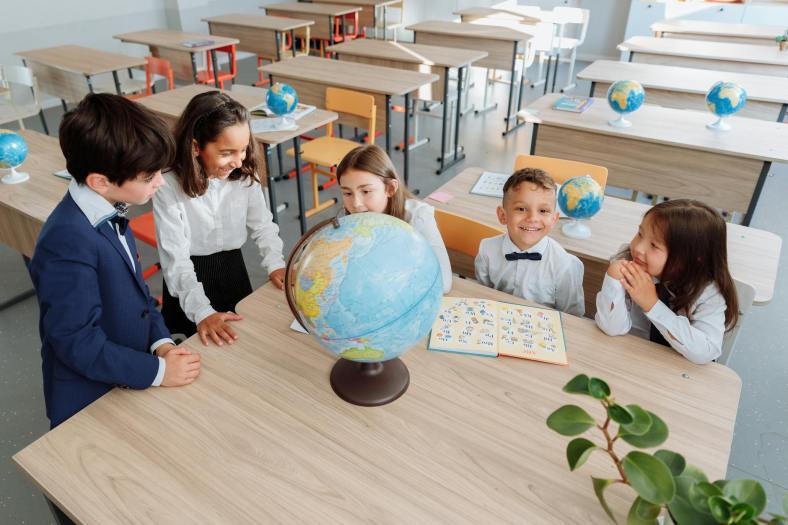
As educators, we must teach students how to stay safe online, especially with the rise of emerging technologies such as artificial intelligence (AI) and generative AI. With the capabilities of technology expanding so rapidly, teaching students about cybersecurity and cyber safety is more important than ever—these are topics that need to be discussed and explored at all grade levels.
Distinguishing between cybersecurity and cyber safety
Cybersecurity is the practice of protecting electronic devices, networks, and sensitive information from unauthorized access. It means proactively taking measures to ensure that confidentiality is protected and thoroughly checking out the resources that we use. Our access to devices and endless types of technology has transformed how we learn and work. However, it has also led to an increase in dangers that can impact our safety and well-being. We need to help students understand how to utilize the technology with a careful focus on how to stay safe online and protect personal information. Cyber safety awareness is critical for everyone.
Cyber safety refers to the practice of responsibly using technology and resources available through the internet. It is especially important to use care when accessing and sharing information online to avoid the risks and potential harm that can result, such as cyberbullying, hacking, phishing, identity theft, or exposure to inappropriate content and other online threats. Because of these risks, we must be intentional about helping students understand how to protect their safety and privacy online.
Dr. Rachelle Dené Poth is a Spanish and STEAM: What’s Next in Emerging Technology Teacher at Riverview High School in Oakmont, PA. Rachelle is also an attorney with a Juris Doctor degree from Duquesne University School of Law and a Master’s in Instructional Technology. Rachelle received her Doctorate in Instructional Technology, and her research focus was on AI and Professional Development. In addition to teaching, she is a full-time consultant and works with companies and organizations to provide PD, speaking, and consulting services. Contact Rachelle for your event!
Rachelle is an ISTE-certified educator and community leader who served as president of the ISTE Teacher Education Network. By EdTech Digest, she was named the EdTech Trendsetter of 2024, one of 30 K-12 IT Influencers to follow in 2021, and one of 150 Women Global EdTech Thought Leaders in 2022.
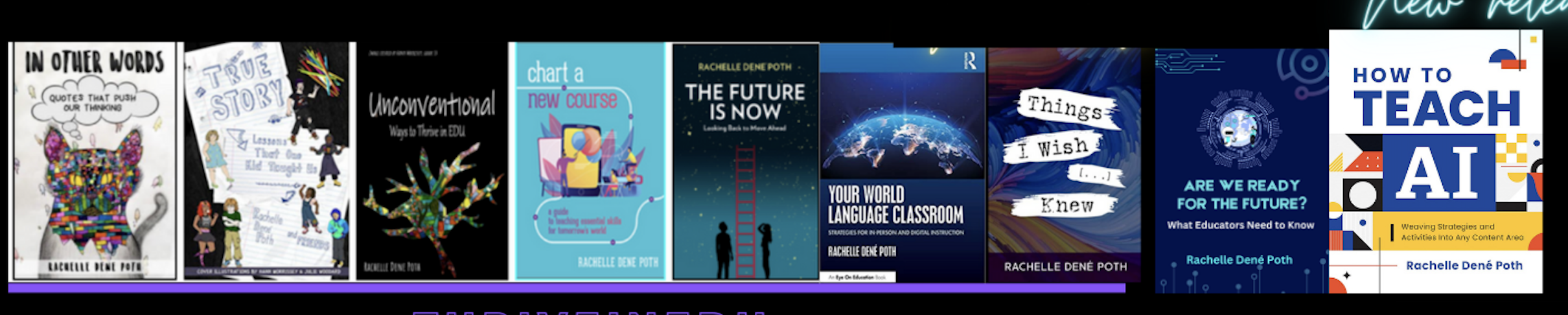
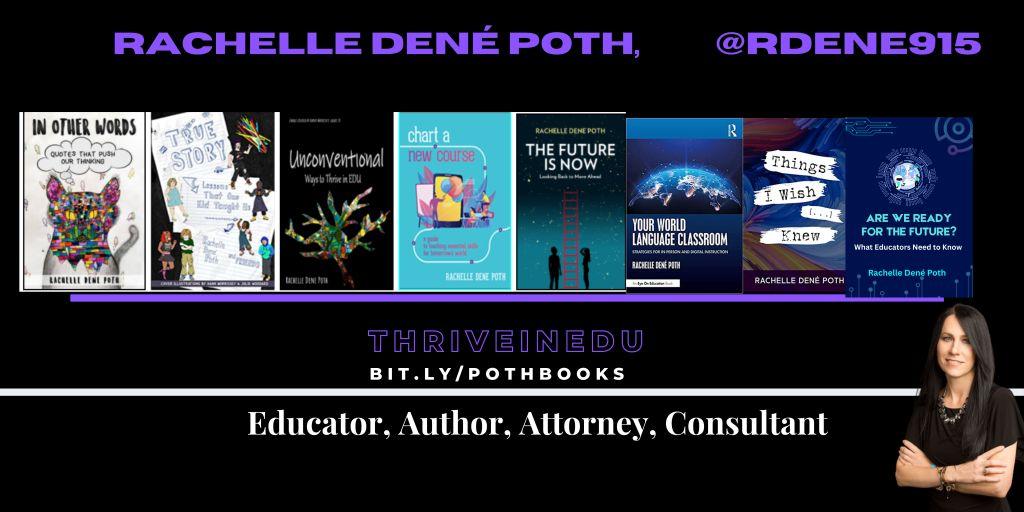
She is the author of nine books including ‘In Other Words: Quotes That Push Our Thinking,” “Unconventional Ways to Thrive in EDU,” “The Future is Now: Looking Back to Move Ahead,” “Chart A New Course: A Guide to Teaching Essential Skills for Tomorrow’s World, “True Story: Lessons That One Kid Taught Us,” “Things I Wish […] Knew” and her newest “How To Teach AI” is available from ISTE or on Amazon.
Contact Rachelle to schedule sessions about Artificial Intelligence, Coding, AR/VR, and more for your school or event! Submit the Contact Form.
Follow Rachelle on Twitter(X) and Instagram at @Rdene915
**Interested in writing a guest blog for my site? Would love to share your ideas! Submit your post here. Looking for a new book to read? Find these available at bit.ly/Pothbooks
************ Also check out my THRIVEinEDU PodcastHere!
Join my show on THRIVEinEDU on Facebook. Join the group here.
Keeping students engagemed throughout the school year can be a challenge. Integrating hands-on learning activities such as STEM, project-based learning (PBL), outdoor activities, gamification, and more helps maintain student engagement and develop essential skills like creativity, problem-solving, and collaboration.
Now that most schools have been in session for a few months, educators like myself might be looking for new ideas to explore. Some may already be seeing a decrease in student engagement. While the start of a new school year brings great excitement, that can wear off as activities pick up, colder months set in, and the content becomes more complex. Keeping all students engaged in authentic and meaningful learning experiences becomes even more critical during this time and throughout the year.
Along with engaging students more in learning, It’s important that we find ways to foster essential skills, such as creativity, collaboration, problem-solving, and critical thinking, while making lessons authentic and relevant. In my experience, I have advocated for bringing STEM to all classrooms. Other ideas besides STEM activities include involving students in more active and even outdoor learning, challenge, or project-based learning (PBL) opportunities and using some out-of-the-box ideas. Each of these methods is versatile, and when combined with tools like Defined resources, they help to boost student engagement, spark curiosity, and, best, students retain their content knowledge even more.
Essential Skills Development
As we see so many changes happening in education, especially with technology like AI and other digital tools, students need to develop essential skills that will prepare them for the in-demand careers of the future. According to the World Economic Forum Job Sills Outlook for 2027, these skills include creativity, critical thinking, problem-solving, and collaboration, and now, number three is AI and big data. STEM-related activities provide all students with an excellent way to build these skills. Whether done through coding lessons, hands-on projects, or exploring scientific concepts, STEM encourages students to think critically and solve real-world problems and hopefully spark an interest they may not have realized they had.
Dr. Rachelle Dené Poth is a Spanish and STEAM: What’s Next in Emerging Technology Teacher at Riverview High School in Oakmont, PA. Rachelle is also an attorney with a Juris Doctor degree from Duquesne University School of Law and a Master’s in Instructional Technology. Rachelle received her Doctorate in Instructional Technology, and her research focus was on AI and Professional Development. In addition to teaching, she is a full-time consultant and works with companies and organizations to provide PD, speaking, and consulting services. Contact Rachelle for your event!
Rachelle is an ISTE-certified educator and community leader who served as president of the ISTE Teacher Education Network. By EdTech Digest, she was named the EdTech Trendsetter of 2024, one of 30 K-12 IT Influencers to follow in 2021, and one of 150 Women Global EdTech Thought Leaders in 2022.
She is the author of nine books including ‘In Other Words: Quotes That Push Our Thinking,” “Unconventional Ways to Thrive in EDU,” “The Future is Now: Looking Back to Move Ahead,” “Chart A New Course: A Guide to Teaching Essential Skills for Tomorrow’s World, “True Story: Lessons That One Kid Taught Us,” “Things I Wish […] Knew” and her newest “How To Teach AI” is available from ISTE or on Amazon.
Contact Rachelle to schedule sessions about Artificial Intelligence, Coding, AR/VR, and more for your school or event! Submit the Contact Form.
Follow Rachelle on Twitter(X) and Instagram at @Rdene915
**Interested in writing a guest blog for my site? Would love to share your ideas! Submit your post here. Looking for a new book to read? Find these available at bit.ly/Pothbooks
************ Also check out my THRIVEinEDU PodcastHere!
Join my show on THRIVEinEDU on Facebook. Join the group here.
Guest post by Dr. Amy Mathews-Perez, a Director of Special Programs in a public school in Central Texas. Connect with Amy on X (formerly Twitter) at @drgrowtoknow or her website dramyperez.com
Lead With Curiosity…..Follow With Learning
No matter your role, if you want to create or improve relationships, there are lots of ways to do that. Whether it is personal or professional, relationships matter. Relationships influence us in ways that are obvious (when we get into an argument with someone and stay mad until we decide to forgive, forget, or just quit giving it energy) and ways that are less than obvious, like the way we feel when we think of someone, our anticipation (or dread) of running into/meeting with a person, or the way our choices are influenced by someone (whether intentional or not). One example of that last thing – choices being influenced – is a tradition I follow at work. I have a small team of great people that I am lucky enough to coordinate. Each year I take each person to lunch with the intention of quality one-on-one time talking about anything but work. I always order what they order for lunch. I love to try new things, and while mirroring their decision is an intentional choice for me, the impact on that person and our relationship is subtle. It validates that person, and it provides a topic of conversation (whether I’ve had that meal before or not, why they like it, etc.).
This blog is about two specific ways you can improve relationships: (1) Lead with curiosity and (2) Follow with learning. First things first: the assumption behind this blog is that you want to create positive relationships or improve the ones you already have.
Most of us have probably heard the phrase, “Lead with curiosity.” Many people think that means asking a lot of questions. While that is a reasonable interpretation of the phrase, let’s consider purpose and timing when leading with curiosity. The purpose of your curiosity is to learn more about the other person, so asking questions is a great start. However – being intentional about the purpose of your questions will guide the conversation and validate the other person. Asking questions that do NOT yield “Yes/No” responses will yield only that: one-word answers, which does not perpetuate authentic conversation. Asking questions with the intention of discovering what the other person enjoys talking about is where the magic is.
The next strategy is to “Follow with learning.” Once you are in a conversation with someone and you discover something, learn it. Seeking to understand is powerful in creating trust.Follow up in ways that confirm for the other person that you are learning from them/about them. This can be accomplished through phrases (like “I didn’t know that…”, “I’m learning so much from you/about you.” Or “Let me get this straight [state back what you just learned]…..” are examples of such phrases. Your intention is to validate their input by learning it, repeating it and/or linking it to something you relate to about it. If you really want to solidify this learning, mention the learning to them at another time or mention it to someone else while this person is present.
Each one of these strategies is important, but for maximum impact, use them both: Lead with curiosity, then immediately follow with learning. Same strategies as mentioned above, but combine them in the conversation. Ultimately, your goal is to suspend your ego, eliminate your “I” voice (talking about yourself without relevance to the conversation), and focus on the other person/people in the conversation through your questions and your learning.
CHALLENGE: Have a conversation with a good friend and a new acquaintance. Have your friend count how many times you say “I” – if it is more than you expected, don’t be surprised. We are all guilty of defaulting to “I” when we run out of things to say, get uncomfortable, or can’t handle silence. There is no magic number about how frequently you say “I” – this challenge is simply a way to raise your awareness. It makes it hard to build authentic relationships with others if we mostly talk about ourselves.
I encourage you to be intentional by leading with curiosity and following that with learning and seeing how your relationships improve in-depth, authenticity, and positivity. Fair warning, though: it is harder than it seems, but remember that “better” is the result of intentional decisions. Bottom line: I believe you can do it. You’ve got this!
About Amy
Texas-born & raised, Amy has served public education for over 30 years. General Ed. Teacher, SLP, Diagnostician, SPED Supervisor, Assistant Principal, Principal, and Director of Special Education are the roles she has held. She is the CEO of Making Education Special for All (M.E.S.A), an LLC dedicated to training, facilitation, consultation, and speaking engagements that revolve around information, motivation, and insights on why and how to make education special for all stakeholders as well as leadership. Her passions are communication, joy, authenticity, and empowerment. “Life is short, but our influence is never-ending,” and Amy is committed to connecting with others through service and smiles.
About Rachelle
Dr. Rachelle Dené Poth is a Spanish and STEAM: What’s Next in Emerging Technology Teacher at Riverview High School in Oakmont, PA. Rachelle is also an attorney with a Juris Doctor degree from Duquesne University School of Law and a Master’s in Instructional Technology. Rachelle received her Doctorate in Instructional Technology, and her research focus was on AI and Professional Development. In addition to teaching, she is a full-time consultant and works with companies and organizations to provide PD, speaking, and consulting services. Contact Rachelle for your event!
Rachelle is an ISTE-certified educator and community leader who served as president of the ISTE Teacher Education Network. By EdTech Digest, she was named the EdTech Trendsetter of 2024, one of 30 K-12 IT Influencers to follow in 2021, and one of 150 Women Global EdTech Thought Leaders in 2022.
She is the author of nine books including ‘In Other Words: Quotes That Push Our Thinking,” “Unconventional Ways to Thrive in EDU,” “The Future is Now: Looking Back to Move Ahead,” “Chart A New Course: A Guide to Teaching Essential Skills for Tomorrow’s World, “True Story: Lessons That One Kid Taught Us,” “Things I Wish […] Knew” and her newest “How To Teach AI” is available from ISTE or on Amazon.
Contact Rachelle to schedule sessions about Artificial Intelligence, Coding, AR/VR, and more for your school or event! Submit the Contact Form.
Follow Rachelle on Twitter(X) and Instagram at @Rdene915
**Interested in writing a guest blog for my site? Would love to share your ideas! Submit your post here. Looking for a new book to read? Find these available at bit.ly/Pothbooks
************ Also check out my THRIVEinEDU PodcastHere!
Join my show on THRIVEinEDU on Facebook. Join the group here.
Since the early 2000s, education has had to evolve with the rapid integration of technology into the classroom. From the general use of computers and laptops for schoolwork to the rise of smartphones and tablets in the classroom, teachers have had to be agile to keep up with these changing trends. Unfortunately, despite these advancements, many teachers struggle in their jobs, leading to a mass exodus in recent years. In August this year alone, Statista reported that 51,000 teachers and other educational staff quit their jobs in the United States. As the education sector is struggling to find teachers to replace them, artificial intelligence (AI) could be the next advancement that not only changes how students learn but also improves the teaching profession by making the job easier. In a guest post by Matthew Rhoads, Ed.D., he wrote that AI can improve teachers’ workflow by providing opportunities for them to optimize their workflow and instruction in the classroom. Below are 7 ways that AI will make teachers’ jobs easier.
Grading
One of the biggest reasons for teacher stress and burnout is the extra work they must do in addition to teaching. Grading is one of the most time-consuming tasks and is often done outside of regular school hours, eating into a teacher’s work-life balance. As discussed in A Look Back at AI in Education, AI grading tools can automate this process. AI can appraise student work instantaneously with very little human input needed, thereby increasing the time teachers can spend on other aspects of their job as well as increasing their free time. These tools also provide much faster feedback to the students, which in turn will help with engagement.
Roleplaying
One factor of AI that will provide a new dimension to how students learn about different subjects is Generative AI (GenAI). MongoDB details how GenAI is based on foundation models that can perform tasks like classification, sentence completion, the generation of images or voice, and synthetic (artificially generated) data. This means that teachers can use AI to educate students through roleplaying. Gabriel Rshaid, co-founder and director at The Learnerspace & The Global School, writes on LinkedIn that GenAI systems that can impersonate a famous, historical, or even current person as well as replicate historical situations. He argues that not only will it foster critical thinking, but it will also elevate the level of interest and engagement for students. Lack of engagement in lessons is regularly touted as a common issue in modern classrooms, leading to added stress for teachers.
Foreign Language Teaching
Language learning in the classroom can be very difficult for teachers due to the lack of one-on-one time with students. With AI, students can speak to a Language Learning Model such as ChatGPT or an AI interlocutor to create a dialogue that is exactly pitched at their level. In a previous post on AI Literacy, we asked a student about the benefits of using AI for language learning. She replied: “The chatbot was very helpful. Immersing yourself with technology that helps you learn Spanish or any other language can help a lot. You have real-time conversations, and the chatbot expands the conversation so you can learn even more about the language. It also helps you become more comfortable speaking!” As students engage with the AI on their own terms, foreign language teachers will have more time to address individual needs.
Plan Lessons
Like grading, a good amount of time outside teaching is spent planning lessons due to the amount of research and reinvention needed. AI can streamline and optimize this process by not only creating new plans from scratch very quickly but also analyzing past lesson plans to cater to the teacher’s own preferences and style of teaching. Curriculum standards also change very frequently, and AI can be used to ensure that the lessons are updated with the latest requirements. This decreases the time teachers spend on planning lessons and increases their ability to work with students.
Personalized Learning For Students
One of the major issues that makes a teacher’s job difficult is not being able to adapt their teaching methods for individual students. It is not possible for teachers to create personalized learning plans for each student in their classroom, which can lead to some students getting left behind and resulting in a lack of engagement. AI-powered adaptive learning platforms can analyze students’ strengths and weaknesses and provide personalized lessons and study paths.
Improve Classroom Management
While AI will revolutionize how teachers can adapt their lessons to students to improve their learning outcomes, another important aspect of AI that will make a teacher’s job easier is classroom management. A Medium post notes how “one of the most pressing challenges for teachers has always been classroom management,” with discipline being one of the most difficult aspects of the job. When it comes to class management, AI can create a more harmonious classroom environment by being able to “detect when a student is distracted, struggling with a concept, or even feeling unwell.” This will allow teachers to immediately intervene and address the issues before they escalate and result in classroom disruption.
Reduce Burnout
As the above benefits show, AI can have a positive impact on many different facets of teaching to make the job easier. By improving each of the above aspects, AI will reduce overall burnout in teachers, which is having a massive impact on the industry. HMH’s 9th Annual Educator Confidence Report found that burnout is a critical issue, with 82% of educators citing that what they need most is a more balanced workload. Education and students are changing fast, with one teacher noting that “today’s student is different from students even five years ago.” AI will not only allow teachers to keep up, but it will also reduce their workload and give them more time to focus on their students. This will make their job easier and improve their work-life balance, which will hopefully stem the number of teachers leaving the profession.
About Rachelle
Dr. Rachelle Dené Poth is a Spanish and STEAM: What’s Next in Emerging Technology Teacher at Riverview High School in Oakmont, PA. Rachelle is also an attorney with a Juris Doctor degree from Duquesne University School of Law and a Master’s in Instructional Technology. Rachelle received her Doctorate in Instructional Technology, and her research focus was on AI and Professional Development. In addition to teaching, she is a full-time consultant and works with companies and organizations to provide PD, speaking, and consulting services. Contact Rachelle for your event!
Rachelle is an ISTE-certified educator and community leader who served as president of the ISTE Teacher Education Network. By EdTech Digest, she was named the EdTech Trendsetter of 2024, one of 30 K-12 IT Influencers to follow in 2021, and one of 150 Women Global EdTech Thought Leaders in 2022.
She is the author of nine books including ‘In Other Words: Quotes That Push Our Thinking,” “Unconventional Ways to Thrive in EDU,” “The Future is Now: Looking Back to Move Ahead,” “Chart A New Course: A Guide to Teaching Essential Skills for Tomorrow’s World, “True Story: Lessons That One Kid Taught Us,” “Things I Wish […] Knew” and her newest “How To Teach AI” is available from ISTE or on Amazon.
Contact Rachelle to schedule sessions about Artificial Intelligence, Coding, AR/VR, and more for your school or event! Submit the Contact Form.
Follow Rachelle on Twitter(X) and Instagram at @Rdene915
**Interested in writing a guest blog for my site? Would love to share your ideas! Submit your post here. Looking for a new book to read? Find these available at bit.ly/Pothbooks
************ Also check out my THRIVEinEDU PodcastHere!
Join my show on THRIVEinEDU on Facebook. Join the group here.
Guest post by Rachel Wood, PhD Candidate studying AI and the future of work, education, and relationships: LinkedIn at www.linkedin.com/in/rachelwoodphd
Opinions expressed are those of the guest blogger.
Every night at bedtime, I sing songs with my son. We snuggle close as the lyrics “lullaby and goodnight, go to sleep…” dance off our lips. Lately, he has begun asking me to make up songs about various important objects in his life- blue blankey, mister fox, and big excavators. I sing songs on the spot that tie melodies to his little world of things. One night, out of his mouth comes “sing a song about Ms. Davey”. Delightfully surprised, I met this request with a smile in my heart because of how it exemplified the fondness he feels toward his school teacher.
Educators are irreplaceable. They are far more than academic messengers; they serve as overseers of students’ psychological wellbeing. Learning has been and always will be a social experience. We learn from teachers, from peers, from successes, from mistakes, and from interactions with others. Sure, we learn our academic material, but more so, we learn social and relational skills. We begin to learn our place in the world as we rub shoulders with others. Relationships are the foundation for motivation and learning (McKay & Macomber, 2023). Educators offer numerous key psychological and relational nutrients, two of which are object constancy and friction. These unique human components are increasingly important to instill in students amidst a world of proliferating emerging technologies.
Object Constancy
Definition: object constancy begins when the “empathic parent holds a vision of the future child and in various ways mediates this vision to the child. The child, in identification with it, can then grow. By internalizing aspects of the parent, the child also internalizes the parent’s image of the child…a primary concern for a teacher is the aiding in the growth and development of another. The idea that teacher’s capacity to imagine future growth, anticipate something for the student, hold that in mind for them, and offer that vision is a reflective way of expanding possibilities and potentialities for them. Perhaps in this way, the successful, authentic, and autonomous student begins in the mind of the teacher” (Danze, 2022, pg. 149).
As overseers of students’ psychological and emotional development, educators contribute to the formation of students’ object constancy. Object constancy is a psychological concept describing how we acquire our internal voice. When we are young, parental figures, family members, and teachers speak into us and speak over us. The tone and content of these voices become embedded in our developing identities. Over time, and with enough repetition, these voices become our own internal voice. For better or for worse, what we hear in our early developmental stages sticks with us. Object constancy is when we internalize external voices, making them our own inner dialog.
Educators contribute to students’ developing object constancy on a regular basis; recognizing achievements, applauding kindness, and course-correcting missteps. Teachers even have the privilege of helping rewire negative voices ringing in students’ ears. Neuroplasticity is the science that reveals how we can change our thoughts, feelings, and actions, unlearning that which is detrimental and instead, learning what is beneficial. A consistent, encouraging voice from a teacher can act as a counterpoint to disparaging voices that may be lingering in students’ minds. Just as educators help students internalize positive voices, they also create opportunities for students to learn from challenges.
Friction
Definition: friction is “shap[ing] learning as people with different backgrounds and skill sets engage with each other on real problems if these people are provided with the right context. Productive friction is particularly valuable at boundaries because it exposes people to different ways of seeing problems and the potential solutions” (Ward et al., 2011).
All human relationships contain some degree of friction. Friction is the concept of learning through challenges. Friction may be small or great, it may be above or below the surface, and it may be beneficial or consequential. Friction is a necessary element of relationships because it teaches us to consider others, compromise, and reduces our tendency toward self-absorption. Educators encourage, yes, but they also challenge. Both are equally important. Excellent educators can gauge the individual balance for each student between encouragement and challenge. This both affirms students as they are and calls them forward to who they can be.
AI and Educators
Definition: Artificial Intelligence, AI is broadly defined as giving a computer human-like capabilities, such as understanding, problem-solving, and reasoning (Enholm et al., 2022).
Object constancy and friction are two components of relationships that cannot be replaced by emerging technologies such as Artificial Intelligence (AI). Sure, on a superficial level you could prompt a Generative AI Large Language Model to mimic these relational elements, but they come naturally in human interactions. There are specific use cases for AI that can offer support in the form of augmentation for teachers who are overwhelmed with work yet longing to return to what led them to education in the beginning: the opportunity to positively influence students through relational connection. There is a place for AI in the classroom that does not threaten but enhances the role of the teacher. Drawing the conclusion that we must choose between teachers and AI is a false dichotomy. Augmenting work with AI can serve as a catalyst to redesign the vocational identity of educators. This ever-present help can afford teachers the opportunity to once again return to a primary role of relational facilitator and guide. Bringing AI into the classroom cannot and will not replace educators, but it may open the door for administrative burdens to lighten and therefore relational dynamics to increase.
The vital role of educators extends beyond the confines of academic instruction, shaping students’ emotional and psychological landscapes through concepts like object constancy and friction. Just as the simple yet profound request to “sing a song about Ms. Davey” highlights the deep bond students form with their teachers, it underscores the immeasurable value of human connection in education. Successful integration of AI into the classroom is predicated upon the fact that technology complements, not replaces, the relational essence of teaching. Leveraging AI to assist with administrative tasks allows educators to return to their core mission: fostering meaningful relationships that guide and shape students’ development. So tonight, as we sing about Ms. Davey, and by extension countless other educators, may AI serve as a tool to enhance impact, and bolster ongoing service in the name of young minds.
References
Danze, E. (2022). How the psychoanalytic use of object constancy and internalization can inform our understanding of the teacher/student relationship. ACSA 110th Annual Meeting. https://www.acsa- arch.org/proceedings/Annual%20Meeting%20Proceedings/ACSA.AM.110/ACSA.AM.1 10.20.pdf?v=2
Enholm, I. M., Papagiannidis, E., Mikalef, P., & Krogstie, J. (2022). Artificial intelligence and business value: A literature review. Information Systems Frontiers, 24(5), 1709-1734. https://doi.org/10.1007/s10796-021-10186-w
McKay, C., & Macomber, G. (2023). The Importance of Relationships in Education: Reflections of Current Educators. Journal of Education, 203(4), 751-758.
Ward, C. J., Nolen, S. B., and Horn, I. S. (2011). Productive friction: How conflict in student teaching creates opportunities for learning at the boundary. International Journal of Educational Research, 50(1), 14-20. https://doi.org/10.1016/j.ijer.2011.04.004
Interested in guest blogging or Rachelle’s consulting services?
Contact Rachelle to schedule sessions about Artificial Intelligence, Coding, AR/VR, and more for your school or event! Submit the Contact Form.
Follow Rachelle on Twitter(X) and Instagram at @Rdene915
**Interested in writing a guest blog for my site? Would love to share your ideas! Submit your post here. Looking for a new book to read? Find these available at bit.ly/Pothbooks
************ Also check out my THRIVEinEDU PodcastHere!
Join my show on THRIVEinEDU on Facebook. Join the group here.
As we head back into our classrooms for a new school year, educators are thinking about class schedules, grading, lesson plans, school meetings, observations, and so much more. Getting back into the daily teaching schedule can be a challenge, especially after having the summer “off.”
However, many educators don’t take the summer off. Instead, they take advantage of the extra time to engage in professional learning. Whether by attending conferences, joining book studies, participating in online learning events, or even heading to their classroom to prepare for the new school year, being prepared for school is always on teachers’ minds. Having the summer off, even if only for a few weeks, is nice because it provides time to relax and recharge and also time to be better prepared than the year before.
No matter how many years of experience an educator has, a new school year can be stressful. I think it is important to start the year with goals and use our prior experiences to set clear focus points for ourselves and our students.
For many years, I remember conversations with colleagues about how they couldn’t sleep the night before the first day of school. Attributing it to being excited and nervous about starting a new school year and doing it right. In my experience, I always slept well and never really worried about being prepared for the first day of school. For me, it was always the second day and every day after that. For me, the first day of school was simply the time to introduce myself to students, talk about what they could expect in my class, and provide any materials they needed to take home for their families. I started each year with rules and procedures. Unfortunately, I did not realize that the content could wait. I should have placed more importance on creating a supportive classroom community and focusing on building relationships first. Now that I know better before the year starts, there are some questions that I ask myself:
Did I reflect enough on my teaching practice, and have I identified areas I want and need to work on?
Am I prepared with new ideas, whether different methods or digital tools, to bring into my classroom to help engage students in learning?
What are some ways that we can build relationships and get to know one another?
How can I create a welcoming classroom space that fosters creativity and curiosity for learning?
Many more questions cross my mind and likely cross the minds of educators everywhere. It comes down to thinking about and reflecting on what we learned about our practice and methods used during the past school year. What activities and methods have made an impact not only on student learning but also on building essential social-emotional learning (SEL) skills? Which methods or tools helped students feel more connected with their classmates and the content? Cultivating a learning environment where students have choices, feel comfortable, and become more confident amplifies their learning potential. It leads to a supportive classroom community.
As we head into a new school year, it is always the perfect time to try a few new ideas and see how the students respond and the impact on learning and then decide where to go from there. Teaching the content material is important, but finding ways to boost student engagement and foster the development of essential SEL skills is also important. With so many things to consider, I am choosing five focus points for starting the new school year:
Build Relationships: Starting on day one, we need to get to know our students and let them get to know us, too. When we create opportunities for students to connect with each other and build a collaborative and supportive space, we will see how it positively impacts the learning that happens in our classroom. By starting with relationship building, we will create a space where students feel comfortable making mistakes and know they are supported by us and their peers. Creating a comfortable, supportive space is essential for learning. Have students create an “About Me” or use icebreakers to get to know each other and make sure that you participate too.
Set goals and reflect: At the start of the school year, have students set some goals for themselves in your class. Not just students it’s also important that we set goals for ourselves and share them with our students. When we do this together, we hold each other accountable and provide the support that we all need in our classroom space. We know the importance of SEL and by setting goals and reflecting on them throughout the year, we will be focusing on self-awareness and self-management in particular, which are essential for student learning and being prepared for the future. Provide some questions for reflection, such as: How do I think it went? What would I change? Are there areas that I can improve upon?
Create a community: Students need to know how to access resources for the class and to be able to connect with the teacher and classmates. It is important to set up a space or have a system for being able to communicate with students. Sending an email every Friday with a recap of the week, using a messaging app, or designing a class website are all good ways to create a learning community. Having a space where students can interact and access the resources they need to be successful is important, and we have definitely learned how essential it is after our experiences over the past couple of years. Another thing to consider is how to involve students more in the design of the learning experiences in the classroom and have them truly be a part of the learning community.
Promote collaboration: In preparing students for the future, we know that one of the essential skills they need is the ability to communicate and collaborate with others. Students need opportunities to do this in the classroom as well as in a virtual space. Using different methods, like station rotations, where students can work with peers, or through digital tools like Padlet, we can promote collaboration. Students can build content area skills while also building digital citizenship skills and SEL skills.
Foster creativity and curiosity for learning: When we create a learning environment where students feel welcomed and supported, they will feel more comfortable participating in class activities, interacting with their peers, and taking risks with learning. Provide students with different choices for creating and sharing what they have learned. Use methods like Genius Hour or PBL to spark curiosity and promote student-driven learning. Offer choices in digital tools that foster creativity, such as Book Creator, Canva, Genially, Storybird or Storyboard That.
Start the year with some focus areas and involve students in the discussion. Get their feedback, ask for ideas, and enjoy the learning process together. Don’t be afraid to take some risks with new ideas or tools. With new ideas, we can boost student engagement and creativity, spark curiosity for learning, and student needs and interests are better met.
About the Author:
Dr. Rachelle Dené Poth is a Spanish and STEAM: What’s Next in Emerging Technology Teacher at Riverview High School in Oakmont, PA. Rachelle is also an attorney with a Juris Doctor degree from Duquesne University School of Law and a Master’s in Instructional Technology. Rachelle received her Doctorate in Instructional Technology, and her research focus was on AI and Professional Development. In addition to teaching, she is a full-time consultant and works with companies and organizations to provide PD, speaking, and consulting services. Contact Rachelle for your event!
Rachelle is an ISTE-certified educator and community leader who served as president of the ISTE Teacher Education Network. By EdTech Digest, she was named the EdTech Trendsetter of 2024, one of 30 K-12 IT Influencers to follow in 2021, and one of 150 Women Global EdTech Thought Leaders in 2022.
She is the author of nine books including ‘In Other Words: Quotes That Push Our Thinking,” “Unconventional Ways to Thrive in EDU,” “The Future is Now: Looking Back to Move Ahead,” “Chart A New Course: A Guide to Teaching Essential Skills for Tomorrow’s World, “True Story: Lessons That One Kid Taught Us,” “Things I Wish […] Knew” and her newest “How To Teach AI” is available from ISTE or on Amazon.
Contact Rachelle to schedule sessions about Artificial Intelligence, Coding, AR/VR, and more for your school or event! Submit the Contact Form.
Follow Rachelle on Twitter(X) and Instagram at @Rdene915
**Interested in writing a guest blog for my site? Would love to share your ideas! Submit your post here. Looking for a new book to read? Find these available at bit.ly/Pothbooks
************ Also check out my THRIVEinEDU PodcastHere!
Join my show on THRIVEinEDU on Facebook. Join the group here.
Guest post by Dr. Amy Mathews-Perez, a Director of Special Programs in a public school in Central Texas. Connect with Amy on X (formerly Twitter) at @drgrowtoknow, on Facebook at DrAmy MP, or at her website dramyperez.com
I’m wondering how you read the title of this blog. Did you read it as Dear, Stressed Me (self pity-ish) or as the beginning of a letter? Either way works (and both apply at some point or another for all of us, right?) and serve as an opportunity to self-reflect on why you read it that way. The intention was that the title is the beginning of a note – to yourself.
We all get stressed out, no doubt. Stress is not a selective force – it impacts every one of us in different ways, at different times, for different reasons, for different lengths of time, and with different results/responses. If you have spent time reflecting, you’ve probably figured out (or are figuring out) how to talk yourself through these stressful times. There is a popular quote by Zig Ziglar: “The most influential person you will talk to all day is you.” There are also many varieties of this message floating around, but the point is the same: Self-talk is powerful.
The hard part about self-talk is easy to identify: judgment. We second guess ourselves, we feel silly, we want to do it “right.” However, I want to make you aware of two important things related to self-talk: (1) You already talk to yourself, whether out loud or just in your head -or both for some of us. When it is instinctive, we don’t pause to evaluate it, we just do it. Whether we are pumping ourselves up to do something challenging (EX: A job interview), calming ourselves down to get through something difficult (EX: Getting pulled over) or celebrating our success in getting something accomplished (EX: We got the job?). Here is your challenge: pay attention next time it happens, and then add to it with an intentional, positive phrase. The second thing I want to make you aware of is this: (2) There is no “right” or “perfect” way to do self-talk. You know yourself – or are learning about yourself. We figure out if we need a voice of rant, rage, encouragement, empowerment, cheer (or all of these). Some of us need a pep-talk, some of us need to be reminded to live up to our potential, some of us need to be remotivated with goals, some of us need a “no-excuses” approach, and some of us need empathy during times of stress.
We live, we learn; we stress, we recover; we breathe and continue going forward in learning.
Understanding the value of positive talk, encouragement and kindness, imagine if you could facilitate a positive outcome for someone else that is going through a stressful time. This blog provides a method for you to do that. Originally intended for leaders in work settings, this activity can be done with any group or person you choose.
Whatever your relationship (leader, friend, co-worker, etc.) I’m going to assume that you want to help others be their best; you do your best to meet the needs of others. There will be times when your support will be effective & that is awesome. However, other times, a person’s “self-talk” support can be more helpful than our support. A common situation we all face is that we get so busy we don’t take the time to think about motivating ourselves or others, much less by writing it down. So, here is an activity that capitalizes on creating that opportunity for others: it honors each person’s self-awareness/knowledge and allows you to support each person individually during stressful times. This is an activity that I’ve done with my staff for three years in a row and it has had multiple positive outcomes every time.
You pick the “Who” & the “When.”. Here is the “How” (then we’ll visit the benefits):
Give each person a blank note card & envelope. (have each person seated away from each other)
Have the person write their name on the envelope.
Ask each person to write themselves a “Dear Stressed Me” note. Assure them that this is 100% confidential; NO ONE will read their note.
Once they each complete the note, have them put it in the envelope that they put their name on – and seal the envelope.
Collect the envelopes and put them in a place you’ll remember.
During the school year, when you notice that one of those people is stressed out, hand-deliver their note to them. (If you want to give them a treat when you do that, that typically brings a smile; a Sonic drink, candy bar, favorite pen, etc., but this is not foundational to this activity)
When they say, “Thank you” (they typically do) you can respond with something like: “Don’t thank me, thank yourself.”
What they are really thanking you for is “seeing” them; acknowledging them, and showing care about them being stressed. Done with authenticity, this can build relationships, ease stress, and create a moment to take a breath. As an added benefit, it promotes the value of you being in tune with each person because YOU are going to give each person their own note….at a time that you notice they need it. Notice a need, share your care, and build resiliency.
I believe in positive intent, and I’m passionate about empowering and encouraging others. I hope that this has provided an easy action you can take, and, equally importantly, I hope you take time to validate yourself for the hard work you’ve done, the progress you’ve made, and your willingness to learn. If you use this activity & would like to share your outcomes, I’d appreciate the opportunity to connect. dramymp@gmail.com or on X @drgrowtoknow.
About Amy
Texas-born & raised, Amy is in her 32nd year of serving public education. General Ed. Teacher, SLP, Diagnostician, SPED Supervisor, Assistant Principal, Principal, and Director of Special Education are roles she’s held. She is the CEO of Making Education Special for All (M.E.S.A), an LLC dedicated to training, facilitation, consultation, and speaking engagements that revolve around information, motivation, and insights on why and how to make education special for all stakeholders. Her passions are communication, joy, authenticity, and empowerment. “Life is short but our influence is never-ending,” and Amy is committed to connecting with others through service and smiles.
Rachelle’s blog
Dr. Rachelle Dené Poth is a Spanish and STEAM: What’s Next in Emerging Technology Teacher at Riverview High School in Oakmont, PA. Rachelle is also an attorney with a Juris Doctor degree from Duquesne University School of Law and a Master’s in Instructional Technology. Rachelle received her Doctorate in Instructional Technology, and her research focus was on AI and Professional Development. In addition to teaching, she is a full-time consultant and works with companies and organizations to provide PD, speaking, and consulting services. Contact Rachelle for your event!
Rachelle is an ISTE-certified educator and community leader who served as president of the ISTE Teacher Education Network. By EdTech Digest, she was named the EdTech Trendsetter of 2024, one of 30 K-12 IT Influencers to follow in 2021, and one of 150 Women Global EdTech Thought Leaders in 2022.
She is the author of nine books including ‘In Other Words: Quotes That Push Our Thinking,” “Unconventional Ways to Thrive in EDU,” “The Future is Now: Looking Back to Move Ahead,” “Chart A New Course: A Guide to Teaching Essential Skills for Tomorrow’s World, “True Story: Lessons That One Kid Taught Us,” “Things I Wish […] Knew” and her newest “How To Teach AI” is available from ISTE or on Amazon.
Contact Rachelle to schedule sessions about Artificial Intelligence, Coding, AR/VR, and more for your school or your event! Submit the Contact Form.
Follow Rachelle on Twitter(X) and Instagram at @Rdene915
**Interested in writing a guest blog for my site? Would love to share your ideas! Submit your post here. Looking for a new book to read? Find these available at bit.ly/Pothbooks
************ Also check out my THRIVEinEDU PodcastHere!
Join my show on THRIVEinEDU on Facebook. Join the group here.
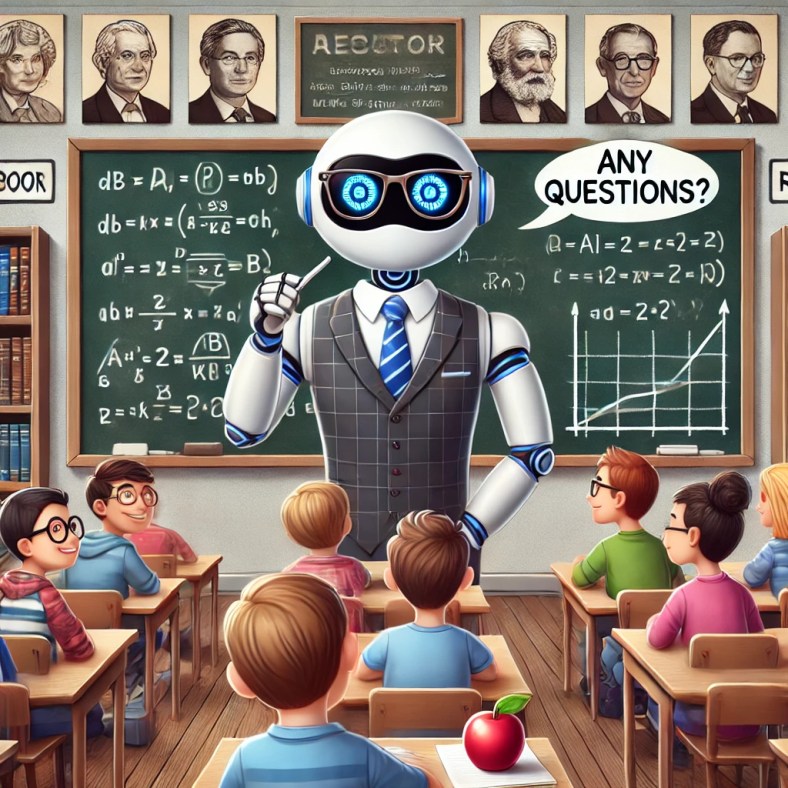
A slight update of my first post on AI in 2018. Image above generated by AI.
Over the past seven years, I have focused on learning more about artificial intelligence. Initially I thought I understood the meaning of AI. But I did not.
In early 2018, I noticed that AI was becoming an increasingly popular topic of discussion in the blogs that I was reading and in social media posts. When I first started thinking of AI, I had a flashback to the 2004 movie I, Robot, which starred Will Smith. In the movie, set in 2035, robots filled public service positions and were able to think like humans and take action. Then, I thought about virtual assistants such as Alexa and Siri. But what is AI, and how do we use it daily?
What is AI?
A quick Google search turns up more than 615 million results. AI is computer code that displays some form of intelligence, learning and problem-solving in what has been referred to as a “super intelligence.” AI “learns” on its own, and makes adjustments and improvements based on past iterations. As AI becomes “smarter,” its knowledge base grows, and it is able to complete more tasks. Digging a little deeper, I found #AskAboutAI, a research project launched by Getting Smart, which identified over 100 applications of AI.
Shehzad Najib, CEO and co-founder of Kinteract, told me a few years ago: “You shouldn’t notice that AI is working. You should notice that life is easier and you’re saving time.”
Keep that in mind. Here are a few ways that we interact with AI daily:
Communication: We all use email and receive a lot of spam. AI is used to streamline the amount of spam allowed through filters, and it continues to learn over time as you mark items as spam.
Travel: If you use driving apps such as Uber or Lyft, you have experienced machine learning, a form of AI that determines your estimated arrival time. In the airline industry, “human-steered” flight time is estimated to be about seven minutes, leaving the rest to autopilot, which is AI.
Social networks: Most people are engaging in some form of social media use. Years ago, Facebook shared results of how AI successfully detects spam but was not as successful at detecting hate speech or cyberbullying. When photos are used in social media, AI uses facial detection to suggest a name for photo tagging. If you’ve wondered how it recognizes your friends and family without even typing a name into the platform. It learns over time.
Shopping: Many people use Amazon and similar services. They are quite helpful, and who doesn’t appreciate it when suggestions are provided for other items of interest? AI analyzes your prior data and makes decisions based on your preferences over time.
Fraud protection: When making purchases online or in person, systems analyze your purchasing trends and locations and can immediately flag and send alerts for unusual transactions.
Were you familiar with all of these AI uses? Thinking back to Shehzad’s statement, these do save time and often go unnoticed because they are just performing what they have been programmed to do.
What can AI do for education?
One of the most interesting articles that I read during my initial research, came from an article in Forbes, which highlighted 10 ways to use AI in education. Looking at these, how much has changed? Remember, this article is from nearly 10 years ago, which was the original post before its update in 2017.
AI can automate basic activities in education, such as grading.
Educational software can be adapted to student needs.
AI can point out places where courses need improvements.
AI tutors can help support students.
AI-driven programs can give students and educators helpful feedback.
AI is altering how we find and interact with information.
AI could change teachers’ roles.
AI can make trial-and-error learning less intimidating.
Data powered by AI can change how schools find, teach, and support students.
AI could change where students learn, who teaches them, and how students acquire basic skills.
Regardless of the technology we choose to explore and use in education, we have to focus on the technology’s purpose. What are the benefits of using AI? Is it practical to use AI?
Time is always a consideration, and when it comes to providing authentic, meaningful, and personalized learning experiences for our students, we need to make the most of it. AI can make an impact here.
For example, students and teachers can connect and have instant access to resources that meet their specific needs. AI will make decisions based on responses and interactions.
AI can save teachers time in grading and help to provide differentiated instruction that adjusts as students continue to work through class materials. AI analyzes data faster, so teachers can act on it faster and, again, have more time to work with students.
We must actively explore the resources that are being shared in the education world today. There are many blogs, books, podcasts, webinars, and other learning opportunities for educators. We have so many digital tools available to choose from. Have fun exploring but be mindful of not just the possibilities, but always focus on our responsibilities as educators.
If you want to learn more, check out recent Edutopia and Getting Smart blogs. Many AI books are available, including my recent book. Keep on learning and growing, and don’t be afraid of not being the expert. We are all learning as we go!
About the Author:
Dr. Rachelle Dené Poth is a Spanish and STEAM: What’s Next in Emerging Technology Teacher at Riverview High School in Oakmont, PA. Rachelle is also an attorney with a Juris Doctor degree from Duquesne University School of Law and a Master’s in Instructional Technology. Rachelle received her Doctorate in Instructional Technology, and her research focus was on AI and Professional Development. In addition to teaching, she is a full-time consultant and works with companies and organizations to provide PD, speaking, and consulting services. Contact Rachelle for your event!
Rachelle is an ISTE-certified educator and community leader who served as president of the ISTE Teacher Education Network. By EdTech Digest, she was named the EdTech Trendsetter of 2024, one of 30 K-12 IT Influencers to follow in 2021, and one of 150 Women Global EdTech Thought Leaders in 2022.
She is the author of nine books including ‘In Other Words: Quotes That Push Our Thinking,” “Unconventional Ways to Thrive in EDU,” “The Future is Now: Looking Back to Move Ahead,” “Chart A New Course: A Guide to Teaching Essential Skills for Tomorrow’s World, “True Story: Lessons That One Kid Taught Us,” “Things I Wish […] Knew” and her newest “How To Teach AI” is available from ISTE or on Amazon.
Contact Rachelle to schedule sessions about Artificial Intelligence, Coding, AR/VR, and more for your school or your event! Submit the Contact Form.
Follow Rachelle on Twitter(X) and Instagram at @Rdene915
**Interested in writing a guest blog for my site? Would love to share your ideas! Submit your post here. Looking for a new book to read? Find these available at bit.ly/Pothbooks
************ Also check out my THRIVEinEDU PodcastHere!
Join my show on THRIVEinEDU on Facebook. Join the group here.
We have experienced so many changes in the world of education and the world of work. Technology is constantly evolving, and skills in demand now may not be needed five years from now. Jobs are changing, technology is advancing rapidly, and careers that exist today may not exist in the future. We also have to remember that many jobs don’t exist yet that will need to be filled by the students in our classrooms today. How do we prepare for what we can’t truly know and understand?
Students must have opportunities to explore a variety of topics and careers. They need experiences that will guide them to learn about their areas of interest and themselves. We need to spark curiosity about learning and help students discover what they might actually be interested in.
Students must be active in learning and have time to explore the world around them. In some classrooms, students may experience passive learning and solely consume content rather than create it. To really enhance and transform learning for our students, we must create experiences that may even cause some good chaos. It might push us to shift from what has been a traditional classroom structure of our teaching practice. What I have learned by stepping out of my comfort zone and taking some risks is that learning can and should happen beyond our classroom space. We must embrace new learning models that promote student agency and spark student curiosity for learning. Using methods and creating opportunities that foster the development of essential SEL skills, we will best prepare students for the future through real-world learning opportunities. When they see the relevance of what they are learning and how that applies to the real world and careers that are available to them, it will boost interest and excitement for learning.
How do we prepare?
We have to consider which methods and tools will best meet the needs and interests of our students. In education, we have been focusing on developing “21st-century skills” for many years. We can’t possibly know everything about what the future holds for students when it comes to careers and specific skills, so to prepare, we must help students build a variety of skills, especially skills that are beneficial to many areas of work. Opportunities that support students as they learn how to adapt to changes and become flexible in learning and growing will prepare them for whatever the world of work will look like five, ten, or more years from now. I also recommend following the Job Skills Outlook Report shared by the World Economic Forum to look at the Top Ten Skills in Demand and gain insights into careers that are on the rise. In my STEAM class, we recently did some career research on areas such as Cybersecurity Experts, Ethical Hackers, Data Analysts, Smart City Developers and more.
Here are three more ways to spark curiosity for the future and engage students in career-focused learning:
CTE and Work-based learning: Students need to continue to learn about the career options that are available and how they may be changing. With CTE, work-based learning, and even job shadowing programs, students gain practical and real-world insights into different fields. Being able to experience what it is like in the work environment and interact with people working in careers of interest to students will have a bigger and more meaningful impact. By partnering with local businesses and professionals, inviting guest speakers, and involving students in real-world, hands-on projects, they will become more aware of the opportunities available. Through these experiences, they learn about what their interests are and how they can make an impact in the world.
Place-based learning: By shifting our focus from solely the content area, we can identify a geographical area or the culture of a place as a way to build content knowledge and help students develop SEL skills. Through place-based learning, we place students into the community to collaborate with local businesses, entrepreneurs, and other organizations. These experiences allow students to apply the content they are learning in the real world and see the impact. These experiences foster the development of student agency, boost engagement and excitement for learning, and enhance student awareness of the issues in the world around them. To further engage students, we can arrange field trips to local industries, invite guest speakers to our schools, and have students research local challenges and offer solutions.
Project-based learning (PBL): With PBL, students take the lead in deciding what they want to learn and how they want to learn it. With PBL, students choose an area of interest, design their own learning journey, and, throughout the experience, will see the “process” of learning rather than a finite endpoint. In our classroom, we explored a variety of student-chosen topics and also incorporated the United Nations Sustainable Development Goals (SDGs) into the projects. We can help students to become more globally aware and involved in finding solutions to challenges faced in the world. PBL helps students to become more independent in learning while developing essential SEL skills such as self-management and social awareness.
There are many more options available, but starting with just a few is the way to go. Think about your local community or reach to your global network. There are organizations available that help educators to provide these types of opportunities. While we may not know exactly which jobs will still exist, we do know that there are specific skills that will help students stay flexible and adapt to the changing landscape of learning and work. In real-world opportunities, students will make connections that will positively impact their learning and, hopefully, spark curiosity and excitement for learning!
About the Author:
Dr. Rachelle Dené Poth is a Spanish and STEAM: What’s Next in Emerging Technology Teacher at Riverview High School in Oakmont, PA. Rachelle is also an attorney with a Juris Doctor degree from Duquesne University School of Law and a Master’s in Instructional Technology. Rachelle received her Doctorate in Instructional Technology, and her research focus was on AI and Professional Development. In addition to teaching, she is a full-time consultant and works with companies and organizations to provide PD, speaking, and consulting services. Contact Rachelle for your event!
Rachelle is an ISTE-certified educator and community leader and served as president of the ISTE Teacher Education Network. She was named the EdTech Trendsetter of 2024 by EdTech Digest, One of 30 K-12 IT Influencers to follow in 2021 and one of 150 Women Global EdTech Thought Leaders in 2022.
She is the author of nine books including ‘In Other Words: Quotes That Push Our Thinking,” “Unconventional Ways to Thrive in EDU,” “The Future is Now: Looking Back to Move Ahead,” “Chart A New Course: A Guide to Teaching Essential Skills for Tomorrow’s World, “True Story: Lessons That One Kid Taught Us,” “Things I Wish […] Knew” and her newest “How To Teach AI” is available from ISTE or on Amazon.
Contact Rachelle to schedule sessions about Artificial Intelligence, Coding, AR/VR, and more for your school or your event! Submit the Contact Form.
Follow Rachelle on Twitter(X) and Instagram at @Rdene915
**Interested in writing a guest blog for my site? Would love to share your ideas! Submit your post here. Looking for a new book to read? Find these available at bit.ly/Pothbooks
************ Also check out my THRIVEinEDU PodcastHere!
Join my show on THRIVEinEDU on Facebook. Join the group here
Think of a problem you are currently experiencing. If you are like me, you have plenty of options to choose from. We are often stuck in a cycle of response when it comes to resolving challenges we regularly face resulting in the same problems cropping up again and again. In the book titled Upstream: the quest to solve problems before they happen, Chip and Dan Heath liken problem solving to a river – more solutions exist the farther upstream you are from the problem. What a great reminder that numerous solutions exist for every single challenge faced. However, if there are all of these solutions, how do I select the right one for my specific problem? Hence, the firefighting mindset!
Why firefighting?
The firefighting mindset is steeped in design thinking and comes from my work in the juvenile justice system. I have the privilege to work with educators and students in the juvenile justice system across the US. When traveling to secure schools, often located in detention centers and jails, I ask teachers how they are doing and typically get the same response, Oh you know, just putting out fires. This response led to the question, why are we always putting out the same fire or in other words, why are we always solving the same challenge? If we are stuck in a cycle of response, always putting out the same fire, then we are not actually solving the problem. If the Heath brothers are right and there are many solutions to each problem, how do we find them? We find them by changing our mindset toward the problems themselves. Firefighting becomes a metaphor for a way to see problems and challenges as opportunities for new ways of thinking and new solutions designed.
Putting Out Fires
Putting Out Fires as a mindset helps us to begin to understand problems at its core in order to truly end the problem with the most effective solution. Do you need a solution right now because you cannot take this problem for one more minute or this problem is harming students and must be stopped immediately? Or, do you have time to track data about the problem in order to effectively implement a solution? Not all problems are created equal and each deserves its own unique solution. We are often so busy that we try a one size fits all approach to problem solving. Instead, the firefighting mindset helps us to understand problems at their core and implement a solution designed specifically for the problem itself allowing us to truly end the cycle of response for that particular problem.
An example of the putting out fires mindset can be found in the use of metro turnstiles in Paris to create clean energy. Climate change is a rising issue across the globe. As each year brings more one-of-a-kind storms, wildfires, hurricanes, earthquakes, rising sea temperatures, and more, Paris began a groundbreaking project to harness green energy in an attempt to build a new energy source stopping the need for depleting the Earth of its natural resources. The solution is incredibly simple, “as commuters pass through the turnstiles, their movements spin the turbines, generating kinetic energy. Though each rotation produces a small amount of energy, the cumulative effect is significant due to the millions of daily commuters using the metro system” (TSUI, 2023). The use of turnstiles in Paris is the launching point of an innovative solution to creating clean energy. Imagine how much energy can be created from similar public transportation hotspots like airports, railway stations, office buildings, and more. “Initiatives that empower individuals to participate in the energy transition, even through daily activities, are vital in shaping a greener world” (TSUI, 2023).
This example embodies the firefighting mindset because the creators of this solution understood their specific problem, its root causes and symptoms, and designed a creative solution in a different area using a mundane action, going through the metro turnstiles, to create clean energy and help lessen the effects of climate change.
You can learn more about the firefighting approach to problem-solving by grabbing a copy of “Putting Out Fires: A Framework for Solving Problems in Your Classroom or School”. Releasing this summer, this book delves into the intricacies of the firefighting mindset, provides practical strategies for implementing creative solutions to problems you’re facing, and offers inspirational examples of problem solving at its finest just like the Paris metro turnstiles mentioned above. If this approach works for some of the most restrictive classrooms in the US, it can work for you too!
We all have challenges we face every single day. We can either allow the challenges to take over causing us to live in a consistent cycle of response. Or, you can take ownership of the problem, adjust your mentality, and design a unique solution to end the problem for good.
The fire alarm is ringing….let’s get started putting out those fires!
Kaylah Holland, Ed.D. Bio:
Dr. Kaylah Holland is passionate about empowering educators through professional development, one-on-one coaching, and innovative lesson design. She holds a Doctorate of Education in Instructional Design and Technology with extensive research in active learning environments. Driven by a passion for education, Dr. Holland consistently explores innovative methods to empower educators and champion student-centered classrooms. She is a Google Certified Innovator, Trainer, and Coach, a college professor, and an ISTE Community Leader. She was presented the “20 to Watch” award by ISTE in 2022 and was recognized by EdTech K-12 Magazine as a top 30 influencer in 2023. She was named a Featured Voice for ISTE in 2024. Dr. Holland is the author of Putting Out Fires: a Framework for Solving Problems in Your Classroom or School published in 2024. As the Director of Instructional Technology and Blended Learning for BreakFree Education, Kaylah empowers educators to foster innovative, sustainable, and active educational experiences inside juvenile justice facilities across the United States offering students held in confinement a path to success in school and life. She also works to empower educators across the globe as the founder of Go Teach Be Love, a nonprofit providing professional development to educators in developing countries, and the co-founder of Global Good Edu, a program recognizing the incredible impact educators are making around the world.
Contact Rachelle to schedule sessions about Artificial Intelligence, Coding, AR/VR, and more for your school or your event! Submit the Contact Form.
Follow Rachelle on Twitter(X) and Instagram at @Rdene915
**Interested in writing a guest blog for my site? Would love to share your ideas! Submit your post here. Looking for a new book to read? Find these available at bit.ly/Pothbooks
************ Also check out my THRIVEinEDU PodcastHere!
Join my show on THRIVEinEDU on Facebook. Join the group here