
In Part 1, I shared why understanding the legal landscape of artificial intelligence is essential as schools continue to explore how these tools can support teaching and learning. Schools everywhere are thinking through policies and how to best provide resources for educators, students, and families. Awareness of laws such as FERPA, COPPA, and GDPR, accessibility requirements, and concerns such as algorithmic bias and deepfakes set an important foundation for responsible implementation.
We need guidelines and guardrails. A common question I hear from educators and leaders after presenting sessions and workshops, or speaking at conferences, is: “What do we do next?”
Understanding the guardrails is only the first step. The real work begins when schools start building systems that support educators in applying this knowledge in practical, sustainable ways. And it requires true collaboration.
Responsible AI Adoption Is a Team Effort
One of the most important shifts happening right now is the recognition that AI adoption and policy development should not be the responsibility of a single person or a select few administrators or IT teams. Responsible implementation and policy development require collaboration across roles.
District leaders are shaping policy and expectations for the school community.
Technology teams are evaluating vendor compliance and infrastructure readiness. (I have a future post coming up about IT Teams and ongoing PD).
Instructional leaders are aligning tools with learning goals and supporting teachers with implementation.
Teachers are modeling and supporting ethical classroom use.
Students are exploring and developing AI literacy skills that will shape how they interact with technology throughout their lives.
What I truly believe is that when schools recognize AI is a shared responsibility rather than an isolated initiative, implementation becomes more intentional, reflective, and sustainable.
I consistently see this when working with districts across the country. The schools that are moving forward with confidence are not the ones adopting the most tools. They are the ones creating a community, developing a common language, and building shared understanding first.
Transparency Builds Confidence Across the Community
Another theme that has been coming up in conversations with educators and families is trust.
Families want and need to know:
What tools are being used?
What information is being collected?
How is student data protected?
How is AI, or any technology, being used in support of learning rather than replacing it?
Having clear answers to these questions helps to strengthen the essential partnerships between schools and families. It also creates opportunities for students to participate more actively in conversations about responsible technology use.
Transparency is not simply a compliance strategy. It is a relationship-building strategy. When schools communicate clearly and proactively, they reduce uncertainty and help communities better understand how innovation supports student success.
AI Literacy Is Now Part of Digital Citizenship
One of the biggest shifts happening in education right now is the expansion of digital citizenship to include AI literacy. We’ve been talking about media literacy, digital literacy, AI literacy, and even discernment. Our work is a bit more involved now, and we need to be prepared.
Students are already interacting with AI systems daily, both in and maybe more frequently outside of school. They need guidance, which means classrooms must play an essential role in helping students understand:
How to protect their personally identifiable information (PII)
How AI systems generate responses
How bias can appear in outputs
How misinformation spreads
How data is collected and used
How to evaluate whether a tool should be trusted
AI literacy is not about teaching students how to use a single platform. It is about helping them develop judgment.
When students learn how to ask better questions about technology, they become more confident learners and more thoughtful digital citizens. Emerging tools continue to shape how students research, communicate, and create, and as educators, we have to keep learning so we can guide them to use the tools available to them safely and successfully.
Accessibility and Equity at the Center
As schools explore AI tools, accessibility must be a part of every conversation.
AI has tremendous potential to support multilingual learners, provide personalized feedback, assist with reading and writing tasks, and help students access content in new ways. It has endless ways to support educators. Schools must continue evaluating whether tools meet accessibility expectations and support equitable learning experiences.
Responsible implementation means asking questions such as:
Does this tool improve students’ access?
Does it create barriers? There has been more talk about the digital divide recently.
Does it support multiple learning pathways?
Does it align with universal design principles? Or a Portrait of a Graduate or an AI-Ready graduate?
Technology should expand opportunity rather than narrow it.
Supporting Educators Through the Transition
One of the most encouraging things I have seen in my work with educators is their investment in learning and the desire to learn with and from their students.
Educators are exploring AI tools while also asking important questions about privacy, ethics, and instructional impact. This balance is exactly what responsible adoption should look like.
Professional learning plays an essential role.
Educators benefit from opportunities to:
Explore tools safely
Review privacy expectations
Understand policy implications
Design classroom strategies
Collaborate with colleagues
Develop shared language around responsible use
When professional learning includes both legal awareness and classroom application, educators feel more confident making decisions that support students. Confidence leads to stronger implementation. And this is the work I am most passionate about when working with schools.
Leadership Matters More Than Ever
School leaders are in a unique position to support responsible AI adoption by:
Developing clear expectations
Supporting cross-team collaboration
Communicating with families (consistently)
Reviewing vendor agreements carefully
Building a common language around the use of AI
Creating space for experimentation, but having guardrails in place
Moving Forward
Artificial intelligence is already part of the learning landscape. We should not be talking about whether schools should engage with AI, but rather deciding how they will engage with it.
When schools combine legal awareness, transparency, accessibility considerations, and strong professional learning structures, they create innovative environments built on human decision-making.
Students benefit when educators feel confident.
Educators benefit when leaders provide clarity.
Communities benefit when schools communicate openly.
Responsible AI adoption is about moving forward with purpose.
When schools take that approach and have a team to work with, they are preparing students to understand technology, question it, and be the ones who determine what comes next.
About Rachelle
Dr. Rachelle Dené Poth is a Spanish and STEAM: What’s Next in Emerging Technology Teacher. Rachelle is also an attorney with a Juris Doctor degree from Duquesne University School of Law and a Master’s in Instructional Technology. Rachelle received her Doctorate in Instructional Technology, with a research focus on AI and Professional Development. In addition to teaching, she is a full-time consultant and works with companies and organizations to provide PD, speaking, and consulting services. Contact Rachelle for your event!
Rachelle is an ISTE-certified educator and community leader who served as president of the ISTE Teacher Education Network. By EdTech Digest, she was named the EdTech Trendsetter of 2024, one of 30 K-12 IT Influencers to follow in 2021, and one of 150 Women Global EdTech Thought Leaders in 2022.
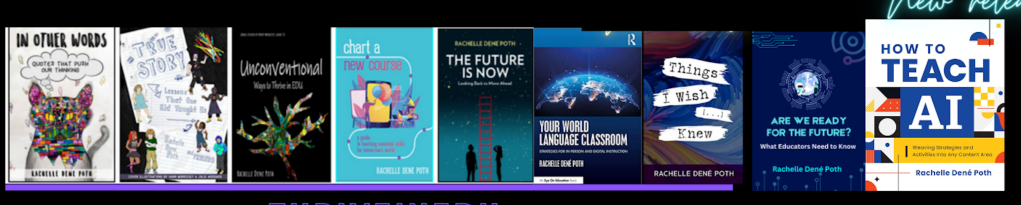
She is the author of ten books, including ‘What The Tech? An Educator’s Guide to AI, AR/VR, the Metaverse and More” and ‘How To Teach AI’. In addition, other books include, “In Other Words: Quotes That Push Our Thinking,” “Unconventional Ways to Thrive in EDU,” “The Future is Now: Looking Back to Move Ahead,” “Chart A New Course: A Guide to Teaching Essential Skills for Tomorrow’s World, “True Story: Lessons That One Kid Taught Us,” “Things I Wish […] Knew” and her newest “How To Teach AI” is available from ISTE or on Amazon.
Contact Rachelle to schedule sessions about Artificial Intelligence, AI and the Law, Coding, AR/VR, and more for your school or event! Submit the Contact Form.
Follow Rachelle on Bluesky, Instagram, and X at @Rdene915
**Interested in writing a guest blog for my site? Would love to share your ideas! Submit your post here. Looking for a new book to read? Find these available at bit.ly/Pothbooks
************ Also, check out my THRIVEinEDU Podcast Here!
Join my show on THRIVEinEDU on Facebook. Join the group here.
 Learning as I go: Reflections & lessons learned