
As I reflect on 2025, it feels like a year of recalibration. I think about education, and while things were definitely moving faster, especially with AI and the changes it has brought, I feel like things are moving at a deeper level. After several years of rapid changes, disruptions, and adjustments, many educators, leaders, and systems seem to have shifted from being reactive to proactive, and, more importantly, to focusing more on reflective practices. Some questions I consider are:
What is actually working?
What is overwhelming students and teachers?
What does “future-ready” really mean, and is it the proper term?
In many ways, 2025 feels more like a time when education stopped trying to keep up with every new trend, took a breath, and began reclaiming its intention.
From Urgency to Intention
The past few years have required schools to operate in what I’ve heard in many conversations as a “crisis mode.” After some thought, I have seen and experienced a shift away from an overwhelming sense of urgency to accomplish everything and toward purposeful decision-making. A word that I have used a lot after reading a book by Kevin Roose called Futureproof is “discernment.” He wrote about the shift from media and digital literacy to digital discernment. I’ve seen this in my own practice as well. Educators have become more discerning about initiatives to invest in, tools to explore, and expectations to set. The question “Can we do this?” shifted to “Should we do this? And “Why?” Which then led to the “How” part.
This shift showed up in conversations around curriculum, assessment, technology use, and student well-being. Schools began reducing or being more selective rather than layering, which helped educators to adjust better to change. Leaders focused more on coherence instead of compliance. And in some conversations I had or articles I read, I noticed respectful pushback on practices that added complexity without improving learning.
I think this is why the recalibration mattered.
AI Moved From Novelty to Normal
Since artificial intelligence and all of the new tools arrived in classrooms, it was an interesting time for educators. Something novel, something cool yet scary at times I’ve been told by educators that I am training, and other times, something to be avoided at all costs. But, what I noticed this year has been a shift. A shift away from the worries about plagiarism and cheating, about the time needed to learn how to leverage AI in our work, to a focus on how to bring it into our classrooms intentionally, purposefully, responsibly. In 2025, AI in education has become more of the norm.
I have noticed a change in the reactions. Now I see more focus on:
- Data privacy
- Ethical use and attribution
- Age-appropriate access
- Skill-building over shortcut-taking. (Leaning on versus learning from)
- Transparency instead of surveillance
AI has become less about “cheating” and more about helping students and others learn how to think, evaluate, and create responsibly in an AI-infused world. Educators that I have worked with in my own school, at conferences and during professional development sessions that I have provided, have been asking different questions. At first, questions focused on “How can I tell when a student has used ChatGPT?” “Why do I need to teach about AI in the elementary level, they are too young and it is too much technology?” and “How do I find the time to evaluate the tools?” and more. But now, the questions are more targeted. Some examples are “How does this tool support learning goals?” and “When does it enhance or push thinking and when does it replace it?” Questions are also asked about how to connect AI into different grade levels and content areas without it feeling like something extra. I think the key to these questions is keeping the focus on the human aspect of learning and teaching.
We need to become AI literate and help students to develop their AI literacy skills, which do not only require developing technical skills. It also involves essentially human skills such as judgment, empathy, discernment, and reflection. With so much technology, the impact on us as humans is real and brings out the importance of digital wellbeing in addition to digital citizenship.
Digital Wellness
I’ve been working on an initiative through ISTE+ASCD and Pinterest that focuses on digital wellbeing and digital citizenship, both aligned with innovation. Something that I’ve noticed in the conversations at the schools is that educators are realizing that digital citizenship alone is not enough. Conversations about constant connectivity and the cost of it have been taking place and leading to new policies and guidelines in schools.
As a result, digital wellness has emerged as a priority for all, rather than as a standalone curriculum In my work with educators, each group talked openly about:
- Attention fatigue
- Notification overload
- Screen balance
- Emotional regulation
- Boundaries and agency
Cellphone bans were in place and while some saw the positives, others raised some interesting points. Rather than banning technology outright or ignoring its impact, should we instead focus on intentional use of it and guide students? Questions like “When does technology add value?” and “When should we step away?” became part of the discussions in and out of the classroom.
Focusing on the human connection
I noticed in some schools that I visited, more socialization, more connections being made between students in the classrooms. More time for colleagues to work together and with their students.
There was renewed emphasis on:
- Relationships over rigid pacing
- Depth over coverage
- Dialogue over compliance
- Reflection over reaction
Administrators that I spoke with have said they are listening more closely and trust teachers to use their professional judgment. Something else I noticed was an increase in the inclusion of student voice in conversations about learning, technology, and school culture. I have asked students for feedback for many years and value their input as it expands my understanding and helps me to better connect. In some of the schools that I have visited, common questions to students have been:
- How do you learn best?
- What feels supportive vs. stressful?
- How does technology affect your focus and well-being?
- What do you want your teachers, families, friends, to understand about your experience?
When students were invited into these conversations, the results were powerful. They wanted agency, not avoidance. They wanted guidance on balance, which could not be learned through complete bans. When students were treated as collaborators or partners in shaping their learning environments, it led to powerful learning and growing as a school community.
The Power of Reflection
I wrote about it, spoke about it, and engaged in reflection myself and with other educators. We often noted the increase in the need for reflection, especially in our field that is constantly changing.
Some areas that I considered:
- What I kept doing out of habit
- What I needed to let go of for sustainability
- What truly mattered in my classroom
- What I needed to do to make a difference
- Was I involving my students in decisions
- What kind of educator I wanted to be
Reflection shouldn’t be about perfection, at least not in my mind. I see it as a way to focus on continued growth, clarity, and purpose in my work.
Some things that I learned in 2025
I had many opportunities to learn and share my learning with others. I provided some keynotes and a lot of training and working with educators from around the world. When I tried to gather my thoughts about innovation, effective technology use, digital wellness, student voice and agency, and reflection, I came to some conclusions…at least as of today. But I will continue to reflect.
- Innovation without intention leads to exhaustion.
- Technology must serve learning, not dominate it.
- Wellness is foundational to continued growth.
- Students are capable of thoughtful insight when involved in the conversation.
- Reflection is a powerful driver of meaningful change.
Education does not become easier with each passing year but I do find that the conversations become more transparent and honest.
As I close the year on blogs for 2025, I leave you with some questions to consider, that I have considered myself:
Looking Back
- What was one moment in 2025 when teaching or learning felt especially meaningful for you? Why?
- What was draining or unsustainable this year as opposed to other years?
- What practice, tool, or expectation did you decide to let go of, and why?
Technology & Learning
4. Where did technology genuinely support learning this year? How?
5. Where did it lead to distraction, add extra pressure, or increase overload?
Well-being
6. When did you feel most balanced as an educator this year? What contributed to your balance?
7. What helped you to decide when something was “too much”?
You might even choose to engage in conversations with colleagues or a PLC for even more opportunities to learn and connect.
As we move forward into 2026, we must continue to design learning experiences that are human-centered, values-driven, and always reflective. If 2025 could offer advice, it might be to Slow down in order to choose well.
About Rachelle
Dr. Rachelle Dené Poth is a Spanish and STEAM: What’s Next in Emerging Technology Teacher. Rachelle is also an attorney with a Juris Doctor degree from Duquesne University School of Law and a Master’s in Instructional Technology. Rachelle received her Doctorate in Instructional Technology, with a research focus on AI and Professional Development. In addition to teaching, she is a full-time consultant and works with companies and organizations to provide PD, speaking, and consulting services. Contact Rachelle for your event!
Rachelle is an ISTE-certified educator and community leader who served as president of the ISTE Teacher Education Network. By EdTech Digest, she was named the EdTech Trendsetter of 2024, one of 30 K-12 IT Influencers to follow in 2021, and one of 150 Women Global EdTech Thought Leaders in 2022.
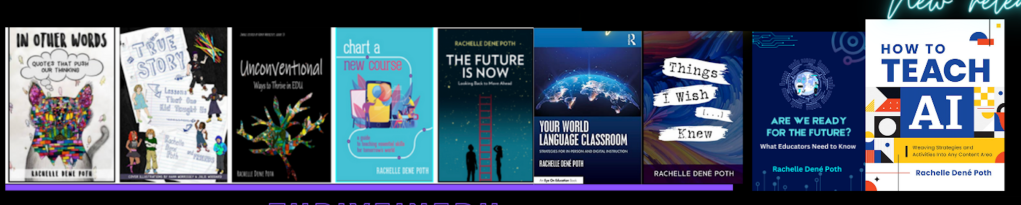
She is the author of ten books, including ‘What The Tech? An Educator’s Guide to AI, AR/VR, the Metaverse and More” and ‘How To Teach AI’. In addition, other books include, “In Other Words: Quotes That Push Our Thinking,” “Unconventional Ways to Thrive in EDU,” “The Future is Now: Looking Back to Move Ahead,” “Chart A New Course: A Guide to Teaching Essential Skills for Tomorrow’s World, “True Story: Lessons That One Kid Taught Us,” “Things I Wish […] Knew” and her newest “How To Teach AI” is available from ISTE or on Amazon.
Contact Rachelle to schedule sessions about Artificial Intelligence, AI and the Law, Coding, AR/VR, and more for your school or event! Submit the Contact Form.
Follow Rachelle on Bluesky, Instagram, and X at @Rdene915
**Interested in writing a guest blog for my site? Would love to share your ideas! Submit your post here. Looking for a new book to read? Find these available at bit.ly/Pothbooks
************ Also, check out my THRIVEinEDU Podcast Here!
Join my show on THRIVEinEDU on Facebook. Join the group here.
 Learning as I go: Reflections & lessons learned