
Guest post by Cherry-Anne Gildharry
Change Agent I Designer I Coach I Educator of 33 Years I
“In all my years as a professor of this Postgraduate Teaching Program, I have never had someone use knowledge gained from this course and the related professional development (PD) sessions offered at the university level in such meaningful, innovative, and excellent ways to create a teaching portfolio and lesson plans with ongoing reflective implementation structures. Cherry-Anne, I am extremely impressed by your excellent learning portfolio and the meaningful lessons that you implemented throughout this course” – this is a summary of my professor’s message to me in 2001 when I pursued my Post Graduate Diploma.
Whether I am designing learning for students, teachers, and leaders or engaging in professional learning, my creations and implementations have always been aligned with the four powerful elements of the science of learning and implementation: neurodesign, plasticity, connectivity, and continuity. These elements have guided my effectiveness and success as a teacher, department chair, teacher mentor, school-based and district- level coach, a virtual instructional coach, and a professional learning designer, developer, facilitator, and change agent.
I received an A in Teaching Practice in 2001 for my designs and implementation; a grade that numerous colleagues said I would never get because my professor had not given an A in many years to Post Graduate Diploma in Education (DIPED) students. My professor was extremely impressed by my work and encouraged me to attend professional learning workshops in the U.S. to gain additional strategies because of my passion for learning and implementing at extremely high levels.
My first visit to the U.S. was in 1988, when I went to New York on a one-month vacation, but even at that time, the exchange rate was high, which increased in 2001, making professional learning workshops in the U.S. extremely expensive for me to attend. However, I sent my dream out into the universe and willed it into reality, as advised in the book, The Secret, which I was introduced to in 2006.
With 15 years of teaching experience in Trinidad and Tobago and a track record of success, I applied to teach in the U.S. in April 2007. After meeting many criteria to become a teacher in the U.S.and attending an interview scheduled in the Bahamas, where I taught a full lesson that incorporated strategies gained from my postgraduate professional learning opportunities, I was offered a teaching job the next day. So, bet your bottom dollar, I was ready to gain ideas and excel at implementing strategies attained from professional learning.
My very first professional development session in the U.S. was in August 2007, when I attended a district math workshop that shared how to connect the use of Texas Instruments calculators to math concepts. A birthday candle lab was referenced for collecting data when teaching the topic of Scatter Plot. Of course, I took extensive notes and documented my implementation action plans, which materialized into a final for now learning products using assessment techniques that I am accustomed to from my country of origin. I have attended numerous professional learning sessions since then, and I have had numerous opportunities to individually facilitate professional learning, with an ongoing focus on growth in each design I develop.
I am immensely thankful for the opportunities to attend and facilitate workshops in the U.S. So, to pay it forward, the following parts of this article provide a deeper dive into the Science of Learning and Implementation strategies I learned and used, specifically connected to the four powerful elements: neurodesign, plasticity, connectivity, and continuity.
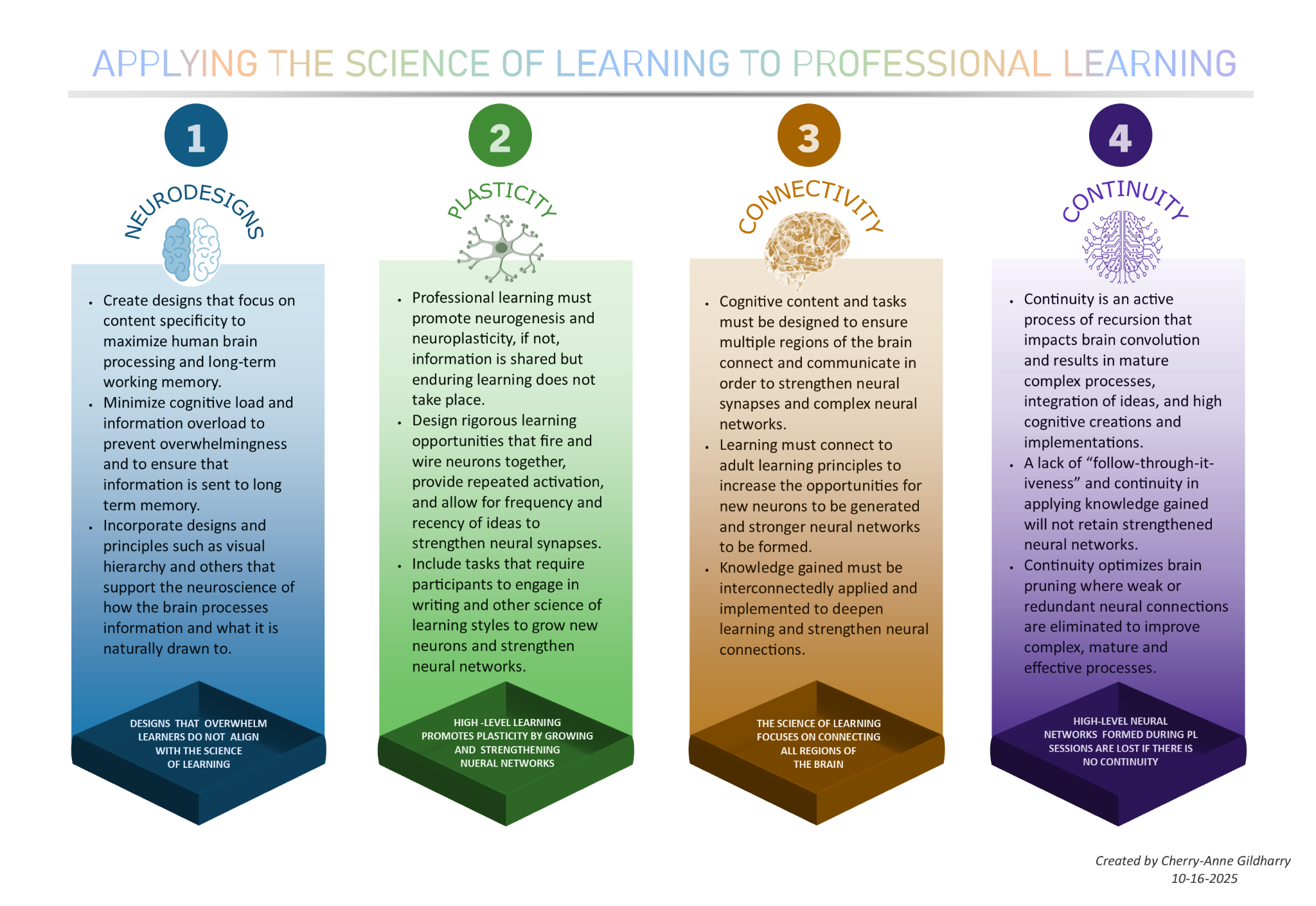
Neurodesign- Minimize Cognitive Load and Maximize the Working Memory
It is important to focus on the elements of neurodesign to minimize cognitive load and ensure that learners are not overwhelmed or burned out when designing and implementing professional learning.
- Create designs that focus on content specificity to maximize human brain processing and long-term working memory.
- Minimize cognitive load and information overload to prevent overwhelmingness and ensure that information is sent to long-term memory.
- Incorporate designs and principles such as visual hierarchy and others that support the neuroscience of how the brain processes information and what it is naturally drawn to.
When content is overwhelming, the amygdala, the system responsible for routing information based on your emotional state, takes over and sends information to the reactive brain, thus blocking it from entering the prefrontal cortex. The reactive brain responds to information instinctively instead of through thinking.
Professional learning designs and implementations must ensure that information is channeled to the prefrontal cortex (PFC) instead of the reactive brain, because the PFC is responsible for cellular changes that produce long-term neural networks. Unfortunately, “the prefrontal cortex is actually only 17 percent of your brain; the rest makes up the reactive brain” (Willis, 2009).
Designs that tightly pack content onto slides and have too many slides make learners overwhelmed and burned out. We must use profound neurodesign principles that focus on:
- Organizing and delivering content to provide specificity, clarity, precision, connectivity, simplicity of design, consistency, and calmness for learning.
- Including elements that the brain is naturally drawn to, such as:
- Varying sizes of shapes and text.
- Consistent fonts, themes, colors, and style.
- Distinct guiding titles and guiding arrows.
- Contrasting colors and icons.
- Chunked and well-spaced text.
- Clutter-free slides with white space that improve readability.
- Adding relevant pictures and images and allowing them to profoundly communicate a thousand words.
- Using visual hierarchy or infographics in which content is prioritized, and the importance is shown to guide users through a seamless and aesthetically appealing flow that hooks and deepens learning.
Is your professional learning design using neurodesign principles to ensure that information is sent to the prefrontal cortex, which is only 17 percent of the brain?
Plasticity- Heighten Neurogenesis and Neuroplasticity to Promote Enduring Learning
The Science of Learning and Implementation places significant emphasis on plasticity, more specifically, neurogenesis and neuroplasticity, when designing professional learning. To grow new neurons, strengthen neural connections, and develop high-level executive functioning skills, we must implement the following essential practices and ideas:
- Create professional learning that promotes neurogenesis and neuroplasticity. If not, information is shared, but enduring learning does not take place.
- Design rigorous learning opportunities that fire and wire neurons together, provide repeated activation, and allow for frequency and recency of ideas to strengthen neural synapses.
- Include tasks that require participants to engage in writing and other science of learning styles to grow new neurons and strengthen neural networks.
It was once believed that the brain did not have the ability to grow new neurons, but this belief was disproven in 1960 by Joseph Altman and replaced with the belief of neurogenesis, the birth of new neurons. Neurogenesis is understood to be a lifelong process; adults can grow new neurons. The concept of neuroplasticity, or brain plasticity is the brain’s ability to develop stronger structures and networks; it dates back to 1890.
Once information enters the prefrontal cortex, it is transmitted to short-term memory by synapses and neurons. If the information is deemed important, then and only then is it sent to the hippocampus and afterwards to the neocortex for long-term storage. It is not at all automatic that information is transferred to long-term storage.
So, how do we develop new neurons and fire and wire neurons together to strengthen neural networks for long-term storage when we design professional learning?
- Neurodesign components explored in the neurodesign section must be a number one priority to ensure content is sent to the pre-frontal cortex and the process of neuroplasticity is heightened.
- Use it or lose it: Repetition is key in strengthening neural networks. Repetition here does not relate to rote memory and step-by-step memorization, but to repetition of in-depth and profound ideas that help learners generate long-term connections for retrieval and application. Active engagement is critical!
- Create larger and stronger networks of neurons by seamlessly incorporating and blending multiple research-based strategies that connect ideas from slide to slide and within slides.
- Ensure that learners are not passive recipients but instead are given numerous and extensive opportunities to be active participants. Learners must be given time to work on high-level tasks and create high-level learning products.
Is your professional learning design firing and wiring neurons together and developing strong neural networks so that information is deemed important and sent to the neocortex?
Connectivity – Connect to Different Regions of the Brain, Pedagogy, and Andragogy
A focus on the power of connectivity when creating professional learning designs is extremely crucial if we want learners to generate excellent learning artifacts and continuously apply learning at a high level. Connectivity strengthens neural connections and heightens learning.
- Cognitive content and tasks must be designed to ensure multiple regions of the brain connect and communicate in order to strengthen neural synapses and complex neural networks.
- Learning must connect to adult learning principles to increase the opportunities for new neurons to be generated and stronger neural networks to be formed.
- Knowledge gained must be interconnectedly applied and implemented to deepen learning and strengthen neural connections.
To significantly improve connectivity, it is essential to ensure the implementation of the following science of learning practices.
- Personalize learning by focusing on goals. Your learners have prioritized goals and learning outcomes, so learning designs must provide opportunities for learners to focus on their goals during the learning session and create learning artifacts that align with them.
- Include brain-related learning styles and multiple sensory designs that the brain is naturally drawn to (not the myth of fixed learning styles). Some of these are visual, auditory, reading/writing, and kinesthetic. Ensure that both the left and right hemispheres are involved in learning to strengthen neural connections.
- Provide learners with choice to meet their needs and have relevance for learning. Both adults and young learners need to see the relevance for learning and choose tasks that are relevant to their needs, goals, and experiences.
- Incorporate writing into learning sessions. Writing deepens connectivity; “the process of creative formulation and physical writing lights up a whole lot of the human brain. Language, cognition, memory, visual processing, planning and control, and the ability to make associations between unrelated concepts all come into play” (This Is Your Brain on Writing, n.d.).
- Learning designs must incorporate the connectedness of all pedagogical strategies to show how these can be used concurrently. Use flowcharts or infographics to communicate the big picture. Too often, strategies are shared in isolation, but this goes against the science of learning and implementation theories.
Do your learning designs use pedagogical and andragogical principles that connect both regions of the brain to develop long-lasting neural connections?
Continuity – Optimize Brain Pruning and Mature Complex Processes
Excellence in designing professional learning is not a one-time situation. Instead, it is a dedicated journey of ongoing creations, metacognition, and revisions. Learning does not stop at a PL session; it has only just begun. Continuity is key in the science of learning and implementation.
- Continuity is an active process of recursion that impacts brain convolution and results in mature complex processes, integration of ideas, and high cognitive creations and implementations.
The science of learning and implementation stresses the importance and need for continuity for brain functions such as pruning, recursion, and brain convolution to take place to impact excellent and enduring learning. How can we promote continuity of learning after the professional learning session?
- Time must be carved into the learning design for participants to reflect on their goals and learning artifacts and develop an implementation timeline with steps for ongoing revision.
- Young and adult learners need to understand the principles behind having a growth mindset. Develop a simple framework for learners to complete and focus on ways to deal with setbacks during implementation. Here are two examples of growth mindset initiatives I developed from scratch and spearheaded: SAGE Growth Conversations and the GROW Growth Mindset Framework. Teachers were asked to collaborate with me after I created a framework, timeline, and artifact.
- Incorporate self-learning activities that develop self-directed and autonomous learners.
- It is said that emotions are closely related to the brain and learning. How can you tap into your participants’ emotions to make a lasting impact for high-level continuity? I have used images, questions, videos, stories, and more to promote connectivity.
Knowledge gained from professional learning can easily be forgotten or lost if we do not incorporate strategies that ensure continuity.
How are you designing professional learning to guarantee continuity?
As a unique autodidactic learner from the age of three and a half years old, I have always been riveted in my purpose, goals, and my innate passion for learning and continuously applying knowledge gained. My wife, Melanie Gildharry, an educator turned business analyst, is blazing trails and creating excellent products at extremely high levels in the business world. Like me, she is also an autodidactic learner who follows a heutagogy learning model and has a deep-seated passion for learning and creating.
When I analyze the common principles, traits, and mindsets we share from attending and presenting professional development, it narrows down to the four science of learning principles of neurodesign, plasticity, connectivity, and continuity. For us, even when these elements were not incorporated into PL sessions we attended, we ensured that our learning products included them. No professional learning session is ever wasted for us!
Professional learning attendees, the onus is also on you. Your learning artifacts and implementation steps must focus on neurodesign, plasticity, connectivity, and continuity, even if these are not present in your professional learning sessions.
It is important to remember that “Knowledge is not power until it is applied” ~ Dale Carnegie. However, know that there will be failures in the journey of applying the science of learning and implementation to design excellent professional learning and create learning artifacts, but always remember the profound and inspiring words of Albert Einstein:
- “Failure is success in progress”
- “You never fail until you stop trying”
- “The only sure way to avoid making mistakes is to have no new ideas”
- “We cannot solve our problems with the same thinking we used to create them”
Keep in mind, professional learning designs in the U.S. are used as exemplars for learners around the world. Therefore, it is extremely important to ensure that we continue to incorporate the science of learning and implementation principles into professional learning designs to generate exceptional learning sessions.
Let’s lead professional learning designs that focus on The Science of Learning and Implementation elements.
References
Ford, D. J. (2011, July 20). How the Brain Learns – Training Industry. Training Industry. https://trainingindustry.com/articles/content-development/how-the-brain-learns/
Neurogenesis and Neuroplasticity: Similarities and Differences. (n.d.). http://Www.re-Origin.com. https://www.re-origin.com/articles/neurogenesis-and-neuroplasticity
Understanding Brain Connectivity: How Our Minds Develop and Adapt. (2020). Brainbalancecenters.com. https://www.brainbalancecenters.com/blog/understanding-brain-connectivity-how-our-minds-develop-and-adapt
What Is Neurodesign? | Built In. (2024). Built In. https://builtin.com/articles/neurodesign
About the Author Cherry-Anne Gildharry
I have a Bachelor of Science in Mathematics, a Master of Science in Education, and a Graduate Certificate in Instructional Coaching. I have 33 years of experience in education, and counting, and I have taught math in Trinidad and Tobago, North Carolina, Iowa, and Texas.
Throughout my career, I have held numerous roles, such as a High School and Middle School Math Teacher, Department Chair, and Teacher Leader. I have also served as an Algebra 1 and Geometry Lead Teacher, Workshop Creator and Facilitator, and Marzano’s Demonstration Teacher. Additionally, I served as a School-Based and District Coach, Leadership Coach and Collaborator, Learning Design Strategist, Virtual Instructional Coach, Professional Development Auditor, and Professional Development Content Creator.
I have a track record of success both as a teacher, curriculum designer, school-based and district-level coach, and virtual instructional coach. In North Carolina, 100% of my Algebra 1 and Geometry students achieved passing scores for consecutive years using tasks I designed from scratch. As an instructional coach, consultant, and change agent, I have coached teachers in North Carolina, Iowa, Texas, and Teach for America teachers to attain similar track records. I currently help develop courses for teachers and coach teachers in various states across the United States.
I am a lifelong and self-driven learner and educator with a growth mindset and an undeniable passion for education. I am beyond blessed to be married to the woman of my dreams; a former Chemistry teacher, technology coach, E-Learning Designer, and Curriculum Manager turned Business Analyst, and a lifelong learner and educator. Together, our energies drive our success, philosophies, dedication, career, and family goals even more. We are work-life balance advocates. We believe in working extremely hard but intentionally setting time aside to recharge and rejuvenate!
About Rachelle
Dr. Rachelle Dené Poth is a Spanish and STEAM: What’s Next in Emerging Technology Teacher. Dr. Rachelle Dené Poth is an edtech consultant, presenter, attorney, author, and teacher of Spanish and STEAM: Emerging Technology. Rachelle has a Juris Doctor degree from Duquesne University School of Law and a Doctorate in Instructional Technology. Rachelle’s focus was on the need for professional development for educators, specific to Artificial Intelligence. Rachelle specializes in Artificial Intelligence, AI and the Law, AI and Healthcare, Cybersecurity, and STEM. She has more than 8 years of experience teaching and presenting on AI in her classroom, as well as working with educators worldwide.
Rachelle is currently serving as the Grant Coach for an initiative through ISTE+ASCD and Pinterest. Rachelle works with a Task Force from 12 districts in the United States and assists with policy revision, professional development, and the design of digital wellness resources for students, educators, and families.
Rachelle provides professional development related to AI policy and implementation to school districts, universities, and organizations. She also presents and provides keynotes on AI at state, national, and international events and in schools. Rachelle also provides AI training for other industries, including business, healthcare, and legal fields.
Rachelle is an ISTE-certified educator and recipient of the ISTE Making IT Happen Award and several Presidential Awards for volunteer service to education. Rachelle received the EdTech Trendsetter Award from EdTech Digest in 2024 and 2026.
She is the author of ten books, including “What the Tech? An Educator’s Guide to AI, AR/VR, the Metaverse and More! and “How to Teach AI: Weaving Strategies and Activities Into Any Content Area.” She has written curricula and courses on AI for all levels.
She is also a blogger for Defined Learning, EdTech K12, Edutopia, Getting Smart, and Tech & Learning. She is the host of the ThriveinEDU podcast, ISTE’s Learning Unleashed podcast, and The Lift by Amazon on BAM Radio Network. Contact Rachelle for your event!


